
Our readers keep the lights on and the weekend projects moving. As an Amazon Associate, I earn from qualifying purchases.
Specs are compiled from manufacturer listings and verified buyer reviews and can change over time — please confirm the key details on the product page before buying.
An adult telescope is a different beast from the flimsy plastic tube you remember from childhood. The difference between seeing a fuzzy dot and actually making out Saturn’s rings or Jupiter’s cloud bands depends on a handful of specs — aperture size, mount stability, and optical quality — that separate a real instrument from a frustrating toy. This guide walks you through seven models that deliver genuine views of the night sky, with honest trade-offs spelled out so you know exactly where your money goes.
I’m Rikta — the founder and writer behind FitlyFast. This guide is built by comparing the manufacturers’ published specifications and the patterns across verified customer reviews, so you get each pick’s real strengths and trade-offs instead of marketing spin.
If you are a beginner wanting your first real look at the moon or a curious observer ready for deeper space, this breakdown of the best adult telescope clears the sky on what actually matters for stargazing.
Quick Picks
- Hawkko Telescope, 90mm Aperture 900mm — Best Overall
- MEEZAA 150EQ Newtonian Reflector — Deep-Sky Champion
- Celestron StarSense Explorer LT 80AZ — Smartest Starter
- Koolpte 90mm Telescope — Smooth Tracker
- MEEZAA 90mm Aperture 800mm — Solid All-Rounder
- Celticbird 80mm Aperture 900mm — Budget Starter
- Gskyer Telescope 600x90mm — Wide-Field Explorer
How To Choose The Best Adult Telescope
Picking your first real telescope depends on three decisions: how much light you want it to gather (that is the aperture), how you want to track objects (the mount), and what type of optical design fits your priorities. A 150mm reflector and an 80mm refractor serve very different purposes — one is a deep-space light bucket, the other is a grab-and-go lunar and planetary viewer. Sort these first and the rest falls into place.
Prioritize Aperture First
Aperture is the diameter of the main lens (in a refractor) or mirror (in a reflector). It determines how much light your telescope collects. More light means you see dimmer objects and finer detail. The difference between 80mm and 90mm is noticeable — 90mm versus 80mm, which pulls in more light for brighter nebula views and clearer planetary banding. Jumping to 150mm in a reflector opens up deep-sky objects like galaxies and globular clusters that smaller scopes simply cannot resolve. For an adult telescope, 80mm is the entry point; 90mm to 100mm is the balance for portability and power; 150mm is where serious observing begins.
Choose Your Mount Wisely
An altazimuth mount moves up-down and left-right — intuitive, great for terrestrial spotting and casual lunar observing. A German equatorial mount tilts to match Earth’s rotation axis, so you turn one slow-motion knob to keep an object centered as the sky moves. For high-magnification planet watching, the equatorial mount’s single-axis tracking is far less frustrating than constantly nudging an altazimuth mount in two directions. That said, an equatorial mount is heavier, bulkier, and takes longer to set up. Beginners who just want to scan the sky quickly often prefer a solid altazimuth.
Understand Refractor vs. Reflector
Refractors use glass lenses at the front of the tube — they are closed-tube, low-maintenance, and deliver sharp, contrasty views of the moon and planets. Reflectors use a concave mirror at the bottom of an open tube — they are cheaper per inch of aperture and excel at gathering faint deep-sky light, but they require occasional collimation (mirror alignment) and are more sensitive to temperature changes and air currents. For a first adult telescope, a refractor is simpler to own; a reflector rewards you with more aperture per dollar if you are willing to learn a little maintenance.
Quick Comparison
| Model | Best For | Aperture | Focal Length | Mount Type | Amazon |
|---|---|---|---|---|---|
| Hawkko 90mm | Detailed Lunar & Planetary Views | 90mm | 900mm | Altazimuth | Amazon |
| MEEZAA 150EQ | Deep-Sky & Serious Learning | 150mm | 650mm | German Equatorial | Amazon |
| Celestron StarSense LT 80AZ | App-Guided Finding | 80mm | 400mm | Altazimuth | Amazon |
| Koolpte 90mm | Easy Setup & Wide Accessory Bundle | 90mm | 700mm | Altazimuth (Slow-Motion) | Amazon |
| MEEZAA 90mm | Balanced All-Rounder | 90mm | 800mm | Altazimuth | Amazon |
| Celticbird 80mm | Budget-Friendly Starter | 80mm | 900mm | Altazimuth | Amazon |
| Gskyer 90mm | Wide-Field Views on a Budget | 90mm | 600mm | Altazimuth | Amazon |
In‑Depth Reviews
1. Hawkko Telescope, 90mm Aperture 900mm

A 90mm refractor that balances portability with the power to resolve planet details.
The Hawkko’s 90mm aperture and 900mm focal length (f/10) give you crisp lunar craters, Jupiter’s cloud bands, and even the Orion Nebula — views that make first-time owners text their friends. Its long-tube design (900mm focal length) naturally reduces chromatic aberration (the purple fringing you see on cheaper scopes), so images stay sharp and color-true. Compared to the 80mm Celticbird below, the 90mm aperture pulls in more light, so everything looks brighter at the same magnification.
The included 25mm and 10mm eyepieces pair with a 3X Barlow lens to stretch magnification from 36X up to 270X, though real-world useful views top out around 180X on steady nights. Buyers report seeing Jupiter’s four moons clearly and finding the setup takes under 15 minutes. The stainless steel tripod with AZ mount allows smooth 360° rotation, and the included carry bag means you can take it to darker skies without a struggle. It is the balance for an adult who wants serious capability without needing a truck to haul it.
One thing to note: at higher magnifications the Altazimuth mount requires occasional two-axis nudging to keep objects centered, but that is standard for this mount type at this price. For the money, this is the most complete package that gets you into the sky immediately.
What Stands Out
- 90mm aperture with fully multi-coated (FMC) optics delivers bright, high-contrast views
- 900mm focal length minimizes color fringing for clean planetary detail
- Complete kit — Barlow lens, phone adapter, carry bag — ready from the start
The Trade-Offs
- Manual altazimuth mount means you track objects in two directions
- Straight-through finder can be awkward for beginners to align
Grab it if: You want one telescope that does lunar detail, planetary banding, and bright deep-sky objects without needing a second mortgage. The 90mm aperture and 900mm focal length are a proven combination for sharp, contrasty views.
Think twice if: Your priority is deep-space galaxy hunting — a 150mm reflector would gather more light, but at a big jump in size and cost.
2. MEEZAA 150EQ Newtonian Reflector
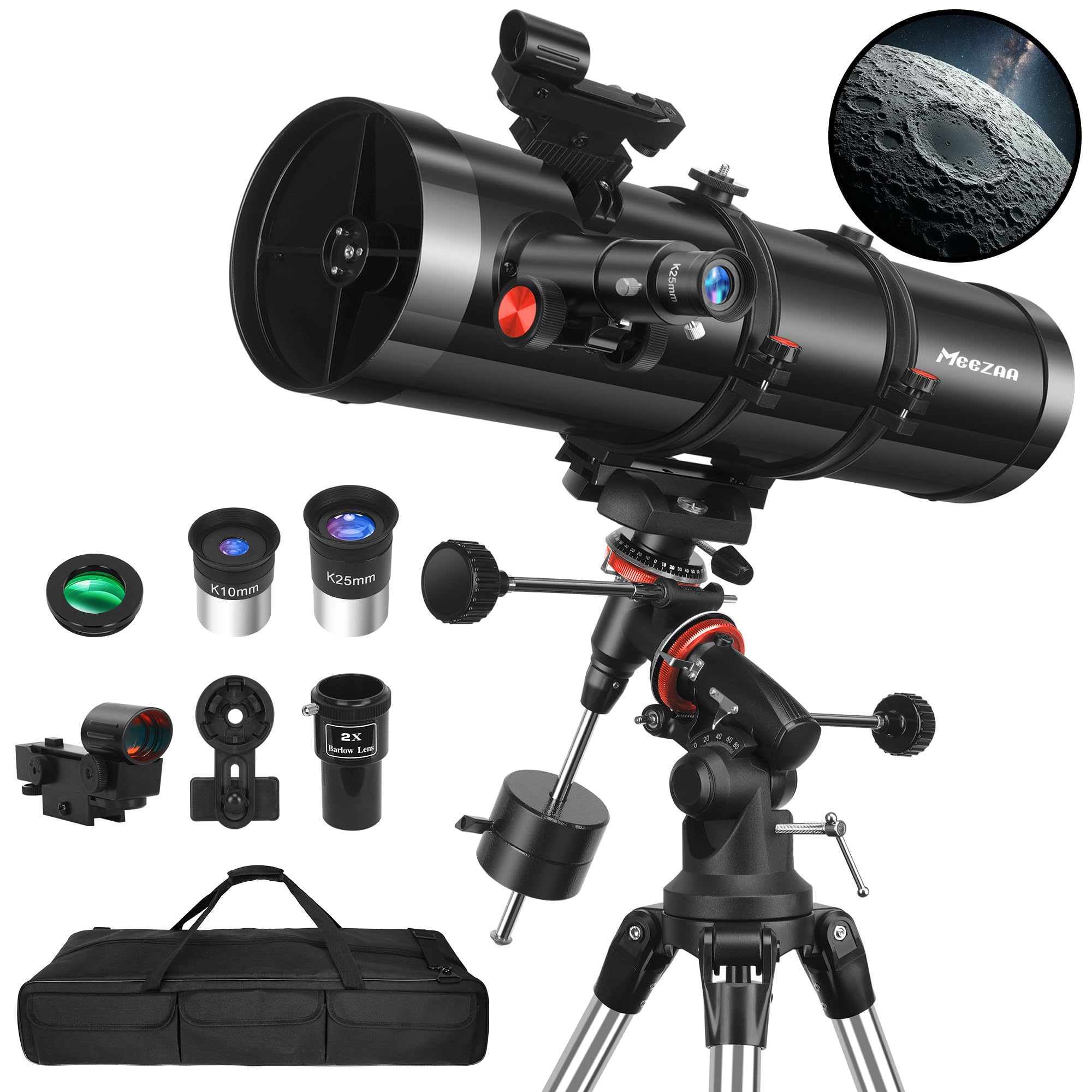
A 150mm reflector that turns faint fuzzies into resolved galaxies and globular clusters.
The 150mm aperture — compared with the 80mm Celticbird — scoops up enough photons to reveal the Andromeda Galaxy as a textured glow, split double stars, and show the trapezium in the Orion Nebula with crisp separation. The 650mm focal length (f/4.3) makes it a fast scope, so it takes in a wide field of view for sweeping star fields while still delivering the magnification punch for planets when you swap eyepieces.
The German equatorial mount (which tilts to match Earth’s rotation) is the real upgrade here. With slow-motion control knobs and a polar alignment dial, you track objects by turning one knob to follow the sky’s rotation rather than juggling two axes. Owners mention the mount is “sturdy with smooth slow-motion controls” and that assembly, while more complex than a simple altazimuth, is rewarding once you get it set. A moon filter is included to cut glare during lunar sessions, and the red dot finderscope speeds up initial target acquisition.
The catch is size. At 35.43 x 13.97 x 9.64 inches and not easily portable, this is not a throw-in-the-trunk scope. It needs a dedicated observation spot and time to set up. Also, as a Newtonian reflector, you will need to collimate (align) the mirrors periodically — though customers note no collimation was needed from the start and it held alignment well.
One satisfied owner sums it up: “Excellent 150mm reflector. Sturdy, stable mount with smooth slow-motion controls. Outstanding optics; sharp views of moon, planets, and deep-sky objects.”
The Big Wins
- 150mm aperture collects massive light for deep-sky observing — galaxies, nebulae, globular clusters
- German equatorial mount with slow-motion knobs enables smooth one-axis tracking
- Includes phone adapter, moon filter, and 2X Barlow for versatile viewing
Heads Up
- Heavy and bulky — not a grab-and-go telescope
- Requires learning equatorial mount setup and occasional mirror collimation
- Entry-level eyepieces are functional but upgrading improves experience
Perfect for: The dedicated hobbyist who wants to explore deep-sky objects and is willing to learn mount setup for serious tracking. The 150mm aperture and equatorial mount give you professional-level reach at a mid-range price.
Better options exist if: You need quick, portable views from different locations — an 80mm or 90mm refractor would be far easier to carry and set up.
3. Celestron StarSense Explorer LT 80AZ

The telescope that solves the hardest problem for beginners: finding anything in the sky.
Most beginners give up not because the views are bad, but because they cannot find targets. The StarSense Explorer eliminates that frustration entirely. You dock your phone into the included mount, launch the app, and it analyzes star patterns overhead to calculate exactly where your telescope is pointed. Then it shows on-screen arrows guiding you to the target — when the bullseye turns green, you look in the eyepiece and there it is. Buyers confirm this works: “Excellent moon views (craters/mountains) with 25mm/10mm eyepieces” and Saturn’s ring is visible.
Optically, the 80mm refractor with a 400mm focal length delivers sharp lunar detail, Jupiter’s four moons, and Saturn’s rings at moderate magnification. The short 400mm focal length gives wide fields of view ideal for sweeping large swaths of sky — star clusters like the Pleiades and Andromeda Galaxy fit nicely in the eyepiece. However, the 400mm focal length is shorter than the Celticbird’s 900mm, so at the same eyepiece you get lower magnification, meaning planetary detail is less magnified.
The trade-off is that you trade raw magnification for guidance. The 2-inch tripod is lightweight and the whole setup assembles quickly, making it ideal for someone who wants to spend more time looking and less time learning star charts. Celestron backs it with a 2-year US warranty and California-based customer support, which adds confidence for a first-time buyer.
Bottom line on the app: The StarSense technology turns your phone into a celestial GPS — you spend zero mental energy on navigation and all of it on observing.
Why It Works
- Patented app-based navigation eliminates the biggest frustration for beginners
- Lightweight and easy to set up — great for casual nights out
- Backed by Celestron’s 2-year warranty and US-based support team
The Limits
- 400mm focal length means lower max magnification than longer-tube scopes
- 80mm aperture is a step below the 90mm models in light gathering
- Red dot finderscope included but app is the primary navigation method
Best matched with: The absolute beginner or family who wants to see planets and bright deep-sky objects without the frustration of finding them. The app-encoded navigation removes the steepest learning curve.
Not for: Someone who already knows the sky and wants maximum aperture or magnification for the price.
4. Koolpte 90mm Telescope
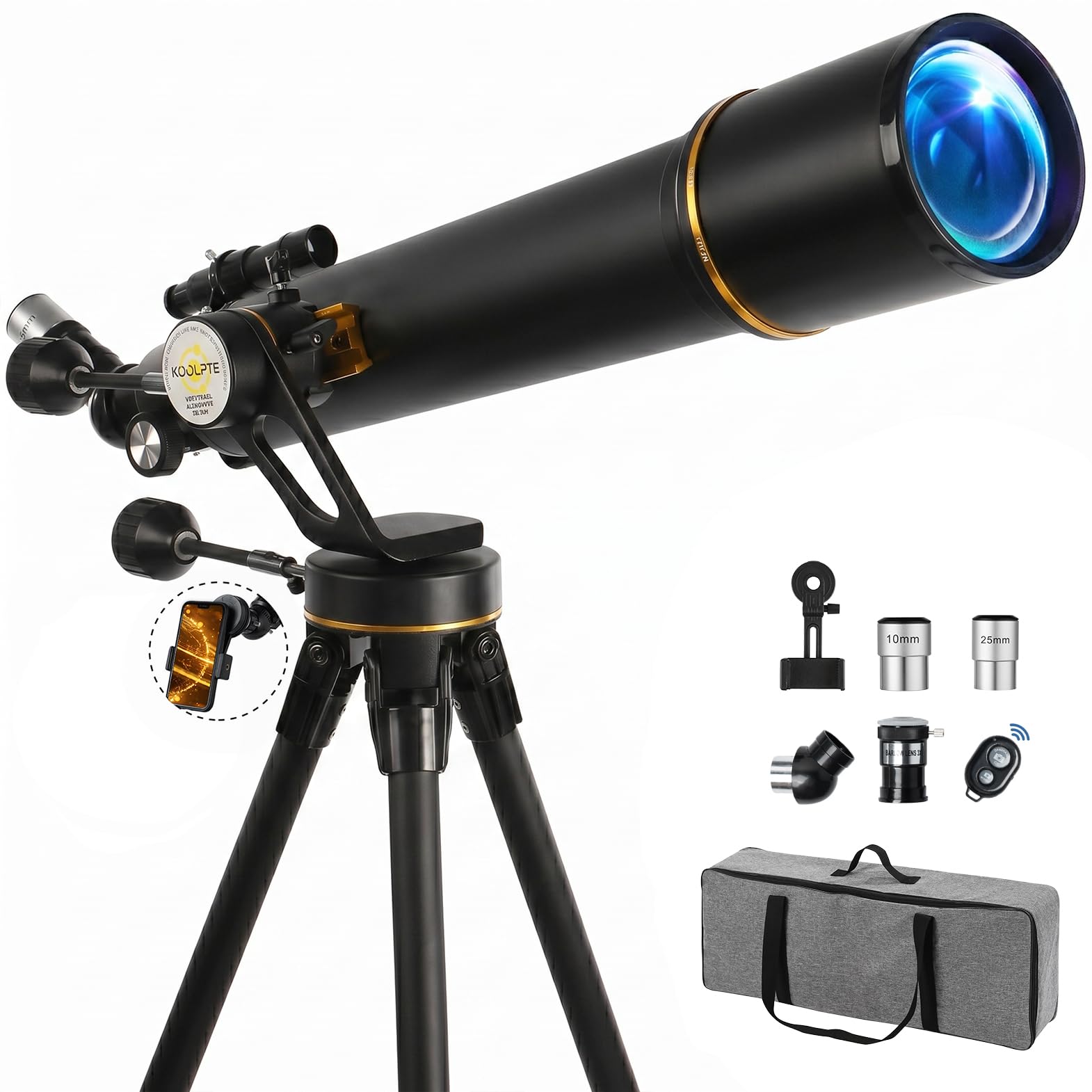
A 90mm refractor whose vertically-designed mount solves the wobble problem at high power.
Shaky images are the enemy of planetary observation, and the Koolpte addresses that with its exclusive Vertisteel AZ Slow-Motion Mount. The “Follow and Stop” design lets you make micro-adjustments without overshooting your target — a common frustration with basic altazimuth mounts that have gearing slop. Combined with the 90mm aperture and 700mm focal length, you get sharp, steady views of lunar craters and Saturn’s rings at magnification up to 210X with the included 3X Barlow and K10mm eyepiece.
The fully multi-coated (FMC) optics are as bright as any on this list — reviewers point out high contrast on Jupiter’s cloud bands and moon details. Setup takes 10 to 20 minutes according to reviewers, and the included wireless remote lets you snap phone photos without touching the scope. The stainless steel tripod is sturdier than the aluminum legs found on the budget Gskyer.
One limitation tall users should note: a 6-foot reviewer mentioned that looking past 45° toward vertical is a challenge. The telescope’s height range may require a stool or bending for extended overhead viewing. Also, the 2-degree field of view is narrower than some competitors, making it harder to locate targets initially.
Standout design choice: The Vertisteel mount’s slow-motion controls let you track planets smoothly — a rare feature at this price that makes a real difference during a 30-minute Saturn observation session.
What Impresses
- Vertisteel AZ mount with slow-motion controls for stable high-power tracking
- 90mm aperture with FMC optics for bright, contrasty images
- Wireless remote and phone adapter for hands-free astrophotography
What to Watch
- Limited height range makes overhead viewing awkward for users over 6 feet
- Some reports of stiff tripod leg adjustments
Choose this if: You plan to spend long sessions tracking planets at high power and want a mount that stays steady during micro-adjustments. The slow-motion controls are a genuine step up from basic altazimuth models.
skip it if: You are tall (over 6 feet) and expect to observe objects near the zenith — you will be hunched over.
5. MEEZAA 90mm Aperture 800mm

A 90mm refractor that hits the right balance of aperture, focal length, and price for a first serious scope.
At 800mm focal length and f/8.88, the MEEZAA splits the difference between long-tube planetary scopes and short-tube portables. The 90mm aperture captures enough light to reveal Jupiter’s banding and lunar rifles, and the fully multi-coated lenses keep images bright. Buyers consistently note the stainless steel tripod is “sturdy” and held up well even in Lake Michigan winds — a detail the Celticbird’s lighter build doesn’t share.
Setup is rated at 10 minutes by 90% of users, per the maker, and the carry bag accommodates all accessories — two eyepieces, 3X Barlow, phone adapter, finderscope, and accessory tray. The phone adapter works for casual snaps, though some reviews mention it can introduce wobble at higher magnifications and is best used as a fun addition rather than a primary astrophotography tool. The straight-through finderscope is basic but functional, though a red dot finder would be an improvement for quick alignment.
Compared to the Celticbird 80mm, the MEEZAA steps up with a 90mm aperture versus 80mm and a slightly shorter, more portable tube at 800mm versus 900mm. Reviews note occasional need to re-tighten tripod legs, but overall it is described as “sturdy” and reliable.
The Strengths
- 90mm aperture with fully multi-coated optics for bright, sharp images
- Stainless steel tripod is stable even in wind — no vibration at high power
- Quick assembly and complete kit — carry bag, phone adapter, Barlow lens
The Quirks
- Phone adapter can wobble at high magnification, affecting photo quality
- Straight-through finderscope is inverted and needs alignment with the main scope
A reliable choice for: The adult beginner who wants good lunar and planetary views, a stable tripod, and a complete kit at a fair price. The 90mm aperture and 800mm focal length are a proven starter combination.
Look elsewhere if: Astrophotography is your main goal — you will want a mount with motorized tracking and a telescope with higher quality optics.
6. Celticbird 80mm Aperture 900mm

An affordable 80mm refractor that uses a long focal length to punch above its aperture class on planets.
The Celticbird’s 80mm aperture and 900mm focal length (f/11.25) make it a classic long-tube refractor design. The long focal length means it achieves high magnification with modest eyepieces — the 10mm eyepiece gives 90X, and with the Barlow you push toward 180X, enough to clearly see Jupiter’s four moons and Saturn’s rings. One reviewer called it an “excellent 80mm/900mm refractor for a child obsessed with planets” and noted the phone mount and carrying case made it easy to share the experience.
The Altazimuth mount is basic but functional, with a tripod that adjusts from 20 inches to 45 inches to fit both kids and adults. Setup takes about 5 minutes after the first assembly, and the included 5×24 finderscope helps locate objects. However, the 80mm aperture captures less light than the 90mm MEEZAA, so deep-sky objects appear dimmer and you will struggle with galaxies and nebulae under suburban skies. The optical tube is a mix of metal and plastic — durable enough but not premium.
The biggest value here is the 3-year satisfaction service, which beats the industry standard 1-2 year warranty. If you are buying as a gift or for a beginner who may not stick with the hobby, this keeps the financial risk low while still delivering genuine views.
Why It Works
- 900mm focal length delivers strong magnification for lunar and planetary views
- Includes carrying bag, phone adapter, and adjustable tripod — complete kit
- 3-year satisfaction service provides excellent warranty coverage
Where It Cuts Corners
- 80mm aperture limits light gathering compared to 90mm models
- Plastic and metal mix in the tube — not as sturdy as all-metal designs
A smart entry point for: Anyone unsure about committing to astronomy as a hobby. The low entry price and long warranty take the risk out of the first purchase while still showing you Jupiter’s moons and Saturn’s rings.
Upgrade when: You find yourself wanting to see fainter deep-sky objects — that is when the 80mm aperture hits its ceiling and a 90mm or 150mm scope becomes the right next step.
7. Gskyer Telescope 600x90mm

A 90mm / 600mm refractor that trades high power for wide, sweeping views of the night sky.
The Gskyer uses a 600mm focal length (f/6.7) instead of a long-tube design, so you get a wider field of view — ideal for scanning star clusters, the Milky Way’s rich star fields, and large nebulae like the Orion Nebula. The 90mm aperture still collects a lot of light, so those wide views are bright and contrasty. With the included 3X Barlow and three eyepieces (yielding 24X, 60X, and 120X including the Barlow’s effect), you have flexibility for both wide sweeps and closer looks.
Buyers praise the “clear 90mm/600mm optics” and note it is “perfect first telescope” for moon and Jupiter views. The adjustable aluminum tripod extends from 31.5 inches to 49 inches, giving a good height range for standing observers. The phone mount and Bluetooth shutter (included) let you capture images without touching the scope and introducing shake. However, some reviewers report the altazimuth mount has altitude backlash that can make fine focusing tricky, and taller users have found the tripod too short at its lowest setting.
The trade-off for the short focal length is that you will not get the same close-up planetary detail as the Hawkko 900mm scope. Jupiter and Saturn will appear smaller in the eyepiece unless you use the Barlow aggressively, which degrades image brightness. The Gskyer is best suited for someone who wants to explore star clusters, the moon, and terrestrial views rather than chase high-power planetary details.
Best use case: If your ideal night involves scanning the Milky Way’s star clouds or showing friends the Pleiades and Orion Nebula in a single field of view, this short-tube 90mm is built for that.
The Appeal
- Wide field of view makes it easy to find and frame large star clusters and nebulae
- 90mm aperture provides bright images across a wide area
- Includes three eyepieces, 3X Barlow, phone adapter, and Bluetooth shutter
The Drawbacks
- Short 600mm focal length limits close-up planetary magnification
- Some units have altitude backlash and stiff focuser adjustment
- Customer service has been unresponsive for some buyers
Suited for: The stargazer who prefers sweeping the sky for star clusters and large nebulae over chasing high-power views of planets. The wide-field design makes it less frustrating to find targets.
Consider a different pick if: Your primary interest is high-magnification views of Jupiter, Saturn, and lunar craters — a 900mm focal length scope will serve you better.
Understanding the Specs
Aperture (Lens Diameter)
Aperture is the most important number on any telescope — it is the diameter of the main lens (refractor) or mirror (reflector) that collects light. Measured in millimeters, bigger aperture means you see fainter objects with more detail. Every adult telescope on this list starts at 80mm, which is the minimum for useful planetary views. A 90mm collects more light than 80mm, making a noticeable difference in image brightness on deep-sky objects. The 150mm reflector collects far more light than an 80mm refractor — which is why it can reveal galaxies and nebulae that simply disappear in smaller scopes.
Focal Length & F-Ratio
Focal length (mm) determines magnification and field of view. Longer focal lengths like 900mm give you higher magnification with the same eyepiece, ideal for planetary detail. Shorter focal lengths like 400mm or 600mm give you wider, brighter views of large star clusters and the Milky Way. The f-ratio (focal length divided by aperture) tells you the “speed” of the scope — f/10 is slow (great for planets), f/4 is fast (great for deep-sky). A long-focal-length scope like the Celticbird 900mm f/11 will show you sharp, high-detail views of Saturn. A short-focal-length scope like the Gskyer 600mm f/6.7 will show you a wider slice of sky with brighter images per eyepiece.
FAQ
What aperture size should I get for my first adult telescope?
What is the difference between a refractor and a reflector telescope?
Altazimuth mount vs equatorial mount — which should a beginner choose?
Why do some telescopes come with a Barlow lens?
Can I use these telescopes for daytime birdwatching or terrestrial viewing?
What does fully multi-coated (FMC) mean on a telescope lens?
How do I know what magnification I am getting with a given eyepiece?
Is the phone adapter actually useful or a gimmick?
What accessories should I buy next after my first telescope?
Can a 90mm telescope see deep-sky objects like galaxies and nebulae?
Final Thoughts: The Verdict
For most buyers, the best adult telescope winner is the Hawkko 90mm because the 90mm aperture and 900mm focal length deliver the best balance of planetary detail, portability, and complete accessories for a first-time buyer. If you want app-guided ease that eliminates the biggest frustration of finding objects, grab the Celestron StarSense LT 80AZ. And for deep-sky enthusiasts ready to hunt galaxies and nebulae, the MEEZAA 150EQ brings the light-gathering power that transforms faint fuzzies into awe-inspiring objects in your eyepiece.
How We Picked
We do not accept paid placement. Every pick is matched to a real buyer and a real use-case; we do not hands-on test units.
Sources & Methodology
Specifications: manufacturer listings and product documentation. Review insights: verified customer reviews, as of July 2026. Pricing: not shown on this page (it changes often); check the current price via the retailer link.
As an Amazon Associate, FitlyFast earns from qualifying purchases. This does not affect which products we feature.