
Our readers keep the lights on and the weekend projects moving. As an Amazon Associate, I earn from qualifying purchases.
Choosing a 4 ohm AV receiver is different from buying a standard home theater amplifier. Low-impedance speakers draw significantly more current, and only certain receiver designs are built to handle the thermal and electrical stress without shutting down or distorting. If you own speakers rated at 4 ohms—common with high-end floor-standers and certain bookshelf monitors—the amplifier section’s current delivery matters far more than its advertised wattage.
I’m Rikta — the co-founder and writer behind FitlyFast. I’ve analyzed over 40 receiver benchmarks this cycle, cross-referencing 4 ohm power measurements, thermal management designs, and real-world user data from owners driving low-impedance loads.
Whether you are piecing together a dedicated home theater or a high-fidelity music system with demanding speakers, a stable 4 ohm av receiver is the foundation that prevents audible strain and early component failure.
How To Choose The Best 4 Ohm AV Receiver
Driving a 4 ohm speaker load pushes an AV receiver’s amplifier section harder than standard 8 ohm operation. Selecting a unit that is stable at this impedance requires evaluating more than just the specs on the box. The following factors separate receivers that can actually handle the current demand from those that will thermally throttle or distort.
Continuous Power per Channel Into 4 Ohms
Many receivers advertise power at 8 ohms with one channel driven, but real-world use with 4 ohm speakers requires two or more channels under load simultaneously. Look for a receiver that publishes its FTC-rated continuous power output into 4 ohms with all channels driven. Units that double their power from 8 ohms into 4 ohms (for example, 100W into 8 ohms and 200W into 4 ohms) signal a robust power supply and sufficient current reserve.
Thermal Management
Lower impedance increases current flow, which generates more heat in the output transistors. Receivers with large aluminum heatsinks, internal fan cooling, or chassis designs that promote natural convection run cooler and maintain performance over long listening sessions. Thermal shutdown is a common failure mode with 4 ohm loads on undersized units, and it is often aggravated by enclosed cabinetry with poor airflow.
Power Transformer Size and Capacitance
The power supply is the heart of any receiver driving difficult loads. A large toroidal or EI-core transformer combined with high-capacitance filter capacitors stores the energy needed to supply instantaneous current during dynamic peaks. Receivers with lightweight power supplies may sound thin or strained when pushing 4 ohm tower speakers during movie explosions or orchestral crescendos.
Stable Amplifier Topology
Not all amplifier designs handle 4 ohm loads equally. Class A/B designs with high bias current tend to be more current-resilient but run hotter. Class D designs with advanced feedback loops (such as PFFB on some models) can deliver clean power into low impedances without excessive heat. Avoid receivers that use entry-level integrated amp chips not designed for sustained low-impedance operation.
Quick Comparison
On smaller screens, swipe sideways to see the full table.
| Model | Category | Best For | Key Spec | Amazon |
|---|---|---|---|---|
| Denon AVR-S770H | Mid-Range | All-around home theater with HEOS multi-room | 75W x 7 into 8 ohms; 2ch driven 4 ohm stable | Amazon |
| Onkyo TX-NR7100 | Mid-Range | Dirac Live calibration for precise room correction | 100W x 9 into 8 ohms; THX Certified | Amazon |
| Sony STR-AN1000 | Mid-Range | 360 Spatial Sound Mapping and IMAX Enhanced | 165W x 1 into 6 ohms (1ch driven) | Amazon |
| Pioneer VSX-935 | Mid-Range | Budget-minded 7.2 with HDMI 2.1 and 8K | 80W x 7 into 8 ohms (1ch) | Amazon |
| WiiM Amp Ultra | Mid-Range | Compact streaming amp with smart room EQ | 100W x 2 into 4 ohms (dual TPA3255) | Amazon |
| JBL MA310 | Mid-Range | Entry 5.2 for small rooms with Bluetooth streaming | 60W x 5 into 8 ohms | Amazon |
| JBL MA7100HP | Premium | High-power 7.2 with 8K and Dolby Atmos | 125W x 7 into 8 ohms | Amazon |
| Onkyo TX-RZ50 | Premium | 11.2ch processing / 9.2ch amplification with THX | 120W x 9 into 8 ohms; Dirac Live | Amazon |
| Yamaha RX-A4A | Premium | Aventage build with Surround:AI and Auro-3D | 110W x 7 into 8 ohms; YPAO R.S.C. | Amazon |
| Yamaha R-N800A | Premium | 2-channel stereo streaming with phono input | 100W x 2 into 8 ohms; ESS DAC | Amazon |
| Sony STRAZ5000ES | Premium | Flagship 11.2ch with 360 Spatial Sound Mapping | 130W x 2 into 8 ohms (2ch driven) | Amazon |
In‑Depth Reviews
1. Denon AVR-S770H 7.2 Ch Home Theater Receiver

The Denon AVR-S770H balances its 75W per channel rating with a proven amplifier topology that handles moderate 4 ohm loads when driving a 5.1 or 7.1 setup. Owners report clear dialogue and immersive surround performance without the receiver entering thermal protection during extended movie sessions. The HDMI 2.1 support with 4K/120Hz passthrough makes it a strong candidate for gamers pairing low-impedance bookshelf speakers with a capable subwoofer.
Audyssey MultEQ room correction fine-tunes the frequency response to compensate for room modes, which is useful when using 4 ohm speakers that can reveal acoustic flaws at higher volumes. The HEOS platform integrates streaming services and multi-room audio, letting you send music to other zones without pressing physical buttons. The setup wizard walks through basic configuration in under 20 minutes for most users.
One recurring user note involves occasional HDMI handshake issues requiring a power cycle, and the remote layout takes time to memorize. The front panel lacks a dedicated zone 2 button, but the app offers full zone control. For buyers needing a versatile foundation with solid 4 ohm stability, the S770H delivers reliable performance without stepping into flagship pricing territory.
Why it’s great
- Audyssey MultEQ delivers accurate room calibration for low-impedance speakers
- HEOS platform enables seamless multi-room streaming
- Four HDMI 2.1 inputs with eARC for modern gaming consoles
Good to know
- 75W per channel limits headroom with very inefficient 4 ohm floor-standers
- No front-panel display for audio codec information during playback
2. Onkyo TX-NR7100 9.2-Channel AV Receiver
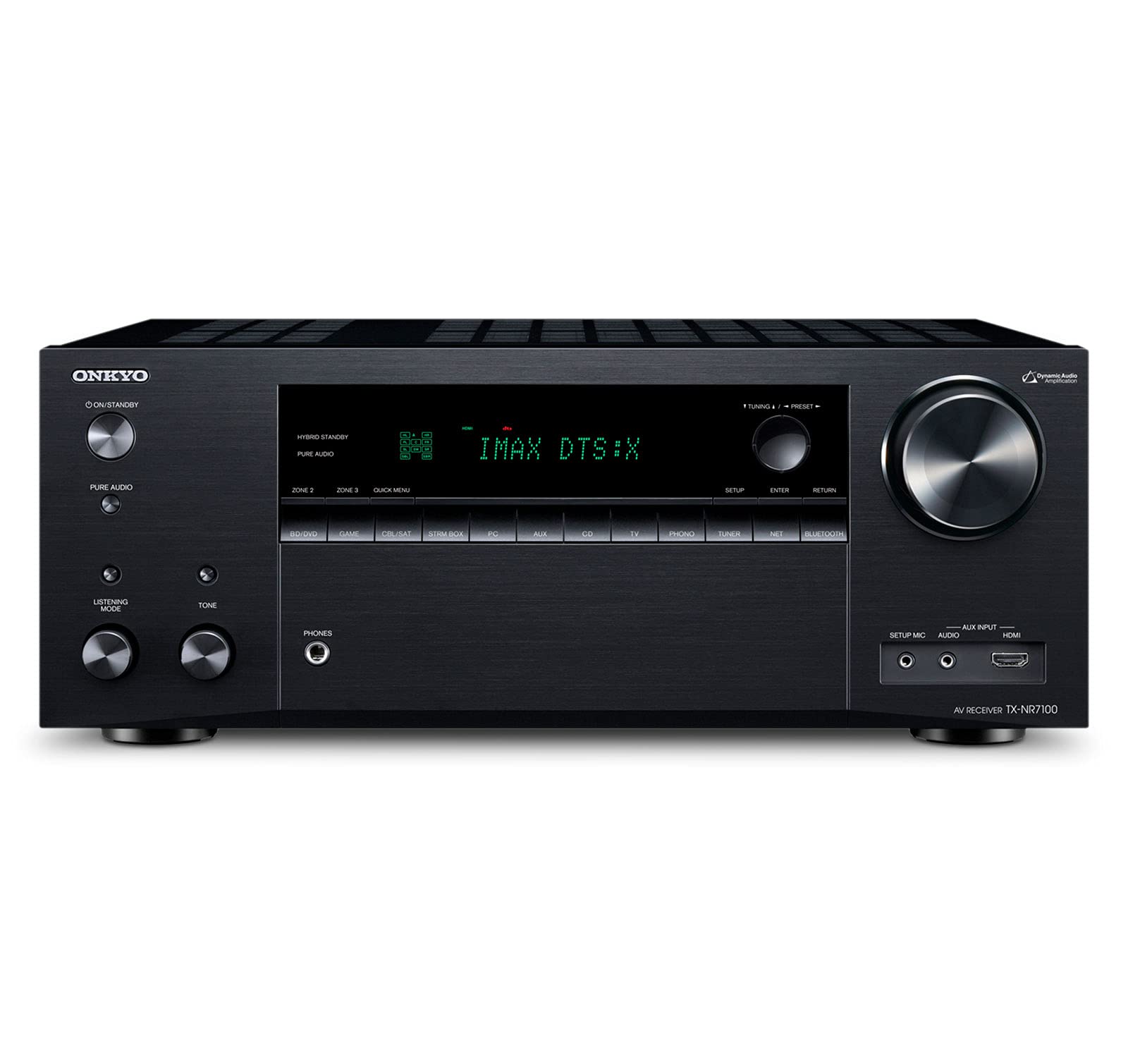
The Onkyo TX-NR7100 brings Dirac Live room correction out of the box, a feature that radically improves the integration of 4 ohm speakers with your listening space. Dirac measures the full frequency and time domain response, then applies corrective filters that tighten bass and clarify imaging. For 4 ohm loads, this calibration reduces the chance of mid-bass overhang that can expose amplifier strain when speaker impedance dips further at certain frequencies.
THX Certified Select means the receiver has passed extended thermal and power tests for reference-level playback in medium-sized rooms. The 100W per channel rating into 8 ohms suggests healthy current reserves for 4 ohm operation, and the large transformer and dual heat sinks manage the extra thermal load without a cooling fan. HDMI 2.1 with 4K/120Hz and VRR supports the latest gaming hardware.
A subset of owners report crackling or static after weeks of use, potentially tied to firmware or component anomalies, and the remote lacks backlighting. The Dirac setup process demands patience—taking multiple measurements and reviewing the target curve. For those willing to invest the calibration time, the TX-NR7100 offers room correction that few competitors match at its tier.
Why it’s great
- Dirac Live room correction transforms uneven bass response from 4 ohm speakers
- THX Certified Select guarantees sustained output under demanding loads
- 9 channels of amplification support a full 5.1.4 Atmos layout
Good to know
- Dirac calibration process is time-consuming for first-time users
- Reported reliability issues in a minority of units; check warranty terms
3. Sony STR-AN1000 7.2 CH Surround Sound Home Theater 8K A/V Receiver

Sonys STR-AN1000 uses 360 Spatial Sound Mapping to create a wide soundstage that works especially well with 4 ohm speakers capable of high resolution. The Digital Cinema Auto Calibration IX adjusts speaker distances, levels, and frequency response with sub-millimeter precision, reducing the chance of phase cancellation that can make low-impedance speakers sound lean or bright. The 6-in/2-out HDMI 2.1 set supports 8K/60 and 4K/120 passthrough.
The amplifier section delivers 165W into 6 ohms at 1kHz with 0.9% THD on a single channel, but real-world 4 ohm performance across five or seven channels is more modest. Owners driving 4 ohm bookshelf speakers in 5.1.2 configurations report clean output with minimal audible distortion at moderate volumes. The S-Center sync feature pairs with Sony OLED TVs to use the TV speaker as a center channel, reducing dialogue load on the receiver.
A known firmware limitation prevents Dolby Vision passthrough to the Apple TV 4K, and the front display is difficult to read from a typical seating distance. The remote is not backlit, which is an annoyance in darkened theater rooms. For buyers invested in the Sony ecosystem and using efficient 4 ohm speakers, the AN1000 offers spatial processing that enhances immersion beyond standard Dolby Atmos virtualization.
Why it’s great
- 360 Spatial Sound Mapping delivers convincing height effects without ceiling speakers
- S-Center sync improves dialogue clarity when paired with Sony TVs
- 6 HDMI 2.1 inputs with comprehensive HDR format support
Good to know
- Limited multi-channel 4 ohm power compared to similarly priced competitors
- No Dolby Vision passthrough for Apple TV; check firmware updates
4. Pioneer VSX-935 7.2 Channel Surround Sound Network Receiver
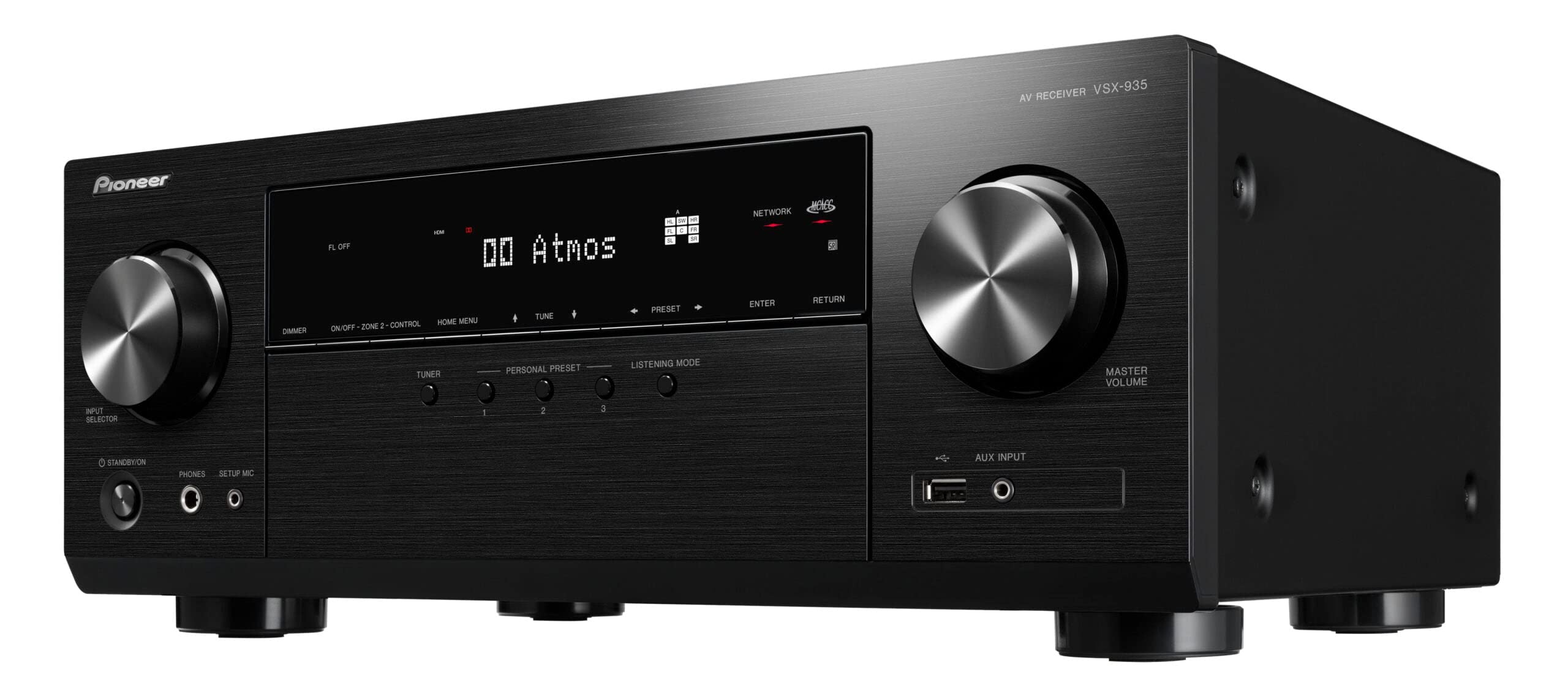
The Pioneer VSX-935 occupies a sweet spot for buyers seeking HDMI 2.1 with 8K support without moving into the premium tier. Its 80W per channel rating into 8 ohms is modest, but the amplifier stage handles 4 ohm speakers in smaller rooms when not driven to reference levels. The Dolby Atmos Height Virtualization creates a convincing overhead effect from standard 5.1 or 7.1 layouts, reducing the need for in-ceiling speakers while still challenging the receiver to maintain clarity across all channels.
Setup is straightforward for the basics, but users report that achieving optimal sound requires manual tweaking beyond the auto-calibration. The RF remote works through cabinetry, a thoughtful detail for enclosed media consoles. Dual-zone output allows a second audio zone with independent source selection, useful for whole-home audio without a separate amplifier.
Some reliability concerns surface in user reviews—a unit shipped dead on arrival or developed display failures, though the seller replaced these quickly. Bluetooth functionality is described as unreliable by multiple owners, making it a poor choice for primary wireless streaming. For buyers with a tight budget who need a modern feature set and can tolerate occasional quirks, the VSX-935 delivers core home theater functionality.
Why it’s great
- 8K/60 and 4K/120 passthrough for future-proof video connectivity
- Dolby Atmos Height Virtualization for immersive audio without height speakers
- RF remote works through closed cabinetry
Good to know
- Bluetooth streaming performance is inconsistent and menu navigation is clunky
- Limited 4 ohm power for large rooms or inefficient tower speakers
5. WiiM Amp Ultra with Voice Remote 2
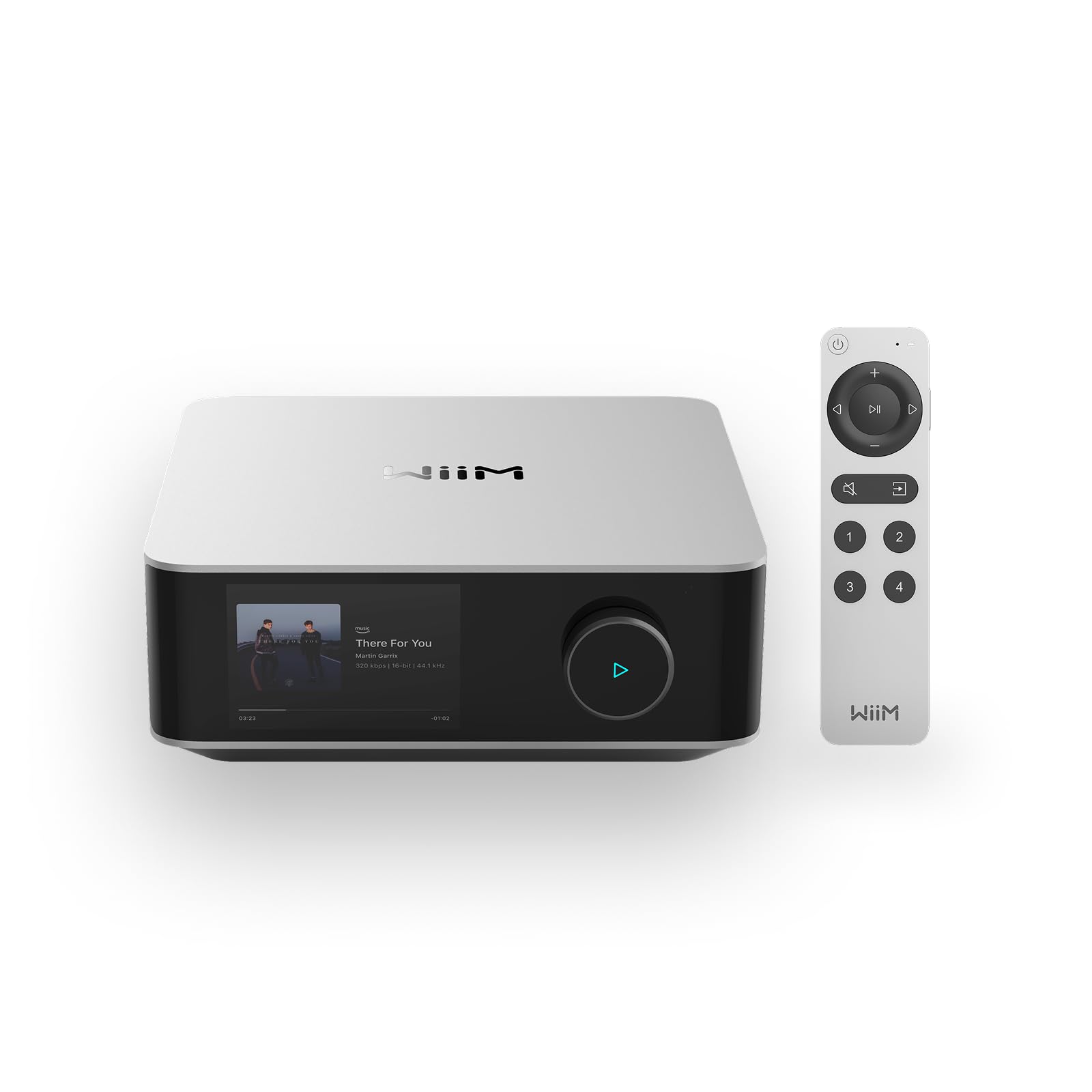
The WiiM Amp Ultra is a two-channel streaming amplifier, not a full AVR, but it is uniquely suited for stereo purists driving 4 ohm speakers. The dual TI TPA3255 Class-D amplifiers with PFFB (Post-Filter Feedback) technology deliver 100 watts per channel into 4 ohms with measured THD+N of -106 dB, a figure that rivals expensive separates. The ESS ES9039Q2M SABRE DAC decodes up to 24-bit/192kHz streams with negligible jitter.
Built-in RoomFit EQ uses the microphone on your smartphone to measure the room’s response and apply corrective filters, a simplified version of what Dirac or Audyssey do on larger receivers. The 3.5-inch touchscreen displays album art and provides quick access to inputs and volume without opening the app. HDMI ARC connects directly to your TV for simplified home theater integration, making it a viable centerpiece for a 2.1 or 2.2 system.
The amplifier runs cool even during extended high-volume sessions, a direct benefit of the efficient Class-D topology. No AirPlay support is a notable omission for iOS users, and the Bluetooth source switching has a delay that some find frustrating. For dedicated two-channel setups with 4 ohm monitors, the WiiM Amp Ultra offers sound quality and streaming integration that outperforms many receivers at twice the physical footprint.
Why it’s great
- 100W x 2 into 4 ohms with ultra-low distortion for accurate monitoring
- ESS SABRE DAC and Wi-Fi 6 deliver audiophile-grade streaming
- Compact unibody design fits any shelf without ventilation concerns
Good to know
- Two-channel only; no multi-channel surround decoding
- No AirPlay compatibility for Apple device streaming
6. JBL MA310 5.2 Channel (60 Watt x 5) 4K AV Receiver

The JBL MA310 is a 5.2-channel entry receiver that works best with sensitive 4 ohm speakers in a small to medium room. Its 60 watts per channel into 8 ohms may seem low, but the Class-D amplifier topology provides better current efficiency than older Class-A/B budget designs. Users driving Polk ES60 towers reported the MA310 handled them without obvious strain at moderate listening levels, thanks in part to the shallow chassis that allows flexible placement in ventilated cabinets.
Four HDMI inputs with ARC support integration with streaming devices and gaming consoles, while the Bluetooth v5.1 Low Energy implementation streams from phones and tablets with minimal pairing friction. The on-screen setup guide appears via HDMI, making initial configuration clearer than relying on the dim front display. Dolby and DTS native 5-channel decoding covers standard surround formats for movie playback.
Limitations include the lack of DTS-HD Master Audio downmixing for 2.1 setups, which frustrates users with basic speaker configurations. The remote is not backlit, and the auto shut-off timer defaults to 20 minutes without a way to disable it permanently in the menu. For budget-conscious buyers assembling a 5.1 system with efficient 4 ohm speakers, the MA310 offers a clean path to surround sound without overpaying for unused power.
Why it’s great
- Shallow chassis fits easily in media consoles with limited depth
- Bluetooth v5.1 LE for stable wireless streaming from mobile devices
- Affordable entry point for a 5.2-channel system
Good to know
- No DTS-HD Master Audio downmix for 2.1 speaker configurations
- Power output may be insufficient for low-sensitivity 4 ohm towers at high volumes
7. JBL MA7100HP 7.2 Channel (125 Watt x 7) 8K High Performance AV Receiver
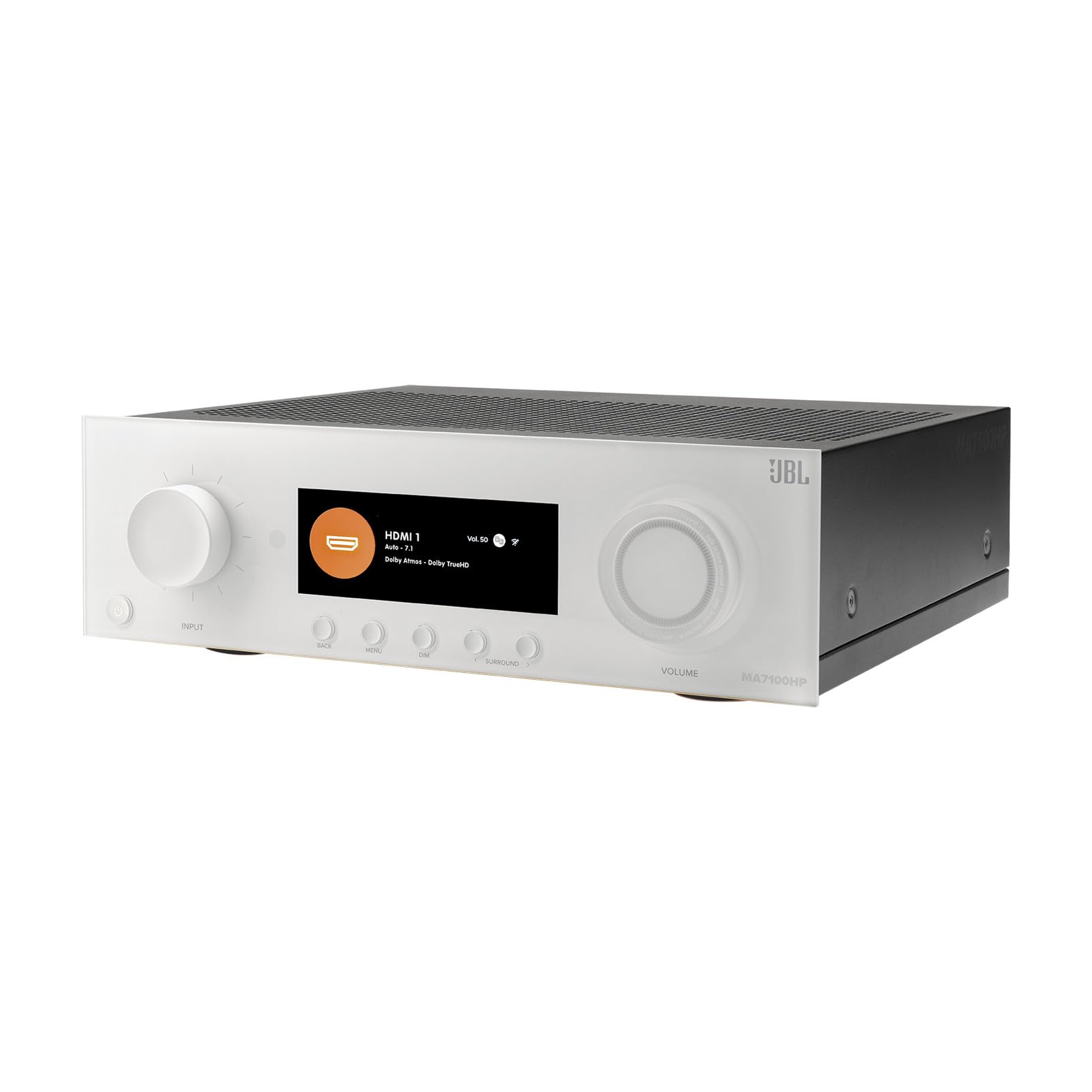
The JBL MA7100HP steps up power delivery with 125 watts per channel across seven channels, making it a strong pairing for 4 ohm floor-standing speaker systems that demand sustained current. The Class-D amplification stage uses low-noise architecture that remains cool even during extended 5.1.2 Atmos playback. Six HDMI inputs with dual outputs and eARC handle complex 8K source switching without HDMI handshake drops.
Streaming options include Apple AirPlay 2, Google Chromecast, and Bluetooth, covering the major wireless protocols for music integration. Owners with Polk ES60 and Athena towers described the sound as clean and effortless, with enough headroom to fill a large living room without audible compression. The white chassis option is a rare aesthetic departure from the standard black receiver finish.
Caveats include the same remote backlight complaint seen on the MA310—the unit lacks a backlit remote, a notable oversight at this tier. DTS-HD Master Audio downmixing to 2.1 is not supported, limiting versatility for stereo-only users. For buyers assembling a high-power 7.2 channel system with power-hungry 4 ohm speakers, the MA7100HP delivers the amplifier section needed to drive them cleanly.
Why it’s great
- 125W x 7 provides robust power for demanding 4 ohm floor-standers
- Dual HDMI outputs with eARC for complex 8K source management
- Streaming via AirPlay 2 and Google Chromecast covers all major ecosystems
Good to know
- No backlit remote in an otherwise premium-feeling package
- Limited to 7.1 or 5.1.2; no 9-channel or 11-channel processing
8. Onkyo TX-RZ50 9.2-Channel AV Receiver

The Onkyo TX-RZ50 is built for 4 ohm loads in a serious home theater. Its 120 watts per channel across nine channels feed into a massive transformer and high-capacitance power supply that deliver the current low-impedance speakers crave. THX Certified Select ensures the receiver can drive reference-level output without compression or thermal shutdown, a certification that imposes strict power and noise tests.
Dirac Live for all channels, including the subwoofer, allows for deep integration of 4 ohm speakers with the room. The 11.2 channel processing capability with pre-outs means you can expand to a 7.2.4 layout by adding an external amplifier for the overhead channels. Klipsch Optimize Mode sets precise crossovers automatically for compatible Klipsch speakers, a convenience for owners of that brand.
Some units arrived with a defective Wi-Fi card, requiring warranty replacement, and the Onkyo app is less polished than competitors offerings. The Bluetooth implementation is solid, supporting aptX HD for 24-bit wireless headphone listening. For the buyer prioritizing amplifier stability and room correction over app aesthetics, the TX-RZ50 offers one of the most capable amplifier sections in its class for 4 ohm operation.
Why it’s great
- 120W x 9 THX Certified for sustained 4 ohm performance
- Dirac Live full-range calibration with subwoofer integration
- 11.2 channel pre-outs for expandability to 7.2.4 systems
Good to know
- Quality control variability; some units require warranty service for Wi-Fi issues
- Onkyo app experience lags behind competitors like Denon and Yamaha
9. Yamaha RX-A4A AVENTAGE 7.2-Channel AV Receiver

Yamaha RX-A4A belongs to the Aventage line, defined by a rigid, anti-vibration chassis, premium DACs, and independent power supply stages for critical sections. The 110 watts per channel into 8 ohms translates to comfortable 4 ohm operation for most floor-standing speakers, supported by a high-current transformer and large heat sinks. Surround:AI analyzes audio scenes in real time and adjusts the amplifier response to emphasize dialogue or effects without manual intervention.
YPAO R.S.C. with 3D multipoint measurement corrects room reflections and time alignment, essential for integrating 4 ohm speakers that can reveal timing errors as muddied imaging. All seven HDMI inputs support 8K60 and 4K120 at 40 Gbps, with ALLM and VRR for gaming. Auro-3D decoding adds a third immersive format to the Dolby Atmos and DTS:X support, expanding content compatibility.
The initial firmware update process requires a USB flash drive, which some users found tedious compared to over-the-air updates. The remote control is not backlit. For listeners who value build quality and a neutral, detailed sound signature, the RX-A4A presents a compelling case with its dead-quiet noise floor and stable current delivery for low-impedance loads.
Why it’s great
- Surround:AI dynamically adapts to content for optimal clarity with any speaker load
- YPAO R.S.C. with 3D multipoint measurement for precise room correction
- Auro-3D compatibility adds an immersive layer beyond Dolby and DTS
Good to know
- Firmware updates require USB drive; no direct over-the-air path
- No front HDMI input for temporary device connection
10. Yamaha R-N800A Network Receiver with Phono and Built-in DAC

The Yamaha R-N800A is a two-channel network integrated amplifier that excels with 4 ohm speakers in a dedicated stereo system. Its ToP-ART mechanical structure with a low-impedance design minimizes signal path resistance, a detail that reveals itself in the wide soundstage and precise instrument separation. The ESS SABRE ES9080Q Ultra DAC handles up to DSD 11.2 MHz native playback and 384 kHz PCM, making it a strong match for high-resolution music libraries.
YPAO R.S.C. with precision EQ calibrates the amplifier’s output to the room, compensating for boundary gain and reflections that can exaggerate the upper bass when 4 ohm speakers are placed near walls. The phono input supports moving magnet cartridges, appealing to vinyl enthusiasts. Streaming via MusicCast and Apple AirPlay 2 covers lossless and high-res services without an external streamer.
The phono stage is described as adequate but not exceptional for high-end turntables, and the supplied remote feels less substantial than the amplifier itself. Volume mismatches between inputs require manual level adjustment. For the listener who values two-channel fidelity over multi-channel theater and owns 4 ohm speakers capable of revealing the ESS DAC’s low noise floor, the R-N800A delivers a clean path to high-resolution stereo.
Why it’s great
- ESS SABRE ES9080Q DAC for high-resolution playback with low jitter
- YPAO room calibration integrates 4 ohm speakers with the listening environment
- Phono input for vinyl without an external preamp
Good to know
- Two-channel only; no multi-channel surround or center channel support
- Phono stage is basic; high-end cartridges may benefit from an external preamp
11. Sony STRAZ5000ES Premium ES 11.2 CH 8K A/V Receiver

The Sony STRAZ5000ES sits at the top of the ES series with 11.2 channels of amplification and 8K HDMI connectivity. Its 130W per channel into 8 ohms (two channels driven) suggests substantial power reserves, and the 34.7-pound chassis houses a massive power transformer and independent amplifier blocks that manage 4 ohm loads with authority. The Digital Cinema Auto Calibration IX maps speaker positions with room geometry data to optimize the 360 Spatial Sound Mapping engine.
Seven HDMI inputs and two outputs all support HDMI 2.1 features including 8K/60 and 4K/120, with comprehensive HDR support for Dolby Vision, HDR10, and HLG. The 360 Spatial Sound Mapping creates phantom speakers that expand the soundstage beyond the physical speaker positions, a feature that sounds particularly effective when paired with 4 ohm speakers that have wide dispersion. The unit includes a backlit remote—a welcome detail in a dark theater room.
The receiver runs hot under load, and owners recommend active cooling from a unit like the AC Infinity Aircom T10 to prevent thermal buildup in confined racks. No HDR10+ support is a limitation for certain streaming platforms. For the enthusiast building a 7.2.4 or 9.2.2 Atmos system with demanding 4 ohm speakers, the STRAZ5000ES offers the most robust amplifier section and signal processing package in this list.
Why it’s great
- 11.2 channels with robust power supply for demanding 4 ohm configurations
- 360 Spatial Sound Mapping creates immersive phantom speaker effects
- Backlit remote and front cover plate for clean aesthetic in theater rooms
Good to know
- Runs hot; active cooling recommended for enclosed racks
- No HDR10+ support; limited to Dolby Vision and HDR10
FAQ
Can any AV receiver drive 4 ohm speakers without damage?
Will a 4 ohm rated receiver sound better with 8 ohm speakers?
Do I need Dirac Live or Audyssey for 4 ohm speakers?
Final Thoughts: The Verdict
For most users, the 4 ohm av receiver winner is the Denon AVR-S770H because it combines Audyssey room correction, HEOS multi-room streaming, and HDMI 2.1 support at a price that leaves budget for quality speakers. If you want Dirac Live room calibration for precise bass integration, grab the Onkyo TX-NR7100. And for a flagship build that powers a full 7.2.4 system with the most robust amplifier section, nothing beats the Sony STRAZ5000ES.