
Our readers keep the lights on and the weekend projects moving. As an Amazon Associate, I earn from qualifying purchases.
A 4K OLED gaming monitor gives you perfect black levels, colors that feel alive, and response times so fast you stop noticing the screen is even there. The main challenge is deciding which spec trade-off matters most to you — raw brightness, a dual-mode refresh rate, or a premium brand with the longest warranty — because once you go OLED, your old monitor will look broken in comparison.
I’m Rikta — the co-founder and writer behind FitlyFast. This guide is built by comparing the manufacturers’ published specifications and the patterns across verified customer reviews, so you get each pick’s real strengths and trade-offs instead of marketing spin.
Below you will find five carefully selected models covering different budgets and priorities — from dual-mode speedsters to color-accurate workstation monitors — all of which earn a spot on the list of the best 4k oled gaming monitor options available right now.
How To Choose The Best 4K OLED Gaming Monitor
The main differences between these monitors come down to panel type, brightness, and extra features like dual-mode refresh rates. Here are the key things to look at before you buy.
Refresh rate and response time
Refresh rate (how many times per second the image redraws, measured in Hz) and response time (how fast a pixel changes color, measured in milliseconds) determine how smooth motion looks. Every monitor on this list runs at 240Hz. A 240Hz screen redraws 240 times per second, so fast movement in racing or shooter games stays crisp instead of blurring into a smudge. The 0.03ms response time on these OLED panels means a black pixel can switch to white in under a tenth of a millisecond — so you see the action before your brain even registers a delay.
Brightness and HDR certification
OLED panels can turn pixels completely off for perfect blacks, but they also have lower peak brightness than high-end LCD screens. Look for VESA DisplayHDR True Black 400 certification, which guarantees the monitor can hit at least 400 nits of peak brightness while keeping blacks deep and inky. A nit is a unit of brightness — a typical office monitor runs around 250 to 300 nits. Some of the monitors on this list, like the LG model, push brightness up to 1300 nits on small bright areas, making explosions and sunlight in games look extremely vivid.
Panel type: W-OLED versus QD-OLED
W-OLED (white OLED) panels use a white subpixel alongside red, green, and blue, which helps with brightness and reduces color fringing on text. QD-OLED (quantum dot OLED) panels use blue OLEDs with quantum dots to create red and green, resulting in wider color gamuts — typically 99% DCI-P3 — and slightly punchier colors in bright rooms. Both types deliver the perfect blacks OLED is famous for. The practical difference is that QD-OLED tends to look more vibrant in a brightly lit room, while W-OLED usually handles reflections a bit better thanks to a different anti-glare coating.
Connectivity for modern consoles and PCs
To get the full 4K 240Hz experience, you need a graphics card or console that supports HDMI 2.1 or DisplayPort 1.4 with DSC (display stream compression). HDMI 2.1 carries enough data for 4K 240Hz without compression. DisplayPort 2.1, which you will find on the LG model, offers even more bandwidth and can handle the full refresh rate without needing any compression at all. If you plan to connect a PS5 or Xbox Series X, make sure the monitor has an HDMI 2.1 port — most do.
Burn-in risk and warranty coverage
OLED panels are susceptible to burn-in (permanent image retention) if static elements like taskbars or HUDs stay on screen for thousands of hours. Modern OLED gaming monitors include features like pixel cleaning (a routine that shifts the pixels slightly to prevent uneven wear) and screen dimming for static content. Some manufacturers, like ASUS, cover burn-in under a three-year warranty, which takes the worry out of long daily use. If your monitor will double as a work screen with fixed UI elements, a burn-in warranty is a serious advantage.
Quick Comparison
On smaller screens, swipe sideways to see the full table.
| Model | Category | Best For | Key Spec | Amazon |
|---|---|---|---|---|
| LG 32GX870A-B | Premium | Dual-mode gaming (4K 240Hz or 1080p 480Hz) | 275 nits typical brightness, 1300 nits peak | Amazon |
| ASUS ROG Swift PG32UCDM | Premium | No-compromise image quality and burn-in warranty | 3-year warranty with burn-in coverage | Amazon |
| INNOCN 27″ GA27W1Q | Mid-Range | Gamers on a mid-range budget wanting QD-OLED quality | 1,500,000:1 contrast ratio | Amazon |
| msi MPG 321URX QD-OLED | Mid-Range | Productivity and dual-monitor Mac setups | True Black HDR 400 certification | Amazon |
| Acer Predator X32 | Value | Best entry point into 4K OLED gaming | 1700R curved QD-OLED panel | Amazon |
In‑Depth Reviews
1. LG 32GX870A-B 32-inch Ultragear
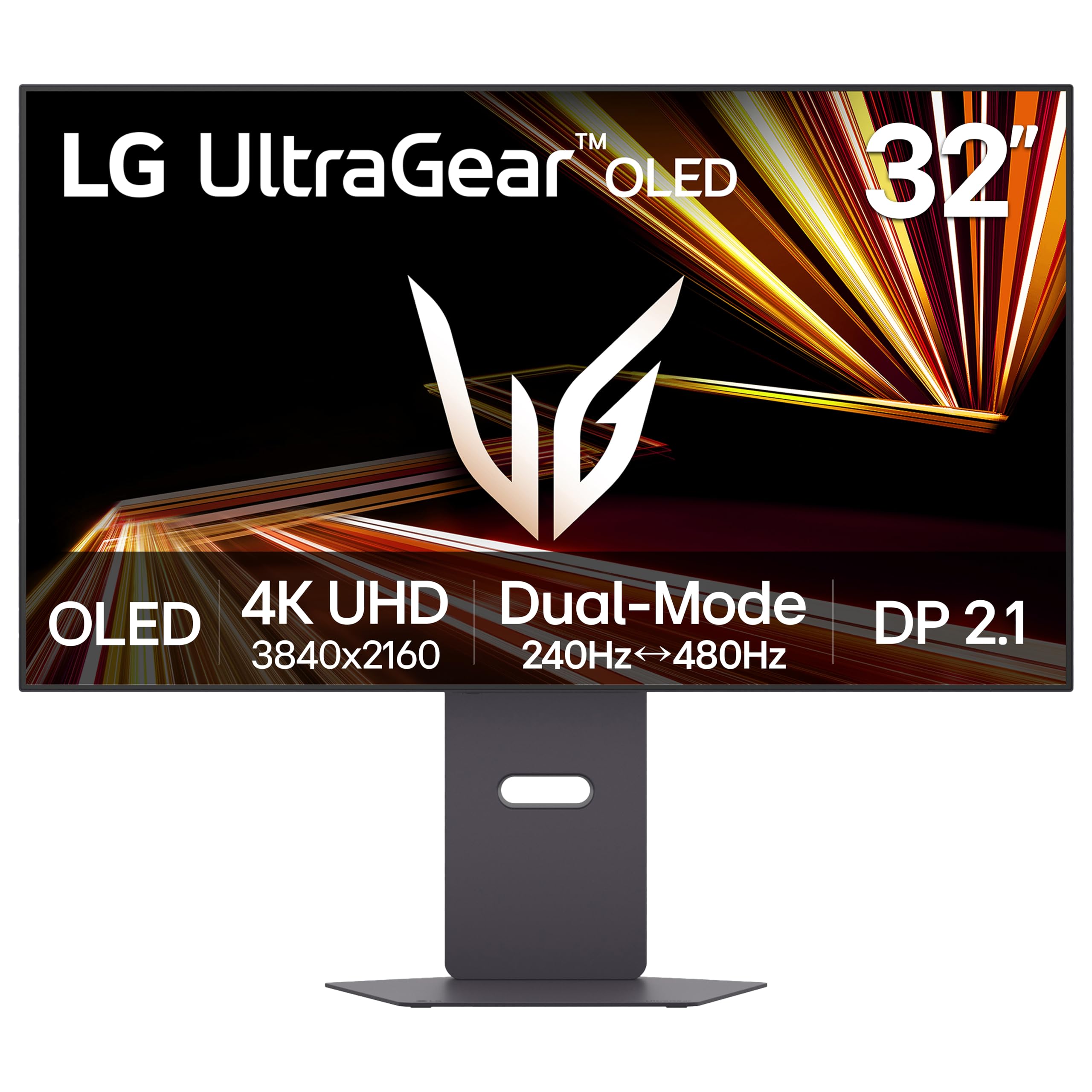
The LG 32GX870A-B earns the top spot because it packs a dual-mode feature that no other monitor here offers — you can run it at 4K 240Hz for story-rich single-player games or flip to Full HD 480Hz for ultra-fast competitive shooters, all on a 32-inch W-OLED panel (white OLED, which uses a white subpixel to boost brightness and improve text clarity). This is the monitor for the buyer who plays both Elden Ring and Counter-Strike and wants one screen that handles both perfectly.
Its Micro Lens Array+ technology pushes typical brightness to 275 nits — roughly 10% brighter than the msi MPG 321URX which sits at 250 nits — and it can spike to 1300 nits on small bright highlights, so explosions and reflections in racing games look punchy without washing out the dark areas. Buyers report the built-in speakers are surprisingly crisp and clear, often sounding better than a headset. The 1.5M:1 contrast ratio means black is truly black, even with the room lights on.
The catch is that initial vertical banding may appear on the first day of use, though owners mention it fades after a few automatic pixel-cleaning cycles. If you want one monitor that can switch between a deep 4K adventure and a lightning-fast 480Hz esports arena, this is the confident choice that future-proofs your setup.
Why it’s great
- Dual-mode refresh rate (4K 240Hz / 1080p 480Hz) covers every game type
- Anti-glare matte coating keeps reflections low even in bright rooms
- VESA DisplayHDR True Black 400 delivers deep blacks with strong highlight pop
Good to know
- Typical brightness of 275 nits is modest compared to high-end LCD gaming monitors
- Matte coating can look slightly grainy on bright static web pages
2. ASUS ROG Swift 32″ PG32UCDM

The ASUS ROG Swift PG32UCDM outpaces the LG model on color and peace of mind — its QD-OLED panel (quantum dot OLED, which uses blue OLEDs with quantum dots to create richer reds and greens) covers 99% of the DCI-P3 color gamut, the standard used in digital cinema, for more vibrant reds and greens, and ASUS includes a three-year warranty that specifically covers burn-in (permanent image retention from static on-screen elements). This is the pick for the buyer who wants the absolute best image quality and plans to keep the monitor for years without worrying about static UI elements.
The glossy screen finish is a deliberate choice: it boosts clarity and makes colors look more saturated than a matte coating, while the anti-reflection treatment keeps distracting glare surprisingly low in normal room lighting. Customers note the text clarity is excellent for an OLED, with minimal color fringing around letters — a common complaint on earlier QD-OLED panels. The custom heatsink and graphene film inside keep temperatures down, reducing the long-term burn-in risk that OLED skeptics fear most.
If you value a manufacturer-backed burn-in warranty that removes the mental worry of using an OLED for both gaming and daily desktop work, choose this over the LG. The display itself is a top-tier 4K QD-OLED that excels equally at games and media.
Where it shines
- 3-year warranty includes burn-in coverage for total peace of mind
- Glossy QD-OLED screen delivers richer colors and deeper contrast than matte alternatives
- Custom heatsink and graphene film manage heat to reduce long-term burn-in risk
Worth noting
- Glossy screen may show reflections in very bright or sunlit rooms
- Requires periodic pixel refresh to maintain uniform brightness over time
3. INNOCN 27″ GA27W1Q
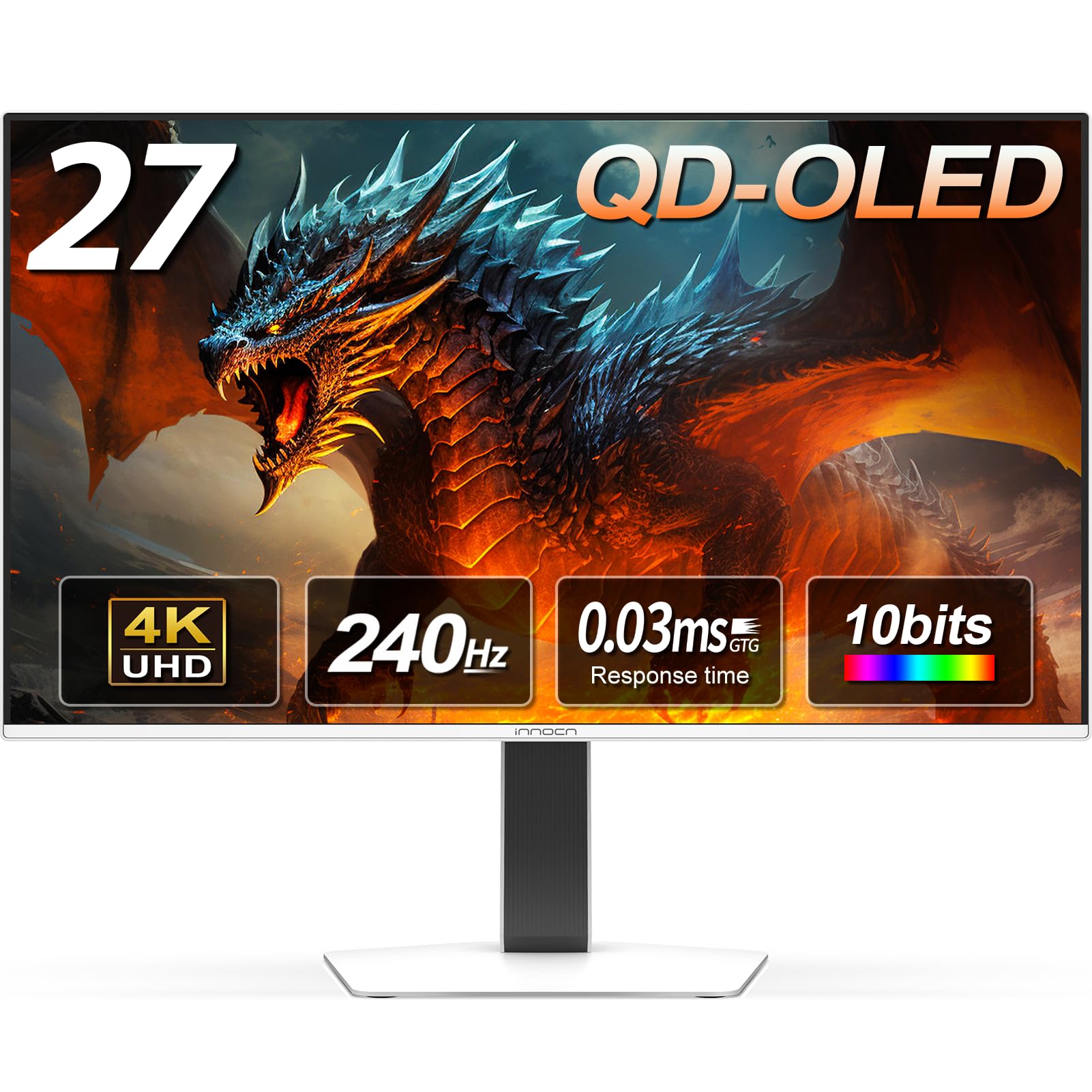
If you want a 27-inch 4K QD-OLED for competitive gaming without paying the premium of bigger brands, the INNOCN GA27W1Q delivers a 240Hz refresh rate and 0.03ms response time at a significantly lower price. At 27 inches, the pixel density is higher than a 32-inch screen at the same 4K resolution, so text and fine details look exceptionally sharp — ideal if you sit close to your monitor.
The QD-OLED panel covers 99% DCI-P3 and delivers a 1,500,000:1 contrast ratio, so game worlds like the wasteland in Fallout or the dark corridors in L4D2 look vivid and detailed. Reviewers specifically mention that the monitor performs excellently for Call of Duty and Fallout, with great frame handling and fast response times when connected via HDMI. The stand offers height, tilt, swivel, and even pivot adjustment, plus it supports VESA wall mounting on a 100mm x 100mm bracket.
One reviewer described the quality as “flagship specs at an insanely low price” compared to ASUS, which would cost more for the same QD-OLED panel. The only significant trade-off is that the built-in speakers are poor — fine for system sounds, but you will want dedicated speakers or a headset for gaming audio.
What stands out
- QD-OLED panel delivers 99% DCI-P3 color gamut for vibrant, lifelike gaming
- Fully adjustable stand (height, tilt, swivel, pivot) plus VESA mount support
- G-Sync Compatible and FreeSync for tear-free gaming on either GPU brand
The trade-offs
- Built-in speakers are very weak; external audio is strongly recommended
- On-screen menu presets lack clear instructions for HDR mode selection
4. msi MPG 321URX QD-OLED

The single number that matters most in this category is the 240Hz refresh rate, and the msi MPG 321URX QD-OLED scores a perfect match with that spec, alongside a 0.03ms response time. Its VESA DisplayHDR True Black 400 certification guarantees deep blacks while maintaining 250 nits of typical brightness, and the 99% DCI-P3 color gamut makes photo editing and video grading accurate enough for semi-professional use. The KVM (keyboard-video-mouse) switch built into the monitor lets you control two connected devices from a single keyboard and mouse without unplugging anything.
Buyers running dual-monitor Mac workstations report that after fixing an initial DSC (display stream compression) handshake issue — simply disable DSC and lock the input to DisplayPort at 120Hz — the monitors run stable with perfect blacks and zero eye strain, making them “ideal for productivity”. The 240Hz refresh rate and 0.03ms response time handle gaming just as well as the other picks, and the 10-bit color depth (1.07 billion colors) ensures smooth gradients without banding in dark game scenes. The 90W USB-C port can charge a laptop while it carries the display signal, reducing cable clutter.
On brightness, the msi sits at 250 nits typical, while the LG hits 275 nits — a roughly 10% advantage for the LG in bright-room HDR content. If you need a monitor that excels at both gaming and Mac-based productivity with a built-in KVM, this is the model that bridges the two worlds better than any other on the list, offering strong price-to-value for users who prioritize versatility over peak brightness.
The upsides
- Built-in KVM switch lets you control two PCs or a PC and a Mac with one keyboard and mouse
- 90W USB-C charges a laptop and carries video through a single cable
- Excellent color accuracy (Delta E ≤2) for creative work and photo editing
Keep in mind
- Typical brightness of 250 nits is noticeably lower than the LG’s 275 nits
- Dual-monitor setups on Mac may require disabling DSC and running at 120Hz for stability
5. Acer Predator X32
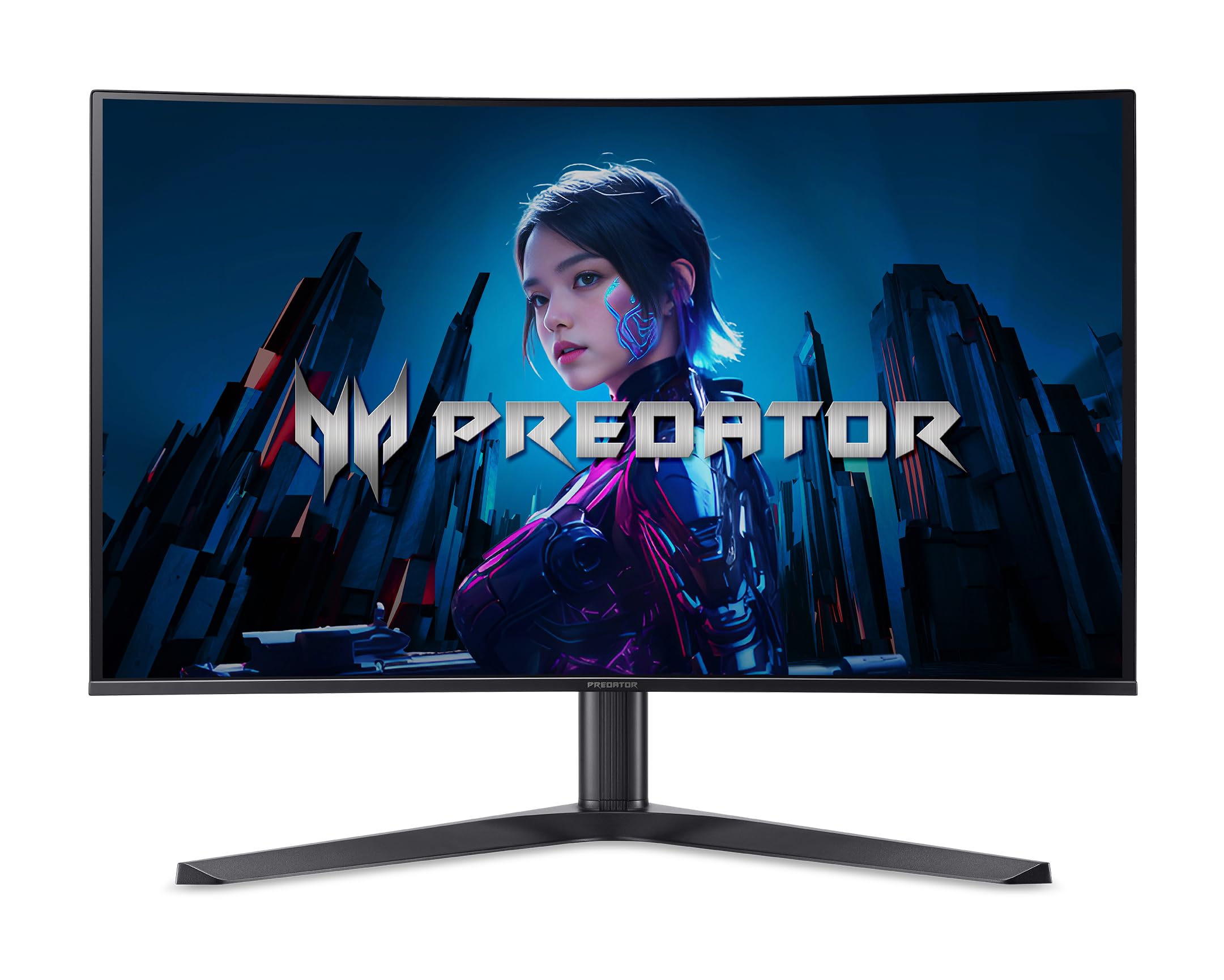
The Acer Predator X32 is the most affordable entry point into 4K OLED gaming on this list, yet it still packs a curved 31.5-inch quantum dot OLED panel with a 240Hz refresh rate and a 0.03ms response time. At this price, you get the same core OLED benefits — perfect blacks, 99% DCI-P3 color, and VESA DisplayHDR True Black 400 — but with a 1700R curve that wraps the screen around your field of view for a more immersive feel in racing and flight sim games.
The curve is subtle enough that reviewers point out you do not really notice it during normal use, but it helps reduce reflections from side lighting and makes the edges of the screen feel equally visible. The stand adjusts for tilt, swivel, and height, and the monitor includes two HDMI 2.1 ports plus DisplayPort 1.4, so you can connect a PS5 and a PC simultaneously. One reviewer who replaced a 48-inch LG OLED called the X32 a “great value” with superior image quality for MotoGP, D4, and Top Gun — and noted it runs cooler than the larger TV it replaced.
The downside is that some units ship with a locked settings menu that limits color calibration, and the peak 1000-nit brightness only applies to tiny highlights — on large bright backgrounds the monitor looks dimmer than a standard 400-nit IPS panel. One reviewer warned it is “worth max -500” based on the brightness limitations. If you want a curved 4K OLED gaming monitor at the lowest possible entry price without sacrificing core specs, this is the exact budget buyer it is perfect for.
Why we’d pick it
- Curved 1700R QD-OLED panel creates a more immersive gaming feel than flat screens
- True 10-bit color depth ensures smooth gradients without color banding
- FreeSync Premium Pro support matches well with AMD graphics cards
A few caveats
- Peak 1000-nit brightness is only available on very small highlights — large bright areas look dimmer
- On-screen prompts asking for user intervention every few hours can be distracting
Understanding the Specs
Refresh Rate (Hz)
Refresh rate tells you how many times per second the monitor redraws the entire image. A 240Hz monitor refreshes 240 times every second, which makes fast motion — like a character sprinting through a battlefield or a car speeding around a corner — look fluid rather than a blurry mess. The jump from 60Hz to 240Hz is dramatic because each frame is on screen for only 4.2 milliseconds instead of 16.7 milliseconds, so there is much less motion blur between frames. All five monitors on this list run at 240Hz.
Response Time (GtG)
Response time, measured in milliseconds (ms), is the time it takes a single pixel to change from one color to another. A 0.03ms GtG (grey-to-grey) response time means a pixel can shift from one shade of grey to another in 0.03 milliseconds — roughly 100 times faster than a typical 4ms gaming LCD. This near-instantaneous switching eliminates ghosting (the faint trail that follows a moving object) and makes OLED the fastest display technology available today for fast-paced shooters and racing games.
VESA DisplayHDR True Black 400
This certification means the monitor meets strict standards for HDR performance with OLED and micro-LED panels. “True Black” is the key: unlike standard HDR certifications that only measure peak brightness, True Black 400 requires a minimum 0.0005 nit black level (basically total black when the pixel is off) plus at least 400 nits of peak brightness. The result is that a bright explosion in a dark cave looks simultaneously very bright and completely black — a combination that LCD monitors simply cannot achieve because their backlight always leaks some light.
DCI-P3 Color Gamut
DCI-P3 is a color space standard used in digital cinema that covers about 26% more colors than the older sRGB standard. A monitor with 99% DCI-P3 coverage, like all the QD-OLED models here, can display nearly every shade that movie projectors and professional video editors use. In practical terms, this means grass looks a richer green, a sunset sky shows more shades of orange and pink, and the reds in game logos and UI elements appear more saturated and accurate without looking artificial.
FAQ
What is the real difference between W-OLED and QD-OLED panels?
Can I use a 4K OLED gaming monitor for office work without burning it in?
Does a curved screen make a difference for gaming?
Do I need HDMI 2.1 for a 4K 240Hz monitor?
Why do some OLED monitors look dimmer than LCD monitors?
Final Thoughts: The Verdict
For most people, the best 4k oled gaming monitor winner is the LG 32GX870A-B because its dual-mode refresh rate — 4K 240Hz for story games and 1080p 480Hz for esports — covers every type of gaming you will do, and its 275-nit typical brightness (10% higher than the msi MPG 321URX) gives it an edge in well-lit rooms. If you want the best image quality with a three-year burn-in warranty for total peace of mind, grab the ASUS ROG Swift PG32UCDM. And for the mid-range buyer who wants a compact 27-inch QD-OLED with flagship specs at hundreds less, the INNOCN GA27W1Q is the smartest value on this list.