
Our readers keep the lights on and the weekend projects moving. As an Amazon Associate, I earn from qualifying purchases.
When you’re miles into the backcountry, carrying enough water for a multi-day trip is simply not an option. Every pound you haul is a pound you feel on the trail. A backpacking gravity water filter lets you refill from any stream, lake, or creek using nothing but gravity — no pumping, squeezing, or batteries required. This guide breaks down the best gravity filters for 2025, comparing flow rates, capacity, and filter lifespan so you can find the one that fits your adventures.
I’m Rikta — the co-founder and writer behind FitlyFast. This guide is built by comparing the manufacturers’ published specifications and the patterns across verified customer reviews, so you get each pick’s real strengths and trade-offs instead of marketing spin.
We’ve analyzed five top-rated models to help you choose the right backpacking gravity water filter for your needs.
How To Choose The Best Backpacking Gravity Water Filter
Choosing a gravity filter means you’re opting for convenience and hands-free operation, but you still need to match the right specs to your trip style. Here’s what matters.
Filter Lifespan (Gallons)
This is the total amount of water the filter element can process before you need to replace it. A higher gallon rating means lower cost per trip and less waste. Most backpacking filters last between 1,000 and 1,800 gallons, which could cover years of weekend trips before needing a new cartridge.
Flow Rate (ml/min or L/min)
Flow rate determines how fast you get clean water. A fast flow means less waiting around camp — you can fill your bottles and hit the trail sooner. Keep in mind that cold water and silty water will slow flow on any filter, so a higher rated flow gives you more margin in tough conditions.
Capacity (Bag Size)
A bigger bag lets you filter more water in one batch, which is ideal for groups or dry camps where you need to carry water to your tent. Smaller bags are lighter and work better for solo hikers. Most gravity filters come with 1.5 to 3 liter bags, but some include multiple bags for dirty and clean water separation.
Weight and Packability
Every ounce counts when you’re carrying your gear on your back. A typical gravity filter system weighs between 6 and 15 ounces. Look for collapsible bags that pack flat when empty — this saves precious space in your pack and keeps your kit organized.
Quick Comparison
On smaller screens, swipe sideways to see the full table.
| Model | Category | Best For | Key Spec | Amazon |
|---|---|---|---|---|
| Katadyn BeFree Gravity 3L | Premium | Lightweight fast-flow for solo & small groups | 3L bag, 2 L/min flow, 1,000L capacity | Amazon |
| LifeStraw Peak Series 3L | Premium | Versatile multi-use filter with proven brand | 3L bag, multi-use (gravity/squeeze/straw) | Amazon |
| Practical Survival Gravity 6L | Mid-Range | Groups & high-volume filtering | 6L total, 0.6 GPM, 1,800-gal filter | Amazon |
| Waterdrop Gravity Straw 1.5 Gal | Mid-Range | Fast flow with backup straw mode | 1.5 gal bag, 700 ml/min, 1,400-gal capacity | Amazon |
| Yuclet Gravity Filter 2 Gal | Budget | Large groups & basecamps on a budget | 2 gal bag, 600 ml/min, 1,300-gal capacity | Amazon |
In‑Depth Reviews
1. Katadyn BeFree Gravity 3L

2 liters per minute (filling a standard 1-liter Nalgene in under 20 seconds) makes the Katadyn BeFree Gravity 3L the top pick for solo backpackers who prioritize speed and minimal pack weight. It is the fastest and lightest 3-liter gravity setup in the roundup at just 6.4 ounces, and the bag packs down flat when empty so it barely shows in your pack.
The 0.1-micron hollow fiber filter removes bacteria and protozoa, and EZ-Clean technology restores flow by simply swishing the filter in clean water — no tools needed. Buyers report filling the 3-liter bag in 3–5 minutes on the trail, with one reviewer noting the filter was “faster than expected” and appreciating the lightweight design for solo trips.
The bag can be prone to punctures if treated roughly, and you fill it only through the cap — no rear opening for faster filling. The filter lifespan is 1,000 liters (264 gallons), which is lower than the 1,800 gallons on the Practical Survival. Stick with this if flow speed and pack weight are your top priorities.
Why it’s great
- Fastest flow in this roundup: up to 2 L/min
- Very lightweight at 6.4 oz; packs flat when empty
- Easy to clean — just shake or swish the filter in water
Good to know
- Bag is somewhat prone to punctures if not handled with care
- Can only fill through the cap, no rear opening for faster filling
- Filter capacity is 1,000 L (264 gal) — lower than some competitors
2. LifeStraw Peak Series 3L

Compared to the top pick, the LifeStraw Peak Series 3L weighs 228 grams (about 8 ounces), which is slightly heavier, but it offers four modes—gravity system, squeeze bottle, straw for direct drinking, and attachment to a standard water bottle—versus the top pick’s single gravity-only mode. The re-engineered membrane and custom backwash accessory are designed to keep flow strong even in silty water, a common problem in backcountry streams.
The filter protects against 99.999999% of bacteria (like E. coli and Salmonella) and 99.999% of parasites (like Giardia and Cryptosporidium), as claimed by the manufacturer. One reviewer on a 10-mile hike said the system worked well for both filtering into a pouch and drinking directly through the straw. A key limitation: the bag can be hard to fill in slow-moving water — one reviewer cut a corner from a Ziploc bag to use as a scoop.
Choose this over the top pick if you need one tool for many water sources on a multi-day trip.
Where it shines
- Four modes: gravity, squeeze, straw, and bottle attachment
- Excellent filtration ratings: 99.999999% bacteria, 99.999% parasites
- Durable, leak-proof construction with premium materials
Worth noting
- Hard to fill the bag in slow-moving streams without a scoop
- Slightly heavier than other 3L gravity systems at 8 oz
- Filter flow may slow over time if not backwashed regularly
3. Practical Survival Gravity 6L

You’re leading a Scout troop or a family of four on a weekend backpacking trip, and everyone needs water for dinner, breakfast, and the next day’s hike. The Practical Survival Gravity 6L lets you set up one 6-liter dirty bag and one 6-liter clean bag — 12 liters total capacity, about 4x the capacity of the Waterdrop model’s single 1.5-gallon bag — so you filter all the cooking and drinking water for the whole group in a single session.
The 0.1-micron filter removes over 99.99% of bacteria (including E. coli) and parasites (including Giardia), per the brand’s claims, and the kit includes a cleaning plunger to restore flow over time. The downsides: the tubing can twist when you screw on the caps, and the clean bag lacks a pour spout — you unscrew the connection to pour. One reviewer who used it with Scouts said it filtered 6 liters (about 6 Nalgene bottles) in roughly 10 minutes.
Pick this if you regularly filter for a crew or basecamp setting and want the lowest per-trip filter cost — the filter lifespan is a massive 1,800 gallons, which could cover years of weekend trips.
What stands out
- Massive 6L total capacity perfect for groups of 4+ people
- Excellent 1,800-gallon filter lifespan offers years of use
- Includes cleaning plunger to maintain flow over time
The trade-offs
- Tubing can twist when attaching caps; requires some care
- Clean bag lacks a pour spout — you need to unscrew the connection
- Not as packable as smaller systems when the bags are full
4. Waterdrop Gravity Straw 1.5 Gal

The single number that matters most in this category is flow rate, and the Waterdrop Gravity Straw scores 700 ml/min — 17% faster than the Yuclet model’s 600 ml/min — which cuts camp chore time noticeably when you are thirsty after a long hike. At that speed, a 1-liter bottle fills in about 1.4 minutes. You get a 1.5-gallon gravity bag plus a removable filter straw that also works for direct drinking from a stream. This dual-use design saves you from carrying a separate straw.
The catch is capacity: the single 1.5-gallon bag holds about 11 standard 500ml water bottles, enough for a solo hiker or pair but not for a group. Some users report the reservoir top doesn’t seal completely when full, so you cannot lay it flat without spilling. On the plus side, the 1,400-gallon filter lifespan is among the highest here, keeping your replacement cost per trip low. Reviewers praise its speed and weight — one reviewer noted “no illness after 3-day use,” which is the real test for any backcountry filter. Another noted it flows twice as fast as their old Sawyer filter.
This is the pick for the value-conscious solo hiker who wants fast flow without spending for the premium BeFree; skip it if your group needs more than 1.5 gallons per batch — making its price-to-value read strongest for lightweight solo trips where speed matters more than volume.
The upsides
- Fast flow rate at 700 ml/min fills bottles quickly
- High 1,400-gallon filter lifespan keeps long-term costs low
- Includes a detachable straw for direct drinking from streams
Keep in mind
- Reservoir top doesn’t seal completely when full — can leak if laid flat
- Single 1.5-gal bag limits capacity for groups
- Flow control clip may not fully stop water flow for some users
5. Yuclet Gravity Filter 2 Gal
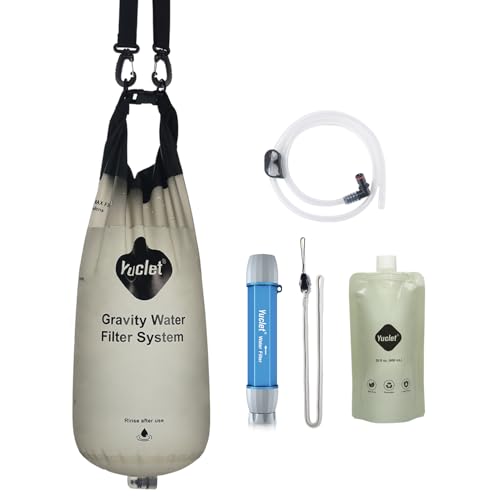
At this lower price, the Yuclet gives you a complete gravity setup: a 2-gallon dirty reservoir, a 0.1-micron hollow fiber filter, a water pouch, and a hanging strap. The 0.1-micron hollow fiber works the same way as the pricier filters, trapping bacteria and protozoa. The filter lifespan is 1,300 gallons — close to the 1,400 gallons of the Waterdrop and competitive with filters costing much more.
The flow of 600 ml/min is the slowest here, so you wait longer for each batch. Build quality uses TPU (thermoplastic polyurethane — a flexible, puncture-resistant plastic) on the bag, which one buyer mentioned “felt sturdy.” The included 20 oz water pouch is small for general camp use. One husband “loved it, said it worked very well and was bigger than he thought it was going to be” for group camping. Another reviewer called it a good survival kit staple.
This is the system for the budget-focused backpacker who needs reliable gravity filtration for group camps, basecamps, or emergency kits without a big spend. The slow flow is the downside you accept for the price.
Why we’d pick it
- Full gravity system with 2-gal bag and durable TPU material
- Respectable 1,300-gallon filter lifespan for long-term value
- Versatile screw-on fit works with standard 28/30mm bottles
A few caveats
- Slower flow rate at 600 ml/min compared to mid-range options
- Included water pouch is small (20 oz) for general use
- Some users report a short learning curve for filling the bladder
Understanding the Specs
Micron Rating
The micron rating tells you the size of particles the filter can trap. 0.1 micron is the standard for backpacking filters — it captures bacteria (like E. coli and Salmonella) and protozoa (like Giardia and Cryptosporidium) that cause waterborne illness. A lower number means smaller pores, which means cleaner water but potentially slower flow. All the filters in this guide use 0.1-micron hollow fiber technology, which is the industry benchmark for backcountry safety.
Flow Rate (ml/min or L/min)
Flow rate measures how quickly water passes through the filter element. It’s listed in milliliters per minute (ml/min) or liters per minute (L/min). A faster flow means you spend less time waiting for water — 700 ml/min fills a 1-liter bottle in about 1.4 minutes, while 2 L/min does it in 30 seconds. Real-world flow will be slower in cold or silty water, so a higher rated speed gives you more margin in tough conditions.
Filter Lifespan (Gallons)
This is the total volume of water the filter can process before the element needs replacing. Higher lifespans (1,400–1,800 gallons) mean lower cost per trip and less waste. Think of it like a printer cartridge — a higher capacity saves you money over time. Some filters offer replaceable cartridges, while others require a whole new system when the filter expires. Check if replacements are available before you buy.
Bag Material and Durability
The bag holds the dirty water and takes the most abuse on the trail. Most gravity filters use either TPU (thermoplastic polyurethane) or a heavy-duty plastic. TPU is more flexible, packs flatter, and is more resistant to punctures than standard plastic. Bag durability directly affects how long your system lasts — a bag that springs a leak in the backcountry can ruin a trip.
FAQ
How does a gravity water filter work for backpacking?
Can I drink straight from the filter without the bag?
How do I clean a gravity water filter on the trail?
Final Thoughts: The Verdict
For the majority of shoppers, the backpacking gravity water filter winner is the Katadyn BeFree Gravity 3L because it offers the fastest flow, lightest weight, and easiest cleaning of any model here — perfect for solo hikers and small groups who value time on the trail. If you want maximum versatility with a trusted brand, grab the LifeStraw Peak Series 3L. And for large groups needing high capacity at a budget-friendly price, the standout is the Practical Survival Gravity 6L.