
Our readers keep the lights on and the weekend projects moving. As an Amazon Associate, I earn from qualifying purchases.
A 7 1/4 circular saw is the backbone of any framing crew or serious DIY workshop. The decision isn’t just about blade size—it’s about balancing motor torque against weight, deciding between corded reliability and cordless freedom, and understanding whether a stamped or cast-aluminum base plate matters more for the cuts you make daily. Choosing poorly here means fighting the tool on every rip cut instead of letting the saw do the work.
I’m Rikta — the founder and writer behind FitlyFast. I spend my time digging through motor specs, comparing base plate rigidity across brands, and analyzing real-world cut tests to separate marketing claims from genuine performance.
This guide examines seven competing models to help you find the right 7 1/4 circular saw for your specific mix of materials, worksite conditions, and budget.
How To Choose The Best 7 1/4 Circular Saw
Every 7 1/4 circular saw follows the same basic formula—a spinning blade, a motor, and a guide shoe—but the details of execution separate a tool that frustrates from one that becomes an extension of your arm. Focus on the specs that define real-world usability rather than the headline numbers.
Motor Power and Torque Delivery
A 15-amp motor is the standard for corded models, delivering between 5,200 and 6,800 RPM depending on the saw. Higher RPM means faster cuts in softer materials like plywood, but torque at lower speed matters more when ripping through dense LVL or pressure-treated 2x lumber. Look for dual-field motor designs, which dissipate heat more effectively and sustain power under continuous load without bogging down or shortening the motor’s service life.
Base Plate Quality and Cut Accuracy
The base plate, or shoe, is the saw’s reference surface against your material. Stamped steel shoes are cheap to produce but can warp over time, introducing drift into cuts. Cast aluminum or heavy-duty aluminum shoes hold their flatness and offer cleaner edges for tracking along a straightedge or rip fence. A wraparound base design, like those found on models engineered for job-site durability, provides additional rigidity and a wider bearing surface for improved cut stability at both 90 and 45 degrees.
Weight, Balance, and Ergonomics
Weight directly affects user fatigue during extended cutting sessions. The lightest professional-grade corded saws sit around 8.6 pounds, while heavier models approach 11 pounds. A well-balanced saw—where the handle is positioned close to the blade’s centerline—feels lighter than the scale suggests because the weight isn’t trying to twist your wrist. Rubber overmold grips and anti-vibration systems further reduce fatigue by damping the motor’s natural harmonics, allowing you to maintain control during repetitive cuts.
Corded vs. Cordless: The Real Trade-off
Corded saws deliver consistent, unlimited runtime and peak torque at a lower upfront cost, making them ideal for stationary workshop use or jobs where a generator is present. Cordless models offer unmatched mobility for roof work, tight crawlspaces, or remote sites, but require an investment in batteries (typically 6Ah or larger for sustained cutting) and accept a runtime trade-off. For a cordless saw to compete with a corded one in framing applications, look for brushless motor designs and battery platforms that support high-amperage draws without thermal shutdown.
Quick Comparison
On smaller screens, swipe sideways to see the full table.
| Model | Category | Best For | Key Spec | Amazon |
|---|---|---|---|---|
| Makita HS7600 | Corded | DIY precision cuts | 10.5 Amp, 5200 RPM | Amazon |
| DEWALT DCS590B | Cordless | Most powerful cordless cuts | Brushless, 5500 RPM | Amazon |
| BOSCH CS5 | Corded | Left-blade visibility | 15 Amp, left-sided blade | Amazon |
| Metabo HPT C7UR | Corded | Fastest cutting speed | 15 Amp, 6800 RPM | Amazon |
| SKILSAW SPT67WL-01 | Corded | Lightest pro-grade saw | 15 Amp, 8.6 lbs | Amazon |
| CRAFTSMAN CMCS551B | Cordless | Versatile cordless mobility | Brushless, 56° bevel | Amazon |
| Metabo HPT C7SB3 | Corded | Entry-level pro value | 15 Amp, 6000 RPM | Amazon |
In‑Depth Reviews
1. Makita HS7600 Circular Saw, 7-1/4″

The Makita HS7600 runs a 10.5-amp motor that spins at 5,200 RPM, which sounds modest on paper compared to the 15-amp competition, but the torque delivery feels punchy in practice. The heavy-gauge aluminum wraparound base is the standout feature here—it’s thicker than the stamped steel alternative found on budget models and maintains flatness even after bouncing around a job site. At 8.6 pounds, it’s as light as the premium corded saws, which makes overhead cuts or long rip sessions notably less fatiguing.
Cut depth reaches 2-1/2 inches at 90 degrees and 1-5/8 inches at 45 degrees, which covers dimensional lumber and most plywood stacks without bottoming out. The lower guard design is particularly smart for bevel cuts—it doesn’t hang up when the saw is tilted, a common irritation on saws where the guard spring tension fights the angle. Owners consistently mention the saw’s accuracy out of the box, with the blade tracking true to the shoe without needing adjustment.
For a homeowner or finish carpenter who prioritizes smooth, accurate cuts over raw speed, this is a small trade-off. Paired with a Diablo blade and a simple track jig, the HS7600 delivers table-saw-level straight cuts for a fraction of the space and cost.
Why it’s great
- Wraparound cast aluminum base stays flat and rigid for precise cuts.
- Lightest pro-grade weight at 8.6 lbs reduces fatigue.
- Lower guard clears bevel cuts without snagging.
Good to know
- 10.5-amp motor has less overhead torque than 15-amp competitors.
- Stock blade is adequate but quickly outclassed by an aftermarket upgrade.
- No on-board wrench storage for quick blade changes.
2. DEWALT 20V MAX XR Brushless Cordless 7-1/4 in. Circular Saw (DCS590B)

The DCS590B is DEWALT’s most powerful 20V MAX circular saw, rated for 1,700 MWO (Maximum Watts Out) and spinning up to 5,500 RPM from a brushless motor. The headline number—368 cuts per charge on a single charge—depends on battery capacity, but in real framing conditions with a 6Ah battery, you’ll get through a stack of 2x material without reaching for a spare. The electric brake stops the blade nearly instantly when you release the trigger, which is a genuine safety upgrade over models that let the blade coast for several seconds.
Cut depth at 90 degrees is 2-9/16 inches, enough to chew through stacked dimensional lumber in a single pass. At 9.2 pounds, it is competitive with corded saws and feels well-balanced for a cordless unit because the battery sits in line with the handle rather than protruding awkwardly. The aluminum shoe is rigid and flat, and the upper metal guard adds durability for job-site conditions where the saw might get knocked off a workbench or dropped.
Battery life is the limiting factor—aggressive cuts on treated lumber will drain a 6Ah pack in roughly 15 minutes of continuous use, and the battery can get uncomfortably hot. This is not a saw for production framing where you are cutting all day, but for remodel work, service calls, or any situation where running a cord is impractical, the power-to-mobility ratio is the best in the cordless class. Tool-only pricing means you need an existing DEWALT 20V battery platform to make it cost-effective.
Why it’s great
- Brushless motor delivers power comparable to a corded 15-amp saw.
- Electric brake stops the blade immediately for safer handling.
- Rigid aluminum shoe and metal guard hold up to job-site abuse.
Good to know
- Bare tool requires a separate battery and charger investment.
- Battery drains quickly under heavy continuous use on dense lumber.
- Battery can overheat during extended rip cuts in hot weather.
3. BOSCH CS5 120-Volt 7-1/4-Inch Circular Saw

The Bosch CS5 is a left-sided blade saw, meaning the motor sits to the right of the blade and the blade is on the left side of the cut. This design puts the cut line directly in front of your line of sight rather than underneath the shoe, which dramatically improves accuracy for rip cuts and bevel cuts. The 15-amp motor delivers genuine torque for the hardest materials, and the saw is rated at 9.3 pounds—lighter than many sidewinders, let alone left-sided units.
Bosch engineered this saw with cast-metal components rather than plastic for critical structural parts, and the base plate is machined flat. The built-in spindle lock and wrench storage mean you never have to fumble for a tool between cuts. Experienced users report the saw holds its settings over months of abuse—the bevel and depth adjustments stay locked down once set, which eliminates the frustration of a saw that wanders off square mid-project.
The dust chute design is not effective—debris tends to blow into the operator’s face, especially without a vacuum attached. The stock 24-tooth blade has a wide kerf and can leave scorch marks on clean plywood cuts; most owners swap it for a Bosch Daredevil or Diablo blade immediately. The left-sided design also means some aftermarket track systems require an adapter to align the blade correctly.
Why it’s great
- Left-sided blade offers unobstructed cut-line visibility for precision work.
- 15-amp motor handles hardwoods and wet lumber without bogging.
- Cast-metal components and machined base plate maintain long-term accuracy.
Good to know
- Poor dust management sends debris toward the operator.
- Stock blade has wide kerf and may burn clean plywood.
- Left-sided design requires compatible track saw guides or adapters.
4. Metabo HPT Circular Saw Kit C7UR

The Metabo HPT C7UR spins at 6,800 RPM, the highest no-load speed in this lineup, which translates to up to 40 percent faster cutting speed through framing lumber compared to a standard 5,200 RPM saw. This is a 15-amp motor that sustains power well under load without the RPM drop that stalls lesser saws mid-cut. The anti-vibration system dampens the motor’s natural shake noticeably—you feel less fatigue after a day of ripping rafters than you would with a similarly powered saw without vibration isolation.
The handle is positioned closer to the blade than on traditional sidewinders, shifting the saw’s center of gravity back toward your grip. This makes the 11.1-pound weight feel more manageable because the saw doesn’t want to tip forward at the nose. The ribbed stamped aluminum base is a compromise between cost and rigidity—it is flatter than typical stamped steel but not as durable as a full cast-aluminum wraparound like the Makita’s.
The dust blower function effectively clears sawdust from the cut line, though no auxiliary dust port is provided for vacuum attachment. The 0-to-55-degree bevel range with positive stops at 0, 45, and 55 degrees is generous, but the bevel lock mechanism can feel vague when dialing in intermediate angles. The included 24-tooth VPR framing blade is genuinely good for a stock blade, cutting cleanly through OSB and pressure-treated 2x material without excessive tear-out.
Why it’s great
- Highest no-load RPM in the class for fast cuts in dimensional lumber.
- Anti-vibration system reduces arm fatigue during extended use.
- Handle positioned close to the blade improves balance and control.
Good to know
- 11.1 lbs is heavier than the lightest pro-grade alternatives.
- Ribbed aluminum base is not as torsionally rigid as cast wraparound designs.
- Bevel lock feels vague for precise intermediate angle adjustments.
5. SKILSAW SPT67WL-01 15 Amp 7-1/4 In. Sidewinder Circular Saw

At 8.6 pounds, the SKILSAW SPT67WL-01 is the lightest pro-grade 7-1/4 circular saw on this list without sacrificing motor power—it still packs a 15-amp motor with a dual-field design that runs cooler than conventional windings. The lightness makes a real difference when you are cutting roof sheathing overhead or carrying the saw between job sites all day. The 56-degree bevel capacity with a positive stop at 45 degrees covers almost any angle cut you’ll encounter in framing or trim work.
The 10-foot cord is noticeably longer than most, which reduces the need for extension cords or constant repositioning on sheet goods. The cast aluminum base plate is machined flat and stays square, and the 5-inch wide fence aids setup by providing a stable reference surface when you clamp a straightedge. Owners consistently report that the saw tracks accurately out of the box and holds its settings through months of use, unlike some budget alternatives where the base develops play over time.
The depth adjustment lever can loosen unintentionally during use if you don’t apply enough clamping force, allowing the blade to drift deeper than intended. The included 24-tooth blade is serviceable for rough framing but should be replaced for clean finish cuts. This saw is optimized for the user who wants professional-grade performance without paying for more saw than they need, and who values weight savings over features like dust collection ports.
Why it’s great
- Lightest pro-grade 15-amp saw at 8.6 lbs for all-day use.
- 10-foot cord reduces the need for extension cords on sheet materials.
- Cast aluminum base plate stays flat and accurate for precise cuts.
Good to know
- Depth adjustment lever can loosen during heavy use if not tightened fully.
- Stock blade is adequate for framing but not for clean finish work.
- No auxiliary dust port for vacuum attachment.
6. CRAFTSMAN V20 RP Cordless Circular Saw (CMCS551B)
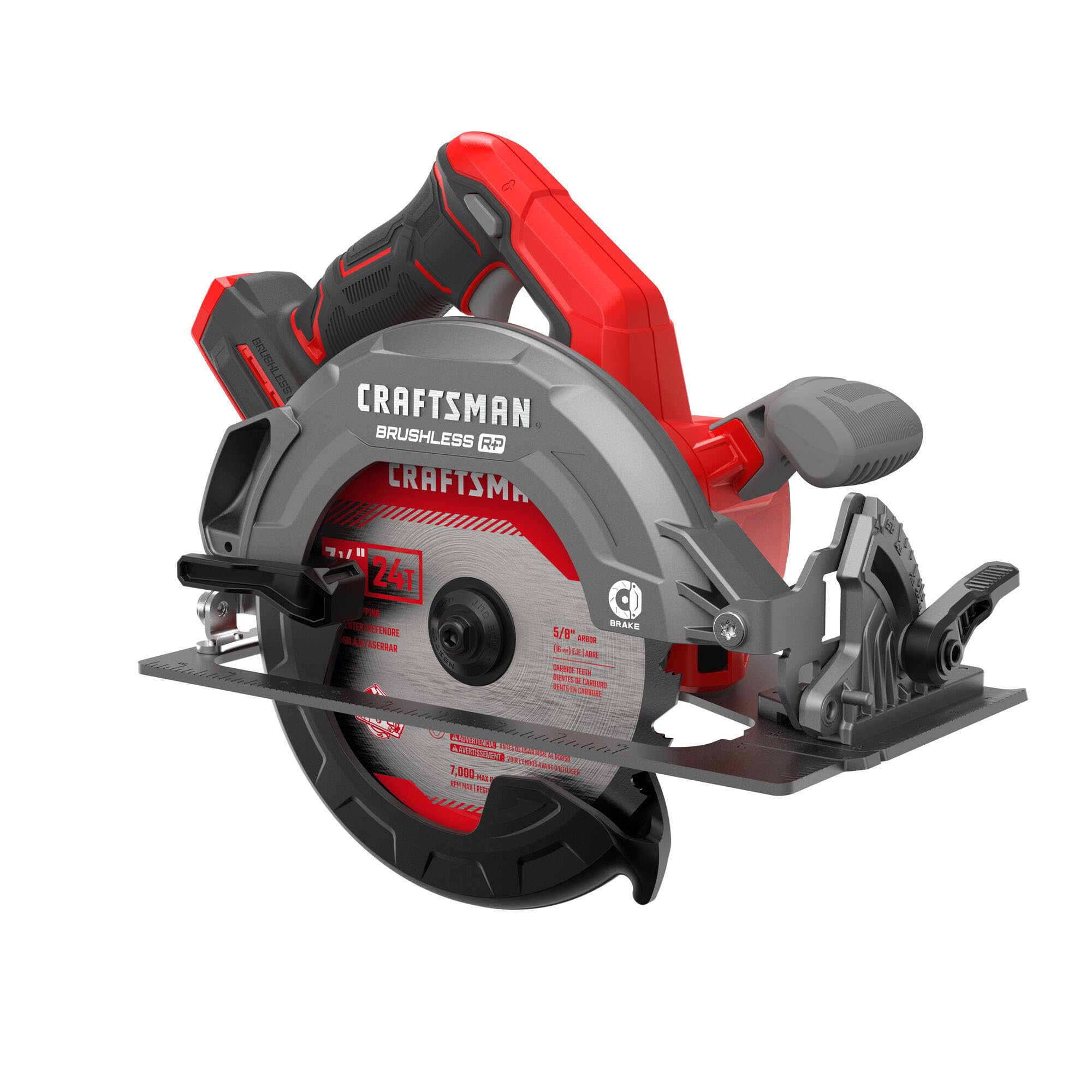
The CRAFTSMAN CMCS551B runs on the V20 battery platform with a brushless motor that DEWALT’s parent company rates at 75 percent more power than its brushed predecessor. In practice, this means it cuts through 2×6 treated lumber cleanly without bogging, and the 56-degree bevel capacity with positive stops at 22.5 and 45 degrees gives you more tilt range than most cordless saws. The LED light illuminates the cut line effectively in dim job-site conditions, which is more useful than it sounds when you are making cuts in a basement or attic.
The upper metal guard adds durability, and the aluminum shoe provides a stable reference surface that stays flat. At 9.3 pounds, it is well within the cordless class weight range, and the balance is good because the V20 battery slides into the rear handle rather than sticking out the back. The saw is compatible with the full CRAFTSMAN V20 line, so if you already own other CRAFTSMAN tools, adding this one requires no new battery infrastructure.
Battery consumption is the primary limitation—a 4Ah battery will deliver roughly 10 minutes of continuous cutting, and aggressive ripping in dense lumber will drain it faster. This is fine for quick repairs, trim work, or cutting a few studs, but not for production framing. The saw is sold as a bare tool, so the cost of adding batteries and a charger can push the total investment past the price of a comparable corded saw with similar power output.
Why it’s great
- Brushless motor provides near-corded power for cordless convenience.
- 56-degree bevel range with stops covers most angle cut requirements.
- LED light improves cut-line visibility in low-light environments.
Good to know
- Battery drains quickly under heavy framing cuts; larger packs needed.
- Bare tool purchase requires additional battery and charger investment.
- Battery can overheat during extended continuous use on dense lumber.
7. Metabo HPT 7-1/4-Inch Circular Saw Kit (C7SB3)

The Metabo HPT C7SB3 is the most affordable entry into professional-grade 7-1/4 circular saws, pairing a 15-amp motor with 6,000 RPM in a package that weighs 9.5 pounds. The heavy-duty cast aluminum base is the primary differentiator from budget stamped-steel saws—it stays flat and square, allowing accurate reference cuts even after months of job-site use. The integrated dust blower clears sawdust from the cut line effectively, though it lacks a port for vacuum attachment.
Cut capacity reaches 2-7/16 inches at 90 degrees and 1-7/8 inches at 45 degrees, which covers standard framing lumber and most sheet goods. The included 24-tooth premium framing blade is noticeably better than the generic blades bundled with other budget-oriented saws, making clean cuts in OSB and 2x material right out of the box. The carrying bag is basic but functional for keeping the saw and blade wrench together in a truck bed or gang box.
The saw is heavier than premium alternatives like the SKILSAW, and the bevel adjustment uses a single-handed mechanism that works smoothly but lacks the positive stops found on higher-end models. The depth adjustment lever loosens easily during use, which can allow the blade depth to shift if you don’t crank it down firmly. For the weekend warrior or pro on a tight budget who needs a saw that cuts accurately without breaking the bank, this is the strongest value proposition in the category.
Why it’s great
- Cast aluminum base plate provides stamped-steel alternatives with accuracy.
- 15-amp motor delivers genuine framing power at a competitive entry point.
- Included premium framing blade is usable immediately for rough cuts.
Good to know
- Heavier than some pro-grade saws at 9.5 lbs.
- Bevel adjustment lacks positive stops for quick repeatable angles.
- Depth adjustment lever can loosen during heavy use.
FAQ
Does a higher no-load RPM always mean faster cutting?
Is a 15-amp motor always necessary for a 7-1/4 circular saw?
What does a left-sided blade design actually improve?
Final Thoughts: The Verdict
For most users, the 7 1/4 circular saw winner is the Makita HS7600 because it combines a rigid wraparound cast aluminum base with a lightweight 8.6-pound build that delivers accurate cuts for both framing and finish work without punishing your arms. If you want raw speed and don’t mind extra weight, grab the Metabo HPT C7UR. And for unmatched mobility on job sites without accessible power, nothing beats the DEWALT DCS590B brushless cordless saw.