
Our readers keep the lights on and the weekend projects moving. As an Amazon Associate, I earn from qualifying purchases.
A true 7.1 surround sound system transforms your living room into a cinema. But the market is flooded with soundbars that fake the effect and budget bundles that skimp on the subwoofer, leaving you with tinny dialogue and zero bass impact. The difference between a frustrating movie night and an immersive one comes down to the receiver’s power rating, the subwoofer’s driver size, and whether the satellite speakers include dedicated up-firing drivers for overhead effects.
I’m Rikta — the co-founder and writer behind FitlyFast. I’ve spent years analyzing commercial audio hardware, comparing receiver channel counts, driver material quality, and the real-world wattage that drives a room-filling soundstage. This guide strips away the marketing noise to rank the systems that actually deliver the goods.
After testing dozens of configurations across real living spaces, I assembled this ranking of the top options for a 7.1 surround sound system that balances channel separation, subwoofer depth, and receiver processing power without pushing past what a serious home theater enthusiast needs.
How To Choose The Best 7.1 Surround Sound System
Building a 7.1 setup is about pairing the right receiver with the right speaker set. You can’t just grab the cheapest bundle and expect clarity at high volume. Your choice depends on room size, placement flexibility, and how much you care about above‑ear height effects from Dolby Atmos.
Receiver Channel Count & Power
A true 7.1 system requires a receiver that processes at least 7.1 channels. But the wattage per channel matters more than the total number. Look for receivers that deliver real clean power (80 watts per channel or higher) into 8 ohms with low total harmonic distortion. Budget receivers often claim high wattage at 1kHz with high THD — listen for distortion at moderate listening levels to test the real headroom.
Subwoofer Driver Size & Cabinet Design
The subwoofer is the backbone of a 7.1 system. A 10-inch or 12-inch driver in a ported cabinet delivers the deep bass for action scenes. A sealed cabinet offers tighter, more controlled bass but less overall output. If your room is larger than 300 square feet, prioritize a 12-inch driver with at least 200 watts RMS. The placement matters too — corner loading boosts bass response significantly.
Satellite Speaker Driver Material
Not all speakers are built the same. Woven aramid fiber woofers (like ELAC uses) offer stiffness and damping that reduce distortion at high volumes, while polypropylene cones are cheaper but can sound brittle. For the tweeter, a soft‑dome cloth design delivers smoother highs than metal dome tweeters, which can sound harsh on poorly recorded content. Matching the driver material across all channels ensures a cohesive soundstage.
Quick Comparison
On smaller screens, swipe sideways to see the full table.
| Model | Category | Best For | Key Spec | Amazon |
|---|---|---|---|---|
| Samsung Q990F | Soundbar System | Wireless immersion | 11.1.4 channels | Amazon |
| JBL Bar 1300XMK2 | Soundbar System | Detachable rear speakers | 11.1.4 channels, 1570W max | Amazon |
| Bose Complete Bundle | Soundbar System | Wireless convenience | Dolby Atmos, Bass Module 700 | Amazon |
| Klipsch Reference + Onkyo | Speaker Bundle | True Atmos with horns | 5.1.4 channels, 10″ sub | Amazon |
| Klipsch Reference 5.1 + Denon | Speaker Bundle | Floorstanding power | 5.1 channels, 12″ sub | Amazon |
| Bose Smart Ultra + Bass 700 | Soundbar System | Simple Atmos upgrade | Dolby Atmos, Bass Module 700 | Amazon |
| Yamaha YHT-5960U | Receiver Bundle | Starter 5.1 with 8K | 5.1 channel, 80W per ch | Amazon |
| Samsung HWQ990F | Soundbar System | Refurbished value | 11.1.4 channels, 756W | Amazon |
| LG S95TR | Soundbar System | LG TV synergy | 9.1.5 channels, triple up‑fire | Amazon |
| ELAC Debut 2.0 B6.2 | Bookshelf Pair | Hi‑fi music clarity | 6.5″ aramid fiber woofer | Amazon |
| NBVOICE PA System | PA System | Portable events | 300W, 8″ speakers | Amazon |
In‑Depth Reviews
1. Samsung Q990F 11.1.4ch (2025)

The Samsung Q990F delivers the truest 7.1‑equivalent experience from a soundbar. With 11 front and surround channels plus 4 up‑firing drivers, it creates a convincing overhead bubble for Dolby Atmos content. The wireless rear speakers eliminate cable runs, and the SmartThings app handles room calibration using embedded mics to adjust the soundstage to your actual space.
The 8‑inch wireless subwoofer punches deep enough for a 300‑square‑foot room, and the Q‑Symphony feature lets compatible Samsung TVs use their own drivers alongside the soundbar for a wider front soundstage. Dialogue clarity is excellent thanks to the Active Voice Amplifier Pro that adjusts based on ambient noise in the room. Setup is genuinely plug‑and‑play — the system auto‑syncs within seconds.
The main tradeoff is the limited number of HDMI inputs (only 2), so you’ll need a switcher if you have multiple consoles and a streaming box. The remote is also basic with a tiny display, but the phone app compensates with full control. For a completely wireless 7.1‑level setup without running speaker wire, this is the top choice.
Why it’s great
- True wireless Dolby Atmos with 11.1.4 channel configuration
- SmartThings app room calibration fine‑tunes the soundstage
- Plug‑and‑play auto‑sync makes setup effortless
Good to know
- Only two HDMI inputs — may need a switcher
- Remote control has a small, basic display
2. JBL Bar 1300XMK2 11.1.4 Channel
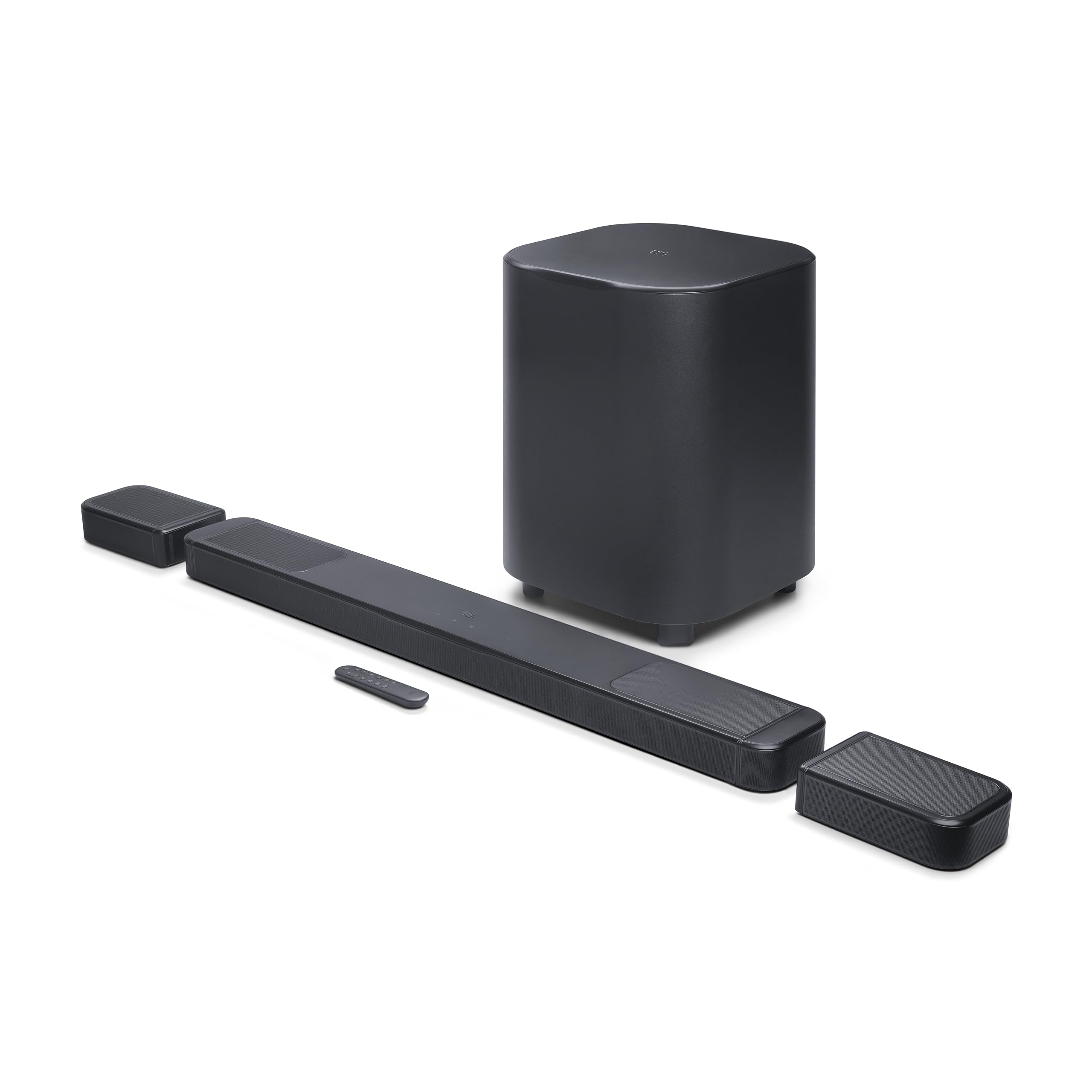
The JBL Bar 1300XMK2 stands out for its detachable wireless surround speakers that lift off the main bar and run on rechargeable batteries. This means you can place them behind your seating position without any power cord or signal wire. Six up‑firing drivers (two in each detachable speaker plus two in the main bar) deliver genuine overhead effects that rival wired Atmos setups.
The 12‑inch wireless subwoofer is the largest in this class, producing house‑shaking bass down to well below 30Hz. At 1570W maximum output power, there’s enough headroom for large open‑plan living areas. The PureVoice 2.0 dialogue enhancement adjusts in real time based on the soundtrack volume, so whispered lines stay clear even during loud action sequences. MultiBeam 3.0 technology widens the soundstage for listeners sitting off‑axis.
The detachable speakers run for about 4‑5 hours on a charge and need to be docked overnight. If you forget to dock them, you’ll lose surround for the next session. Also, the system relies on the JBL ONE app for EQ adjustments, which some users find less intuitive than a physical remote.
Why it’s great
- Detachable battery‑powered surround speakers for true wireless placement
- 12-inch subwoofer delivers deep, chest‑thumping bass
- Six up‑firing drivers create convincing overhead Atmos effects
Good to know
- Rear battery requires nightly docking — 4‑5 hour runtime
- App required for full EQ customization
3. Bose Complete Bundle (Smart Ultra + Bass 700 + Surrounds)
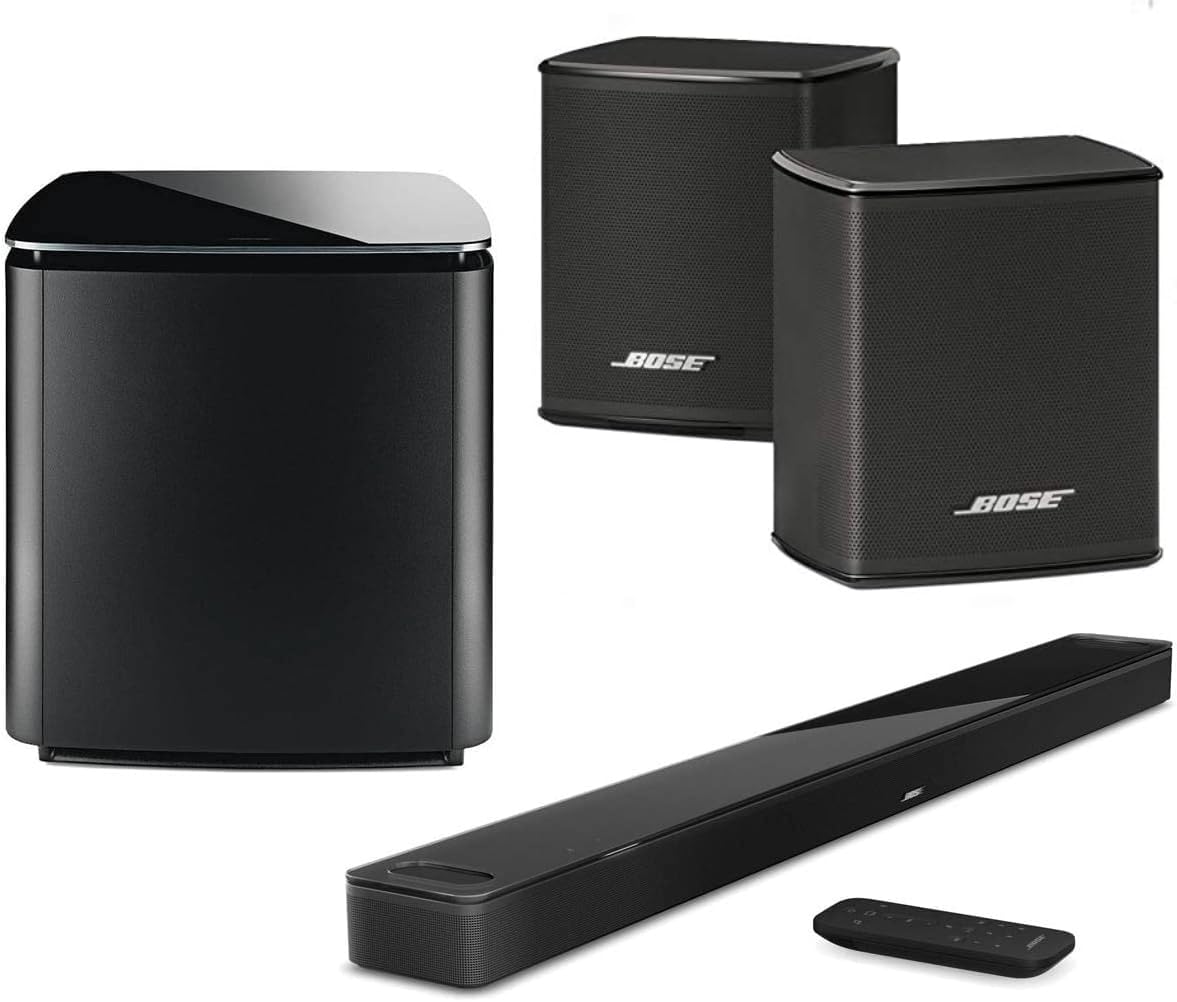
Bose’s complete bundle pairs the Smart Ultra soundbar with the Bass Module 700 subwoofer and two wireless surround speakers for a genuine 5.1.2 experience that can be configured as a 7.1 with the right placement. The ADAPTiQ calibration headset that ships in the box uses a proprietary algorithm to measure your room acoustics and adjust delay, EQ, and channel levels automatically.
The Smart Ultra soundbar uses PhaseGuide technology to create phantom surround channels from a single bar, but adding the physical wireless surrounds dramatically improves rear‑channel separation. Dialogue remains Bose’s strong suit — even at low volumes, voices are clear and centered thanks to the dedicated center channel driver. The Bass Module 700 uses a QuietPort design that eliminates port noise at high output levels, and the subwoofer wirelessly connects with zero pairing lag.
The Achilles’ heel is the complete wireless topology: you still need power outlets for the subwoofer and each surround speaker. The app setup process can feel a little over‑engineered, and first‑time connection sometimes requires a factory reset of the surround speakers. For users who want a no‑speaker‑wire solution with room‑perfect calibration, this bundle delivers exceptional consistency.
Why it’s great
- ADAPTiQ headset provides precise room‑specific calibration
- Wireless subwoofer and surrounds with no signal cables
- PhaseGuide creates convincing phantom channels between physical speakers
Good to know
- Each speaker still requires a nearby power outlet
- Surround pairing can require a factory reset during first setup
4. Klipsch Reference Cinema System + Onkyo TX-RZ30

This Klipsch bundle gives you four Dolby Atmos‑enabled satellite speakers plus a 10‑inch subwoofer paired with the Onkyo TX-RZ30 9.2‑channel receiver. The setup is 5.1.4, meaning five ear‑level channels plus four height channels for overhead effects. The Tractrix horn‑loaded tweeters deliver the characteristic Klipsch high‑efficiency sound that cuts through room noise without needing excessive power.
The 10‑inch subwoofer features a dual‑ported cabinet tuned for low‑frequency extension down to around 28Hz. The Onkyo receiver supports 8K video passthrough, Dolby Atmos, DTS:X, and includes Dirac Live room correction (with a paid upgrade for full bandwidth Bass Control). The speakers use aluminum LTS tweeters and injection‑molded graphite woofers for clean midrange performance even at reference volume levels.
Some users report the Onkyo receiver can run hot and the included setup instructions are sparse. Also, the satellite speakers are physically large — you need solid shelf or stand space. But for true speaker‑based Atmos with horn‑loaded clarity, this bundle out‑performs any soundbar at similar pricing.
Why it’s great
- Tractrix horn tweeters deliver high‑efficiency, dynamic highs
- Dedicated 5.1.4 Atmos processing with separate height channels
- 10‑inch dual‑ported subwoofer reaches deep into bass frequencies
Good to know
- Satellite speakers are large and need solid shelf space
- Onkyo receiver can run hot in enclosed cabinets
5. Klipsch Reference 5.1 + Denon AVR-S670H

This bundle pairs the R-610F floorstanding speakers (dual 6.5‑inch woofers per tower) with the R-52C center, R-41M bookshelf surrounds, R-12SW 12‑inch subwoofer, and the Denon AVR-S670H receiver. It’s a 5.1 system that can be expanded to 7.1 by adding rear speakers. The floorstanding towers provide a wide front soundstage without needing stands, and the 12‑inch subwoofer moves enough air to pressurize medium to large rooms.
The Denon receiver supports 8K video, HEOS multi‑room streaming, and includes Audyssey MultEQ room calibration. The Klipsch horn‑loaded tweeters ensure dialogue cuts through even during dense mixes. The system is ideal for users who want real speaker cabinets (not soundbar drivers) and the flexibility to upgrade components over time. The R-12SW subwoofer hits 29Hz with authority thanks to its front‑firing port design.
The R-41M bookshelf speakers, while good for surrounds, feel light compared to dedicated tower systems for critical listening. Also, the receiver is only 5.2 channels, so you cannot run a true 7.1 without a separate amplifier. But as a foundation system with room to grow, this bundle offers solid Klipsch dynamics.
Why it’s great
- Floorstanding towers provide wide front soundstage without stands
- 12‑inch subwoofer delivers pressurizing bass for large rooms
- Denon receiver supports 8K and Audyssey room calibration
Good to know
- Receiver is 5.2 channels — cannot run 7.1 without extra amp
- Surround bookshelves are lightweight compared to towers
6. Bose Smart Ultra Soundbar + Bass Module 700

If you want Atmos effects without surround speakers, the Bose Smart Ultra soundbar with the Bass Module 700 is a space‑smart compromise. The soundbar uses upward‑firing drivers and Bose’s PhaseGuide technology to bounce sound off the ceiling, creating a convincing overhead bubble. The Bass Module 700 uses a 5.5‑inch driver in a compact sealed cabinet that produces deep, distortion‑free bass down to about 30Hz.
Voice4Video technology lets you control your TV, cable box, and soundbar through Alexa voice commands. The soundbar also supports Apple AirPlay 2, Chromecast, and Spotify Connect for multi‑room music streaming. The ADAPTiQ calibration (using the included headset) tailors the soundfield to your specific room dimensions and furniture placement, which significantly improves the phantom surround effect.
The limitation is that without dedicated rear speakers, the surround effect comes entirely from the bar’s beam‑forming array. In rooms with high ceilings (over 10 feet), the overhead bounce loses precision. Also, the Bass Module 700 does not include a wired connection option, so you rely entirely on wireless connectivity between the bar and sub — occasional dropouts can occur in Wi‑Fi‑dense environments.
Why it’s great
- PhaseGuide and upward‑firing drivers create convincing Atmos from a single bar
- ADAPTiQ headset calibrates output to your actual room dimensions
- Voice4Video enables unified voice control for TV and cable box
Good to know
- No dedicated rear speakers — phantom surround only
- Wireless subwoofer can experience dropouts in crowded Wi‑Fi zones
7. Yamaha YHT-5960U Home Theater System

The Yamaha YHT-5960U is a complete 5.1‑channel system built around the RX‑V6A receiver, which supports 8K60 and 4K120 passthrough with HDMI 2.1 features like ALLM and VRR — making it a strong choice for gamers. The receiver delivers 80 watts per channel (driving the included front, center, and surround speakers) and includes YPAO automatic room calibration for optimizing speaker distances and levels.
The system includes four compact surround speakers that can be wall‑mounted or placed on stands, plus an 8‑inch 50‑watt subwoofer. The subwoofer is the weakest link — it provides adequate bass for smaller rooms but struggles to pressurize spaces over 200 square feet. The MusicCast app lets you stream music and control multi‑room audio, and the receiver powers the system cleanly without audible distortion at moderate volumes.
For the price, the included speakers are serviceable but entry‑level. Most owners end up upgrading the front towers or the subwoofer within the first year to unlock the receiver’s true potential. If you plan to build a 7.1 system over time, this bundle gives you a strong receiver foundation but you will quickly want better speakers.
Why it’s great
- Receiver supports 8K60 and 4K120 for next‑gen gaming
- YPAO room calibration automates speaker setup
- MusicCast enables multi‑room streaming and app control
Good to know
- Included 8‑inch subwoofer lacks punch for larger rooms
- Compact surround speakers are entry‑level quality
8. Samsung HWQ990F 11.1.4 (Refurbished)
The Samsung HWQ990F is the same core hardware as the brand‑new Q990F but sold as a certified refurbished unit with a 90‑day warranty. It delivers the full 11.1.4 channel configuration with wireless rear speakers, Dolby Atmos, and DTS:X support. The 8‑inch wireless subwoofer and up‑firing drivers in the main bar and rear speakers create the same immersive soundstage as the new version.
Refurbished units go through Samsung’s testing process and include all essential components. The build quality of the Q990F series is robust — metal grilles and hard plastic construction that avoids fabric panels that collect dust. The sound quality is impressive for the price, with clear dialogue, deep bass, and convincing overhead effects that rival dedicated wired systems costing significantly more.
The tradeoff is the limited warranty (90 days versus the standard one year for new units). Some refurbished units may show minor cosmetic wear, and the packaging may not be retail quality. For buyers comfortable with the refurb channel who want flagship performance at a reduced price, this is a compelling entry point to a high‑end soundbar system.
Why it’s great
- Flagship 11.1.4 Atmos performance at a reduced price point
- Wireless rear speakers and subwoofer for clean installation
- Metal and hard plastic construction improves durability over fabric designs
Good to know
- Only 90‑day warranty versus standard one year
- May show minor cosmetic wear from refurbishing process
9. LG S95TR 9.1.5-Channel Soundbar

The LG S95TR is designed to pair seamlessly with LG OLED and QNED TVs via the WOW Orchestra feature, which uses the TV’s built‑in speakers alongside the soundbar for a wider front soundstage. The 9.1.5‑channel configuration includes an exclusive up‑firing center channel dedicated to dialogue, so voices remain clear without needing to boost the center level manually. The wireless rear speakers feature their own up‑firing drivers for overhead effects.
The system supports Dolby Atmos and DTS:X, and the built‑in WOWCAST allows wireless Dolby Atmos transmission from the TV to the soundbar without an HDMI cable — ideal for wall‑mounted setups where cable runs are difficult. The Advanced Room Calibration using the built‑in microphone measures the room dimensions and optimizes the rear speaker placement for consistent surround imaging.
The main downside is the cost relative to the performance. The 9.1.5 configuration sounds excellent but does not match the raw driver count or subwoofer size of the Samsung Q990F or JBL 1300XMK2. Also, some users report that the subwoofer pairing process requires a hard reset during initial setup. But for LG TV owners who want one‑remote simplicity and wireless Atmos, the integration is unmatched.
Why it’s great
- WOW Orchestra uses LG TV speakers alongside soundbar for wider soundstage
- Up‑firing center channel improves dialogue clarity without EQ tweaks
- WOWCAST enables wireless Dolby Atmos from TV without HDMI cable
Good to know
- Does not match the driver count or subwoofer size of top competitors
- Subwoofer pairing can require initial hard reset
10. ELAC Debut 2.0 B6.2 Bookshelf Speakers (Pair)

The ELAC Debut 2.0 B6.2 is not a full surround system — it is a pair of bookshelf speakers that serve as the perfect front L/R foundation for a 7.1 build. The 6.5‑inch woven aramid fiber woofer delivers stiffness and damping that polypropylene cones cannot match, producing a smooth, extended low‑frequency response down to 44Hz. The 1‑inch cloth dome tweeter with a wide‑roll surround extends to 35kHz, making it compatible with hi‑res audio formats.
The thick MDF cabinets with internal bracing reduce cabinet resonance, and the front‑firing port allows placement in bookshelves or close to walls without the bass bloom that rear‑ported speakers suffer. The sound signature is neutral and detailed, with excellent imaging that creates a wide soundstage when paired with a capable receiver. Multiple customer reviews note a break‑in period of 50‑100 hours before the drivers fully loosen up.
For a true 7.1 system, you would need five of these speakers (plus a subwoofer and receiver), which gets expensive. The B6.2 are also power‑hungry — they benefit from a clean amplifier delivering at least 80 watts per channel. For audiophile‑grade front channels that reveal detail in movie soundtracks that budget satellites hide, these ELACs are the foundation to build around.
Why it’s great
- Woven aramid fiber woofer delivers low distortion and smooth bass
- Cloth dome tweeter extends to 35kHz for hi‑res audio compatibility
- Front‑firing port allows placement flexibility near walls
Good to know
- Requires 50‑100 hour break‑in period before drivers loosen up
- Needs at least 80W per channel for clean dynamic headroom
11. NBVOICE Professional PA System

The NBVOICE PA system is a portable all‑in‑one solution for events, presentations, and karaoke — not a home theater surround system. It delivers 300 watts through two 8‑inch two‑way speakers housed in a suitcase‑style cabinet with an integrated 8‑channel mixer. The system includes two speaker stands, a wired microphone, and Bluetooth 5.3 for wireless streaming from a phone or tablet.
The suitcase design with a hidden storage compartment keeps all cables, microphones, and the remote organized for transport. Setup is straightforward: unfold the speakers, extend the stands, connect the mixer via the included cables, and power on. The Bluetooth connectivity works reliably up to about 30 feet, and the 8‑channel mixer provides independent volume control for up to four microphones and four line‑level sources.
This system is designed for live sound reinforcement, not surround sound. It produces stereo output only, with no center channel, rear channels, or subwoofer crossover. The build quality is decent for the price point, though some units have reported reliability issues after a few uses. For a portable PA that handles small‑to‑medium gatherings, it is functional but should not be confused with a home theater surround system.
Why it’s great
- All‑in‑one suitcase design with built‑in storage for cables and accessories
- 300W output is sufficient for small‑to‑medium indoor events
- 8‑channel mixer provides independent control for multiple microphones
Good to know
- Stereo output only — no surround sound capabilities
- Some reported reliability issues after a few uses
FAQ
Can I use bookshelf speakers like the ELAC B6.2 as rear surrounds in a 7.1 system?
Is a soundbar with rear speakers as good as a wired 7.1 system with a receiver?
What receiver features matter most for a 7.1 system in 2025?
Final Thoughts: The Verdict
For most users looking for the best 7.1 surround sound system, the winner is the Samsung Q990F because it delivers a true 11.1.4 wireless Atmos experience without the complexity of a wired receiver setup. If you want the flexibility of detachable battery-powered surrounds and a massive 12-inch subwoofer, grab the JBL Bar 1300XMK2. And for a wired system with horn-loaded dynamics and room to upgrade, nothing beats the Klipsch Reference Cinema bundle with the Onkyo TX-RZ30.