
Our readers keep the lights on and the weekend projects moving. As an Amazon Associate, I earn from qualifying purchases.
An 80-gallon tank water heater is a massive appliance that takes up significant floor space, heats water continuously whether you need it or not, and can leave a family of five scrambling after the third shower. For large households with simultaneous hot water demands, the smarter path is a high-output tankless unit that delivers endless hot water on demand, slashes energy waste, and mounts on a wall to reclaim your utility room. The real question isn’t tank size anymore — it’s about flow rate, BTU output, and whether the system can keep up when every faucet and shower is running at once.
I’m Rikta — the co-founder and writer behind FitlyFast. I’ve analyzed hundreds of hours of customer feedback, efficiency benchmarks, and technical specifications to identify the tankless water heaters that truly perform for high-demand homes.
Whether you’re upgrading from a storage tank or building new, this guide to the best 80 gallon water heater alternatives will help you choose a system that delivers consistent hot water, lower utility bills, and long-term reliability without the bulk.
How To Choose The Best 80 Gallon Water Heater Alternative
When you outgrow an 80-gallon tank, the upgrade path is a tankless system sized for your peak demand. You need to focus on flow rate, BTU capacity, fuel type, and installation complexity to match your household’s actual usage.
Flow Rate — The True Capacity Number
Forget tank volume. In a tankless system, flow rate measured in gallons per minute (GPM) tells you how many fixtures you can run simultaneously. A family with two showers, a dishwasher, and a washing machine needs at least 7–8 GPM. For homes with large soaker tubs or multiple bathrooms in use at once, look at 8.5 GPM and above.
BTU Input — The Power Behind the Hot Water
British Thermal Units (BTU) measure the heater’s raw heating capacity. A standard 80-gallon tank runs around 36,000–50,000 BTU. Tankless units for whole-house use start at 160,000 BTU and go up to 199,000 BTU. Higher BTU means faster recovery and higher flow rate, especially when incoming groundwater is cold during winter.
Installation Considerations — Venting, Gas Line, and Placement
Tankless units require a larger gas line (typically 3/4-inch or 1-inch) to feed the burner. Non-condensing models use standard stainless steel venting that can run horizontally or vertically. Condensing models use PVC venting and are more efficient but require a drain for acidic condensate. Outdoor installation simplifies venting entirely but exposes the unit to freezing temperatures — verify built-in freeze protection ratings.
Quick Comparison
On smaller screens, swipe sideways to see the full table.
| Model | Category | Best For | Key Spec | Amazon |
|---|---|---|---|---|
| Rinnai RXP160iN | Condensing | Recirculation & Efficiency | 0.97 UEF · 9.0 GPM | Amazon |
| AO Smith ATI-310CX3 | Non-Condensing | Scale Prevention | 190,000 BTU · 8.0 GPM | Amazon |
| MIZUDO 199K BTU WiFi | Non-Condensing | Smart Control | 199,000 BTU · 10.3 GPM | Amazon |
| Rheem RTG-84XLN-3 | Non-Condensing | Outdoor Natural Gas | 180,000 BTU · 8.4 GPM | Amazon |
| Rheem RTG-84XLP-3 | Non-Condensing | Outdoor Propane | 180,000 BTU · 8.4 GPM | Amazon |
| Rheem RTG-70XLP-3 | Non-Condensing | Outdoor LP · 2–3 Bath | 160,000 BTU · 7.0 GPM | Amazon |
| Rheem RTG-70DVLN-3 | Non-Condensing | Indoor Natural Gas | 160,000 BTU · 7.0 GPM | Amazon |
| Westinghouse 180K | Non-Condensing | WiFi Control | 180,000 BTU · 7.9 GPM | Amazon |
| MIZUDO 180K Propane | Non-Condensing | Outdoor Propane | 180,000 BTU · 8.1 GPM | Amazon |
| Ranein 8.5 GPM | Non-Condensing | Budget · Outdoor NG | 190,000 BTU · 8.5 GPM | Amazon |
| GASLAND Gasmart E | Non-Condensing | Budget · Indoor NG | 199,000 BTU · 7.6 GPM | Amazon |
In‑Depth Reviews
1. Rinnai RXP160iN

The Rinnai RXP160iN is a condensing tankless water heater that installs indoors or outdoors and runs on natural gas or propane without conversion. Its UEF of 0.97 places it among the most efficient residential units available, and the built-in Smart-Circ recirculation pump learns your usage patterns to deliver hot water almost instantly to the farthest faucet.
With 9.0 GPM flow and 160,000 BTU input, this unit handles up to six fixtures at once — enough for a busy family with multiple bathrooms running simultaneously. The condensing design captures exhaust heat for extra efficiency but requires a PVC vent and a condensate drain line. Owners consistently praise the immediate hot water at regularly used faucets and note that gas bills remain comparable to or lower than older tank systems.
The biggest trade-off is complexity. The integrated recirculation pump cycles periodically to maintain warm water in the loop, which some users find causes a faint mechanical hum through the plumbing. The optional wifi module is sold separately and carries a premium price. Professional installation is strongly recommended, though several buyers successfully paired a delivered unit with a local plumber for roughly half the cost of a dealer quote.
Why it’s great
- Industry-leading 0.97 UEF efficiency
- Built-in recirculation with learning algorithm
- Indoor/outdoor and gas/propane flexibility
Good to know
- Wifi module sold separately; app requires pro account
- Recirculation hum may be audible through walls
- Condensate drain required for indoor install
2. A. O. Smith ATI-310CX3
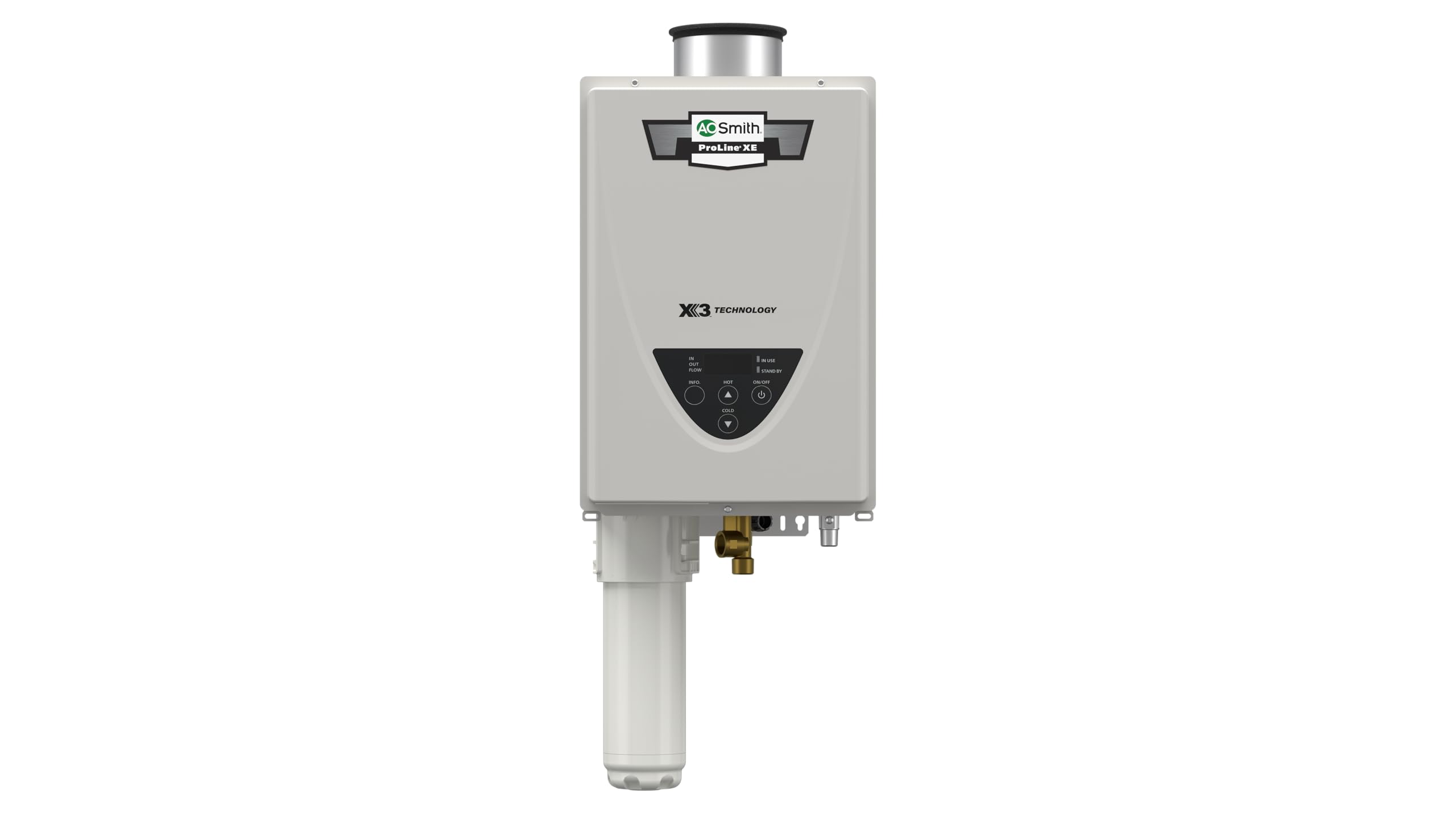
The A. O. Smith ProLine XE ATI-310CX3 stands out for its X3 Scale Prevention Technology, which uses a built-in filter cartridge to reduce mineral buildup without annual descaling or isolation valves. This is a game-changer for homes with hard water, where traditional tankless units require regular vinegar flushing to maintain flow rates.
Rated at 8.0 GPM with 190,000 BTU, this indoor non-condensing unit includes a propane conversion kit out of the box. The commercial-grade phosphorous-deoxidized copper heat exchanger delivers significantly better heat transfer than stainless steel alternatives. Owners report consistent 115°F output even with multiple fixtures active, and the unit operates quietly enough that it’s barely noticeable in an adjacent room.
The unit requires a 3/4-inch gas line and concentric venting (sold separately). Professional installation is recommended to ensure proper gas sizing and vent termination. The 15-year limited heat exchanger warranty adds long-term confidence, though a few users note the stainless steel outer cabinet shows fingerprints readily.
Why it’s great
- Built-in scale prevention eliminates annual descaling
- Propane conversion kit included
- Quiet operation and compact footprint
Good to know
- Concentric vent kit not included
- Professional install recommended for warranty
- Shower mixing valves may cause brief shutdown in warm climates
3. MIZUDO 199K BTU WiFi
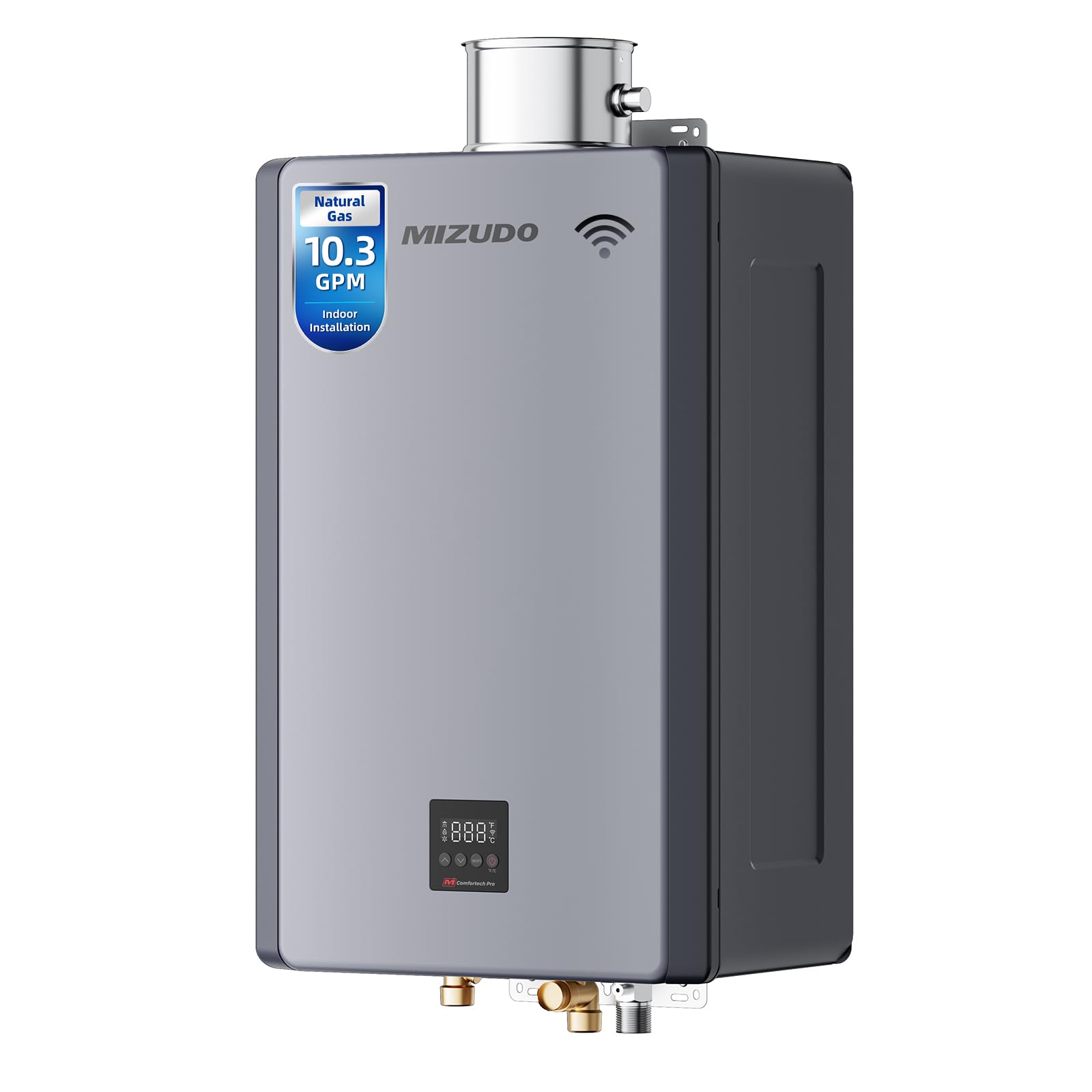
The MIZUDO 199K BTU unit delivers the highest flow rate in this comparison at 10.3 GPM, making it the most capable option for very large homes with five to seven simultaneous fixtures. With 199,000 BTU input and a 6-stage gas modulation system, it maintains water temperature within ±1°F even when demand fluctuates.
Smart WiFi connectivity is built in — no extra module needed. You can adjust temperature, set schedules, and receive maintenance alerts from the dedicated mobile app. The sealed direct vent system draws combustion air from outside, preserving indoor air quality, though the vent kit must be purchased separately.
Owners report straightforward installation with standard 3/4-inch NPT connections, though the gas fitting may require an adapter if your existing line is 1/2-inch. The unit handles cold groundwater well in winter climates. A few users note that the app interface takes some getting used to, but once configured, it offers reliable remote control of the entire system.
Why it’s great
- 10.3 GPM — highest flow on this list
- Built-in WiFi with no extra hardware needed
- ±1°F temperature stability from 6-stage modulation
Good to know
- Direct vent kit not included
- Gas fitting may need adapter for 1/2-inch lines
- Heavier than competitors at 55.5 pounds
4. Rheem RTG-84XLN-3
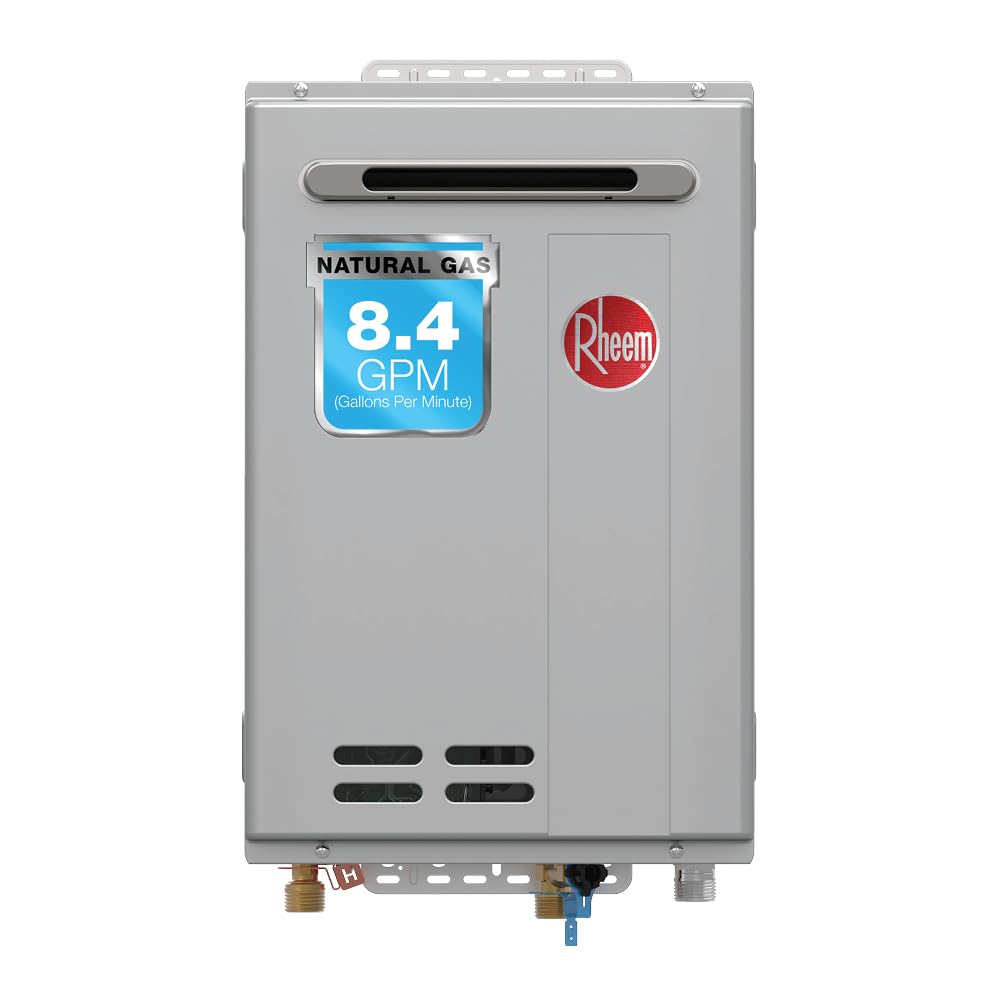
The Rheem RTG-84XLN-3 is an outdoor non-condensing tankless water heater running on natural gas with 8.4 GPM and 180,000 BTU. It’s sized for 2–3 bathroom homes and supports concurrent showers and laundry without noticeable pressure drops. Hot-start programming prevents cold water bursts between back-to-back showers.
Outdoor installation eliminates venting costs and saves interior space — it mounts directly to an exterior wall with a durable metal cabinet rated for weather exposure. The compact 13.5 x 20.75-inch footprint is smaller than many competitor units. Owners consistently report easy installation and reliable performance, with several mentioning that replacement of an older Rheem unit required minimal rework thanks to consistent mounting patterns.
The unit is not smart-home compatible, and the maximum output temperature is capped at 140°F. A few users note the slight delay typical of all tankless systems before hot water reaches distant faucets. Overall, this model offers a strong balance of flow rate and price for homes where outdoor mounting and natural gas are available.
Why it’s great
- Outdoor install — no venting or interior space needed
- Hot-start programming prevents cold bursts
- Compact cabinet at just 20.75 inches tall
Good to know
- Max temperature limited to 140°F
- No smart home connectivity
- Slight hot water delay at distant faucets
5. Rheem RTG-84XLP-3
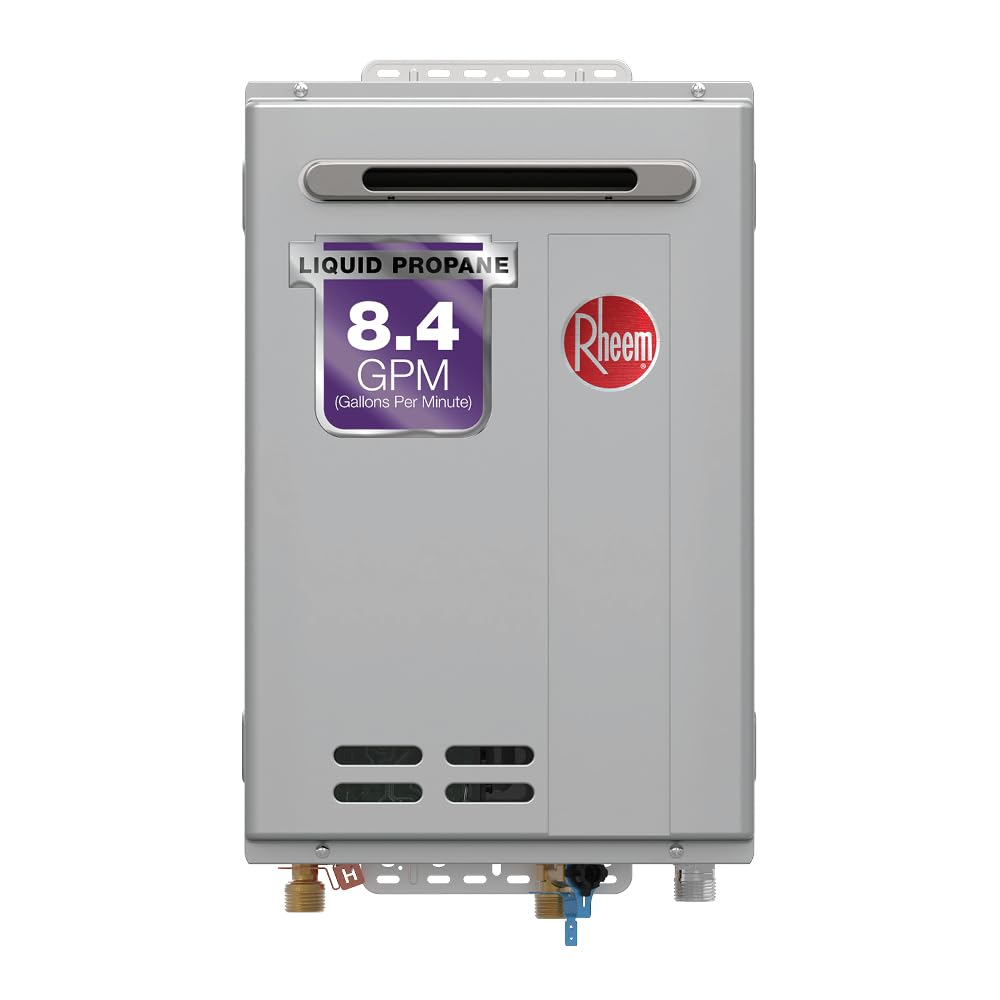
The Rheem RTG-84XLP-3 is the liquid propane counterpart to the RTG-84XLN-3, delivering identical 8.4 GPM and 180,000 BTU performance for homes using propane tanks rather than natural gas service. It’s designed for outdoor wall mounting and includes the same hot-start programming for comfortable consecutive showers.
Owners with propane setups report this unit handles cold groundwater in winter without struggling, maintaining consistent output temperatures. The 39-pound weight makes it manageable for a two-person installation. Several long-term users note the unit replaced an earlier Rheem that ran reliably for 11 years, indicating strong design continuity.
Some buyers have experienced persistent error code 11 issues that reset temporarily but return. Rheem customer support response on these cases has been mixed — some received replacement parts, others were directed to local service. Given this variability, confirming local warranty service availability before purchase is prudent for propane users.
Why it’s great
- 8.4 GPM propane unit for off-gas-grid homes
- Lightweight at 39 pounds for easy mounting
- Proven Rheem platform with long service record
Good to know
- Reported code 11 error in some units
- Customer support experience varies
- Outdoor mounting requires freeze-precaution
6. Rheem RTG-70XLP-3
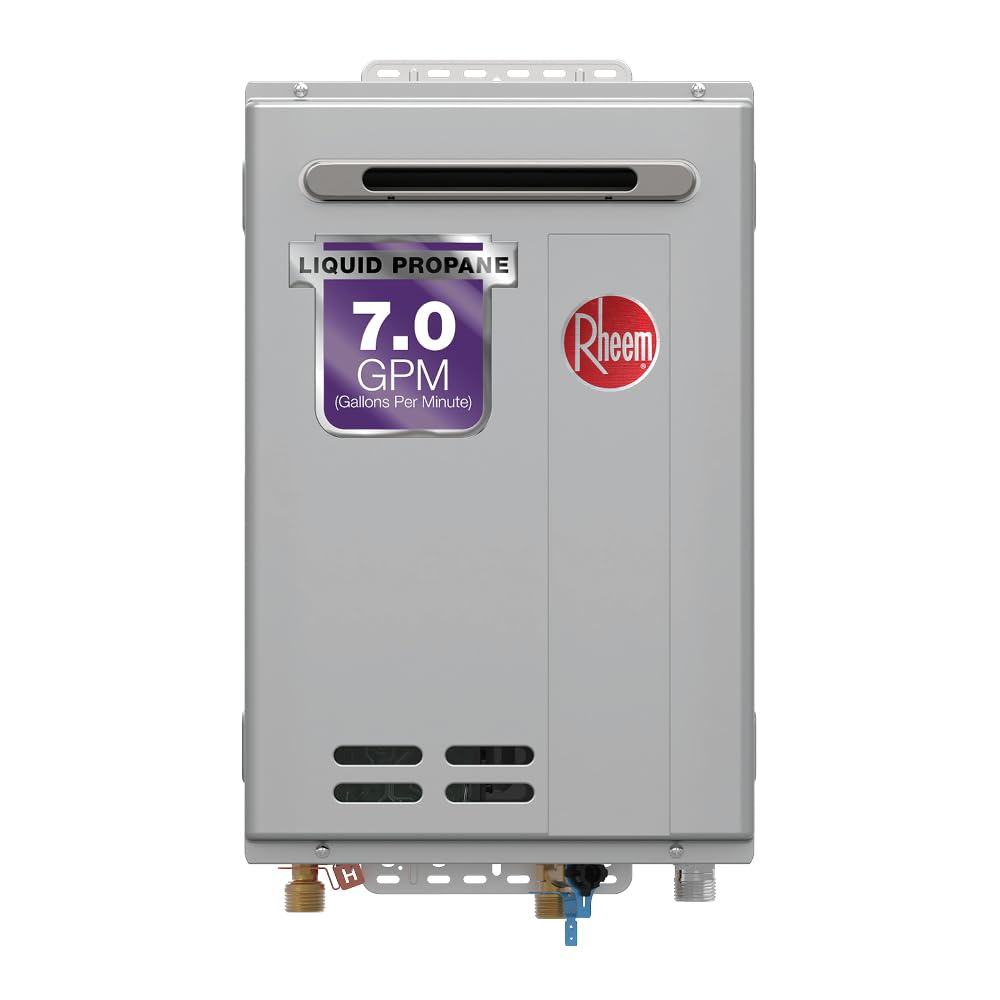
The Rheem RTG-70XLP-3 is a 7.0 GPM, 160,000 BTU outdoor propane unit suited for 2–3 bathroom homes with moderate simultaneous demand. It’s a step down in flow from the 84-series but still capable of handling a shower and dishwasher concurrently without a noticeable drop.
Owners using 23-gallon propane tanks report filling roughly every two months for daily family use, with operating costs significantly lower than electric resistance tanks. The outdoor cabinet holds up well in rain and snow, and the unit’s compact dimensions make it easy to mount in tight exterior spaces.
The 7.0 GPM flow is adequate for most families but may struggle if you have a large soaking tub or run three showers plus appliances at once. A few users experienced freeze-related failures when temperatures dropped below 20°F, and Rheem’s warranty explicitly excludes freeze damage below 30°F. If you live in a region with hard freezes, consider adding a freeze protection valve or choosing a unit with a lower minimum operating temperature.
Why it’s great
- Reliable 7.0 GPM for 2–3 bathroom homes
- Low operating cost on propane vs electric tanks
- Compact outdoor cabinet
Good to know
- 7.0 GPM may not suffice for very high-demand homes
- Freeze damage not covered below 30°F
- Some reports of early failure in cold climates
7. Rheem RTG-70DVLN-3
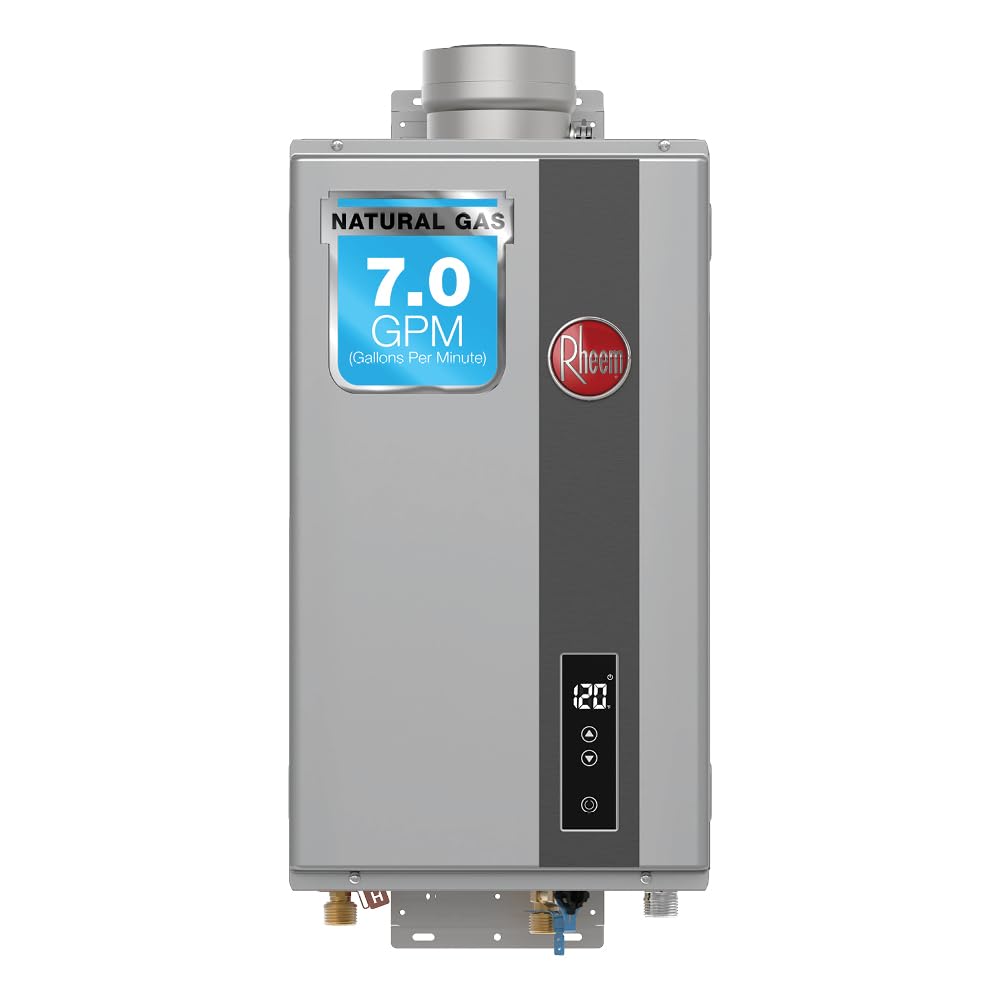
The Rheem RTG-70DVLN-3 is the indoor natural gas version of the 7.0 GPM platform, designed for 2–3 bathroom homes. It operates at 160,000 BTU with a non-condensing design that requires standard Category III stainless steel venting (sold separately).
Owners consistently describe this as a reliable replacement unit that delivers endless hot water for family use. The compact metal cabinet mounts easily on a wall, freeing up floor space previously occupied by a storage tank. Several buyers noted that replacing an older tankless Rheem required purchasing new venting components because the vent standards changed — factor this into your budget if upgrading from an older model.
The unit takes slightly longer than tank-type heaters to deliver hot water to distant bathrooms, a physics limitation of all tankless systems. Rheem backs the heat exchanger with a 15-year warranty. Some users recommend adding a recirculation loop if you want hot water at taps within seconds rather than minutes.
Why it’s great
- Endless hot water for moderate-demand households
- Space-saving wall mount reclaims floor area
- 15-year heat exchanger warranty
Good to know
- Requires Category III venting (not included)
- Noticeable wait time for hot water at distant taps
- Recirculation add-on may be needed for instant hot water
8. Westinghouse 180K Smart
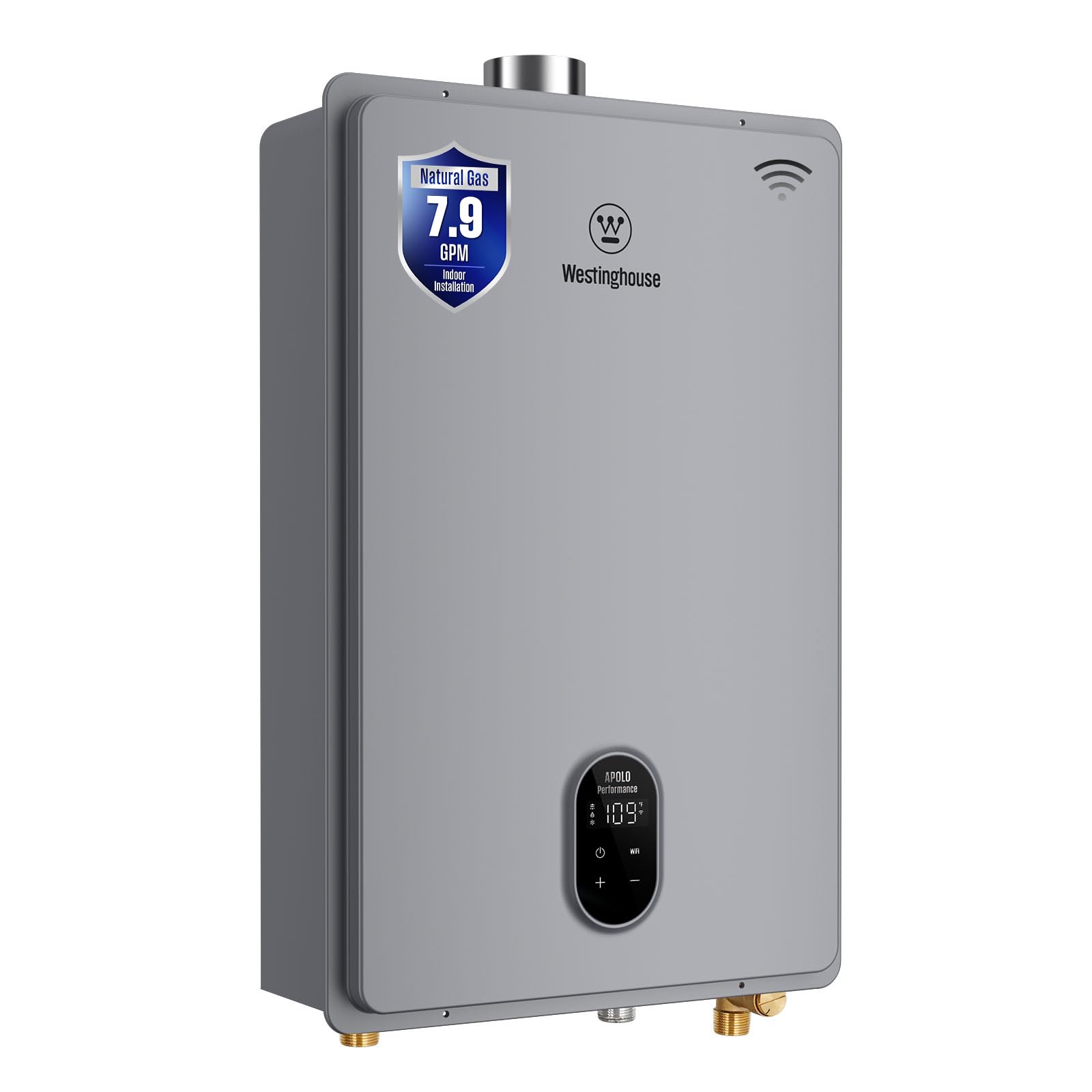
The Westinghouse Smart Tankless Water Heater brings app-based temperature control to the tankless category without requiring a separate module. At 7.9 GPM and 180,000 BTU, it supports 3–5 fixtures and uses self-modulating technology to maintain water temperature within ±1°F.
Owners appreciate being able to adjust the water temperature from their phone, which is particularly useful for families who want different temperatures for baths versus daily showers. The unit’s freeze protection and variable-speed combustion fan contribute to reliable year-round performance. Installation instructions are well-regarded for clarity, and the standard 3/4-inch NPT connections match most residential plumbing.
The WiFi functionality is a bonus rather than a core necessity — the LED display panel provides full control without the app. A few users note finding a contractor familiar with tankless installations was the hardest part of the process. The unit runs quietly once operational, with the fan noise comparable to a modern dishwasher.
Why it’s great
- Built-in WiFi app control for temperature adjustment
- ±1°F temperature stability from self-modulating technology
- Clear installation instructions simplify DIY
Good to know
- Finding a tankless-qualified contractor may be challenging
- App control adds convenience but not essential
- Standard hot water delay for tankless systems
9. MIZUDO 180K Propane
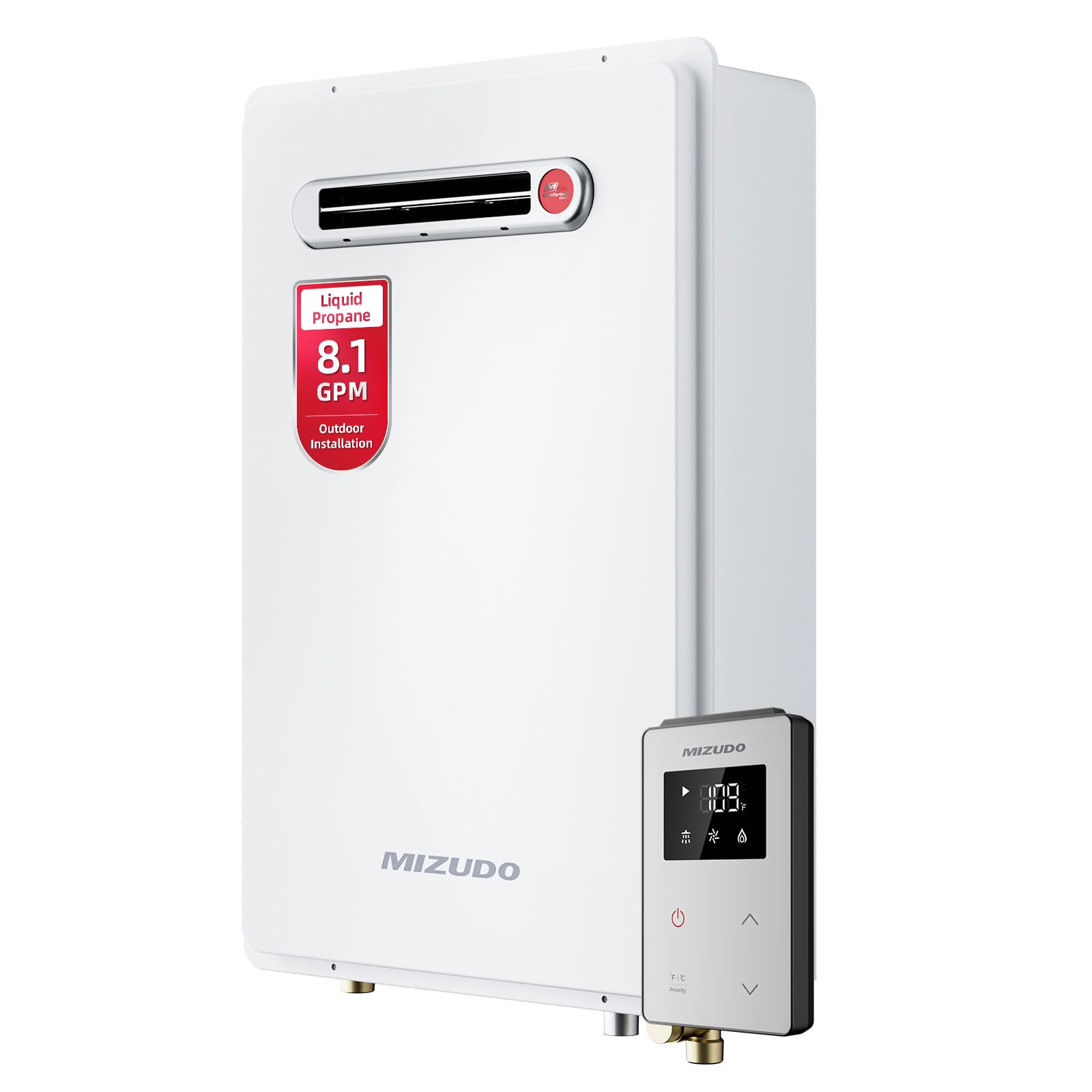
The MIZUDO 180,000 BTU propane unit is designed for outdoor installation with an IPX4 weather rating and 380Pa wind pressure resistance, allowing it to operate in cold and windy conditions. At 8.1 GPM, it supports 4–6 outlet points and is suitable for whole-house use.
CSA certification confirms the unit meets safety standards for overheating and accidental flameout protection. The precise temperature control system uses an internal movement sensor to keep water temperature within ±1°F. Owners report easy installation with standard 3/4-inch NPT fittings and say the unit operates quietly compared to older tankless models.
The gas fitting on this unit uses a non-standard thread that requires an adapter if you’re connecting to 1/2-inch pipe — plan for a trip to the hardware store. Some users note the 8.1 GPM is sufficient for simultaneous showers and laundry but may struggle with very large soaking tubs. The included quick-installation poster is genuinely helpful for DIY installation.
Why it’s great
- IPX4 weather rating and wind-resistant design
- ±1°F temperature accuracy
- CSA certified for safety
Good to know
- Gas fitting may need adapter for standard 1/2-inch lines
- 8.1 GPM not ideal for very large tubs
- Quick-install poster helpful but manual could be clearer
10. Ranein 8.5 GPM
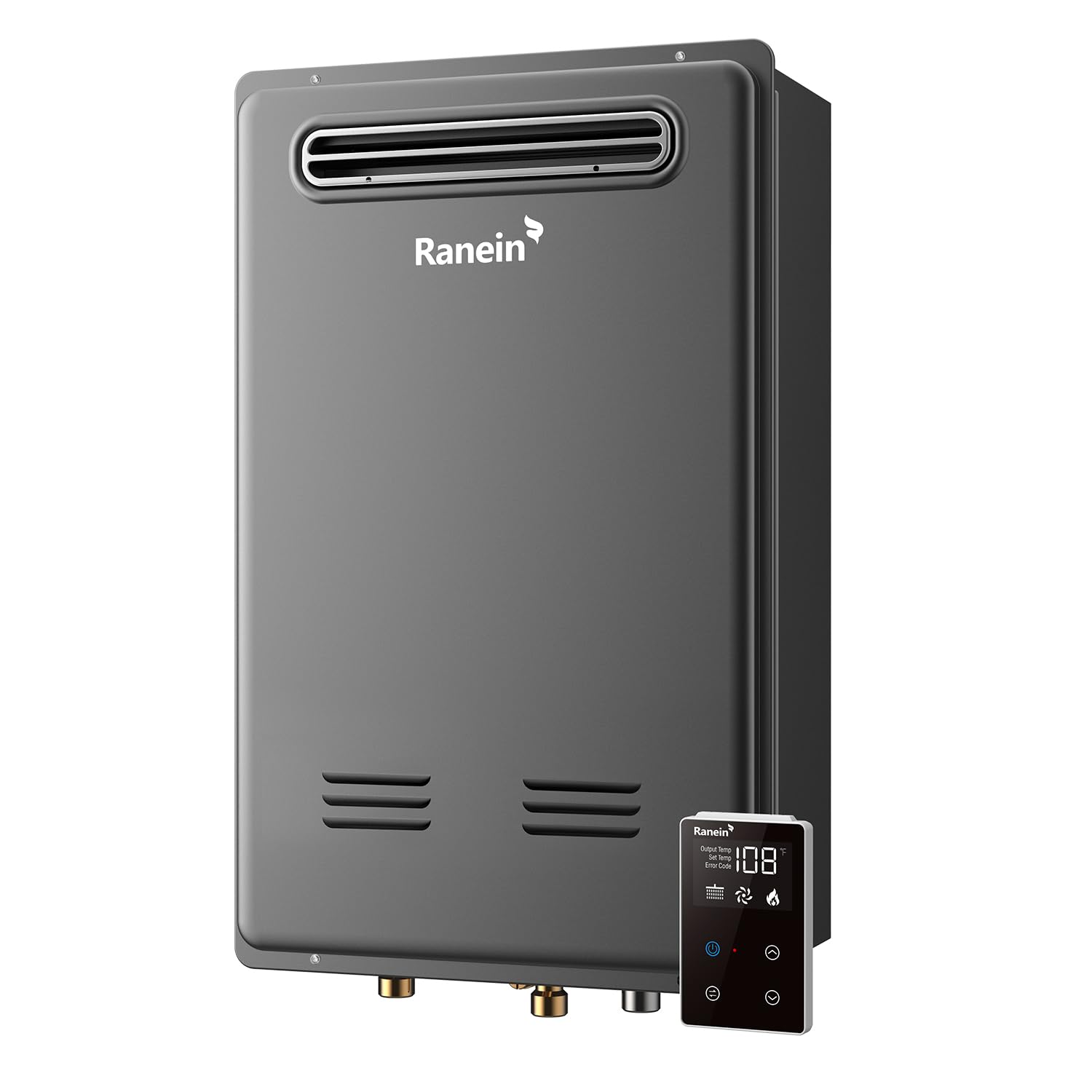
The Ranein natural gas tankless water heater delivers 8.5 GPM from 190,000 BTU in an outdoor-rated cabinet, making it a budget-friendly option for homes needing high flow without paying premium prices. It’s designed for 4–6 outlet points, sufficient for most families.
Owners living in cold climates report the unit survived winter freezes that burst copper pipes elsewhere, thanks to built-in freeze protection. The fan is mounted underneath the unit for safety and noise reduction, and it automatically adjusts speed based on external wind pressure. Several DIY buyers completed installation in under two hours and reported significant drops in monthly propane or gas bills.
The unit is not recommended for elevations above 2,000 feet, which limits its use in mountainous regions. Some users found the instructions vague on certain installation details, particularly around the pressure relief valve. A few reviews mention the unit runs louder than premium brands during high-demand operation.
Why it’s great
- 8.5 GPM at a competitive price point
- Survived freezing conditions reported by owners
- Fast DIY installation for experienced users
Good to know
- Not recommended above 2,000 feet elevation
- Instructions lack detail on some installation steps
- Audible fan noise during high demand
11. GASLAND Gasmart E
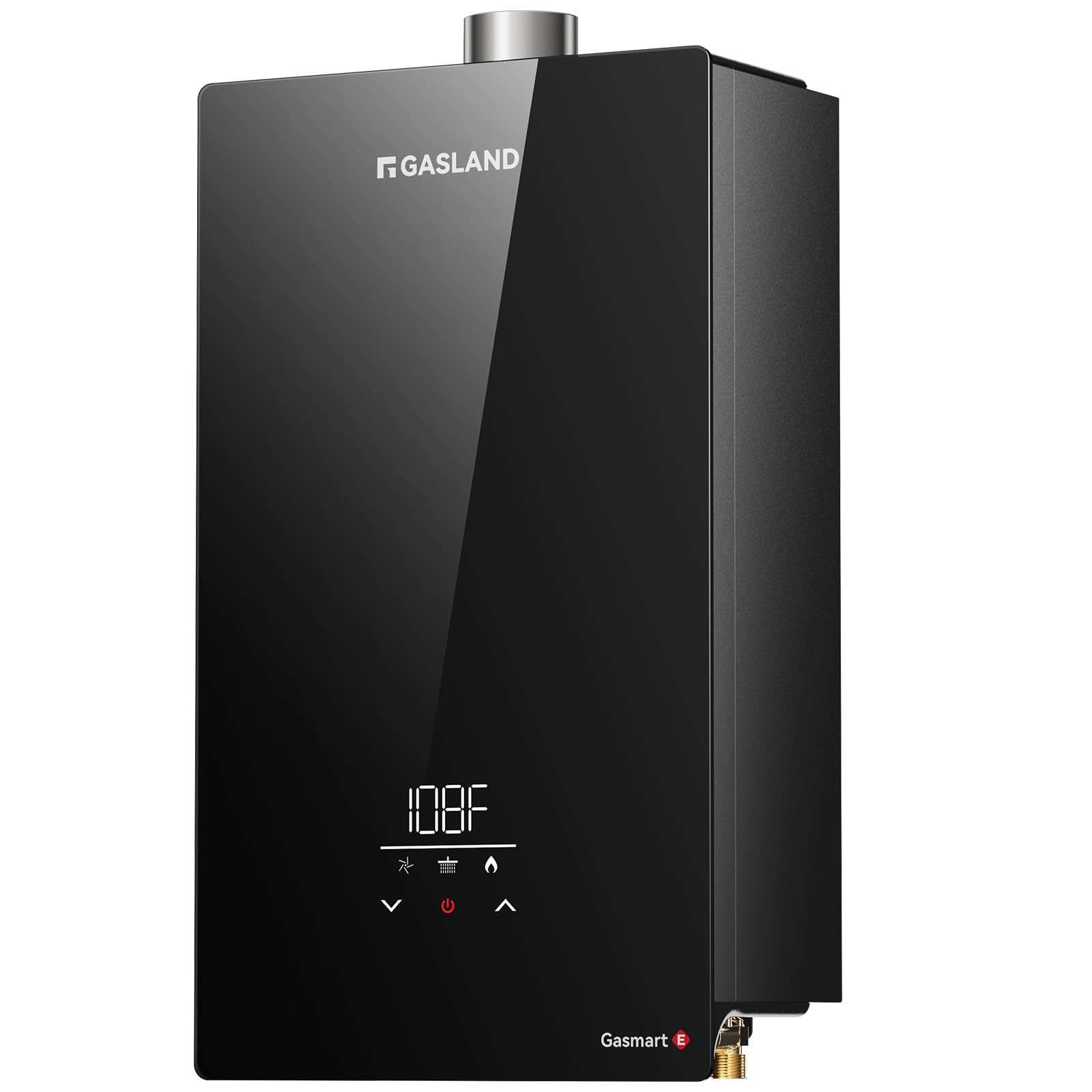
The GASLAND Gasmart E offers 7.6 GPM and 199,000 BTU in a compact indoor cabinet that measures just 7.28 inches deep — shallow enough to fit in tight closets or narrow utility spaces. CSA certified with multiple safety functions including overheat, flame-out, and freeze protection.
Owners note the unit heats water faster than the tank it replaced, and the LED display provides real-time temperature readout. The copper heat exchanger with foam insulation is visible through the housing, giving confidence in build quality. Several buyers report successful installation as a straightforward swap for an existing tankless unit, with standard gas and water connections.
The unit is not Energy Star certified, meaning you won’t qualify for federal tax credits. A small number of owners experienced early failure within the first few months, and the hazardous materials classification makes returns complicated if the unit fails. For the price, it’s a capable entry into tankless, but the reliability track record is shorter than established brands like Rheem or Rinnai. A dedicated customer support team is U.S.-based, which helps when issues arise.
Why it’s great
- Ultra-compact 7.28-inch depth fits tight spaces
- 199,000 BTU provides fast heat recovery
- LED display for real-time temperature monitoring
Good to know
- Not Energy Star certified
- Early failure reports and complicated returns
- Shorter reliability track record than premium brands
FAQ
What size tankless water heater replaces an 80-gallon tank?
Can I install a tankless water heater outdoors in freezing weather?
Does a tankless water heater need a special gas line?
How much does it cost to run a tankless water heater vs an 80-gallon tank?
Final Thoughts: The Verdict
For most users, the best 80 gallon water heater alternative winner is the Rinnai RXP160iN because its 0.97 UEF efficiency, built-in recirculation pump, and indoor/outdoor flexibility make it the most capable and economical long-term choice for large families. If you want built-in scale prevention with no annual maintenance, grab the A. O. Smith ATI-310CX3. And for the highest flow at a competitive price, nothing beats the MIZUDO 199K BTU WiFi with its 10.3 GPM capacity and smart controls.