
Our readers keep the lights on and the weekend projects moving. As an Amazon Associate, I earn from qualifying purchases.
An aluminum bracket snaps, a cast-aluminum housing cracks, or a threaded hole strips on a critical engine component — and you need a repair that won’t let go under heat, oil, or vibration. Aluminum repair epoxy bridges that gap between temporary tape and permanent torch welding, delivering a cured body strong enough to drill, tap, and machine.
I’m Rikta — the co-founder and writer behind FitlyFast. I’ve spent weeks analyzing tensile strength specs, working times, heat thresholds, and real-world user reports across the most popular aluminum-focused epoxy formulations to separate the compounds that actually hold from the ones that just fill a crack.
Whether you’re rebuilding a patio chair strap, sealing a crankcase hairline fracture, or bonding an aluminum insert into carbon fiber, knowing the differences in PSI ratings, cure windows, and thermal resistance will determine whether the aluminum repair epoxy you choose lasts for the life of the part or fails on the first hot cycle.
How To Choose The Best Aluminum Repair Epoxy
A great aluminum repair epoxy has three non-negotiable traits: high tensile strength for load-bearing cracks, a working window long enough to align and clamp the part, and thermal resistance that survives the environment the part operates in. The seven products below each take a different approach to that formula, from fast-setting putty sticks to premium structural adhesives.
Match the Working Time to Your Repair Complexity
Fast-setting epoxies (5-minute set time) demand you work fast and have every clamp, bracket, and alignment tool ready before you mix. Longer-window formulations (20 to 30 minutes) give you the flexibility to shape, position, and build thickness on a complex crack or multi-part assembly. Beginners and overhead repairs benefit enormously from a longer working time.
Read Tensile Strength as Your Load-Bearing Ceiling
Epoxies rated at 4,000 PSI and above (like J-B Weld SteelStik or Original) will handle stressed brackets, stripped threads, and structural cracks on non-flexing aluminum parts. Lower PSI ratings may seal a surface crack or bond a cosmetic piece, but they will not support weight or torque. Always look for the tensile spec, and build the repair thick — never just cover the visible crack line.
Check Heat and Chemical Resistance After Cure
Aluminum engine parts, oil pans, and exhaust-adjacent components hit temperatures that soften standard epoxy. Look for formulations that hold up to at least 350°F continuous (some reach 550°F) and resist petroleum, hydraulic fluids, and oil. If the repair will live underwater or in a pool, choose an epoxy with NSF certification or direct underwater-curing capability.
Quick Comparison
On smaller screens, swipe sideways to see the full table.
| Model | Category | Best For | Key Spec | Amazon |
|---|---|---|---|---|
| J-B Weld 8281 Professional | Premium Cold Weld | Structural load-bearing repairs | 5,020 PSI tensile | Amazon |
| AOJEL S300 Metal Epoxy | Premium Syringe | Controlled 30-min working time | 392°F heat resistance | Amazon |
| 3M Scotch-Weld DP420 | Industrial Grade | Metal-to-composite bonding | Impact & fatigue resistant | Amazon |
| Starbond 5 Min Epoxy Pro | Flexible Formula | Vibration-prone repairs | 2,600 lb shear strength | Amazon |
| J-B Weld SteelStik 2-Pack | Budget Putty | Quick hand-moldable fixes | 4,000 PSI / 1-hour cure | Amazon |
| PC Products PC-Masonry | Masonry Paste | Concrete & stone bonding | Non-sag paste formula | Amazon |
| Epoxybond Atlas Pool Putty | Underwater Cure | Pool & spa leak sealing | Underwater application | Amazon |
In‑Depth Reviews
1. J-B Weld 8281 Professional Size Steel Reinforced Epoxy

The J-B Weld Original formula in the professional 10-ounce size is the benchmark cold-weld epoxy for aluminum repairs. Its 5,020 PSI tensile strength is the highest of any consumer-level epoxy in this roundup, and the steel reinforcement creates a cured body that machines, taps, and drills like the parent metal. The 15- to 24-hour cure window is the tradeoff for that strength — you need patience, but the result is a permanent bond on brackets, housings, frames, and cracked castings.
Users consistently report that it holds up to 550°F intermittent heat and resists petroleum and chemical exposure, making it the go-to for oil pans and engine-adjacent repairs. The 1:1 mix ratio is simple, though the paste consistency requires thorough blending on a flat surface. Some users noted air pockets in the tubes, so dispense a test amount before the final mix to ensure even flow from both sides.
For load-bearing aluminum repairs where failure is not an option, this is the most trusted compound in the category. The longer cure time is a feature, not a flaw — it allows the chemical cross-linking to develop the density required for structural use.
Why it’s great
- Highest tensile strength (5,020 PSI) for aluminum load-bearing repairs
- Withstands 550°F and resists petroleum, chemical, and acid
- Drills, taps, and sands like metal after full cure
Good to know
- Full 15-24 hour cure requires overnight planning
- Tube air pockets reported, waste some product to ensure 1:1 ratio
2. AOJEL S300 Metal Epoxy Repair System
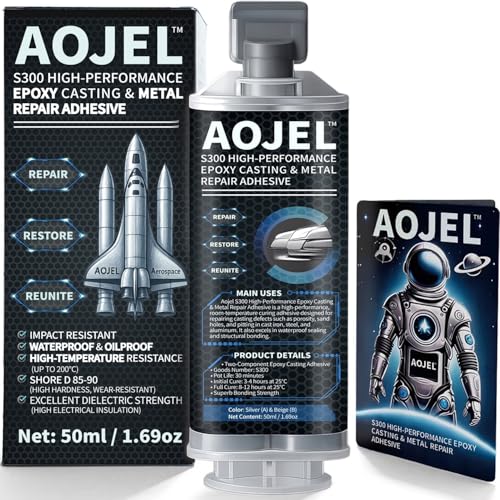
The AOJEL S300 is engineered for the repair professional who needs control. With a 30-minute working time at 77°F, this two-part syringe epoxy allows you to position, align, clamp, and build repair thickness before the compound sets. That extended window makes it ideal for crack repairs on cast-aluminum housings and brackets where you need to reinforce stress points with a metal patch or mesh.
After a 12- to 24-hour full cure, the repair body is waterproof, oil-resistant, and heat-rated to 392°F — specifications directly targeting aluminum engine components and workshop parts exposed to routine heat and vibration. The compound drills, sands, files, and paints cleanly, and users report excellent adhesion on cast iron, steel, and stainless steel as well as aluminum.
The syringe plunger system drew mixed reviews — some found it difficult to achieve equal parts on small repairs. If you are dispensing a tiny amount, consider squeezing a test bead first to normalize the flow. For medium-to-large aluminum crack repairs that require careful alignment, the 30-minute window is a decisive advantage.
Why it’s great
- 30-minute working time allows complex positioning and clamping
- 392°F heat resistance and oil/water resistance after cure
- Drillable, sandable, and paintable for a finished repair
Good to know
- Syringe plunger can be inconsistent on very small amounts
- Full 24-hour cure recommended before stress-testing
3. 3M Scotch-Weld Epoxy Adhesive DP420

The 3M Scotch-Weld DP420 is an industrial structural adhesive that belongs in a different tier from consumer epoxy putties. Its high impact and fatigue resistance, combined with a 20-minute open working time, make it the preferred choice for bonding aluminum to carbon fiber, composites, and dissimilar metals where vibration cycling would crack a rigid epoxy. The black color is a practical detail for finished repairs that should blend into dark substrates.
Users who have bonded aluminum inserts into carbon fiber tubes report that the DP420 bond outlasts the surrounding structure under daily abuse. The 24-hour full cure at 73°F is standard, but experienced users warm the components to 120°F to accelerate cure to 1 hour while increasing bond strength. This epoxy is UL 94 HB certified and intended for industrial and occupational use.
Note that the DP420 requires a separate dispensing gun and mixing nozzles — it does not come with a manual plunger. The cost is a premium, but for critical applications where a failed bond means a safety hazard or a destroyed part, the 3M formulation is the most reliable option on this list.
Why it’s great
- Superior impact and fatigue resistance for vibration-prone bonds
- Excellent adhesion bonding aluminum to carbon fiber and composites
- 20-minute working time allows precise positioning
Good to know
- Requires separate dispensing gun and mixing nozzles
- Industrial grade; premium price compared to consumer epoxies
4. Starbond 5 Minute Epoxy Pro Kit

Starbond’s 5 Minute Epoxy Pro Kit takes a different approach for aluminum repairs that live in a vibration environment. The toughened flexible formula is engineered to absorb cyclic stress without brittle cracking — exactly what you need when repairing an aluminum bracket on a power tool or a frame on a vibrating machine. The clear cure finish is a bonus for visible repairs, and the 5-minute set time delivers handling strength quickly while still allowing a 24-hour window to full cure.
The Pro Kit includes screw-cap bottles, reusable mixing trays, and a spatula — a well-thought-out bundle that reduces waste compared to single-use syringes. Users report clean results on wood, metal, glass, and ceramics, and the flexible bond has held up on basement crack repairs and crown molding joints. The 2,600 lb shear strength is lower than the J-B Weld steel-reinforced formulas, but that is by design — flexibility trades off against raw tensile strength.
If your aluminum repair involves thin-gauge material, thermal cycling, or any degree of flex, the Starbond formula will outlast a rigid epoxy that would crack under the same stress. It is less suited for heavy load-bearing structural repairs where 5,000+ PSI is required.
Why it’s great
- Toughened flexible formula resists cracking under vibration and stress
- Cures clear for a clean, unobtrusive repair
- Complete kit with bottles, trays, and mixing tools
Good to know
- Lower tensile strength than steel-reinforced alternatives
- 5-minute set demands fast preparation and application
5. J-B Weld SteelStik 2-Pack

The J-B Weld SteelStik is the fastest path to a strong aluminum repair when you need immediate results. The putty stick format requires no mixing tray or spatula — you knead the two-part formula in your gloved hand until it reaches a uniform dark grey, then press it into the crack or cavity. The 5-minute set time and 1-hour cure are remarkably fast for a 4,000 PSI compound, and the NSF certification for potable water contact means it is safe for drinking water pipes and fittings.
Users love it for repairing oil pans, stripped screw holes in aluminum chairs, and outdoor furniture brackets. It molds, shapes, sands, drills, and taps after cure, and the steel reinforcement prevents rust. The 2-pack gives you two sticks for the price of a single tube, making it a budget-friendly entry into the category.
The speed is the main tradeoff — once the putty starts to set, you have seconds to finalize positioning, not minutes. Beginners should have the repair area prepped, roughened, and degreased before they cut the putty. For quick, non-structural aluminum fixes or emergency repairs, this is the most convenient option available.
Why it’s great
- Hand-moldable putty requires no mixing tools
- 1-hour cure with 4,000 PSI tensile strength
- NSF certified for potable water contact
Good to know
- 5-minute set time leaves little room for adjustment
- Putty format less precise for small cracks on flat surfaces
6. PC Products PC-Masonry Epoxy Adhesive Paste
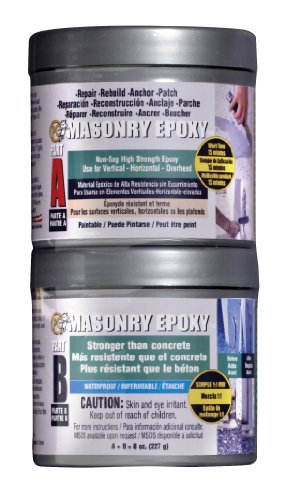
The PC Products PC-Masonry Epoxy is purpose-built for concrete and stone repair, but its properties make it relevant for aluminum repairs that also involve masonry substrates. The non-sag paste formula stays in place on vertical and overhead surfaces, and it can be applied to wet surfaces — a unique capability if you are repairing an aluminum bracket embedded in damp concrete or masonry.
The 35°F to 115°F application temperature range is wider than most epoxies, and the cured material can be painted, stained, and machined. Users report successful repairs on flagstone pavers, slate tiles, and cracked concrete pool edges where the bond needs to hold up to moisture. The 1- to 2-day full cure is slower than epoxy putties, but the paste consistency allows for thick fills without sagging.
This is not a dedicated aluminum-to-aluminum repair epoxy — the 4,000 PSI range is competitive, but the formulation is optimized for porous mineral surfaces rather than smooth metal. If your repair involves an aluminum component bonded to concrete or masonry, this epoxy bridges that material gap effectively.
Why it’s great
- Non-sag paste works on vertical and overhead surfaces
- Can be applied to wet surfaces, ideal for damp environments
- Paintable, stainable, and machinable after cure
Good to know
- Optimized for concrete and masonry, not pure aluminum bonding
- Full cure takes 1-2 days for maximum strength
7. Epoxybond Atlas Pool Putty Epoxy Leak Sealer Kit

The Epoxybond Atlas Pool Putty solves a very specific problem that no other epoxy on this list addresses: curing underwater. If you have a crack in an aluminum pool fitting, a skimmer, or a light housing that cannot be drained, this putty stick can be kneaded, applied, and cured while fully submerged. The resin-and-catalyst putty hardens into a durable white patch that sands, drills, and saws after full cure.
The kit includes step-by-step instructional videos that walk through common leak locations on pools and spas, which is genuinely helpful for first-time users. The putty cures quickly enough that you can often fix a leak in under 10 minutes including surface cleaning and sanding. Users have successfully sealed cracks in concrete pool plaster, skimmer baskets, pool filter casings, and spa spillways.
This is a niche product — it is not designed for general aluminum structural repairs, and its tensile strength is lower than the steel-reinforced epoxies. But if your aluminum repair involves water exposure and cannot be dried out, the underwater-curing capability makes it the only viable choice. For pool owners and marine DIYers, it is indispensable.
Why it’s great
- Cures underwater without draining the pool or spa
- Hand-moldable putty is easy to apply in tight spaces
- Includes instructional videos for common leak locations
Good to know
- Not designed for load-bearing structural aluminum repairs
- Lower tensile strength than general-purpose cold weld epoxies
FAQ
Can aluminum repair epoxy hold a load-bearing bracket or engine part?
How do I prepare an aluminum surface for epoxy bonding?
Will aluminum repair epoxy hold up to engine oil and gasoline?
Final Thoughts: The Verdict
For most users, the aluminum repair epoxy winner is the J-B Weld 8281 Professional because it delivers the highest tensile strength (5,020 PSI), steel-reinforced machinability, and 550°F heat resistance in a proven formula that has been the standard for decades. If you need a generous 30-minute working window for complex alignment, grab the AOJEL S300 Metal Epoxy. And for bonding aluminum to carbon fiber or composite materials where impact resistance is critical, nothing beats the 3M Scotch-Weld DP420.