
Our readers keep the lights on and the weekend projects moving. As an Amazon Associate, I earn from qualifying purchases.
Specs are compiled from manufacturer listings and verified buyer reviews and can change over time — please confirm the key details on the product page before buying.
An 8,000-watt generator sits right in the balance for most homes: it can run your well pump, refrigerator, a window AC, and a few lights all at once without breaking a sweat — but picking the wrong one can mean a fridge full of spoiled food and a row with the neighbors over noise. The real split in this category depends on two things: how clean the power is (inverter versus conventional) and if you want one fuel or the flexibility of propane or natural gas on tap.
I’m Rikta — the founder and writer behind FitlyFast. This guide is built by comparing the manufacturers’ published specifications and the patterns across verified customer reviews, so you get each pick’s real strengths and trade-offs instead of marketing spin.
Whether you are outfitting for hurricane season or prepping a workshop, this breakdown of the best 8000 watt generator options walks you through what actually matters when the lights go out.
Our Picks at a Glance

How To Choose The Best 8000 Watt Generator
An 8,000-watt generator is a serious piece of equipment — it is not a tailgate toy. Before you pick one, you need to understand three numbers that will make or break your experience: running watts versus peak watts, THD (total harmonic distortion), and fuel type. Here is what each means for your daily use.
Starting (Peak) Watts vs Running Watts
Every motor — whether in a refrigerator, well pump, or window AC — needs a big burst of power to start and then settles down to a lower draw. That burst is the starting (or peak) wattage, and the steady hum is the running wattage. An 8,000-watt generator might put out 8,000 peak watts but only 6,500 running watts. If your well pump spikes at 7,000 starting watts, that generator will stall. Always check the running wattage first, then make sure the peak covers your biggest motor’s surge.
Inverter vs Conventional (THD)
A conventional generator spins at a fixed speed and produces electricity with more “noise” — measured as THD (total harmonic distortion). High THD (above 5%) can damage sensitive electronics like a laptop, a new TV, or a furnace control board. An inverter generator adjusts its engine speed to the load and produces clean power (under 3% THD) that is safe for any electronics. The trade-off is cost: inverters are more expensive and often have a lower peak wattage for the same frame size.
Fuel: Single, Dual, or Tri-Fuel
Gasoline is the most common fuel, but it goes bad in storage and can be hard to find during a wide outage. Propane stores indefinitely and burns cleaner, but it delivers slightly fewer watts (about 10% less) than gasoline. Natural gas is the easiest if you have a hookup — never refill, never store — but it delivers the lowest power of the three. Dual-fuel generators (gas + propane) are the balance for most homeowners. Tri-fuel (adds natural gas) is ideal if you already have a gas line at your house.
Quick Comparison
| Model | Best For | Running Watts | Fuel Type | Weight | Amazon |
|---|---|---|---|---|---|
| DuroMax XP13000EH★ Best Overall | Whole-home backup, large surge loads | 10,500W (gas) 9,500W (propane) |
Gas & Propane | 234 lb | Amazon |
| Genkins 8000W InverterQuiet Performer | Quiet, portable sensitive electronics | 6,500W | Gasoline | 112 lb | Amazon |
| A-iPower AP10700EHigh-Value Performer | Heavy jobsite loads, budget whole-home | 8,500W | Gasoline | 220.5 lb | Amazon |
| DuroStar DS13000MX | Whole-home, dual-fuel with remote start | 10,500W (gas) 9,500W (propane) |
Gas & Propane | 220 lb | Amazon |
| Westinghouse 10000W Inverter | Clean power for sensitive electronics | 7,600W | Gasoline | 147.7 lb | Amazon |
| AIVOLT 8000W Dual Fuel Inverter | Quiet, light dual-fuel for RV & home | 6,500W (gas) 5,800W (propane) |
Gas & Propane | 131 lb | Amazon |
| Champion 9000W Tri-Fuel Inverter | Tri-fuel flexibility, quiet inverter | 7,250W (gas) 6,525W (prop) 5,875W (NG) |
Gas, Propane & NG | 156.6 lb | Amazon |
| Gidrox 8000W Dual Fuel Inverter | Remote start, compact dual-fuel | 6,500W (gas) 5,800W (propane) |
Gas & Propane | 122 lb | Amazon |
| GENMAX GM9000iE | High peak watts, quiet inverter | 7,600W | Gasoline | 259 lb | Amazon |
| Westinghouse WGen14500TFc | Largest homes, tri-fuel behemoth | 14,500W (gas) 13,000W (prop) 11,600W (NG) |
Gas, Propane & NG | 348.3 lb | Amazon |
In‑Depth Reviews
1. DuroMax XP13000EH 13,000W Dual Fuel
Our pick — 4.5★ from 3,500+ verified ratings; the strongest balance of quality and price.
The whole-home workhorse that shrugs off a 3-ton AC and a refrigerator at the same time.
If your goal is to power an entire house — two HVAC units, a water heater, fridge, and lights — the DuroMax XP13000EH is the one owners call “dependable.” Its 500cc engine and 100% copper windings deliver a genuine 13,000 peak watts, enough to handle a 3-ton AC compressor surge without flinching. The dual-fuel switch between gasoline and propane takes about two seconds to turn, and buyers report running 55 hours across a six-day outage on one 20-pound propane tank, refilling every 7-8 hours. That propane runtime is the kind of insurance that makes multi-day blackouts manageable.
The all-metal frame and power panel — no plastic anywhere — are built to take years of weather and rough terrain. At 234 pounds, it is not a carry-and-go unit, but the included wheel kit and fold-down handle make rolling it across a yard or driveway manageable. Owners mention the muffler is loud (this is a conventional generator, not an inverter), and one owner flagged that the right handle gets hot. The noise is the trade-off for the raw power.
It is 234 pounds versus the Genkins at 112 pounds — a 2.1x gap — and its 30 x 29 x 26-inch frame is 58% larger. That bulk is the price of admission for whole-home backup. The CO sensor, low-oil shutdown, and push-button electric start round out a package that the crowd of 4,000+ owners has solidly backed.
Why it wins for whole-home use
- 13,000 peak watts powers 2 HVAC units plus full household load
- Dual fuel with easy knob switch — propane for long outages, gas for maximum power
- 100% copper windings run cooler and last longer than aluminum
The honest trade-offs
- Loud muffler — expect conventional generator noise
- 234 pounds needs planning for positioning
- Some owners note handles can get hot during extended use
Reach for this if: you need a generator that can shoulder your entire house, run propane for days, and survive years of storms.
Look elsewhere if: noise sensitivity or moving the generator by yourself are deal-breakers.
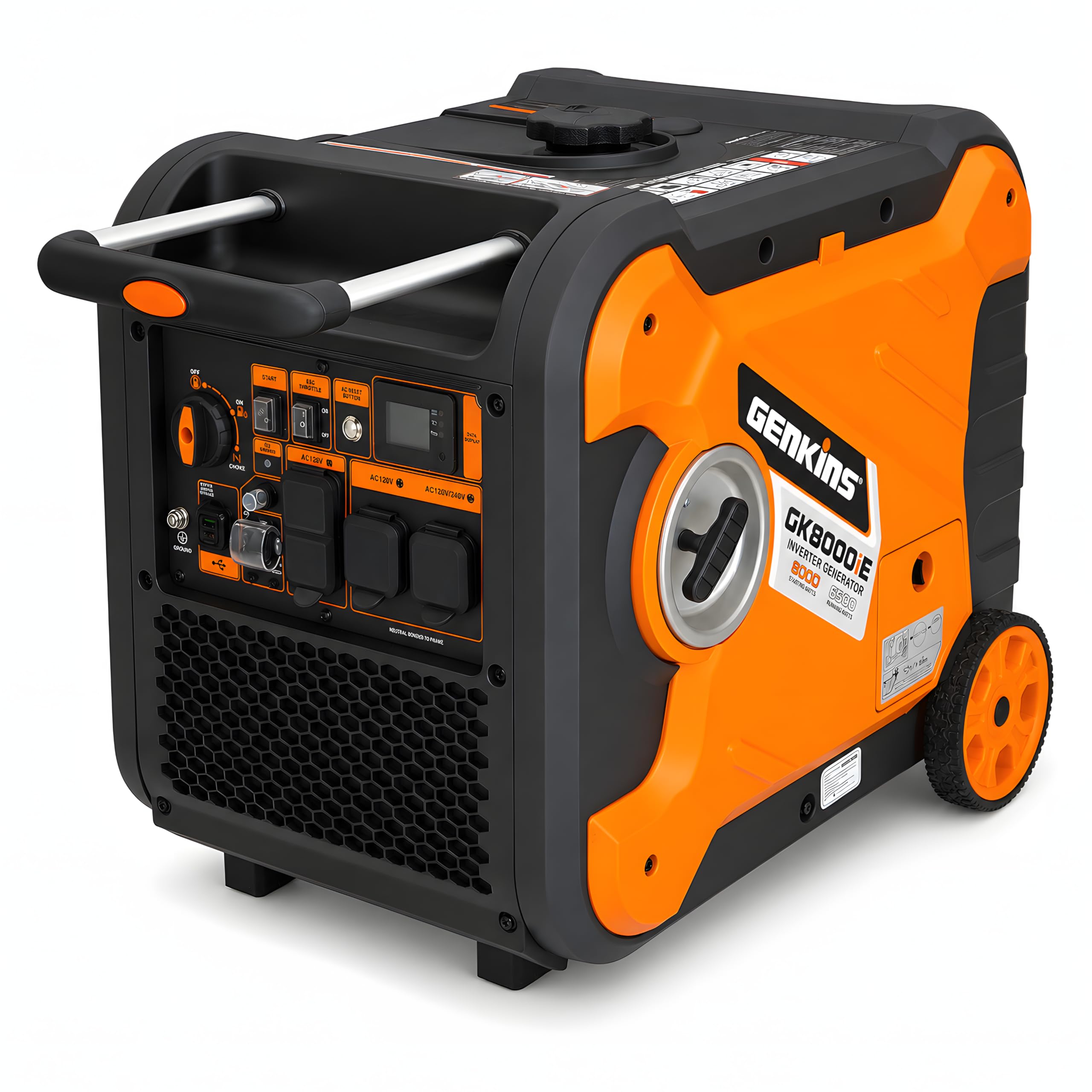
2. Genkins 8000W Inverter Generator
The 112-pound featherweight that whispers while it runs your AC and fridge.
At just 112 pounds and a 62 dBA noise rating from 23 feet away, the Genkins 8000W inverter is the quietest and most portable generator in this lineup. Its 327cc engine delivers 8,000 peak watts and 6,500 running watts through pure sine wave output (under 2% THD) — clean enough for a laptop, TV, or furnace control board without any risk. The 4-gallon fuel tank stretches to over 16 hours at 25% load, which means it can run a small refrigerator and a few lights through an entire overnight without a refill.
Owners generally call it “quiet, powerful” and note it runs a household AC, lights, and refrigerator with ease. The telescopic handle and two explosion-proof tires make it easy to maneuver around a campsite or into a garage. For context, it is just 112 pounds compared to the DuroMax at 234 pounds, and its frame measures 19 x 18 x 24 inches compared to the DuroMax’s 30 x 29 x 26 inches. That portability is the main draw.
The catch is reliability: a few customers note the wheel fell off after three uses and the electric start was dead on arrival (the battery ships disconnected, and connecting the wires near the oil fill fixes it). The electric start battery needs that setup step, and the quick-start guide does not explain it clearly. It is a strong pick for quiet portable power, but a buyer should test it thoroughly within the return window.
Perfect for campers and light home backup: the quietest 8,000-watt-class generator we found, at half the weight of the conventional options — but the early quality reports mean you want to check it immediately on arrival.
Best for: RV trips, camping, and light home backup where noise must stay low and moving the unit is frequent.
Skip if: you need to power a whole house with well pumps or multiple AC units, or you want zero assembly from the start.
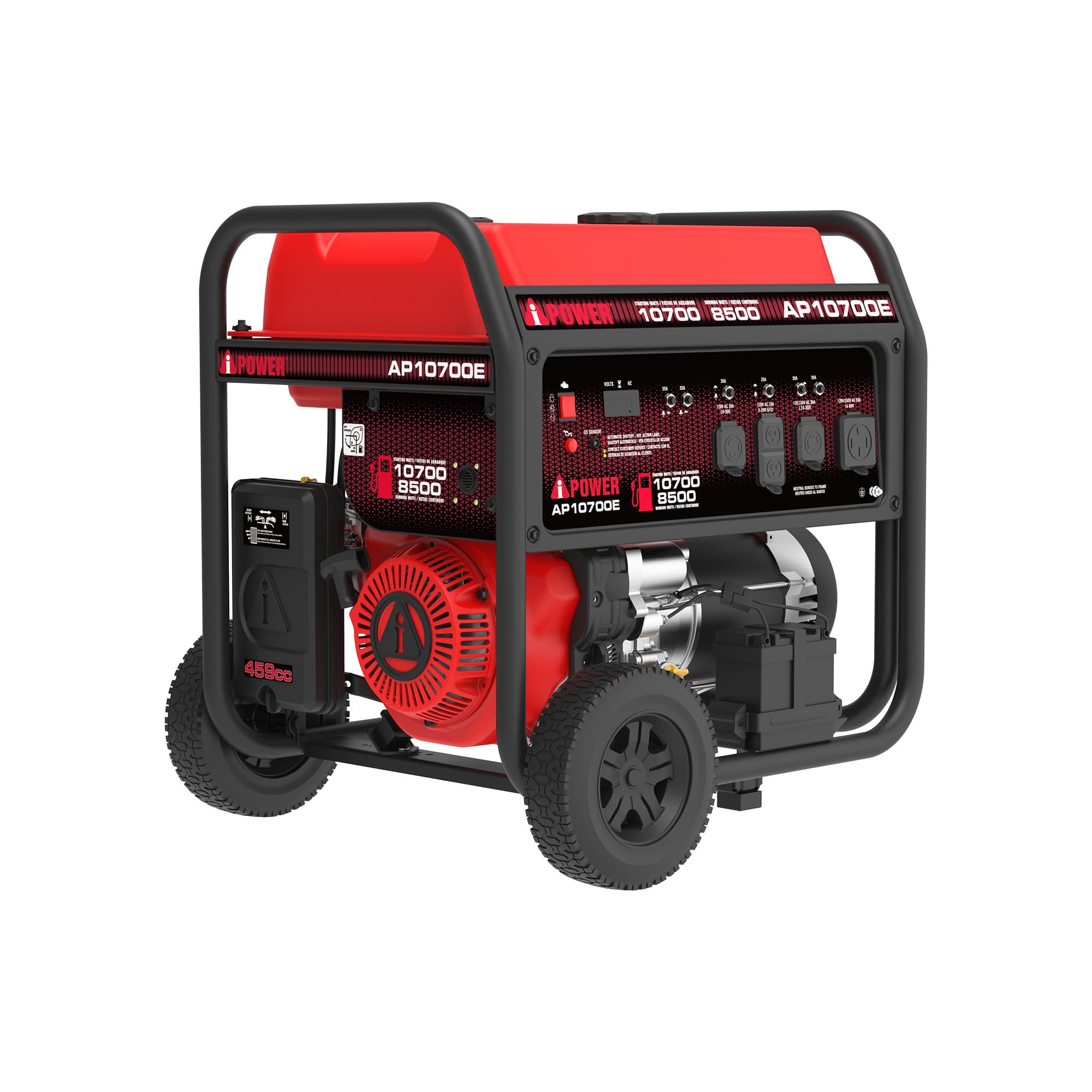
3. A-iPower AP10700E 10,700W Generator
The budget-friendly 10,700-watt bruiser that ran 80 hours straight through a hurricane.
The A-iPower AP10700E punches above its price bracket with a 459cc OHV engine (cast iron sleeve for long life) that puts out 10,700 starting watts and 8,500 running watts on gasoline. That is enough to handle a 3.5-ton AC unit alongside a 2HP well pump starting surge. Owners confirm it powered an entire household during Hurricane Irma — fridge, 12,000 BTU AC, TVs, fans, and lights — running 12-13 hours on 7 gallons of fuel. The electric push-button start and recoil backup give you two ways to fire it up.
The control panel is well-equipped for a unit in this tier: a CO sensor indicator light, digital data center, two GFCI 120V outlets, one L5-30R 30A outlet, one L14-30R 30A 120/240V outlet, and a heavy-duty 14-50R 50A outlet for transfer switch connection. That 50A outlet is normally reserved for more expensive generators. It is 220.5 pounds — heavy but manageable on the included wheels.
Two honest trade-offs: it is loud (standard conventional generator noise), and owners note the 62.5 Hz no-load frequency can cause some APC-brand UPS units to cycle. Tripp Lite units reportedly work fine. The GFCI outlets tripped on one owner’s unit, but customer support resolved it quickly. For the price, the power-to-dollar ratio is tough to top.
The best bang-for-buck whole-home generator: 8,500 running watts at this price is rare, and the cast iron sleeve means it should last through years of storms. The noise and UPS compatibility are the trade-offs.
Grab it for: whole-home backup on a budget, especially if you have a transfer switch ready and a Tripp Lite UPS.
Think twice if: you need quiet operation or you rely on a sensitive APC-brand UPS.
4. DuroStar DS13000MX 13,000W Dual Fuel

Fire it up from inside the house with the remote fob — and propane stores forever.
The DuroStar DS13000MX brings a 500cc dual-fuel engine and a remote start key fob to the 13,000-watt class. That means you can start the generator from inside your RV or house without stepping into the rain. Reviewers point out it powered an entire two-story home — a 1.5-ton AC, split unit, fridge, stove, microwave, TVs, and water heater — with only a brief strain when the AC compressor kicked in. The dual-fuel knob lets you switch between gasoline and propane in seconds.
At 220 pounds with fold-out handles and sturdy wheels, it is mobile enough for most driveways. The all-metal construction is the same rugged frame philosophy as the DuroMax above (same parent company). The CO Alert sensor, low-oil shutdown, and electric start with manual recoil backup give you safety and reliability. One owner calls it “extremely powerful,” noting it runs a vintage 1HP 2-piston air compressor and a 250A welder simultaneously — but also flags the noise as considerable.
The noise is the honest downside: it is loud, and buyers who live close to neighbors should consider that factor. The included remote fob, propane regulator, and tool kit mean you have everything to get running right from the start.
Standout features
- Remote start from inside the house or RV
- 500cc dual-fuel handles whole-home loads
- All-metal construction and CO alert
The real trade-off
- Loud under load — conventional generator noise
- 220 pounds is heavy for repositioning alone
- Bonded neutral needs modification for some transfer switch setups
Ideal for: homeowners who want remote-start convenience and propane storage flexibility with true whole-home power.
Not ideal if: noise is a neighborhood concern or you need a generator that is quiet enough for camping.
5. Westinghouse 10000W Peak Inverter Generator

Inverter-clean power under 3% THD with a remote fob and 12 hours of runtime.
The Westinghouse 10000W inverter generator is built for people who want their sensitive electronics protected. Its 420cc engine with a cast iron sleeve produces 10,000 peak watts and 7,600 running watts with less than 3% THD — clean enough that you can plug a laptop, TV, or furnace control board directly into it without a separate UPS. The Eco mode adjusts engine speed to the load, which shoppers say makes it notably quieter and more fuel-efficient than a conventional generator running at full throttle.
Reliability is the most-mentioned trait by owners — 10 buyers highlight it specifically. The remote start key fob, push-button, and recoil backup give you three ways to start it. The 5.28-gallon fuel tank delivers up to 12 hours of runtime at 25% load. Outlets include four GFCI 120V household outlets, one L14-30R 30A transfer-switch-ready outlet, and one 14-50R 50A outlet — all with rubber covers. At 147.7 pounds, it is noticeably lighter than the conventional 10,000-watt class machines.
The one design gripe owners have is the oil fill location — positioned awkwardly, making the first oil change a bit fussy. It is not a deal-breaker, just a minor annoyance for maintenance.
The go-to for clean backup power: the under-3% THD makes it safe for any electronics, and the remote start plus Eco mode make it feel premium. The oil fill location is the only recurring complaint.
Great for: homeowners with sensitive electronics, those who want inverter fuel efficiency, and anyone who appreciates a remote start from the house.
Consider another if: you need dual-fuel flexibility or you plan to run more than 7,600 running watts regularly.
6. AIVOLT 8000W Dual Fuel Inverter Generator

Sixteen hours of propane quiet in a 131-pound package with automatic fuel switching.
The AIVOLT 8000W dual-fuel inverter generator targets the buyer who wants inverter-clean power and the flexibility of propane without the heavy weight of a conventional frame. Its 208cc engine delivers 8,000 peak watts and 6,500 running watts on gasoline, with the automatic fuel-switching technology letting you swap between gas and propane without any manual adjustment. At just 127.9 pounds with a telescopic handle and two 7-inch never-flat wheels, it is genuinely easy to move by yourself.
Owners praise it for running an RV rooftop AC all night on propane — quiet enough to sleep next to. The CO Alert technology, overload protection, and low-oil shutdown are all standard. The noise level is rated at 62 dBA from 23 feet, though some owners measured 72-73 dB at 5 feet. Still, it is significantly quieter than a conventional generator of this wattage. The electric start with remote fob is a welcome convenience.
The main caveat from the review pool is inconsistency: a few units arrived with issues like fuel pouring from the carburetor overflow after 10 minutes of run time. The customer service team handled refunds quickly (within 12 hours in one case), but the quality control seems uneven. The lack of included oil also caught a few buyers off guard. Test it immediately.
The best light dual-fuel inverter for RV use: the automatic fuel switch and propane overnight runtime are compelling. The mixed early quality reports mean you should test within 30 days.
Go for it if: you want a portable inverter that runs on propane all night without refueling, and you prioritize low weight.
Hesitate if: you cannot afford any downtime — the defect rate is higher than the established brands.
7. Champion 9000W Tri-Fuel Inverter Generator

Gasoline, propane, or natural gas — you choose, and it runs a 5-ton AC on any of them.
The Champion 9000W tri-fuel inverter is the Swiss Army knife of this category: it runs on gasoline (7,250 running watts), propane (6,525), or natural gas (5,875), and the hoses for propane and natural gas are included in the box. That means you can hook it up to your home’s natural gas line and never worry about refueling during a multi-day outage. Owners confirm it powers a 2.5-ton central AC without a soft start kit, and the inverter technology keeps the power clean for electronics.
Champion claims it is quieter than a traditional 7,250-watt generator at 72 dBA, which is a meaningful difference in a residential neighborhood. The 420cc engine includes Cold Start Technology for reliable ignition in freezing weather, and the CO Shield system auto-shuts the unit if carbon monoxide builds up. The Intelligauge display shows voltage, frequency, and operating hours, so you know exactly how much runtime is on the oil. At 156.6 pounds, it is heavier than a pure inverter but still manageable with the included wheel kit.
The tri-fuel versatility is the headline here, but owners note the inverter is not tiny — it is bigger than a portable camping inverter. The 3-year limited warranty and free lifetime technical support from Champion add confidence.
Why it stands out
- Tri-fuel with all hoses included — connect to natural gas from the start
- Inverter design is 72 dBA, quieter than a conventional 7,250W unit
- CO Shield auto-shutdown and Intelligauge display
The trade-offs
- Running watts on natural gas (5,875W) is lower than some homes need
- 156.6 pounds is heavier than compact inverters
- Price is higher than single-fuel options
Perfect for: homeowners with a natural gas hookup who want quiet, clean power and never want to store gasoline.
Look elsewhere if: you need the highest running wattage — natural gas output is the lowest of the three fuels.
8. Gidrox 8000W Dual Fuel Inverter Generator

A 122-pound dual-fuel inverter with a remote start that fits in a compact corner of the garage.
The Gidrox 8000W dual-fuel inverter is built for buyers who want the quiet and clean power of an inverter with the fuel flexibility of gas and propane, all in a frame that weighs just 122 pounds. Its 317cc engine produces 8,000 peak watts and 6,500 running watts on gasoline, with pure sine wave output under 3% THD. The 3.6-gallon fuel tank delivers up to 9.5 hours of runtime at 25% load on gasoline. The built-in RV adapter (NEMA L14-30P to TT-30R) means you can plug a travel trailer directly in without extra adapters.
The thing owners praise most is performance — seven buyers call it out specifically. One owner notes it started on the second pull, and the electric start worked after grounding the battery. Another ran their furnace on ECO mode at less than 25% load with no issues. The CO detection, low-oil shutdown, and overload protection work automatically in the background. You get three start methods: remote fob, push-button electric, or manual recoil.
The small sample size (around 24 ratings) means the long-term reliability picture is not fully formed yet. One owner flagged that the battery needed grounding to get the electric start working, which is a common setup step but not obvious in the quick-start guide.
A strong compact dual-fuel entry: the remote start, under-3% THD, and 122-pound weight make it a compelling RV partner. Early owner reports are very positive, but the pool is small.
Ideal for: RV owners who want a quiet inverter that runs on propane and fits in a small compartment.
Hold off if: you prefer an established brand with thousands of reviews backing it.
9. GENMAX GM9000iE 9000W Inverter Generator

A 62 dBA inverter with parallel capability — double it to 18,000 peak watts later if you need.
The GENMAX GM9000iE is a 458cc inverter generator that produces 9,000 peak watts and 7,600 running watts with under 3% THD and a 62 dBA noise rating at quarter load. That is genuinely quiet — you can hold a conversation next to it. The parallel capability lets you connect two GM9000iE units to double your power to 18,000 peak watts and 15,200 running watts (parallel cord sold separately). The digital control center shows runtime hours, voltage output, and load level on an LCD screen.
One owner who lives off-grid in a Louisiana marsh reports the generator was still reliable after 500+ hours, even handling water-tainted fuel thanks to an easy carburetor drain. Another ran a 50A RV with two 15,000 BTU AC units, a microwave, and a hair dryer simultaneously, calling it superior to a DuroMax 13,000W. The remote start and battery switch (which does not drain when off) are genuine conveniences.
The honest reality from the review pool is mixed: alongside those glowing reports, there are accounts of units arriving damaged (broken handle, misaligned housing) and support being slow. One replacement unit output 160V instead of 240V. The 259-pound weight is also heavier than most inverters in this class, making it less portable than the Genkins or AIVOLT.
Quiet inverter power with future-proof parallel ability: the 500+ hour off-grid testimony is impressive, but the mixed quality control and heavy weight are real concerns.
Choose it for: quiet 7,600 running watts and the option to double power later with a second unit.
Be cautious if: you need reliable support or a lighter unit — quality control is inconsistent based on owner reports.
10. Westinghouse WGen14500TFc 18,000W Tri-Fuel
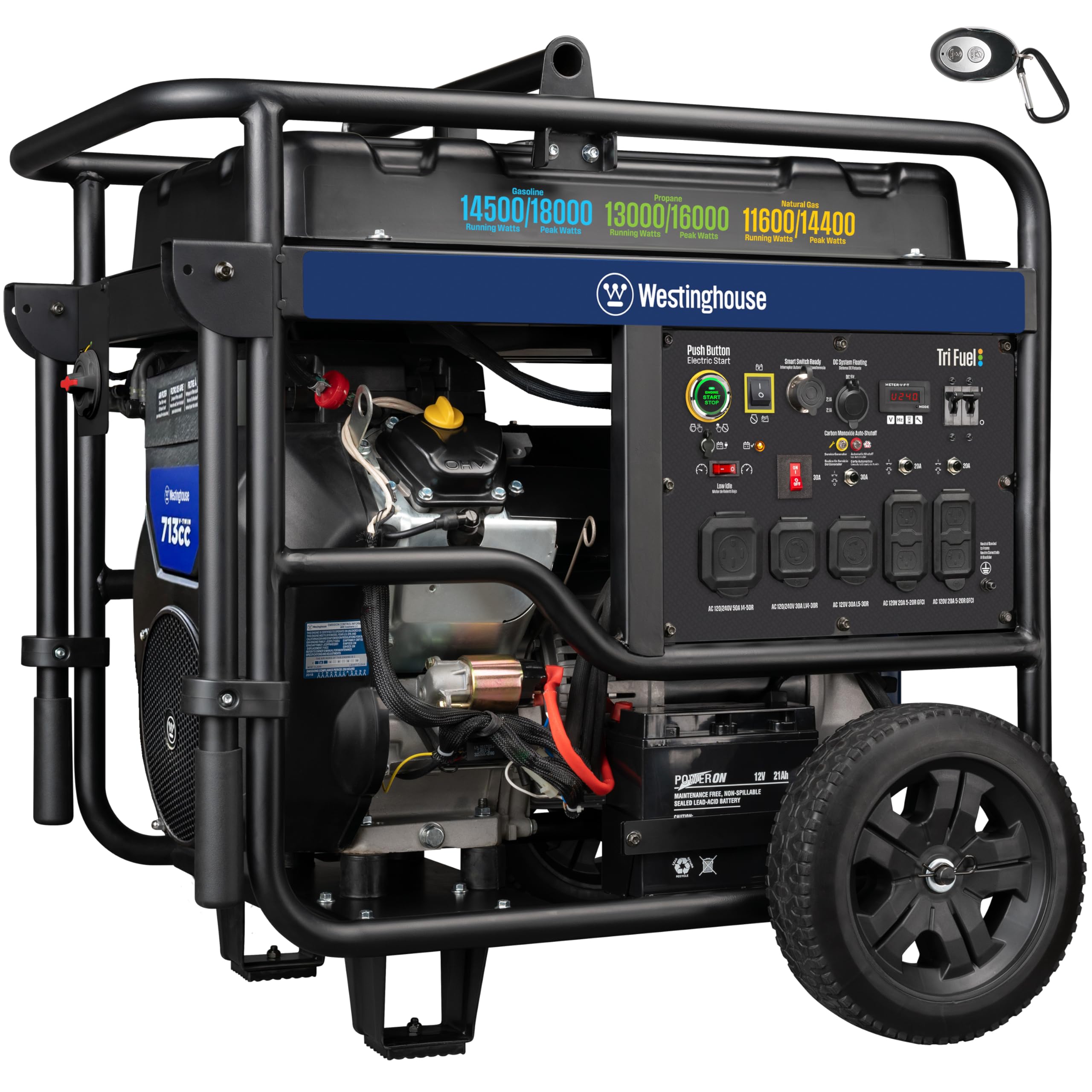
A 713cc V-Twin that runs a 5-ton AC on natural gas — this is whole-home power at an industrial scale.
The Westinghouse WGen14500TFc is the largest generator in this roundup by a wide margin — 18,000 peak watts on gasoline (14,500 running), 16,000 peak on propane (13,000 running), and 14,400 peak on natural gas (11,600 running). The 713cc V-Twin OHV engine is a serious powerplant, and the under-5% THD makes it safe for sensitive electronics. At 348.3 pounds, this is not a mover — it is a park-and-forget backup unit. The 10.5-gallon fuel tank delivers up to 16 hours at 25% load on gasoline.
Owners confirm it runs a 5-ton central AC and a clothes dryer simultaneously on natural gas, with THD measured at 4.5% under that load — well within safe range for electronics. The tri-fuel capability means you can hook it to your home’s natural gas line and literally never refuel. The remote start key fob, push-button start, and VFT data center (voltage, frequency, lifetime hours) are all standard. The 3-year limited warranty backs it.
The honest trade-offs: at 74 dBA it is not quiet, and the 348-pound weight means you want a dolly and a plan for positioning. One owner noted the battery switch must be off to avoid drain, and the included natural gas hose is not long enough for some setups. This is for serious whole-home backup only.
The power you get
- 14,500 running watts on gas — powers the largest homes
- Tri-fuel including natural gas — never refuel with a gas line hookup
- Under 5% THD is safe for sensitive electronics
What it costs in convenience
- 348.3 pounds requires serious planning for positioning
- Loud at 74 dBA — not for close neighbors
- No natural gas hose included per some owner reports
Built for: the largest homes with 5-ton AC units and natural gas hookups — full-house backup with zero refueling.
Not for: anyone without a permanent placement plan or who needs a quiet, portable generator.
Understanding the Specs
Running Watts vs Peak (Starting) Watts
Peak watts is the burst of power a generator can deliver for a few seconds to start a motor (like a well pump or AC compressor). Running watts is what it can sustain continuously. An 8,000-watt generator with 6,500 running watts will stall if your total running load exceeds 6,500W, even if the peak number seems high enough. Always calculate your running load first, then check that the peak covers the surge of your largest motor.
THD — Total Harmonic Distortion
THD measures how “clean” the electricity is. Inverter generators (under 3% THD) produce power as clean as your wall outlet, safe for laptops, TVs, and furnace control boards. Conventional generators (5-10% THD) may damage sensitive electronics over time. If you are powering any modern electronics, an inverter generator or one with under 5% THD is the safer choice.
Dual Fuel vs Tri-Fuel
Dual-fuel generators run on gasoline and propane. Propane stores indefinitely and burns cleaner, but it delivers about 10% fewer watts than gasoline. Tri-fuel adds natural gas, which is the easiest option if you have a gas hookup — no refueling, no storage. The trade-off is that natural gas yields the lowest running watts of the three.
CO Sensor (Carbon Monoxide Detection)
A CO sensor automatically shuts the generator down if it detects dangerous carbon monoxide levels in the surrounding area. This is a critical safety feature, especially if the generator is placed near a house, garage, or camper. It does not replace the rule of keeping the generator at least 15 feet from doors and windows, but it adds a layer of protection.
FAQ
Will an 8000 watt generator run my whole house?
Can I run a generator on propane continuously for days?
What does THD mean and why does it matter?
How loud is an 8000 watt generator?
Can I connect an 8000 watt generator to my house panel?
What is the difference between an inverter generator and a conventional one?
How long does an 8000 watt generator last?
Should I get a dual-fuel generator or stick with gasoline?
Can I run sensitive electronics like a laptop on a conventional generator?
How do I maintain my generator for long-term storage?
Final Thoughts: The Verdict
For most homeowners, the 8000 watt generator winner is the DuroMax XP13000EH because its 13,000 peak watts, dual-fuel flexibility, and all-metal construction deliver whole-home backup that thousands of owners have proven through storms and outages. If quiet, clean power for sensitive electronics is your priority, the Genkins 8000W Inverter or the Westinghouse 10000W Inverter are the right picks, each at roughly half the weight of a conventional frame. And for the largest homes with natural gas hookups, the Westinghouse WGen14500TFc or the Champion 9000W Tri-Fuel Inverter give you the ultimate convenience of never refueling during an outage. Every pick here has proven itself in real blackouts — pick the one that matches how much you need to power and whether you prioritize portability, fuel flexibility, or sheer wattage.
How We Picked
We do not accept paid placement. Every pick is matched to a real buyer and a real use-case; we do not hands-on test units.
Sources & Methodology
Specifications: manufacturer listings and product documentation. Review insights: verified customer reviews, as of July 2026. Pricing: not shown on this page (it changes often); check the current price via the retailer link.
As an Amazon Associate, FitlyFast earns from qualifying purchases. This does not affect which products we feature.