
Our readers keep the lights on and the weekend projects moving. As an Amazon Associate, I earn from qualifying purchases.
A muddied vocal take, a boxy guitar tone, or a slap echo that ruins a podcast — these are the hallmarks of an untreated room. Acoustic panels are the single most effective tool for taming flutter echo, standing waves, and reverb, transforming a bare wall into a controlled listening environment. The challenge isn’t deciding whether to treat your room, but choosing the right density, thickness, and style that matches your workflow and space without wasting money on ineffective decoration.
I’m Rikta — the co-founder and writer behind FitlyFast. My approach to this guide involved cross-referencing hundreds of real-user experiences against material science data on NRC ratings, density in kilograms per cubic meter, and fire-retardant certifications to separate what actually works from what merely looks the part.
Whether you are dialing in a critical mix or recording voiceovers, the right set of acoustic panels for home studio will deliver measurable clarity by absorbing excess energy rather than reflecting it back into your microphone.
How To Choose The Best Acoustic Panels For Home Studio
Selecting the right acoustic treatment goes beyond picking a color that matches your wall. Home studio panels live and die by their material density, thickness, and mounting method. A panel that is too thin will only absorb high frequencies, leaving your low-end muddy and undefined. Understand these core specs before you click “add to cart.”
Density and Material Composition
Panels made from high-density polyester fiber (often 390 lbs/yd³ or higher) absorb more energy across a wider frequency range than cheap polyurethane foam. Open-cell foam with low PCF (pounds per cubic foot) tends to crumble and sag over time, whereas a dense polyester or recycled PET panel maintains its shape and absorption curve for years. Look for materials that are flame-retardant certified and free from formaldehyde off-gassing — especially in a small, ventilated studio room.
Thickness and Low-Frequency Absorption
For a home studio, a 1-inch panel is acceptable for taming high-mid reflections and flutter echo, but you need at least 2-inch thick panels to start absorbing lower frequencies (below 500 Hz). If you deal with bass buildup, combine thick broadband panels with dedicated bass traps in corners. A single thickness does not fit all rooms — match the panel depth to the dominant problem frequencies you measured with a room analysis tool.
Installation and Adhesive Reliability
Self-adhesive backings are convenient, but on textured or painted concrete walls, they often fail within weeks. Many experienced users reinforce with 3M Command strips, construction adhesive, or a brad nailer for a permanent fix. If you are renting, removable strips are critical — but ensure the panel weight and surface area can be supported. Large 48-by-24-inch panels require multiple mounting points to prevent sagging over time.
Quick Comparison
On smaller screens, swipe sideways to see the full table.
| Model | Category | Best For | Key Spec | Amazon |
|---|---|---|---|---|
| TONOR Dual-Layer Panels | Mid-Range | Large wall coverage | 0.72″ thick dual-layer | Amazon |
| AudioSilk Room Kit | Premium | Eco-friendly absorption | NRC up to 0.91 | Amazon |
| Self-Adhesive Hexagon | Mid-Range | Style and performance | 390 lbs/yd³ density | Amazon |
| UMIACOUSTICS Walnut | Premium | Veneer aesthetic | 47.2″ x 23.6″ panel | Amazon |
| Soon Global 8-Pack | Budget | Artistic room decor | 48″ x 32″ large tiles | Amazon |
| Knightsacoustic 24 Pack | Budget | Entry-level coverage | 1″ thick, 24 sq. ft. | Amazon |
| Art3d Wood Slat | Premium | High-end studio decor | 94.5″ slat length | Amazon |
In‑Depth Reviews
1. TONOR Dual-Layer Thickened Acoustic Panels

The TONOR panels use a dual-layer reinforced structure that sandwiches two densities of polyester fiber to handle a broader frequency range than single-layer foam. At 0.72 inches thick, each 47.2-by-23.6-inch slab provides substantial surface coverage with a classic stripe texture that blends into a professional studio aesthetic. Users report significant reduction in mid-frequency reflections and laundry-machine rumble when covering bare drywall.
Installation is straightforward with the pre-applied self-adhesive backing, though some reviewers on painted concrete recommended reinforcing with construction adhesive for long-term peace of mind. The material cuts cleanly with a utility knife, allowing you to fit around outlets and corner angles without frayed edges. TONOR includes reinforced corner protection during shipping to prevent dings.
The 2-year manufacturer warranty adds confidence for a permanent studio install. While not tuned for deep bass trapping, these panels excel at cleaning up the 500 Hz to 4 kHz range where vocals and snare drums live. For apartment dwellers wanting to contain sound without full room isolation, this pack delivers the best balance of coverage and sonic improvement.
Why it’s great
- Dual-layer density absorbs a wider frequency band than standard foam
- Large single-panel size reduces visible seams
Good to know
- Adhesive may struggle on textured walls without reinforcement
- Not designed for sub-200 Hz absorption
2. AudioSilk ROOM KIT Acoustic Panels

AudioSilk panels stand apart from foam competitors with a Noise Reduction Coefficient of up to 0.91, meaning they absorb 91% of incident sound energy across the speech and music range. Made from post-consumer recycled PET, they emit zero chemical odor and will not shrink or peel over time — a common failure point of polyurethane tiles. At 45.7 by 22.8 inches and 0.4 inches thick, each panel is lightweight yet dense enough to tame flutter echo without deadening a room entirely.
The ROOM KIT ships as four panels, which experienced users recommend supplementing with additional units for full-room treatment. 3M Command strips (sold separately) allow damage-free removal, making this a top pick for rented studio spaces. Reviewers noted immediate improvement in vocal recording clarity, with shorter reverb tails and reduced harshness from bare wall reflections.
While the 0.4-inch thickness is thinner than some broadband absorbers, the high-density PET construction outperforms 1-inch foam at the same depth. The Natural color option blends into a minimalist aesthetic. For a home studio owner prioritizing eco-conscious materials and measurable NRC performance, this kit punches well above its price tier.
Why it’s great
- Industry-leading NRC 0.91 from recycled, odor-free PET
- Removable installation ideal for rented studios
Good to know
- Only 0.4″ thick — less effective on very low frequencies
- Adhesive strips sold separately
3. Self-Adhesive Hexagon Acoustic Panels

These second-generation panels use a patented vacuum needle punching technique that achieves a density of 390 lbs/yd³ — roughly 30% higher than typical acoustic foam. The result is a smoother texture and better sound absorption per unit thickness, especially in the mid and high frequencies where vocal sibilance and cymbal wash live. The large hexagon shape (14 by 12 inches) allows creative wall patterns that break up parallel reflective surfaces.
The self-adhesive backing has passed an 88.2-ounce tensile test, but multiple users reported that on painted concrete walls, the adhesion weakened over time and required reinforcement with double-sided tape or adhesive dots. The pack includes a free installation gap tool to ensure consistent spacing.
SGS certification confirms the 6D polyester fiber is free from toxins and formaldehyde, making it safe for bedrooms and playrooms adjacent to the studio. The orange and moon grey color combination adds visual warmth without screaming “studio foam.” For home creators who want their acoustic treatment to double as wall art, this is a compelling option.
Why it’s great
- Ultra-high density (390 lbs/yd³) for superior absorption per inch
- SGS-certified, odor-free material safe for sensitive environments
Good to know
- Adhesive may fail on rough or concrete walls
- Hexagon shape limits uniform corner stacking
4. UMIACOUSTICS Wood-Look Acoustic Panels

UMIACOUSTICS panels feature a wood-looking veneer surface over a 100% polyester fiber core, giving the appearance of hardwood slats without the reflective sound of real wood. Each panel measures 47.2 by 23.6 inches and weighs 22.1 pounds for the six-pack, offering substantial mass that helps dampen structural vibrations. The walnut color provides a furniture-grade finish that integrates seamlessly into a living-room studio setup.
Installation requires a brad nailer (18 gauge, 1.25-inch nails) or construction adhesive — there is no self-adhesive backing, which some users prefer for a permanent, rattle-free mount. Reviewers praised the easy cutability with a utility knife, though the black felt dust from cutting can create a mess and requires vacuuming. The veneer surface is matte and does not produce glare under studio lights.
In a podcast or voiceover studio, these panels noticeably reduce echo without making the room feel claustrophobic. They are not soundproof, but they excel at absorbing reverb in the speech range. For home studio owners who want acoustic treatment that looks like premium wall paneling, this set delivers a clean, professional finish.
Why it’s great
- Wood-look veneer blends acoustic function with high-end decor
- Easy to cut with standard tools for custom fits
Good to know
- No built-in adhesive; requires nails or glue for mounting
- Cutting generates black dust and potential fiber splinters
5. Soon Global Artist-Collab Wall Panels

The Soon Global 8-pack offers large 48-by-32-inch panels printed with designs from collaborating artists, turning a functional acoustic tool into a visual statement. Made from flame-resistant polyester fiber, these panels prioritize safety without adding chemical smell. The high-density fiber construction absorbs flutter echo effectively in mid-sized rooms, making them suitable for a home studio doubling as a live-stream backdrop.
Installation uses 50 included transparent double-sided adhesive dots. Several users noted the adhesive works well on smooth walls but failed on ceilings after a few months, with all panels falling down. If wall-mounting, the dots hold firmly; for ceiling applications, nail or screw reinforcement is recommended. The panels are easy to trim with an exacto knife for fitting around obstacles.
For the home studio owner who wants acoustic treatment that also functions as wall art, the artist-collab designs add personality that plain black foam cannot match. The primary trade-off is the adhesive reliability — plan for mechanical fasteners if your install location is overhead or in a high-humidity environment.
Why it’s great
- Unique artist designs turn panels into wall decor
- Flame-resistant polyester fiber with zero odor
Good to know
- Included adhesive not reliable for ceiling installations
- Large tile size may be unwieldy for small spaces
6. Knightsacoustic 24-Pack Foam Panels
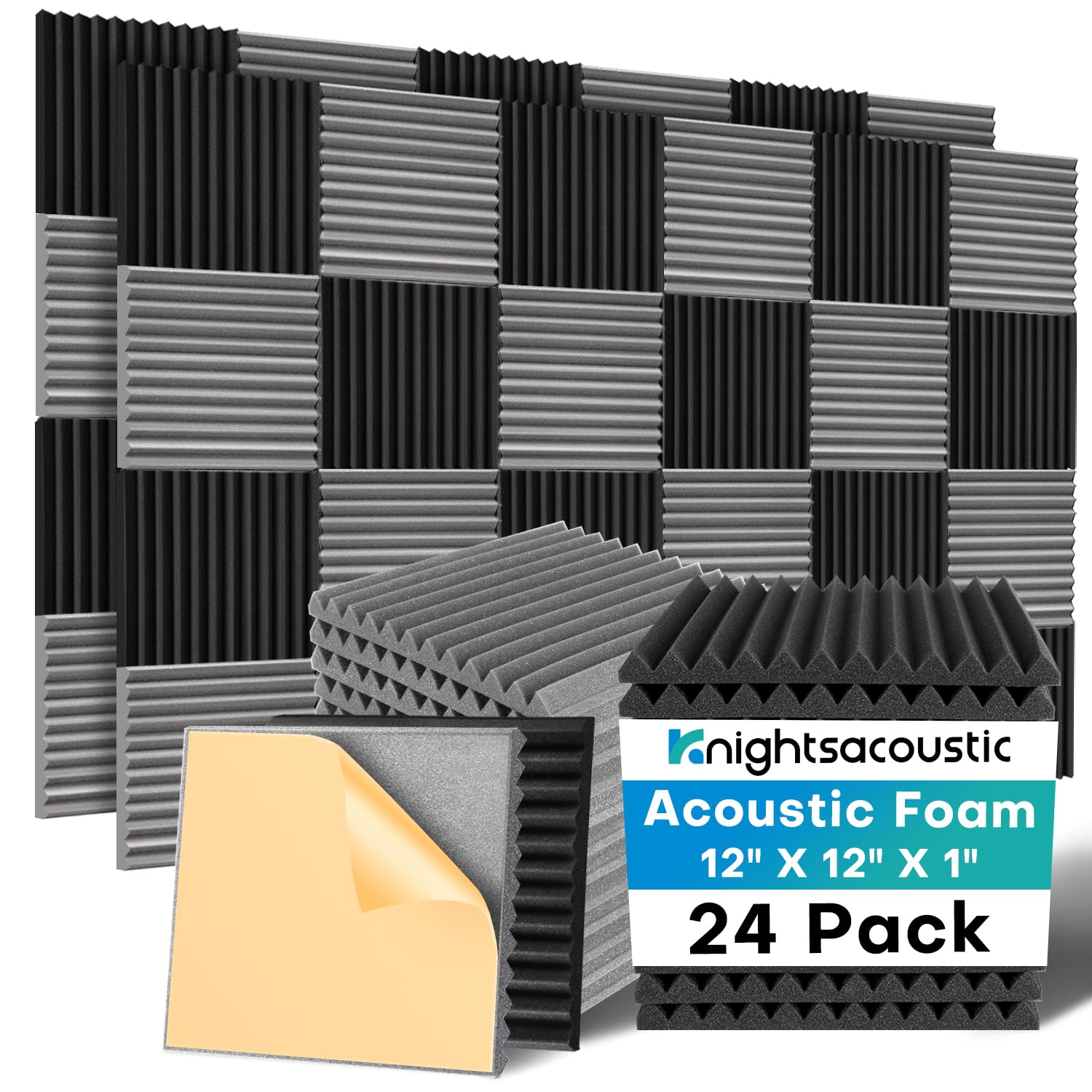
Knightsacoustic delivers 24 square feet of coverage with 1-inch thick, flame-retardant foam tiles in a black-grey wedge pattern. At this entry-level price point, the panels serve as an accessible on-ramp for first-time studio builders who want to reduce slap echo without a large investment. The foam is high-density for its class and recovers its shape within hours after unpacking proper ventilation.
Multiple reviewers noted a strong odor upon opening, which dissipated after airing the panels for 24 hours — a common trait of flame-retardant foam treatments. The tiles do not come with self-adhesive backing, so you will need to supply adhesive dots or spray mount. One creative user soaked and dried the panels to expedite odor removal and flatten any shipping creases.
While 1-inch foam is limited in its ability to absorb low frequencies, it works well for killing high-frequency flutter echo in a vocal booth or control room. For the budget-conscious creator, pairing these panels with corner bass traps creates a functional hybrid setup that punches above its weight for spoken-word and podcast recording.
Why it’s great
- Cost-effective entry point for treating a small room
- Flame-retardant construction adds safety margin
Good to know
- Strong initial odor requires airing out
- No adhesive backing included; needs separate mounting
7. Art3d Wood Slat Acoustic Panels
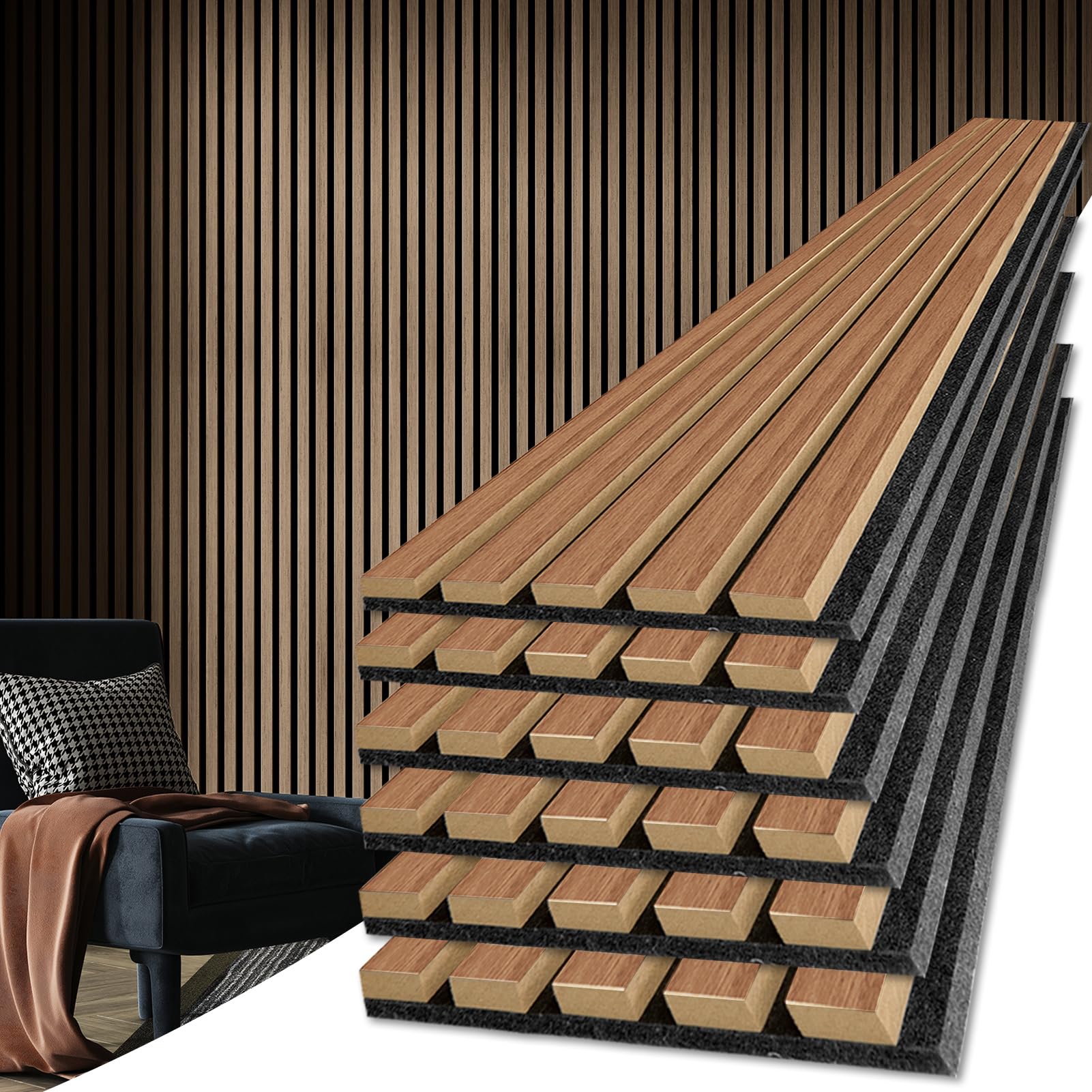
Art3d’s fluted wood slat panels combine MDF (medium-density fiberboard) with high-density polyester fiber backing, creating a 3D textured surface that is as acoustically functional as it is visually dramatic. Each slat measures 94.5 inches long by 7.9 inches wide, allowing floor-to-ceiling coverage with minimal horizontal seams. The walnut finish (also available in oak and matte black) adds a warm, high-end architectural feel.
Installation is straightforward for a DIYer: cut with a fine-tooth blade for clean edges, then secure with adhesive and nails. The panels are perfectly straight and consistent — reviewers praised the lack of chipping during cutting. The MDF core provides rigidity, while the polyester fiber layer absorbs mid- and high-frequency reflections. The six-pack covers roughly 31.5 square feet.
These are not traditional broadband absorbers; the wood slats reflect some high frequencies, creating a balanced acoustic environment that does not sound dead. This makes them ideal for a live room or tracking space where you want controlled ambience rather than anechoic silence. For the home studio owner building a permanent, high-design listening space, the Art3d panels justify their premium positioning with fit and finish that rivals architectural millwork.
Why it’s great
- Floor-to-ceiling slat length for seamless vertical coverage
- Architectural-grade MDF/PET hybrid construction
Good to know
- Higher price per square foot than foam options
- Semi-reflective wood surface not ideal for total absorption
FAQ
How many acoustic panels do I need for a home studio?
Can acoustic panels stop sound from leaving my room?
What is the difference between 1-inch and 2-inch panels?
Do I need bass traps if I already have acoustic panels?
Final Thoughts: The Verdict
For most users, the acoustic panels for home studio winner is the TONOR Dual-Layer Panels because they combine large-format coverage with dual-density absorption that effectively cleans up the vocal and instrument range without breaking the bank. If you want eco-friendly, NRC-verified performance with removable installation, grab the AudioSilk ROOM KIT. And for a high-end studio that doubles as a living space, nothing beats the Art3d Wood Slat Panels for acoustic function and architectural beauty.