
Our readers keep the lights on and the weekend projects moving. As an Amazon Associate, I earn from qualifying purchases.
Cutting steel demands a blade that handles high heat, resists wear, and delivers clean edges without constant disc changes or dangerous kickback. The wrong choice leads to burned workpieces, excessive sparks, or blades that dull in minutes.
I’m Rikta — the co-founder and writer behind FitlyFast. I’ve spent countless hours researching and parsing customer field data on steel-cutting blades, from abrasive cutoff wheels to carbide-tipped cold-cut saw blades, to identify the ones that actually hold up in real workshop conditions.
Whether you are fabricating structural steel, chopping rebar, or cutting plate on a miter saw, the right blade for cutting steel saves time, material, and frustration through proper tooth geometry, material compatibility, and thermal management.
How To Choose The Best Blade For Cutting Steel
Choosing a steel-cutting blade involves matching the blade type to your saw, the steel thickness, and the cut quality you need. Abrasive discs are cheap and fast for demolition, while carbide-tipped cold-cut blades deliver burr-free edges with minimal heat buildup on miter or circular saws.
Tooth Geometry and Count
For ferrous metals like mild steel, a Triple Chip Grind (TCG) or Cermet-tipped blade with 40 to 48 teeth provides the durability and chip clearance needed to prevent overheating. Lower tooth counts (under 24) are better for non-ferrous materials and thick stock where aggressive material removal matters more than surface finish.
Blade Material and Coating
Premium carbide grades like C-6 or Cermet II resist micro-chipping under high friction. Perma-Shield or non-stick coatings reduce gumming on aluminum, but for straight steel cutting, raw carbide with laser-cut expansion slots handles heat expansion better and prevents blade warping during long cuts.
Arbor Size and Saw Compatibility
Most circular and miter saws use a 5/8-inch arbor, but angle grinders use 7/8-inch (22.23 mm) arbors on 4.5-inch discs. Always verify arbor size before purchase — using a blade with a larger arbor than your saw spindle is unsafe. Diamond knockouts on some blades allow adapting to smaller arbors without reducing stability.
Quick Comparison
On smaller screens, swipe sideways to see the full table.
| Model | Category | Best For | Key Spec | Amazon |
|---|---|---|---|---|
| Evoultion 185BLADEST | Cold-Cut Blade | Mild steel plate up to 1/2 in | 40 TCT teeth, 7-1/4 in | Amazon |
| Diablo Steel Demon D0748CF | Cermet II Blade | Thin to medium steel, alloy steel | 48 TCG teeth, 7-1/4 in | Amazon |
| Oshlun SBF-080048 | Cold-Cut Blade | Mild steel, acrylic, light aluminum | 48 TCG teeth, 8 in | Amazon |
| TOMAX TMA10801 | Non-Ferrous Blade | Aluminum, PVC, plastic extrusions | 80 TCG teeth, 10 in | Amazon |
| Benchmark Abrasives Cut-Off Wheels | Abrasive Disc | General metal cutoff, demolition | Al Oxide, .040 in, 4-1/2 in | Amazon |
| LEILUO Reciprocating Blade | Sawzall Blade | Frozen meat, bone, ice blocks | 3 TPI, 12 in length | Amazon |
| Hoiuter Indestructible Disc 2.0 | Multi-Material Disc | Mixed demolition (thin metal, tile, wood) | 12 teeth, 4 in, 7/8 arbor | Amazon |
In‑Depth Reviews
1. Evolution Power Tools 185BLADEST
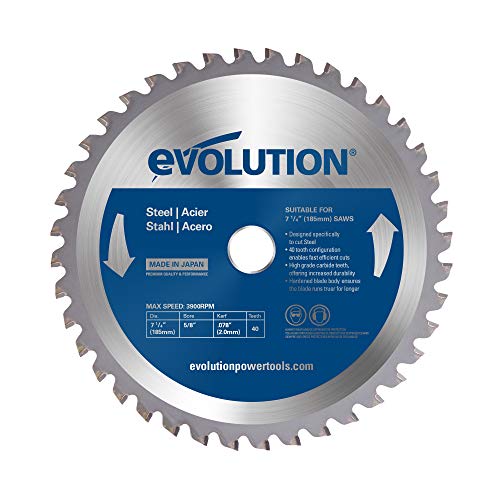
The Evolution 185BLADEST is purpose-built for mild steel cutting on a circular saw, using premium Japanese tungsten carbide teeth and a thin kerf body that minimizes heat and sparks. Field reports confirm clean cuts through 3/16 to 1/2-inch plate steel without burning the metal, allowing immediate handling after the cut.
Its 40-tooth configuration provides a balanced mix of speed and finish quality for structural steel, angle iron, and tubing. The hardened steel body reduces vibration during longer rip cuts, and the blade stays effective for multiple full-length cuts on 1/4-inch plate before needing replacement.
Users note that this blade requires a saw capable of lower RPM operation to achieve its quoted performance — standard 5,800+ RPM circular saws will dull it faster. It works exceptionally well in Evolution’s own metal-cutting saws but can be used in any saw that accepts a 7-1/4-inch blade with a 5/8-inch arbor.
Why it’s great
- Produces virtually no sparks and cool cuts
- Thin kerf design reduces material waste
Good to know
- Designed for mild steel only — not for galvanized or hardened steel
- Best performance requires a low-RPM metal-cutting saw
2. Diablo Steel Demon D0748CF

The Diablo Steel Demon uses Cermet II carbide, a ceramic-metal composite that holds an edge longer than standard carbide when cutting alloy steel, iron, and thicker gauge metal. The 48 TCG tooth geometry produces clean, burr-free edges and leaves the cut metal cool enough to touch seconds after the pass.
Laser-cut stabilizer vents reduce vibration and noise during operation, which translates to less operator fatigue on large jobs. The Perma-Shield non-stick coating prevents gumming and corrosion, though the primary performance driver is the Cermet II material, which handles repeated cuts through 1/4-inch Corten steel without immediate dulling.
Customers report cutting 3-inch schedule 40 galvanized pipe and multiple steel door sections with consistent results. The blade does require a steady feed rate — forcing it through thick stock can cause tooth loss, but with proper technique it outperforms standard carbide-ferrous blades by a wide margin.
Why it’s great
- Cermet II teeth deliver exceptional edge retention on alloy steels
- Cool, spark-reduced cuts with low vibration
Good to know
- Jamming or fast feeding can break teeth
- Designed for 7-1/4 inch saws with 5/8-inch arbor
3. Oshlun SBF-080048

The Oshlun SBF-080048 is an 8-inch 48-tooth cold-cut blade optimized for mild steel and ferrous metals, with a diamond knockout arbor that fits both 5/8 and smaller spindles. Professional-grade C-6 carbide tips and laser-cut expansion slots allow the blade to handle the thermal stress of continuous cuts without warping.
It fits Milwaukee 8-inch saws and most 8-1/4-inch circular saws, and is rated for a max RPM of 5,800, reinforcing its cold-cut design philosophy. Users report clean cuts through 1/4-inch steel plate, acrylic sheet, and light aluminum up to 0.063 inches, making it versatile for metal fabrication shops that switch materials frequently.
One customer noted a tooth shedding early on a single blade, but the majority report it lasting near the lifespan of more expensive Freud or Lennox blades, at roughly half the price. Resharpening costs around , adding further value for frequent users.
Why it’s great
- Diamond knockout adapts to different arbor sizes
- Laser-cut slots manage heat during long cuts
Good to know
- Not designed for hardened or high-carbon steel
- Some units may have inconsistent tip durability
4. TOMAX TMA10801

The TOMAX TMA10801 is a 10-inch, 80-tooth TCG blade specifically made for aluminum, plastic, and non-ferrous metals on miter, table, and circular saws. Its high tooth count delivers a near-polished finish on extrusions and angle stock, with minimal burring that cuts down secondary deburring time.
Construction-grade carbide and an electrophoretic coating resist rust and corrosion, which is especially valuable in humid shops or when cutting wet materials. Ripping 1/4-inch aluminum plate on a table saw produces clean edges, though users report increased vibration compared to a miter saw setup, so clamped workpieces are recommended.
This blade also handles schedule 80 PVC conduit without melting the material, leaving smooth, clean edges. The 5/8-inch arbor fits most standard saws, but the 10-inch diameter requires a saw with sufficient blade clearance.
Why it’s great
- Buttery-smooth finish on aluminum extrusions and PVC
- Coating prevents rust in moist environments
Good to know
- Not for ferrous metals like steel or iron
- Label orientation on the blade can be confusing during setup
5. Benchmark Abrasives Cut Off Wheels

The Benchmark Abrasives 4.5-inch cutoff wheels are a bulk-pack abrasive disc option for angle grinders, designed for cutting metal, stainless steel, cast iron, and rebar. The thin .040-inch profile minimizes kerf loss and allows quicker cuts through bolts, pipes, and thin plate compared to thicker grinding wheels.
Each wheel is reinforced with fiberglass mesh and balanced for low vibration up to 13,300 RPM. Professional welders report that a single wheel lasts as long as four to five budget store wheels and that they are less prone to explosive fragmentation when pinched or twisted during aggressive cuts.
The 25-pack price lands below the cost of five equivalent wheels from big-box stores, making it a clear choice for high-volume cutting where minor spark generation and burrs are acceptable trade-offs for speed and cost efficiency.
Why it’s great
- Longer lifespan than typical budget abrasive wheels
- Thin kerf reduces material and wheel waste
Good to know
- Abrasive discs produce sparks and heat — not for precision finish cuts
- Not suitable for hardened steel or thick plate over 1/4 inch
6. LEILUO 12-Inch Reciprocating Blade

The LEILUO 12-inch reciprocating blades are made from food-grade stainless steel, built for cutting frozen meat, bones, turkey, and ice blocks on a Sawzall. The 3 TPI aggressive tooth design clears meat debris quickly, preventing clogging that would stall the blade on denser materials.
Each blade features a universal 1/2-inch shank that fits most major reciprocating saw brands. The smooth, coating-free surface is safe for direct food contact and easy to rinse clean after use, making it a specialized tool for butchering, game processing, and large-volume kitchen prep.
Users report that the blades are very sharp out of the box and cut through partially frozen meat cleanly. However, some users mention that the tang that locks into the saw can break if the blade is torqued sideways on dense bones, so straight-line feeding is important.
Why it’s great
- Food-grade stainless safe for direct contact with meat
- Aggressive 3 TPI cuts through bone without clogging
Good to know
- Not for general construction or ferrous metal cutting
- Tang can snap if excessive side pressure is applied
7. Hoiuter Indestructible Disc 2.0

The Hoiuter Indestructible Disc 2.0 is a 4-inch, 12-tooth diamond-coated disc for angle grinders that claims to cut metal, tile, ceramics, wood, and marble. It uses a high-manganese steel matrix with a brazed edge, designed for demolition and light fabrication where you might switch between materials on a single job.
On steel up to 20mm thick (thin-walled pipe, angle iron, square tube), the disc cuts quickly with less vibration than standard abrasive wheels. Users confirm clean cuts through rivets, bolts, and barbed wire, making it a decent option for dismantling and recycling metal components.
A critical limitation is that the disc burns wood rather than cutting it, despite the listing claiming wood compatibility. It also has a shorter usable lifespan than dedicated abrasive discs on heavy steel. For the three-pack price, it is a serviceable emergency tool for mixed materials, but not a replacement for a dedicated steel-cutting blade.
Why it’s great
- Low vibration on angle grinders during metal cutting
- Can cut thin steel, tile, and ceramics without changing tools
Good to know
- Does not cut wood — burns it instead despite claims
- Short wear life compared to dedicated abrasive discs on steel
FAQ
Can I cut steel with a regular wood-cutting blade?
What is the difference between an abrasive cutoff wheel and a cold-cut blade?
Final Thoughts: The Verdict
For most users, the blade for cutting steel winner is the Evolution Power Tools 185BLADEST because it delivers cool, burr-free cuts on mild steel plate with virtually no sparks at a reasonable price point. If you need Cermet II durability for alloy steel and irregular cutting conditions, grab the Diablo Steel Demon D0748CF. And for high-volume angle grinder work on demolition projects, nothing beats the value of the Benchmark Abrasives Cut Off Wheels bulk pack.