
Our readers keep the lights on and the weekend projects moving. As an Amazon Associate, I earn from qualifying purchases.
Bonding aluminum to aluminum without a welder used to mean accepting a weak, temporary patch. The latest structural epoxies and urethanes have changed that, delivering bonds that in many applications exceed the tensile strength of the parent metal itself. Choosing the right product means understanding shear strength, working time, and surface preparation down to the grit count on your sandpaper.
I’m Rikta — the co-founder and writer behind FitlyFast. I have spent countless hours analyzing chemical formulations, tensile and compressive strength test data, and real-world repair outcomes across automotive, marine, and industrial applications to compile this guide.
Whether you are repairing a cracked engine bracket, bonding an automotive body panel, or sealing a leaking boat hull, this analysis of the best adhesive for aluminum to aluminum will show you exactly which compound to trust for each specific job.
How To Choose The Best Adhesive For Aluminum To Aluminum
Selecting an aluminum adhesive is not about grabbing the strongest tube on the shelf. The real decision hinges on three variables: the mechanical load the joint will bear, the temperature it will endure, and the working time you need to position the parts correctly. Ignoring any one of these leads to a failed bond.
Match the Strength to the Application
Tensile strength ratings between 3,500 and 5,020 PSI are common for consumer-grade epoxies and are fine for non-structural repairs like filling casting voids or patching radiators. For load-bearing automotive panels or structural brackets, you need an adhesive that approaches or exceeds the yield strength of 6061 aluminum, which is around 40,000 PSI. No glue hits that number alone, but a properly bonded joint using a urethane structural adhesive can become stronger than a spot weld in shear testing.
Heat and Chemical Resistance Matter
An epoxy that works perfectly at room temperature can soften, creep, or fail entirely near an engine block or exhaust manifold. Check the continuous service temperature rating. Standard epoxies cap out around 250°F, while specialized cold-weld compounds can handle up to 550°F. Similarly, oil and coolant exposure will degrade a standard glue, so look for waterproof and oil-resistant formulations if the repair sits inside an engine bay or marine environment.
Working Time is the Hidden Decider
A fast-setting epoxy with a 5-minute working time is excellent for small, simple patches where you can clamp immediately. For larger panels, alignment-heavy repairs, or vertical applications where the glue must not sag, a system offering 30 minutes or more of open time is non-negotiable. Products like the Mastercool Alum Bond use a thick paste specifically to stay put on vertical surfaces, buying you the time to shape and tool the repair before the cure begins.
Quick Comparison
On smaller screens, swipe sideways to see the full table.
| Model | Category | Best For | Key Spec | Amazon |
|---|---|---|---|---|
| J-B Weld 8281 | Cold-Weld Epoxy | All-purpose heavy repairs | 5,020 PSI Tensile | Amazon |
| Mastercool 90935 | Aluminum-Filled Epoxy | Machinable castings & radiators | 8,600 PSI Compressive | Amazon |
| 3M Panel Bonding 38315 | Two-Part Epoxy | Auto panel & SMC bonding | 47.5 mL Net Fill | Amazon |
| Polymix Metal Bond 60 | Two-Part Urethane | Quarter panel & roof replacement | 200 mL Cartridge | Amazon |
| AOJEL S300 | Cold-Weld Epoxy | 30-min alignment repairs | 392°F Heat Resistance | Amazon |
| 3M Impact Structural 07333 | Structural Epoxy | OEM-grade structural bonds | 200 mL Cartridge | Amazon |
| PLJOFRSHI Metal Glue 3-Pack | Fast-Set Epoxy | Multi-purpose budget repairs | 4,680 PSI Tensile | Amazon |
In‑Depth Reviews
1. J-B Weld 8281 Professional Size Steel Reinforced Epoxy

J-B Weld 8281 is the benchmark that every other aluminum epoxy is measured against. Its 5,020 PSI tensile strength comes from microscopic steel particles suspended in the epoxy matrix, creating a bond that users consistently describe as indestructible. The dark grey cured finish drills, taps, and sands cleanly, making it suitable for applications where you need to thread a hole or smooth a surface after the repair.
The 4-to-6-hour set time is a deliberate trade-off: it forces patience but guarantees the epoxy penetrates porous surfaces and micro-cracks before hardening. Users report successful repairs on leaky rain barrel valves, concrete statues, and cracked aluminum brackets. The 1:1 mix ratio simplifies dispensing, though some tubes arrive with air pockets that reduce the effective volume.
With a temperature ceiling of 550°F and full waterproofing after cure, this epoxy handles engine bay heat and marine moisture equally well. It is the go-to recommendation for anyone who needs one product that covers automotive, household, and workshop repairs without second-guessing compatibility.
Why it’s great
- Highest tensile strength in its class at 5,020 PSI
- Withstands continuous heat up to 550°F
- Drillable, tappable, and sandable after full cure
Good to know
- Requires 15-24 hours for full cure strength
- Tube packaging can contain air pockets reducing usable product
2. Mastercool 90935 Alum Bond Aluminum Repair Compound
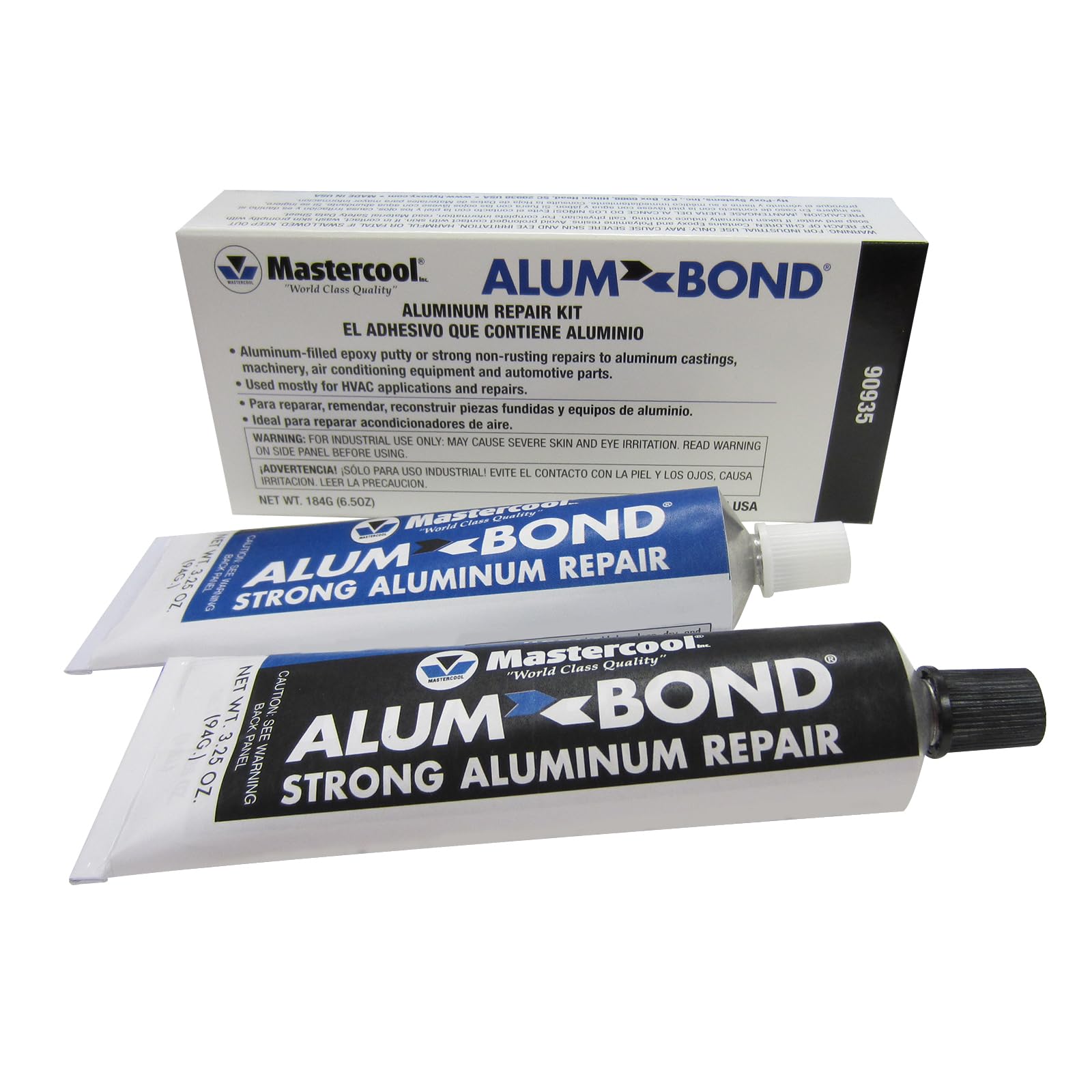
Mastercool 90935 stands apart because it is loaded with a high concentration of actual aluminum particles rather than generic mineral fillers. This gives the cured compound a compressive strength of approximately 8,600 PSI and allows it to be machined, tapped, and drilled with standard tooling — a critical feature when repairing threaded holes or casting surfaces that must match original dimensions.
The non-sag paste consistency is engineered specifically for vertical and overhead applications. Users report using it to seal condenser coils, repair holes in aluminum boat hulls, and patch cracked engine castings. The 250°F continuous heat rating is lower than some competitors, so it is best suited for water-side repairs, HVAC components, and non-engine-block applications.
Working time is generous enough to allow shaping and tooling before the compound sets, but the paste does not slump, which eliminates the need for complex clamping rigs on vertical surfaces. For anyone rebuilding aluminum castings or repairing radiators where machinability is a requirement, this compound is the most targeted solution available.
Why it’s great
- Machinable with standard metalworking tools after cure
- Non-sag formula perfect for vertical repairs
- High compressive strength at 8,600 PSI
Good to know
- Heat resistance limited to 250°F continuous
- Small container size limits large repair areas
3. 3M Panel Bonding Adhesive 38315

3M 38315 is a two-part epoxy specifically formulated for bonding steel, aluminum, SMC, and FRP in automotive panel repair. It uses glass bead technology to ensure consistent bond-line thickness, preventing the joint from becoming gap-starved and weak. The red paste is extremely tacky and grabs immediately — users warn that once the two surfaces meet, sliding them into alignment is nearly impossible, so dry-fitting before application is essential.
The 50 mL cartridge is compact, which is ideal for small repairs like reattaching headlight brackets or reinforcing welded seams, but multiple cartridges are needed for larger panel work. Users pair it with the 3M 08190 manual applicator and 38191 static mixing nozzle for proper dispensing. The 24-hour cure time is standard for this class of adhesive, and the fully cured bond is waterproof and corrosion-resistant.
For technicians working on body panels where welding would burn off coatings or distort the metal, this adhesive provides a clean, strong alternative. It is less suited for gap-filling or thick structural repairs — it is designed for close-fitting panel bonds where shear strength matters most.
Why it’s great
- Glass bead technology ensures consistent bond thickness
- Extremely high tack for immediate grip
- Works on aluminum, steel, SMC, and fiberglass
Good to know
- Very short sliding time once surfaces contact
- Small cartridge size requires multiple units for large panels
4. Polymix Metal Panel Bond 60 Adhesive 200ml Cartridge

Polymix Metal Bond 60 is a two-part urethane adhesive designed explicitly for replacing large automotive body panels — quarter panels, roofs, box sides, and van sides. Unlike epoxies that require precise clamping and minimal movement, urethane-based adhesives offer a longer working window and higher flexibility after cure, which helps absorb vibration without cracking.
The 200 mL cartridge is significantly larger than most epoxy syringes, providing enough material for a full panel bond without needing to swap cartridges mid-job. Each cartridge comes with two mixing nozzles, and the adhesive is self-sealing, meaning it forms a waterproof barrier at the bond line. Users consistently rate it as comparable to premium automotive brands at a lower per-milliliter cost.
Because urethane does not require grinding away welding spots or applying rust-proofing primer to the bonded area, it saves hours of labor on panel replacement jobs. The trade-off is that it is less machinable than epoxy once cured — this adhesive is for bonding, not for building up material for later drilling and tapping.
Why it’s great
- Large 200 mL cartridge suitable for full panel replacement
- Self-sealing waterproof bond line
- Eliminates welding distortion and grinding work
Good to know
- Less machinable than epoxy-based adhesives
- Requires a standard caulking gun for dispensing
5. AOJEL S300 Metal Epoxy Repair System
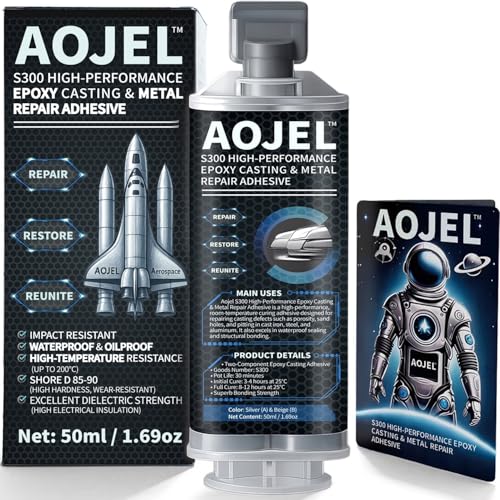
AOJEL S300 differentiates itself with a deliberate 30-minute working time at 77°F — a feature that professional repair crews and serious DIYers value when aligning complex parts, building up thickness on cracked castings, or applying epoxy to vertical surfaces. The slower set allows you to position, clamp, and adjust before the chemical reaction accelerates.
After full cure, the epoxy is waterproof, oil-resistant, and heat-resistant up to 392°F, making it suitable for aluminum crankcase repairs, oil pan patches, and bracket reinforcements in engine compartments. Users report success fixing cracked crankcases on ATVs and separating aluminum patio chair straps, noting that vibration and heat do not degrade the bond over time.
The syringe dispenser plungers received mixed feedback — some users found it difficult to dispense equal amounts of Part A and Part B, especially for small repairs. Pre-dispensing a test amount until both parts flow evenly is advised. For controlled, load-bearing aluminum repairs where you need time to get it right, the S300 delivers on its core promise.
Why it’s great
- Generous 30-minute working time for complex alignments
- Heat resistant up to 392°F after cure
- Waterproof and oil-resistant for engine bay repairs
Good to know
- Syringe plungers can be inconsistent for small dispense amounts
- Requires 24 hours for full load-bearing strength
6. 3M Impact Resistant Structural Adhesive 07333
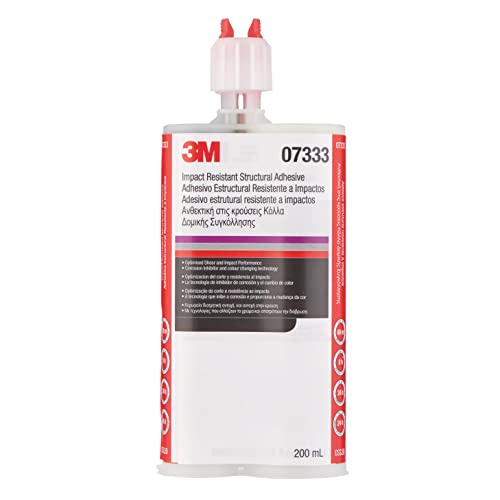
3M 07333 is the adhesive that automotive original equipment manufacturers (OEMs) recommend for structural panel bonding. It delivers higher impact strength than standard bonding adhesives, meaning it absorbs energy without fracturing — a safety-critical property for load-bearing joints in modern unibody vehicles. The adhesive dispenses as a silver paste and transitions to a purple color as it cures, providing a visual indicator that mixing and chemical reaction are proceeding correctly.
The 200 mL cartridge offers substantial volume for full-panel repairs, and the included static mixing nozzle ensures proper 1:1 ratio blending. Users report using it to patch sub-frame rust on classic cars, replace floors without welding, and bond new metal patches to old steel. It can be sanded, ground, and painted after cure, though overheating with a grinder can liquefy the adhesive, so care is needed during finishing.
This is the most expensive option in the lineup, but for applications where safety certification and impact performance matter — such as structural floor replacement or quarter-panel bonding on a daily driver — the cost is justified by the engineering pedigree. It is overkill for simple crack filling or household repairs.
Why it’s great
- OEM-recommended for structural automotive bonding
- Color-change curing indicator for mix verification
- High impact strength for safety-critical joints
Good to know
- Premium price point limits casual use
- Can liquefy if overheated during grinding
7. PLJOFRSHI Metal Repair Glue 3-Pack
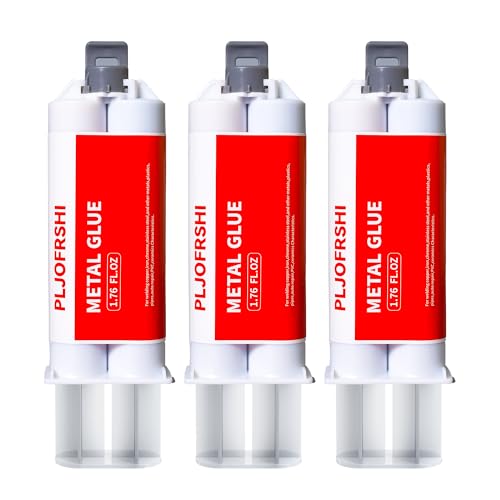
PLJOFRSHI Metal Repair Glue delivers three syringes in one pack at a compelling entry-level price point. Each syringe holds 1.76 oz of a two-part epoxy resin that sets in 5 minutes and cures fully in 24 hours to a tensile strength of 4,680 PSI — respectable numbers for light-duty repairs on aluminum, plastic, wood, and ceramic.
Users report success sealing holes in jeep floors, repairing cracks in bumpers, and bonding motorcycle fairings. The fast 5-minute set time is a double-edged sword: it allows quick repairs but leaves almost no room for repositioning or clamping adjustment, so dry-fitting all parts before mixing is mandatory. The cured color is a neutral gray that accepts spray paint well for cosmetic blending.
The included pusher, scraper, and mixing tools add convenience, but the brand is less established than J-B Weld or 3M, so batch consistency may vary. For budget-conscious users performing non-critical repairs — cracked vases, garden tools, fences — this three-pack provides excellent value and enough material for multiple small jobs.
Why it’s great
- Three syringes included for multiple repairs
- Fast 5-minute set time for quick fixes
- Respectable 4,680 PSI tensile strength
Good to know
- Very short working window — near-immediate set
- Less established brand with potential batch variation
FAQ
How do I prepare aluminum surfaces for the best bond?
Can I use these adhesives on aluminum that will be submerged in water?
Will these adhesives work on aluminum that flexes or vibrates?
Final Thoughts: The Verdict
For most users, the best adhesive for aluminum to aluminum winner is the J-B Weld 8281 because its combination of 5,020 PSI tensile strength, 550°F heat resistance, and machinable finish covers more repair scenarios than any single competitor. If you need a machinable, aluminum-filled compound for casting repairs, grab the Mastercool 90935. And for OEM-grade structural panel bonding where impact strength and corrosion protection are non-negotiable, nothing beats the 3M Impact Resistant Structural Adhesive 07333.