
Our readers keep the lights on and the weekend projects moving. As an Amazon Associate, I earn from qualifying purchases.
Standing over a patchy lawn with a bucket of fertilizer in one hand and a manual spike tool in the other isn’t just inefficient — it’s a waste of a weekend. An aerator spreader combo solves this by punching thousands of holes into compacted soil while simultaneously dropping seed or fertilizer, cutting lawn renovation time in half. The catch: build quality, spread consistency, and towing compatibility vary wildly across models.
I’m Rikta — the co-founder and writer behind FitlyFast. I’ve spent dozens of hours analyzing hopper capacities, tine configurations, gearbox materials, and real owner feedback across the full aerator spreader market to separate durable workhorses from frustrating assembly nightmares.
Whether you are overseeding a half-acre or maintaining a putting-green-quality lawn, choosing the right aerator spreader combo means weighing steel-gauge hoppers against poly construction, spike depth against plug extraction, and transport mode against storage footprint.
How To Choose The Best Aerator Spreader Combo
The best aerator spreader combo for your lawn depends on three factors: how much compacted soil you need to break, whether you tow behind a rider or push manually, and how much seed or fertilizer you want to drop in a single pass. A lightweight unit that flexes on hard clay is as useless as an oversized behemoth that won’t fit through your gate.
Push vs. Tow‑Behind: Which drive style fits your lawn
Push spreader aerators work for lawns up to half an acre where you control the pace and turning radius. Tow-behind models, typically 40 inches wide, attach to garden tractors or zero-turn mowers and cover larger properties faster. Tow-behind units also support weight trays for deeper soil penetration, a feature push models rarely include.
Steel tines vs. plug aerators: Spike depth and soil type
Spike aerators (star-shaped steel wheels) punch solid holes into the soil without removing cores. They’re excellent for overseeding and topdressing on loamy soil. Plug aerators extract actual soil cores, which is essential for heavy clay where compaction runs deep. Most combos in this guide use spike-style tines because the rotating mechanism integrates more easily with a broadcast spreader.
Hopper material and capacity: Poly vs. steel
Polypropylene hoppers resist fertilizer salt corrosion better than painted steel but can flex under heavy loads. Steel hoppers hold up to 100–130 pounds without sagging, but you must rinse them thoroughly after each use to prevent rust. Stainless steel hoppers, found on premium units, offer the best of both worlds — rigid structure and full corrosion resistance.
Gearbox and axle quality: The hidden longevity metric
An enclosed gearbox sealed against moisture and debris extends the life of your spreader by seasons. Look for stainless steel axles and enclosed metal-alloy gears with grease fittings. Open plastic gears exposed to the elements fail within two years, especially if you leave fertilizer sitting in the hopper between uses.
Quick Comparison
On smaller screens, swipe sideways to see the full table.
| Model | Category | Best For | Key Spec | Amazon |
|---|---|---|---|---|
| Brinly AS2-40BH-P | Tow-Behind Combo | Overseeding & aeration in one pass | 132 tine tips, 2″ depth | Amazon |
| Suchtale 40-Inch Tow Spike | Tow-Behind Combo | Budget tow-behind aeration | 9 star-shaped tines, steel | Amazon |
| Chapin 89400C Pull Behind | Pull-Behind Spreader | Large-yard fertilizer application | Stainless steel frame & axle | Amazon |
| Agri-Fab 45-0548 Commercial Push | Commercial Push | Salt/ice melt and heavy use | 130 lb capacity, 13″ tires | Amazon |
| Agri-Fab 45-0614 Push Spread | Push Spreader | High-capacity push spreading | 130 lb, 10–12 ft spread | Amazon |
| Suchtale Compost Spreader | Drop Spreader | Organic compost & peat moss | All-metal, 120 lb load | Amazon |
| Brinly P20-500BHDF-A Push | Push Spreader | Precise edge control | 50 lb, side deflector kit | Amazon |
| Chapin 89200A Push Spread | Push Spreader | Mid-sized lawn broadcast | 80 lb, 12″ pneumatic tires | Amazon |
| Rolling Coring Aerator | Lawn Aerator | Plug aeration (no spreader) | 3″ depth, sand-filled wheels | Amazon |
In‑Depth Reviews
1. Brinly AS2-40BH-P Combination Aerator Spreader

The Brinly AS2-40BH-P is the rare 2-in-1 that actually does both jobs well. Its patent-pending 3-D galvanized steel tines — 132 contact points across eight-inch star wheels — penetrate compacted soil up to two inches deep while simultaneously dropping seed, fertilizer, or lime through the calibrated steel hopper. The included rigid weight tray accepts up to 75 pounds of added ballast for hard-packed clay, a feature missing from most competing combos.
Assembly clocks in around 45 minutes according to owner feedback, with clear instructions and no missing parts. The single-lever transport mode engages the 10-inch pneumatic wheels for crossing driveways without tearing turf, and the universal hitch pin connects to any rider, zero-turn, or ATV. The 100-pound steel hopper does not flex under load, and the enclosed gearbox protects the drive mechanism from moisture and debris.
A handful of reviewers reported the spike agitator slipping on the shaft after initial use, though most confirmed the flow control notch works reliably once dialed in. The plastic wing nut on the adjustment handle can loosen with vibration — a simple c-clamp solves it. For anyone with a half-acre or more who wants to aerate and overseed in a single pass, this is the benchmark unit in its category.
Why it’s great
- Two-inch soil penetration with weight tray support
- Single-lever transport mode protects turf
- Steel hopper resists flex under full loads
- Assembles in under an hour
Good to know
- Spike agitator may slip on shaft initially
- Plastic wing nut on flow control loosens with vibration
2. Chapin 89400C Pull Behind Spreader
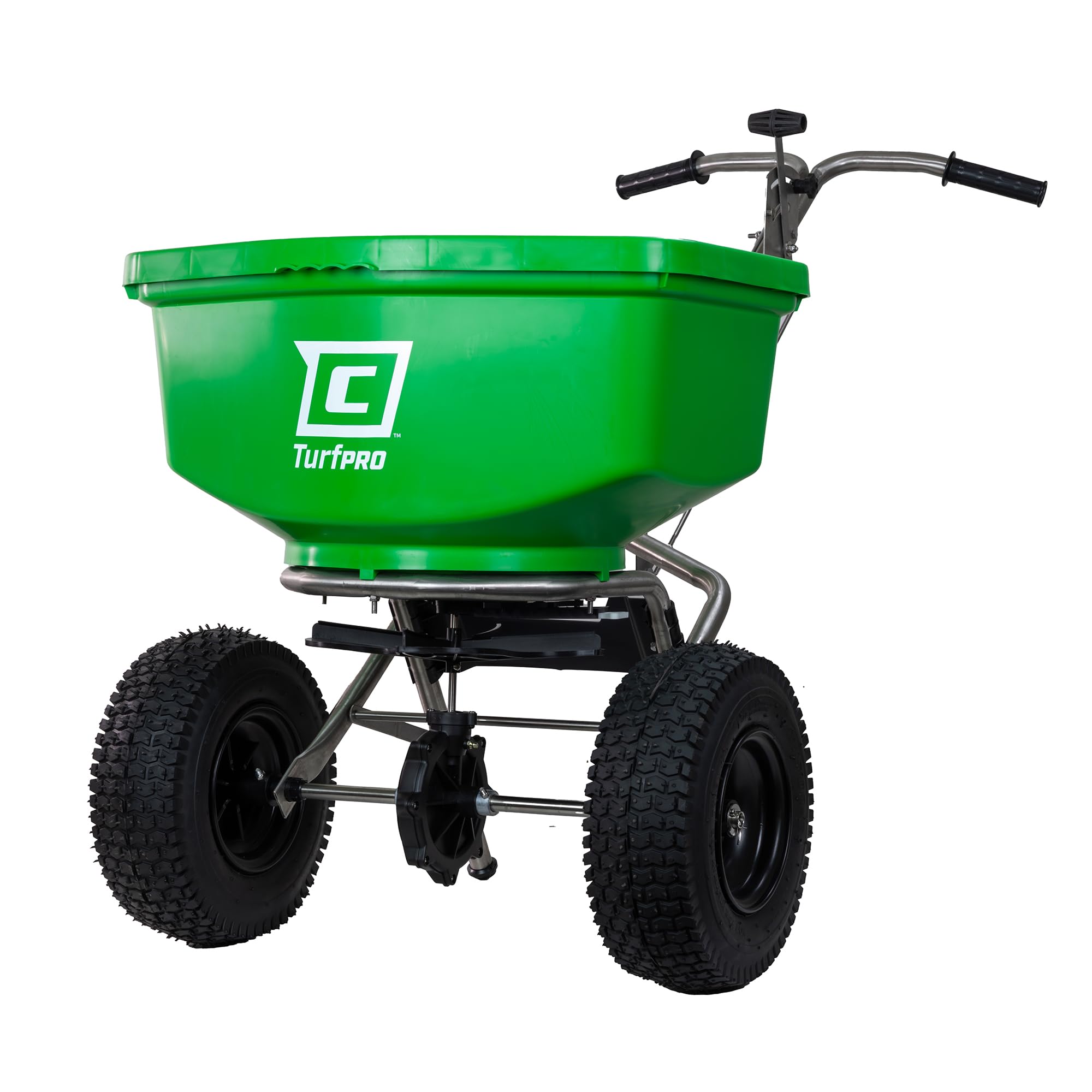
The Chapin 89400C is a buy-it-for-life pull-behind spreader built for contractors and owners of large properties who demand corrosion resistance above all else. The frame, axle, gears, and gate link arm are all stainless steel — a spec that matters when you leave fertilizer in the hopper overnight or store the unit in a damp shed. The enclosed metal-alloy gearbox with a grease fitting seals out moisture far better than the open plastic gears found on budget alternatives.
The 100-pound poly hopper resists fertilizer salt damage while the cast zinc-plated agitator breaks up clumps before they reach the gate opening. With a directional spread pattern control, you can steer material precisely away from flower beds or driveways. The slide-adjust lever gives infinitely variable gate openings, and the ergonomic T-shaped handle with rubber grips reduces fatigue during long sessions. The 12-inch pneumatic turf tread tires roll smoothly over uneven ground without bouncing the spreader plate.
Assembly is the main drawback: expect two to three hours with unclear instructions, and the unit is nearly impossible to build solo. It is also bulky and does not fold for storage. But for anyone who wants to buy one spreader and never replace it, the stainless construction and five-year warranty justify the premium investment.
Why it’s great
- Full stainless steel frame, axle, and gears resist corrosion
- Enclosed gearbox with grease fitting extends lifespan
- Directional spread control for precise application
- Five-year limited warranty
Good to know
- Assembly takes 2–3 hours with poor instructions
- Large footprint; does not fold for storage
3. Suchtale 40-Inch Tow Behind Spiker Seeder
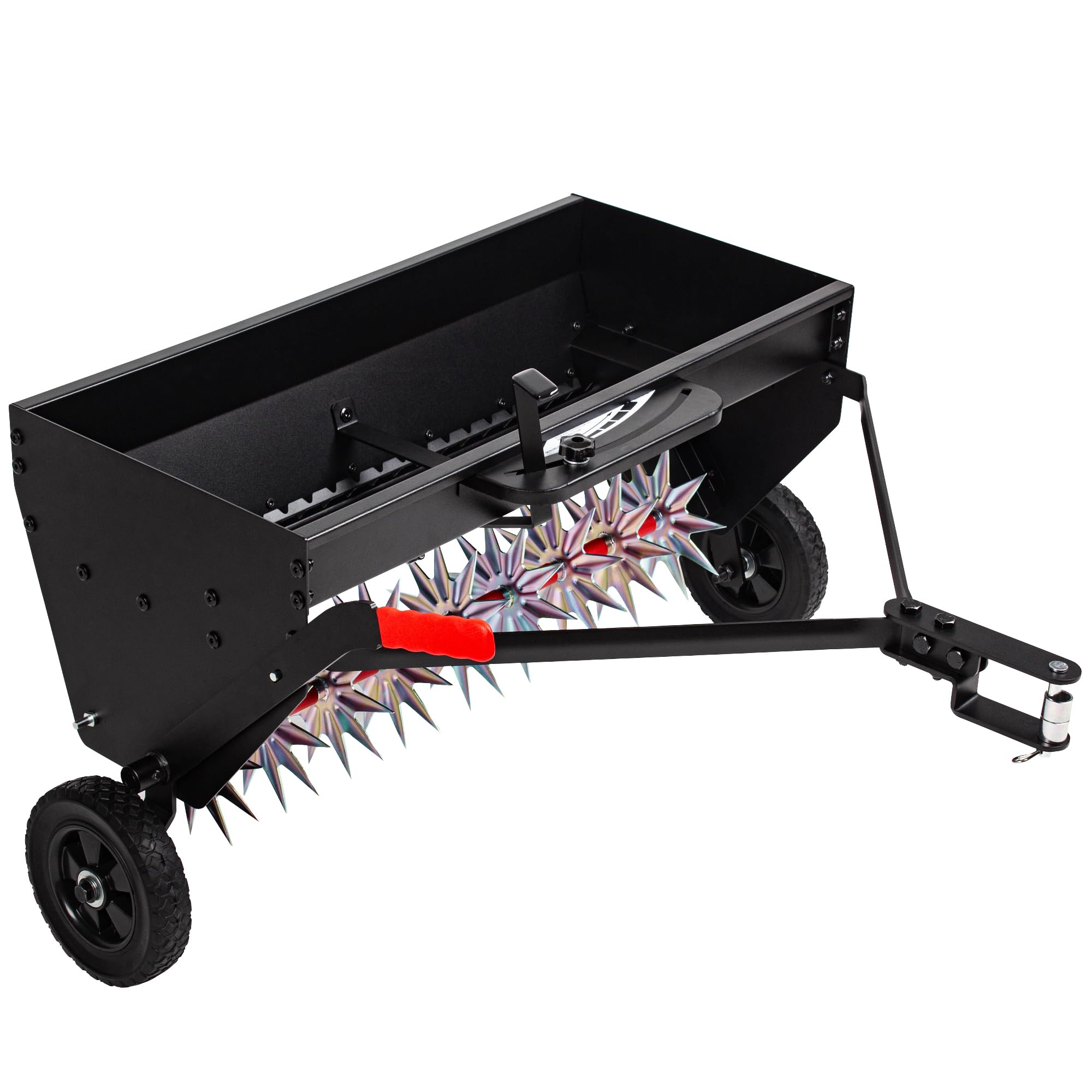
The Suchtale 40-inch tow-behind combines a spike aerator and broadcast spreader at a price point significantly below most branded combos. Its nine star-shaped steel penetrators, each eight inches in diameter with ten curved spikes, rotate independently to create ventilation holes up to two inches deep. The all-steel hopper can hold over 100 pounds without flexing, and the steel agitator inside stirs seeds and fertilizer continuously to prevent clumping at the gate.
The flow control plate features an infinitely adjustable stop device for precise spreading, and the 32-inch spread width covers substantial ground per pass. Owners consistently report that the unit works well once assembled — but assembly is the steepest hill to climb. Reviews describe two to three hours of work requiring a mallet, drilling, and re-drilling holes, with mislabeled parts and insufficient tools supplied. The chain also slips off the sprocket over bumpy terrain, a recurring frustration that some buyers solved by removing the chain and relying on manual agitation.
For the price, the material quality is decent, and the concept is sound. But the assembly experience and chain reliability issues mean this combo is best suited for patient DIYers who know their way around a tool box and are willing to tinker after each use.
Why it’s great
- Very competitive price for a two-function tow-behind
- All-steel hopper with agitator prevents clogs
- Independent star tines adjust to uneven ground
Good to know
- Assembly takes 2–3 hours with poor instructions
- Chain slips off sprocket on bumpy terrain
4. Agri-Fab 45-0548 Commercial Push Spreader

The Agri-Fab 45-0548 is built for punishing environments — specifically ice melt and rock salt application on commercial walkways. The one-inch steel tubing frame, enclosed gearbox, and stainless steel axle and impeller shaft give it the structural integrity to handle 130-pound loads without wobbling. The 13-inch by 5-inch turf tread pneumatic tires roll smoothly over pavement and packed gravel, and the direct steel rod flow control stays put once you set it — a simple but meaningful improvement over plastic levers that drift.
A hopper cover, grate, and deflector kit are all included in the box, adding value for buyers who need to spread fine materials without wind scatter. Several owner reviews highlight excellent spreading performance during the first season, with even distribution across the full 10-foot spread width. The three-year limited warranty provides some peace of mind for commercial users.
Corrosion is the Achilles heel here. Multiple owners report rust forming on the frame within three to four seasons, especially if the unit sits in a damp environment. The wheels and tires are budget-grade Chinese components that wear faster than the rest of the machine. Assembly can also be frustrating — some users had to ratchet-strap the axle to align wheel holes, and a few units arrived missing nuts or cotter pins. For the price, it delivers commercial capacity but requires diligent rinsing and dry storage.
Why it’s great
- 130-pound capacity handles full commercial salt bags
- Enclosed gearbox and stainless axle resist moisture damage
- Direct steel rod flow control stays set
- Includes cover, grate, and deflector
Good to know
- Frame rusts within 3–4 seasons without dry storage
- Assembly can require force and extra hardware
- Chinese tire quality below frame quality
5. Agri-Fab 45-0614 Push Broadcast Spreader

The Agri-Fab 45-0614 is a simple, no-frills push spreader that prioritizes capacity and durability. With a 130-pound hopper that covers roughly 25,000 square feet per fill, this is the unit for owners of half-acre to full-acre lawns who want to minimize refill trips. The 13-by-4-inch pneumatic tires roll through thick grass without bogging down, and the direct rod flow control offers straightforward mechanical gate adjustment — no plastic linkages to break.
The alloy steel frame and polypropylene hopper resist dents and chips, and the spreader plate throws material 10 to 12 feet wide. Several owners note the handle height comfortably accommodates taller users — a welcome detail when you’re pushing a fully loaded unit for an hour. The three-year limited warranty is better than most entry-level spreaders offer.
The drawback is the assembly experience. Instructions are poorly illustrated, with some steps omitted entirely, forcing buyers to consult YouTube videos. The flow control lever feels backward to some users — closing the gate requires a motion that intuitively seems wrong. And when fully loaded with 130 pounds of wet fertilizer, pushing the unit uphill becomes a genuine workout. The balance of capacity and build quality is solid, but be prepared for a frustrating build session.
Why it’s great
- 130-pound capacity covers half an acre per fill
- Large pneumatic tires roll smoothly on turf
- Handle height works well for tall operators
- Three-year limited warranty
Good to know
- Poor assembly instructions with missing steps
- Very heavy to push uphill when fully loaded
- Flow control lever operates opposite to intuition
6. Suchtale Upgrade Drop Spreader

The Suchtale drop spreader fills a niche that most broadcast spreaders ignore: organic compost, peat moss, and flocculent soil amendments that clog standard impeller gates. Its blade mixing mechanism inside the hopper stirs material continuously as you move, preventing the clumping and bridging that plague traditional spreaders when handling wet topsoil or crumbly compost. The flow adjustment port below the drum lets you dial in the drop rate in real time based on the consistency of your material.
The all-metal construction — hopper, frame, and rotating drum — resists rust thanks to a protective surface coating, and the unit ships pre-installed, saving you from the assembly headaches common in this category. A metal pallet inside the hopper supports bulky organic bags, and the open drum design means you can also use it as a garden tool cart for light transport around the yard. The 120-pound load capacity is sufficient for most suburban topdressing projects.
Real-world results are mixed. Owners who spread dry, granular weed-and-feed love it and report smooth operation. Owners attempting to spread wet compost or topsoil found that material clogged immediately and refused to drop, even with vigorous shaking. The small plastic wheels struggle on soft ground when the hopper is full, and the pull-only operation is awkward for shorter users. Buy this if your primary use is dry organic fertilizer; reconsider if your plan involves wet compost.
Why it’s great
- Blade mixing mechanism prevents clumping of organic material
- All-metal construction resists rust
- Ships pre-installed — no assembly
- 120-pound capacity for bulk topdressing
Good to know
- Wet compost clogs the drum easily
- Small plastic wheels struggle on soft turf when loaded
- Pull-only operation awkward for shorter users
7. Brinly P20-500BHDF-A Push Spreader

The Brinly P20-500BHDF-A hits the sweet spot for homeowners with quarter-acre to half-acre lawns who want a sturdy spreader without paying for capacity they do not need. The 50-pound rust-proof poly hopper is more than adequate for a single pass over most suburban lots, and the enclosed gearbox with stainless steel hardware and shaft eliminates the corrosion failures that plague budget alternatives after one season. The 12-by-3-inch pneumatic turf-tread tires roll easily on bumpy terrain and handle light hills without losing traction.
The included side deflector kit is a standout feature at this price point. It flips up and out of the way when not needed, but when engaged it prevents fertilizer from scattering onto flower beds, driveways, or sidewalks — eliminating the need for post-application sweeping. The calibration controls are easy to reach and adjust while walking, though several reviewers note that the spread rate requires experimentation because the manufacturer’s recommended settings are not listed on fertilizer bags. Assembly takes roughly 20 minutes with two wrenches, and the unit arrives mostly pre-assembled.
Some owners wish the handle folded for storage, but the rigid frame is a tradeoff for the price. For a well-built, maneuverable spreader with effective edge control, this Brinly model delivers exceptional value.
Why it’s great
- Side deflector kit prevents waste on hard surfaces
- Enclosed gearbox and stainless hardware resist rust
- Quick 20-minute assembly
- Pneumatic tires roll easily on rough terrain
Good to know
- Handle does not fold for storage
- Spread rate requires calibration experimentation
8. Chapin 89200A TurfPro Push Spreader
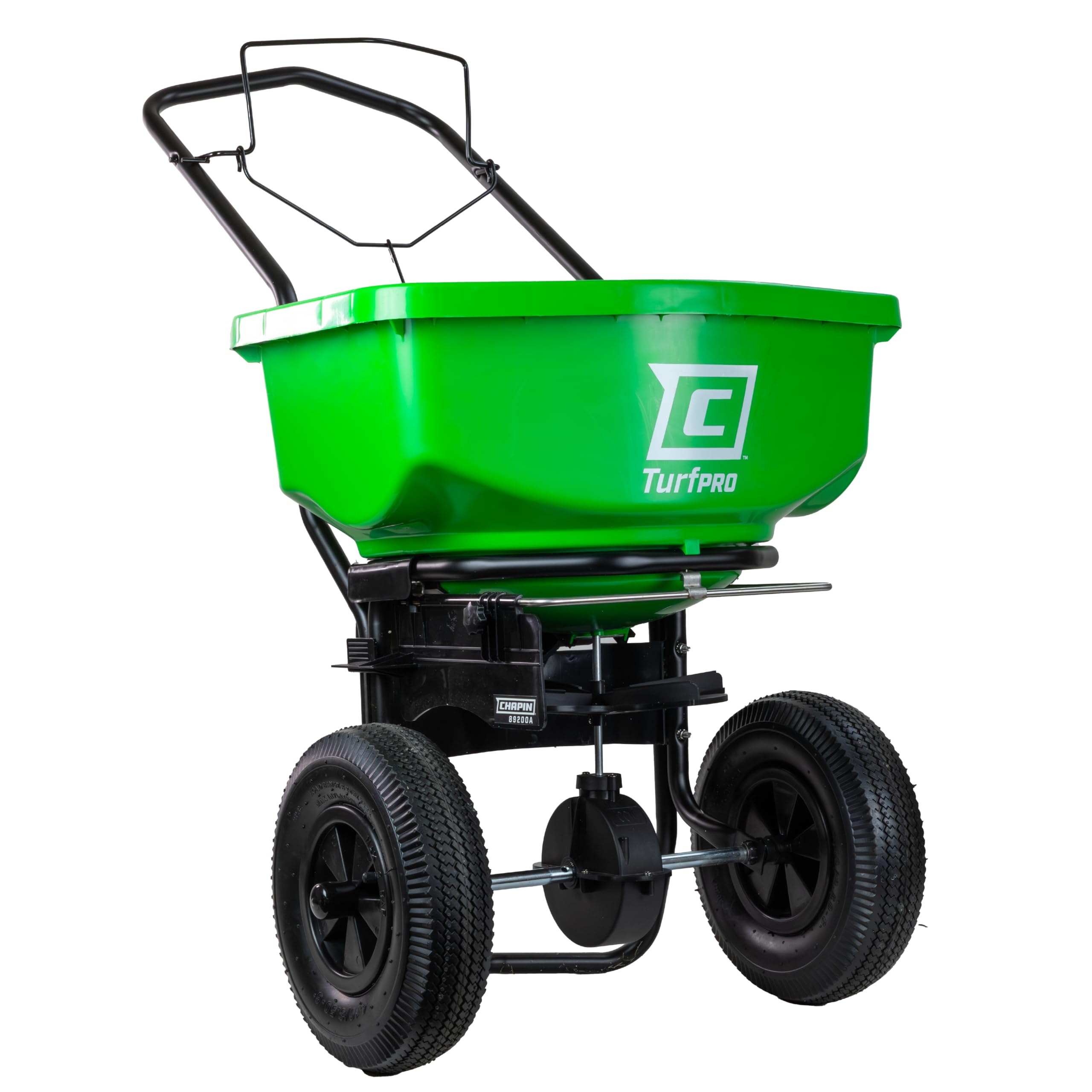
The Chapin 89200A is built for the homeowner who wants contractor-level features without contractor-level pricing. The 80-pound poly hopper is weather-resistant and paired with a spiked auger that actively breaks up clumps before they reach the gate opening — a meaningful upgrade over spreaders that rely solely on gravity feed. The adjustable right baffle gives you precise control over the spread pattern, and the pull-bar lever gate adjustment lets you change the opening on the fly without stopping.
The powder-coated steel frame and enclosed acetal gears handle rough ground well, and the 12-inch pneumatic tires provide traction on hills and wet grass without slipping. With a full hopper covering roughly 18,000 square feet, most suburban lawns need just one refill. Owners consistently describe the build as sturdy and the spreading as even, with several predicting a 10-year service life for typical home use. The two-year limited warranty with US-based customer support adds a layer of confidence.
Not all experiences are positive. A notable number of owners report an adjustability flaw with the gate mechanism — for very small settings, the door does not open enough to release material consistently, making the unit effectively unusable for fine seed. A few units arrived as clear field returns with missing bolts and misaligned axles. For standard fertilizer applications on medium-sized lawns, this is a strong mid-range choice, but inspect the unit promptly upon delivery.
Why it’s great
- Spiked auger breaks clumps before they reach the gate
- Adjustable baffle for precise spread pattern control
- Including 12-inch tires with good traction
- Two-year warranty with US support
Good to know
- Gate adjustability flawed for very small settings
- Some units arrive as field returns with missing parts
9. Rolling Lawn Coring Aerator
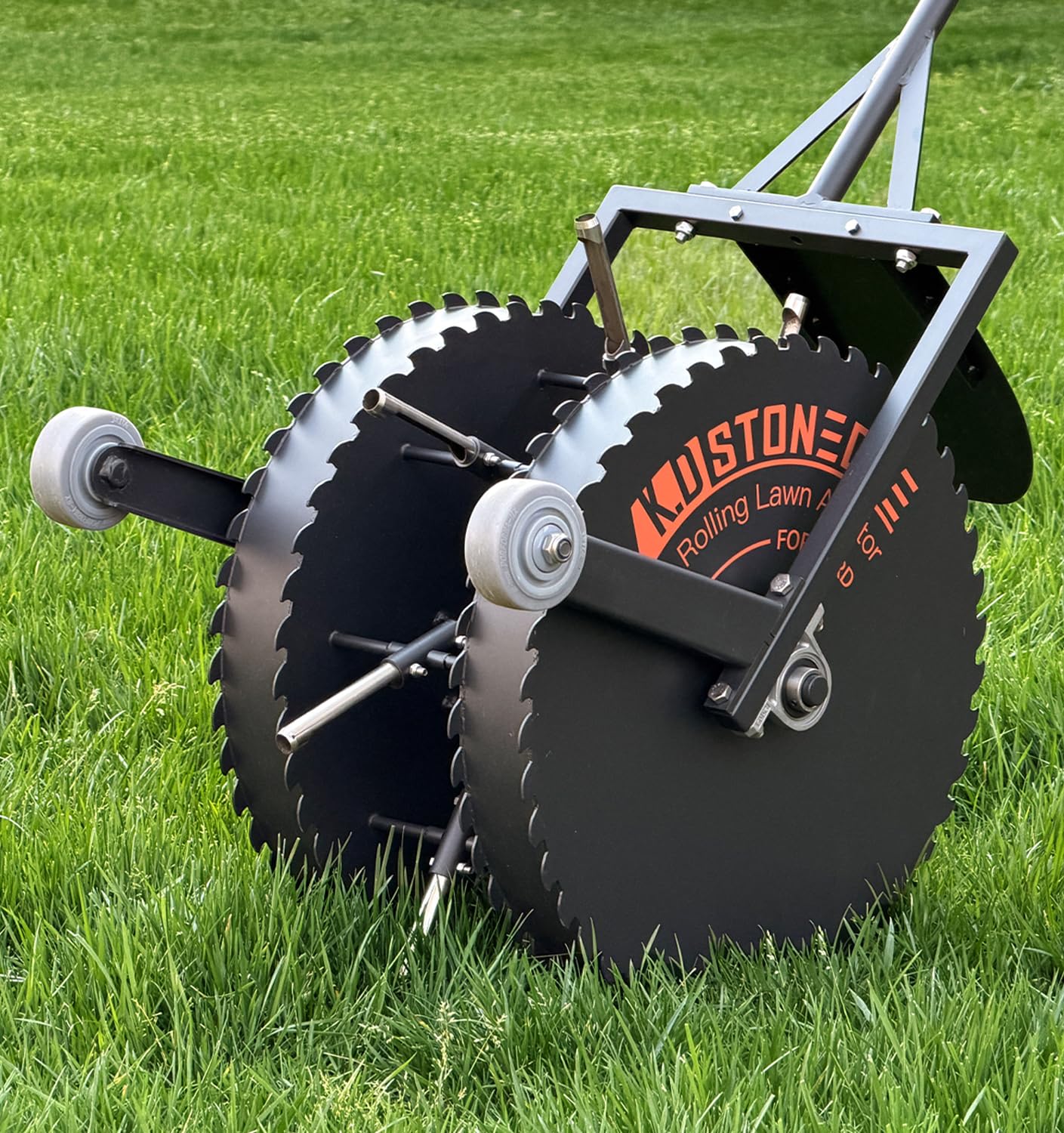
This rolling coring aerator is a dedicated plug aeration tool, not a spreader combo — but it earns a place in this guide because many buyers looking for an aerator spreader combo also evaluate standalone aerators. The design is straightforward: a drum with hollow tines that punch into the soil and extract 2-to-3-inch plugs as you roll it forward. The hollow wheels accept sand ballast (about 50 pounds per wheel) to increase penetration weight, and the spring-loaded tine mechanism prevents turf tearing when you lift the handle.
Owner feedback is polarized but informative. On moist, recently watered soil, the aerator produces deep, clean plugs and covers a quarter-acre in about two hours. The construction is solid enough to handle roots and varied soil types without bending tines. Assembly takes about 20 minutes — the instructions are poor, but the unit is simple enough to figure out without them. The price is a fraction of what a lawn service charges for a single aeration treatment.
The downsides are real. On dry, compacted clay, the tines barely scratch the surface, making the unit nearly useless without pre-watering. Filling the wheels with sand is awkward due to the angle of the fill holes, and the 80-pound filled weight makes maneuvering on concrete or carrying through gates difficult. The single row of tines means you need multiple passes to achieve full coverage, and turning the unit at the end of each row is cumbersome. For soft, loamy lawns, this is a solid budget-friendly aeration tool; for heavy clay, look for a unit with more aggressive tine design or the ability to add weight plates directly.
Why it’s great
- Extracts deep plugs (2–3 inches) in moist soil
- Spring-loaded tines prevent turf tearing
- Cost-effective alternative to professional aeration
- Simple assembly with minimal tools
Good to know
- Ineffective on dry compacted clay without pre-watering
- Filling wheels with sand is awkward and messy
- Single-row tines require multiple passes
- Cumbersome to turn and transport
FAQ
Can I use an aerator spreader combo on wet soil without causing ruts?
How do I prevent the spreader from clogging when using organic compost?
Why does my spike aerator skip over hard ground instead of penetrating?
Final Thoughts: The Verdict
For most users, the aerator spreader combo winner is the Brinly AS2-40BH-P because it combines genuine two-inch soil penetration with a calibrated steel hopper, transport mode, and a weight tray — all in a tow-behind format that works with any rider or zero-turn mower. If you want corrosion-proof build quality and plan to keep the unit for a decade, grab the Chapin 89400C. And for a budget-friendly push spreader that still includes a side deflector and enclosed gearbox, nothing beats the Brinly P20-500BHDF-A.