
Our readers keep the lights on and the weekend projects moving. As an Amazon Associate, I earn from qualifying purchases.
Cheap speakers lie. They boost the bass to sound exciting in a showroom, but that hype falls apart the moment you try to balance a vocal track or place a kick drum in a mix. Affordable studio monitors are built to do the opposite—they reveal flaws so you can fix them before your track leaves the room.
I’m Rikta — the co-founder and writer behind FitlyFast. I spent hundreds of hours cross-referencing frequency response graphs, amplifier specs, and real user reports to find the monitors that deliver honest sound without draining your budget.
After combing through dozens of models and thousands of verified reviews, I built this guide to the affordable studio speakers that actually translate to better mixes.
How To Choose The Best Affordable Studio Speakers
Not every budget monitor delivers a flat response. Many entry-level models hype the low end to mask cheap drivers, which tricks casual listeners but sabotages mix translation. The following factors separate reference-grade monitors from glorified multimedia speakers.
Frequency Response and Flatness
The most critical spec is how evenly the speaker reproduces sound across the audible spectrum. A monitor rated 52Hz–30kHz ±3dB gives you a much truer picture than one with a vague 50Hz–20kHz rating. Wider tolerance usually means uneven mids or exaggerated highs that create phantom problems in your mix.
Woofer Size and Room Fit
A 5-inch woofer is the sweet spot for most home studios. It delivers enough low-end extension for critical listening without exciting room modes in an untreated space. Four-inch woofers can work for nearfield desktop use but often roll off below 80Hz, making a subwoofer necessary for bass-heavy genres.
Amplifier Class and Power
Class-D amplifiers are common in this price range because they run cool and pack surprising wattage into a small cabinet. Look for at least 15–25 watts per channel RMS for a small room. Bi-amped designs, where separate amps drive the woofer and tweeter, usually provide cleaner headroom and less distortion at higher volumes.
Input Flexibility
Balanced connections like XLR or ¼-inch TRS reject electrical noise better than unbalanced RCA, especially when your monitor cable runs near power strips or computer gear. Balanced TRS and RCA inputs give you room to grow without replacing speakers when you upgrade your audio interface.
Quick Comparison
On smaller screens, swipe sideways to see the full table.
| Model | Category | Best For | Key Spec | Amazon |
|---|---|---|---|---|
| Yamaha HS5 (Pair) | Premium | Mixing & mastering reference | 54Hz–30kHz freq response | Amazon |
| KRK Classic 5 (Pair) | Premium | Bass-heavy genres & producers | Glass-aramid composite woofer | Amazon |
| ADAM Audio T5V (Single) | Premium | Detailed high-frequency work | U-ART folded ribbon tweeter | Amazon |
| JBL 305P MkII (Pair) | Mid-Range | Wide sweet spot & imaging | Image Control Waveguide | Amazon |
| PreSonus Eris E4.5 BT (Pair) | Mid-Range | Desktop nearfield with Bluetooth | 4.5-inch woven composite driver | Amazon |
| Edifier MR3 (Pair) | Mid-Range | Hi-Res versatility & app EQ | 52Hz–40kHz freq range | Amazon |
| Micca RB42 (Pair) | Mid-Range | Passive setup with external amp | 10-element crossover network | Amazon |
| Edifier R1280T (Pair) | Budget | Casual listening & vinyl setups | 42 Watts RMS total power | Amazon |
| Micca PB42X (Pair) | Budget | Desktop vocal monitoring | 15W x 2 Class-D amplifier | Amazon |
In‑Depth Reviews
1. Yamaha HS5 (Pair)

The Yamaha HS5 has earned its place as the benchmark for budget studio monitoring. Its 5-inch cone woofer and 1-inch dome tweeter are driven by a bi-amp system that delivers 45W to the low end and 25W to the highs, producing a frequency response of 54Hz to 30kHz. The emphasis is on sonic purity—no boosted bass, no hyped treble—just the uncolored truth of your source material.
Users upgrading from entry-level monitors consistently report hearing details they missed before, especially in the midrange and stereo image. The rear bass reflex port extends low frequencies without boxiness, though placement a few inches from the wall is recommended to avoid port chuffing. The cabinet is hefty and damped, reducing resonance at higher volumes.
You will need an audio interface with XLR or TRS outputs to feed them properly; there are no RCA inputs. This is the choice for anyone who wants mix translation they can rely on from project to project, and the industry-wide adoption across pro studios confirms the engineering behind it.
Why it’s great
- Extremely flat, neutral sound signature for accurate mixing
- Bi-amp design reduces distortion and improves clarity
- Widely used as a reference standard; mixes translate
Good to know
- No Bluetooth or RCA inputs
- Requires a separate audio interface
- Bass roll-off below 70Hz may need a subwoofer
2. KRK Classic 5 (Pair)

The KRK Classic 5 brings the brand’s signature low-end presence into an affordable, professional package. The lightweight glass-aramid composite woofer is stiff and responsive, delivering clean, tight bass with the optional +2dB boost that many producers rely on for beat-making and electronic genres. The soft-dome tweeter extends up to 35kHz for airy highs without harshness.
What sets these apart from the Yamaha HS5 is the ability to adjust the low-frequency contour to suit your space or taste. The front-firing bass port also makes them easier to place near a wall without muddying the low end. Several users report using them as a mastering reference alongside other monitors to check how bass translates across systems.
The package includes XLR cables and a phone holder, which adds value for producers working with reference apps. The built quality is robust, with a vinyl-wrapped MDF cabinet that minimizes coloration. If your mixes lean toward bass-heavy production, these monitors give you the low-end control you need without breaking the budget.
Why it’s great
- Adjustable low-frequency contour for room tuning
- Glass-aramid woofer provides tight, articulate bass
- Front port design allows flexible placement
Good to know
- Slightly hyped low end compared to truly flat monitors
- XLR-only input; no RCA for consumer gear
- Heavier than comparable 5-inch monitors
3. ADAM Audio T5V (Single)
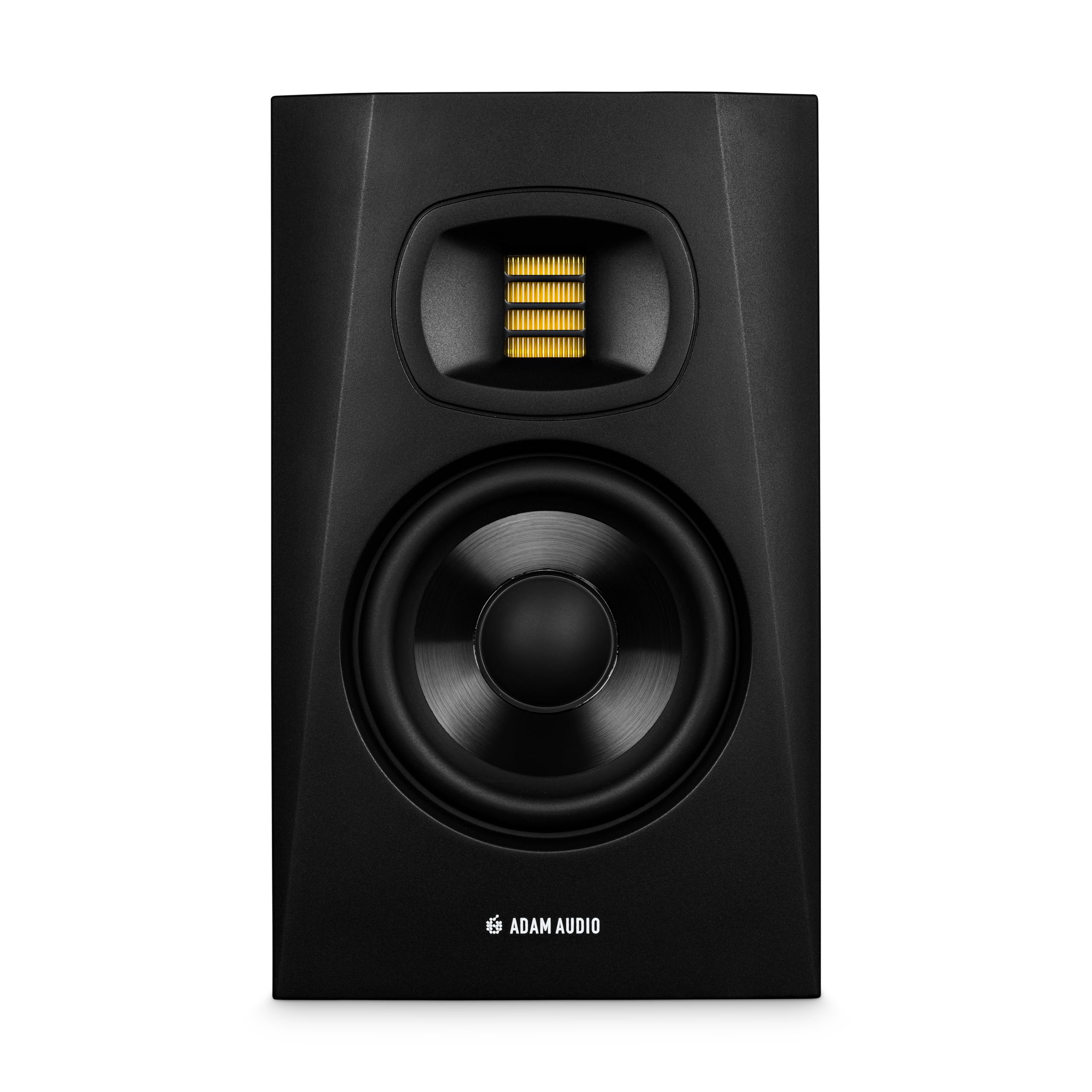
The ADAM Audio T5V is a single monitor that brings Berlin-engineered precision to the affordable segment. Its standout feature is the U-ART folded ribbon tweeter, which moves air far faster than a conventional dome, delivering exceptionally detailed high frequencies with minimal distortion. The HPS waveguide widens the sweet spot so you don’t have to sit glued to one position.
With a 5-inch woofer and a rear-firing bass reflex port, the T5V extends low enough for most critical listening without needing a subwoofer immediately. DSP-based high and low shelf filters let you tune the response to compensate for problematic room acoustics. Users note that the ribbon tweeter reveals sibilance and high-frequency details that dome tweeters gloss over.
You need to buy two of these for a stereo pair, which pushes the total cost higher, but the clarity in the top end is unmatched at this price per monitor. The TRS and XLR inputs allow seamless integration with professional interfaces. Ideal for engineers who need to hear every transient and breath in the mix.
Why it’s great
- U-ART ribbon tweeter delivers unmatched high-frequency detail
- DSP filters for room-specific tuning
- Wide sweet spot from HPS waveguide
Good to know
- Sold individually; stereo pair costs more
- Rear port needs space from the wall
- No Bluetooth or unbalanced inputs
4. JBL 305P MkII (Pair)

JBL’s 305P MkII uses a patented Image Control Waveguide to create a remarkably wide, holographic stereo image that holds together even as you move around your desk. The dual 41-watt Class-D amplifiers give you headroom for dynamic peaks without audible compression, and the Slip Stream port extends bass response smoothly down to 43Hz.
The Boundary EQ switch on the back lets you cut low-end buildup when the monitors are placed near a wall, and the HF Trim tames treble in overly bright rooms. Users upgrading from older multimedia speakers report hearing instruments separate in the mix with new clarity, especially in complex arrangements. The tweeter is clean and detailed without being fatiguing over long sessions.
Inputs are limited to XLR and ¼-inch TRS, which encourages using an interface but keeps the signal path clean. The MDF cabinet is wrapped in a sleek black vinyl that looks professional on any desk. These monitors deliver near-flat response with a slightly more forgiving top end than the Yamaha HS5, making them a strong alternative for long listening sessions.
Why it’s great
- Exceptional stereo imaging and wide sweet spot
- Boundary EQ and HF Trim for room tuning
- High headroom with dual Class-D amps
Good to know
- No Bluetooth or RCA inputs
- Rear port requires some wall clearance
- Slightly larger cabinet than typical 5-inch
5. PreSonus Eris E4.5 BT (Pair)

The Eris E4.5 BT bridges the gap between studio monitoring and everyday desktop use. The 4.5-inch woven composite woofer and 1-inch silk-dome tweeter produce a balanced sound with enough detail for basic mixing, while Bluetooth 5.0 lets you stream from a phone or tablet without plugging anything in. The front-panel headphone jack and auxiliary input make quick connections effortless.
Acoustic tuning controls on the back let you adjust high and low frequencies by ±6dB to compensate for room issues, and the 50W Class AB amplifier provides clean power for nearfield listening. Users describe the sound as clear and articulate with a slightly forward midrange that helps vocals and dialogue cut through. It is not as flat as the HS5, but it is far more convenient for multimedia work.
The bundled Studio One Prime and Studio Magic plugin suite adds significant software value for producers just starting out. If your primary work is editing podcasts, composing with virtual instruments, or enjoying music at your desk, the Eris E4.5 BT offers flexibility without sacrificing accuracy.
Why it’s great
- Bluetooth 5.0 for wireless streaming
- Acoustic tuning controls for room adaptation
- Includes Studio One Prime and plugin suite
Good to know
- 4.5-inch woofer limits low-end extension
- Not as flat as larger studio monitors
- Some users report midrange spike causing fatigue
6. Edifier MR3 (Pair)

The Edifier MR3 brings Hi-Res Audio certification to the affordable monitor category, with a frequency response spanning 52Hz to 40kHz. The 3.5-inch mid-low driver and 1-inch tweeter are powered by an 18W x 2 RMS amplifier, producing a peak SPL of 92.5dB—enough for a small room without strain. The MDF cabinet helps reduce unwanted resonance.
What makes the MR3 stand out is its connectivity. Balanced TRS, RCA, and AUX inputs, plus Bluetooth 5.4 with multi-point connection, let you switch between a studio interface, a phone, and a laptop without swapping cables. The Edifier ConneX app offers further EQ control with Music, Monitor, and Custom presets, giving you more tonal shaping than most competitors in this range.
Reviews consistently praise the clarity at low volumes and the absence of amplifier hiss. The Monitor mode aims for a flatter response, while Music mode adds a slight warmth for casual listening. If you need one pair of speakers that handles both critical monitoring and daily enjoyment, the MR3 is a rare hybrid that succeeds at both.
Why it’s great
- Hi-Res Audio certified for extended high frequencies
- Multiple inputs including balanced TRS and Bluetooth 5.4
- App-based EQ with Monitor and Music presets
Good to know
- 3.5-inch woofer limits low-end weight
- Bluetooth volume control can be finicky
- Not as widely used in pro studios
7. Micca RB42 (Pair)

The Micca RB42 is a passive bookshelf speaker, meaning you need a separate amplifier to drive it. That extra component cost is offset by the quality of the components here: a 10-element crossover with film capacitors and air core coils, a long-throw 4-inch coated paper woofer with a rubber surround, and a 0.75-inch silk dome tweeter. The result is surprisingly deep bass and a warm, non-fatiguing sound signature.
Users consistently describe the bass as defying the 4-inch driver size, delivering weight and punch that rivals small subwoofers in a nearfield setup. The speakers do require around 50–60 watts of clean amplifier power; underpowered amps can cause distortion at higher volumes. The dark walnut finish and magnetic grills give them a furniture-grade look that blends into a living room or office.
These are not self-contained monitors, so they are best for users who already own or plan to buy a stereo amplifier or receiver. If you want the freedom to upgrade amplification later while keeping quality speaker drivers, the RB42 offers a path to better sound without replacing transducers.
Why it’s great
- Exceptional bass extension from a compact 4-inch driver
- High-quality crossover network with film capacitors
- Beautiful dark walnut finish with magnetic grills
Good to know
- Requires a separate external amplifier
- Power-hungry; needs 50W+ for full performance
- Woofer can bottom out at very high volumes
8. Edifier R1280T (Pair)

The Edifier R1280T is an entry-level powered bookshelf speaker that prioritizes ease of use and aesthetic appeal. The 13mm silk dome tweeter and 4-inch full-range driver produce a warm, natural sound that works well for casual listening, vinyl playback, and desktop audio. Dual AUX inputs let you connect two sources simultaneously, and the included remote control adds convenience.
The MDF cabinet with wood-effect vinyl looks much more expensive than it is, and the side-panel bass and treble knobs give you quick tonal adjustment. Reviews note that the bass is adequate for general music enjoyment but lacks the extension needed for critical low-end monitoring. It is a solid choice for a living room or bedroom system, not a mixing setup.
Setup is straightforward—speaker wire connects the passive left speaker to the powered right speaker, and the included cables get you running in minutes. If you are looking for studio-grade accuracy, look elsewhere. But if you want a handsome, affordable pair of speakers for everyday listening with room-filling sound, the R1280T delivers reliable performance.
Why it’s great
- Classic wood-finish design fits any decor
- Dual AUX inputs for multi-device use
- Remote control and side-panel EQ knobs
Good to know
- Limited bass extension; subwoofer recommended
- Not accurate enough for mixing or mastering
- Only unbalanced RCA/AUX inputs
9. Micca PB42X (Pair)

The Micca PB42X packs a balanced woven carbon fiber woofer and a silk dome tweeter into a self-powered bookshelf design. The built-in Class-D amplifier delivers 15 watts per channel, which is modest but clean enough for nearfield desktop use in small to medium rooms. The ported enclosure extends bass response with low distortion, and the highly optimized crossover yields an open, balanced soundstage.
What makes these popular among budget shoppers is the vocal clarity. The midrange is natural and articulate, making them excellent for spoken-word content, podcasts, and vocal-centered music. Treble is detailed but can sound slightly sharp at high volumes until the drivers break in. The bass rolls off gracefully below 80Hz; a subwoofer is needed for bass-heavy genres.
Inputs are limited to RCA, and there is no subwoofer output, so you would need a splitter to add a sub. The supplied cables are adequate, but many users upgrade the speaker wire for a cleaner connection. If your budget is tight and you prioritize clear mids and highs above all else, the PB42X delivers surprising refinement for an entry-level price.
Why it’s great
- Clear, natural midrange and vocal reproduction
- Compact desktop size with magnetic grills
- Woven carbon fiber woofer for fast transient response
Good to know
- No subwoofer output
- Treble can be harsh at high volumes before burn-in
- RCA-only input; no balanced connection
FAQ
Do I need an audio interface for studio monitors?
What is the difference between a studio monitor and a regular speaker?
Should I place studio monitors near a wall?
Can I use studio monitors for watching movies and gaming?
What size studio monitor is best for a small room?
Final Thoughts: The Verdict
For most users, the affordable studio speakers winner is the JBL 305P MkII because it combines wide, holographic imaging with reliable boundary EQ controls and high headroom at a mid-range price. If you want the flattest possible reference for mix translation, grab the Yamaha HS5. And for bass-heavy production with adjustable low-end contour, nothing beats the KRK Classic 5.