
Our readers keep the lights on and the weekend projects moving. As an Amazon Associate, I earn from qualifying purchases.
An affordable TV for gaming must balance a high refresh rate with low input lag and vibrant HDR—three specs that, until recently, were locked behind premium price tags. The latest wave of Mini-LED and QLED panels now delivers 120Hz–165Hz performance and variable refresh rate (VRR) support at prices that don’t require a second mortgage.
I’m Rikta — the co-founder and writer behind FitlyFast. By spending hundreds of hours diving into spec sheets, panel technologies, gaming benchmarks, and real-world user reports across budget, mid-range, and premium tiers, I’ve separated the genuine gaming performers from the marketing fluff.
The following guide cuts through the clutter to help you find the absolute best affordable tv for gaming that won’t sacrifice motion clarity, contrast, or next-gen console compatibility.
How To Choose The Best Affordable TV For Gaming
Finding a TV that excels for gaming on a budget means prioritizing the specs that directly impact responsiveness and visual fluidity. Don’t chase every buzzword — focus on these three pillars.
Refresh Rate: The Number That Defines Fluidity
Native refresh rate is non-negotiable for gaming. A 60Hz panel is a hard pass for anyone playing fast-paced shooters, racing games, or sports titles. Look for a native 120Hz, 144Hz, or even 165Hz panel. These rates allow the TV to display significantly more frames per second (FPS), translating to smoother motion, less blur, and a more responsive feel. Beware of “effective” or “motion rate” ratings—these are often marketing tricks that double or triple the native rate through backlight scanning. Always verify the native panel refresh rate in the technical specifications.
HDMI 2.1: The Gateway to Next-Gen Performance
For the PS5 and Xbox Series X, HDMI 2.1 is essential. This port standard supports the bandwidth for 4K at 120Hz, Variable Refresh Rate (VRR), Auto Low Latency Mode (ALLM), and eARC for lossless audio. VRR eliminates screen tearing by syncing the TV’s refresh rate to the console’s frame rate. ALLM automatically switches the TV into its lowest-lag game mode the moment you launch a game. An affordable gaming TV should have at least two HDMI 2.1 ports to connect a console and a soundbar or PC simultaneously.
Panel Technology: Mini-LED and QLED Offer the Best Bang for the Buck
At the affordable end of the spectrum, OLED TVs are rare. The sweet spot lies with Mini-LED and QLED (Quantum Dot LED) panels. Mini-LED uses thousands of tiny LEDs for precise local dimming, delivering deep black levels and high brightness without the burn-in risk of OLED. QLED enhances color volume and vibrancy. Together or separately, they provide the high brightness needed for HDR gaming and mitigate reflections in brightly lit rooms—a common issue for budget TVs with simpler edge-lit backlighting.
Quick Comparison
On smaller screens, swipe sideways to see the full table.
| Model | Category | Best For | Key Spec | Amazon |
|---|---|---|---|---|
| iFFALCON 55U85 | Mini-LED | Best Overall Value | Native 144Hz / 4x HDMI 2.1 | Amazon |
| TCL QM7K | Mini-LED QLED | High Brightness / HDR | LD2500 Dimming Zones | Amazon |
| Roku Pro Series QLED | QLED Mini-LED | Simple Smart TV Experience | 120Hz / FreeSync Premium Pro | Amazon |
| Amazon Ember Mini-LED | Mini-LED QLED | Seamless Alexa Integration | 144Hz / 512 Dimming Zones | Amazon |
| LG QNED85A | Mini-LED | Alpha 8 AI Processing | 120Hz / VRR 144Hz | Amazon |
| Toshiba Z670R | Mini-LED | Japan-Tuned Processing | Native 144Hz / Dolby Vision IQ | Amazon |
| Sony BRAVIA 2 II | LED | PS5 Exclusive Features | Auto HDR Tone Mapping | Amazon |
| Hisense U7 Mini-LED | Mini-LED QLED | Highest Native Refresh Rate | Native 165Hz / VRR 330 | Amazon |
| LG OLED evo C4 | OLED | Perfect Blacks & Response | 0.1ms Response / 144Hz | Amazon |
| Samsung S90F | QD-OLED | Top-Tier Color & Brightness | 144Hz / NQ4 AI Gen3 | Amazon |
| Sony BRAVIA XR8B | OLED | Best for PS5 & Movies | XR OLED Motion | Amazon |
In‑Depth Reviews
1. iFFALCON 55″ 4K MiniLED Smart TV (55U85)
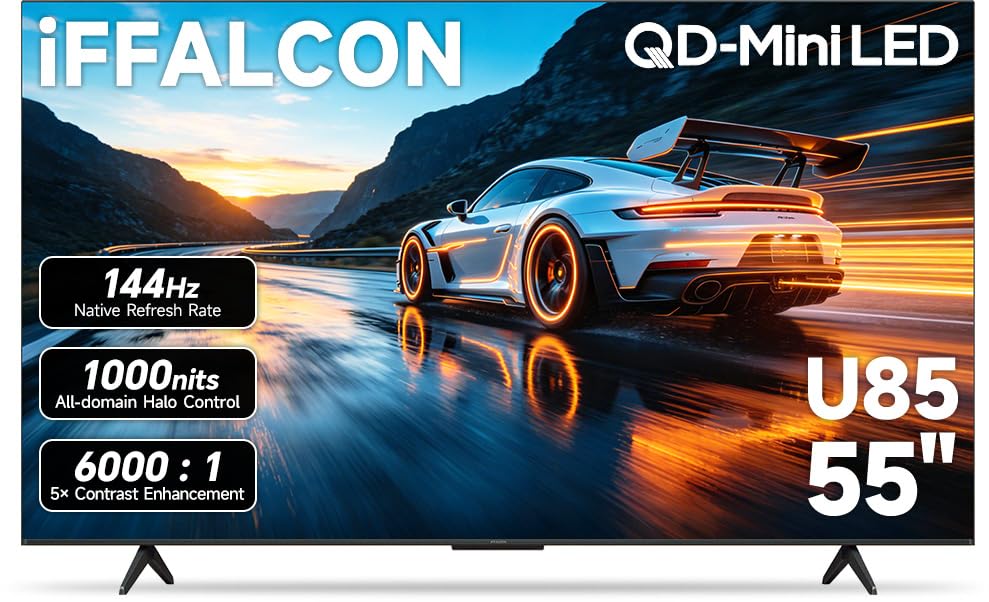
The iFFALCON 55U85 is a remarkable value proposition, packing a native 144Hz Mini-LED panel with VRR up to 288Hz and four HDMI 2.1 ports—a connectivity suite usually reserved for TVs nearly double its price. The 1000-nit peak brightness and 6000:1 contrast ratio, paired with Dolby Vision Gaming and IMAX Enhanced, make Cyberpunk 2077’s neon-lit streets pop while keeping motion blur-free and input lag minimal. The built-in 50W 2.1-channel audio with Dolby Atmos provides convincing directional sound out of the box.
Google TV offers a clean, responsive interface that reviewers consistently praise as faster than competing smart platforms from LG or Samsung. Far-field voice control (Alexa and Google Assistant) works hands-free, and AirPlay 2 support ensures seamless casting from Apple devices. The inclusion of IP/IR control and a hotel mode makes it suitable for hospitality use, but that’s an added bonus rather than a primary gaming feature.
Black levels are excellent for a Mini-LED at this price, though some users noted minor flickering on isolated units. The bezel is slightly thicker than ultra-slim competitors, but the trade-off is a sturdier chassis. For a PS5, Xbox Series X, or PC setup seeking 4K at 144Hz with HDR, this is the single most complete package in the affordable segment. It does not require a soundbar to be enjoyable, though adding one will elevate the experience further.
Why it’s great
- Unmatched connectivity for the price—four HDMI 2.1 ports
- Native 144Hz with FreeSync Premium Pro delivers tear-free gameplay
- Strong built-in audio with Dolby Atmos and a dedicated woofer
Good to know
- Panel brightness may not rival high-end TCL/Hisense Mini-LEDs
- Some units reported flickering, requiring returns
2. TCL 55-Inch QM7K Mini-LED QLED (55QM7K)
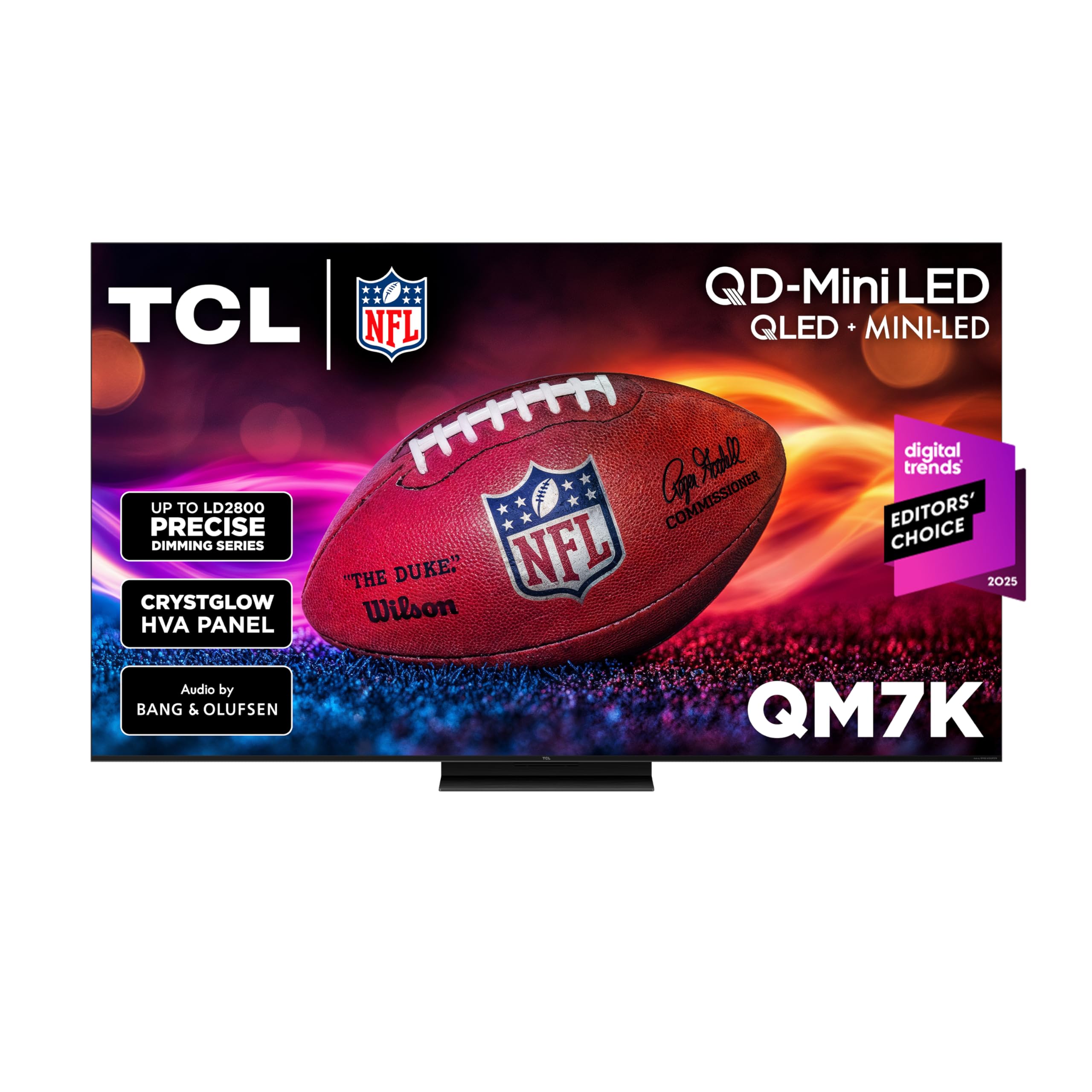
TCL’s QM7K series is a statement of intent in the Mini-LED space. Its QD-Mini LED technology, combined with the Halo Control System and up to 2500 local dimming zones, produces an image with measured black levels that approach OLED territory while maintaining a very high peak brightness for HDR highlights. This makes it ideal for brightly lit living rooms where an OLED would struggle with ambient light reflection. The 144Hz variable refresh rate (CrystGlow HVA panel) handles fast-paced titles like Call of Duty and Forza with zero perceivable ghosting.
The Onkyo-tuned, 2.1-channel audio system with Dolby Atmos is a pleasant surprise—multiple reviewers chose not to add a soundbar thanks to the clear dialogue and robust bass. Google TV runs smoothly, though some bloatware and a cheap-feeling remote are minor complaints. The anti-reflective screen coating works effectively to maintain contrast even with windows behind the viewer.
For gamers who prioritize HDR impact and bright-room performance, the QM7K is a top-tier choice in the mid-range. The main concession is the lack of a 3.5mm audio jack, and the built-in sound, while good, cannot match a dedicated soundbar for cinematic immersion. It is, however, a clear step up in overall picture fidelity from the iFFALCON, justifying its higher price.
Why it’s great
- Excellent local dimming and black levels for a Mini-LED
- Very bright HDR performance; handles glare well
- Surprisingly good built-in audio with subwoofers
Good to know
- Remote feels cheap for the TV’s quality
- Google TV includes some bloatware
3. Roku Smart TV Pro Series 55-Inch QLED
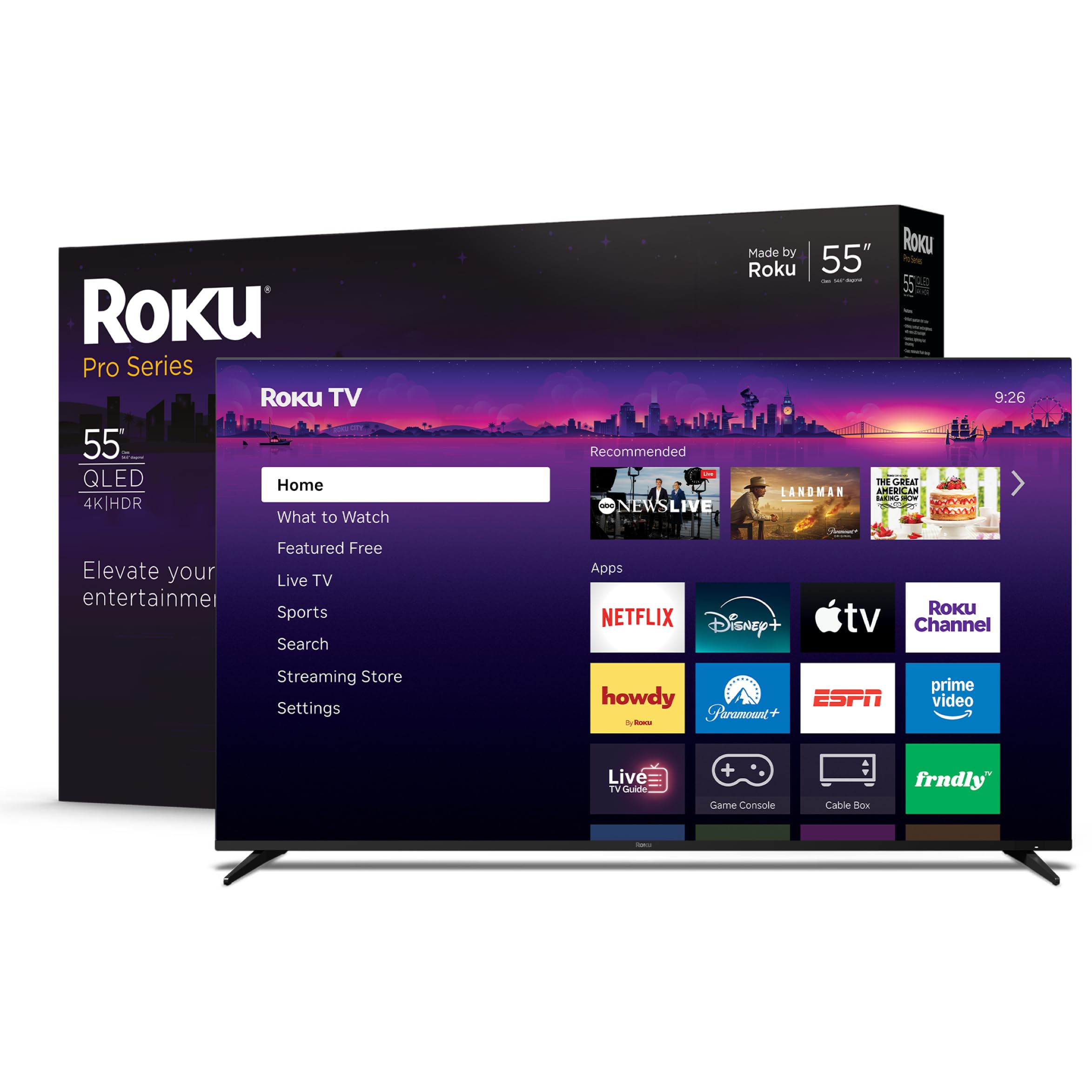
The Roku Pro Series TV prioritizes a frictionless user experience with its Roku OS, widely considered the most intuitive and least bloated smart TV platform. It pairs this with a QLED Mini-LED panel, 120Hz native refresh rate with FreeSync Premium Pro, and Dolby Vision IQ. The 2025 release also includes a backlit, rechargeable Roku Voice Remote Pro, which is a genuinely premium-feeling accessory that eliminates the need for batteries.
Roku’s automatic game mode, VRR, and ALLM support ensure a responsive, tear-free gaming experience. The side-firing speakers create a surprisingly wide soundstage with Dolby Atmos, outperforming many LCD competitors in the same price bracket. The minimalist, bezel-less design is a visual standout, and the Roku Smart Picture Max AI processing cleans up lower-resolution content effectively.
The main drawback is the limited multi-port HDMI 2.1 setup compared to the iFFALCON. While sufficient for a console and a soundbar, PC users may find the port selection restrictive. Some units have reported audio sync issues via eARC after several weeks of use. If the smart TV experience is your priority and you prefer Roku’s ad-light, simple interface, this is the most polished option available.
Why it’s great
- Superior smart platform with zero bloat
- Excellent built-in audio with side-firing speakers
- Premium backlit remote included
Good to know
- Limited HDMI 2.1 ports
- Possible audio sync issues reported after extended use
4. Amazon Ember 55″ Mini-LED Series with Fire TV
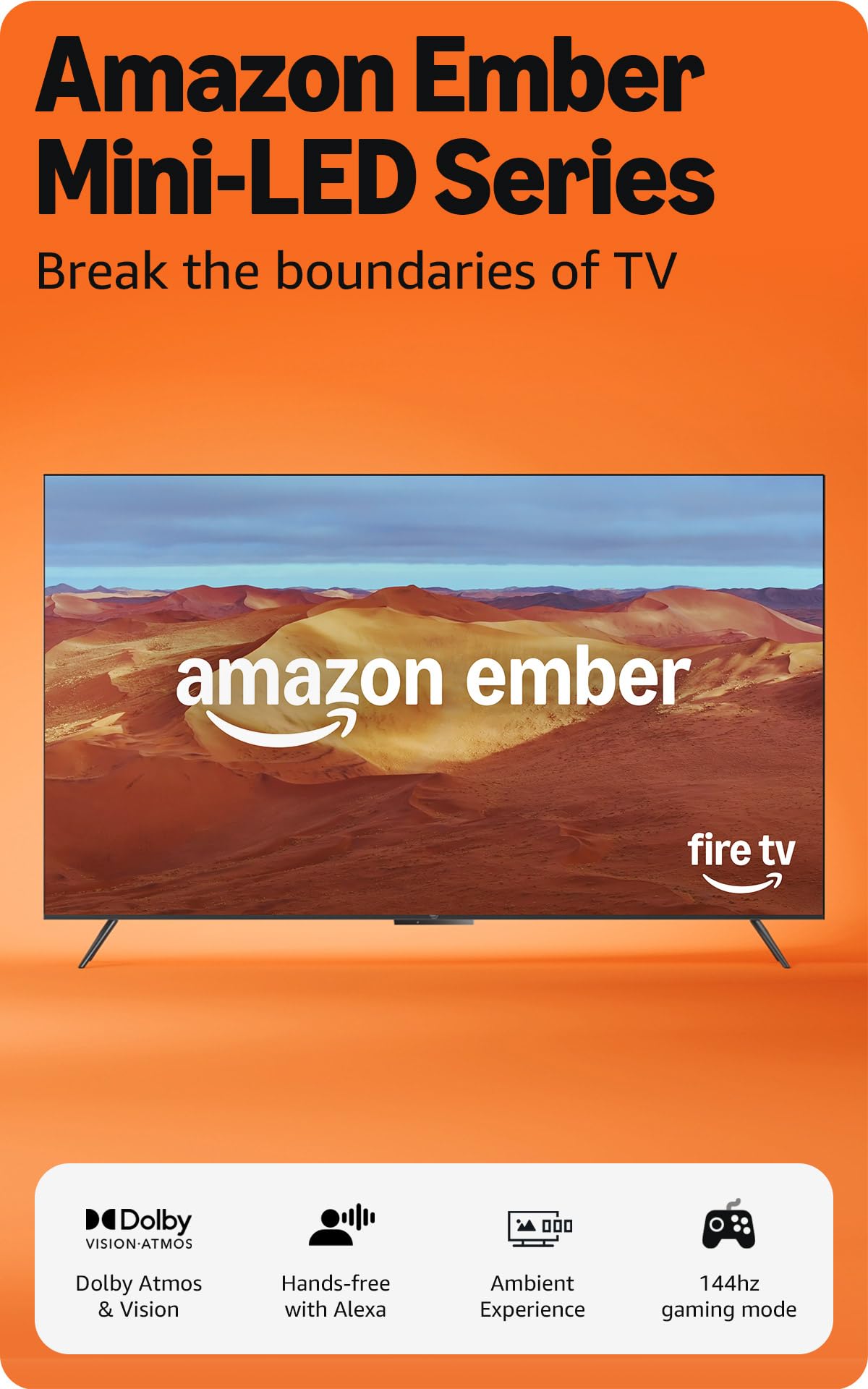
The Amazon Ember Mini-LED series is a 2026 update designed to pair seamlessly with the Fire TV ecosystem. It features a 4K QLED Mini-LED display with 512 dimming zones, peaking at 1400 nits of brightness. The 144Hz panel is AMD FreeSync Premium Pro certified, making it a strong performer for both console and PC gaming. The new Fire TV interface leverages Alexa+ for personalized recommendations and natural voice control, and the “Instantly On” Omnisense sensor wakes the TV as you enter the room.
Picture quality is impressive for the price, with near-OLED black levels and excellent brightness. The 2.1-channel Dolby Atmos sound system delivers robust audio that many users compare favorably to a budget soundbar. The Fire TV software is the main variable—subjectively, some find it fast and feature-rich, while others report slow menus and excessive ads after updates. A FireStick 4K Max can be used as a workaround if the built-in performance degrades.
For those heavily invested in Amazon’s ecosystem (Alexa, Eero, Blink cameras), the tight integration is a major convenience. The hardware is solid, but the software experience’s potential for lag is a gamble. It fills a specific niche: the user who values a single-account, voice-first smart home hub experience as much as the gaming performance.
Why it’s great
- Very high brightness and deep black levels
- Deep Fire TV and Alexa ecosystem integration
- 144Hz with FreeSync Premium Pro for smooth gaming
Good to know
- Fire TV software can become sluggish over time
- Home screen is loaded with ads and recommendations
5. LG 55-Inch QNED evo AI QNED85A (55QNED85AUA)

LG’s QNED85A series brings the company’s acclaimed Alpha 8 AI Processor Gen2 to a more accessible price point. This processor uses AI scene detection to upscale content and optimize picture and sound in real-time. The Mini-LED with Precision Dimming offers better control over light zones than typical edge-lit competitors. It supports a native 120Hz refresh rate, VRR up to 144Hz, and includes LG’s Game Optimizer dashboard for quick access to all gaming settings, including AMD FreeSync and NVIDIA G-Sync compatibility.
The 100% Color Volume from LG’s Dynamic QNED Color technology ensures colors remain vibrant even at peak brightness, and Filmmaker Mode preserves the director’s intent for HDR movies. The built-in 2.0-channel speakers are clear but lack deep bass; LG’s Wow Orchestra feature allows compatible soundbars to sync with the TV’s speakers for a wider soundstage. webOS is a mature platform, though some find the interface slower than Google TV and the remote’s lack of a number pad and dedicated mute button frustrating.
For gamers who also watch a lot of movies and sports, the AI processing is a differentiating factor. The TV excels at cleaning up low-bitrate streams into watchable near-4K quality. The main limitation is the 120Hz panel, which some hardcore PC gamers may find less future-proof than the 144Hz competition, though the VRR at 144Hz on the input side mitigates this somewhat.
Why it’s great
- Excellent AI-powered upscaling and picture processing
- Good gaming features: Game Optimizer, FreeSync, G-Sync
- Vibrant colors with 100% Color Volume
Good to know
- Remote lacks mute button and number pad
- Native refresh rate is 120Hz, not 144Hz
6. Toshiba 55″ Z670R Mini-LED (55Z670R)

Toshiba’s Z670R is a dark horse that delivers a genuinely premium Mini-LED experience. The REGZA Engine ZRi Gen3, fine-tuned by Toshiba’s engineers in Japan, provides scene-by-scene optimization for clarity, contrast, and color that rivals sets from major Korean brands. The 144Hz native panel supports AMD FreeSync Premium, VRR, and ALLM, making it fully compatible with the latest gaming consoles. The REGZA Power Audio Pro system, featuring a dedicated bass woofer, produces room-shaking audio that often eliminates the need for a separate soundbar.
The inclusion of Dolby Vision IQ, HDR10+, and HLG provides total HDR format flexibility. The Fire TV platform is responsive and features a dedicated Alexa button for voice control. The AI Light Sensor Pro automatically adjusts picture settings based on room lighting, reducing eye strain. The design is minimalist, reflecting a refined Japanese aesthetic that sits flush against a wall.
For the price, the Z670R represents an excellent value—in some sales, it undercuts competitors with similar specs. The main drawbacks are the Fire TV interface (which some find ad-heavy) and a Bluetooth version that is version 5.0 rather than the newer 5.4 on some rivals. Overall, if you value refined picture processing from a heritage brand, the Toshiba Z670R deserves serious consideration.
Why it’s great
- Excellent REGZA picture processing for a natural image
- Powerful built-in audio with a dedicated bass woofer
- Full suite of HDR formats: Dolby Vision IQ, HDR10+, HLG
Good to know
- Fire TV interface includes frequent ads
- Bluetooth version is 5.0
7. Sony BRAVIA 2 II 55-Inch (K-55S20M2)

The Sony BRAVIA 2 II is a purpose-built companion for the PlayStation 5, offering exclusive features like Auto HDR Tone Mapping and Auto Genre Picture Mode that optimize HDR and game mode automatically. It uses a 4K Processor X1 to upscale content to near-4K resolution via 4K XR-Reality PRO, and Motionflow XR keeps fast-paced action blur-free. The LED panel delivers respectable brightness and accurate colors, particularly in Sony’s signature skin tone rendering.
The built-in audio is adequate but not class-leading, and the inclusion of Sony Pictures CORE offers a selection of free movies. The Google TV platform is responsive and supports all major streaming apps. The Game Menu conveniently consolidates all gaming picture and assist settings. For PS5 owners, the exclusive features genuinely improve the experience—Auto HDR Tone Mapping ensures games are never washed out, and the TV recognizes the console automatically.
However, the BRAVIA 2 II is an LED TV, not a Mini-LED or OLED, so its black levels and contrast are outclassed by more modern panel technologies in this list. Additionally, some users have reported instability, with the TV freezing or dropping WiFi requiring a hard reset. It is a fantastic choice for a secondary bedroom or office PS5 setup, but the panel technology feels a generation behind the competition at its price point.
Why it’s great
- Seamless PS5 integration with exclusive auto HDR features
- Excellent motion handling and upscaling
- Trusted Sony build quality and ecosystem
Good to know
- LED panel cannot match Mini-LED black levels
- Some units report freezing and WiFi issues
8. Hisense 55″ U7 Mini-LED ULED (55U7SG)
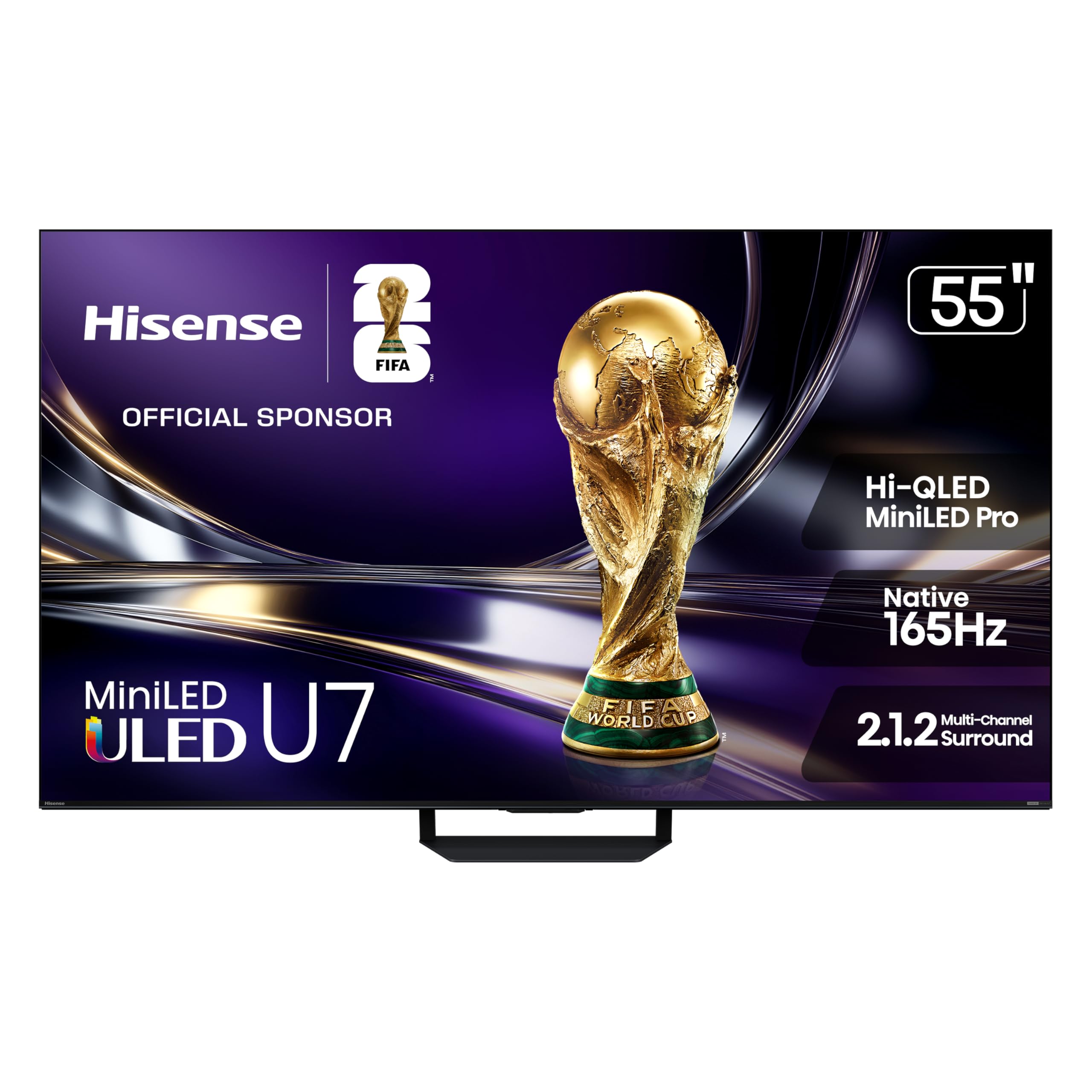
The Hisense 55U7SG is the performance king of the mid-range, offering a native 165Hz refresh rate with VRR up to 330Hz. This is a class-leading spec for competitive PC gamers who prioritize frame rate above all else. The Hi-QLED Mini-LED Pro panel, with up to 3000 local dimming zones and 3000 nits of peak brightness, delivers exceptional contrast, deep blacks, and stunning HDR highlights. The advanced anti-reflection coating makes it a viable option for bright rooms and even outdoor use.
The Hi-View AI Engine Pro processor constantly analyzes scenes to adjust color and contrast, and the 2.1.2-channel sound system with Dolby Atmos produces clear dialogue and impactful bass. Google TV provides a robust app ecosystem. For a 55-inch panel, the 165Hz refresh rate is rare, and the VRR implementation is among the best for reducing tearing in fast-paced shooters like Valorant and Overwatch.
The main concession is value—it occupies a higher price tier. While the U7 delivers performance that competes with upper-mid-range models from Sony and Samsung, it does so at a still-approachable price. Some users find the Google TV interface slightly cluttered, and a soundbar is recommended for the best audio fidelity. For the competitive gamer who needs the highest frame rates and the best HDR brightness, the U7G is the definitive pick.
Why it’s great
- Highest native refresh rate at 165Hz with VRR 330
- Excellent brightness and contrast with many dimming zones
- Strong anti-reflection coating for bright rooms
Good to know
- Higher price point than entry-level options
- Soundbar recommended for full immersion
9. LG 42-Inch OLED evo C4 (OLED42C4PUA)

The LG OLED evo C4 brings the magic of self-lit pixels to a smaller, more affordable 42-inch frame. With over 8 million self-lit pixels, it offers infinite contrast, perfect blacks, and a 0.1ms response time that is unmatched by any LCD technology. It supports a 144Hz refresh rate, G-Sync and FreeSync Premium Pro, and has four HDMI 2.1 inputs. This makes it the ultimate desktop gaming monitor or a dedicated console TV for a bedroom or study.
The a9 AI Processor Gen7 provides excellent upscaling and Dolby Vision support. The webOS platform has improved, though it remains less intuitive than Google TV or Roku. The built-in 2.0-channel speakers are adequate for a small room, but a soundbar is recommended for serious use. The 42-inch size is ideal for PC gaming at a desk, providing a massive field of view without overwhelming the space.
The primary trade-off is real-world handling of ambient light; OLED panels are less bright than Mini-LEDs and can struggle in very bright rooms. Burn-in is a potential long-term concern for static HUD elements, though modern OLEDs have mitigated this significantly. As an entry point into true OLED gaming, the C4 delivers an uncompromising image quality that leaves all LCD-based competition behind in a dark room.
Why it’s great
- Perfect black levels and infinite contrast
- Ultra-fast 0.1ms response time
- Supports G-Sync, FreeSync, and 144Hz
Good to know
- Less bright than Mini-LED, not for bright rooms
- Burn-in risk with static on-screen elements
10. Samsung 55-Inch S90F (55S90F)

The Samsung S90F is a QD-OLED TV that combines the per-pixel lighting of OLED with a quantum dot layer for superior color volume and brightness. The result is a stunning picture that outshines standard OLEDs in both color vibrancy and peak light output. The NQ4 AI Gen3 processor, with 128 neural networks, upscales content to 4K and enhances HDR. It supports Motion Xcelerator at 144Hz, making it a top-tier choice for gaming.
The S90F’s colors are more saturated and realistic than any LCD, and the deep blacks ensure incredible contrast in dark scenes. For gaming, the fast response and 144Hz VRR provide a fluid, tear-free experience. Samsung’s Tizen smart platform includes all major apps but is sometimes criticized for frequent ad prompts. The Q-Symphony feature allows pairing with Samsung soundbars for enhanced audio.
The main draw is the balance—it is an OLED that works better in brighter rooms than standard OLEDs, but it is still not as effective as a high-nit Mini-LED in very bright environments. The build quality is excellent, with a sleek design and thin edges. For the gamer who wants the “best” image quality without going to a reference-grade Sony, the S90F represents the pinnacle of mid-premium performance in the article.
Why it’s great
- Superior QD-OLED color and brightness
- Excellent 144Hz gaming performance
- Top-tier AI upscaling and processing
Good to know
- Anti-reflective coating can be easily damaged
- Smart platform has persistent ad prompts
11. Sony 55-Inch OLED BRAVIA XR8B (K-55XR8B)

The Sony BRAVIA XR8B is the pinnacle of affordable OLED gaming, combining Sony’s legendary XR Processor with over 8 million self-lit pixels. It delivers perfect black levels, and Sony’s XR OLED Motion ensures blur-free motion. It supports Dolby Vision and Atmos, IMAX Enhanced, and DTS:X. The exclusive PS5 features—Auto HDR Tone Mapping and Auto Genre Picture Mode—optimize the console’s output perfectly. The Acoustic Surface Audio+ technology uses the screen itself as a speaker, providing surprisingly clear directional audio.
For the PS5 gamer, this TV is the ultimate companion. Games like Horizon Forbidden West and Spider-Man 2 look and sound incredible, with the HDR tone mapping ensuring that highlights are never crushed or blown out. The Google TV interface is responsive and supports all major streaming apps. The build quality is premium, and the TV is designed for dark room viewing where its contrast excels.
The XR8B’s main limitation is its price, which places it at the top of the “affordable” bracket. It is also a standard OLED, so it does not have the extra brightness of a QD-OLED. For a pure, cinematic gaming experience in a controlled lighting environment, the Sony XR8B is unmatched in this list for motion handling and HDR accuracy.
Why it’s great
- Reference-level OLED image quality for gaming
- Perfect PS5 integration with exclusive features
- Excellent motion handling with XR OLED Motion
Good to know
- Higher price tier among affordable options
- Best reserved for dark room use
FAQ
What is the minimum refresh rate I should accept for a gaming TV in 2025?
Do I need HDMI 2.1 if I only play on a PS5?
Which is better for gaming: Mini-LED or OLED?
Is Dolby Vision Gaming important?
Final Thoughts: The Verdict
For most users, the absolute best affordable tv for gaming winner is the iFFALCON 55U85 because it delivers a native 144Hz panel, four HDMI 2.1 ports, VRR, and excellent built-in audio at an entry-level price, offering the most complete package without compromise. If you want the brightest HDR and deepest black levels for bright room gaming, grab the TCL QM7K. And for the ultimate cinematic gaming experience with perfect blacks and instant response, nothing beats the LG OLED evo C4.