
Our readers keep the lights on and the weekend projects moving. As an Amazon Associate, I earn from qualifying purchases.
African violets are famously picky eaters—feed them the wrong mix and you get lush leaves with zero flowers, or worse, burned roots and drooping crowns. The trick is finding a fertilizer that delivers the right balance of nitrogen (for leaves), phosphorus (for blooms), and potassium (for roots) without overwhelming their sensitive root systems. This guide cuts through the dozens of bottles and powders on the shelf to show you exactly which formulas actually produce more blooms and healthier foliage, and which ones are just repackaged all-purpose plant food.
I’m Rikta — the co-founder and writer behind FitlyFast. This guide is built by comparing the manufacturers’ published specifications and the patterns across verified customer reviews, so you get each pick’s real strengths and trade-offs instead of marketing spin.
Whether you are coaxing a first bloom from a cutting or maintaining a collection of rare varieties, the right african violet fertilizer makes the difference between a plant that survives and one that thrives all year round. I have focused on seven proven formulas that match the specific nutritional needs of Saintpaulia (the botanical name for African violets), so you can feed with confidence.
How To Choose The Best African Violet Fertilizer
African violets have a narrow sweet spot for nutrients. Too much nitrogen and you get a bushy green plant that never flowers. Too little phosphorus and the buds stall before they open. Here is what to watch for when reading the label.
NPK Ratio — The Three Numbers That Decide Everything
The three numbers on any fertilizer label stand for nitrogen (N), phosphorus (P), and potassium (K). For African violets, you want phosphorus to be the highest number because that is what drives blooming. A ratio like 12-36-14 (high phosphorus) is ideal for flowering, while a balanced 3-3-3 is gentler for regular maintenance. Avoid anything with a first number significantly higher than the second (like 20-10-10)—that signals a lawn or foliage formula that will give you leaves but no flowers.
Liquid vs. Powder: Which Form Fits Your Style
Liquid fertilizers are ready to mix and absorb quickly into the soil, which matters if you bottom-water (the safest method for violets). Powders like Jack’s Classic store longer and often cost less per gallon, but you need to dissolve them fully before feeding. Drip-style bottles with a dropper give you precision for single plants, while larger liquid bottles (16 oz or 32 oz) make sense if you have a collection and feed weekly.
Mixing Ratio and Root Safety
African violet roots are thin and delicate—they burn easily if the fertilizer concentration is too high. Every product in this guide lists a mixing ratio (for example, 1 teaspoon per gallon or 5 drops per quart). Always start at the weaker end of the recommended range, especially if you are feeding more than once a week. A gentle formula you can use regularly beats a strong formula you have to skip between waterings.
Quick Comparison
On smaller screens, swipe sideways to see the full table.
| Model | Category | Best For | Key Spec | Amazon |
|---|---|---|---|---|
| Jack’s Classic 12-36-14 | Powder | Maximum blooming | 12-36-14 NPK + micronutrients | Amazon |
| Schultz African Violet Plus 8-14-9 | Liquid | Bottom-watering routine | 8-14-9 NPK, 4 fl oz | Amazon |
| HiThrive 16oz | Liquid | Value per bottle | 16 fl oz, makes 24 gallons | Amazon |
| TPS Nutrients 32oz | Liquid | Large collections | 32 fl oz, gentle formula | Amazon |
| Houseplant Resource Center 3-3-3 | Liquid | Gentle all-year feeding | 3-3-3 NPK + sea kelp | Amazon |
| Bonide 106 | Liquid | Budget entry point | 8 fl oz, 1/8 tsp per quart | Amazon |
| Perfect Plants Drops 2-2-2 | Liquid Drops | Single-plant precision | 4 fl oz, dropper bottle | Amazon |
In‑Depth Reviews
1. Jack’s Classic 12-36-14 African Violet Fertilizer

The single spec that makes Jack’s Classic the best choice for serious bloom production is its 12-36-14 NPK ratio—the highest phosphorus level of any product here, designed specifically to push out deep-colored flowers and strong root development. This is the fertilizer for you if you have been struggling with plants that grow lots of leaves but never flower, or if you want to get cuttings to bloom for the first time.
Because it is a water-soluble powder (not a liquid), you mix just 1/4 teaspoon per gallon of water, and each 8-ounce container lasts a long time—one reviewer noted the powder turns the water blue, which helps you see the level as you mix. It also includes a full set of micronutrients (trace elements like iron and zinc) that other formulas skip, and it contains no urea (a form of nitrogen that can cause root burn). Buyers report that plants that had not bloomed for months started budding within three weeks of switching to this formula.
One honest limit: because this is a powder, you need to stir it thoroughly until it dissolves completely. On the other hand, it has been a trusted name in the African violet world since 1955, and the vacuum-sealed packaging keeps the powder fresh. For the highest bloom count per bottle, this is your pick.
Why it’s great
- Highest phosphorus (12-36-14) for maximum blooming
- No urea formula prevents root burn
- Includes micronutrients and measuring spoon
- Long-established reputation since 1955
Good to know
- Powder form requires thorough mixing
- Blue dye may be unexpected for some users
2. Schultz African Violet Plus Plant Food 8-14-9
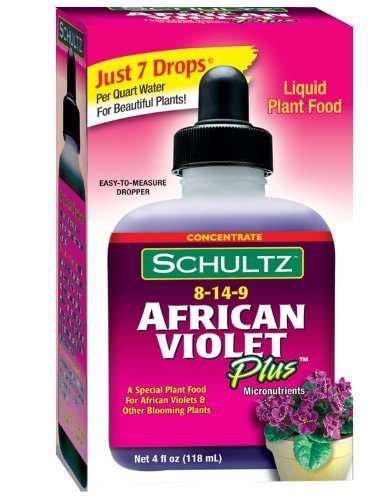
While Jack’s Classic wins on raw bloom power with its 12-36-14 ratio, the Schultz 8-14-9 formula is a close second on phosphorus and significantly easier to use: it is a ready-to-mix liquid that requires no stirring and works beautifully with bottom-watering trays. At 14.08 ounces of item weight (including the bottle), it is over 3.5 times heavier than the Perfect Plants Drops bottle, which tells you this is a more substantial supply for regular feeding.
One reviewer who has used this for over six months says it is “easy-to-use liquid food for bottom-watering; no odor or stain; plant blooming and growing well.” The liquid format means you can add it directly to your watering can with a very dilute mix (the ratio is 1:400, meaning 1 part fertilizer to 400 parts water), which is gentle enough for weekly use even during winter months when growth slows down.
Choose this over the Jack’s Classic if you prefer the convenience of a liquid that needs no mixing effort and you want a mid-range phosphorus level that still produces consistent blooms without pushing your plants too hard. It is also formulated for other plants in the Gesneriad family (the same botanical group as African violets), so it works on related houseplants like streptocarpus.
Where it shines
- Liquid format ready to use instantly
- No odor or staining reported by users
- Gentle 1:400 dilution for weekly feeding
- Trusted brand recommended by violet enthusiasts
Worth noting
- Only 4 fl oz; smaller bottle than some competitors
- Slightly lower phosphorus than Jack’s Classic
3. HiThrive 16oz African Violet Fertilizer
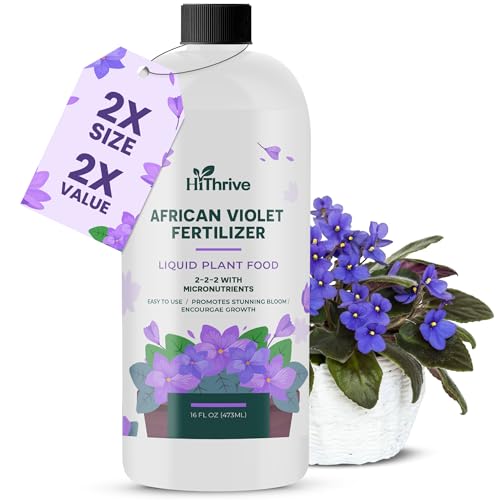
If you are tired of tiny 4-ounce bottles that run out after a month of weekly feeding, this 16-ounce liquid from HiThrive is the value play: it makes 24 gallons of fertilizer solution (versus the 4-ounce bottles that make roughly 6 gallons), and owners mention that it “caused African Violet to bloom within a week” after just one application. The formula includes a full lineup of micronutrients—calcium, magnesium, iron, copper, manganese, and zinc—that specifically target yellowing leaves and weak stems.
The mixing ratio is 1 teaspoon per 32 ounces of water (essentially per quart), which is straightforward even if you are new to fertilizing. Reviewers consistently mention that the instructions are easy to follow and that their plants looked “a lot more vibrant” within days. One user who had given up on a struggling violet said the plant “shot up” within a week of the first feeding.
The standout spec here is the 16-ounce volume—at this price, you are getting four times the liquid of a standard 4-ounce bottle for a small price increase, making it the most economical choice if you have multiple plants or feed weekly.
What stands out
- 16 fl oz makes 24 gallons of feed
- Includes calcium, magnesium, and iron
- Fast results reported within one week
- Simple mixing: 1 tsp per quart
The trade-offs
- Liquid concentrate; needs mixing before each use
- Brand is newer compared to Schultz or Jack’s
4. TPS Nutrients 32oz African Violet Fertilizer
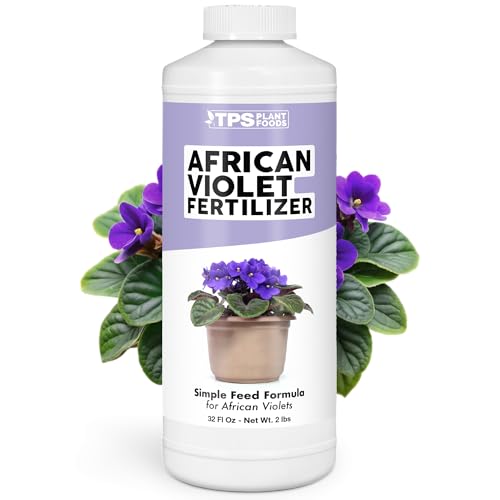
The single number that matters most in this category is concentration: this 32-ounce bottle delivers a 10-10-10 NPK ratio, scoring as a balanced, gentle formula that supports continuous blooming without overdriving plants.
The catch you accept is that the formula is slightly less bloom-focused than the Jack’s Classic or Schultz—it is a balanced, gentle blend designed to support continuous blooming without pushing plants into overdrive. One reviewer who had not seen blooms in a while reported that this fertilizer “got some blooms” after starting use, which suggests it works but may take a little longer than the high-phosphorus options.
At a mid-range price for 32 ounces, the value proposition is strong: you pay a bit more upfront but get drastically more feed per dollar than any 4-ounce or 8-ounce bottle. It is made in the USA and designed specifically for African violets, so you are not paying for general-purpose plant food additives you do not need.
The upsides
- 32 fl oz—8x more than standard 4 oz bottles
- Gentle formula works for regular weekly feeding
- Made in the USA
- No buildup or root stress reported
Keep in mind
- Lower phosphorus than bloom-specific formulas
- May take a few weeks for results
5. Houseplant Resource Center 3-3-3 Premium African Violet Fertilizer
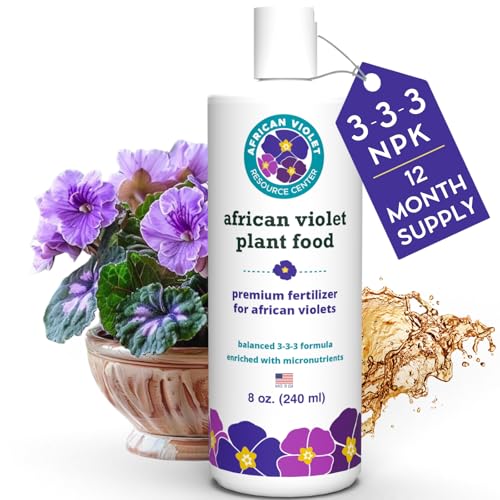
What you actually get at this lower price is an 8-ounce bottle of liquid fertilizer that includes sea kelp, humic acid, and fulvic acid—organic compounds that improve nutrient absorption and stimulate root growth, rather than just dumping synthetic minerals into the soil. The balanced 3-3-3 NPK ratio is deliberately gentle, designed for year-round use without the risk of burning roots, even if you get a little heavy-handed with the measuring spoon.
One reviewer who owns 40 African violets, including rare “Flame” varieties, used this fertilizer weekly for two weeks and reported that the plants “outgrew pots and bloomed beautifully, solving prior lack of blooms.” The mixing ratio is 1 teaspoon per gallon of water, and the 8-ounce bottle is concentrated enough to last a single-plant owner many months. Buyers also note that the liquid formula absorbs quickly without leaving white residue on the soil surface.
The one thing to keep in mind: because the NPK is balanced rather than phosphorus-heavy (unlike Jack’s Classic at 12-36-14), it is not the fastest route to a flower explosion. Think of it as a daily multivitamin for your violet rather than a bloom booster—it keeps the plant healthy so it can bloom on its own schedule. This makes it the perfect budget buyer for a casual violet owner who wants a gentle, all-in-one maintenance feed without chasing maximum blooms.
Why we’d pick it
- Contains sea kelp, humic acid, and fulvic acid
- Gentle 3-3-3 formula safe for weekly use
- Works well for rare and sensitive varieties
- Fast-absorbing liquid
A few caveats
- Not a high-phosphorus bloom booster
- More expensive per ounce than some options
6. Bonide 106 Liquid African Violet Plant Food

This pick is perfect for the beginner or casual grower who owns just one or two African violets and wants a low-commitment, no-fuss entry point: at 8 fluid ounces, it is larger than the dropper-style bottles but smaller than the 16-ounce and 32-ounce options, and the mixing ratio (1/8 teaspoon per quart of water) is so small that a single bottle will last a casual grower several months.
One reviewer who uses it twice a week says their violets are “continually blooming,” which confirms the formula is effective for regular feeding. The liquid is easy to pour directly into a watering can, and buyers appreciate that it does not have a strong chemical smell. However, multiple reviews mention that the bottle lid tends to clog after a few uses—some users prefer to remove the cap and pour directly rather than use the dropper tip.
This is the best pick for anyone who wants to try a specialty African violet fertilizer without investing in a large bottle or a complex mixing routine. Just be aware that the shipping packaging has been criticized: a few buyers received bottles that leaked during transit, so inspect the package when it arrives.
Strong points
- Affordable entry into violet-specific feeding
- Easy 1/8 tsp per quart mixing
- Effective for continual blooming
- 8 oz bottle lasts several months for 1-2 plants
Before you buy
- Lid tends to clog with dried fertilizer
- Shipping leaks reported by some buyers
7. Perfect Plants Liquid African Violet Food Drops 2-2-2
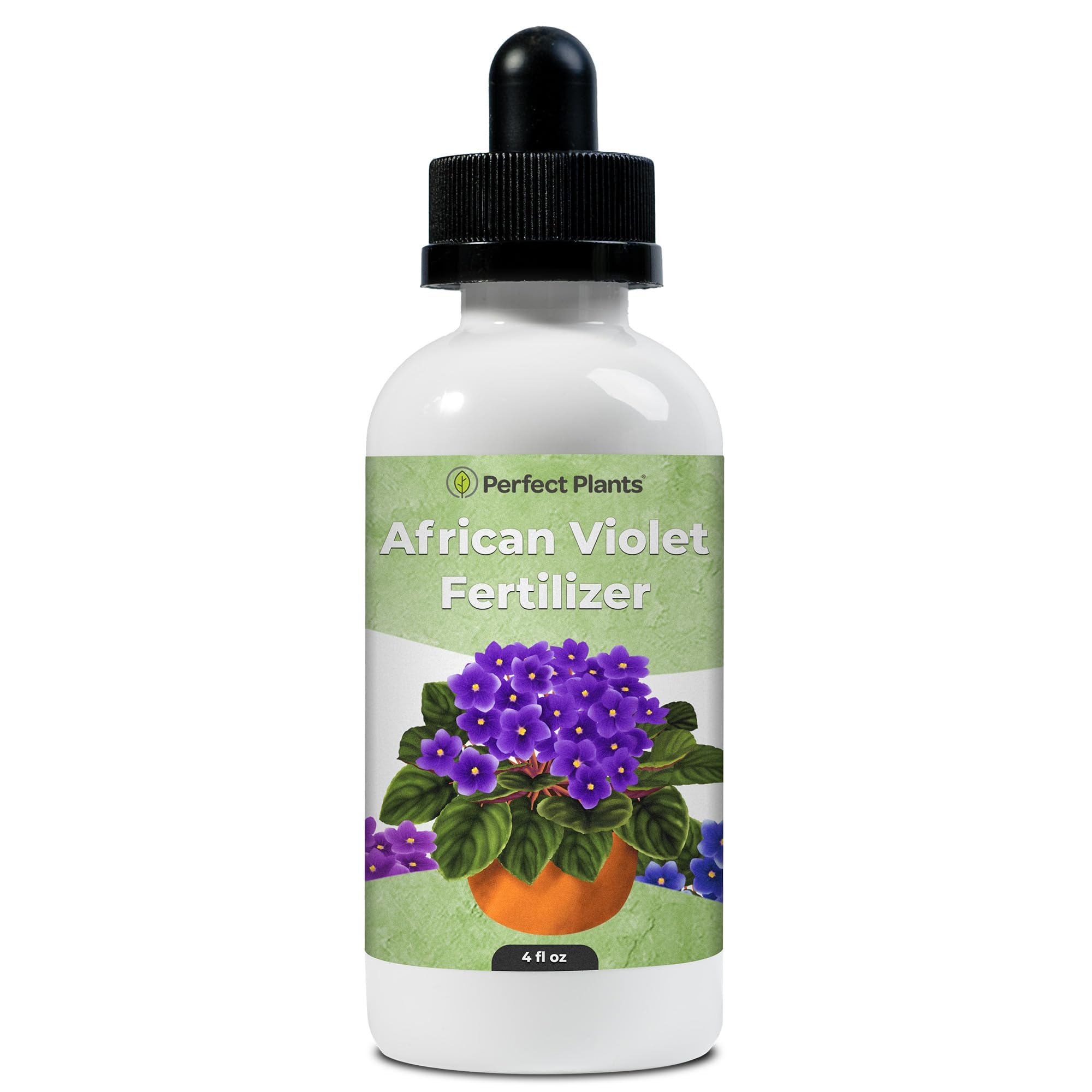
Compared to the larger liquid bottles from HiThrive and TPS Nutrients, the Perfect Plants Drops take a completely different approach: instead of measuring teaspoons or fractions of teaspoons, you simply add 5 to 8 drops per 32 ounces of water using the built-in pipette. This makes it the most precise and foolproof option for single-plant owners who do not want to guess at mixing ratios or deal with measuring spoons.
At 4 fluid ounces, this is the smallest volume bottle in the lineup (4 ounces versus HiThrive’s 16 ounces—a 4x gap), but the drop format is so concentrated that one reviewer with a single plant says “this is going to last me a long time.” The 2-2-2 NPK ratio is the gentlest on this list, designed specifically for violets that are sensitive to strong fertilizers. One buyer mentioned that their “new African violet got its first dose and perked up immediately.”
The one reason to choose this over a larger bottle is the convenience and precision of the dropper—no mixing cups, no spills, and no guessing. It is also from Perfect Plants Nursery, which has over 45 years of horticultural experience, so the formula is built on a deeper understanding of violet care than some generic liquid fertilizers.
What we like
- Dropper bottle for precise 5-8 drop dosing
- Ultra-gentle 2-2-2 formula for sensitive roots
- Perfect for single-plant owners
- From a nursery with 45+ years experience
The downsides
- Smallest volume (4 oz) per dollar
- Very low NPK; may need more frequent feeding
Understanding the Specs
NPK Ratio — What the Three Numbers Actually Mean
The first number (nitrogen) drives leaf and stem growth. The second number (phosphorus) is what your violet needs to produce flower buds. The third number (potassium) supports root strength and overall plant health. For African violets, you want the second number to be the highest or at least equal to the first. A formula showing 12-36-14 is heavily weighted toward blooms, while a balanced 3-3-3 is gentler for maintenance feeding. A fertilizer with a first number far higher than the second (like 20-10-10) will give you a big, leafy plant that rarely flowers.
Mixing Ratio and Concentration
Every fertilizer label tells you how much to mix per quart or gallon of water. A ratio like 1/4 teaspoon per gallon (Jack’s Classic) is highly concentrated—you use very little powder per watering. A ratio like 5-8 drops per quart (Perfect Plants) is even more diluted. Always follow the ratio exactly: too much fertilizer burns the delicate roots of African violets, causing leaf edges to turn brown and curl. If you bottom-water (pouring water into a tray instead of onto the soil), make sure the fertilizer is fully dissolved before adding it to the tray so the roots absorb it evenly.
FAQ
Can I use regular houseplant fertilizer on African violets?
How often should I fertilize my African violet?
What is the best way to apply fertilizer to African violets?
Why are my violet leaves turning yellow after I fertilize?
Is liquid fertilizer better than powder for African violets?
Final Thoughts: The Verdict
For the majority of shoppers, the african violet fertilizer winner is the Jack’s Classic 12-36-14 because its high-phosphorus powder formula reliably produces the most blooms per bottle, and the included micronutrients cover everything your violet needs. If you want the convenience of a ready-to-use liquid that works beautifully with bottom-watering, grab the Schultz African Violet Plus 8-14-9. And for the best value on a large liquid bottle that keeps a collection fed for months, the standout is the HiThrive 16oz.