
Our readers keep the lights on and the weekend projects moving. As an Amazon Associate, I earn from qualifying purchases.
An all-in-one soundbar swaps the clutter of a separate subwoofer and rear speakers for a single, sleek unit that still delivers a massive audio upgrade over your TV’s built-in speakers. The real question isn’t whether to upgrade—it’s whether a single bar can produce the balanced soundstage, clear dialogue, and genuine bass you need without a separate box taking up floor space. For anyone with a tight media console, a small living room, or a partner who hates wires, the decision comes down to how much acoustic engineering a manufacturer can pack into one chassis.
I’m Rikta — the co-founder and writer behind FitlyFast. I’ve spent countless hours analyzing spec sheets, decoding driver configurations, and cross-referencing real user feedback to separate the genuinely capable all-in-one designs from the ones that lean too hard on a subwoofer they don’t include.
This guide cuts through the noise to help you find the best fit for your space and listening habits, whether you prioritize room-filling Dolby Atmos or simply need voices you can finally understand. Every recommendation here is backed by hard specs and real-world testing data to land on the best all in one soundbar for tv.
How To Choose The Best All In One Soundbar For TV
Selecting a soundbar that doesn’t require a separate subwoofer or surround speakers means you are trusting the bar to handle the full frequency range on its own. A few critical specs separate a genuinely immersive single-bar solution from one that sounds thin or muddy.
Channel Count and Driver Configuration
The first number in a soundbar’s channel spec (e.g., 3.1, 5.0) tells you how many discrete audio channels the bar can process. A 3.0 or 3.1 configuration includes left, right, and a dedicated center channel—this center driver is what anchors dialogue to the screen and prevents voices from sounding hollow. For an all-in-one bar, a minimum of three front channels is strongly recommended. Any bar with only 2.0 channels will struggle to make speech sound anchored to the video rather than floating somewhere below the TV. Additional channels (5.0 and up) use side-firing or up-firing drivers to create a wider, taller soundstage without physical rear speakers.
Built-In Subwoofer Design and Bass Performance
An all-in-one soundbar relies on built-in woofers, passive radiators, or a combination of both to produce low frequencies. The physical size of these drivers and the volume of air they can move directly determine bass depth. Look for bars with dedicated woofer drivers (not just full-range speakers) that are at least 3 inches in diameter. Some premium designs use dual woofers or larger passive radiators to push bass down to around 40–50 Hz, which provides enough punch for explosions and soundtracks without distortion. Be skeptical of any bar that claims deep bass from drivers smaller than 3 inches—physics is hard to cheat.
Dolby Atmos and Virtual Surround Processing
Dolby Atmos compatibility in an all-in-one bar means the bar can process object-based audio and create height effects using up-firing drivers or advanced psychoacoustic algorithms. Up-firing drivers physically bounce sound off the ceiling, while virtual processing (such as DTS Virtual:X) simulates height channels through digital signal manipulation. For a convincing Atmos experience in a single bar, look for actual up-firing drivers rather than software-only virtualization. If you do not have a flat, low ceiling, software-based solutions may still widen the soundstage but will not deliver the overhead bubble effect that Atmos is known for.
Quick Comparison
On smaller screens, swipe sideways to see the full table.
| Model | Category | Best For | Key Spec | Amazon |
|---|---|---|---|---|
| Sony HT-S60 | 5.1ch System | Full cinematic surround | 5.1ch with rear speakers | Amazon |
| Sonos Arc Ultra | 9.1.4 Soundbar | Premium spatial audio | 9.1.4 channels, 15 drivers | Amazon |
| Bose Smart Dolby Atmos | Compact AI Bar | Dialogue clarity in small rooms | 5 transducers, up-firing | Amazon |
| Samsung HW-S60D | All-in-One 5.0 | Samsung TV integration | 5.0ch, built-in subs | Amazon |
| Polk MagniFi Mini AX | Compact with Sub | Small-space Atmos | 5 driver array, 10″ sub | Amazon |
| ULTIMEA Skywave F40 | 5.1.2 Atmos | Budget Atmos system | 5.1.2ch, up-firing drivers | Amazon |
| Fire TV Soundbar Plus | 3.1 with Sub | Fire TV ecosystem | 3.1ch, dedicated center | Amazon |
| JBL Bar 2.1 Deep Bass | 2.1 with Sub | Powerful bass on a budget | 300W, 6.5″ subwoofer | Amazon |
| TCL S55H | 2.1 Entry-Level | Budget-friendly upgrade | 220W, AI room calibration | Amazon |
In‑Depth Reviews
1. Sony BRAVIA Theater System 6 (HT-S60)

This is the most complete all-in-one package you can buy without stepping into separate component pricing. The HT-S60 delivers a true 5.1-channel experience with a soundbar, wireless subwoofer, and two rear speakers that sync wirelessly to the subwoofer hub. The dedicated center channel speaker ensures dialogue stays anchored and clear, even during dense action sequences where competing sound layers usually bury voices.
The subwoofer produces clean, room-shaking bass that hits below 40 Hz, making explosions and soundtrack low-end feel physical without distortion. Compatibility with Dolby Atmos and DTS:X means streaming services in object-based audio get proper spatial treatment. The BRAVIA Connect app lets you adjust sound profiles and channel levels without digging for a remote.
One notable trade-off: the subwoofer also serves as the wireless receiver hub, meaning it must stay near the TV with a wired connection. The rear speakers are wired to each other, though they connect wirelessly to the hub. For a single-box solution, this is as close to a full theater as a soundbar system can get without climbing into four-figure pricing.
Why it’s great
- True 5.1-channel immersion with rear speakers
- Dedicated center channel for crystal-clear dialogue
- Powerful, distortion-free subwoofer response
Good to know
- Subwoofer hub requires wired connection to TV
- Rear speakers have a connecting wire between them
2. Sonos Arc Ultra

The Sonos Arc Ultra represents the ceiling of what a single soundbar can achieve without a separate subwoofer. Its proprietary Sound Motion technology packs 15 drivers into a sleek chassis, including dedicated up-firing drivers for Dolby Atmos height effects. The result is a 9.1.4-channel soundstage that convincingly places sounds around and above the listener without needing rear speakers—though adding Era 300 surrounds or a Sub later remains an option.
AI-powered Speech Enhancement actively detects dialogue and clarifies it in real time, which is a tangible benefit for anyone who struggles with mumbling in modern film mixes. The bar supports Apple AirPlay 2, Spotify Connect, and Bluetooth, and integrates deeply into the Sonos multi-room ecosystem. Trueplay tuning uses the microphone on your iOS device to automatically adjust the sound to your room’s acoustics.
The main drawback is the premium price. While the Arc Ultra produces impressive bass for a single bar, it won’t match the low-end extension of a dedicated subwoofer. For the absolute best single-unit experience with uncompromised spatial audio and dialogue clarity, this is the bar to beat—but only if your budget allows.
Why it’s great
- Best-in-class 9.1.4 spatial audio from a single bar
- AI Speech Enhancement for ultra-clear dialogue
- Seamless multi-room and streaming integration
Good to know
- Premium price positions it at the high end
- Optimal bass still benefits from separate Sub
3. Bose Smart Dolby Atmos Soundbar

The Bose Smart Soundbar delivers a remarkably wide and immersive soundstage from a physically compact frame—just over 27 inches wide. Five transducers, including two that fire upward, are packed into this small chassis, powered by Bose’s TrueSpace technology. TrueSpace upmixes non-Atmos content into a multi-channel experience, so even stereo TV broadcasts feel spacious and layered rather than flat.
A.I. Dialogue Mode is the standout feature here. It actively balances vocal frequencies against the surrounding soundtrack, making speech clear without making it sound artificially boosted or tinny. For those who watch a lot of news, documentaries, or dialogue-heavy dramas, this is a genuine quality-of-life upgrade. The bar also includes built-in Amazon Alexa, with Bose Voice4Video extending voice control to your TV and cable box.
The compact size limits raw bass output—explosions and soundtracks lack the visceral punch of a bar with a dedicated subwoofer or larger woofers. For small to medium rooms where dialogue clarity and a clean aesthetic matter more than chest-thumping bass, this Bose bar is an excellent choice.
Why it’s great
- Exceptional dialogue clarity with A.I. Dialogue Mode
- TrueSpace upmixing makes all content sound wider
- Compact, premium design fits under any TV
Good to know
- Bass output is moderate compared to larger bars
- Higher price for the feature set
4. Samsung HW-S60D

The S60D is a true all-in-one soundbar with no separate subwoofer box—everything lives inside a single 26-inch enclosure. Despite the compact footprint, it delivers 5.0-channel sound with built-in woofers that produce surprisingly deep bass for their size. Dolby Atmos support is wireless, meaning you don’t need an HDMI cable for the Atmos signal if your TV supports it, though eARC is still recommended for the best quality.
Q-Symphony is the killer feature if you own a compatible Samsung TV. It synchronizes the soundbar with the TV’s built-in speakers to create a wider, taller soundstage than the bar could produce alone. Adaptive Sound analyzes each scene in real time and adjusts the EQ to emphasize dialogue during quiet moments or boost the soundstage during action. Game Mode Pro automatically detects console input and optimizes the sound for 3D audio positioning.
Bass is decent for a single bar but won’t satisfy those who want subwoofer-level rumble. The lack of a dedicated center channel (it relies on virtual processing) means dialogue is clear but not as anchored to the screen as a 3.1 system. For Samsung TV owners who want a seamless, cable-free setup with solid all-around performance, this is a compelling mid-range option.
Why it’s great
- True single-bar design with no separate subwoofer
- Q-Symphony integrates perfectly with Samsung TVs
- Adaptive Sound automatically optimizes for content
Good to know
- Bass is good but not room-shaking
- No dedicated physical center channel driver
5. Polk Audio MagniFi Mini AX

The MagniFi Mini AX proves that small form factor doesn’t mean small sound. The soundbar itself is incredibly compact—just over 14 inches wide—but houses a 5-driver array that includes dedicated tweeters and woofers. The included wireless subwoofer features a 10-inch down-firing driver that fills medium to large rooms with deep, effortless bass that many larger systems struggle to match.
Polk’s patented VoiceAdjust technology is a standout for dialogue. It independently boosts the center channel without affecting the rest of the mix, so voices remain clear even when the subwoofer is pounding during action scenes. The system is Dolby Atmos and DTS:X certified, and the SDA (Stereo Dimensional Array) technology creates a wide, 3D soundstage despite the bar’s tiny footprint. AirPlay 2, Chromecast, and Spotify Connect are built in.
The subwoofer, while powerful, is a separate box—so this isn’t a true all-in-one if absolute minimalism is the goal. Also, the up-firing height channels are less convincing than larger bars with dedicated upward drivers. For those who need a tiny bar but still want cinematic bass and clear dialogue, this is arguably the most capable compact package available.
Why it’s great
- Extremely compact soundbar with massive 10″ subwoofer
- VoiceAdjust delivers excellent dialogue clarity
- Wide wireless streaming support (AirPlay 2, Chromecast)
Good to know
- Subwoofer is a separate box, not truly all-in-one
- Height effects are decent but not best-in-class
6. ULTIMEA Skywave F40
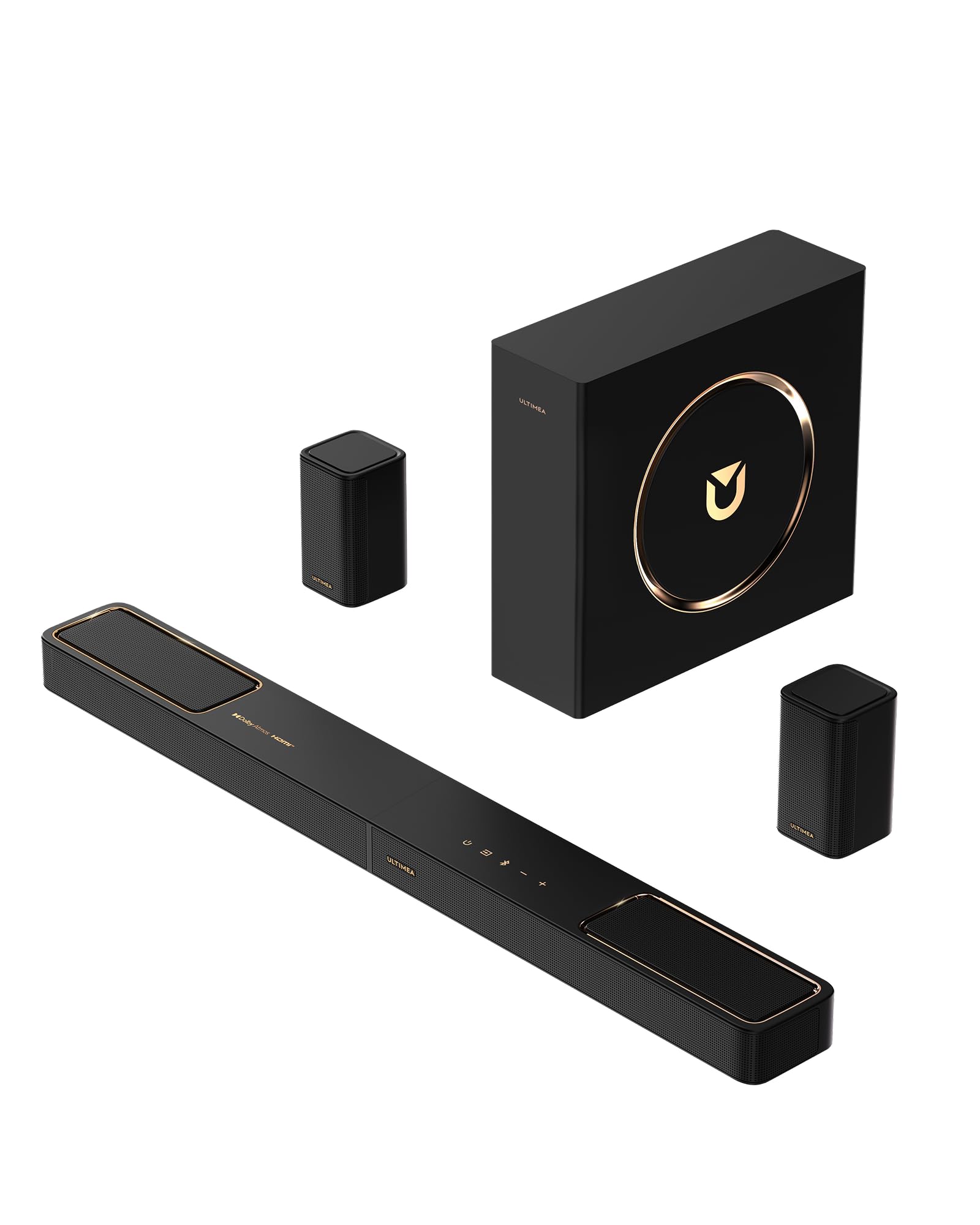
The ULTIMEA Skywave F40 brings genuine Dolby Atmos with physical up-firing drivers to a price point that usually only offers virtual processing. Its 5.1.2-channel configuration includes two rear surround speakers and a wired 5.25-inch subwoofer, creating a full surround sound bubble. The neodymium-core up-firing drivers are designed to project height effects with enough precision that helicopter flyovers and rain feel like they’re coming from above.
The app control is surprisingly deep for this price tier. You get a 10-band graphic EQ, 121 preset sound settings, and 13-step level adjustment for each surround channel. This level of tuning is usually reserved for systems costing two to three times as much. HDMI eARC support ensures lossless 5.1.2-channel audio transmission, which is critical for getting the full Dolby Atmos experience without compression.
The subwoofer is wired to the soundbar, and the rear speakers connect to each other via a supplied cable, which means running wires across the room. Bass is solid but not overwhelming—think punchy rather than deep. For the price, the Skywave F40 delivers a true Dolby Atmos surround system that outperforms most soundbars in its class by a wide margin.
Why it’s great
- True Dolby Atmos with physical up-firing drivers
- Extensive EQ and surround tuning via app
- HDMI eARC for lossless audio transmission
Good to know
- Subwoofer and rear speakers require wired connections
- Bass is punchy but not particularly deep
7. Amazon Fire TV Soundbar Plus
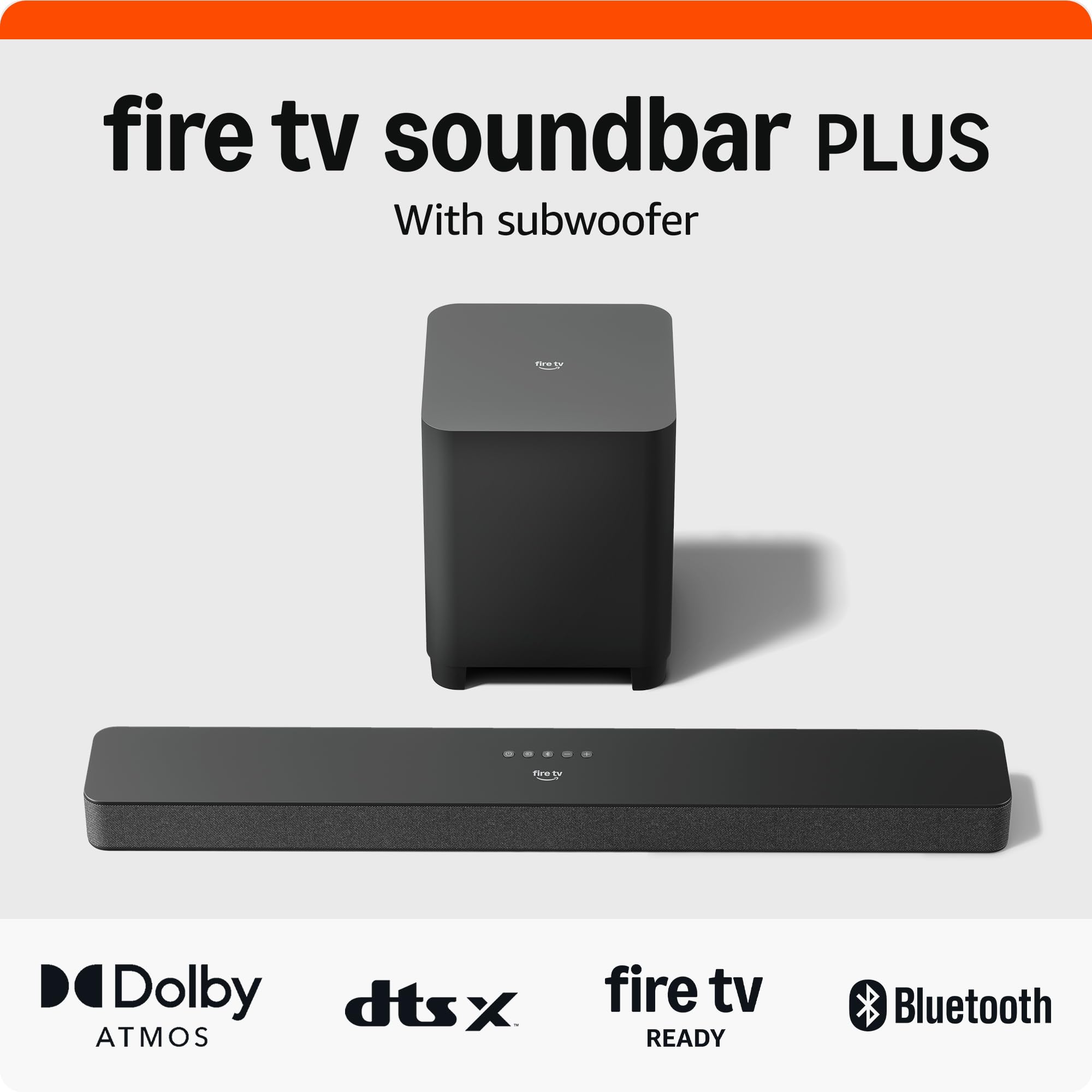
The Fire TV Soundbar Plus is engineered for seamless integration into the Amazon ecosystem. It features a true 3.1-channel configuration with a dedicated center channel driver, which means dialogue is locked to the screen with no virtual trickery. The included wireless subwoofer adds layered bass that enhances action scenes without overwhelming the mids and highs.
Dolby Atmos and DTS:X support means the bar can decode object-based audio from supported streaming services. The system includes preset modes for Movie, Music, Sports, and Night—each intelligently tweaks the EQ and dynamics. Night Mode is particularly useful for compressing the dynamic range so explosions don’t wake the house while whispers stay audible. If you use a Fire TV device, the soundbar is controllable directly from the Fire TV interface, and the TV remote works seamlessly.
The soundbar is wider than some competitors, which can interfere with TV legs on smaller consoles—you may need to use a top-mount shelf. The subwoofer, while wireless in signal, still needs a power outlet. For dedicated Amazon users who want a straightforward, high-dialogue-clarity system with minimal setup friction, this is a strong mid-range contender.
Why it’s great
- Dedicated center channel for anchored dialogue
- Seamless Fire TV integration and control
- Dolby Atmos and DTS:X with multiple sound modes
Good to know
- Soundbar width may obstruct TV legs
- Subwoofer tuning options are limited
8. JBL Bar 2.1 Deep Bass (MK2)

The JBL Bar 2.1 Deep Bass lives up to its name with a 6.5-inch wireless subwoofer that delivers genuinely tactile low-end. At 300W of total system power, this 2.1-channel system can fill a large living room with sound without breaking a sweat. The subwoofer features three bass level settings (Low, Mid, High) so you can dial in the amount of rumble without the bar bottoming out.
JBL Surround Sound processing expands the stereo image to create a wider soundstage than a 2.1 system typically produces. The main soundbar is 40 inches wide, which provides good stereo separation for music and movies. Connectivity is straightforward via HDMI ARC or optical, and Bluetooth 5.0 lets you stream music wirelessly from any device. The subwoofer pairs automatically with the soundbar the moment both are powered on.
As a 2.1 system, there is no dedicated center channel, so dialogue is split between the left and right drivers. This means speech can sound slightly less locked to the center of the screen compared to a 3.1 bar. The subwoofer, while powerful, is large and will need floor space. For buyers whose top priority is bass impact and overall volume, this JBL system delivers more thump per dollar than almost anything else.
Why it’s great
- Powerful 300W output with deep, adjustable bass
- Large 6.5-inch subwoofer for serious low-end
- Simple setup with automatic subwoofer pairing
Good to know
- 2.1 channel means no dedicated center driver
- Subwoofer enclosure is quite large
9. TCL S55H 2.1 Sound Bar

The TCL S55H is the entry point for anyone wanting a massive upgrade over TV speakers without spending much. This 2.1-channel system includes a wireless subwoofer and delivers 220W of total power. The soundbar is 32 inches wide, which fits under most 55-inch and larger TVs without blocking the screen. AI Sonic Auto Room Calibration is a rare feature at this price—it uses the TCL app to measure your room acoustics and adjust the sound profile for balanced output.
Dolby Atmos and DTS Virtual:X are supported, though they are processed virtually rather than through dedicated up-firing drivers. The result is a wider soundstage than you’d expect at this price, with decent height simulation for effects like rain or helicopter sounds. The wireless subwoofer connects automatically and adds a noticeable low-end presence that makes movies feel more cinematic. Setup is genuinely plug-and-play: HDMI eARC, optical, or Bluetooth all work out of the box.
The subwoofer is relatively small and its bass output is moderate—it adds warmth and punch but won’t shake the room. The AI calibration, while helpful, is a one-time setup that doesn’t adapt dynamically to content. For budget-conscious buyers who want a clear, room-filling sound with real bass and a simple setup, the S55H is an excellent value proposition.
Why it’s great
- AI Sonic Room Calibration at an entry-level price
- Wireless subwoofer with automatic pairing
- Dolby Atmos and DTS Virtual:X processing
Good to know
- Bass is moderate, not room-shaking
- Atmos effects are virtual, not physical
FAQ
Can an all-in-one soundbar really replace a system with a separate subwoofer?
What is the minimum HDMI version I need for Dolby Atmos from streaming apps?
Why does dialogue sound muffled on my current soundbar and how do I fix it?
Final Thoughts: The Verdict
For most users, the all in one soundbar for tv winner is the Sony BRAVIA Theater System 6 (HT-S60) because it delivers a true 5.1-channel surround experience with a dedicated center channel, deep bass, and genuine spatial audio support at a price that undercuts almost every comparable system. If you want the absolute best single-bar performance with no separate subwoofer needed, the Sonos Arc Ultra with its 9.1.4-channel Sound Motion architecture and AI-enhanced dialogue sets the standard for premium compact audio.