
Our readers keep the lights on and the weekend projects moving. As an Amazon Associate, I earn from qualifying purchases.
Specs are compiled from manufacturer listings and verified buyer reviews and can change over time — please confirm the key details on the product page before buying.
Buying aluminum foil sounds simple, but pick the wrong roll and you will be double-wrapping to stop tears or running out halfway through grilling season. The real difference between a roll that saves dinner and one that frustrates you depends on three numbers: thickness measured in microns (the higher the number, the less it tears), total square footage (how many meals it actually covers), and the cutter quality (a blunt edge turns every wrap into a wrestling match).
I’m Rikta — the founder and writer behind FitlyFast. This guide is built by comparing the manufacturers’ published specifications and the patterns across verified customer reviews, so you get each pick’s real strengths and trade-offs instead of marketing spin.
if you need a heavy-duty sheet for a slow-smoked brisket or an everyday roll for school lunches, these are the aluminum foil options that actually deliver on their promises without tearing your patience.
Quick Picks
- LuxLiv Heavy Duty 30 Micron Tin Foil Roll — Heavy Duty Champ
- Reynolds Wrap Everyday Strength Aluminum Foil Roll — Maximum Coverage
- SZZJKJ Aluminum Foil Roll, 12in x 190ft — Thick & Tidy
- Stock Your Home Heavy Duty Aluminum Foil Roll, 300 FT — Bulk Value Giant
- Reynolds Wrap Heavy Duty Aluminum Foil Roll — The Trusted Classic
How To Choose The Best Aluminum Foil
Picking the right foil is about matching the thickness and length to what you actually cook. Thin standard foil (around 14-16 microns) works for covering dishes and wrapping sandwiches, while heavy-duty foil (25-30 microns) handles grilling, smoking, and lining baking sheets without tearing. Here are the two specs that separate a frustrating roll from a kitchen hero.
Micron Thickness: The Numbers Game
Micron (µm) is the unit that measures how thick one sheet of foil is. Standard rolls sit around 14 to 18 microns — fine for cold storage or tenting a dish. Heavy-duty rolls start at 25 microns and go up to 30 microns. A 30-micron foil is thicker than a 16-micron foil, which means you can wrap a rack of ribs with more protection against bone tips poking through. Check the product specs for this number; if a roll does not list its micron rating, it is almost certainly standard-thickness.
Square Footage: The Real Value Meter
Roll length in feet tells you half the story — the width also matters. Square footage (length x width) is the true measure of how much foil you are getting. A 200-square-foot roll at a similar price to a 130-square-foot roll is the better buy if you go through foil quickly. But if you mostly grill and need tear-resistant sheets, a shorter heavy-duty roll might still be the smarter choice because you will not need to double-layer it.
Quick Comparison
| Model | Best For | Thickness | Square Footage | Weight | Amazon |
|---|---|---|---|---|---|
| Reynolds Heavy Duty | Grilling & smoking | — | 130 sq ft | 1.64 Pounds | Amazon |
| Reynolds Everyday Strength | Daily cooking & roasting | — | 200 sq ft | 1.86 Pounds | Amazon |
| SZZJKJ Aluminum Foil | Budget-friendly bulk | 18 Microns | 190 sq ft | — | Amazon |
| LuxLiv 30 Micron | Restaurant-grade thickness | 30 Microns | 150 sq ft | 2.2 Pounds | Amazon |
| Stock Your Home 300ft | High-volume kitchens | 25 Microns | 300 sq ft | — | Amazon |
In‑Depth Reviews
1. LuxLiv Heavy Duty 30 Micron Tin Foil Roll
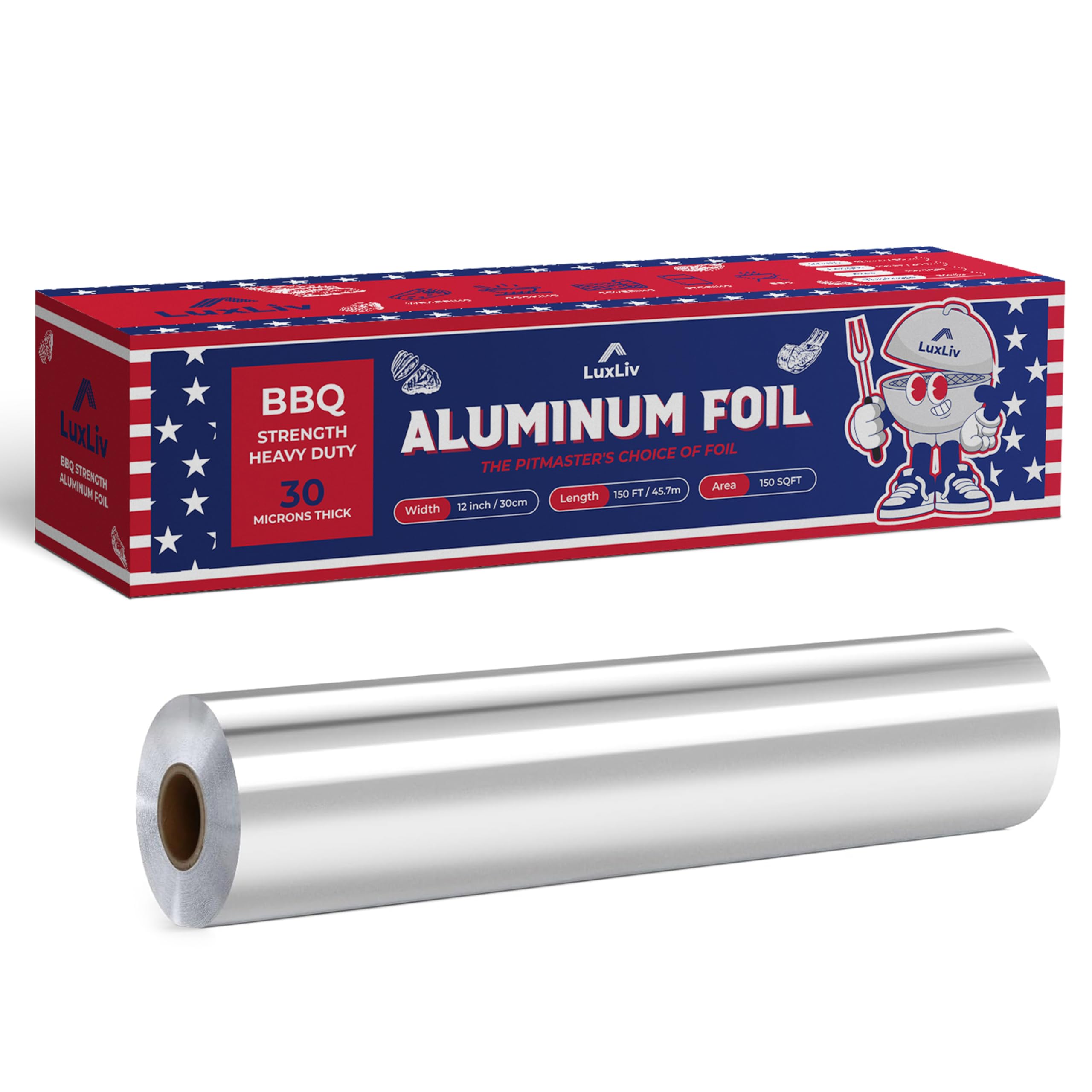
The thickest roll on the list — a full 30 microns (the unit of foil thickness) that feels like metal sheeting.
If you have ever had a standard foil shred when wrapping a turkey leg or a brisket point, this LuxLiv roll is the fix. At 30 microns thick, it is denser than almost every other consumer foil — the Reynolds Heavy Duty roll below does not publish its micron count, but it weighs 1.64 pounds for 130 square feet versus 2.2 pounds for 150 square feet on this LuxLiv roll. Buyers report it is the “Best Foil Ever” and note they have never used a foil this thick before. The cutter has plastic ends so it slides smoothly, and while the edges are sharp enough to cut you (one reviewer warns of that), you will appreciate that sharpness when you tear off a clean sheet.
Where it gives ground is simple value-per-foot: you pay for the premium 30-micron material, so if your main use is covering a casserole dish, you may be overspending on strength you do not need. Marketed as commercial-grade for restaurants and caterers, this is the foil you reach for when the meal matters and tearing is not an option.
Why It Wins
- Thickest foil at 30 microns — resists punctures from bones and grill grates so your wraps stay intact
- Weighs 2.2 pounds versus 1.64 pounds for the Reynolds Heavy Duty 130 sq ft roll, which points to a denser, stronger sheet
- Plastic end caps and integrated cutter for clean, waste-free tearing
One Trade-Off
- You pay for that thickness; if you mostly wrap leftovers, a standard 18-micron foil stretches your dollar further
Reach for this if: you smoke meats, grill often, or need a tear-proof wrap for heavy foods — the 30-micron thickness is industrial strength for your home kitchen.
Think twice if: you only need foil for light covering or cold storage, where thinner foil works fine and costs less per square foot.
2. Reynolds Wrap Everyday Strength Aluminum Foil Roll

200 feet of reliable foil that handles 500°F oven heat without burning, giving you a versatile daily workhorse.
This is the foil for the cook who does everything — roasting vegetables, wrapping fish packets, lining baking sheets, and covering a pot roast. Owners mention it is “tough, versatile, withstands 500°F roasting without burning easily,” making it one of the safest bets for oven use. The box has the familiar Reynolds stay-closed tab, and the large roll will last a heavy-cooking household for weeks.
The catch is that this is standard thickness, not heavy-duty. It tears more easily than the 30-micron LuxLiv above, so if you are wrapping sharp-boned ribs or pressing foil into a hot grill grate, you may need two layers. Also, the roll is wide enough that the corners can snag on the box as you pull — a few customers note cutting by hand with scissors is smoother than fighting the built-in cutter. Still, for the price per square foot, this is tough to beat for daily kitchen life.
What Stands Out
- 200 square feet of foil versus 130 square feet on the Reynolds Heavy Duty roll, so you run out less often
- Withstands 500°F roasting heat without burning, confirmed by buyer reports, so you can use it for high-heat cooking
- BPA-free, lead-free, and phthalate-free for food safety
One Limitation
- Standard thickness means it can tear on sharp edges; heavy users may want the LuxLiv 30-micron or Stock Your Home 25-micron for puncture resistance
Best for: the all-around home cook who roasts, bakes, and grills regularly — 200 feet at this strength-to-price ratio is the most versatile pick here.
Maybe not for: pitmasters or anyone who wraps heavy meats on a grill; you will save money on coverage but lose some tear resistance compared to the LuxLiv 30-micron.
3. SZZJKJ Aluminum Foil Roll, 12in x 190ft
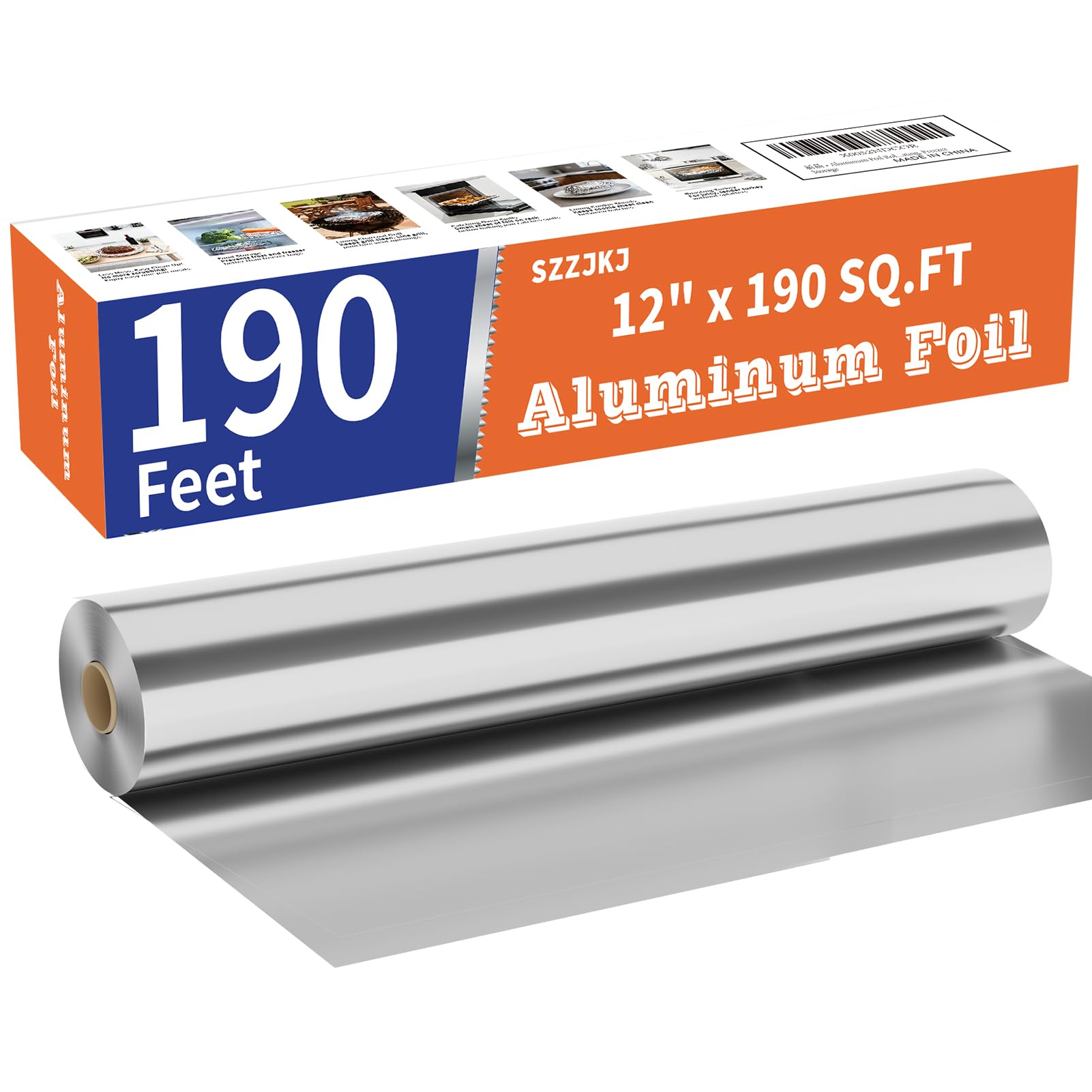
An 18-micron foil with a cutter that actually tears straight, giving you a clean sheet every time without jagged edges.
If you are tired of foil that rips diagonally, this SZZJKJ roll addresses that directly. The 18-micron foil is noticeably sturdier than the thinnest bargain rolls while still being friendly on the budget. Reviewers point out it is “thick, sturdy foil; tears cleanly with built-in cutter,” and the 190-square-foot roll gives you a generous amount of coverage. The manufacturer specifically says it is designed for cafeterias and delis, so the emphasis on easy dispensing and resistance to tearing makes sense — you are getting a roll built for volume use.
The trade-off is that at 18 microns, it is still not heavy-duty. If you press it into direct grill duty or wrap a spiky roast, you may get small tears. Some shoppers say the foil is thinner than standard Reynolds Everyday Strength, so if you are used to that roll, this may feel a bit flimsier. But for wrapping sandwiches, covering dishes, and lining trays, the clean tear and 190-foot length make it a solid mid-range choice.
Why It Earns Its Spot
- 18-micron thickness offers a good middle ground between thin economy foil and premium heavy-duty
- Built-in cutter delivers clean, straight tears according to buyer feedback, saving you frustration
- 190 square feet of coverage at a budget-friendly price point
One Thing to Know
- For heavy grilling tasks like wrapping ribs, the Reynolds Everyday Strength or LuxLiv 30-micron perform better without tearing
Grab this for: everyday food storage, sandwich wrapping, and lining baking sheets — the cutter alone saves you frustration.
skip it if: you primarily use foil on a hot grill or smoker; you will want a 25-30 micron heavy-duty roll such as the Stock Your Home or LuxLiv for that job.
4. Stock Your Home Heavy Duty Aluminum Foil Roll, 300 FT

300 feet of 25-micron heavy-duty foil — a serious bulk buy for frequent grillers that gives you 300 square feet versus 130 square feet on the Reynolds Heavy Duty.
When you buy foil by the case or go through a roll every month, this Stock Your Home 300-foot roll starts to make real sense. At 25 microns, it is not quite as thick as the 30-micron LuxLiv, but it is substantially denser than any standard foil and gives you 300 square feet versus the Reynolds Heavy Duty’s 130 square feet. Buyers report it is “super thick, makes Reynolds looks thin,” and that the box-and-cutter dispenser keeps the roll stable through heavy use. The foil is BPA-free, phthalate-free, and PVC-free, so it is safe for direct food contact.
The dispenser box is 14 inches long, which is larger than standard foil boxes — make sure you have pantry or drawer space. One reviewer noted they use it on a pellet grill regularly and found it performs as well as commercial rolls, so for high-volume cooking, the per-foot cost is tough to top.
The Big Advantage
- 25-micron heavy-duty construction — denser than standard foil and ready for grill heat, so you can wrap ribs without double layering
- 300 feet of foil, the longest single roll in this lineup; ideal for heavy users who want to stop buying rolls weekly
- Dispenser box with built-in blade cuts cleanly and keeps the roll secure
One Practical Note
- Bigger roll and larger box take up more pantry space; not ideal for small kitchens or occasional use
Ideal for: families who grill multiple times a week or anyone who wants to stop buying foil for months — the 300-foot length plus 25-micron thickness delivers serious staying power.
Less suited for: light users or those with limited storage; a 130-200 foot roll such as the Reynolds Everyday Strength would serve you without the bulk.
5. Reynolds Wrap Heavy Duty Aluminum Foil Roll

The name everyone knows, with heavy-duty strength that prevents tears during grilling and roasting — a dependable workhorse for moderate use.
Reynolds Wrap Heavy Duty is the foil you grab when the recipe says “cover tightly with foil.” It is a dependable 130-square-foot roll with the same easy-open, stay-closed tab that keeps the box shut in a drawer. Owners mention it is a “heavy duty, versatile, durable foil with a precise metal cutter,” and note it is ideal for grilling and smoking meats because it holds up well for covers and cooking on a griddle. The heavy-duty construction is thicker than the Everyday Strength version, so it handles direct heat and heavy foods without tearing.
The shortcoming is clear when you compare it to the LuxLiv 30-micron pick: at 1.64 pounds for 130 square feet vs 2.2 pounds for 150 square feet, the Reynolds is a lighter-duty heavy foil. It is also 130 square feet versus 200 square feet on the Everyday Strength roll above. So if you go through foil quickly, the Everyday Strength roll actually gives you more material for a similar cost. But if you want the Reynolds brand guarantee and a specific heavy-duty build for tasks like tenting a Thanksgiving turkey, this is still a solid, proven choice.
Why It Endures
- Heavy-duty construction trusted by home cooks for decades — tested for grilling and roasting so you can cover a brisket without tears
- Precise metal cutter with a stay-closed tab that keeps the box organized
- Buyers specifically recommend it for smoking meats and griddle cooking
Compared to Others
- At 130 square feet, it offers less coverage than the Reynolds Everyday Strength 200 sq ft roll — better suited to lighter users
- Heavier than standard foil but not as dense as the 30-micron LuxLiv or 25-micron Stock Your Home options
Choose this when: you want the Reynolds name and a reliable heavy-duty sheet for occasional to moderate grilling or holiday cooking — it is the safe, well-known pick.
Look elsewhere if: you burn through foil quickly or need maximum puncture resistance; the 200-foot Everyday Strength or 30-micron LuxLiv give you more material or more thickness for your money.
Understanding the Specs
Micron Thickness (µm)
A micron is one-millionth of a meter — it measures how thick a single layer of foil is. Standard foil runs from roughly 14 to 18 microns, which is fine for wrapping a sandwich or covering a dish in the fridge. Heavy-duty foil starts around 25 microns and goes up to 30 microns. Thicker foil means fewer punctures when you wrap sharp foods like ribs or chicken bones, and it holds up better under direct heat on a grill. If a product page does not list the micron rating, you should assume it is standard thin foil.
Square Footage vs Roll Length
Roll length (in feet) is only half the equation — the other half is the width. Standard foil width is 12 inches. Square footage is calculated as length (ft) x width (ft). A 200-foot roll at 12 inches wide gives you 200 square feet of foil. A 130-foot roll at the same width gives you 130 square feet. That is a 70-square-foot difference, with 200 square feet on the longer roll versus 130 square feet on the shorter roll. When comparing value, always check total square feet rather than just the number of feet on the roll, because a narrower or wider roll changes the math.
FAQ
What micron thickness should I look for in aluminum foil?
Is Reynolds Wrap safe to use in the oven?
Can I use aluminum foil in a microwave?
What does “heavy duty” mean on a foil box?
How many square feet of foil do I really need?
Will 18-micron foil work on a grill?
Which side of aluminum foil should face the food?
Is aluminum foil safe for storing acidic foods?
How do I get a clean tear from a foil box?
Can you recycle aluminum foil?
Final Thoughts: The Verdict
For the majority of shoppers, the best aluminum foil winner is the Reynolds Wrap Everyday Strength 200 Sq Ft because it delivers the best balance of coverage (200 square feet) and everyday tear resistance, backed by a 500°F heat rating that fits roasting, baking, and grilling alike. If you want the ultimate puncture-proof thickness for smoking and heavy grilling, grab the LuxLiv 30 Micron Roll. And for a high-volume kitchen or non-stop griller who wants to buy foil once and be set for months, the standout is the Stock Your Home 300-Foot Heavy Duty Roll.
How We Picked
We do not accept paid placement. Every pick is matched to a real buyer and a real use-case; we do not hands-on test units.
Sources & Methodology
Specifications: manufacturer listings and product documentation. Review insights: verified customer reviews, as of July 2026. Pricing: not shown on this page (it changes often); check the current price via the retailer link.
As an Amazon Associate, FitlyFast earns from qualifying purchases. This does not affect which products we feature.