
Our readers keep the lights on and the weekend projects moving. As an Amazon Associate, I earn from qualifying purchases.
Watching a colony of ants carve intricate tunnel systems through sand or gel is one of the most quietly captivating science experiments you can set up at home. The problem is that most ant farm kits on the market are flimsy, poorly designed, or so small that the ants barely have room to work before they die. A great kit changes that — giving you a clear, escape-proof habitat where a small society can thrive, dig, and interact for months.
I’m Rikta — the co-founder and writer behind FitlyFast. I’ve spent hundreds of hours researching ant habitats, analyzing customer feedback on construction quality, sand type, lighting systems, and long-term colony survival rates to separate the living-room-worthy farms from the ones that end up in a closet after a week.
This guide breaks down the best models for every budget and use case, so you can find the perfect ant farm kit for your curious kid, classroom, or even your own desk.
How to Choose the Best Ant Farm Kit
The ant farm market splits into two main terrain types — gel and sand. Gel kits are mess-free and require zero maintenance, but they are a dead end for the ants; the gel slowly dehydrates and shrinks, and the colony cannot expand or reproduce. Sand kits are more work — you have to keep the sand moist and feed the ants — but they allow for genuine tunneling behavior and can sustain a colony for many months. For anyone serious about observation, sand is the only real choice.
Build Quality and Escape Prevention
The number one complaint across every price tier is ants escaping. Look for kits with tight-fitting lids, locking mechanisms, and thick acrylic walls. Any gap large enough for a worker ant to squeeze through will be found. Kits with silicone gaskets or child-lock clips are far safer than simple snap-on lids.
Viewing and Lighting
A built-in LED light transforms the experience — especially in the evening when ants are most active. Magnifying glasses built into the lid or side panels are a huge bonus for kids who want to see the tiny details. The habitat should be fully transparent, with no tinted plastic that dims the view.
Included Tools and Sand Quality
A good kit includes a tunnel starter tool, a water dropper, tweezers, and a feeding area. The sand should be fine, clean, and sterilized — coarse or dusty sand can collapse tunnels or harm the ants. Some kits come with colored sand, which looks fun but can contain unknown additives. Stick with natural quartz sand or the specific sand the manufacturer recommends.
Quick Comparison
On smaller screens, swipe sideways to see the full table.
| Model | Category | Best For | Key Spec | Amazon |
|---|---|---|---|---|
| National Geographic Ant Habitat | Gel + Light | Mess-free starter | Built-in magnifiers, LED lit | Amazon |
| Tigerific Real Sand Ant Farm | Sand | Classic sand dig | 9 x 2 x 7 inches, 0.78 kg | Amazon |
| WodGod Illuminated Habitat | LED Sand | Detailed observation | Top-down LED, 500g quartz sand | Amazon |
| Kahopy Ant Farm Castle | Acrylic Sand | Large colony space | 9.37 x 5.67 x 1.7 inches | Amazon |
| ELNMLHT Ant Castle | Acrylic Sand | Multi-chamber setup | 10.8 x 5.8 x 1.6 inches | Amazon |
| Educational Insights GeoSafari | Classroom Sand | STEM education | 12 x 9 x 5 inches, 16 oz | Amazon |
| AntHouse 3D Sand T Kit | Pro Breeder | Serious enthusiasts | 15x15x1.5 cm, aluminum | Amazon |
In‑Depth Reviews
1. National Geographic Ant Habitat Kit
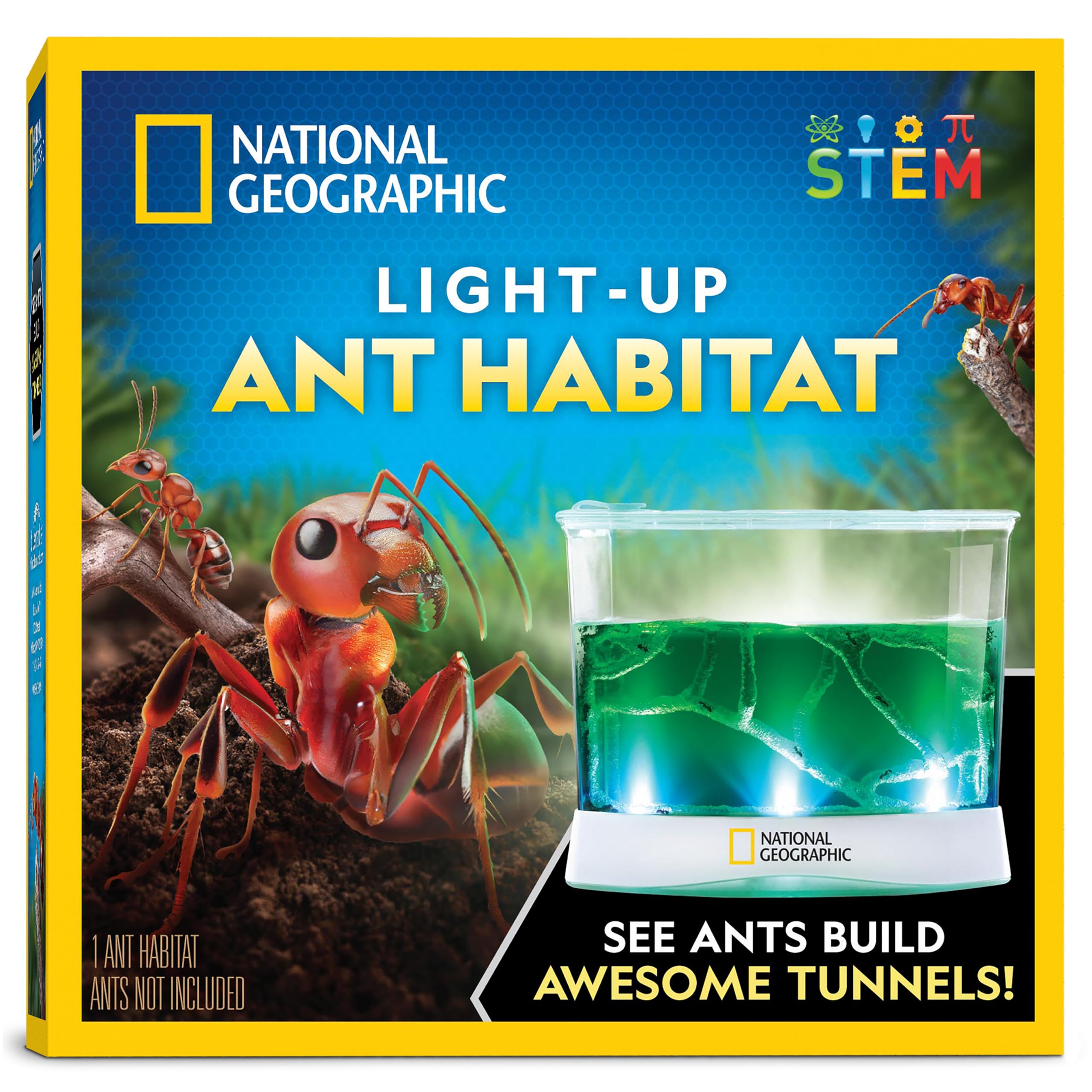
The National Geographic Ant Habitat uses a translucent nutrient gel instead of loose sand, which makes it arguably the cleanest option in this lineup — no sand spills, no dust, and the ants eat the gel directly. The habitat lights up when plugged in, giving you a spectacular top-down view of tunnel activity even in a dim room, and the lid integrates two magnifying glasses for close inspection.
At roughly 1.6 pounds and measuring 8.46 by 7.4 inches, it is compact and stable. The tunnel starter tool lets you create an initial channel so the ants begin digging immediately. Because the gel is the food source, you don’t need to worry about weekly feeding — simply add water to the gel if it starts to shrink after a few months.
The main trade-off is that gel habitats are biologically limited. Ants cannot reproduce in gel (no queen survival), and the colony will slowly decline over 2 to 4 months. This is a starter kit for younger kids who want a low-commitment, high-visibility experiment. For longer-term observation, a sand-based farm is better.
Why it’s great
- Plug-in LED light makes observation easy day or night
- Gel substrate is zero-mess and self-feeding
- Magnifiers in the lid give kids a close-up view
Good to know
- Gel shrinks over time and cannot support a breeding colony
- Ants not included and can be tricky to source separately
2. Tigerific Real Sand Ant Farm

Tigerific’s offering puts real sand at the center — not gel, not colored granules, but actual sterilized digging material that ants recognize and use immediately. The habitat is fully transparent on all sides, and the included AntWay Connector Tube lets you attach additional habitats or foraging areas later. This modular approach is rare at this price point.
The kit ships with two bags of sand, a water dropper, a detailed learning booklet, and a coupon to order live harvester ants at a discount. Users consistently report that ants begin tunneling within hours of introduction. The 9 by 7 inch frame is wide enough to create a visible network of tunnels without being bulky.
A few buyers noted that the included connector tube can bend and crimp, confusing the ants if not positioned carefully. Also, without a queen, the colony will eventually dwindle — but that is true of any kit that sells ants separately. For the price, this is the richest educational package you will find.
Why it’s great
- Real sand allows natural tunneling behavior
- Modular connector tube for expansion
- Comes with learning booklet and discount ant voucher
Good to know
- Connector tube can bend and restrict ant movement
- No queen included, so colony will not reproduce
3. WodGod Illuminated Ant Habitat
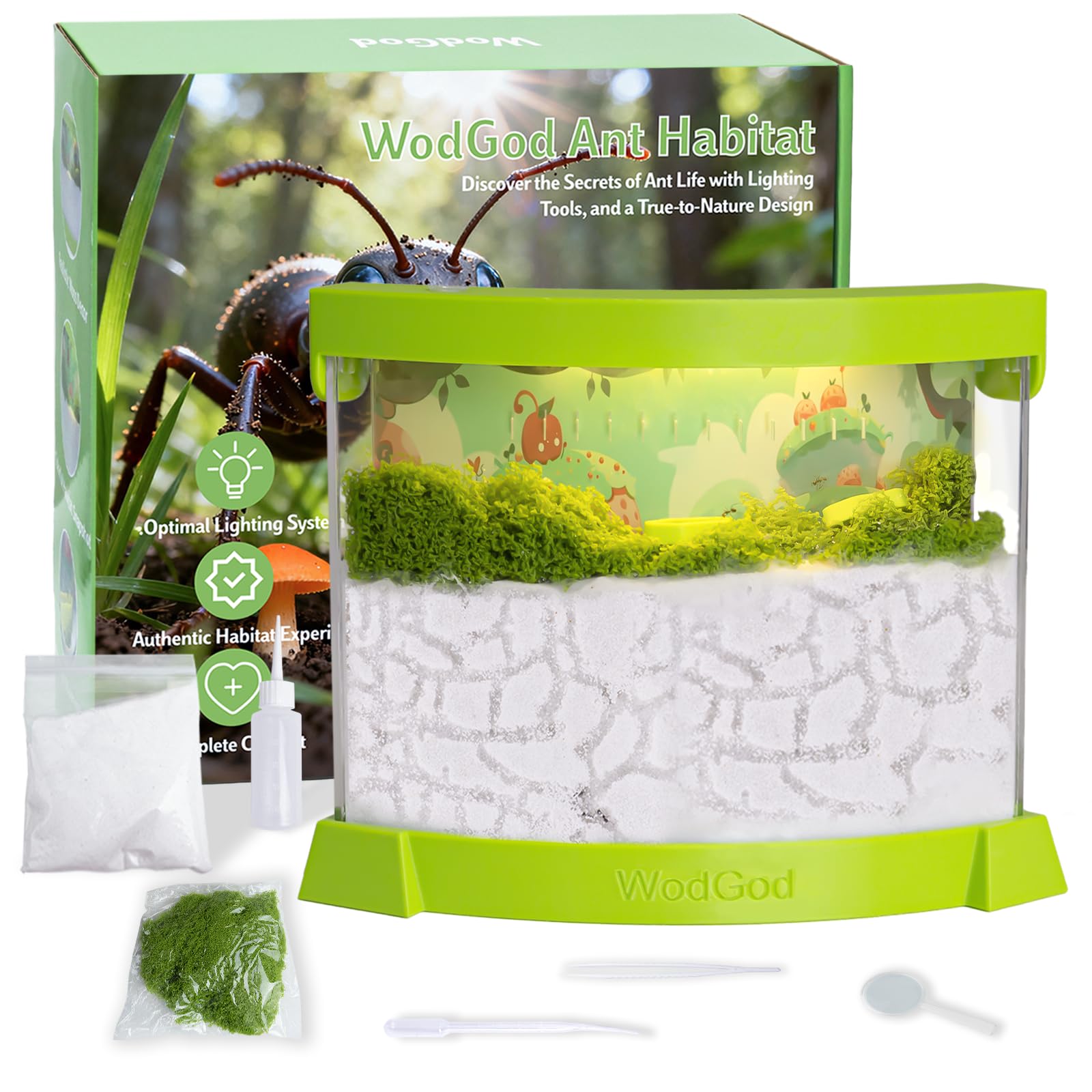
The WodGod Habitat elevates the category with a top-down LED lighting system that illuminates tunnels from above, eliminating shadows and making every grain of sand visible. It comes with 500 grams of sterilized quartz sand, a realistic moss decor set, anti-escape tweezers, and a calibrated water dropper. The viewing area is large — 8.66 by 11.02 inches — giving ants plenty of vertical depth to dig.
The kit’s transparent acrylic body is thick and feels premium in hand. Buyers highlight that the moss and natural landscape printed at the back make the habitat look more like a tiny ecosystem than a plastic box. The LED strip attaches cleanly along the top edge and runs on a standard USB cable.
Some units have arrived cracked or with internal smudges, and the lid does not lock — a few ants escaped during feeding. Also, the kit cannot be connected to other habitats, so expansion is not an option. If you want a self-contained, beautifully lit observation farm, this is a strong contender.
Why it’s great
- Top-down LED provides bright, even tunnel illumination
- Comes with 500g sterilized quartz sand and moss decor
- Large viewing area for detailed colony observation
Good to know
- Lid does not lock securely; ants can escape if opened carelessly
- Some units have arrived with cracked panels
4. Kahopy Ant Farm Castle
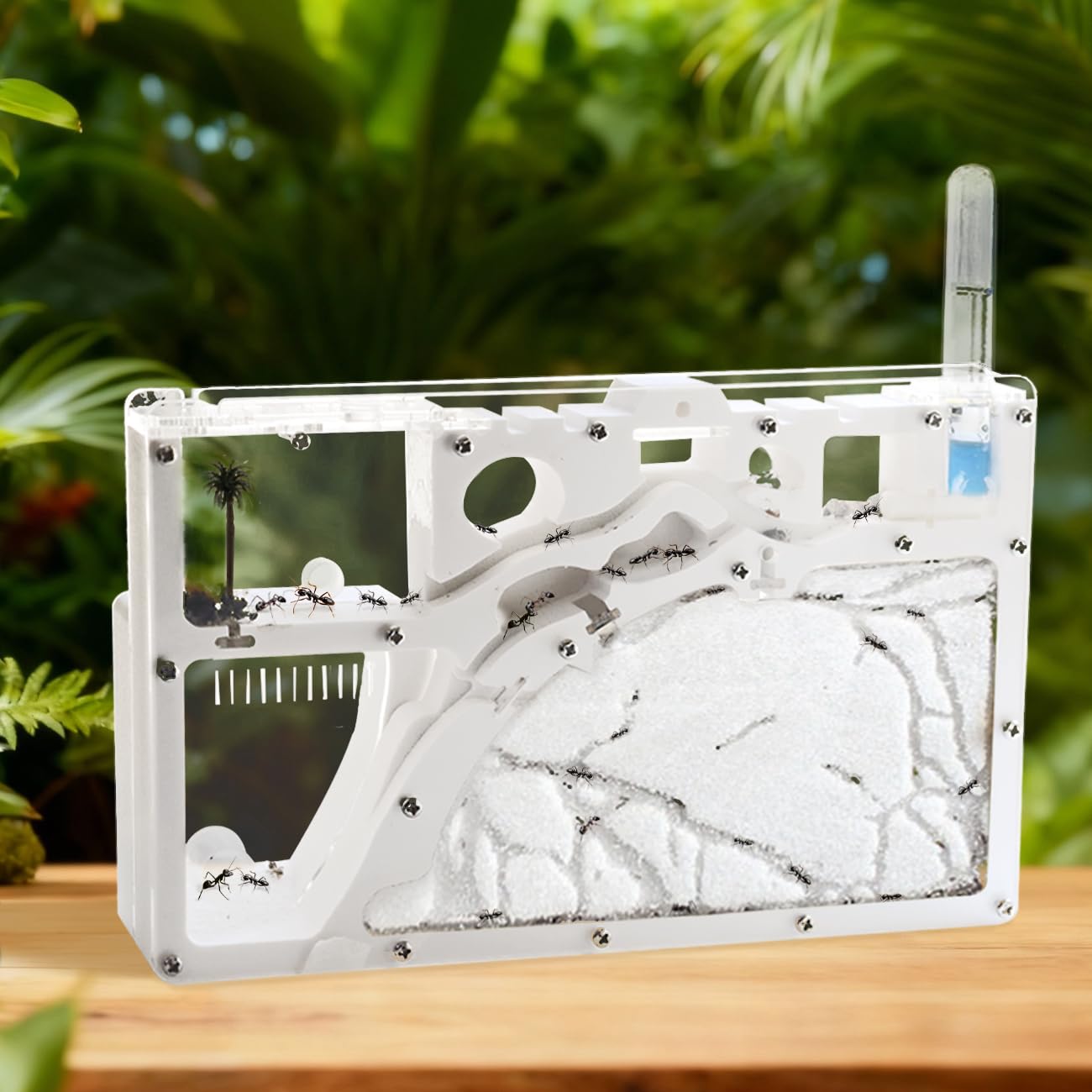
Kahopy’s ant castle uses thick, break-resistant acrylic with a child-lock function that genuinely prevents ants from escaping and kids from prying the lid off too easily. The design includes an automatic water supply system — a small water tower that slowly hydrates the sand through a built-in channel — and a flood outlet to drain excess moisture. These are thoughtful features that reduce daily maintenance.
The habitat is spacious at 9.37 by 5.67 inches, with multiple chambers that encourage ants to build separate rooms for food storage, tunnels, and waste. It comes with a full accessory set: funnel, dropper, tweezers, decorative tree, food basin, and a flag. Cleanup, however, is nearly impossible once the sand is inside — the acrylic can develop permanent mold stains if food is overfed.
Water tends to seep between the clear cover panels if you pour too fast, which can lead to condensation and mold growth. Some users reported ants finding their way out if the lid was left ajar during maintenance. Still, for the price, the castle-like design and anti-escape features are hard to beat.
Why it’s great
- Thick acrylic with child-lock lid is very escape-proof
- Built-in water tower and flood outlet reduce mold risk
- Large multi-chamber space for complex tunnel networks
Good to know
- Nearly impossible to clean once sand is inside
- Condensation buildup can cause visible mold over time
5. ELNMLHT Ant Castle
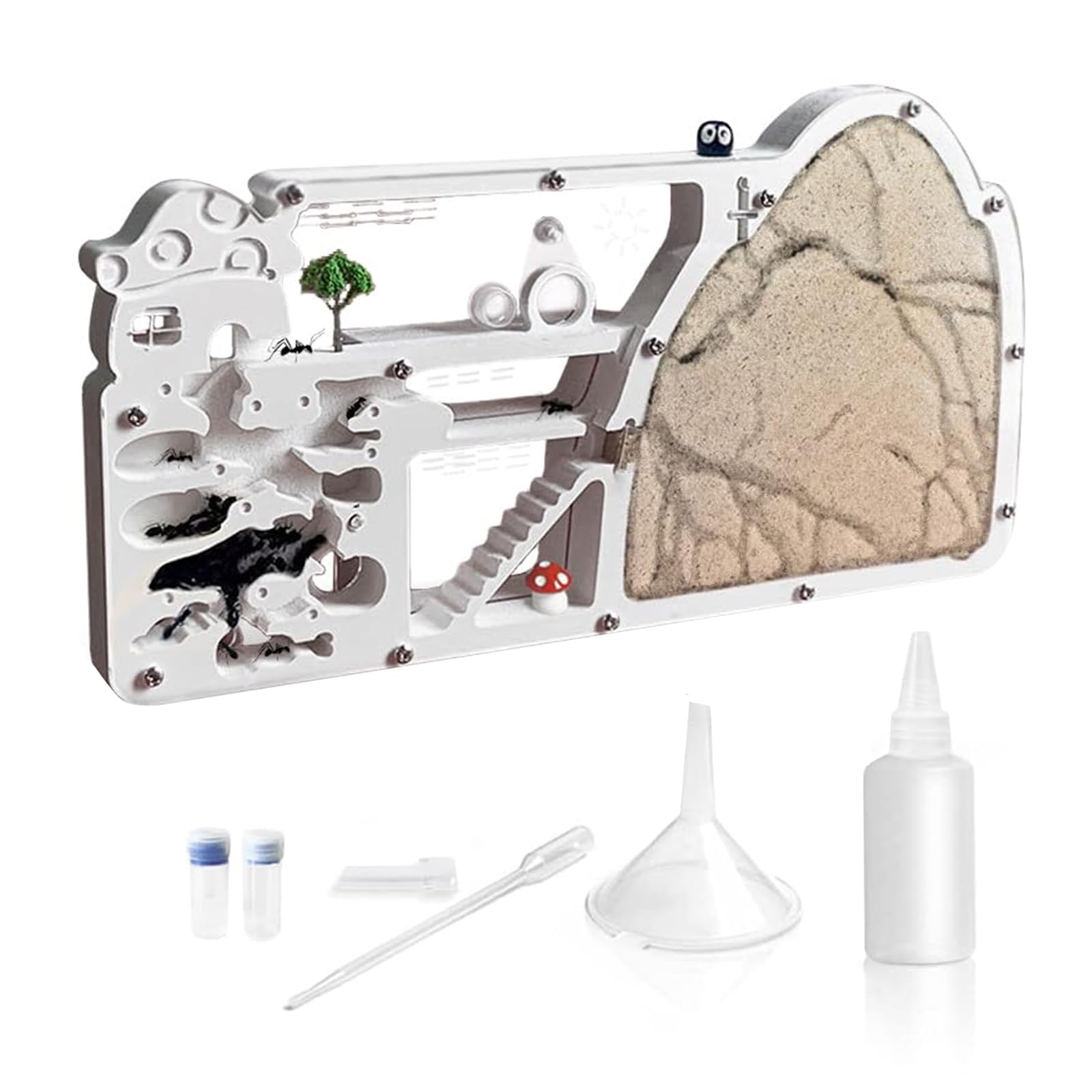
The ELNMLHT Ant Castle is a double-sided acrylic farm that divides its interior into distinct functional zones: an ant-loading area, an egg-laying chamber, and an excavation dump area. This room-like layout encourages natural colony organization and makes it easy to see where the queen (if you have one) is spending her time. The 10.8 by 5.8 inch footprint is one of the largest in this roundup.
It includes yellow sand, a drip bottle, a funnel, a water tower, and a dropper. The automatic water supply system has a refill hole on top so you can hydrate the sand every 10 days without opening the lid — a major design win that reduces escape risk. Build quality is solid, and the slim profile lets it sit on a desk or bookshelf without dominating the space.
The included instructions are notably vague — buyers report some trial and error with water levels and sand packing. Also, the yellow sand is dyed, which some purists dislike because they cannot verify purity. But for the price and features, this is a well-thought-out habitat for kids and adults alike.
Why it’s great
- Large double-sided layout with dedicated colony zones
- External water refill hole prevents escape during hydration
- Slim profile fits easily on a desk or shelf
Good to know
- Instructions are vague and require some guesswork
- Sand is dyed yellow — purity is unclear
6. Educational Insights GeoSafari Ant Factory
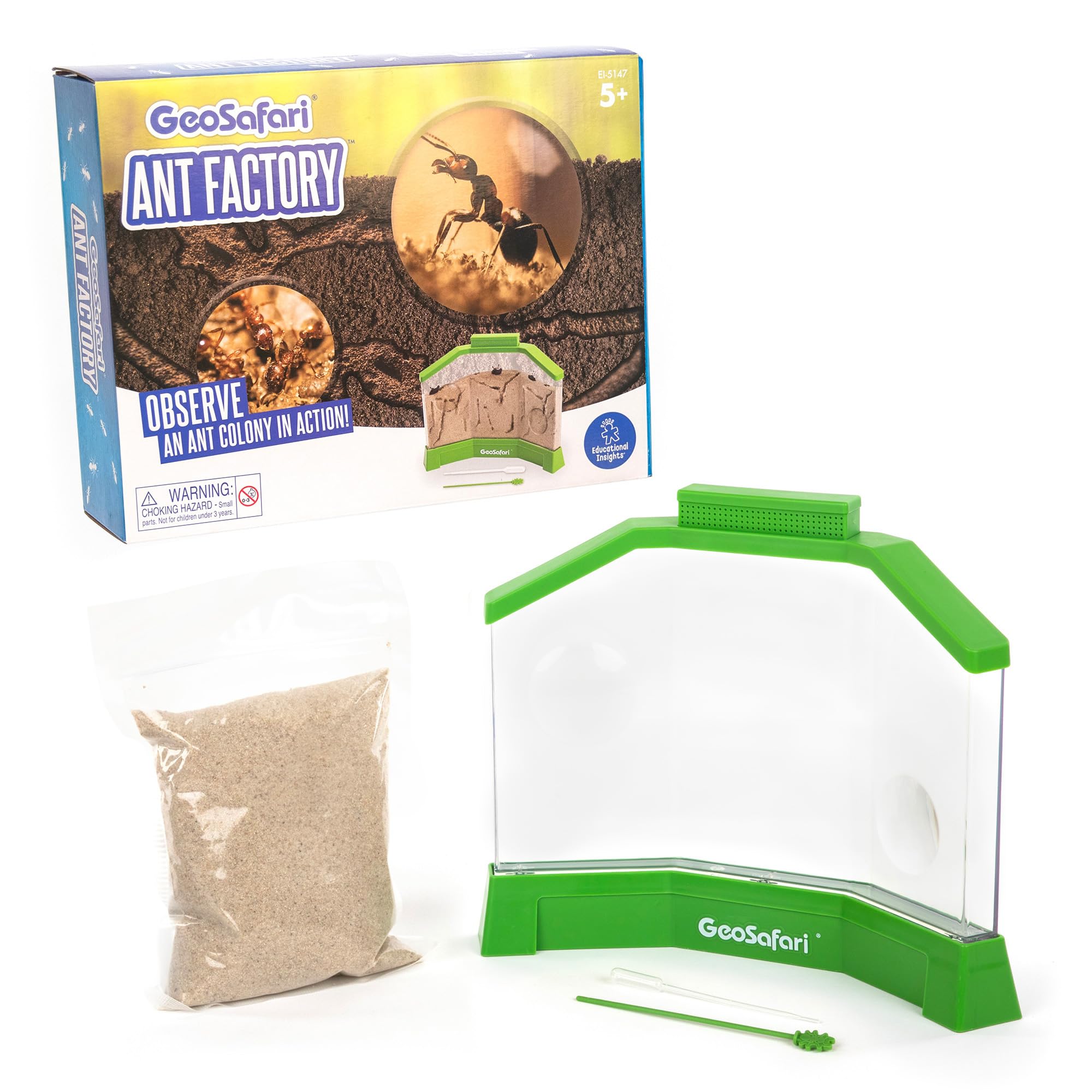
Educational Insights has a long reputation for classroom-grade STEM kits, and the GeoSafari Ant Factory lives up to that. The habitat is escape-proof, with a large viewing area and built-in magnification spots that let a whole group of kids watch from different angles. It comes with a stand, special ant sand, a feeding tool, and an activity guide with journaling prompts — making it a turnkey solution for teachers.
The sand provided is specifically formulated for tunneling — it holds its structure without collapsing, yet it is loose enough for ants to dig easily. The feeding tool inserts into a small opening so you can drop food without opening the lid. Reviewers consistently note that ants begin tunneling within a day and that the colony remains visible for weeks.
Ants are shipped separately via a redemption card, and the kit cannot ship to Alaska or Hawaii. The 12 by 9 by 5 inch size is larger than most home-use farms, so it is best suited for a dedicated shelf or table. For a classroom, science fair, or any group setting, this is the most thoughtfully designed farm in the lineup.
Why it’s great
- Classroom-grade escape-proof design with magnification spots
- Specially formulated sand holds tunnels without collapsing
- Includes activity guide with scientific journaling ideas
Good to know
- Larger footprint requires dedicated shelf space
- Ants must be ordered via redemption card; can’t ship to Hawaii or Alaska
7. AntHouse 3D Sand Ant Hill T Kit
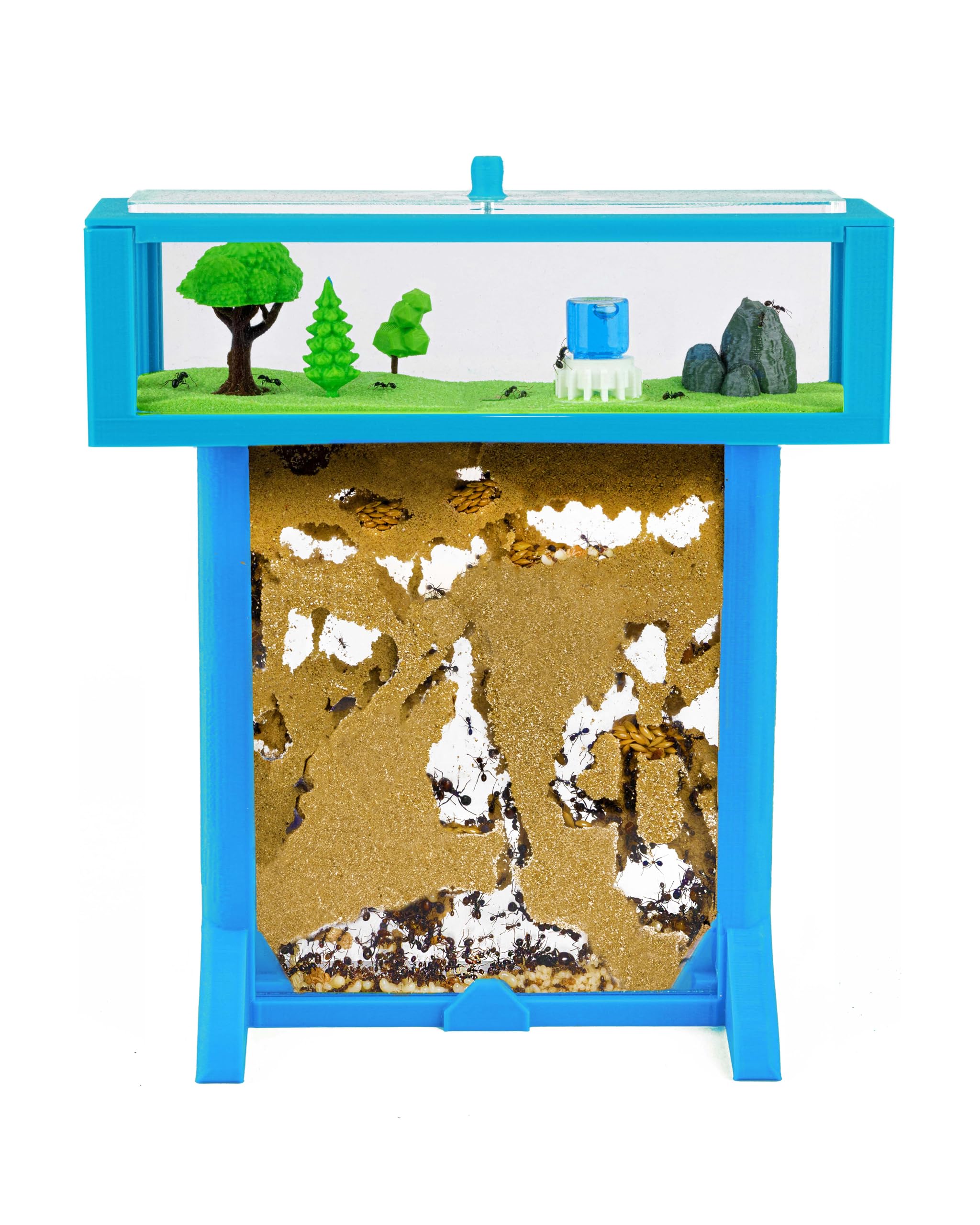
The AntHouse 3D Sand T Kit is built for the serious ant enthusiast. It uses an aluminum frame and a compact 15x15x1.5 cm form factor, with a side hole that allows you to connect additional ant houses or auxiliary foraging zones. Unlike every other kit on this list, it actually ships with live ants in a test tube that already contains food and water for two weeks — so you can start observing immediately.
The habitat is a 3D sandwich design: a thin layer of natural sand held between two transparent panels, with a removable foraging box on top. Ants tunnel in the sand layer while the foraging box serves as a feeding and waste area. The aluminum side guards prevent escapes and add a premium feel. Users report ants tunneling within two hours of introduction.
The major drawback is the price — it costs significantly more than any other kit here. Also, it is small: the 0.59 inch depth means tunnels are visible but shallow, and large ant species may feel cramped. Cleaning instructions are strict — no alcohol, only soapy water. This is not a toy; it is a compact professional formicarium for adults or older kids who already know they love myrmecology.
Why it’s great
- Ships with live ants in a test tube — ready to observe immediately
- Aluminum frame and side guards are durable and escape-proof
- Modular design can connect to additional habitats
Good to know
- Small shallow tunnel area may not suit all ant species
- Premium price; requires careful cleaning with soapy water only
FAQ
How often do I need to feed ants in a sand ant farm?
Can I use ants I find in my backyard instead of ordering them?
Why do my ants keep dying after a few weeks?
Final Thoughts: The Verdict
For most users, the ant farm kit winner is the National Geographic Ant Habitat because its plug-in LED lighting, built-in magnifiers, and zero-mess gel substrate make it the easiest, most engaging first farm for kids. If you want a more natural sand-based experience with real tunneling and modular expansion, grab the Tigerific Real Sand Ant Farm. And for serious enthusiasts who want a professional formicarium that ships with live ants and can be linked to additional habitats, nothing beats the AntHouse 3D Sand T Kit.