
Our readers keep the lights on and the weekend projects moving. As an Amazon Associate, I earn from qualifying purchases.
Flickering pixels, sudden signal drops in the middle of a touchdown, or the frustrating “no signal” screen that kills your evening plans — the hunt for a reliable local channel pull is one of the most underrated pains of cord-cutting. The right antenna solves this by locking onto broadcast frequencies with stability that feels nothing like the finicky rabbit ears you remember.
I’m Rikta — the co-founder and writer behind FitlyFast. I track market data on over-the-air reception gear, analyze signal-to-noise ratios across real-world installations, and break down which engineering choices actually deliver consistent channel counts.
Whether you live 20 miles from a transmitter cluster or deep in fringe territory, this guide to the best antenna for local tv cuts through the marketing to focus on what matters: usable range, band support, and build quality that survives a single season.
How To Choose The Best Antenna For Local TV
Picking an OTA antenna is not about picking the longest range number on the box. Real-world reception depends on frequency band support, gain profile, and your local geography. Learn what separates a winner from a paperweight.
Range Realities vs. Manufacturer Claims
Every outdoor antenna claims 150 to 200 miles, but physics limits pure line-of-sight range to around 60-70 miles from a transmitter, even under ideal conditions. Advertised ranges assume zero obstacles and maximum height. Subtract 30% if you live among trees or hills, and plan for 40-50 miles as a practical ceiling for stable reception in suburban settings. Focus on the antenna’s gain in dBi rather than the mileage on the package.
VHF vs. UHF — Why It Matters for Local Channels
Many budget antennas only pick up UHF (channels 14-51), which covers most networks but misses high-VHF (channels 7-13), where ABC or CBS broadcast in some markets. If you need Hi-VHF reception, look for an antenna that explicitly lists VHF elements — either a Yagi with longer rods or a combined design like the ClearStream 2V. Skipping VHF support is the most common reason a buyer can’t pull ABC or Fox after mounting.
Directional vs. Multi-Directional vs. Motorized
Fixed directional antennas offer the highest gain per signal path but leave you blind to transmitters behind the antenna. Multi-directional designs capture signals from all sides at the cost of weaker gain in any single direction. Motorized rotators let you aim a high-gain directional unit remotely, which is ideal if towers sit in opposite directions — the PBD motorized antenna solves this with a wireless remote. Choose based on whether your towers cluster in one direction or surround your home.
Quick Comparison
On smaller screens, swipe sideways to see the full table.
| Model | Category | Best For | Key Spec | Amazon |
|---|---|---|---|---|
| Antennas Direct ClearStream 2V | Multi-Directional | Suburban Hi-VHF + UHF | 60+ mi range, reflector, 20″ mast | Amazon |
| RCA ANT751Z | Yagi | Attic install, 75 mi | Pre-assembled, lock-fold reflector | Amazon |
| PBD WA-2608 | Motorized | Multi-direction towers | 360° rotation, 150 mi, 40ft RG6 | Amazon |
| Five Star Outdoor | Long-Range Yagi | Deep fringe reception | 200 mi, 4-TV splitter kit | Amazon |
| PIBIDI UHD-8903 | Yagi | Rural, distance hunting | 200 mi, pre-assembled elements | Amazon |
| 1byone Omni | Omni-Directional | Simple single-TV install | 100+ mi, 4G LTE filter, 39ft coax | Amazon |
| Televes DAT BOSS Mix LR | Smart Directional | Extreme fringe + 5G filtering | 100 mi, TForce amp, LTE/5G filter | Amazon |
In‑Depth Reviews
1. Antennas Direct ClearStream 2V
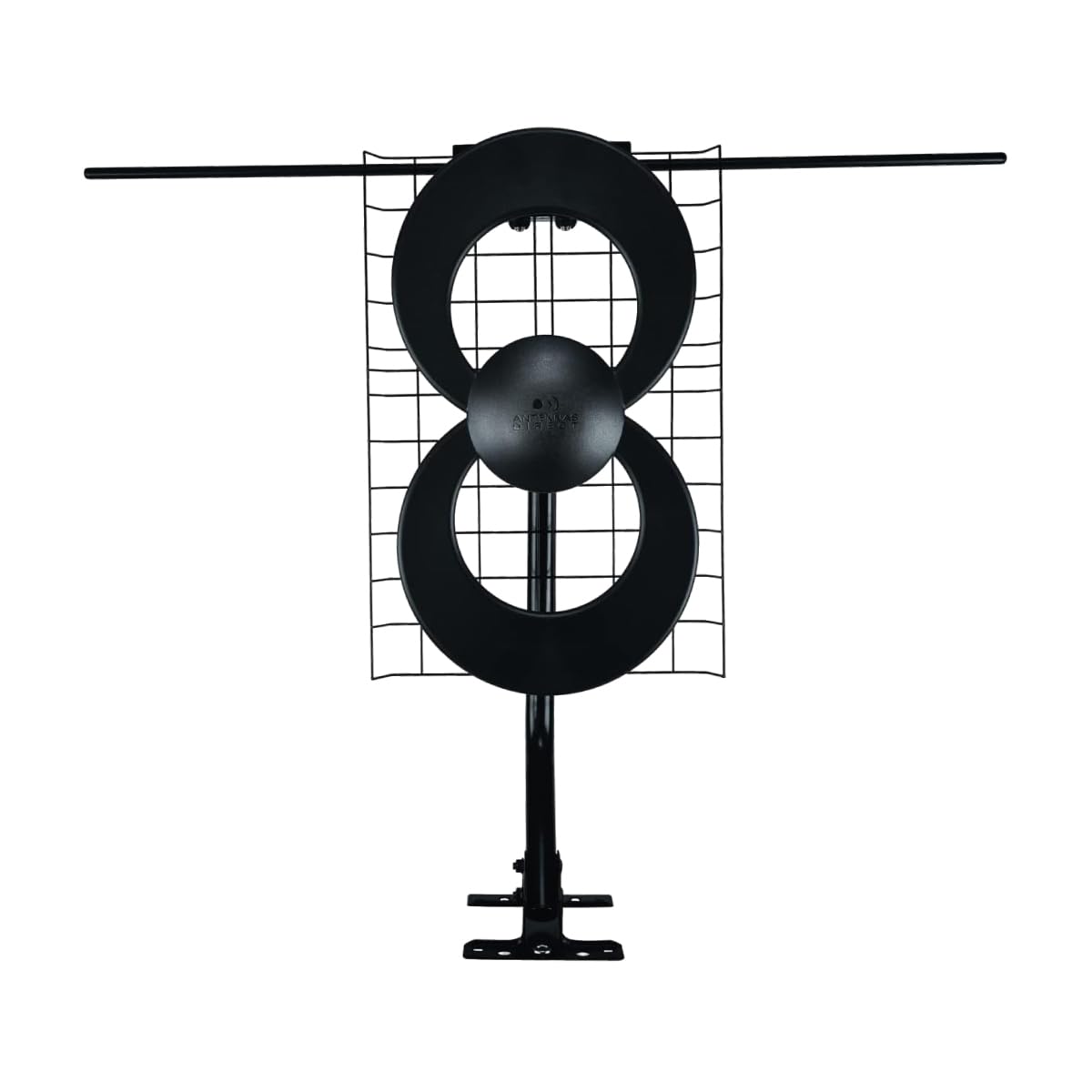
The ClearStream 2V is the goldilocks of OTA antennas — wide enough to pull signals from multiple directions yet focused enough to reject interference, thanks to its removable reflector. In suburban tests 38 miles from Seattle, users report 70 channels, 65 of which come through crystal clear, even with hills and trees in the path. The dual-loop UHF design combined with dedicated Hi-VHF elements means it covers channels 7-13, something many comparably priced antennas skip entirely.
Mounting flexibility sets it apart: the included 20-inch mast with pivoting base works flat against a roof peak or vertically on a pole, and the whole assembly weighs just 2 pounds. Indoor attic installation is common with strong results, as one buyer noted a clean 92% signal strength on ABC (VHF-Lo) from behind a TV cabinet without an amplifier. The lifetime antenna warranty from Antennas Direct, a US-based engineering company, adds confidence that budget imports don’t match.
The only catch is the coax is not included, so budget for a quality RG6 cable run. It also does not include a built-in amplifier, though many installations don’t need one — and an external preamp like the Winegard LNA-200 can be added if you’re pushing past 50 feet of cable or splitting to multiple rooms.
Why it’s great
- Strong Hi-VHF + UHF capture from multiple directions
- Reflector reduces multipath interference
- Lightweight, easy attic or outdoor mount
- Lifetime manufacturer warranty
Good to know
- Coax cable not included
- No built-in amplifier
- Best for suburban range under 60 miles
2. Televes DAT BOSS Mix LR 149884
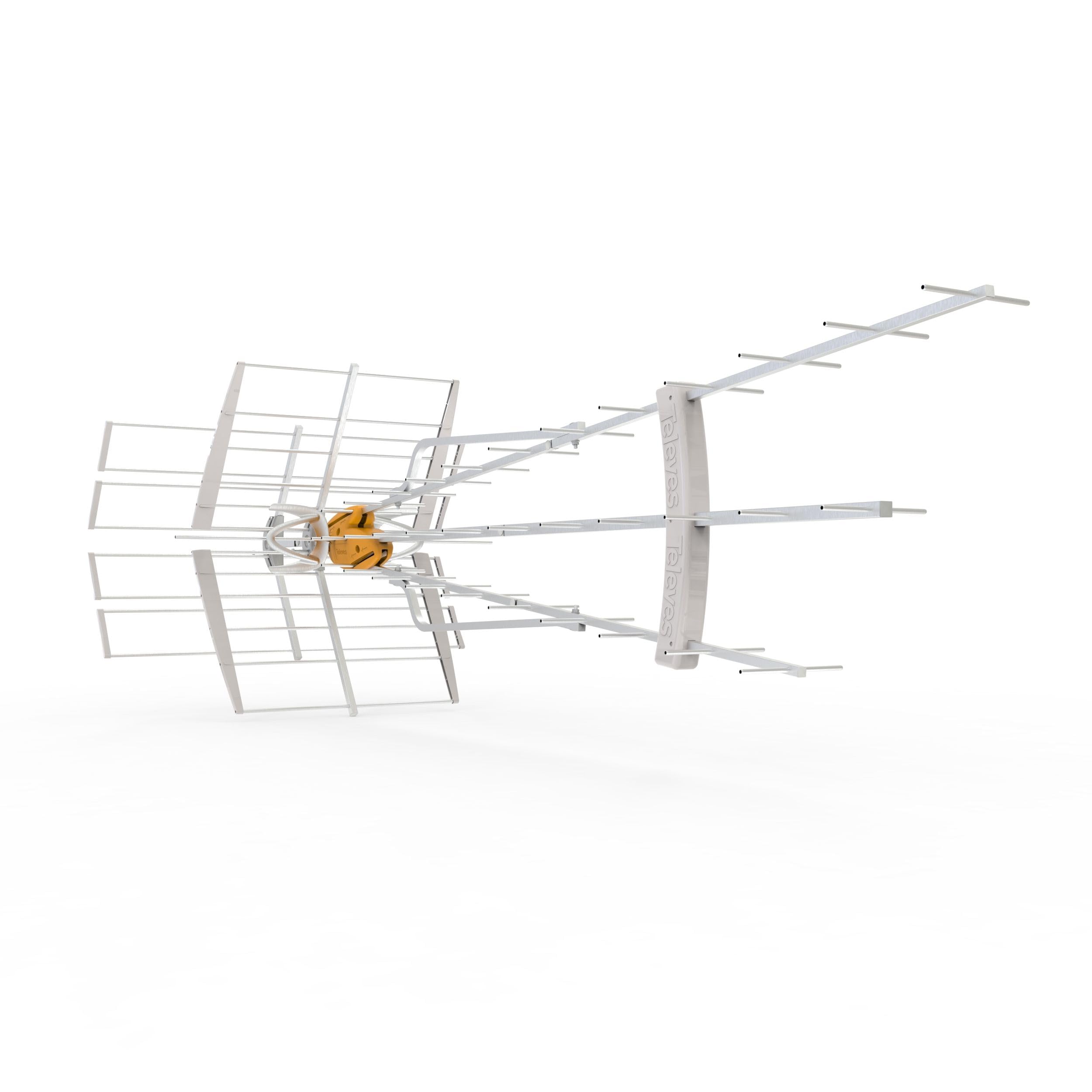
The Televes DAT BOSS is a category unto itself — a professional-grade directional antenna designed for extreme fringe and high-interference environments. Its patented TForce intelligent gain control automatically adjusts amplification separately for UHF (up to 46 dBi) and Hi-VHF, preventing the overload that fixed-gain amps cause when signals briefly spike. The stacked triple-boom, multi-director design achieves a front-to-back ratio of 25 dB on UHF, meaning signals from behind are almost completely rejected.
Built-in filtering for FM, LTE, 4G, and 5G up to 608 MHz is a rare and critical feature if you live near a cell tower. In rural Wisconsin, 70 miles from stations, this antenna pulled in 37 usable OTA channels where previous attempts failed, and a buyer in fringe Seattle gained 16 new channels while finally eliminating pixelation on high-UHF broadcasts. The all-metal construction, stainless hardware, and UL-listed power inserter reflect its European engineering heritage.
This is not a grab-and-go option: the antenna measures over 7 feet wide and weighs 10 pounds, demanding serious structural mounting. It also sits at a premium price point, so it only makes sense if you’re battling long distances, dense foliage, or cellular interference that cheaper antennas cannot overcome.
Why it’s great
- Dynamic gain control prevents overload and pixelation
- Integrated 5G/LTE filtering protects reception
- Highest raw gain and directivity in this list
- Pass-through mode works without power
Good to know
- Very large — requires robust mounting
- Premium price; overkill for suburban close-range
- Heavier construction adds installation complexity
3. PBD Amplified Outdoor TV Antenna WA-2608

The PBD WA-2608 solves one of the most annoying OTA problems: your local towers sit in opposite directions. Instead of choosing a fixed direction and losing half the channels, this antenna includes a wireless remote-controlled 360° motorized rotator that lets you aim the 150-mile-rated array at any tower cluster in seconds. Buyers replacing the popular Mohu Sky 60 report picking up significantly more channels without pixelation, even when mounted in a challenging attic location only 7 feet off the ground.
Hardware-wise, it packs a built-in high-gain amplifier, a 40-foot RG6 cable, and dual TV outputs that let you feed a second set without an external splitter. The weatherproof housing and included mounting pole make outdoor installation straightforward. One buyer in Detroit pulled in 80 channels from 25 miles away on a first try, while a user 35 miles from Philadelphia praised the responsive customer support team that provided a detailed channel map for optimal aiming.
Reviews note that the included RG6 cable is not the highest quality, and some users re-terminated it or swapped for a thicker run. The motor adds moving parts that could wear over time, but for households with transmitters scattered across two or three compass points, the convenience of remote re-aiming beats any fixed antenna.
Why it’s great
- Motorized 360° rotation for scattered tower clusters
- Dual TV outputs without external splitter
- Lifetime warranty and responsive tech support
- Strong performance in attic and outdoor mount
Good to know
- Included coax may need upgrade to premium RG6
- Motor mechanism adds potential wear point
- Range claim of 150 miles optimistic in real use
4. RCA Compact Outdoor/Attic Yagi ANT751Z

RCA’s ANT751Z is a classic Yagi that earned its reputation through decades of reliable attic installation. The pre-assembled design with easy-lock fold-out UHF reflectors and snap-lock elements means you can go from box to mounted in under 20 minutes. Its 75-mile rating is realistic for suburban areas, and the free RCA Signal Finder app helps you point the antenna precisely using your phone’s compass — a genuinely useful tool that other brands don’t offer.
In practice, attic-mounted users consistently report strong numbers: one buyer 28 miles from transmitters pulls 79 channels with major networks at 80-85% signal strength without any amplifier. Another in a foothill area within 25 miles gets 51 channels with full signal on both VHF and UHF using an external Winegard LNA-200 preamp. The picture quality often exceeds cable, with sharper 1080 HD and AC-3 audio. It also feeds whole-house coax networks and integrates with HDHomeRun tuners and TiVo for DVR recording.
The main shortfall is that VHF-Lo reception (channels 2-6) is weak, and some users report missing ABC if it broadcasts on a low VHF frequency in their market. The included mounting mast uses wood screws that may not hold in strong wind, so replacing with lag bolts is recommended for outdoor installations. Coax is sold separately.
Why it’s great
- Pre-assembled for fast attic installation
- Strong UHF and Hi-VHF reception in suburban range
- Free Signal Finder app simplifies aiming
- Works with whole-house coax and DVR systems
Good to know
- VHF-Lo reception is inconsistent
- Mounting hardware (wood screws) is basic
- Coax cable must be purchased separately
5. Five Star Outdoor HDTV Antenna

The Five Star antenna is built for buyers who want a complete kit: the antenna, J-pole mount, mounting bracket, and a TV splitter all come in the box. At 46 inches wide with long receiving elements, it captures VHF and UHF signals from distances claimed up to 200 miles. Real-world performance is strong — one buyer 45 miles from towers with buildings in between picked up 128 channels, while another 45 miles away with a mountain obstructing line-of-sight still receives 60 channels reliably.
The assembly is straightforward but the instructions have a minor omission: the VHF vibrator alignment detail is missing, so some users had to recheck the positioning of the short VHF rods after initial setup. The 40-foot RG6 cable is adequate for most roof or eave mounts, and one user ran an 80-foot extension with no signal loss. Higher elevation dramatically improves results, with a second unit mounted at 40 feet pulling ABC from 37 miles away that the ground-level mount could not reach.
It supports up to 4 TVs through the included splitter, but splitting reduces signal strength — expect to lose a handful of weaker channels on the far runs. The construction is decent for the price, though the plastic elements feel less robust than the all-metal RCA or Televes units. For a budget-minded multi-TV household within 50 miles of towers, this kit delivers strong value.
Why it’s great
- Complete kit with mount, J-pole, and splitter
- High channel counts reported in suburban fringe
- Supports multi-TV distribution without extra gear
- ATSC 3.0 compatible for future NextGen TV
Good to know
- Manual missing VHF assembly detail
- Plastic elements feel less durable than metal
- Splitting to 4 TVs reduces weaker channels
6. PIBIDI Outdoor TV Antenna UHD-8903

The PIBIDI UHD-8903 is a no-nonsense Yagi that prioritizes element length and surface area over fancy features. Its extended receiving elements are physically longer than most comparably priced antennas, which translates to better real-world gain on weak signals. In rural areas 40-100 miles from towers, users report pulling stations with sharp, clear pictures — one buyer upgraded from a larger, more expensive 12-year-old antenna and got better results with half the size and weight.
Assembly is mostly pre-done: just attach a few remaining elements without tools, then mount the unit on the included pole. Weather resistance includes lightning protection via a grounded design, though users should still follow local code for proper grounding. The lack of a built-in rotator is the biggest limitation — if you need to re-aim, you must climb up and physically turn the mast. One buyer noted they cannot receive MeTV-toon because it transmits from behind their mounting direction.
It lacks an amplifier, LTE filter, or any smart gain management, so fringe reception is entirely dependent on passive element design. A few users commented that the actual range is below the advertised 200 miles, which is expected — treat it as a solid 60-80 mile unit with excellent sensitivity in that band. The 1-year warranty is shorter than the lifetime offers from PBD or Antennas Direct.
Why it’s great
- Longer elements capture weak distant signals well
- Tool-free assembly, pre-wired design
- Lightning protection built into design
- Lightweight compared to older Yagi models
Good to know
- No rotator — requires manual re-aiming
- Advertised range is inflated
- 1-year warranty, shorter than premium competitors
7. 1byone Outdoor TV Antenna Omni-Directional

The 1byone omni-directional antenna is the simplest outdoor option on this list: mount it once, and it receives UHF and VHF signals from every direction with no adjustments needed. The compact white housing hides a built-in pre-amplifier and a 4G LTE filter that removes cellular interference, a smart inclusion for suburban areas where mobile towers are dense. A 39-foot RG6 coax cable is included, enough to reach most eave or roof-edge locations.
Buyers praise the quick setup — one user mounted it just 10 feet off the ground and got all their desired channels without any tuning. The weather resistance is adequate for outdoor mounting, though several users reported water ingress after two years, with the pre-amp module filling with moisture and corroding the RF connector. Sealing the seams and drilling drainage holes restored function, but this is a durability concern for permanent installations.
Performance is inconsistent: strong in some locations (124+ channels initially for one user) but finicky in others, dropping to 70 channels when weather shifts or movement occurs. Many of the extra channels are foreign-language or shopping networks rather than major broadcasters. It works best as a tool-free starter antenna for a single TV in a clear-sky suburban location, but buyers looking for long-term outdoor reliability may want to choose a more sealed design.
Why it’s great
- No aiming needed — picks up 360° signals
- Built-in LTE filter + amplifier in compact form
- Very fast, tool-free installation
- Includes long 39ft RG6 coax
Good to know
- Not fully waterproof — risk of internal moisture
- Channel count varies with weather and movement
- Many received channels are non-English or shopping
FAQ
Why do I lose channels when the weather changes?
What do ATSC 3.0 and NextGen TV compatibility mean for my local channels?
Can I use a single antenna to feed multiple TVs in different rooms?
Final Thoughts: The Verdict
For most users, the best antenna for local tv winner is the Antennas Direct ClearStream 2V because its multi-directional design, Hi-VHF support, and lifetime warranty hit the sweet spot for suburban cord-cutters who want reliable channel counts without complexity. If you have transmitters in opposite directions, grab the PBD WA-2608 for its motorized 360° rotator. And for extreme fringe or 5G interference, nothing beats the Televes DAT BOSS Mix LR as a true professional-grade solution.