
Our readers keep the lights on and the weekend projects moving. As an Amazon Associate, I earn from qualifying purchases.
Digging post holes in rocky, clay-filled, or root-tangled soil turns a simple fencing project into a full-day battle with the earth. Standard augers bind, jerk, and stall when they hit a stone, leaving you bruised and the hole half-finished. The right gas-powered earth drill, however, changes the equation—it delivers the torque, bit design, and anti-kickback protection to chew through stubborn ground without tearing your arms off.
I’m Rikta — the co-founder and writer behind FitlyFast. I’ve spent years analyzing power tool hardware, comparing engine displacement, gearbox durability, and bit metallurgy across dozens of auger models to determine what actually survives repeated contact with buried rock and dense clay.
This buying guide focuses exclusively on machines built to handle the punishment of stone-laden earth, presenting the best auger for rocky soil based on real-world torque, starting reliability, and structural toughness that keeps you drilling instead of wrenching.
How To Choose The Best Auger For Rocky Soil
Selecting a rock-ready auger means looking past simple horsepower numbers and focusing on the specific mechanical traits that prevent bind-ups and protect your body. Three factors dominate the decision.
Engine Displacement and Torque Delivery
Engines in the 54cc to 85cc range provide the low-end twisting force needed to shear through stone without stalling. A 43cc unit can handle light-duty work in topsoil, but once you hit a fist-size rock at depth, you need the extra cubic centimeters to keep the bit turning and cutting rather than catching. Four-stroke engines offer better low-end torque and quieter operation, while 2-stroke engines deliver higher RPM for speed in softer patches.
Bit Metallurgy and Blade Geometry
Alloy steel bits with powder-coated surfaces resist corrosion, but the critical detail is blade sharpness and the fishtail pilot point. Replaceable cutting blades let you restore bite after repeated rock impacts instead of replacing the entire auger. Bits with aggressive, angled cutting edges penetrate faster and shed soil more efficiently, reducing the time the auger spends in contact with buried obstacles.
Safety Systems and Vibration Control
Rocky soil causes sudden kickback when the bit catches on an unmovable stone. Anti-kickback clutches or electronic motor-cut systems (as seen on brushless electric models) stop the rotation instantly, preventing the handlebars from spinning out of your grip. Anti-vibration foam grips and ergonomic handle shapes reduce arm fatigue, allowing you to maintain control over a long day of drilling. A well-placed emergency stop switch accessible by gloved fingers is non-negotiable.
Quick Comparison
On smaller screens, swipe sideways to see the full table.
| Model | Category | Best For | Key Spec | Amazon |
|---|---|---|---|---|
| Earthquake E43 Powerhead | Mid-Range | Reliable power in clay & rock | 43cc, 36″ bit, replaceable blades | Amazon |
| 85cc PRIJESSE | Premium | Max torque for deep rock holes | 85cc, 3 bits (4/8/12″), 2 extensions | Amazon |
| PROYAMA 54cc | Premium | Versatile multi-bit rock drilling | 54cc, 4 bits (4/6/8/12″), 5yr gearbox | Amazon |
| Prowoo 78CC 4-Stroke | Premium | Low-vibration continuous digging | 78cc 4-stroke, 2 bits, extension rod | Amazon |
| Baotree 78CC | Mid-Range | Full kit for varied soil types | 78cc, 2 bits (6/8″), 2 extension rods | Amazon |
| 72CC Gas Auger (2-Stroke) | Mid-Range | Budget-friendly high-torque work | 72cc, 2 bits (6/8″), extension rod | Amazon |
| VEVOR 43cc Gas | Mid-Range | Entry-level gas auger for farm use | 43cc, 8″ bit, shock-absorbing handle | Amazon |
| Seymour AUA2 Manual | Budget | No-gas option for small rocky holes | Adjustable 4-8″, steel blade, wood handle | Amazon |
| WORX Nitro 40V Cordless | Premium | Safe electric alternative to gas | 40V brushless, anti-kickback, 59 lb-ft | Amazon |
In‑Depth Reviews
1. Earthquake E43 1-Person Earth Auger Powerhead

The Earthquake E43 hits the sweet spot between outright power and manageable weight. Its 43cc Viper engine starts reliably on the second pull, even after storage, and the industrial-grade air filtration keeps fine dust out of the cylinder during prolonged use in dry, rocky soils. The 36-inch auger length lets you stand upright while drilling to full depth, reducing lower back strain.
Real-world tests in thick clay with embedded gravel show the 8-inch bit boring through 30-inch holes without binding. The replaceable cutting blades are a major advantage: when repeated rock impacts dull the edge, you swap blades rather than retiring the entire auger. The anti-vibration foam grips and fingertip throttle provide precise control when the bit encounters resistance.
It does struggle if you try to push a 12-inch bit through heavy clay—the powerhead is matched best to the included 8-inch unit. For a one-person operation that demands consistent starts and repairable bits, this is the most balanced rock-soil auger on the market.
Why it’s great
- Industrial air filtration protects engine in dusty rocky soil
- Replaceable auger blades extend tool life significantly
- Starts easily even after storage with fresh fuel mix
Good to know
- Not enough torque for 12-inch bits in heavy clay
- Lacks a built-in bubble level for plumb holes
2. 85cc Post Hole Digger 2-Stroke
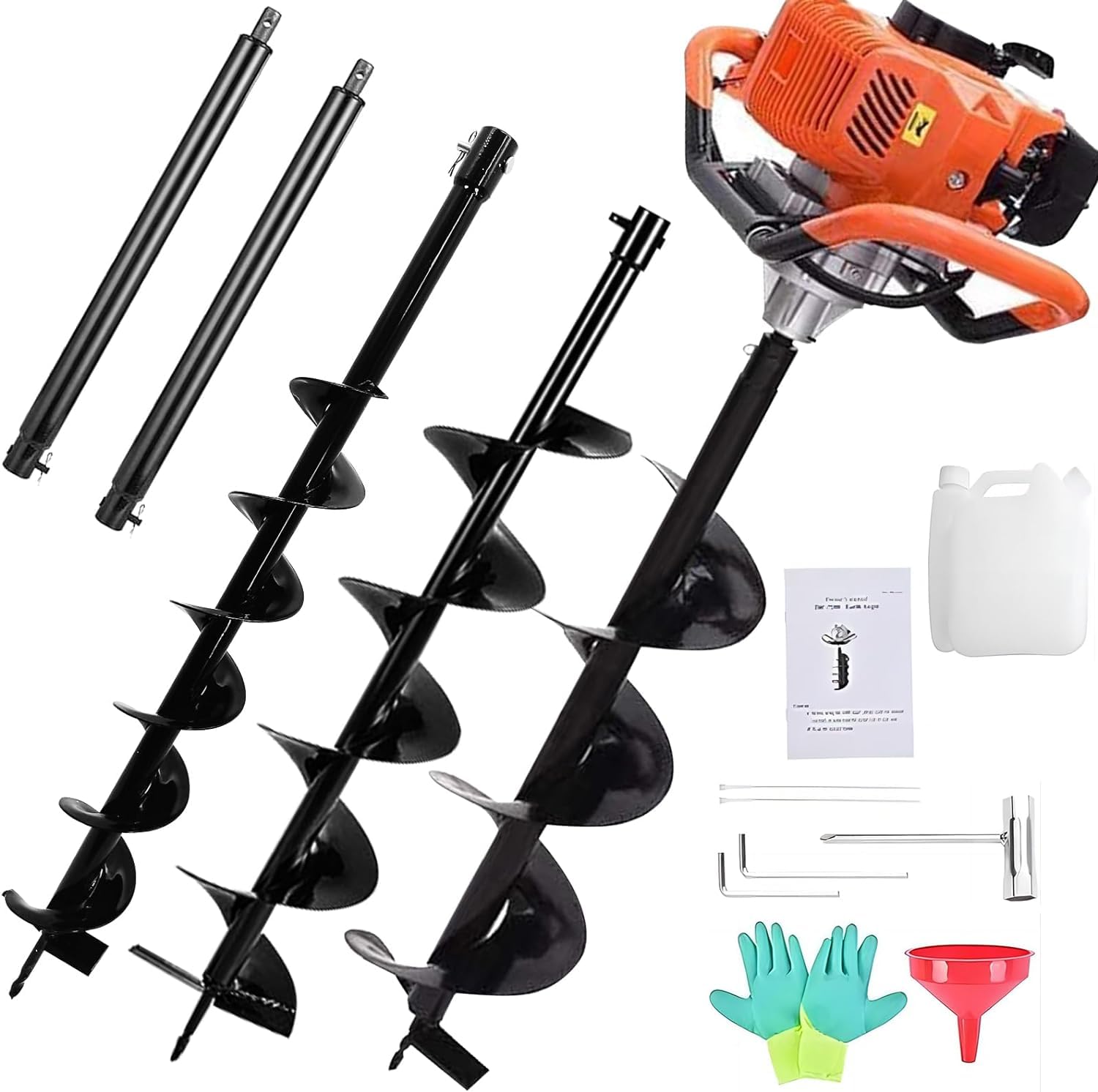
The 85cc 2-stroke delivers the highest torque in this lineup, making it the go-to choice for drilling through Arizona desert caliche or Tennessee river rock. With three auger bits (4, 8, and 12 inches) and two 24-inch extension bars, you can reach 48-inch depths with the largest bit—a feat that would stall lesser machines. Owners report boring 36-inch holes using the 12-inch auger in 3 to 4 minutes per hole.
The ergonomic anti-skid grips and vibration-proof handles reduce the punishing feedback when the bit grinds against stone. However, the throttle is sensitive: a reflex grip can cause unintended acceleration, and if the unit snags, it can rip the control wires loose. Several users have added a lanyard kill switch as a precaution. The choke tab requires manual return to run position, which is easy to forget.
For sheer material-moving capability in truly rocky conditions, nothing in this price tier matches the 85cc. Just budget time for bolt checks and consider reinforcing the handlebar switch housing before heavy use.
Why it’s great
- Highest displacement in this guide — real rock-busting torque
- Includes 4″, 8″, and 12″ bits plus two 24″ extensions
- Anti-vibration grips reduce arm fatigue on long jobs
Good to know
- Throttle is touchy; handlebar switch can pull loose on snag
- Choke tab must be manually pushed back to run position
3. PROYAMA 54cc Post Hole Digger
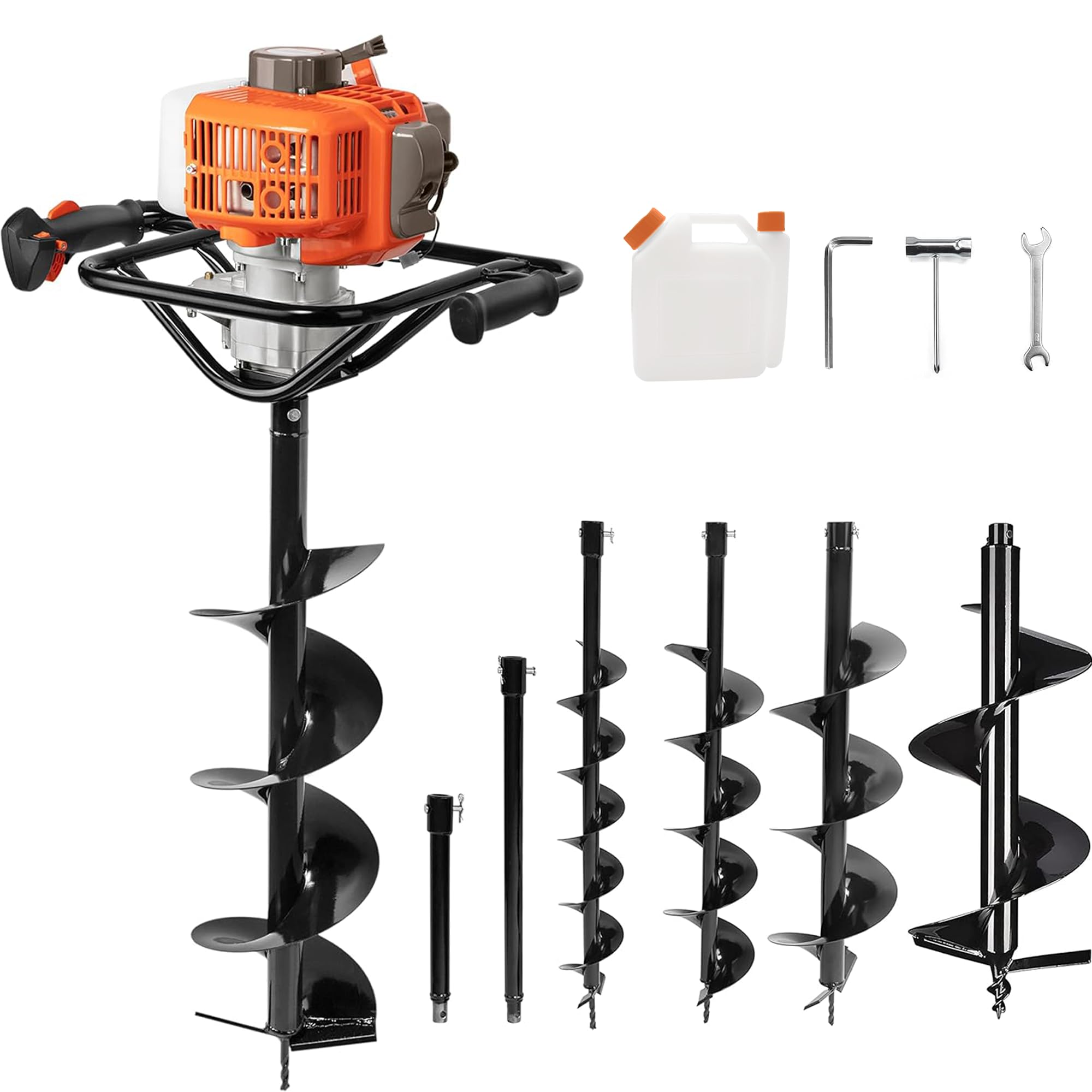
The PROYAMA 54cc includes four auger bits (4, 6, 8, and 12 inches) plus a 12-inch and 20-inch extension rod, giving you the widest diameter range of any model in this guide. The engine produces 2.4 HP with a 50:1 gas-oil mix, and the 5-year warranty on the gearbox signals confidence in the alloy gears and ball-bearing shafts that handle rock-induced shock loads.
Users report the 12-inch bit can dig through moderate rock fields, but the unit tends to jump when it grabs a large stone—the torque is sufficient, but the 54cc displacement means you need to let the weight of the machine do the work rather than forcing it. Starting is straightforward with the manual recoil system, and fuel efficiency is above average for a 2-cycle engine.
The included bits are not replaceable-blade type, meaning heavy rock use will eventually dull them. For a property owner who needs a single machine to handle 4-inch soil sampling holes and 12-inch fence post holes in mixed terrain, the PROYAMA delivers remarkable breadth.
Why it’s great
- Four-bit kit covers every common hole diameter
- 5-year gearbox warranty for peace of mind
- Good fuel efficiency for a 2-cycle engine
Good to know
- Bits have fixed, non-replaceable blades
- Can jerk hard when bit catches on a large buried rock
4. Prowoo 78CC 4-Stroke Auger
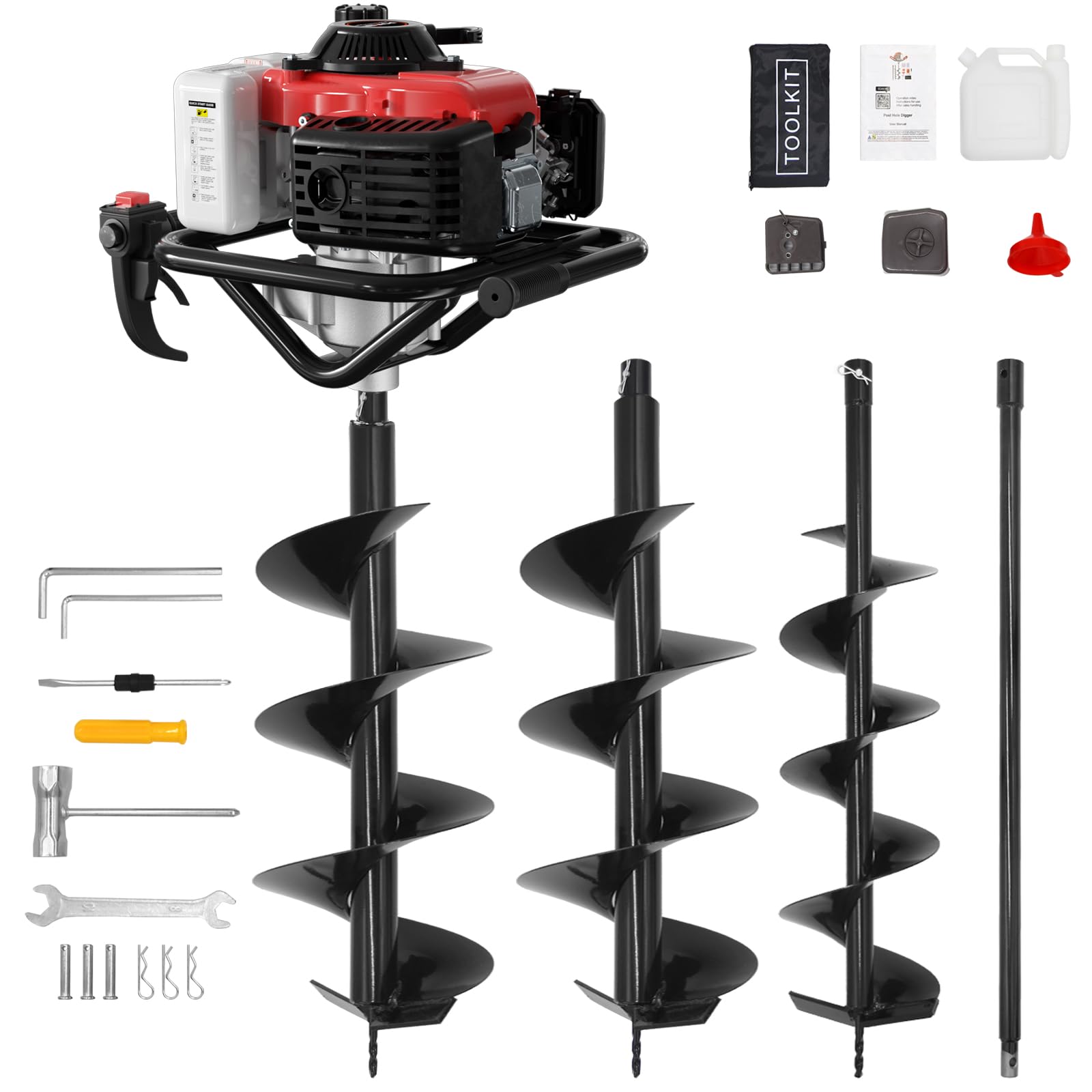
The four-stroke engine on the Prowoo 78CC eliminates the need to premix gas and oil, a convenience that also reduces exhaust smoke and noise compared to 2-stroke competitors. The 78cc displacement provides solid low-end torque, and the vibration-damping design cuts arm fatigue noticeably during continuous drilling. Users in North Carolina reported drilling 40-plus holes in rock-hard clay without needing a break.
The included 6-inch and 8-inch auger bits handle most fence-post and tree-planting tasks, and the extension rod allows drilling to 36-inch depths. One caveat: the 8-inch bit’s cutting edge can bend if you encounter a large rock at full depth. A torch and hammer realigned it, but heavier rocks may require slowing down and taking smaller bites.
Starting is reliable on the second or third pull when cold, and the manual recoil system has a fuel-priming bulb that simplifies the process. For anyone who hates smelling like gasoline after a day of digging, the four-stroke Prowoo is a clean-running workhorse.
Why it’s great
- Four-stroke engine runs cleaner and quieter than 2-stroke
- No gas-oil mixing step saves time
- Vibration damping reduces arm fatigue significantly
Good to know
- 8-inch bit edge can bend on large rocks
- Only 6″ and 8″ bits included — no smaller or larger options
5. Baotree 78CC Post Hole Digger
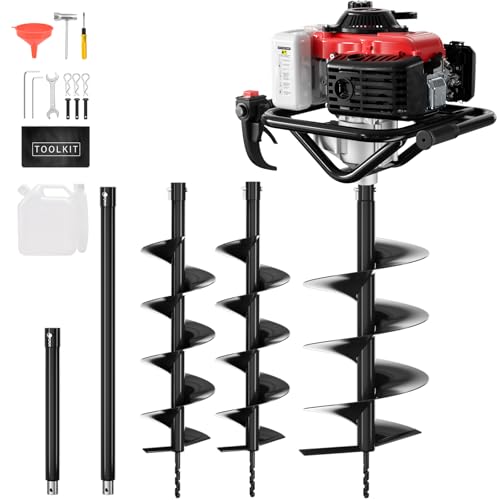
The Baotree 78CC comes with two drill bits (6 and 8 inches) and two extension rods, providing extra depth reach for situations where a standard single extension leaves you short. The four-stroke engine delivers smooth torque and easy cold starts, and the reinforced handles resist flexing when you apply downward pressure in compacted soil.
The 78cc power plant handles rocky terrain better than the 43cc units, but the bits are standard steel rather than hardened carbide, so expect faster wear if your soil contains quartz or chert. The manual recoil start is consistent, and the large fuel tank supports extended sessions.
Some units arrive with the mixture ratio label slightly off, so double-check the manual. For the price, the dual-extensions kit offers better value than many competitors that only include a single rod.
Why it’s great
- Two extension rods for deeper holes than most kits
- Four-stroke power with consistent cold starts
- Reinforced handles resist flex under pressure
Good to know
- Bits are standard steel, not hardened carbide
- Fuel mixture label may be incorrect — check manual
6. 72CC Gas Auger Post Hole Digger
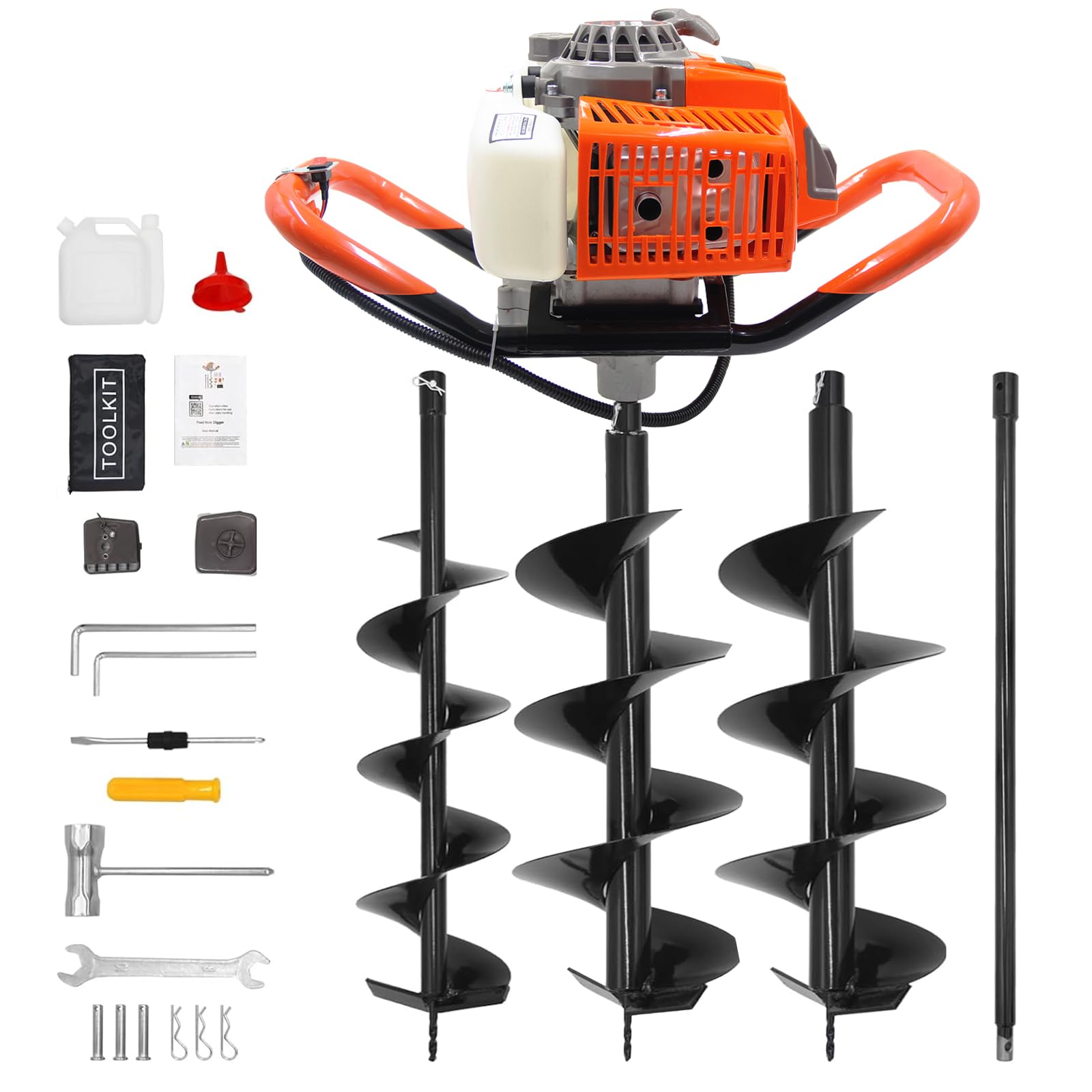
The 72cc 2-stroke strikes an excellent balance between price and performance. It includes a 6-inch and 8-inch bit plus a 60cm extension rod, and the manual recoil start typically fires on the second pull. Users with 14 years of lineman experience reported drilling 4-foot-deep, 12-inch-wide holes for fence posts with minimal effort, simply by taking small bites.
In rocky soil, the 72cc has enough torque to grind through small stones, but the bottom tines on the auger bit can bend if you force the machine through heavy ground. Several owners trimmed the bent tine and continued using the bit without issue. The throttle cable is prone to sticking in the ON position if the guide isn’t lubricated before first use, and the plastic throttle trigger requires careful handling.
For a property owner installing a fence or planting a small orchard, this auger provides 85% of the capability of the premium units at a noticeably lower investment. Just plan to lubricate the throttle cable and replace the bits a season or two sooner.
Why it’s great
- High torque-to-price ratio for rocky soil work
- Includes 6″ and 8″ bits plus extension rod
- Reliable cold start on second pull
Good to know
- Auger tines can bend in heavy soil — may need trimming
- Throttle cable requires lubrication to prevent sticking
7. VEVOR 43cc Post Hole Digger
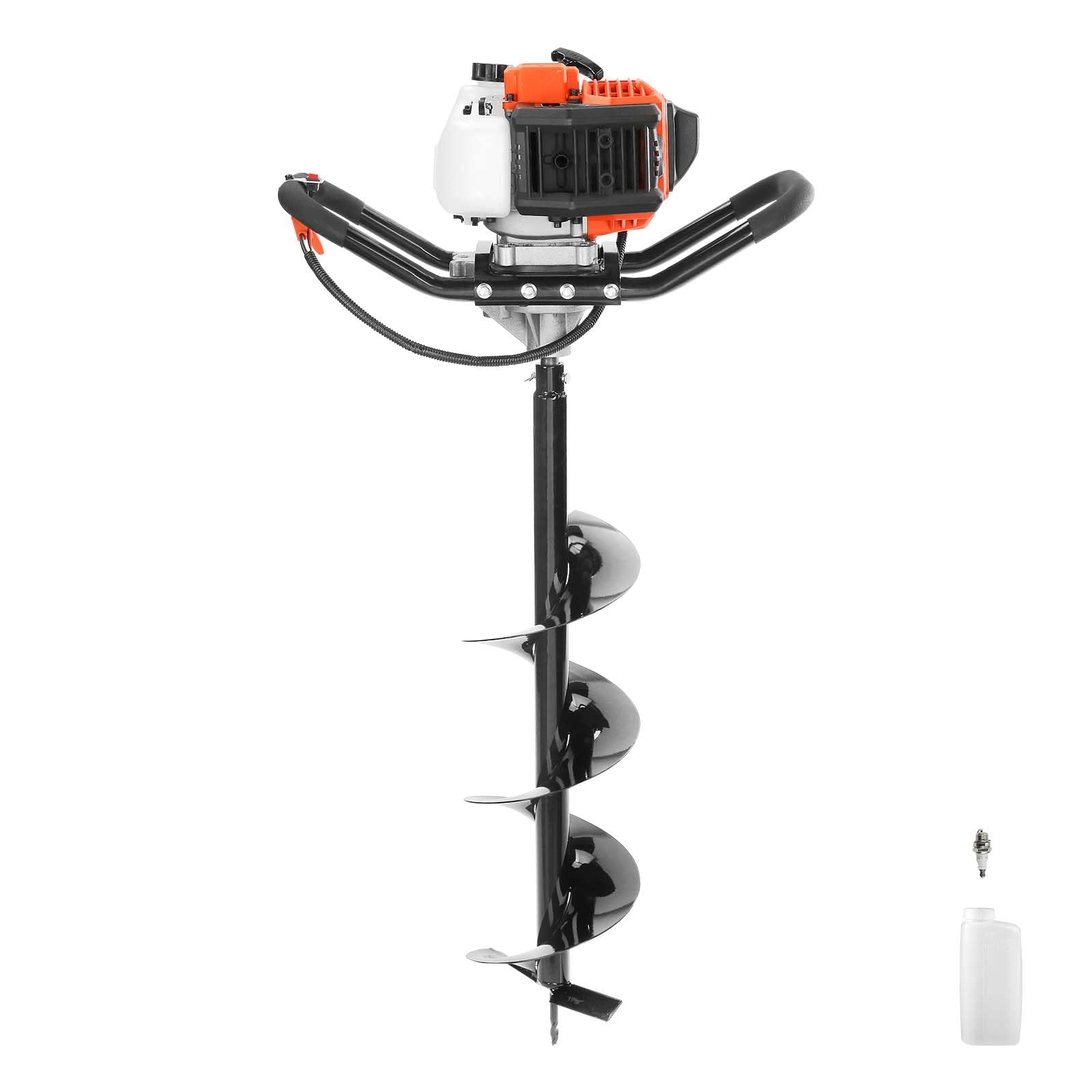
The VEVOR 43cc is the lightest gas-powered option in this guide, making it approachable for users who don’t want to wrestle a 30-pound machine. The 43cc engine delivers up to 9350 RPM, and the 30-inch alloy steel bit lets you drill without bending over. The shock-absorbing foam handle reduces vibration transfer, and the emergency stop switch is positioned conveniently on the handlebar.
In practice, this unit works well in topsoil and sandy loam, but it struggles in compacted clay or rock-laden ground. Multiple users reported that the pull cord broke within the first few pulls, and the auger locks up when it encounters a root or stone, causing significant handlebar jerk. The 43cc simply lacks the torque reserve to power through obstructions that a 72cc or 85cc machine would handle.
The EPA certification is a plus for emissions-conscious buyers, and the included tool kit and oil can are handy. For light-duty garden work in screened soil, this is a functional tool; for rocky fence-post projects, you’ll want more displacement.
Why it’s great
- Lightest gas auger in this review at 33 pounds
- EPA-certified engine with low emissions
- Shock-absorbing foam handles reduce vibration
Good to know
- Underpowered for rocky or compacted clay soils
- Pull cord durability issues reported by multiple users
8. Seymour AUA2 Adjustable Auger

The Seymour AUA2 is a manual auger with no engine, no fuel, and no maintenance—just a welded steel tee handle and adjustable steel blades that expand from 4 to 8 inches in diameter. It weighs only 7.5 pounds, making it easy to carry across rough terrain, and it excels in heavy clay where its constant-diameter bore leaves a clean, uniform hole. Users with heavy clay soil report digging 4-foot holes in about 15 minutes per hole.
In rocky soil, however, the manual auger stops cold when it hits a stone larger than 3 inches. You’ll need a digging bar or spud bar to break through, and loose soil can fall back into the hole on extraction. The adjustment bolt can loosen during use, so checking it before each session is essential. For a homesteader who needs a few post holes in clay and doesn’t want to deal with gas engine maintenance, this is a reliable fallback.
For large-scale rocky projects, the Seymour is best used as a cleanup tool after a gas auger breaks through the top layer. As a primary rock-soil digger, it requires serious upper-body strength and patience.
Why it’s great
- No fuel, no engine maintenance, instant start
- Adjustable 4-8″ diameter from a single tool
- Excels in heavy clay with uniform straight holes
Good to know
- Stops dead on rocks over 3 inches
- Adjustment bolt loosens during use
9. WORX Nitro 40V Cordless Earth Auger

The WORX Nitro 40V is the only electric auger in this guide and the safest option for rocky soil. Its brushless motor delivers 59 ft-lbs of torque equivalent to a 45cc gas engine, and the anti-kickback system cuts motor power instantly when the bit jams on a rock or root. Multiple owners report that when the bit hits an obstruction, the tool simply stops spinning instead of wrenching your arms—a decisive safety advantage over gas models.
In Georgia red clay with abundant rocks, users found the low-speed setting sufficient for boring 24-inch holes. The two-speed gearbox offers low speed for soil and high speed for ice drilling, plus a reverse function that simplifies extracting a stuck bit. The included batteries drill up to 38 holes per charge in average soil, though rocky conditions reduce that figure. At 30 pounds with batteries, it’s lighter than most gas units.
For a homeowner who prioritizes safety over raw speed, or anyone with a history of wrist or shoulder injuries, the WORX Nitro eliminates the most dangerous part of rock-soil drilling: the uncontrolled spinout. The main trade-off is that you cannot work all day on a single battery charge, and replacement batteries add cost.
Why it’s great
- Anti-kickback system stops motor instantly on rock impact
- Reverse function helps extract stuck bits safely
- Much quieter and cleaner than any gas auger
Good to know
- Battery runtime limits continuous digging to 30-40 holes
- Equivalent torque is 45cc gas — less than 72-85cc units
FAQ
What is the minimum engine size I should consider for rocky soil?
How do I prevent the auger from kicking back when it hits a rock?
Are 4-stroke or 2-stroke engines better for rocky soil?
Can I use a cordless electric auger in rocky soil?
How do I maintain an auger after digging in rocky soil?
Final Thoughts: The Verdict
For most users, the best auger for rocky soil winner is the Earthquake E43 Powerhead because its reliable starts, replaceable cutting blades, and industrial air filtration make it the most practical all-around machine for stone-laden ground. If you want maximum torque to chew through deep caliche or river rock, grab the 85cc PRIJESSE. And for unmatched safety and zero engine maintenance, nothing beats the WORX Nitro 40V Cordless with its anti-kickback system that stops the instant you hit a rock.