
Our readers keep the lights on and the weekend projects moving. As an Amazon Associate, I earn from qualifying purchases.
A rubber duck antenna on a high-end scanner is like putting bicycle tires on a sports car — it limits what you can actually hear. Unlocking distant towers, weak trunked systems, and air band chatter requires an antenna designed to pull weak signals out of thin air, not just sit there looking like a stub. Choosing the right antenna for your scanner means accepting that the stock whip is almost always a compromise, and a dedicated wideband solution is the single most effective upgrade you can make to your setup.
I’m Rikta — the co-founder and writer behind FitlyFast. My deep market research focuses on the engineering trade-offs between gain, bandwidth, and mounting options across the major scanner antenna categories, helping listeners get the most out of their receivers without overspending.
Buyers often mistake a premium base antenna for overkill, but a well-designed discone or mobile whip can be the difference between hearing a conversation and static. After analyzing dozens of designs across flexible whips, glass-mount, NMO, and discone styles, this guide to the antenna for scanner breaks down exactly why each design matters and which ones actually deliver measurable signal improvement.
How To Choose The Best Antenna For Scanner
Selecting an antenna for scanner use involves more than grabbing the tallest whip. Your listening environment, the frequency bands you monitor, and your mounting options all play a role. Here are the core factors that separate a good antenna from a great one.
Frequency Coverage vs. Gain
A wideband antenna covering 25 MHz to 1300 MHz will let you hear everything from low-band VHF public safety to 800/900 MHz trunked systems. However, a true multiband resonant design typically sacrifices some gain on any single band compared to a dedicated quarter-wave. For general scanning, the convenience of total coverage outweighs the marginal gain loss. If you mainly monitor a specific band like 700–800 MHz P25, a tuned whip can outperform a generic wideband in signal strength.
Mounting and Environment
The mount determines how well the antenna works and how long it lasts. Glass-mount antennas like the Tram 1199 offer a no-drill solution for vehicles but require a clean tint-free window and proper grounding through the capacitive coupler. NMO mounts with a permanent hole or L-bracket give superior electrical connectivity and stability at highway speeds. For base stations, a discone thrives on a mast or in an attic — just ensure you have enough clearance for the radials and top whip. Handheld users need a flexible whip that can take a bend without snapping the connector.
Connector Compatibility
Scanners typically use either a BNC or SMA antenna jack. The Uniden SDS100 and BCD436HP use SMA, while older models like the BCD396XT and most Whistlers use BNC. Many antennas ship with a BNC connector and include a free SMA adapter, or come with a dedicated SMA connector. Check your scanner’s port before buying — an adapter works fine but adds a tiny point of potential signal loss and mechanical stress.
Quick Comparison
On smaller screens, swipe sideways to see the full table.
| Model | Category | Best For | Key Spec | Amazon |
|---|---|---|---|---|
| Diamond D3000N | Super Discone | Premium base station | 25–1300 MHz coverage | Amazon |
| Tram 1411 Discone | Base Discone | High-power wideband base | Incl. CB transmit bands | Amazon |
| Taurus Desktop Discone | Desktop Discone | Indoor base / mobile | 25–2000 MHz frequency range | Amazon |
| Tram 1199 Glass-Mount | Glass-Mount | Vehicle no-drill install | 17 ft RG58/U cable length | Amazon |
| ProCom 290M/SMA | Mini Mag Mount | Mobile compact wideband | 25–1200 MHz / SMA connector | Amazon |
| AEcreative Flexible Whip | Flexible Whip | Handheld / portable use | 50–1200 MHz / BNC + SMA adapter | Amazon |
| HYS NMO L-Bracket Kit | NMO Mobile Whip | Mobile ham / scanner dual-use | 2.15 dBi gain on VHF/UHF | Amazon |
In‑Depth Reviews
1. Diamond Antenna D3000N Super Discone
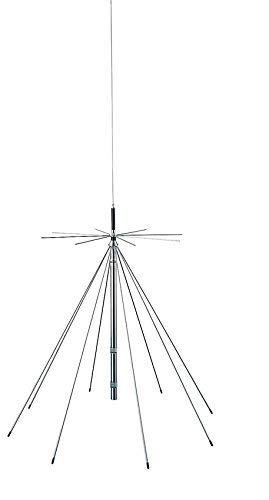
The Diamond D3000N is the benchmark for wideband receiving antennas. Its super discone design covers from well below 25 MHz up through 1300 MHz, making it equally adept at pulling in HF aviation weather, VHF marine traffic, UHF trunked systems, and 800/900 MHz P25 simulcast. The corrosion-resistant construction — stainless steel radials and a heavy-duty aluminum hub — ensures the antenna survives years of rain, sun, and snow without degrading performance. Users report receiving trunked systems 50 miles away with clarity that smaller antennas miss entirely.
Installation is straightforward: the hub clamps to a standard 1-3/8 inch mast, and the eight radials and top whip assemble with set screws. The D3000N also includes transmit capability on 6M, 2M, 70CM, 33CM, and 23CM amateur bands, making it a viable option for hams who want a single antenna for both scanning and low-power transmission. The 50-ohm impedance matches most scanners and SDRs without an impedance transformer.
Diamond backs the D3000N with a one-year warranty. Some users note the instruction sheet is minimalist, and the set screws are small enough to lose easily, so work over a tray. But the build quality and signal performance are consistently rated higher than cheaper discones from lesser-known brands. For a permanent base station installation where maximum reception is the goal, this antenna is the clear premium choice.
Why it’s great
- Exceptional build quality with corrosion-resistant stainless steel radials and aluminum hub.
- True wideband receive from below 25 MHz to 1300 MHz with transmit capability on multiple bands.
- Users report 50+ mile trunked system reception with consistent signal clarity.
Good to know
- Set screws are tiny — keep them organized during assembly.
- Requires a sturdy mast mount; not suitable for portable or handheld use.
2. Tram 1411 Broad-Band Super Discone
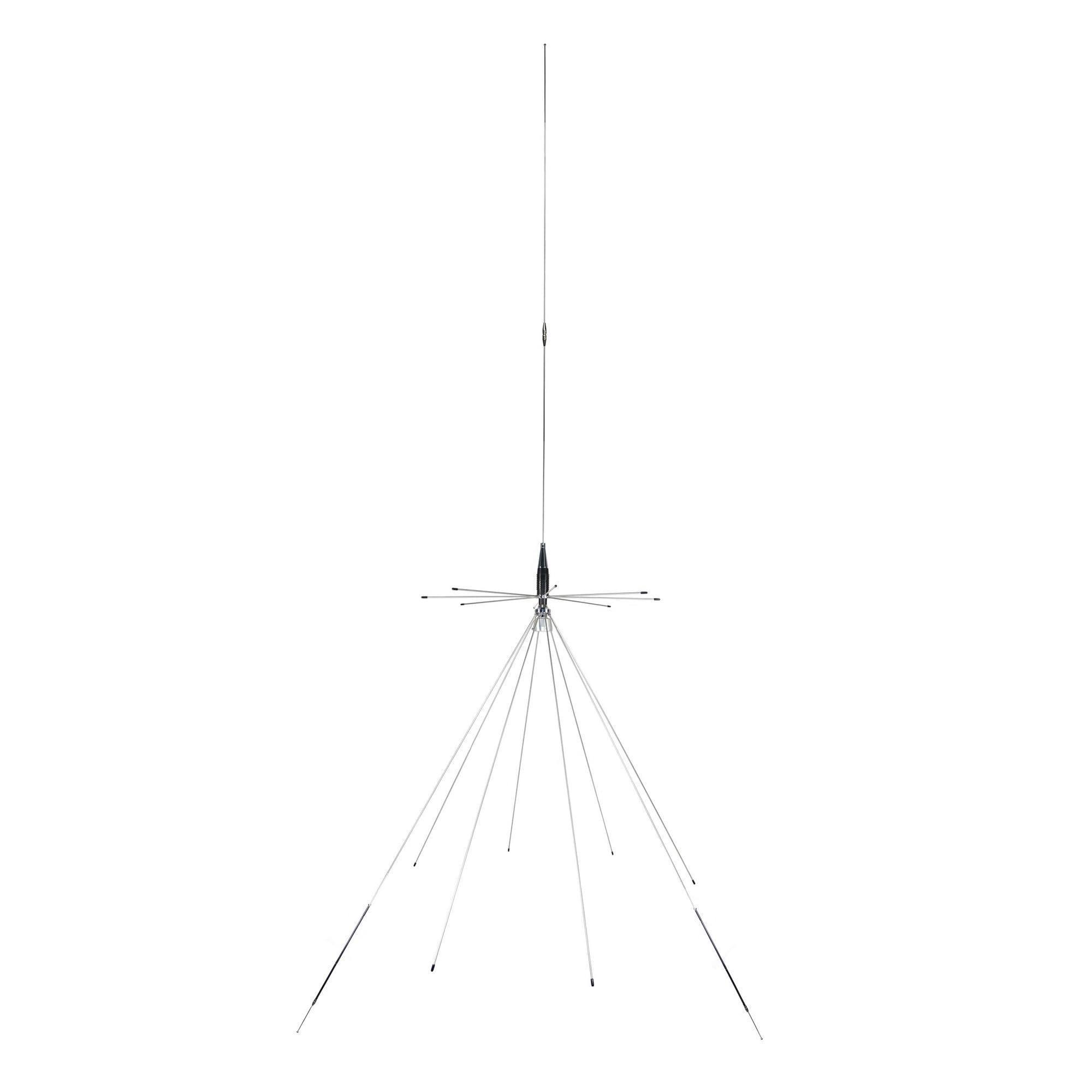
The Tram 1411 is a heavy-duty base discone that prioritizes both raw reception and transmit flexibility. Covering 25 MHz to 1300 MHz, it includes dedicated transmit bands for CB (26/27 MHz), 6M (46/49/72 MHz), 2M (144 MHz), 220 MHz, 440 MHz, 900 MHz, and 1.29 GHz — something few scanner antennas offer. The rust-free stainless steel construction and rated SWR under 1.5:1 mean it handles 300 watts on scanning bands and 200 watts on CB without distortion or overheating.
Physically, the 1411 is substantial: six lower radials at 32 inches, two adjustable lower radials up to 53 inches, and a 55-inch top whip. The entire assembly is designed for permanent outdoor mast mounting. Users report CB SWR of 1.1:1 on channel 19 out of the box, and excellent 2M/70CM performance with solid P25 decoding on 800 MHz. The adjustable lower radials let you fine-tune the antenna for specific low-band frequencies.
One common user note is that the SO-239 connector lacks the spike notch that some PL-259 plugs rely on for a tight bite, so your coax connection may feel slightly loose without a locking ring. Also, the mast diameter clearance is 1-3/8 inches maximum — larger masts require adapters. For a base station that combines scanner listening with amateur radio or CB transmission, the Tram 1411 is a versatile and rugged performer.
Why it’s great
- Transmit capability on CB, 6M, 2M, 220, 440, 900, and 1.29 GHz bands.
- Adjustable lower radials for low-band tuning.
- Rugged stainless steel build with SWR under 1.5:1.
Good to know
- SO-239 connector lacks a spike notch — secure with a locking ring.
- Large physical size: 55-inch top whip requires significant clearance.
3. Taurus Desktop Discone 25–2000 MHz

The Taurus Desktop Discone is a rare find: a discone design optimized for indoor or stationary-vehicle use. It covers 25 MHz to 2000 MHz — the widest frequency range in this lineup — and comes on a heavy-duty 125mm magnetic plate that can sit on a metal desk, filing cabinet, or vehicle roof. The 70cm (roughly 27.5-inch) height keeps it manageable for a shelf, while the 4-meter RG58 mil-spec coax with a pre-fitted BNC male plug gets you connected immediately.
User feedback is consistently strong on signal clarity. Multiple owners report it outperforms compact whips like the Remtronix 842 on the Uniden SDS100, particularly on 700/800 MHz trunked systems. The magnetic base is plenty strong for stationary applications, though it shouldn’t be trusted on a fast-moving vehicle without additional securing. The discone design provides an omni-directional pattern, meaning you don’t have to rotate the antenna to capture signals from different directions.
Assembly is simple — the base and radials lock together in minutes. Some users add a DIY ground plane (a pizza pan works well) to further boost reception in attic or desk setups. The BNC connector is standard, but for SMA scanners like the SDS200 you’ll need an adapter. The Taurus is not designed for transmit, so keep it strictly for scanning. For an indoor discone that doesn’t require a mast, this is the best option available.
Why it’s great
- Widest frequency coverage of any antenna here: 25 MHz to 2000 MHz.
- Heavy magnetic base allows placement on metal surfaces without drilling.
- Compact desktop form with pre-installed BNC coax cable.
Good to know
- Receive-only — no transmit capability.
- Magnetic base is not suitable for high-speed vehicle use.
4. Tram 1199 Glass-Mount Scanner Antenna
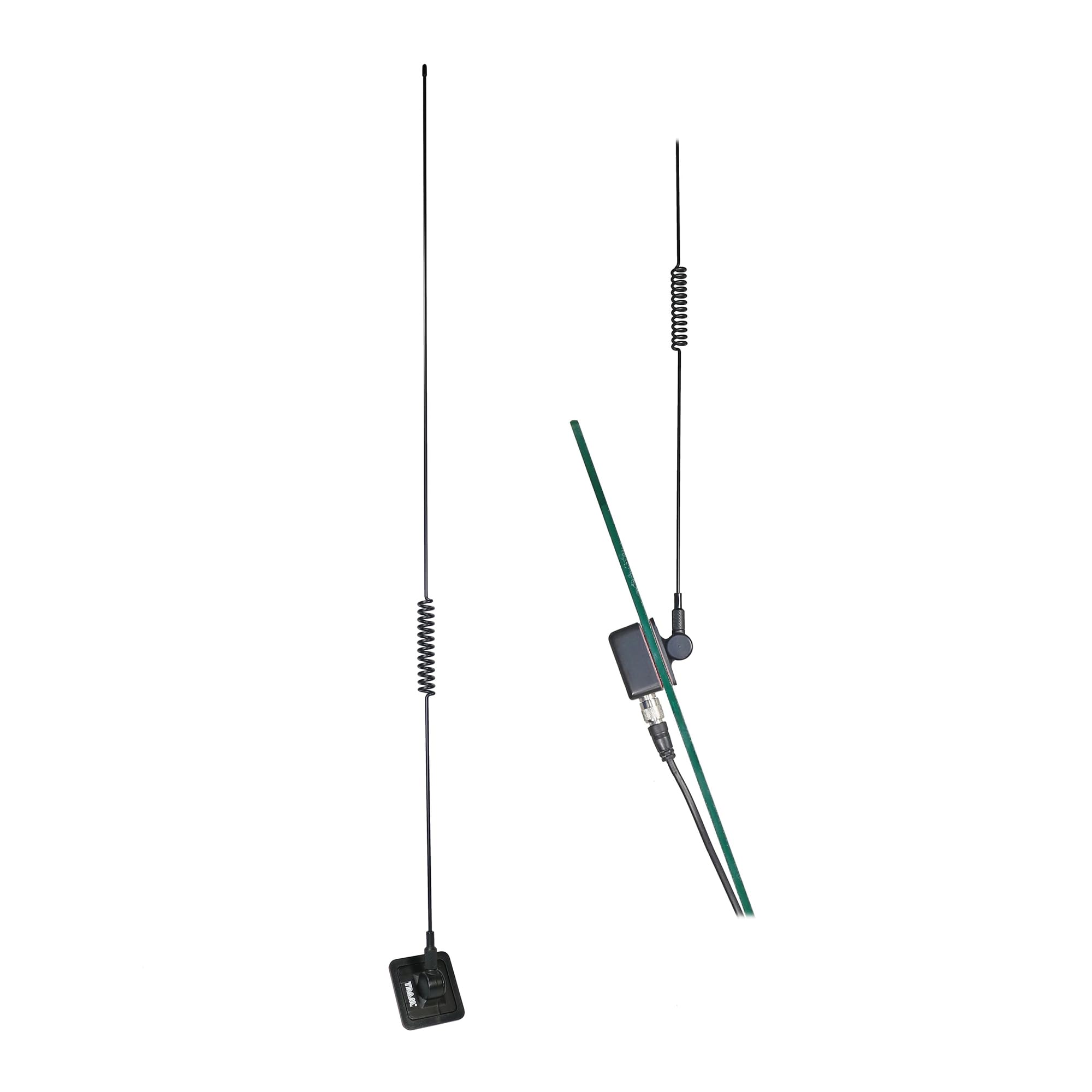
The Tram 1199 solves the mobile antenna installation dilemma with a no-drill glass-mount design. Covering 25 MHz to 1300 MHz, the center-loaded whip stands 28 inches tall and includes a capacitive coupling box that transfers the signal through the window. The 17-foot RG58/U cable with BNC connector provides ample routing length to reach your scanner on the dashboard or center console. The adhesive-backed coupling box installs easily on any clean glass surface.
Performance-wise, the 1199 dramatically reduces the ignition and alternator noise that plagues inside-car magnetic antennas. Users consistently report picking up 3 or more NOAA weather radio stations where they previously could only get 1 or 2, along with clear reception of 800 MHz P25 systems and VHF public safety. The whip unscrews from the mounting hub, allowing you to remove it before automatic car washes without damaging the adhesive mount.
The antenna is not an amplifier or active booster — it’s a passive tuned radiator. Some users note that the whip can unscrew from the hub over time due to vibration, so adding a small chain tether or thread-locker is a common field modification. Also, the instructions specify the coupling box must be at least 1.5 inches from the edge of the glass and away from defroster lines or metallic tint. Follow those placement rules and the Tram 1199 is a reliable, high-performance mobile upgrade.
Why it’s great
- No-drill glass mount means zero holes in your vehicle.
- Dramatic reduction in vehicle electrical noise compared to interior antennas.
- Whip unscrews for automatic car washes.
Good to know
- Coupling box must stay away from defroster lines and metallic tint.
- Whip can unscrew from vibration — consider thread-locker or a tether.
5. ProCom 290M/SMA Mini Mag Mount Antenna

The ProCom 290M/SMA is a purpose-built mini mag mount antenna for scanner users who want a low-profile mobile solution. It covers 25 MHz to 1200 MHz and stands roughly 15 inches tall — far shorter than a full-size whip but still capable of outperforming a rubber duck by a wide margin. The included mini magnet mount holds firmly on steel surfaces, and the 12-foot RG-174 coax cable with a factory-installed SMA connector plugs directly into Uniden SDS100, BCD436HP, BCD396XT, and similar models without an adapter.
In head-to-head tests, users report the 290M/SMA outperforms dedicated 800 MHz eBay antennas and picks up 700/800 MHz digital systems from 30+ miles away. The slim, thin whip design minimizes wind noise and drag compared to thicker base-loaded antennas. One reviewer who tested over 12 antennas rated this as the best of the bunch, crediting its roof-mounted performance on an SDS100 for pulling in VHF signals 35 miles out with a -40 RSSI reading.
The trade-off is cable quality: RG-174 is thinner and more lossy than RG-58, particularly at UHF frequencies. For runs longer than 12 feet, you may want to replace the cable with RG-58 or RG-6 coax. Also, the magnet isn’t rated for off-road speeds — several users report the mount losing hold during aggressive driving. Keep this as a daily driver or urban mobile solution and it’s an excellent value in a compact package.
Why it’s great
- Factory-installed SMA connector fits modern Uniden scanners without an adapter.
- Compact 15-inch whip with excellent 700/800 MHz performance.
- Wideband coverage from 25 MHz to 1200 MHz.
Good to know
- RG-174 coax is lossy compared to RG-58 on long runs.
- Magnetic base may lose grip at high speeds on rough roads.
6. AEcreative Wide-Band Flexible Scanner Antenna

The AEcreative flexible whip offers the most accessible entry point for handheld scanner users who want a tangible upgrade over the factory rubber duck without spending heavily. Covering 50 MHz to 1200 MHz, it includes both a BNC base and a free SMA adapter, making it compatible with nearly every Uniden, Whistler, RadioShack, and Icom handheld on the market. The 17-inch whip is fully bendable, meaning it won’t snap if shoved into a pocket or caught on a car seat.
Users report noticeable improvements on VHF air band and UHF public safety frequencies compared to stock antennas. On the Uniden SDS100, the AEcreative delivers strong 700/800 MHz P25 decode and pulls in signals the stock duck struggles with. The broad spectrum performance is impressive for the size — several listeners note dramatic improvements on air band reception, where the stock antenna often sounds muffled.
Potential downsides are documented: the antenna is long, and some users find it gets in the way during daily carry. A few reviewers report that overall reception can be slightly lower than the factory antenna on specific bands, likely due to the wideband tuning trade-off. The construction feels adequate for the price point, but the SMA adapter is a small plastic piece that can wear out with repeated swapping. For bedside scanning or occasional portable use, this flexible whip is a solid budget-friendly upgrade.
Why it’s great
- Versatile BNC base with included SMA adapter fits most scanners.
- Fully bendable whip prevents breakage during portable use.
- Clear improvement on air band and 700/800 MHz P25 systems.
Good to know
- Wideband tuning may result in slightly lower gain on specific frequencies.
- Antenna is long — can feel cumbersome during daily carry.
7. HYS NMO VHF/UHF Mobile Antenna Kit
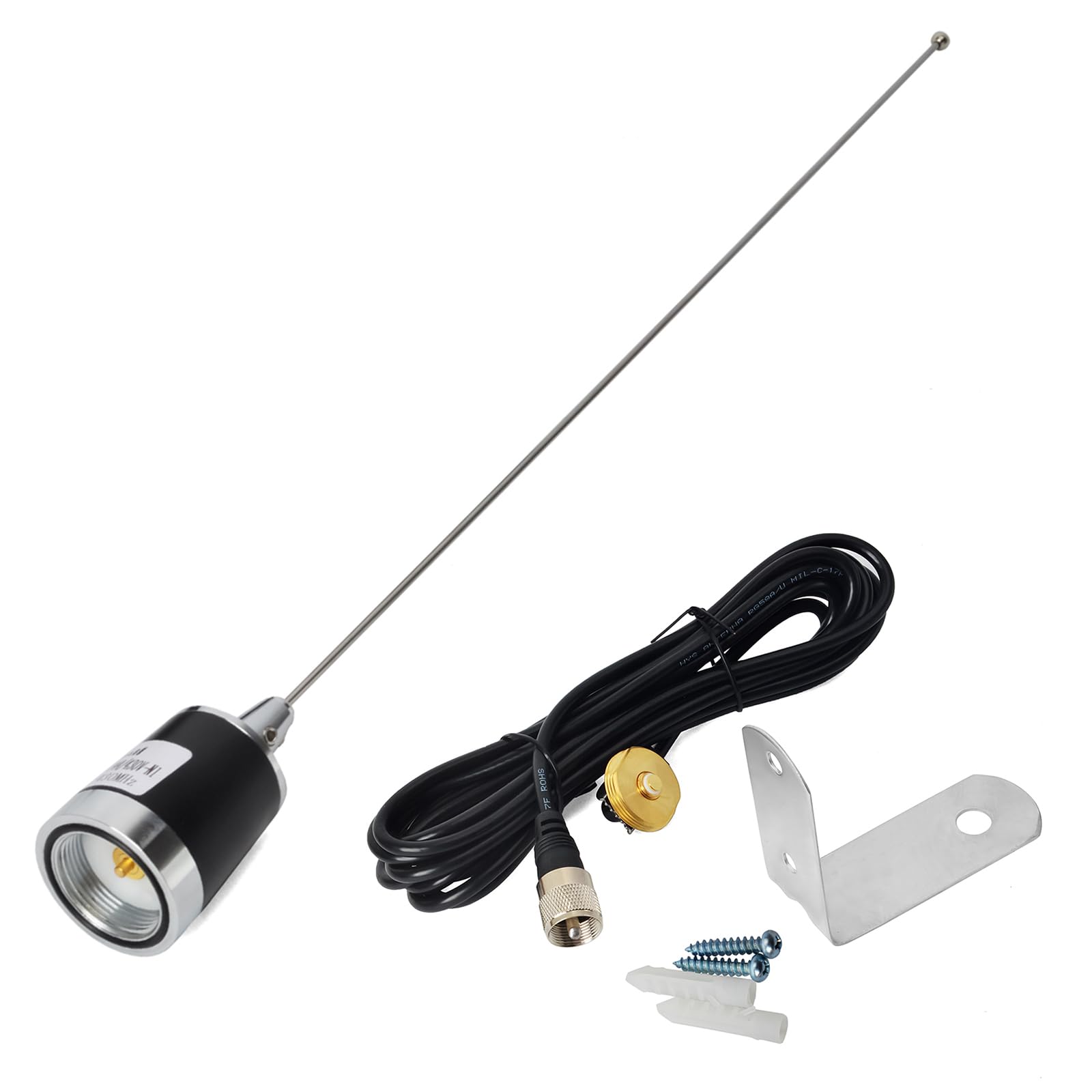
The HYS NMO kit bundles everything needed to install a permanent mobile dual-band antenna: a 21-inch stainless steel whip, an NMO base with an L-bracket mount, 13.1 feet of coaxial cable terminated with a PL259 connector, and all necessary mounting hardware. It’s designed primarily for amateur radio (VHF/UHF) but works excellently for scanner reception on 2M, 70CM, and 800 MHz bands. The 2.15 dBi gain and VSWR rated under 1.5:1 ensure clean signal transfer.
Installation is straightforward: the L-bracket clamps to a hood lip, trunk lip, or fender, and the NMO base screws securely into the bracket. The 13.1-foot cable provides enough length to route behind panels and reach most dashboard locations. Users on 2M report hitting repeaters 20 miles away with just 5 watts, indicating the antenna’s resonant efficiency. For scanner-only use, the same design pulls in VHF marine, police, and fire bands with clarity comparable to dedicated scanner whips.
The main caveat is the bracket: some users describe it as a bit flimsy, opting to use the NMO base in a permanent roof mount instead. The 3-month warranty is shorter than premium alternatives. Also, the PL259 connector works best with a mating SO-239 jack — scanners with BNC inputs will need an adapter (PL259-to-BNC). For the budget-friendly price point, this kit is a solid choice for anyone who wants a proper NMO mobile setup and doesn’t mind a little DIY bracket reinforcement.
Why it’s great
- Complete NMO kit includes whip, mount, and cable-ready to install.
- 2.15 dBi gain and low VSWR provide strong reception on VHF/UHF.
- L-bracket allows lip-mount on hood, trunk, or fender without drilling.
Good to know
- L-bracket feels lightweight — consider upgrading for permanent roof mounting.
- PL259 connector requires an adapter for scanners with BNC inputs.
FAQ
Can I use a scanner antenna for transmitting on my ham radio?
Will a longer antenna always give me better reception on a handheld scanner?
What is the difference between a discone and a traditional whip antenna?
Do I need a ground plane for my scanner antenna?
Final Thoughts: The Verdict
For most users, the antenna for scanner winner is the Diamond D3000N Super Discone because it combines premium build quality, true wideband coverage from below 25 MHz to 1300 MHz, and multi-band transmit capability in a corrosion-resistant package that outperforms cheaper discones on distant trunked systems. If you want a portable mobile antenna, grab the Tram 1199 Glass-Mount for its no-drill installation and dramatic reduction in vehicle noise. And for an entry-level handheld upgrade, nothing beats the AEcreative Flexible Whip for its universal compatibility and noticeable improvement over stock rubber ducks.