
Our readers keep the lights on and the weekend projects moving. As an Amazon Associate, I earn from qualifying purchases.
An inconsistent aquarium heater is one of the fastest ways to stress your fish, trigger disease outbreaks, and wipe out a carefully planted aquascape. The difference between a stable 78°F and a water column that swings 4–5 degrees daily often comes down to a single choice: picking a heater with the right wattage-to-volume ratio, accurate temperature sensing, and reliable safety cutoffs.
I’m Rikta — the co-founder and writer behind FitlyFast. I’ve spent years comparing submersible heater specs, reading through thousands of verified owner reports on aquarium forums, and analyzing how different thermostat designs hold up under continuous 24/7 operation in both freshwater and saltwater tanks.
Choosing the best aquarium heater means looking past wattage alone and focusing on sensor accuracy, shatter-resistant materials, and whether the control system allows you to dial in the precise temperature your specific fish or coral species demands.
How To Choose The Best Aquarium Heater
Buying a tank heater is not a one-size-fits-all decision. The heater that keeps a 5-gallon betta tank perfectly stable at 80°F will struggle to maintain even 72°F in a 50-gallon community setup. Understanding three critical factors — wattage guidelines, sensor accuracy, and material safety — narrows your options immediately.
Wattage Rules: The 5-Watts-Per-Gallon Baseline
The industry rule of thumb is 5 watts per gallon of water for standard indoor tanks, but that ratio changes if your room runs cold (below 70°F), if the tank is heavily planted, or if you keep demanding species like discus or reef corals that need very tight temperature windows. A 50W heater covers 5–10 gallons comfortably, while 200–300W units handle the 30–75 gallon range. Oversizing past 5W per gallon is safe because the heater will simply cycle on and off less frequently, but undersizing forces the heater to run constantly and shortens its lifespan.
Sensor Accuracy: Single vs. Dual Probe Designs
Many budget heaters use a single built-in thermistor located inside the glass tube, which reads the temperature right next to the heating element — often giving a false higher reading and causing the heater to cycle off prematurely. Higher-end models use dual sensor systems with an external probe placed away from the heat source, or they place the thermistor at the very tip of the unit for a truer reading of the bulk water temperature. If you keep shrimp, fry, or any species that is sensitive to even a 2°F deviation, prioritize models with demonstrated accuracy from user reports rather than just marketing claims.
Material Safety: Shatterproof Glass vs. ABS Plastic Housing
Traditional glass tube heaters crack when bumped, dropped during cleaning, or exposed to thermal shock if you add cold water too quickly. More modern designs use shatterproof quartz, reinforced with protective ABS housings that also prevent fish from burning themselves on the glass surface. For active fish like cichlids or for tanks where you regularly reach in for maintenance, a fully enclosed plastic or metal guard adds a significant safety margin. Also check for IP ratings or manufacturer claims about explosion-proof construction — cheap heaters that crack inside the tank can leak voltage into the water and harm livestock.
Quick Comparison
On smaller screens, swipe sideways to see the full table.
| Model | Category | Best For | Key Spec | Amazon |
|---|---|---|---|---|
| EHEIM Jager 50W | Thermostat | Reliable long-term stability | TruTemp recalibration dial | Amazon |
| NICREW 300W | Adjustable | Large tanks up to 80 gal | Dual temperature sensors | Amazon |
| HiTauing 300W | Digital | Quick heating with safety | Removable 4-section housing | Amazon |
| HiTauing 200W | Digital | Mid-size tanks 20-40 gal | Off-water E1 auto shut-off | Amazon |
| Inkbird ITC-306T | Controller | Dual heater failure safety | 24-hour day/night cycles | Amazon |
| hygger 50W | Digital | Small nano/betta tanks | LED display + memory function | Amazon |
| Aqueon Preset 50W | Preset | Simple set-and-forget use | Preset to 78°F ±1° | Amazon |
In‑Depth Reviews
1. EHEIM Jager Aquarium Thermostat Heater 50W

Its TruTemp dial allows you to recalibrate the thermostat if the internal sensor drifts, extending the service life beyond what most heater designs offer. Multiple long-term owners report maintaining a steady 78°F for 8–9 years in planted 10-gallon tanks without a single failure, even when the room temperature dropped into the low 60s overnight.
The heater uses a thick shatterproof quartz glass tube and an on/off indicator light for at-a-glance monitoring. Its auto shut-off feature protects the unit if the water level dips too low, which is a common failure point on cheaper models. The thermostat dial requires manual calibration out of the box — several owners note setting the dial 2–3 degrees below their target to get the actual desired temperature — but once dialed in, the stability is unmatched.
On the downside, the included suction cups tend to weaken after a year of weekly removal for cleaning, and the power cord lacks a molded drip loop, so you’ll want to create your own loop above the outlet. It is also slightly long for nano tanks under 5 gallons; angling it diagonally solves the fit problem.
Why it’s great
- Trusted brand with decade-long reliability in planted and community tanks
- TruTemp recalibration dial allows you to correct sensor drift
- Auto shut-off prevents dry-fire damage when water level drops
- Shatterproof quartz glass withstands bumps during maintenance
Good to know
- Thermostat requires initial calibration; dial setting may not match actual temp
- Suction cups weaken over time with frequent removal
- No molded drip loop on the power cord
2. NICREW 300W Aquarium Heater
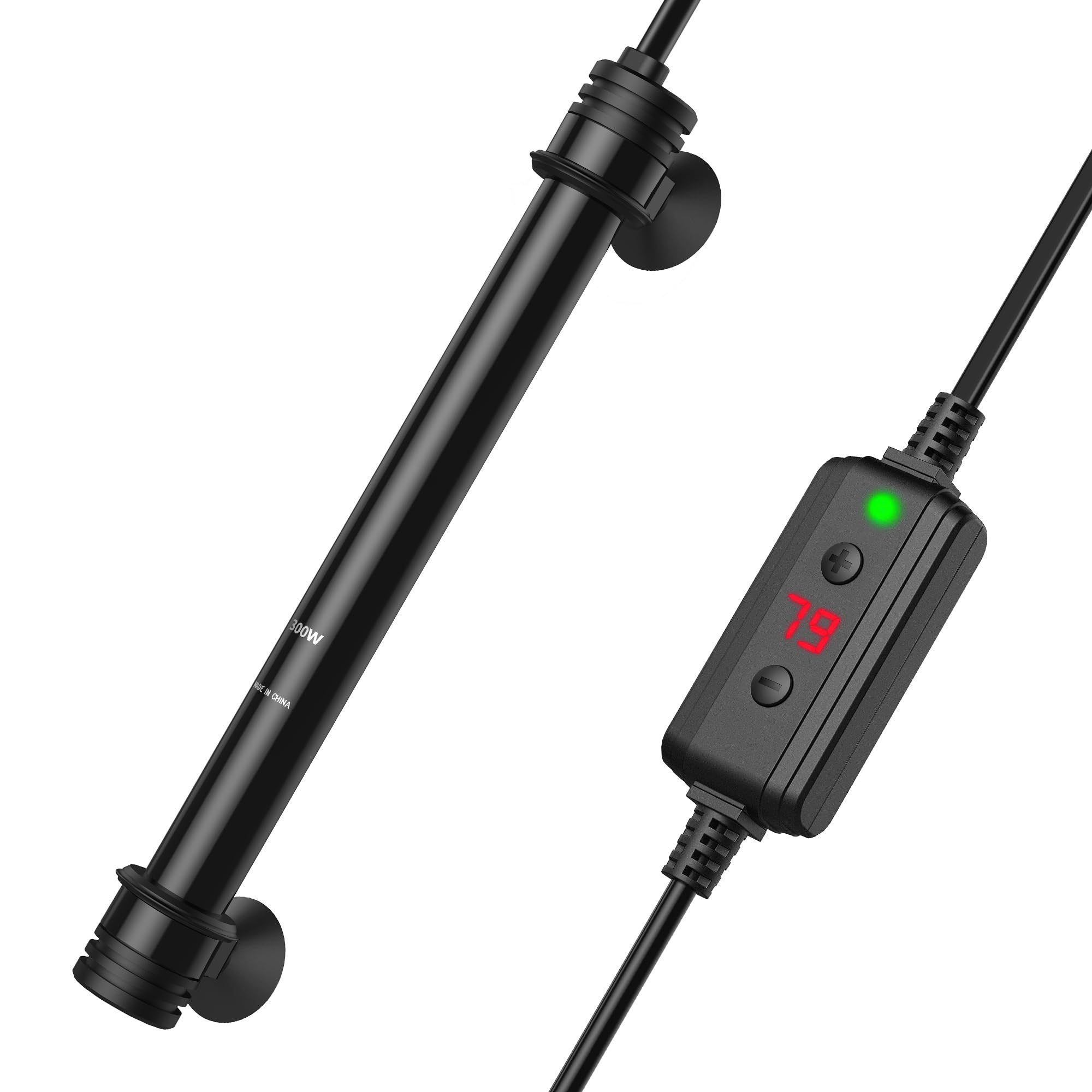
The NICREW 300W uses a dual temperature sensor system that places sensing elements at separate locations within the heater body, producing more accurate water temperature readings than single-sensor competitors. Owners of 50-gallon tanks report that it brings water from 50°F up to 75°F in about 25–30 minutes, and then holds the set point with minimal oscillation throughout the daily cycle.
The external controller box stays above water, so you never need to reach into the tank to adjust the temperature. It also includes a power-off memory function that retains your setting after a power outage — a feature that matters if you live in an area with frequent short power flickers. The nickel-chromium alloy heating element is packed in magnesium oxide filling, which transfers heat efficiently into the water without hot spots on the glass surface.
A few users found that the built-in thermometer reads about 2–3 degrees higher than the actual tank temperature measured with a separate digital thermometer. Setting the controller a couple of degrees above your target compensates for this offset. The heater also activates overheat protection at 98°F, preventing cooking your fish if the thermostat malfunctions.
Why it’s great
- Dual temperature sensors improve reading accuracy over single-probe designs
- Rapid heating performance for large tanks up to 80 gallons
- Power-off memory prevents reset after outages
- External controller keeps your hands dry during adjustments
Good to know
- Internal thermometer may read 2–3°F above actual water temperature
- Needs to be placed near strong water flow for even heat distribution
3. HiTauing 300W Aquarium Heater

The HiTauing 300W stands out for its removable four-section ABS protective housing, which allows you to disassemble the outer guard for thorough cleaning of algae and mineral buildup — a maintenance detail that most sealed-tube heaters ignore. The housing also prevents direct contact between fish and the hot quartz surface, reducing burn risk for curious cichlids or bottom-dwellers.
It features an intelligent water sensor that stops heating and displays “E1” if the heater head rises above the water line, which provides a solid defense against accidental dry-starting after water changes. The dual display shows real-time water temperature on the top and the set temperature on the bottom, with a long-press function to switch between Fahrenheit and Celsius. Owners of 60-gallon paludariums and 75-gallon freshwater tanks consistently report that it holds temperature with minimal drift and activates the red/green indicator lights reliably.
Accuracy is the main trade-off. Multiple verified reports show the heater consistently reads about 2°F off from external thermometers. You can compensate by setting it higher, but if your fish need exact temperature within a 1°F window, consider pairing this heater with a separate thermometer-based controller like the Inkbird ITC-306T.
Why it’s great
- Four-section removable housing simplifies deep cleaning and descaling
- Intelligent off-water sensor prevents dry-run damage
- Explosion-proof quartz with ABS guard protects fish and heater body
- Digital dual display shows real-time and set temperature simultaneously
Good to know
- Reading is often 2°F off from an independent thermometer
- Temperature programming only cycles upward, requiring a full reset to lower degrees
4. HiTauing 200W Aquarium Heater

The HiTauing 200W is effectively the smaller sibling of the 300W model, designed for the 20–40 gallon range. It uses the same high-durability ABS shell, nickel-chromium heating wire, and quartz glass construction as its larger counterpart, so you get the same material quality in a more compact 8.3-inch package. Owners of 30–40 gallon community tanks report steady 76–78°F holding for weeks after initial setup.
The digital controller displays a bright red/green indicator — red means actively heating, green means the set temperature is maintained. It includes two safety protections: over-max-temperature warning, which stops heating and flashes “HH” if water exceeds 94°F, and off-water warning that shows “E1” and stops power if the heater is not fully submerged. The 5.9-foot cord offers flexibility for positioning the controller outside the canopy or cabinet.
One quirk noted by several users is that the digital readout on the controller itself reads about 2°F lower than the actual tank temperature measured by multiple independent thermometers. If you set it to 78°F, the water will actually be around 80°F. The bright LED lights can also be distracting in a low-light tank, though a piece of electrical tape over the display solves that.
Why it’s great
- Same durable ABS and quartz construction as the premium 300W version
- Two independent safety alerts (over-temp HH and off-water E1)
- Compact 8.3-inch length fits easily in 20–40 gallon tanks
- Red/green indicator lights give instant heating status at a glance
Good to know
- Digital readout reads about 2°F below actual water temperature
- Bright LED may require taping over for dark-room setups
- Controller must stay above water; only the heater tube submerges
5. Inkbird ITC-306T Aquarium Heater Controller
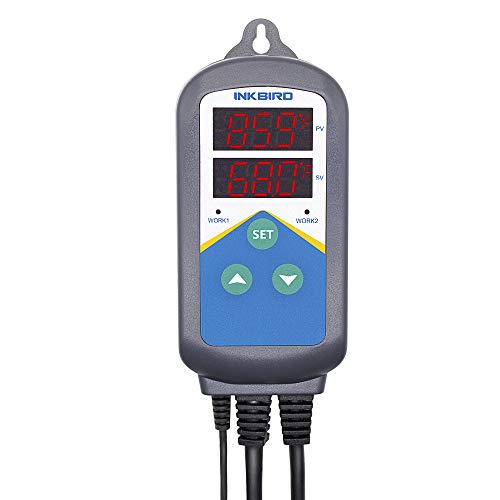
The Inkbird ITC-306T is not a heater itself — it is an external temperature controller that you pair with one or two standard heaters to add an independent fail-safe layer. This is the device experienced aquarists buy after losing a tank to a stuck-on heater. The controller uses a submersible probe separate from your heater’s internal thermostat, and it cuts power to both heater outlets if the water temperature exceeds your programmed high limit.
Its standout feature is the 24-hour dual time cycle: you can set a daytime temperature and a slightly cooler nighttime temperature, mimicking natural diurnal temperature shifts that some fish species and corals respond to positively. The LCD dual display shows both the current probe reading and the set temperature. The unit supports up to 1200W total load at 110V, which covers even large 300W+ heaters for big tanks.
Setup is the main hurdle — the manual is borderline unusable, and several owners recommend watching YouTube tutorials to understand the configuration sequence. The suction cup mount for the probe is also weak and tends to fall off within weeks; using a zip tie or a dedicated probe holder solves that. For the peace of mind it provides against a cooked aquarium, the Inkbird is worth the programming effort.
Why it’s great
- Independent temperature controller adds fail-safe against heater malfunction
- 24-hour day/night temperature cycle supports natural biological rhythms
- Handles up to 1200W total load for large or multi-heater setups
- Dual heater outlets allow redundancy and reduced strain on each unit
Good to know
- Setup process is not intuitive; manual is difficult to follow
- Included probe suction cup mount is unreliable and detaches easily
- Unit is a controller only — you must purchase a separate heater
6. hygger 50W Small Submersible Aquarium Heater
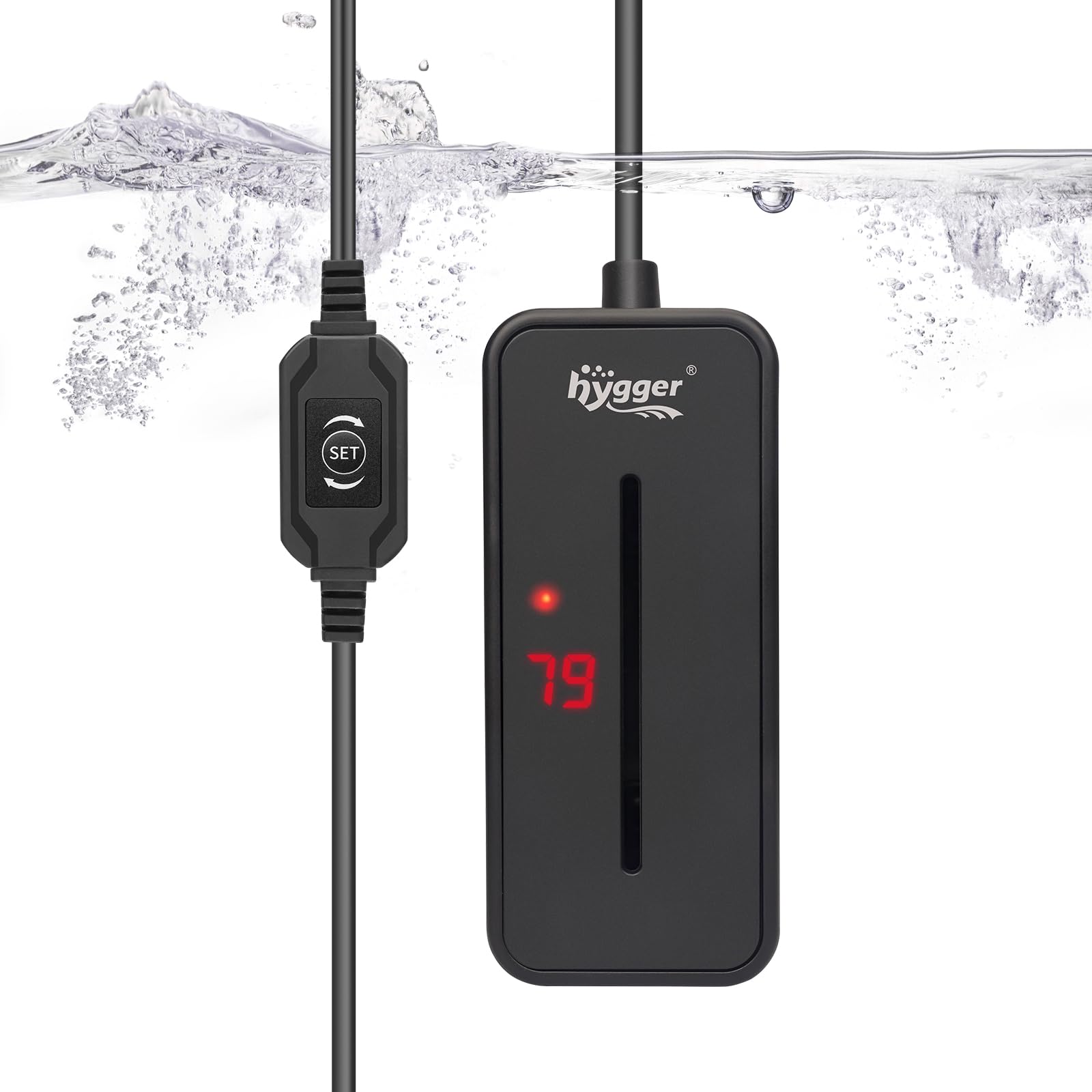
The hygger 50W is built specifically for the sub-10-gallon nano tank market, with a slim flat profile measuring just 4.3 inches tall and 0.9 inches thick. This design lets you hide it behind a filter intake, a piece of driftwood, or rockwork, preserving the clean aquascaping aesthetic that nano tank keepers prioritize. The LED digital readout shows real-time water temperature, with a red indicator when actively heating and a green light when the set temp is maintained.
It supports an adjustable temperature range of 59°F to 93°F in 1-degree increments, controlled by a button on the top cap that stays above the water line. The memory function retains the last temperature setting after a power interruption — a reliability feature that matters when you are maintaining a small shrimp or betta environment where even a 4°F swing can be fatal. Owners of 5.5-gallon betta tanks report holding 80°F with only 1°F of visible oscillation.
The heater includes a shatterproof quartz tube and a plastic guard that prevents direct contact between the heating surface and fish. Some users reported that after one year of continuous use, the unit starts flashing an error code, which the manufacturer apparently treats as a mandatory replacement reminder. If you prefer heaters that work for 5+ years without forced replacement, consider the EHEIM Jager instead.
Why it’s great
- Ultra-slim 0.9-inch profile fits behind filter intakes and decorations
- Adjustable from 59°F to 93°F with 1-degree precision
- Memory function preserves settings through power outages
- Digital display with red/green heating indicator
Good to know
- Error code appears after ~1 year, functioning as a replacement timer
- LED light is noticeable in bedroom or low-light aquarium setups
- Some users report readings 2–3°F off from external thermometers
7. Aqueon Preset Aquarium Heater 50W
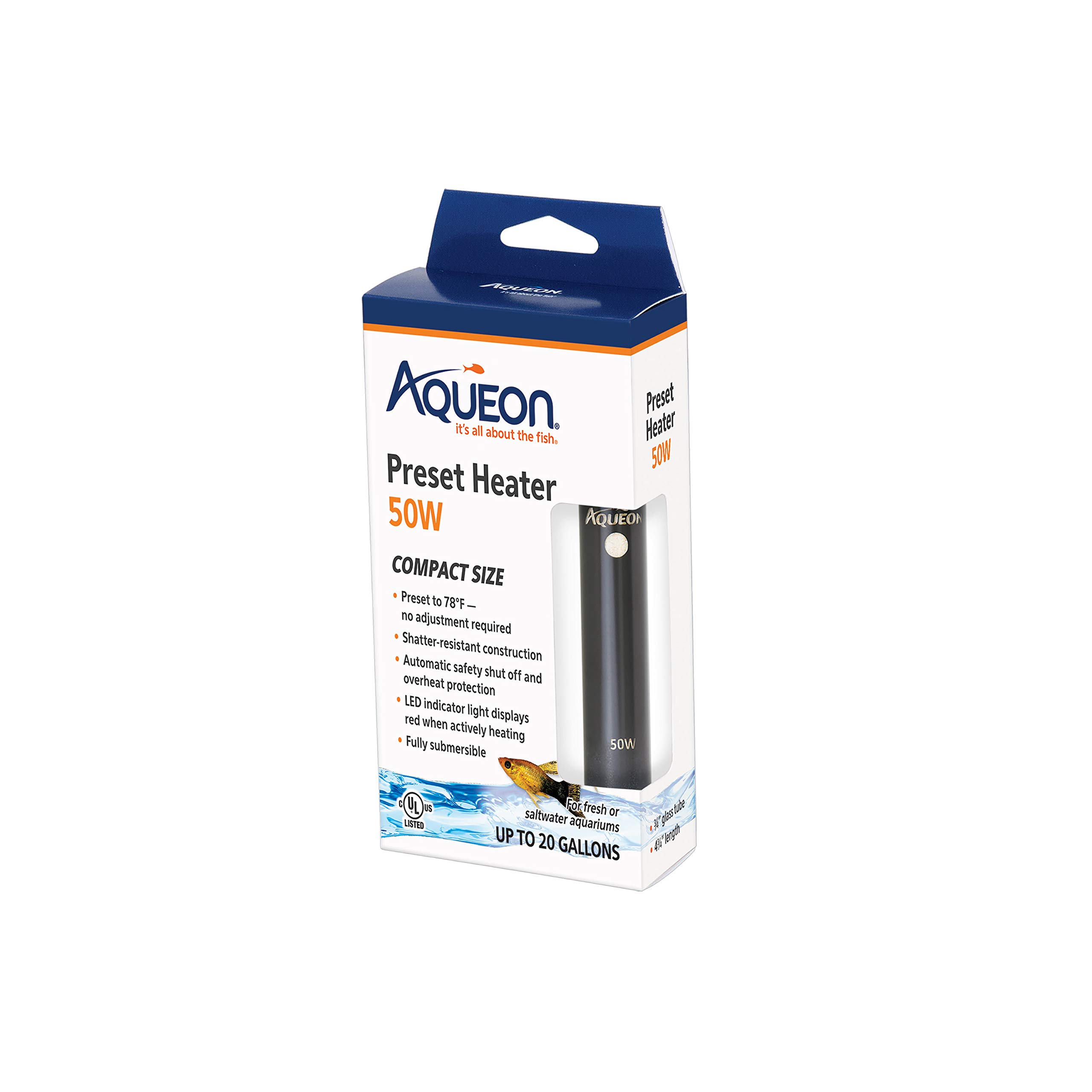
The Aqueon Preset heater is the simplest option on this list — no digital display, no adjustable dial, just a shatter-resistant plastic tube pre-calibrated to hold 78°F ±1°. You plug it in, stick it to the glass with the included suction cups, and it maintains temperature automatically. It is so straightforward that it works for beginners who just want their 10-gallon community tank stable without fiddling with settings.
The auto shut-off feature kicks in if the water level falls low enough to expose the heating element, and an LED light turns on when the heater is actively warming the water. Multiple owners report using the same unit for 4 years without performance degradation, though some note that after a year of continuous use, the heater can start drifting and running hotter than 78°F. Aqueon’s customer service is well-regarded for replacing faulty units under warranty.
The main limitation is the lack of adjustability. It holds to 78°F, which is perfect for many tropical community fish like tetras, mollies, and corydoras, but if you need a specific temperature for breeding discus at 82°F or keeping cool-water goldfish at 70°F, this heater cannot accommodate that. It is also not recommended for any aquarium larger than 20 gallons at the 50W rating.
Why it’s great
- Zero-setup design — preset to 78°F, just submerge and attach suction cups
- Very compact at 7 inches for tight spaces in smaller tanks
- Auto shut-off protection prevents dry-fire damage
- Strong brand customer service reputation for warranty replacements
Good to know
- Not adjustable — cannot change temperature above or below 78°F
- May drift and run hotter after extended continuous use beyond one year
- Suction cup grip weakens over time, requiring periodic replacement
FAQ
Should I buy a preset heater or an adjustable heater?
Can I use a heater rated for 50 gallons in a 20-gallon tank?
Why does my digital heater read a different temperature than my glass thermometer?
What does the E1 error code mean on my aquarium heater display?
Final Thoughts: The Verdict
For most users, the aquarium heater winner is the EHEIM Jager 50W because it combines a decade of proven reliability, a TruTemp recalibration feature that other models lack, and shatterproof construction that withstands routine maintenance. If you want a dual-sensor system with accurate external control for a large tank, grab the NICREW 300W. And for small nano tanks where space is tight and you need adjustable temperature control, nothing beats the hygger 50W for its ultra-thin profile and digital display.