
Our readers keep the lights on and the weekend projects moving. As an Amazon Associate, I earn from qualifying purchases.
The difference between a brown smudge in a tree and a crisp, frame-filling portrait of a painted bunting often comes down to one choice: the camera in your hands. Most bird watchers start with binoculars, only to discover that capturing the fleeting moments of a warbler’s foraging or a raptor’s stoop requires a tool that merges a spotter’s reach with a photographer’s precision.
I’m Rikta — the co-founder and writer behind FitlyFast. I’ve spent hundreds of hours comparing the optical zoom ranges, sensor sizes, image stabilization systems, and autofocus algorithms that separate a decent birding snapshot from a publishable wildlife photograph.
This guide breaks down the very real trade-offs between a do-it-all superzoom bridge camera and a modular interchangeable-lens system, so you can find the best bird watching camera for the species you chase and the budget you carry into the field.
How To Choose The Best Bird Watching Camera
Choosing a bird watching camera is really about understanding one number: your effective focal length in full-frame terms. A sparrow at 20 meters requires roughly 600mm to fill even one third of the frame. From there, your decisions cascade into sensor size, stabilization, and whether you want a self-contained superzoom or the flexibility of interchangeable lenses.
Zoom Reach vs. Light Gathering
Every superzoom camera (Nikon P1000, P950, Kodak AZ653) trades a small sensor for massive focal lengths. A 1/2.3-inch sensor at 3000mm gives you the reach, but it struggles in low light and produces more noise at moderate ISOs. A larger APS-C or full-frame sensor with a 500mm lens delivers cleaner files and better subject separation — but you may need to crop or carry extra weight to match the zoom range. Decide whether you shoot mostly at golden hour (bigger sensor wins) or under full midday sun (superzoom reach is fine).
Image Stabilization Grade
At focal lengths above 400mm, hand-shake becomes the enemy of sharp feather detail. Look for cameras with at least 4 stops of optical stabilization; 5.5 to 6 stops is ideal. Panasonic’s POWER O.I.S., Nikon’s Dual Detect VR, and Canon’s RF IS all make a meaningful difference. Without it, you will need a tripod or monopod for every shot above 600mm, which reduces your mobility in the field.
Autofocus Capabilities for Birds
Birds in flight — swallows, hawks, swifts — demand fast, predictive autofocus. Sony’s Real-time Eye AF for birds and Canon’s Dual Pixel AF are class-leading. Superzoom cameras often rely on slower contrast-detection AF that hunts at the telephoto end. If you plan to photograph flyovers or birds on the wing, prioritize a mirrorless system with animal eye-tracking and a fast burst rate of at least 10 fps.
Quick Comparison
On smaller screens, swipe sideways to see the full table.
| Model | Category | Best For | Key Spec | Amazon |
|---|---|---|---|---|
| Sony A6700 Kit | Mirrorless | Bird Eye AF & portability | 26MP APS-C, 759 AF points | Amazon |
| Nikon P1000 | Superzoom | Maximum optical reach | 125x optical zoom (24-3000mm) | Amazon |
| Fujifilm X-H2 Kit | Mirrorless | High-res crop detail | 40MP APS-C, 7-stop IBIS | Amazon |
| Sony A7 IV Bundle | Full Frame | Full-frame low light | 33MP FF sensor, 759 AF | Amazon |
| Nikon P950 | Superzoom | 83x zoom & moon mode | 83x optical (24-2000mm) | Amazon |
| Panasonic FZ80D | Superzoom | Budget 4K video & reach | 60x optical (20-1200mm) | Amazon |
| Tamron 150-500mm | Telephoto Lens | Sharp 500mm on Sony E | 500mm, VC stabilization | Amazon |
| Canon RF 100-400mm | Telephoto Lens | Lightweight RF tele zoom | 100-400mm, 5.5-stop IS | Amazon |
| Canon Rebel T7 Bundle | DSLR Kit | Entry-level with 500mm | 24.1MP, 9 AF points | Amazon |
| Kodak PIXPRO AZ653 | Superzoom | 65x zoom on a budget | 65x optical (24-1560mm) | Amazon |
| Canon 18×50 IS Binoculars | IS Binocular | Steady observation | 18x magnification, IS | Amazon |
In‑Depth Reviews
1. Sony Alpha 6700 with 18-135mm Lens

The Sony A6700 is the finest birding camera in its class because it packs Sony’s dedicated AI processor and Real-time Recognition for birds directly into a compact APS-C body. The 26-megapixel back-illuminated sensor captures excellent feather detail, and the 759-point autofocus system tracks a flying blue jay with sticky accuracy. The included 18-135mm lens is a versatile walk-around zoom, but serious birders will want to pair the body with the Tamron 150-500mm or Sony 200-600mm for real reach.
4K video at 60p oversampled from 6K gives you the ability to extract stills from footage, and the 10-bit 4:2:2 color depth means you can grade the golden-hour light without banding. The 5-axis in-body stabilization works well, though the electronic viewfinder is small compared to full-frame rivals. The single SD card slot is a limitation for pro use, but for most bird photographers, the A6700 delivers the best autofocus and image quality per gram you can buy.
Battery life is solid for a mirrorless camera, and the USB-C charging means you can top off in the field with a power bank. The menu system has improved from earlier Sony bodies, but it still requires some time to configure custom buttons for bird-in-flight scenarios. Once set up, this camera rarely misses focus on a perched warbler or a soaring osprey.
Why it’s great
- Best-in-class animal/bird eye-tracking AF
- Excellent 4K 60p video oversampled from 6K
- Lightweight APS-C body with strong IBIS
Good to know
- Single SD card slot limits redundancy
- Kit lens reach (135mm) requires a telephoto add-on for birds
- Small EVF compared to full-frame models
2. Nikon COOLPIX P1000

The Nikon P1000 holds the crown for raw optical reach: 24-3000mm equivalent in a single lens. This is the camera that lets you fill the frame with a Tufted Titmouse at 50 meters or capture the texture of a lunar crater. The 16-megapixel 1/2.3-inch sensor is the limiting factor — images at the telephoto end can be soft due to atmospheric haze and diffraction — but the sheer versatility for casual birding is unmatched.
Dual Detect Optical Vibration Reduction keeps the viewfinder steady at extreme focal lengths, though a monopod becomes essential beyond 1500mm for anything beyond a snapshot. The vari-angle LCD and eye-level electronic viewfinder make it easy to shoot from awkward angles in the understory. Autofocus is contrast-detection and will hunt in low light or on fast-moving birds, but the dedicated Moon mode and Bird mode simplify settings for beginners.
4K UHD video at 30p is decent, and the RAW format support gives you some latitude in post-processing. The camera is bulky — it weighs about 1.4 kg — and the lens barrel extends considerably. If your priority is maximum focal length without changing lenses, the P1000 is the undisputed champion. Just keep expectations in check for low-light performance and fast action.
Why it’s great
- Extraordinary 24-3000mm optical zoom (125x)
- In-camera Bird and Moon scene modes
- 4K video and RAW capture in one body
Good to know
- Small 1/2.3-inch sensor struggles in low light
- Contrast-detect AF hunts at max zoom
- Heavy and bulky for extended hikes
3. Fujifilm X-H2 with XF 16-80mm Lens

The Fujifilm X-H2 is built for bird photographers who want to crop mercilessly. Its 40-megapixel APS-C X-Trans sensor offers the highest pixel density in this lineup, allowing you to frame loosely and crop to a tight portrait of a bird’s head without losing critical feather detail. The X-Processor 5 enables 15 fps burst shooting with the mechanical shutter and in-body stabilization rated at 7 stops — enough to handhold at 80mm and still get sharp results with the kit lens.
Paired with a telephoto like the Fujinon XF 150-600mm, the X-H2 gives an effective 900mm reach with room to crop further thanks to that 40MP resolution. The autofocus is hybrid phase-detection with 425 points, which handles perched birds and large birds in flight well, though it does not match Sony’s bird-dedicated eye tracking. The Film Simulations produce gorgeous out-of-camera JPEGs that require minimal editing — a real perk for birders who share images quickly.
Video capabilities are class-leading with internal 8K/30p recording using CFexpress Type B cards and F-Log2 for 13+ stops of dynamic range. The body is larger than the X-T5 but still compact for an APS-C setup, and the ergonomics are excellent with deep grip and well-placed dials. The 16-80mm kit lens is a great general-purpose zoom but is not a birding lens; plan to budget for a long telephoto.
Why it’s great
- 40MP sensor allows extreme cropping for distant birds
- 7-stop IBIS for handheld stability
- Beautiful color science and film simulations
Good to know
- Bird eye AF not as refined as Sony
- Requires a dedicated telephoto lens for bird shoots
- High resolution demands good technique and fast shutter speeds
4. Sony A7 IV Extreme Photo Bundle

The Sony A7 IV with its full-frame 33-megapixel sensor delivers the best low-light performance in this guide. The 759-point Fast Hybrid AF with Real-time Eye AF for birds locks onto subjects in dim forest light where smaller sensors fail. This bundle includes a 420-800mm manual telephoto lens plus a 28-70mm lens, a flash, filters, a tripod, and a 128GB memory card — a massive kit that gets you into bird photography with everything you need.
The 420-800mm manual lens is a variable-aperture f/8.3 optic that requires good light and a steady hand; it is best suited for daytime shooting of perched birds at distance. The A7 IV body itself is exceptional: 4K 60p 10-bit video, 5-axis IBIS, and a 3.68-million-dot EVF with 120 fps refresh for tracking movement. The included flash and grip stabilizer add value for non-bird photography, but the manual telephoto is the weak link — consider replacing it with the Tamron 150-500mm for autofocus capability.
Battery life is good for a full-frame mirrorless, and the vari-angle touchscreen makes low-angle shooting comfortable. The bundle is a cost-effective way to enter the Sony full-frame ecosystem, but the 420-800mm lens is more of a scope than a precision birding tool. If your budget allows, buy the body alone and invest in a stabilized autofocus telephoto lens from Sony or Tamron.
Why it’s great
- Excellent full-frame low-light performance
- Reliable Real-time Eye AF for birds
- Massive all-in-one bundle with telephoto reach
Good to know
- 420-800mm lens is manual focus and soft at long end
- Bundle quality varies (tripod, flash are entry-level)
- Total weight with telephoto lens is significant
5. Nikon COOLPIX P950

The Nikon P950 refines the formula of the famous P900 with a sharper lens, better ergonomics, and 4K video. Its 83x optical zoom (24-2000mm equivalent) covers virtually every birding scenario from a wide-angle habitat shot to a distant eagle on a cliff. The 16-megapixel CMOS sensor is the same small 1/2.3-inch size, but Nikon has improved the Dual Detect Optical VR to make handheld shooting at 2000mm more viable than ever.
The built-in Bird Mode and Moon Mode are genuinely useful; Bird Mode prioritizes shutter speed and uses subject tracking to keep small birds in focus. The manual focus ring on the lens barrel feels much better than the P900’s and makes fine-tuning easier at extreme zoom. Autofocus can still hunt on low-contrast backgrounds or fast-moving wings, but for perched birds and slow walkers, it performs well in good light.
4K UHD video at 30p is a significant upgrade over the P900, and the vari-angle LCD is excellent for getting eye-level shots without lying in the mud. Battery life is reasonable but carrying a spare EN-EL20a is smart for a full day in the field. The P950 is the best all-around superzoom for bird watchers who want one camera that does everything from a butterfly to a full moon.
Why it’s great
- 83x optical zoom with improved VR
- Dedicated Bird and Moon scene modes
- Manual focus ring for precise tweaking
Good to know
- Small sensor limits low-light and dynamic range
- Autofocus can hunt with fast-moving birds
- No USB-C charging
6. Tamron 150-500mm f/5-6.7 Di III VC VXD

For Sony E-mount users, the Tamron 150-500mm is the ideal birding telephoto that balances sharpness, weight, and cost. At 4.1 pounds and with an external zoom design that remains compact at the wide end, this lens is significantly more portable than the Sony 200-600mm. The VXD linear motor delivers fast, silent autofocus that pairs beautifully with the A6700 or A7 IV, and the VC (Vibration Compensation) provides three modes for standard, panning, and framing-priority stabilization.
Optical quality is strong with XLD and LD elements controlling chromatic aberration and color fringing — a common issue when shooting high-contrast bird plumage. At 500mm, the f/6.7 maximum aperture is dimmer than the Sony 200-600mm’s f/6.3, but the difference is negligible in daylight birding. The rotating Arca-type tripod mount is a thoughtful addition for monopod users, and the Flex Zoom Lock keeps the barrel from creeping when pointed downward.
The lens does not support teleconverters, limiting your reach extension, and the front-heavy balance is noticeable on smaller bodies like the A6400. However, when mounted on the A6700, the combo delivers an effective 225-750mm range on APS-C, which is perfect for backyard feeders and local parks. It is the best value telephoto for serious Sony birders who want pro-level results without pro-level weight.
Why it’s great
- Sharp telephoto zoom with excellent VC stabilization
- Compact external zoom design for its class
- Fast and quiet VXD autofocus
Good to know
- No teleconverter compatibility
- Front-heavy on smaller Sony bodies
- F/6.7 at 500mm limits low-light performance
7. Canon RF 100-400mm f/5.6-8 IS USM

The Canon RF 100-400mm is the lightest and most compact full-frame telephoto zoom in this guide, weighing just over one pound. For Canon EOS R-series shooters — especially the R50, R10, or R7 APS-C bodies — this lens provides an effective 160-640mm reach with up to 6 stops of combined IS when paired with an in-body stabilized R-series camera. The Nano USM motor is whisper-quiet and fast enough for backyard birds and slow-moving waders.
At 400mm and f/8, the lens is limited to daytime use; morning and evening shoots will push ISO higher than ideal, particularly on the R50 or R10 which have smaller sensors. The minimum focus distance of 2.89 feet at 200mm is a bonus for capturing butterflies or flowers alongside your bird subjects. The lens barrel is made of plastic but feels solid in hand, and the control ring allows you to adjust aperture or ISO without taking your eye off the viewfinder.
Taken for what it is — a budget-friendly RF telephoto — the 100-400mm delivers surprisingly sharp images for the price. The lack of weather sealing means you need to be cautious in drizzle or dust, and the rotating zoom ring is reversed from the standard Canon direction. For birders migrating to Canon mirrorless, this lens is the logical starting point before investing in the significantly heavier RF 100-500mm L.
Why it’s great
- Extremely lightweight and compact for hiking
- Excellent optical stabilization with IBIS pairing
- Fast, silent Nano USM autofocus
Good to know
- F/8 at 400mm is slow for low-light birding
- No weather sealing for wet conditions
- Zoom ring rotates opposite to standard Canon direction
8. Panasonic LUMIX FZ80D

The Panasonic FZ80D is a budget-friendly bridge camera with a 60x optical zoom (20-1200mm equivalent) that punches above its price point. The 20-1200mm wide-angle lens starts wider than most competitors, making it useful for habitat shots or flocking birds in a landscape. The 18.1-megapixel MOS sensor is paired with POWER O.I.S. stabilization that keeps the image steady even at 1200mm, though a tripod is recommended for critically sharp work.
This camera is unique for its 4K Photo mode, which lets you extract 8-megapixel stills from 4K video — a godsend for capturing the exact moment a hummingbird extends its tongue. The Post Focus feature allows you to select the focus point after shooting, which can salvage a near-miss shot of a bird in dense branches. The electronic viewfinder is a 2,360K-dot LVF that works well in bright sunlight, and the 3-inch LCD tilts for low-angle compositions.
Autofocus is contrast-detection and the 39-point system is adequate for static or slow-moving birds but lags behind phase-detect systems for action shots. Battery life is the FZ80D’s weakest link; heavy zoom use drains the battery quickly, and purchasing a spare is nearly mandatory for a day trip. For the birder on a tight budget who needs zoom flexibility and 4K video, the FZ80D is a surprisingly capable tool.
Why it’s great
- Great value 60x zoom with wide 20mm start
- 4K Photo and Post Focus features for action
- Effective POWER O.I.S. stabilization
Good to know
- Battery drains quickly with extended zoom use
- Contrast-detect AF struggles with fast birds
- Small sensor limits low-light quality
9. Canon EOS Rebel T7 Double Zoom Bundle
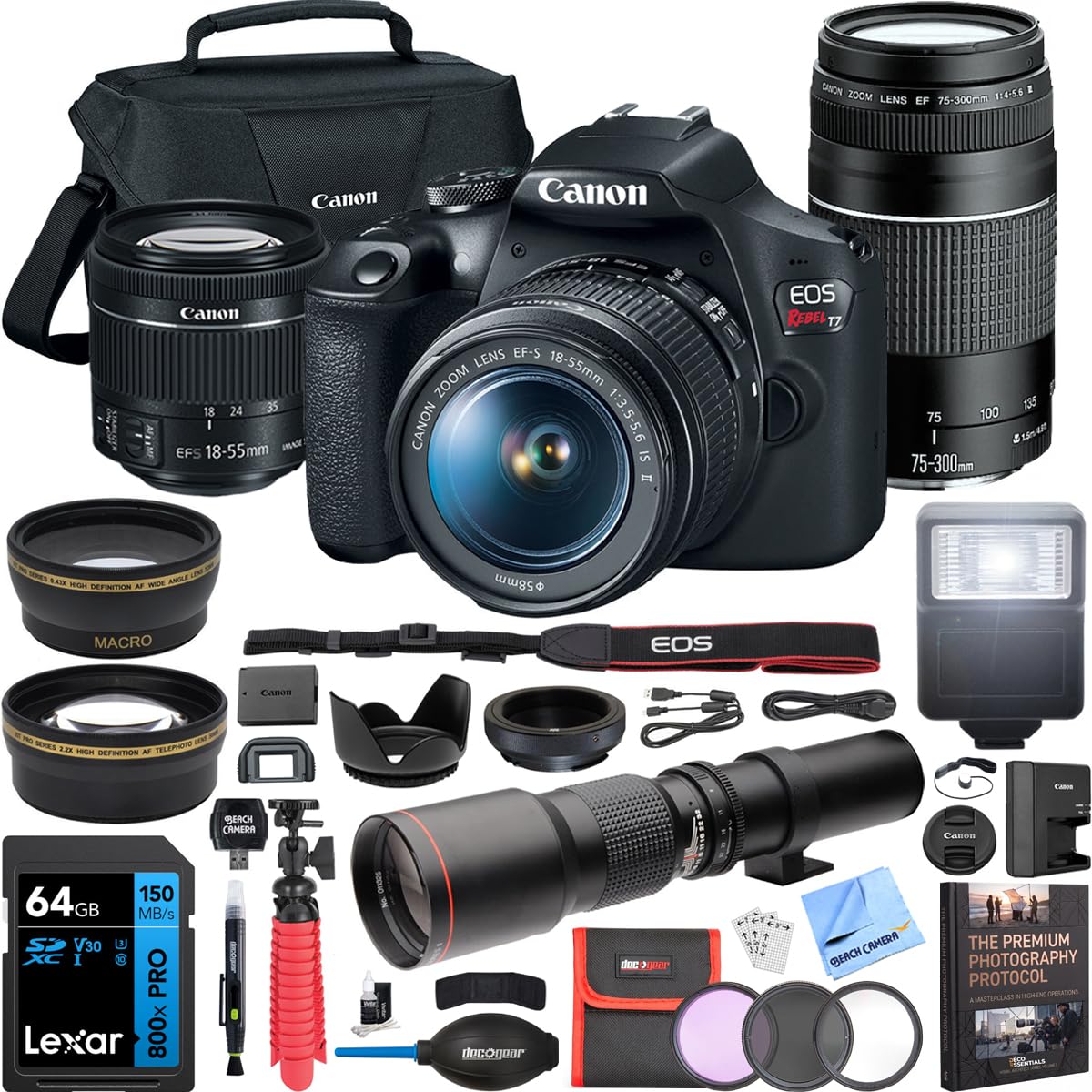
The Canon Rebel T7 bundle is designed for beginners who want to try bird photography without a huge upfront investment. The 24.1-megapixel APS-C sensor is a proven performer, and the dual zoom kit (18-55mm and 75-300mm) gives you a range from wide-angle to 300mm — equivalent to 480mm on the APS-C body. The bundle includes a 500mm f/8 preset telephoto lens that extends your reach significantly, though the manual focus-only design requires patience and a tripod.
The 9-point autofocus system is dated by modern mirrorless standards; it works well for slow-moving birds at feeders but will miss fast flyovers. The 3 fps continuous shooting is also slow — expect to shoot single frames of perched birds rather than action sequences. The optical viewfinder is bright and familiar for DSLR users, and the built-in WiFi allows quick image transfer to your phone for sharing on social media.
The bundle includes a 64GB memory card, a camera bag, a flash, and filter kit, plus a tripod — everything a beginner needs to start shooting immediately. The biggest limitation for birding is the 75-300mm lens, which is soft at 300mm and slow to focus; the 500mm preset lens offers reach but no autofocus. For a birder ready to learn manual technique on a budget, the T7 bundle is a solid entry point, but plan to upgrade lenses as your skill grows.
Why it’s great
- Complete kit with dual zoom and 500mm preset lens
- Proven 24.1MP APS-C sensor
- Excellent value for entry-level birding
Good to know
- 9-point AF and 3 fps are slow for action
- 75-300mm lens is soft at full telephoto
- 500mm preset lens is manual focus only
10. Kodak PIXPRO AZ653 Astro Zoom
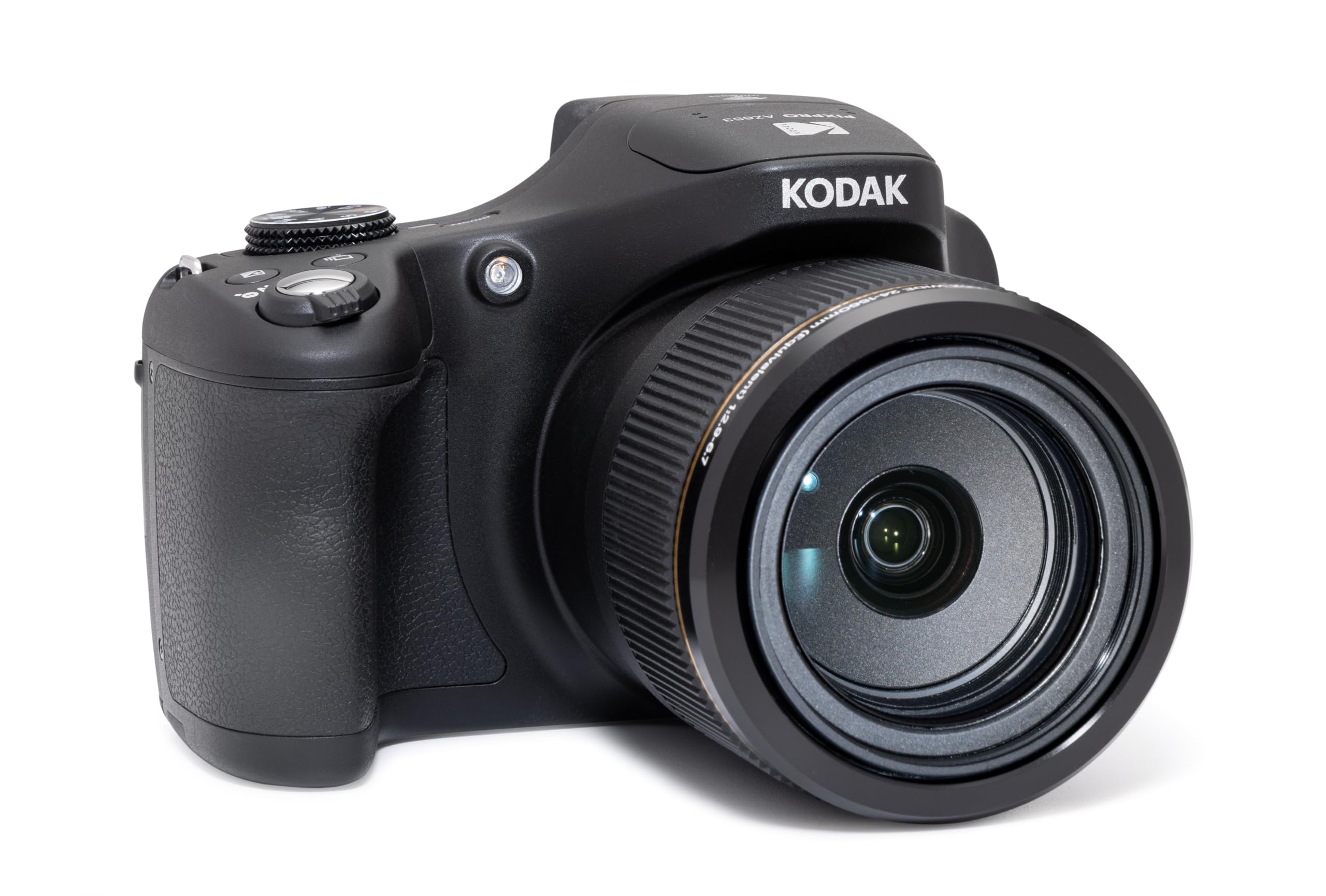
The Kodak PIXPRO AZ653 is a budget superzoom with a 65x optical zoom (24-1560mm equivalent) that offers impressive reach for the price. The 20-megapixel BSI CMOS sensor produces decent daytime images with warm, pleasing colors straight out of camera. The optical image stabilization helps at the long end, but a tripod is strongly recommended for anything beyond 600mm to counteract the noticeable shake.
This camera is best used in Auto or Scene modes — the smartphone-app WiFi control is handy for remote shutter release, and the 1080p HD video at 30 fps is adequate for casual clips. The 3-inch LCD and diopter-adjustable EVF give you two framing options, though the EVF is lower resolution than pricier competitors. The built-in flash is weak for bird photography but fine for group shots.
The AZ653 feels like a circa-2010 design with modern internals; the button layout is functional but awkward for fast adjustments. For a birder on the tightest budget who wants a single camera for both landscapes and distant wildlife, the AZ653 delivers acceptable results in good light. Manage expectations on low-light performance and autofocus speed, and you will find it a fun, lightweight travel companion for the trail.
Why it’s great
- Affordable 65x optical zoom reach
- WiFi connectivity for remote control
- Compact and lightweight for travel
Good to know
- Image quality degrades above 600mm
- Autofocus hunts in low light and at max zoom
- Only 1080p video, no 4K
11. Canon 18×50 Image Stabilization Binoculars

While binoculars do not capture photographs, the Canon 18×50 IS serves a special role for bird watchers who need sustained observation at high magnification. The 18x power combined with Canon’s optical image stabilization turns what would be a shaky, unusable view into a rock-solid image of a distant hawk or a feeding heron. The 50mm objective lens provides a wide, bright field of view that performs well even in overcast conditions.
The IS system runs on two AA batteries and activates with a single button. It eliminates the hand-shake that makes 18x binoculars impossible to hold steady without a tripod, and the image quality is excellent with multi-coated lenses that deliver true-to-life colors and sharp edges. The all-weather construction is shock and water-resistant, making these suitable for use in light rain or dusty environments.
The primary drawbacks are the stiff, uncomfortable eyecups that many users modify, and the poor accessory kit — the included case is flimsy. There are no front lens caps or filter threads from the factory, though generic 58mm filters can be fitted. For serious birders who want the best possible viewing experience without a camera, the Canon 18×50 IS binoculars are a premium observation tool.
Why it’s great
- Exceptional image stabilization for 18x handheld use
- Bright, clear multi-coated optics
- Rugged all-weather build
Good to know
- Uncomfortable stock eyecups require modification
- Cheap included case and no lens caps
- No filter threads from factory
FAQ
How much zoom do I really need for bird photography?
Should I get a superzoom bridge camera or a mirrorless with a telephoto lens?
Why do my bird photos look soft even with a powerful zoom?
Is image stabilization important for bird watching cameras?
Can binoculars with a phone adapter replace a dedicated bird camera?
Final Thoughts: The Verdict
For most users, the best bird watching camera winner is the Sony Alpha 6700 because its AI-powered bird eye autofocus, 26MP APS-C sensor, and compact body strike the ideal balance between image quality, portability, and reach when paired with a good telephoto lens. If you want maximum optical reach in a single device without changing lenses, grab the Nikon COOLPIX P1000. And for the budget-conscious birder who wants to learn the craft, nothing beats the value of the Panasonic LUMIX FZ80D.