
Our readers keep the lights on and the weekend projects moving. As an Amazon Associate, I earn from qualifying purchases.
Standard binoculars fail the moment the sun drops. The pupil of the human eye dilates to roughly 7mm in darkness, and unless your optics deliver an exit pupil that matches, the image collapses into a dim, unsatisfying blur. Serious astronomy binoculars solve this not with electrical amplification but with raw aperture — real glass measured in millimeters — paired with prism coatings that squeeze every photon into your retina. The difference between seeing Andromeda as a faint smudge and resolving its core comes down to a single choice: objective diameter.
I’m Rikta — the co-founder and writer behind FitlyFast. I’ve spent hundreds of hours researching optical specifications, cross-referencing real owner experiences, and analyzing the construction trade-offs that separate a lasting observation tool from a tripod-bound disappointment.
This guide cuts through the marketing to help you identify the best astronomy binoculars for your budget, your observing style, and the light pollution you actually deal with.
How To Choose The Best Astronomy Binoculars
Astronomy binoculars are defined by three interlocking specs — aperture, magnification, and optical coatings — plus a hard reality about weight. Most beginners overestimate the magnification they can hold steady and underestimate the light-gathering they need for deep-sky objects. Here is how to balance the variables.
Aperture Is The Only Spec That Cannot Be Faked
The number printed next to the millimeter label — 60mm, 80mm, 100mm — determines how much light enters the system. That light eventually reaches your eye as a circle called the exit pupil. For astronomy, you want an exit pupil between 5mm and 7mm to match a fully dark-adapted pupil. A 10×50 binocular produces a 5mm exit pupil. A 12×60 gives you 5mm. A 20×80 gives 4mm. Drop below 4mm and deep-sky objects become hard to distinguish from the background sky. Always divide objective lens diameter by magnification to find the exit pupil before you buy.
BaK-4 Prisms and Multi-Coatings Deliver Contrast
A BaK-4 glass prism has a higher refractive index than common BK-7 glass, meaning it reflects more light internally toward your eye instead of scattering it. The second layer is the lens coating. Fully Multi-Coated (FMC) optics apply anti-reflective layers to every air-to-glass surface, pushing light transmission into the 95% range. Single-coated or multi-coated (without the “fully”) lose 10-15% of the already limited night-time light. For astronomy, BaK-4 and FMC are baseline requirements, not upgrades.
Magnification Above 15x Requires Tripod Infrastructure
Hand-holding a 12×60 pair is possible for short bursts. Hand-holding a 20×80 produces a shaky image that cancels the resolution advantage of the larger glass. Once magnification exceeds 15x, a sturdy tripod and a fluid pan head become necessary accessories. Many premium astronomy binoculars ship with built-in tripod adapters for exactly this reason — manufacturers know the unit will rarely be used without support. Factor the tripod cost into your final budget.
Quick Comparison
On smaller screens, swipe sideways to see the full table.
| Model | Category | Best For | Key Spec | Amazon |
|---|---|---|---|---|
| Celestron SkyMaster 25×100 | Premium Giant | Deep-sky galaxy clusters | 5.0mm exit pupil | Amazon |
| Sogries 25×100 | Premium Giant | All-weather marine astronomy | 4.0mm exit pupil, nitrogen filled | Amazon |
| Tenjin 30×80 | High-Magnification | High-power lunar sessions | 2.67mm exit pupil | Amazon |
| Pentax SP 10×50 WP | Mid-Range Classic | Rugged portable stargazing | 5.0mm exit pupil | Amazon |
| Nikon ACULON A211 12×50 | Mid-Range All-Rounder | Hand-held astronomy and terrestrial | 4.2mm exit pupil | Amazon |
| Celestron SkyMaster 12×60 | Mid-Range Wide-Field | Beginner grab-and-go sessions | 5.0mm exit pupil | Amazon |
| ESSLNB 15-30×80 | Variable Zoom | Day-to-night variable use | 5.25–2.67mm exit pupil | Amazon |
| Sogries 18×70 | Budget Mid-Aperture | Twilight stargazing on a tripod | 4.7mm exit pupil, BaK-4 | Amazon |
| Aurosports 20×80 | Budget Large Aperture | Low-cost deep-sky entry | 4.0mm exit pupil | Amazon |
In‑Depth Reviews
1. Celestron SkyMaster 25×100 Binoculars
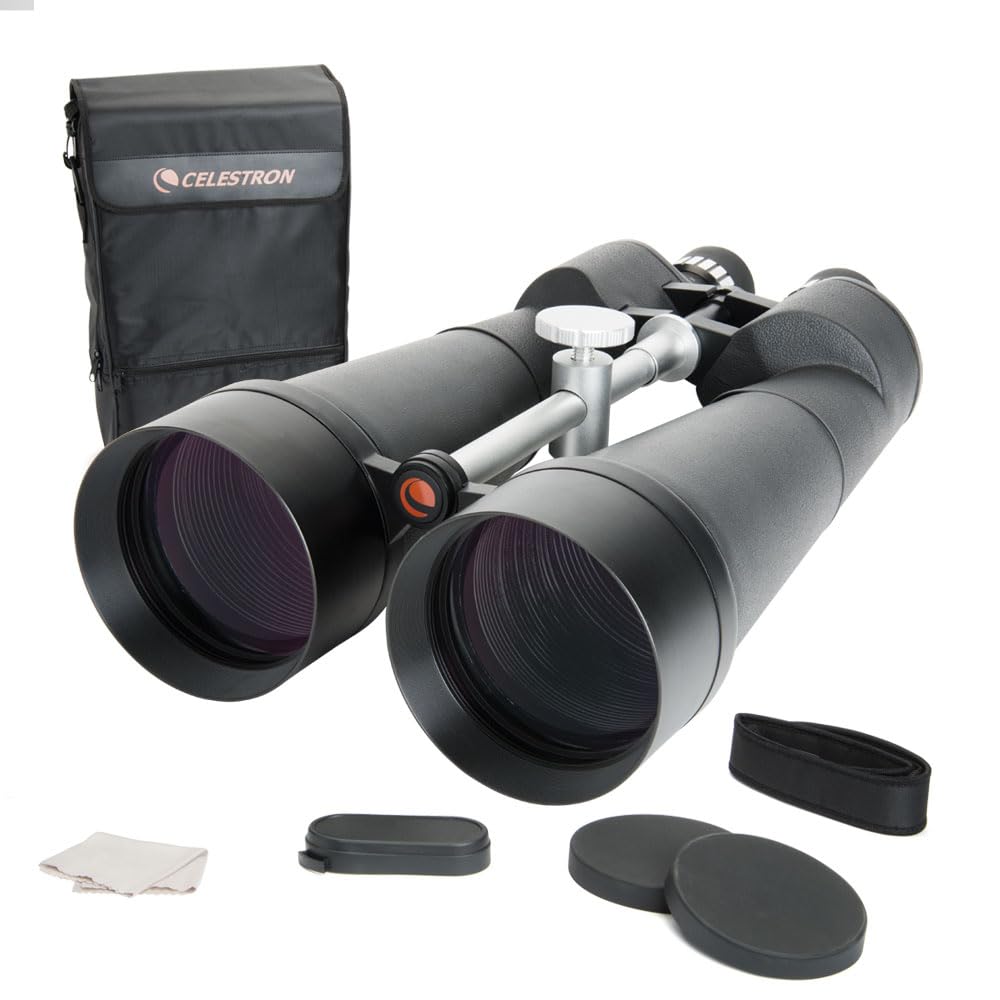
The SkyMaster 25×100 represents Celestron’s largest production binocular and the sweet spot for binocular astronomy under moderately dark skies. With a 100mm objective, BaK-4 prisms, and multi-coated optics, this unit delivers the light grasp needed to resolve globular clusters like M13 into individual stars and reveal dust lanes in Andromeda. Owners consistently report sharp collimation and an image that punches well above its price tier when mounted on a stable tripod.
The individual eyepiece focus system is ideal for astronomical use because it locks each diopter independently and eliminates the drift common in center-focus bridges under heavy glass. The built-in ¼-20 tripod adapter mates directly to standard photo heads, though the 10-pound body demands a head rated for at least 30 pounds of load to avoid vibration. The 3-degree field of view is narrow for a binocular but generous compared to a telescope at equivalent magnification.
Be prepared for a few quality-control variables — some units arrive with slightly stiff focus rings or a lopsided tripod adapter, and the included case offers minimal protection. The chromatic aberration on the lunar limb is moderate but not distracting for deep-sky work. For the observer transitioning from a small refractor who wants both eyes on the sky, this is the most capable instrument in the list.
Why it’s great
- Massive 100mm aperture reveals faint deep-sky detail inaccessible to smaller glass
- Individual eyepiece focus provides stable, drift-free adjustment for astronomy
- Long-standing reputation with Celestron’s limited lifetime warranty
Good to know
- Requires a heavy-duty tripod — total setup cost climbs significantly
- Quality control on accessories (adapter, case) can be inconsistent
- Narrow field of view makes star-hopping slower than with 80mm alternatives
2. Sogries 25×100 Binoculars
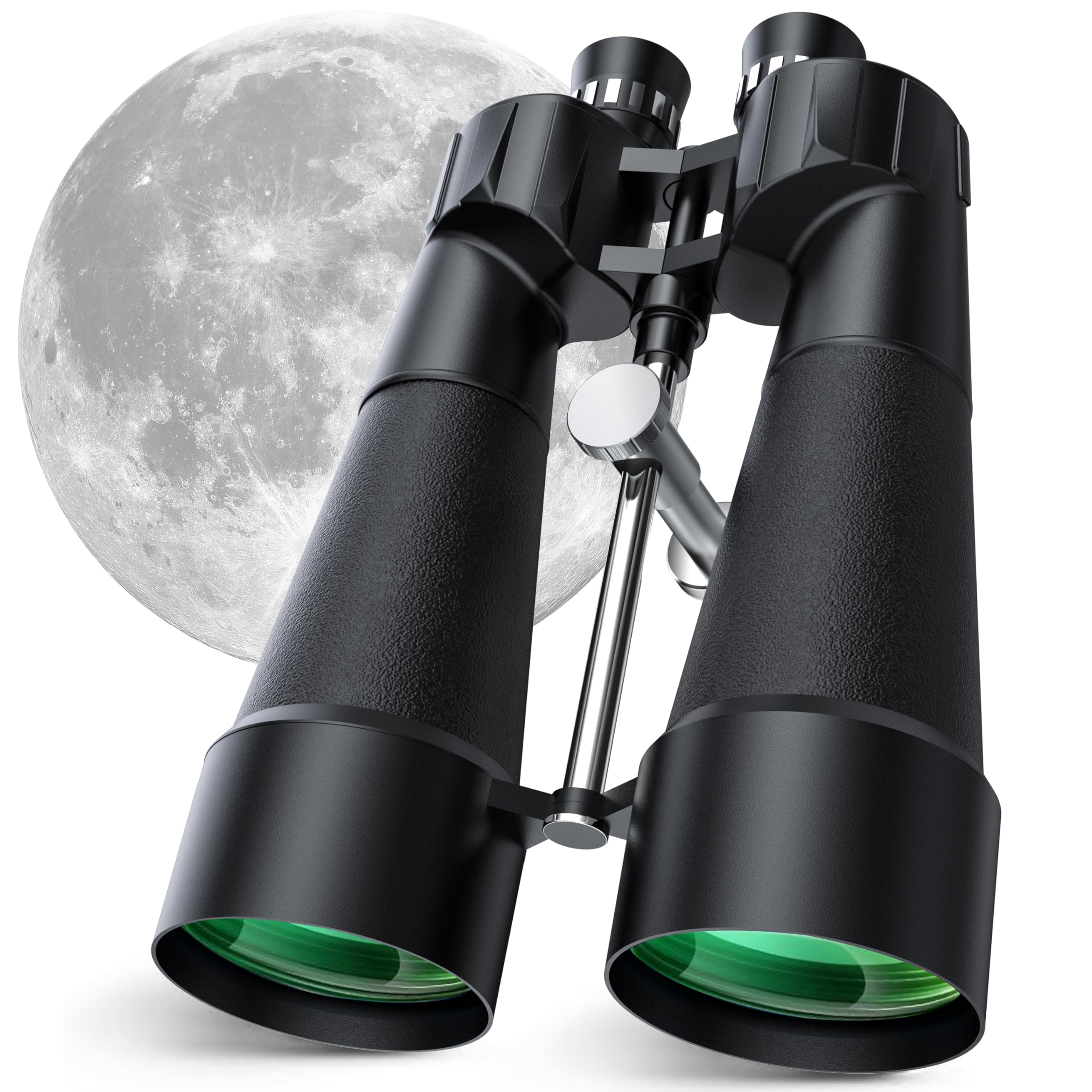
The Sogries 25×100 enters the giant binocular space with a fully multi-coated BaK-4 prism train and a critical advantage over many competitors — nitrogen-filled waterproof construction. This seals the optics against internal fogging during humid night sessions and allows safe use near marine environments where salt spray and temperature swings are common. The 25x magnification and 100mm aperture produce a 4.0mm exit pupil that balances light throughput with enough magnification to resolve lunar rilles and separate the components of double-double stars.
The bundled accessories are noticeably better than what Celestron provides in the same category. The premium leather backpack holds the binocular securely with space for a phone adapter and cleaning tools, and the built-in ¼-20 adapter integrates cleanly into the metal housing. Users report that the center hinge tension is consistent out of the box, which matters because misaligned barrels are a common failure in budget giant binoculars. The field of view at 147 feet per thousand yards is tight but expected for a 25x system.
The 8.8-pound weight demands a sturdy tripod — this is not a binocular for hand-held use under any circumstances. Some owners note that the lens covers are thin and untethered, increasing the risk of losing them during field sessions. The anti-reflective coating is effective, with minimal ghosting around bright objects like Jupiter. For the observer who wants weather-sealed durability in a giant binocular package, this is the most complete kit available.
Why it’s great
- Nitrogen-filled waterproof construction for fog-free operation in all conditions
- Premium leather backpack included — rare at this price point
- Fully multi-coated BaK-4 prisms deliver high contrast and edge clarity
Good to know
- Same tripod requirement as the Celestron 25×100 — add a heavy-duty head
- Untethered lens caps are easy to misplace in the dark
- Narrow 2.8-degree field limits survey scanning speed
3. Tenjin 30×80 Astro Binoculars

The Tenjin 30×80 pushes magnification to 30x while retaining an 80mm objective, resulting in a 2.67mm exit pupil that is best suited for lunar and planetary detail rather than faint nebula hunting. At this magnification, the Moon fills the field of view with enough resolution to show individual crater terraces and central peaks. The aluminum alloy body with a green rubber armor wrap feels dense and premium, and the double-layer EVA carrying case provides protection that is uncommon among mid-range binoculars.
The BaK-4 prism system is paired with a blue-film coating that leans toward cooler color temperatures — acceptable for astronomy but noticeable when used for terrestrial viewing. The built-in tripod adapter is integrated into the body, and the individual focus wheels on each eyepiece lock firmly. Owners report that the 30x magnification reveals surface detail on Jupiter’s cloud bands and splits Saturn’s rings from the planet, though the small exit pupil means these images are dimmer than what a 20×80 would show. The 2.3-degree apparent field is narrow, but the 19.58mm eye relief is generous for eyeglass wearers.
The trade-off for the high magnification is chromatic aberration — a purple halo appears along high-contrast edges like the lunar terminator. This is typical for an 80mm binocular without ED glass. The weight distribution feels front-heavy, which makes a fluid head tripod essential for smooth panning. For the observer who already owns wide-field binoculars and wants a dedicated high-power companion for the Moon and planets, the Tenjin fills the niche effectively.
Why it’s great
- 30x magnification provides detailed lunar and planetary views unavailable at lower power
- Aluminum alloy body with protective EVA case offers excellent durability
- Wide eye relief accommodates users who wear glasses
Good to know
- 2.67mm exit pupil reduces brightness on deep-sky objects
- Pronounced chromatic aberration on the Moon and bright planets
- Front-heavy design requires a fluid head tripod for comfortable use
4. Pentax SP 10×50 WP Binoculars

The Pentax SP 10×50 WP diverges from the “bigger is better” philosophy by delivering a compact, ruggedized 10×50 package that can live in a backpack without dominating it. The 5.0mm exit pupil matches the fully dark-adapted human pupil, which means this binocular provides the maximum possible image brightness at a hand-holdable magnification. The magnesium alloy body is nitrogen-purged and JIS Class 6 waterproof (submersible to 1 meter), making it the most field-rugged option in this comparison.
The multi-coated optics deliver a neutral color balance with minimal flare, and the lockable center focus wheel prevents creep during temperature changes — a common frustration in cheaper 10x50s. The 20mm eye relief is generous, and the twist-up eyecups lock into position securely. Owners consistently praise the mechanical feel of the focus mechanism and the durable lens coating that repels dust and grease. The 87.2-foot field of view at 1000 yards is on the narrow side for a 10×50, but the image flatness and low distortion make it easy to scan the Milky Way.
The lens caps are poorly fitted and tend to fall off during transport. The bundled case is thin and offers minimal impact protection. The narrow eye box requires precise eye placement, which can be frustrating during quick looks. For the observer who wants a binocular that can survive a drop off a boulder and still deliver crisp star fields, the Pentax SP is the most durable choice in the mid-range tier.
Why it’s great
- JIS Class 6 waterproof certification — submersible and nitrogen-purged
- Lockable center focus wheel prevents drift during night sessions
- Compact 10×50 format is genuinely hand-holdable for extended sessions
Good to know
- Narrow field of view limits scanning speed compared to wider 10x50s
- Lens caps are loose and easily lost in the field
- Thin bundled case offers minimal protection for transport
5. Nikon ACULON A211 12×50 Binocular

The Nikon ACULON A211 12×50 represents a deliberate compromise — 12x magnification for extra reach over the standard 10x, mated to a 50mm objective that keeps the total weight at 2 pounds. The 4.2mm exit pupil is below the ideal 5mm for dark skies, but the aspherical multicoated Eco-Glass lenses compensate with excellent light transmission and sharpness across the field. This binocular works best in suburban skies where light pollution already limits what the eye can see, and the extra magnification helps isolate objects from the sky glow.
The Porro prism design produces a wider interpupillary distance than roof prisms, which feels natural for most users and provides a three-dimensional depth effect on the Moon and open clusters. The turn-and-slide rubber eyecups are comfortable for extended sessions, and the smooth center focus knob operates with the precision expected from Nikon. Owners with 12×50 experience report that it reveals the Pleiades string of stars, resolves the Andromeda core, and shows Jupiter’s four Galilean moons clearly. The 272-foot field of view at 1000 yards is competitive for its magnification class.
The 2-pound weight is manageable for short bursts but will strain the neck after an hour of continuous use — the included strap is thin and should be upgraded. The multi-coated (not fully multi-coated) optics are a cost-saving measure that shows in slightly reduced contrast compared to premium glass. The 11.5mm eye relief is tight for eyeglass users. For the birder who also wants a capable astronomy binocular without stepping into 60mm or 70mm weight, the Nikon ACULON is the most balanced middle option.
Why it’s great
- Lightweight 2-pound build allows limited hand-held use during short sessions
- Aspherical multicoated optics deliver sharp images with low edge distortion
- Trusted Nikon brand with reliable mechanics and smooth focus action
Good to know
- 4.2mm exit pupil is sub-optimal for deep-sky observation under dark skies
- Thin included neck strap needs replacement for comfort
- 11.5mm eye relief may not accommodate all eyeglass wearers
6. Celestron SkyMaster 12×60 Binoculars

The Celestron SkyMaster 12×60 is the gateway drug to binocular astronomy. The 60mm objective with a 5.0mm exit pupil matches the dark-adapted eye perfectly, delivering bright images of star clusters, the Andromeda core, and the Orion Nebula. The BaK-4 prisms and multi-coated optics are a proven combination for this price tier, and the 2.4-pound weight is low enough that some observers can hand-hold for short periods if they brace their elbows against a wall or car roof. The rubber-armored housing provides a secure grip in cold weather.
The center focus system is smooth and intuitive, making this the most beginner-friendly unit in the lineup. The 5.3-degree field of view is genuinely wide for a 12x binocular, allowing users to sweep the Milky Way without constantly readjusting. Owners consistently report that this binocular reveals Jupiter’s moons, Saturn’s ring shadow, and the brighter Messier objects with ease. The included carrying case, lens cloth, and rainguard minimize accessory costs for first-time buyers.
The thin neck strap is borderline unusable and should be replaced immediately. Celestron does not include a tripod adapter, which is frustrating because the 12×60 benefits from one for extended viewing. Some users report slight chromatic aberration on the Moon, but it is less pronounced than on larger 80mm models. For the absolute beginner who does not yet own a tripod and wants a binocular that can operate on its own two feet, the SkyMaster 12×60 is the most forgiving option to start with.
Why it’s great
- Wide 5.3-degree field makes Milky Way scanning intuitive and satisfying
- 5.0mm exit pupil provides maximum brightness for dark-adapted eyes
- Long-established model with thousands of verified positive reviews
Good to know
- No tripod adapter included — an essential accessory not in the box
- Included neck strap is too thin for comfortable long sessions
- 12x magnification still benefits from a tripod for steady views
7. ESSLNB 15-30×80 Zoom Binoculars

The ESSLNB 15-30×80 offers a variable magnification range within a single body — a design that trades some optical perfection for versatility. At 15x the 80mm objective produces a generous 5.25mm exit pupil that is excellent for wide-field sweeping, while cranking up to 30x provides detailed lunar views. The BaK-4 fully multi-coated prism train and 21mm green-film FMC eyepieces keep the image bright across the zoom range. The built-in metal tripod mount is integrated into the bridge, eliminating the need for a separate adapter.
The zoom mechanism is controlled by a left-hand knob that feels smooth at low magnifications but introduces noticeable image shift and softening past 20x. The 5.11-pound weight forces tripod use, but the integrated mount makes setup faster than competing models. The phone adapter with a rubber suction mount attaches to one eyepiece and includes 180-degree angle adjustment for digiscoping. The 288-foot field of view at 1000 yards at 15x is generous, but this collapses to approximately 144 feet at 30x.
Quality control is the main risk — multiple users report double vision issues that cannot be corrected by the diopter adjustment, and the phone adapter in some shipments does not match the advertised design. The close focus distance of roughly 50 feet limits its use for birding or terrestrial observation at close range. For the experimenter who wants one binocular that can both survey the summer triangle and zoom in on the Moon without swapping glass, the ESSLNB delivers variable utility at a reasonable weight.
Why it’s great
- Variable 15-30x magnification eliminates the need for multiple binoculars
- Built-in metal tripod mount saves the cost and hassle of a separate adapter
- Generous 5.25mm exit pupil at the low end for bright wide-field views
Good to know
- Image quality drops noticeably above 20x magnification
- Quality control inconsistencies — some units arrive with collimation issues
- 50-foot close focus restricts versatility for nearby terrestrial targets
8. Sogries 18×70 Astronomy Binoculars

The Sogries 18×70 packs a 70mm aperture into a well-sealed, fully multi-coated body at a price that undercuts most 70mm competitors. The BaK-4 prism system and FMC lenses deliver a 4.7mm exit pupil that produces bright, high-contrast views of the Pleiades and the Double Cluster. The IPX7 waterproof rating is rare at this price tier and means the optics stay fog-free during humid nights or unexpected rain. The built-in ¼-20 tripod thread and included adapter make tripod integration straightforward.
The 18x magnification is a sweet spot — high enough to resolve detail on Jupiter and Saturn, but low enough that the 4.7mm exit pupil still provides a pleasingly bright image on most deep-sky objects. The field of view at 231 feet per thousand yards is competitive for the magnification. The smartphone adapter attaches to the eyepiece via a clamping mechanism and works with most phone widths between 2.09 and 3.54 inches. The heavy-duty carrying case and included lens covers protect the optical train during transport.
The weight is approximately 3 pounds — too heavy for prolonged hand-held use, but manageable on a starter tripod. The individual focus design locks each barrel independently, which is a pro for astronomy but a con for rapid target switching. Some users find the focus knobs stiff at first. The package value is exceptional for the price, but the tripod recommendation is not optional — this binocular is usable without support only for brief glances. For the budget-conscious observer who already owns or plans to buy a tripod, the Sogries 18×70 delivers the best light-per-dollar ratio in this list.
Why it’s great
- IPX7 waterproof certification protects against rain, humidity, and internal fogging
- BaK-4 with FMC delivers bright, sharp images at an entry-level price
- Includes tripod adapter and smartphone digiscoping kit in the box
Good to know
- 3-pound body is too heavy for comfortable hand-held use
- Individual focus style is slower than center focus for changing targets
- Focus knobs may require a break-in period to achieve smooth rotation
9. Aurosports 20×80 Binoculars

The Aurosports 20×80 achieves something rare in this category — a 20x binocular with fully multi-coated BaK-4 optics and an 80mm objective at a price that leaves room for a decent tripod in the same budget. The 4.0mm exit pupil delivers bright enough images under moderately dark skies to reveal the Milky Way’s structure, the Andromeda core, and dozens of globular clusters. The field of view at 168 feet per thousand yards is standard for the magnification, and the 95%+ light transmission claim from the FMC coating holds up well in practice.
The rubber-armored exterior provides a secure grip even with gloves, and the 20x magnification reveals detail on the Moon that 10x binoculars cannot approach. Users consistently praise the clarity and sharpness for terrestrial long-distance viewing and note that the binocular holds collimation well during transport. The included carrying bag and neck strap are functional but basic — serious users will want a dedicated hard case. The eye relief of 15mm is adequate for most eyeglass users.
The 20×80 format demands a tripod — hand-holding produces an unusable shaky image. The ABS construction is lighter than aluminum-alloy competitors but transmits more vibration. Some units exhibit chromatic aberration on the lunar limb, but it is mild enough not to obscure surface detail. The Aurosports is best understood as the most economical entry point into genuine 80mm astronomical observation, leaving budget room for the essential tripod investment that many cheaper binoculars omit.
Why it’s great
- 80mm aperture with BaK-4/FMC at a price that beats most competitors by 30%
- Light 20×80 body compared to aluminum-chassis alternatives
- Proven optical train delivers bright, contrast-rich images for the price
Good to know
- ABS construction transmits more vibration than metal-bodied binoculars
- Strictly tripod-only — 20×80 cannot be hand-held for astronomical use
- Mild chromatic aberration visible on the Moon at high contrast edges
FAQ
Can I hand-hold astronomy binoculars with 20x magnification?
What is the difference between individual focus and center focus for astronomy binoculars?
Why do some astronomy binoculars include a phone adapter?
Final Thoughts: The Verdict
For most users, the best astronomy binoculars winner is the Celestron SkyMaster 25×100 because its 100mm aperture unlocks deep-sky detail that 80mm binoculars cannot reach, and Celestron’s long-standing optics reputation provides confidence for a significant purchase. If you want weather-sealed durability with premium accessories, grab the Sogries 25×100. And for the budget-conscious observer looking for maximum light-per-dollar in a tripod-mounted system, nothing beats the Sogries 18×70 package with its IPX7 waterproof build and included digiscoping kit.