
Our readers keep the lights on and the weekend projects moving. As an Amazon Associate, I earn from qualifying purchases.
Stringing tiny seed beads or clay beads by hand is a test of patience that few hobbyists have time for. The repetitive pinch, the dropped beads, the sore fingers — it turns a creative outlet into a tedious chore. A quality bead spinner replaces that finger gymnastics with a smooth, rotating bowl that feeds beads onto your needle in seconds.
I’m Rikta — the co-founder and writer behind FitlyFast. I’ve spent hundreds of hours analyzing the mechanics, motor specs, bowl designs, and needle geometry of the top bead spinners on the market to help you find the one that actually saves you time without introducing new frustrations.
Whether you need a motorized unit for bulk bracelet production or a quiet wooden manual spinner for focused beadwork, this guide cuts through the noise to reveal the best bead spinner options for every beading style and budget.
How To Choose The Best Bead Spinner
Not all bead spinners are created equal. The wrong one will leave you fighting with a slow motor, bent needles, or a bowl that won’t hold enough beads to thread properly. Here’s what matters most when picking your tool.
Manual vs. Electric: Which Serves Your Workflow?
Manual wooden spinners like those from The Beadsmith rely on you turning the spindle by hand. They’re quiet, require no batteries, and give you full control over speed — ideal for fine seed bead work where you need to load beads deliberately. Electric spinners automate the rotation, making them far faster for high-volume clay bead bracelet or necklace production, but they introduce noise, battery dependencies, and a learning curve for needle positioning.
Bowl Design and Bead Capacity
A shallow bowl forces you to stop and refill constantly, breaking your rhythm. Deep bowls hold more beads, allowing the needle to dip into the stream continuously. Look for bowls with a 5-inch diameter or larger, especially if you work with 6 mm clay beads that need room to tumble. Some kits offer interchangeable bowls for different bead types — a feature that matters more for mixed-media beaders than for those using a single size.
Needle Quality and Curve Tuning
The needle is the single point of failure in any bead spinner. Cheap needles bend under the friction of heavier beads and lose their J-curve shape, which is essential for scooping beads. Premium units include thicker, tempered steel needles, while budget options often ship with wire that requires manual bending. A needle that’s too flimsy for 6/0 seed beads will frustrate you within minutes. Always check whether replacement needles are available separately.
Speed Adjustability and Direction Control
Fixed-speed electric spinners work for one type of bead at one volume. Adjustable speed lets you slow down for delicate 15/0 seed beads or speed up for chunky clay beads. Forward and reverse rotation is a practical feature — it prevents beads from jamming against the needle in a single direction and helps distribute bead flow evenly around the bowl.
Quick Comparison
On smaller screens, swipe sideways to see the full table.
| Model | Category | Best For | Key Spec | Amazon |
|---|---|---|---|---|
| Beadalon Spin N Bead | Manual | Seed bead enthusiasts | Hardwood bowl, 4.75″ diameter | Amazon |
| The Beadsmith Spin & String | Manual | Bead crochet & knitting | 5.6″ diameter wood bowl | Amazon |
| ETUDAW Electric Bead Spinner | Electric | High-volume clay bead projects | 2000 mAh rechargeable battery | Amazon |
| LITTLE CHILTERN Electric Bead Spinner | Electric | Multi-bead type versatility | 3 bowls with lids included | Amazon |
| Myartype 2-in-1 Electric Spinner | Electric | Clay & seed bead dual use | 2 dedicated bowls included | Amazon |
| Beadact Electric Bead Spinner Kit | Electric | Complete beginner kit | 5280 clay beads included | Amazon |
| SHOP LC Blue Electric Spinner | Electric | Budget-friendly starter | Adjustable speed & direction | Amazon |
In‑Depth Reviews
1. Beadalon Spin N Bead Spinner

The Beadalon Spin N Bead is the gold standard for manual bead spinners, and for good reason. Its hardwood bowl provides a smooth, dense surface that doesn’t snag needles the way unfinished wood can. The included curved big eye needle is long enough to load 12/0 seed beads, and experienced users report stringing fifteen yards of size 11 beads in about an hour once the needle curve is tuned to match the bowl’s angle.
This is a manual spinner, meaning you rotate the spindle by hand while holding the needle in your other hand. That two-hand technique takes a few minutes to learn, but it gives you unmatched control over bead flow — no motor to fight, no batteries to replace. The bowl is a generous 4.75 inches in diameter, deep enough to hold a substantial quantity of beads without needing constant refills.
Some users note the included needle can feel flimsy for larger 6/0 and 8/0 beads and prefer a bent wire substitute. The unit also arrives loose in its packaging, so the bowl may need slight sanding if the inner rim catches. Still, for pure seed bead efficiency, this is the benchmark.
Why it’s great
- Hardwood bowl resists wear and feels premium during use
- Dense construction stays stable on the workbench without sliding
- Smooth rotation with minimal friction delivers consistent bead loading
Good to know
- Big eye needle may require bending adjustment for larger bead sizes
- Packaging lacks padding, so inspect bowl for minor finishing issues
2. The Beadsmith Spin & String

At 5.6 inches in diameter, The Beadsmith Spin & String is one of the largest manual bead spinners you’ll find, and that extra real estate makes a real difference for bead crochet and bead knitting projects. The larger bowl holds more beads, reducing the frequency of refills and giving the needle a wider pool to work from. The wood is finished smooth, and the center spindle rotates freely with minimal resistance from the factory.
The two included wire needles measure 6.25 inches long with a J-hook at the end — long enough to load dozens of beads per pass. Users with limited dexterity in one hand have reported success using this spinner with a single functional hand, which speaks to the low friction of the rotation mechanism. It handles seed beads from size 6/0 to 15/0, as well as delicas and other small glass beads.
The printed instructions on the box are genuinely helpful for first-time users, walking through the correct spindle rotation direction and needle angle. The only trade-off is that it’s a purely manual tool — no electric assist for those seeking maximum speed. But for fine beadwork where control matters more than raw throughput, this is a superb choice.
Why it’s great
- Large bowl capacity minimizes refill interruptions during long sessions
- Smooth, low-friction spindle rotation suitable for users with limited hand mobility
- Clear illustrated instructions on the box reduce the learning curve
Good to know
- No motor means slower overall throughput compared to electric models
- Needle gauge may be too thick for the smallest 15/0 seed beads without adjustment
3. ETUDAW Electric Bead Spinner Kit
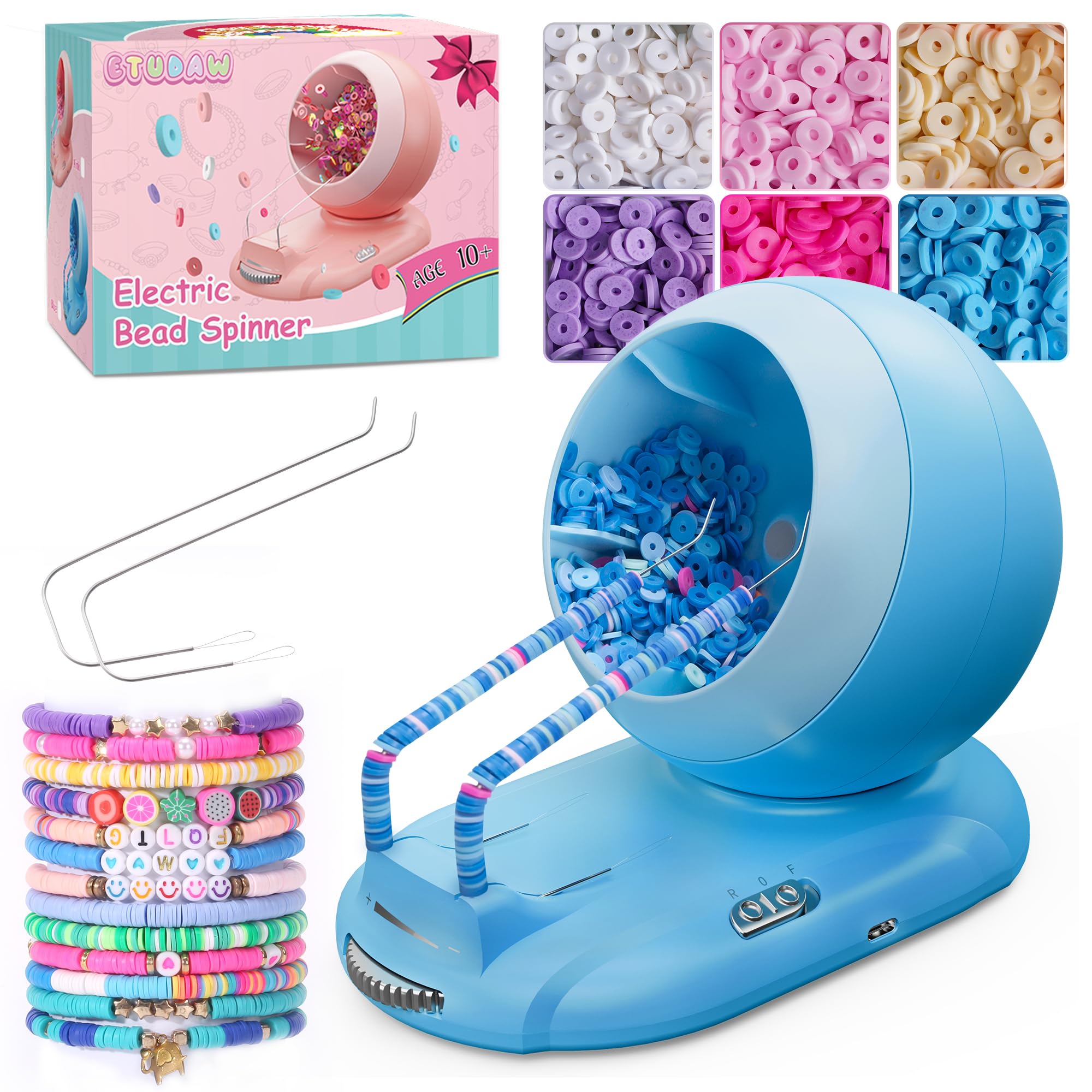
The ETUDAW Electric Bead Spinner is a standout cordless option thanks to its built-in 2000 mAh rechargeable battery. That capacity is enough for multiple extended beading sessions without hunting for outlets or swapping batteries. The dual-needle structure lets you work continuously without pause, and the adjustable speed range lets you dial down for 2 mm seed beads or crank up for 6 mm clay beads.
The kit arrives with 4500 clay beads, including letter beads, fruit beads, and heart beads, along with a complete tool set that includes two big eye needles, thread, scissors, and a USB cable. For beginners who want everything in one box, this is a thorough package. Kids as young as seven have picked up the technique quickly, making it a practical option for family craft time.
The cordless design is genuinely liberating for outdoor or travel use — no wires, no power bank tethering. The trade-off is that the motor requires the bowl to be at least one-third full to function optimally; too few beads and the pickup rate drops considerably. Some users also wish the instruction manual offered more detail on the needle positioning technique for different bead sizes.
Why it’s great
- Rechargeable battery eliminates cord clutter and enables on-the-go beading
- Comprehensive bead and tool kit makes it a true all-in-one starter package
- Adjustable speed accommodates both fine seed beads and larger clay beads
Good to know
- Bowl must be filled to at least one-third capacity for reliable threading
- Needle positioning technique is not fully explained in the included manual
4. LITTLE CHILTERN Electric Bead Spinner
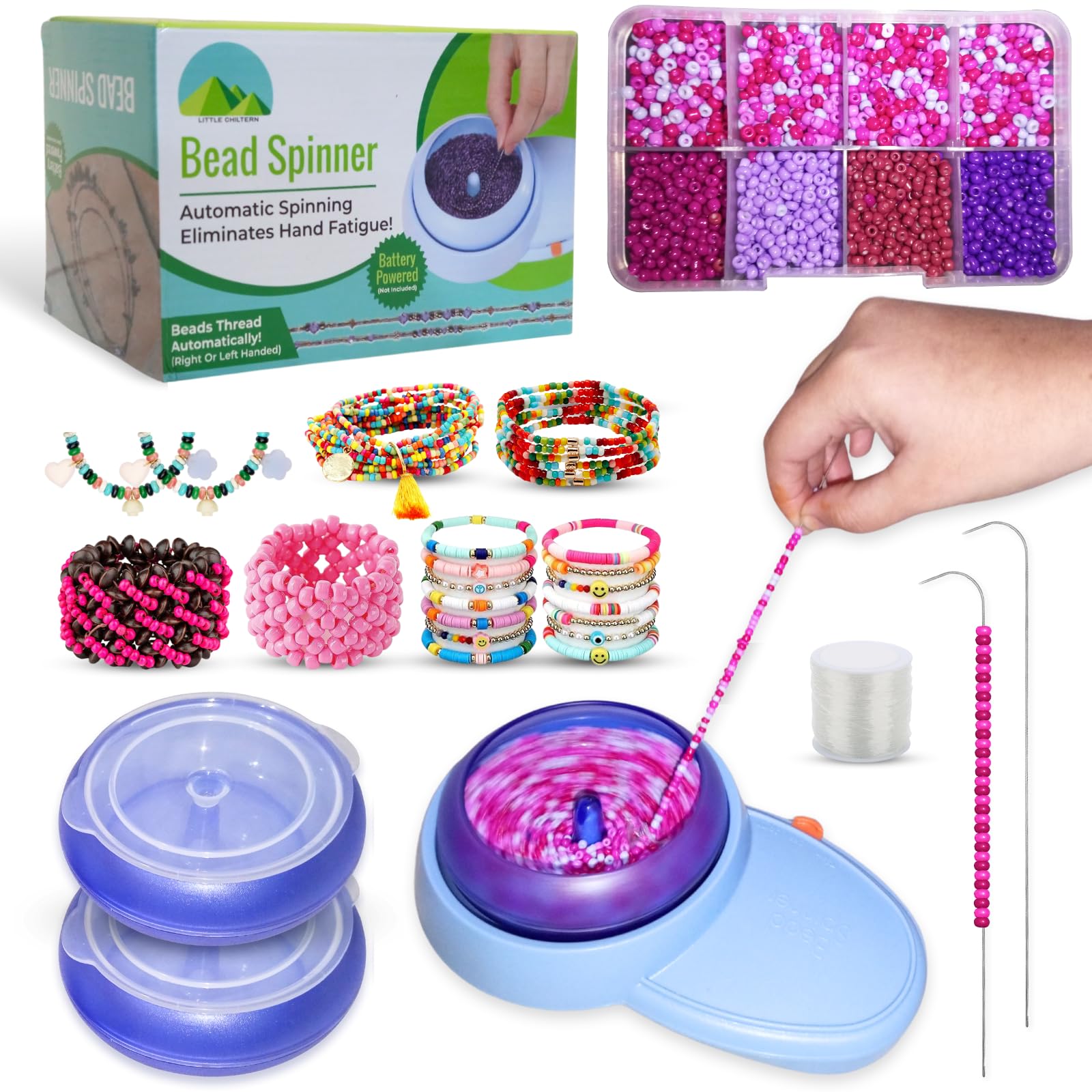
The LITTLE CHILTERN distinguishes itself with three interchangeable bowls that each come with a lid — a feature that transforms how you switch between bead types mid-project. Snap on a filled bowl, run your string, then cap it and swap to a different color or size without dumping any beads. That workflow efficiency is hard to overstate for makers producing multiple bracelet designs in a single session.
The motor delivers smooth forward and reverse rotation, and the clamshell design makes cleaning straightforward. The kit includes two needles (one thick, one thin) to match different bead gauges, plus a wire coil and eight colors of starter beads in a bead organizer. The plastic construction is durable for the price point, though it doesn’t have the wood-grain aesthetic that some hobbyists prefer.
The major limitation is the included needles, which some users find too large for seed beads — you may need to purchase smaller hooked needles separately for 6/0 or 8/0 work. The motor also runs slower than some competing electric models, which helps with control but reduces throughput for large-volume projects. Batteries are not included, so factor that into your initial setup.
Why it’s great
- Three lidded bowls enable rapid bead type swaps without cleanup
- Forward and reverse rotation reduces bead jams and improves flow
- Clamshell bowl design is simple to rinse and maintain
Good to know
- Included needles are too thick for most seed bead sizes
- Requires batteries (not included) and runs slower than premium electric models
5. Myartype 2-in-1 Electric Bead Spinner

Myartype solves a specific pain point for beaders who work with both flat clay beads and round glass seed beads. The kit includes two dedicated bowls — one with internal baffles designed for clay beads and one without baffles for seed beads — plus two different needle thicknesses to match each bead type. That means you’re not compromising the bowl geometry to accommodate two different bead shapes.
The motor is USB-powered and offers adjustable spinning speed, letting you find the sweet spot for your current project. Users report a ten-minute learning curve before they’re producing consistent results, and the quiet motor means you can bead without disturbing others. The package includes an adjustable stand, magnetic needle holder, and clear stretchy string.
The catch is that the manufacturer explicitly warns against powering the spinner from a computer USB port, requiring a standard wall adapter instead. Too few beads in the bowl will also prevent proper threading, so you need a decent supply on hand. Some users found the spinner slower than expected for high-volume work, but for mixed-media beaders who switch between bead types regularly, the dedicated bowl system is a genuine time saver.
Why it’s great
- Separate bowls with optimized internal geometry for clay vs. seed beads
- Two included needle gauges match the different bead sizes without compromise
- Adjustable speed works well once you find the right setting for each bead type
Good to know
- Requires a standard wall adapter — computer USB ports lack sufficient power
- Slower motor speed compared to some competitors may limit throughput for bulk work
6. Beadact Electric Bead Spinner Kit

The Beadact Electric Bead Spinner Kit is aggressively all-inclusive, packing 5280 clay beads across 24 colors, plus letter beads, heart beads, shells, pearls, pendants, lobster clasps, jump rings, scissors, tweezers, big eye needles, and crystal thread. If you’re starting from zero beads and tools, this kit is designed to have you making bracelets within minutes of unboxing — no secondary purchases required.
It offers dual power options: three AA batteries or USB Type-C. That flexibility is practical for workshops or outdoor settings where outlets aren’t available. The motor handles both clay and seed beads effectively, though the included needles are somewhat delicate — several users report needing to buy replacement needles after the originals bent during use. The spinner itself is lightweight at just over a kilogram with beads, making it easy to move around your workspace.
The white ABS and PC construction is sleek but less impact-resistant than some competitors. Beaders working with dense 6 mm clay beads in volume may find the motor labors slightly compared to premium units. Still, for the sheer volume of materials included and the beginner-friendly design, this kit delivers remarkable value for anyone entering the craft.
Why it’s great
- Massive bead count with 24 colors plus accessories provides immediate project readiness
- Dual power supply (battery or USB-C) offers flexibility for any environment
- Lightweight and compact design is easy to store and transport
Good to know
- Included needles are prone to bending with heavier beads and may require replacement
- Motor can struggle with dense bead loads compared to higher-end electric models
7. SHOP LC Delivering Joy Electric Bead Spinner
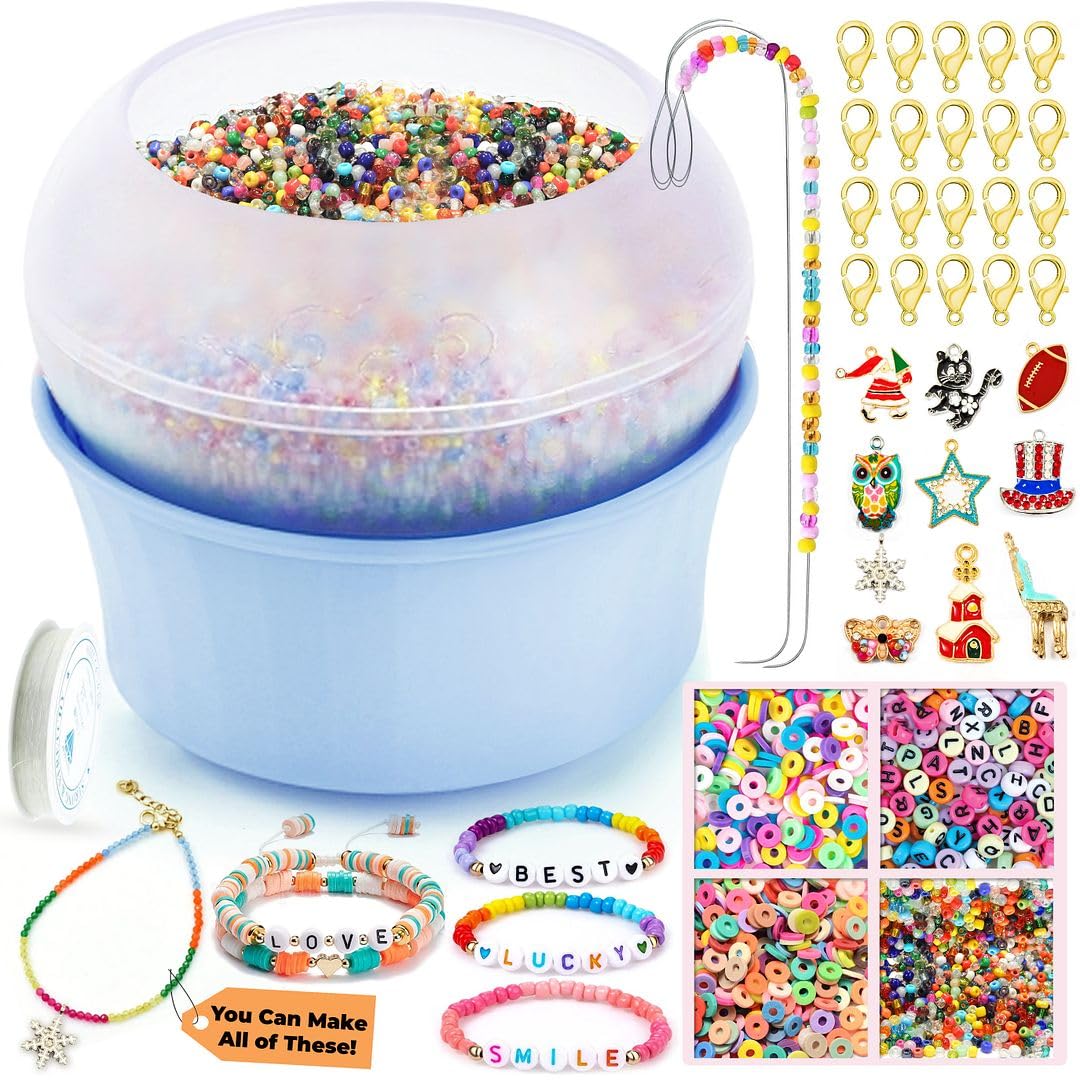
The SHOP LC Delivering Joy Electric Bead Spinner enters as an entry-level electric option for those testing whether a motorized spinner fits their workflow. It offers adjustable speed and direction — including both left and right rotation to accommodate left-handed users — at a lower investment point than most electric kits. The blue plastic body measures 4.33 by 3.85 inches, making it one of the more compact units on this list.
The kit ships with two big eye needles (one 14 cm, one 9.8 cm), 14.5 meters of crystal thread, and a mixed bag containing rice beads, polymer clay beads, acrylic beads, 20 lobster clasps, and 10 pendants. That’s enough to produce several bracelets or a necklace right away. The 100-gram rice bead inclusion is a thoughtful addition for beginners learning the needle positioning technique without wasting premium materials.
Quality control is the main concern here. Several users report that the motor requires multiple plug-unplug cycles to start, and even then runs disappointingly slow at high speed. The needle threading challenge is also steeper than with manual or upper-tier electric spinners. This unit works best for occasional crafters who prioritize low entry cost over consistent performance — and are willing to troubleshoot the occasional startup issue.
Why it’s great
- Left and right rotation accommodates both left-handed and right-handed users
- Compact footprint fits easily in small craft spaces or travel bags
- Included rice beads provide an inexpensive learning material for technique practice
Good to know
- Motor reliability is inconsistent — some units require multiple restarts to engage
- Threading the needle in the rotating bowl is harder than with higher-end electric models
FAQ
Can I use a bead spinner with any bead size?
How do I fix a bead spinner needle that stops picking up beads?
Do electric bead spinners work for left-handed users?
Final Thoughts: The Verdict
For most users, the best bead spinner winner is the Beadalon Spin N Bead because its hardwood construction, smooth manual rotation, and compatibility with seed beads from 6/0 to 15/0 make it the most reliable long-term tool for serious beaders. If you want cordless freedom and a complete starter kit, grab the ETUDAW Electric Bead Spinner. And for mixed-media work switching between clay and seed beads, nothing beats the dedicated dual-bowl system of the Myartype 2-in-1.