
Our readers keep the lights on and the weekend projects moving. As an Amazon Associate, I earn from qualifying purchases.
Hooking up a new 4K TV only to realize your decade-old receiver can’t pass through HDR or Dolby Atmos is the moment you know an upgrade is overdue. An audio AV receiver is the central brain of your home theater — it decodes every audio format, handles every HDMI handshake, and powers every speaker in the room. Choosing the wrong one means wasted money on unused channels or, worse, a system that can’t keep up with your TV and gaming consoles.
I’m Rikta — the co-founder and writer behind FitlyFast. I spend my weeks dissecting component specs, comparing room correction algorithms, and filtering through hundreds of verified owner reports to separate marketing claims from real-world performance in the home theater space.
Whether you are building a dedicated cinema room or upgrading your living room setup, finding the best audio av receiver means matching channel count, HDMI 2.1 support, and room correction sophistication to your specific speaker layout and TV capabilities.
How To Choose The Best Audio AV Receiver
An audio AV receiver is a long-term investment that anchors your entire home theater. The right choice depends on your speaker count, TV resolution, gaming needs, and future expansion plans. Here are the key factors to compare before clicking purchase.
Channel Count and Speaker Layout
The first number in a spec like “7.2” tells you how many speaker channels the receiver can power, while the second indicates subwoofer outputs. A 5.1 system is the entry point for surround sound. A 7.2 adds rear surround speakers, and a 9.2 or 11.2 adds front-height or ceiling speakers for full Dolby Atmos overhead effects. Decide on your speaker layout now — buying a receiver with too few channels means you cannot add height speakers later without an external amplifier.
HDMI 2.1 and Gaming Features
If you own a PS5, Xbox Series X, or a 4K/120Hz TV, HDMI 2.1 is non-negotiable. Look for support of 4K/120 passthrough, VRR (Variable Refresh Rate) to reduce screen tearing, ALLM (Auto Low Latency Mode) for responsive gaming, and eARC for sending lossless audio from your TV back to the receiver. Many 2021-era receivers had HDMI 2.1 bugs, but current models have sorted these issues.
Room Correction and Calibration
Room correction software automatically adjusts speaker levels, distances, and equalization to compensate for your room’s acoustics. Basic systems like YPAO and Audyssey MultEQ do a decent job with minimal fuss. Premium systems like Dirac Live offer full-bandwidth correction and allow manual target-curve adjustments, making a dramatic difference in bass tightness and soundstage precision. If you have an irregular room shape, invest in better calibration.
Power Output and Pre-Outs
Power ratings are often listed per channel with only two channels driven. Real-world output when all channels are firing is lower. A receiver with 90-120 watts per channel is sufficient for most living rooms with efficient speakers. If you plan to use external power amplifiers, ensure the receiver has pre-outs for each channel. This feature is typically found on premium models and gives you the flexibility to upgrade amplification later without replacing the whole unit.
Quick Comparison
On smaller screens, swipe sideways to see the full table.
| Model | Category | Best For | Key Spec | Amazon |
|---|---|---|---|---|
| Onkyo TX-RZ50 | Premium | Dirac Live room correction | 9.2 channels, 120W per channel | Amazon |
| Denon AVR-S970H | Mid-Range | Powerful 8K value | 7.2 channels, 90W per channel | Amazon |
| Yamaha RX-A4A | Premium | Surround:AI processing | 7.2 channels, 8K/4K120 HDMI | Amazon |
| Onkyo TX-RZ70 | High-End | 11.2 channel reference system | 11.2 channels, 140W per channel | Amazon |
| Sony STRAZ5000ES | High-End | 360 Spatial Sound Mapping | 11.2 channels, 130W per channel | Amazon |
| Denon AVR-S770H | Mid-Range | Great all-around 7.2 system | 7.2 channels, 75W per channel | Amazon |
| Sony STRAZ1000ES | Premium | Immersive 360 audio | 7.2 channels, 100W per channel | Amazon |
| JBL MA710 | Mid-Range | Phono input for turntables | 7.2 channels, 110W per channel | Amazon |
| Yamaha RX-V6A | Mid-Range | Reliable all-purpose performer | 7.2 channels, 8K HDMI | Amazon |
| Marantz NR1510 | Mid-Range | Compact slim 5.2 setup | 5.2 channels, 50W per channel | Amazon |
| Pioneer VSX-935 | Mid-Range | Budget-friendly 7.2 entry | 7.2 channels, HDMI 2.1 | Amazon |
In-Depth Reviews
1. Onkyo TX-RZ50 9.2-Channel AV Receiver

The Onkyo TX-RZ50 is the sweet spot for buyers who want premium room correction without jumping to separates pricing. It ships with full-bandwidth Dirac Live out of the box, which is rare at this tier — most competitors reserve advanced calibration for their top models. The 9.2 channels support a 5.2.4 or 7.2.2 Dolby Atmos setup, giving you flexibility with overhead speakers. It is also THX Certified and Works with Sonos Certified, meaning it integrates seamlessly into multi-room audio systems.
Under the hood, the TX-RZ50 delivers 120 watts per channel and includes pre-outs for all channels, so you can add external power amplifiers later. The HDMI 2.1 board supports 8K/60 and 4K/120 passthrough, VRR, ALLM, and eARC — everything a PS5 or Xbox Series X demands. Owners consistently report that Dirac Live dramatically improves bass tightness and soundstage width compared to basic calibration, and that the unit runs cool even during extended sessions.
A handful of users experienced a bad WiFi card on early units, easily resolved via warranty replacement. The remote control feels utilitarian compared to the unit’s premium internals. For the price, you get a feature set that rivals receivers costing significantly more, making it the most balanced recommendation for anyone building a serious home theater.
Why it’s great
- Full Dirac Live room calibration included
- Pre-outs for all channels for future expansion
- THX Certified and Sonos compatible
Good to know
- WiFi card had quality issues in early batches
- Remote control feels basic
- Minor HDMI input switching delay reported
2. Denon AVR-S970H 8K Ultra HD 7.2 Channel Receiver

The Denon AVR-S970H punches above its class by offering 90 watts per channel across seven channels — a meaningful step up from the 75W found on the S770H model. This extra headroom makes a real difference when driving less efficient speakers in a medium-sized room. It includes full 8K/60 and 4K/120 passthrough, VRR, ALLM, and QFT, so it is ready for HDMI 2.1 gaming from day one. The built-in phono input also makes it a strong choice for vinyl enthusiasts.
HEOS multi-room streaming is built in, allowing you to group the receiver with other Denon Home speakers for whole-house audio. The on-screen setup assistant and Audyssey MultEQ room correction walk you through calibration in under 15 minutes. Owners note the eARC works flawlessly for returning Dolby Atmos audio from TV apps, and the unit runs noticeably cooler than previous Denon generations — around 80°F in normal use.
The main trade-off is Zone 2 flexibility: using powered Zone 2 consumes the rear surround channels, limiting your main room to a 5.1 setup. The remote lacks a dedicated TV power button, which some may find inconvenient. If you need a seven-channel receiver with solid power and modern HDMI features, the S970H delivers class-leading value.
Why it’s great
- 90W per channel offers real dynamic headroom
- Full HDMI 2.1 gaming support
- Excellent eARC performance and HEOS multi-room
Good to know
- Powered Zone 2 limits main room to 5.1
- Remote lacks TV power button
- No tape deck or legacy connections
3. Yamaha RX-A4A AVENTAGE 7.2-Channel AV Receiver

The Yamaha RX-A4A belongs to the AVENTAGE series, which represents the top tier of Yamaha’s home theater lineup. Its defining feature is Surround:AI technology, which analyzes scenes in real time and automatically adjusts the sound field to prioritize dialogue clarity during quiet moments or expand the soundstage during action sequences. It is a set-and-forget upgrade that genuinely improves movie immersion without requiring manual tweaking.
This receiver supports Dolby Atmos, DTS:X, and Auro-3D, with seven HDMI inputs (all 8K/60 and 4K/120 capable) and three outputs for multi-zone displays. The YPAO R.S.C. room correction includes multipoint measurement and precision EQ, performing admirably for most rooms. Build quality is exceptional — the unit weighs over 40 pounds, with a rigid chassis and premium internal components designed to minimize vibration.
Owners rave about the sound quality but universally warn about setup complexity. The firmware update process requires a USB flash drive and a computer, and the initial menus are densely packed. Once configured, the RX-A4A runs reliably and the MusicCast app provides solid multi-room control. For buyers who value sophisticated DSP processing, this is a top contender.
Why it’s great
- Surround:AI adapts audio in real time per scene
- Sturdy AVENTAGE build quality
- All HDMI inputs support 8K and 4K/120
Good to know
- Setup is complicated with USB firmware update required
- No front HDMI port for easy access
- Pre-outs limited compared to competitors
4. Onkyo TX-RZ70 11.2-Channel AV Receiver
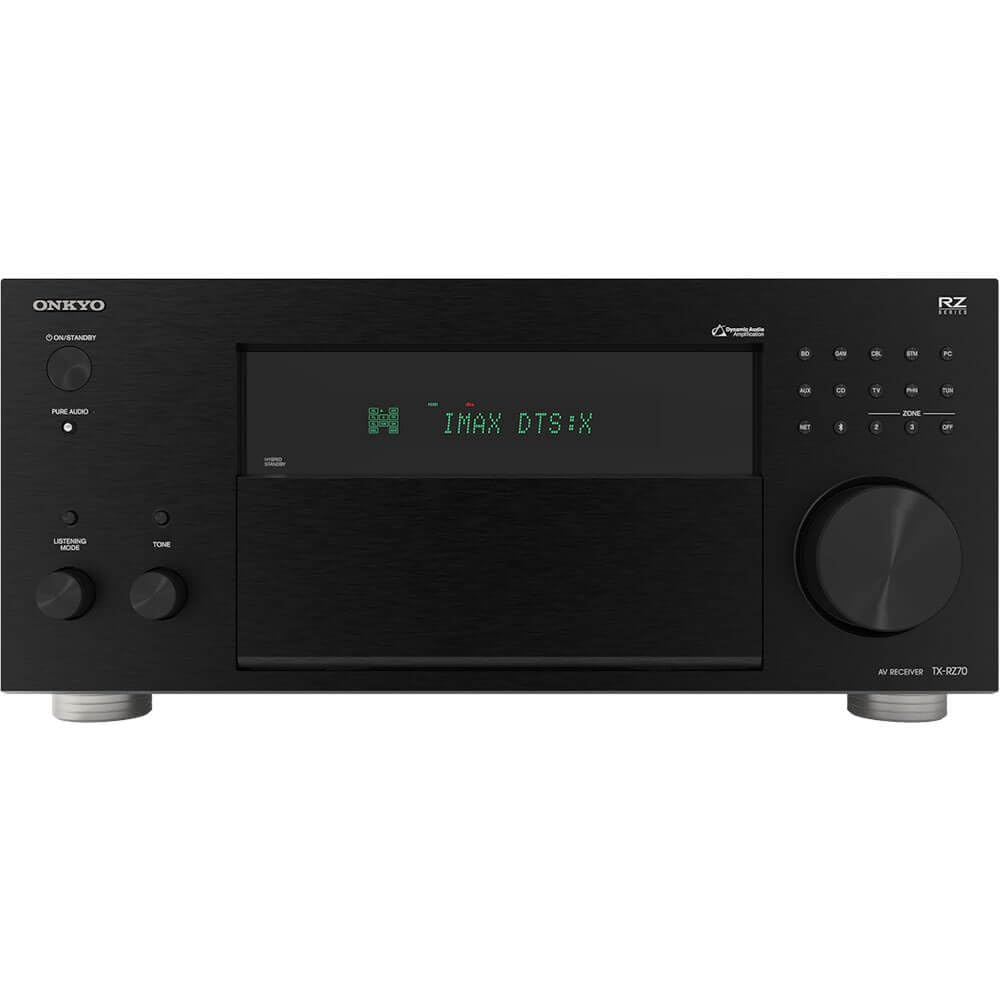
The Onkyo TX-RZ70 is a true reference-grade receiver designed for enthusiasts building a dedicated 7.2.4 or 5.2.6 Atmos system. It pumps 140 watts per channel into 11 channels, with independent ESS Sabre DACs on every output for exceptionally clean signal processing. The inclusion of Dirac Live Full Bandwidth room correction at no extra cost is a major value advantage over competing high-end units that charge extra for similar software.
All HDMI 2.1 ports handle 8K/60 and 4K/120 with VRR and eARC, and the unit features dual 12V triggers for seamless integration with external power amplifiers. The TX-RZ70 is THX Certified and supports IMAX Enhanced mode, which adjusts the aspect ratio and audio to match filmmaker intent. Owners upgrading from mid-tier receivers consistently describe the sound as “punchy” and “dynamic,” with Dirac Live tightening subwoofer response noticeably.
The main drawback is sheer physical size — this receiver requires a spacious AV rack or cabinet. A few users note that Zone 2 control via the app is clunky compared to the primary zone. If you need eleven channels of amplification with future-proof room correction, the TX-RZ70 delivers performance that rivals separates costing much more.
Why it’s great
- 11 channels with ESS Sabre DACs
- Full Dirac Live included, not an add-on
- IMAX Enhanced and THX Certified
Good to know
- Extremely large and heavy for a cabinet
- Zone 2 control works poorly
- Remote feels cheap for this price tier
5. Sony STRAZ5000ES Premium ES 11.2 CH Receiver

The Sony STRAZ5000ES is the flagship of Sony’s ES series, engineered to deliver a truly immersive audio experience with 360 Spatial Sound Mapping. This proprietary technology uses object-based audio processing to create phantom speakers, making a 5.1.2 system sound like a 7.1.4 layout. The effect is genuinely impressive for movies and games, enveloping the listener in a seamless sound bubble that traditional setups cannot match.
With 130 watts per channel across 11.2 channels, the STRAZ5000ES includes Digital Cinema Auto Calibration IX, which measures speaker distances and adjusts the sound field. The receiver supports Dolby Atmos, DTS:X, and IMAX Enhanced, and features Chromecast built-in, AirPlay 2, and Works with Sonos certification. The remote has backlit buttons and the front panel features a magnetic cover for a clean, minimalist look.
Owners note the unit runs hot and recommend adding a AC Infinity Aircom T10 cooling fan for long sessions. It also lacks HDR10+ support, which affects compatibility with some streaming content. For buyers who prioritize the unique spatial audio processing and already have a well-ventilated rack, the STRAZ5000ES is a compelling choice.
Why it’s great
- 360 Spatial Sound Mapping creates phantom height channels
- Backlit remote and magnetic front cover
- Supports Chromecast, AirPlay 2, and Sonos
Good to know
- Runs very hot, needs active cooling
- No HDR10+ support
- Auto calibration can fail with non-standard layouts
6. Denon AVR-S770H 7.2 Ch Home Theater Receiver

The Denon AVR-S770H is a well-rounded 7.2-channel receiver that brings 75 watts per channel and full HDMI 2.1 support to a mid-range price. It supports Dolby Atmos, DTS:X, Dolby Height Virtualization, and DTS Virtual:X, allowing you to simulate overhead effects even without ceiling speakers. The HEOS platform enables multi-room streaming to other Denon devices, and the receiver works with Amazon Alexa for hands-free control.
On the video side, the S770H passes 8K/60 and 4K/120 signals, supports HDR10+, Dolby Vision, and Dynamic HDR, and includes VRR, ALLM, and QFT for gaming. The Audyssey MultEQ room correction handles basic calibration well, and the setup assistant guides you through speaker configuration. Owners are impressed with the warm, detailed sound signature and call it a significant upgrade from entry-level models.
Some users have reported firmware-related issues, including random volume drops and intermittent HDMI handshake failures. These appear to affect a minority of units and can often be resolved by updating the firmware. The menu system is also dense and takes time to learn. For its feature set, the S770H remains a strong all-around choice for most home theaters.
Why it’s great
- Full HDMI 2.1 with gaming features
- HEOS multi-room and Alexa compatible
- Virtual height processing for rooms without ceiling speakers
Good to know
- Occasional firmware bugs reported
- Menu system is complex
- Only 75W per channel
7. Sony STRAZ1000ES Premium ES 7.2 CH Receiver

The Sony STRAZ1000ES is a 7.2-channel receiver that brings Sony’s ES series craftsmanship and 360 Spatial Sound Mapping to a smaller chassis. With 100 watts per channel, it offers more power than many 7.2 competitors, and the spatial sound processing creates a convincing sense of height and envelopment even in a 5.1.2 configuration. The Digital Cinema Auto Calibration IX handles automatic setup admirably.
Connectivity includes six HDMI 2.1 inputs (8K and 4K/120) with two outputs, Chromecast built-in, Apple AirPlay 2, and Spotify Connect. The receiver integrates with Sonos systems and supports Google Assistant for voice control. The build quality is excellent with a sturdy metal chassis and a front cover plate for a clean appearance when components are not in use.
Like its bigger brother, the STRAZ1000ES runs hot and lacks HDR10+ support. Owners note the Neural X upmixing does a good job with stereo music, but the auto calibration can struggle if you use height channels without rear surrounds connected. For a seven-channel system with premium Sony processing, it delivers outstanding clarity and soundstage.
Why it’s great
- 360 Spatial Sound Mapping at a 7.2 price point
- 100W per channel provides good headroom
- Excellent DAC quality for music
Good to know
- Runs hot, needs ventilation
- No HDR10+ or QMS support
- Auto calibration has quirks with non-standard layouts
8. JBL MA710 7.2 Channel 8K AV Receiver

The JBL MA710 stands out in the mid-range by offering a moving magnet phono input for turntable connectivity, a rare feature at this price point. It delivers 110 watts per channel across seven channels and supports Dolby Atmos and DTS:X for 5.1.2 or 7.1 setups. The design is notably shallow, fitting easily into media consoles with limited depth. With 6 HDMI inputs (including eARC), it covers modern gaming and streaming needs.
Wireless streaming is covered via Bluetooth, Apple AirPlay 2, and Google Chromecast built-in, giving you flexibility across ecosystems. The on-screen setup menu is straightforward, and owners report that once the mandatory firmware update is completed, HDMI ARC works reliably for TV audio passthrough. The MA710 drives speakers with authority, and users with Klipsch and Polk towers note the sound is clean and punchy.
The remote is not backlit, which is a significant oversight for a receiver used in dark home theaters. Some users also report that the MA710 does not mix down DTS-HD Master Audio to 2.1, making it unsuitable for stereo-only setups that play Blu-ray discs. If you need a phono input in a slim form factor, this is a unique option, but verify your audio source compatibility first.
Why it’s great
- Built-in phono input for turntables
- Shallow chassis fits many media consoles
- AirPlay 2 and Chromecast built-in
Good to know
- Remote lacks backlighting
- Does not mix DTS-HD MA to 2.1
- Mandatory firmware update needed before use
9. Yamaha RX-V6A 7.2-Channel AV Receiver

The Yamaha RX-V6A is a dependable 7.2-channel receiver that has been a popular choice for shoppers wanting HDMI 2.1 without breaking the bank. It includes three 8K/60 HDMI inputs and four 4K/120 inputs, covering all modern gaming consoles and streaming devices. The MusicCast platform handles multi-room audio well, and voice control works with Alexa, Google Assistant, and Siri via AirPlay 2.
Audio support includes Dolby Atmos and DTS:X, plus Dolby Atmos Height Virtualization for rooms without ceiling speakers. The YPAO room calibration is simple and effective, and owners upgrading from older Yamaha units report a noticeable improvement in dialogue clarity and dynamic range. The setup process is familiar to Yamaha users and takes about 20-30 minutes.
Some users find the on-screen menus dated and note a steep learning curve for advanced features like zone management. A few also report that the receiver does not auto-power on with the TV via eARC, requiring you to press the remote. Despite these quirks, the RX-V6A offers solid performance and reliability at its price point.
Why it’s great
- Three 8K HDMI inputs for future-proofing
- MusicCast multi-room is robust and reliable
- Dual subwoofer pre-outs included
Good to know
- On-screen menus feel dated
- Does not auto-turn on with TV via eARC
- Steep learning curve for advanced features
10. Marantz NR1510 UHD AV Receiver – Slim 5.2 Channel

The Marantz NR1510 is a slim 5.2-channel receiver that stands just 4.1 inches tall, making it the best option for shallow media cabinets or shelf setups. At 50 watts per channel, it is not built for massive rooms or inefficient speakers, but it delivers a clean, detailed sound signature for moderate living spaces. It includes a moving magnet phono input for vinyl, HEOS multi-room streaming, and support for Dolby TrueHD and DTS-HD Master Audio.
Video support covers 4K/60, HDR10, Dolby Vision, HLG, and eARC — sufficient for streaming and Blu-ray but not for 4K/120 gaming. The setup assistant walks through speaker configuration step by step, and the Audyssey MultEQ calibration works effectively for basic room correction. Owners praise the build quality and the ability to drive Klipsch and Polk bookshelf speakers with authority.
The receiver runs warm and needs space for ventilation. It also does not support 8K or 4K/120, and there are only four HDMI inputs, which can feel limiting. If you are building a compact 5.1 system and do not game, the NR1510 offers excellent sound quality in a space-saving package.
Why it’s great
- Ultra-slim design for tight spaces
- Phono input for turntables
- HEOS multi-room streaming capable
Good to know
- Only 50W per channel; limited to efficient speakers
- No 4K/120 or 8K support
- Runs warm, needs good ventilation
11. Pioneer VSX-935 7.2 Channel Surround Sound Receiver
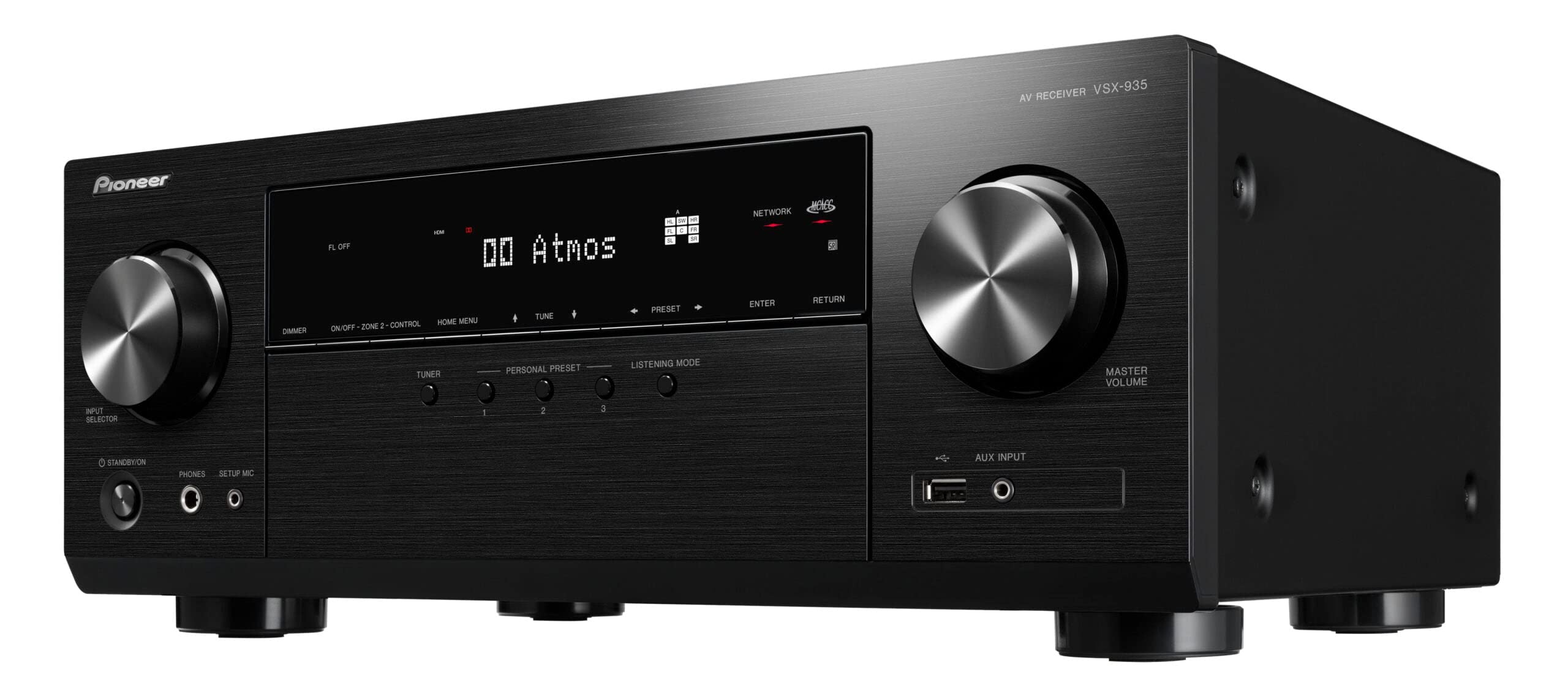
The Pioneer VSX-935 is an entry-level 7.2-channel receiver that brings HDMI 2.1 with 8K passthrough to a budget-friendly price. It supports Dolby Atmos and DTS:X with Height Virtualization, meaning you can simulate overhead effects without mounting ceiling speakers. The unit includes built-in Chromecast, AirPlay 2, and Bluetooth for wireless audio streaming.
Owners report that sound quality is crisp and clear, especially for movies, with dual-zone output and an RF remote that works through walls. The on-screen display features a dimmer for dark room use. The MCACC room calibration system does a decent job of balancing speaker levels for a basic setup. It is a functional receiver that covers all the essential modern features.
The main complaints revolve around reliability: some users received defective units dead on arrival, and a few report Bluetooth connectivity issues. The interface is also dated compared to Denon or Sony offerings, and the room correction is basic. If you need a seven-channel receiver with HDMI 2.1 at the lowest possible entry point, the VSX-935 is a functional choice, but expect some compromises in polish.
Why it’s great
- HDMI 2.1 with 8K passthrough at a low price
- Dolby Atmos Height Virtualization included
- RF remote works through cabinets
Good to know
- Some units arrive DOA or with display failures
- Bluetooth connectivity is unreliable according to some users
- Room correction and interface feel basic
FAQ
How many channels do I need for a proper Dolby Atmos setup?
Do I need an 8K receiver if I only have a 4K TV?
What does THX certification mean for an AV receiver?
Can I use a powered subwoofer with any AV receiver?
Why does my receiver need a firmware update right out of the box?
Final Thoughts: The Verdict
For most users, the audio av receiver winner is the Onkyo TX-RZ50 because it delivers premium Dirac Live room correction, pre-outs for all channels, and THX certification at a price that undercuts similarly equipped competitors. If you want a compact 5.2 system for a small living room, grab the Marantz NR1510. And for a massive 11.2 channel reference system with ESS Sabre DACs and IMAX Enhanced, nothing beats the Onkyo TX-RZ70.