
Our readers keep the lights on and the weekend projects moving. As an Amazon Associate, I earn from qualifying purchases.
Whether you are recording a lecture, capturing dialogue for a short film, or laying down a podcast episode, the gap between usable audio and ruined audio is often a single bad level setting. An audio recorder microphone that delivers clean, distortion-free sound without constant monitoring is the difference between a professional result and a frustrating re-shoot.
I’m Rikta — the co-founder and writer behind FitlyFast. I’ve spent countless hours analyzing recording technology, from entry-level dictation devices to professional field recorders, to understand exactly which specs separate a great buy from a mediocre one.
This guide focuses on the best audio recorder microphone options available today, covering budget-friendly dictation tools to premium 32-bit float field recorders with XLR inputs.
How To Choose The Best Audio Recorder Microphone
Choosing the right recorder comes down to understanding the environments you will record in and the level of control you need. A journalist in a quiet office has very different requirements than a filmmaker capturing dialogue on a windy street or a musician recording a rehearsal.
Recording Technology: Bit Depth and Sample Rate
Standard recorders use 16-bit or 24-bit audio, which requires careful gain adjustment to avoid clipping. The newer 32-bit float format captures an extremely wide dynamic range, meaning you can record a whisper and a shout in the same take without distortion, and fix the levels in post-production. Look for 96kHz sample rate support if you need high-fidelity sound for music or sound design.
Microphone Configuration and Connectivity
Built-in microphones are convenient for interviews and lectures. X/Y stereo mics provide a natural stereo image, while shotgun mics offer high directionality for isolating a subject. For professional setups, XLR inputs allow you to attach external microphones, such as lavaliers or industry-standard shotguns. USB-C connectivity is valuable for using the device as an audio interface with a computer.
Storage, Battery Life, and Build
Internal memory is handy for immediate use, while a microSD card slot provides expandable storage. Battery life varies drastically — from 10 hours on feature-rich models to over 900 hours on simple dictation recorders. Consider the form factor: pocket-sized devices are great for discreet capture, while larger units with larger microphones and XLR inputs offer better audio and durability.
Quick Comparison
On smaller screens, swipe sideways to see the full table.
| Model | Category | Best For | Key Spec | Amazon |
|---|---|---|---|---|
| Zoom H4 Essential | Premium Handheld | Musicians & Podcasters | 32-bit float / 192 kHz | Amazon |
| Sennheiser MKE 600 | Shotgun Mic | Film & Video Dialogue | Battery or Phantom Power | Amazon |
| OM System LS-P5 | Premium Compact | Lectures & Field Recording | 96 kHz / 24-bit + Bluetooth | Amazon |
| Zoom H1 XLR | Entry XLR Recorder | Interviews & Podcasting | 32-bit float / 2 XLR Inputs | Amazon |
| TASCAM DR-05XP | Mid-Range Field Recorder | Music & Audio-for-Video | 32-bit float / USB-C | Amazon |
| OM System DM-720 | Voice Recorder | Meetings & Dictation | 985 Hours Battery Life | Amazon |
| Olympus WS-883 | Budget Voice Recorder | Simple Voice Capture | 8GB Internal + 32GB microSD | Amazon |
In‑Depth Reviews
1. Zoom H4 Essential Handheld Recorder

The Zoom H4 Essential is a powerhouse for serious audio work. Its largest-in-class 19.4mm X/Y microphone capsule captures a wide dynamic range with remarkable clarity, and the 32-bit float recording ensures you never waste a take due to clipping. This is the recorder you reach for when the audio matters most.
With two XLR/TRS combo inputs and the ability to record up to four tracks simultaneously at 192 kHz, this device functions as a portable studio. The dedicated gain knobs give you hands-on level control during live sessions—a feature invaluable for musicians and podcasters who need precision without menu diving.
Battery life is rated at up to 20 hours, and the unit can be powered via a USB power bank for extended sessions. While it is too large for a pants pocket, its lightweight design (243 grams) makes it easy to carry in a bag. The included windscreen is a necessary addition, as the onboard mics are sensitive to wind noise.
Why it’s great
- 32-bit float eliminates gain-staging anxiety entirely
- Four-track simultaneous recording at 192 kHz
- Dual XLR/TRS inputs for professional external mics
Good to know
- Bulkier than pocket-sized voice recorders
- Onboard mics susceptible to wind noise without the windscreen
2. Sennheiser MKE 600

The Sennheiser MKE 600 is a professional-grade shotgun microphone that delivers audio quality rivaling units costing three times as much. Its high directivity picks up sound from directly in front of the mic while effectively rejecting noise from the sides and rear—essential for dialogue capture on a film set or a noisy environment.
This microphone is incredibly versatile, offering both phantom power (48V) and battery operation via a single AA battery that lasts up to 150 hours. The switchable low-cut filter minimizes wind and handling noise, and the included shock mount and foam windshield get you started immediately. It is an ideal upgrade for camera-mounted recording or boom work.
Users consistently praise its smooth, full voice reproduction with less sibilance than competitors like the MKH 416. The aluminum build feels solid without being overly heavy. Keep in mind that this is a microphone only—you will need a recorder or camera with an XLR input to capture the audio.
Why it’s great
- Professional audio quality at a mid-range price point
- Ultra-long battery life (150+ hours on a single AA)
- Excellent off-axis noise rejection for focused dialogue capture
Good to know
- Requires an external recorder or camera with XLR input
- Not a standalone recorder; it is a microphone only
3. OM System LS-P5

The OM System LS-P5 is a remarkably compact recorder that packs a surprising amount of capability. Its TRESMIC three-microphone system offers adjustable directionality, allowing you to capture a wide ambiance or focus on a single speaker for lectures. The 96 kHz/24-bit hi-res audio recording (WAV/FLAC) ensures pristine sound quality in a device the size of a pack of gum.
Bluetooth connectivity is a standout feature here, enabling wireless remote control via the OM System app. You can start and stop recording, add index marks, and even monitor audio live from across the room—ideal for discreet recording or operating the device while it is placed near a speaker. It also functions as a USB audio interface for streaming and podcasting.
Battery life is solid, with the included NiMH rechargeables providing ample runtime. Users note the microphone is extremely sensitive, picking up distant sounds clearly. One caveat: high-resolution audio is not transmitted via Bluetooth, so you will need a wired connection for monitoring at the full bit depth.
Why it’s great
- Extremely pocketable with professional 96kHz/24-bit recording
- Bluetooth remote control and live monitoring
- Adjustable TRESMIC system for different recording scenarios
Good to know
- High-resolution audio cannot be monitored wirelessly via Bluetooth
- Micro-USB charging, not USB-C
4. Zoom H1 XLR

The Zoom H1 XLR brings 32-bit float recording and dual XLR/TRS inputs to an entry-level price point, making professional-grade audio accessible. Unlike older budget recorders, this device captures without any fear of clipping, saving you hours of retakes. The stereo 3.5mm input adds flexibility for external mics or line-level sources.
The OLED waveform display provides clear visual feedback on your levels, which is especially helpful when setting up in challenging environments. It supports SDXC cards up to 1TB, giving you plenty of space for long interview sessions or multi-day field recording trips. The USB-C port allows for fast file transfer and use as an audio interface.
Build quality is light plastic, which keeps the weight down but means it is less rugged than metal-bodied recorders. Some users recommend a protective case or warranty for peace of mind. The interface is intuitive, but checking that the record button is properly engaged requires attention—a common point raised by experienced users.
Why it’s great
- 32-bit float recording at an exceptional value
- Two XLR/TRS combo inputs for versatile micing
- OLED waveform display for precise level monitoring
Good to know
- Plastic housing feels less durable than premium models
- Requires careful attention to confirm recording has started
5. TASCAM DR-05XP

The TASCAM DR-05XP is a straightforward, reliable field recorder that excels at capturing clean audio for music, video, and podcasting. Its omnidirectional condenser microphones can handle sound pressure levels up to 125dB SPL, making it suitable for loud environments like live music or crowded rooms. The 32-bit float mode means you can set gain and forget it.
With flexible recording options including 32-bit float, 24-bit, and 16-bit at up to 96kHz, this recorder adapts to various production pipelines. The 2-in/2-out USB-C audio interface functionality lets you record directly to a computer, acting as a simple interface for software like Audacity or Logic. Battery life reaches up to 17.5 hours on two AA alkalines.
User feedback is generally positive, with praise for its intuitive operation and build quality that feels solid without being heavy. One notable criticism is that the line input can be overly sensitive to certain voltages, requiring a low pre-amp level to avoid distortion. For most users, using the built-in mics or a standard external mic via the 3.5mm jack will be the primary workflow.
Why it’s great
- 32-bit float and 96kHz support in a compact form
- High 125dB SPL handling for loud sources
- USB-C audio interface for direct computer recording
Good to know
- Line input sensitivity may require careful matching with external pre-amps
- SD card and batteries not included
6. OM System DM-720
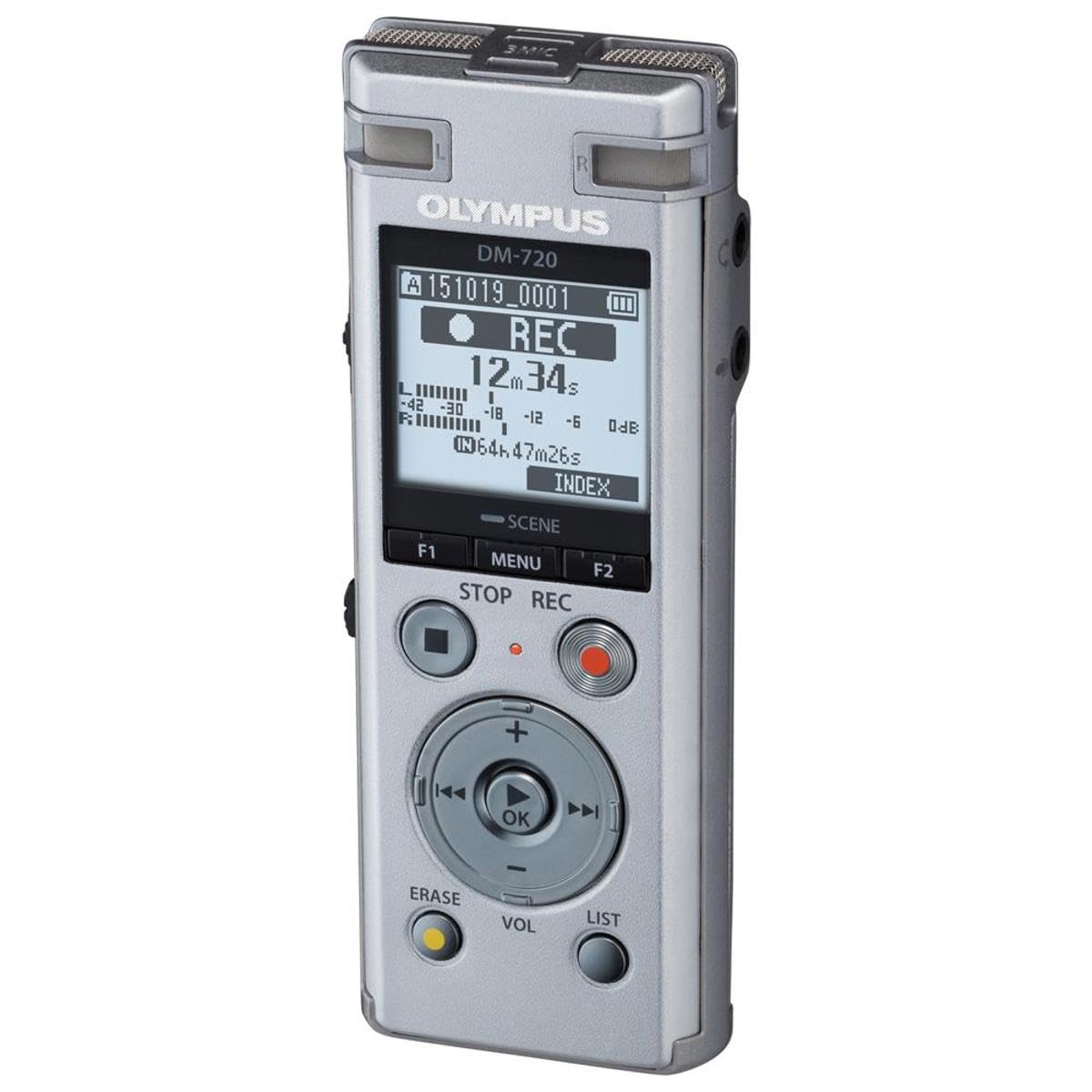
The OM System DM-720 is a dedicated voice recorder built for clarity in meetings, lectures, and transcription. Its TRESMIC three-microphone system intelligently adjusts sensitivity to capture a wide sound field, and the low-cut filter removes rumble from HVAC systems or handling noise below 300 Hz. This makes it a superior choice over basic dictation devices for noisy room environments.
Battery life is staggering at up to 985 hours (recording in MP3 mode), meaning you can leave it in your bag for months without worry. The built-in USB connector allows for direct file transfer without a cable, and transcription mode integrates seamlessly with voice-to-text software. It is powered by a single AAA battery, keeping the weight down to a mere 0.16 pounds.
Users coming from older Olympus recorders will find the interface familiar but note a slightly slower startup time. The plastic battery cover feels a bit flimsy, and the device is limited to SDHC cards up to 32GB. For its intended purpose—clear, long-duration voice recording—it performs excellently, especially in challenging acoustic environments where cheaper recorders introduce hiss.
Why it’s great
- Exceptional battery life for long meetings and lectures
- TRESMIC system reduces background noise effectively
- Built-in USB for easy file transfer
Good to know
- Limited to 32GB SDHC cards
- Plastic battery cover feels less robust
7. Olympus WS-883

The Olympus WS-883 is a no-frills digital voice recorder that delivers exactly what most people need: reliable, clear voice capture with minimal complexity. It features 8GB of internal memory plus a microSD slot for up to 32GB of additional storage, and can record up to 2080 hours in its lowest quality MP3 mode. The true stereo microphones provide decent spatial separation for meeting recordings.
Operation is simple with a one-switch, two-button interface that makes it ideal for elderly users or anyone who does not want to learn a complex menu. The USB-A connector slides out directly from the device for charging and file transfer, eliminating the need for a cable. It uses two AAA batteries (NiMH rechargeable supported) with a battery life of up to 68 hours.
While the recording quality is good for voice at its price tier, it lacks the fidelity of more expensive recorders. Users note that the auto power-off feature cannot be disabled, which may interrupt recording if you forget to press a button periodically. For simple dictation, classroom notes, or quick interviews, it gets the job done without fuss.
Why it’s great
- Straightforward operation with simple interface
- 8GB internal plus expandable microSD storage
- Built-in USB-A connector for charging and data transfer
Good to know
- Auto power-off cannot be disabled, may cut recordings short
- Audio fidelity is lower than premium PCM recorders
FAQ
What is the difference between 24-bit and 32-bit float recording?
Do I need XLR inputs for a voice recorder?
Can I use these recorders as a microphone for my computer?
Final Thoughts: The Verdict
For most users, the audio recorder microphone winner is the Zoom H4 Essential because its 32-bit float recording, four-track capability, and dual XLR inputs cover nearly every scenario from field recording to podcast production. If you want a compact recorder for lectures with Bluetooth control, grab the OM System LS-P5. And for professional dialogue capture in film and video, nothing beats the Sennheiser MKE 600.