
Our readers keep the lights on and the weekend projects moving. As an Amazon Associate, I earn from qualifying purchases.
The pursuit of an audiophile-grade Bluetooth speaker is a hunt for vanishingly small compromises. You want the convenience of wireless streaming without the sonic veil, the portable freedom without the boxy, phase-coherence-killing cabinet resonance that plagues most portable designs. The real challenge is finding a speaker that delivers genuine high-fidelity traits—respectable transient response, a flat frequency response curve, and a soundstage that doesn’t collapse into a mono point source—while still operating as a practical, everyday Bluetooth device.
I’m Rikta — the co-founder and writer behind FitlyFast. My analysis for this guide required cross-referencing driver topologies, amplifier wattage claims against measured THD figures, and the real-world Bluetooth codec support across nine uniquely positioned products to separate the genuinely revealing from the merely loud.
Whether you’re after a desktop near-field monitor that can go wireless or a party-grade speaker that doesn’t embarrass your lossless Tidal stream, understanding the trade-offs inside the driver array and the DAC matters. Let’s dissect the current landscape for the best audiophile bluetooth speaker.
How To Choose The Best Audiophile Bluetooth Speaker
Choosing a Bluetooth speaker that satisfies audiophile sensibilities means shifting your focus from raw volume output to signal integrity and driver architecture. You are essentially hunting for a product that minimizes the inherent compromises of Bluetooth while maximizing the physical fidelity of the speaker cabinet.
Driver Configuration is Paramount
A single full-range driver is a mass-market compromise. For high-fidelity, you must look for a multi-way design: a dedicated tweeter for high-frequency air and detail, a midrange driver for vocal presence, and a separate woofer for controlled, non-bloated bass. A sealed or ported cabinet with a proper crossover network defines whether the sound is a wall of noise or a layered, spatial experience.
Codec Support and Digital-to-Analog Conversion
Standard SBC and AAC codecs are lossy and introduce artifacts. An audiophile Bluetooth speaker must support aptX Adaptive, aptX HD, or LDAC to preserve high-resolution audio. The internal DAC chip matters more than the amplifier wattage; a clean DAC feeding a modest amp will always outperform a cheap amplifier driven by a noisy digital signal.
Cabinet Construction and Acoustic Tuning
The speaker enclosure is the silent partner to the drivers. Braced MDF or thick aluminum cabinets are stiff and reduce unwanted sympathetic vibrations that muddy the midrange. Lightweight, hollow plastic shells will always introduce a color to the sound. Look for acoustic-grade wood, high-density composites, or rigid metal chassis for the most neutral, revealing playback.
Quick Comparison
On smaller screens, swipe sideways to see the full table.
| Model | Category | Best For | Key Spec | Amazon |
|---|---|---|---|---|
| Bowers & Wilkins Zeppelin Pro | Premium | Hi-fi desktop & living room | 5-way: 2x 1″ titanium tweeters | Amazon |
| JBL Authentics 500 | Premium | Room-filling Dolby Atmos | 3.1 ch, 270W, 3x tweeters | Amazon |
| Edifier S1000W | Mid-Range | Versatile bookshelf system | 120W RMS, 5.5″ woofers | Amazon |
| Audioengine A5+ Wireless | Mid-Range | Vinyl & desktop monitoring | 150W, 5″ Kevlar woofers | Amazon |
| Marshall Woburn III | Mid-Range | Home theater & record players | 90W sub + 4x15W, 35Hz–20kHz | Amazon |
| JBL Boombox 4 | Mid-Range | Outdoor parties & deep bass | 200W RMS, dual woofers | Amazon |
| Sonos Play | Mid-Range | WiFi multi-room integration | 24-hour battery, stereo pairing | Amazon |
| Bose SoundLink Plus | Mid-Range | Portable outdoor use | IP67, 4500mAh battery | Amazon |
| KEF Muo | Budget | Near-field listening | Bluetooth 5.4, aptX Adaptive | Amazon |
In‑Depth Reviews
1. Bowers & Wilkins Zeppelin Pro Edition
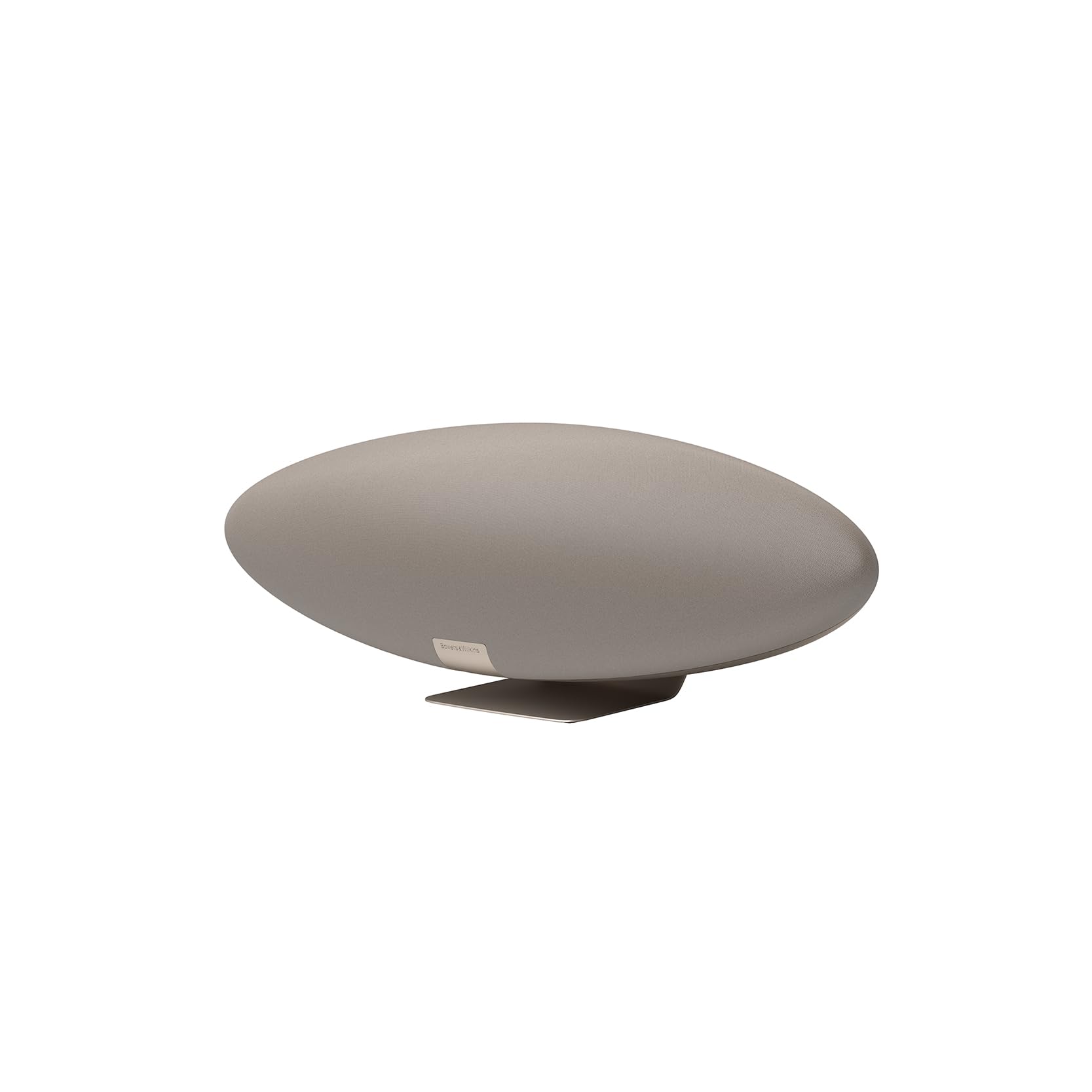
The Zeppelin Pro Edition is the single-unit solution for the discerning listener who demands real hi-fi performance without a multi-component stack. Its five-driver array includes two 1-inch Titanium Dome tweeters derived from the acclaimed 600 Series, two 3.5-inch midrange drivers, and a dedicated 6-inch subwoofer, all housed in a sculpted enclosure that serves as a statement piece. The frequency response extends from 35Hz to 24kHz, giving it genuine sub-bass extension and airy top-end sparkle.
Streaming is handled via AirPlay 2 and Spotify Connect, and the Bowers & Wilkins Music app provides access to Tidal and Qobuz for high-res playback. The built-in DAC is clean enough that the Zeppelin reveals mastering flaws and studio depth equally, making it suitable as a primary living room system. It operates on mains power, so wireless convenience comes without the battery-life trade-off.
Where the Zeppelin truly separates itself is in soundstage width and instrument separation. Unlike mono portable speakers, the stereo image here is palpable, with distinct left-right placement across the listening position. The driver complement crosses over seamlessly, so vocals feel present without being shouty. This is the speaker for anyone who has outgrown soundbars and wants a single elegant box that actually sounds like a proper hi-fi setup.
Why it’s great
- True three-way stereo driver topology with titanium tweeters
- Measured frequency response from 35Hz–24kHz
- Furniture-grade design and build quality
Good to know
- AirPlay connection reliability has occasional hiccups
- Requires mains power, not portable
2. JBL Authentics 500

The JBL Authentics 500 is a retro-modern powerhouse that leverages a 3.1-channel configuration with three 1-inch tweeters, three 2.75-inch woofers, and a dedicated 6.5-inch downward-firing subwoofer. The total system power of 270W gives it headroom that few all-in-one Bluetooth speakers approach, and its Dolby Atmos decoding adds a height dimension that conventional stereo cannot replicate. The cabinet is wrapped in a leather-like enclosure with a cast-aluminum handle, bringing a vintage studio-monitor aesthetic into the living room.
Connectivity is comprehensive: built-in Wi-Fi with AirPlay and Qplay, dual voice assistants (Alexa and Google Assistant), and Bluetooth. The automatic self-tuning feature calibrates the EQ to the room each time the speaker is powered on, compensating for wall reflections and placement issues that usually degrade speaker performance. This tuning intelligence is what separates it from a dumb power amplifier—it genuinely adapts to your environment.
Sonically, the Authentics 500 produces a V-shaped profile with deep, controlled bass that doesn’t overwhelm the midrange. The instrument separation is notably distinct; acoustic guitar strums and cymbal crashes maintain their edges even at high volume. The Dolby Atmos upmixing adds a sense of vertical space that flat-sounding speakers lack. For those who want a loud, room-shaking experience with modern streaming flexibility, this is the choice.
Why it’s great
- Automatic self-tuning for room acoustics
- Dolby Atmos height processing
- 270W total system power with low distortion
Good to know
- App setup can be finicky with dual assistants
- Exposed bass cone is a durability concern
3. Edifier S1000W WiFi

The Edifier S1000W delivers a genuine bookshelf speaker experience with the convenience of Wi-Fi and Bluetooth connectivity, bridging the gap between passive hi-fi and casual streaming. Each cabinet houses a 5.5-inch woofer and a dedicated tweeter, driven by a total of 120W RMS of built-in Class D amplification. The solid wood side panels and medium-density fiberboard (MDF) baffle provide a resonant-free enclosure that supports clean bass reproduction down to 37Hz at -3dB.
This speaker supports AirPlay 2, Spotify Connect, and Tidal Connect, alongside Bluetooth 5.0 with aptX. The Wi-Fi streaming capability means you can send high-resolution audio (up to 24-bit/192kHz) without the compression of Bluetooth. Multiple connection inputs—optical, coaxial, RCA, and AUX—make it compatible with turntables, televisions, and game consoles, giving it a versatility that few wireless speakers in this tier can match.
The sound signature is uncolored and natural, prioritizing accuracy over exaggerated bass. Instrument timbre is realistic, with piano and strings retaining their harmonic texture. The stereo separation is wide and deep, especially when the speakers are placed 5–8 feet apart. For the listener who wants a wired-quality system that can also stream from a phone, the S1000W offers performance that competes with passive speakers costing significantly more before amplification.
Why it’s great
- Real wood side panels reduce cabinet resonance
- Full 24-bit/192kHz Wi-Fi streaming
- Versatile connectivity for all sources
Good to know
- Speaker pair is heavy at roughly 45 lbs total
- Minor tweeter hiss within inches of the driver
4. Audioengine A5+ Wireless

The Audioengine A5+ Wireless is a refined bookshelf system designed with analog purity in mind. Each speaker pair delivers 150 watts of built-in power, driving a 5-inch Kevlar woofer and a 0.75-inch silk dome tweeter. The handcrafted, furniture-grade bamboo cabinet (or high-gloss finishes) is acoustically inert, reducing cabinet coloration that cheaper MDF boxes introduce. This is not a lifestyle speaker—it is a serious monitoring tool for music lovers, turntable enthusiasts, and desktop producers.
The Bluetooth implementation is secondary to the analog inputs. You get RCA and 3.5mm AUX inputs for connecting a turntable with a built-in preamp, a television, or a computer directly. The wireless connectivity is simple and app-free, but the true fidelity is unlocked via the wired path. The internal DAC and amplifier circuitry are clean enough that a lossless source sounds noticeably more dimensional than an SBC Bluetooth stream.
Sonically, the A5+ excels at vocal clarity and instrumental detail. The Kevlar woofers provide punchy, controlled bass that stays tight without spilling into the midrange. Silk dome tweeters handle high frequencies with a smoothness that avoids the brittle edge found in metal-dome designs. These speakers are best for near-field or medium-room listening, where their precise imaging and low distortion make them perfect for long critical sessions.
Why it’s great
- Acoustic-grade bamboo cabinet for low resonance
- 150W of clean amplification built-in
- Excellent for vinyl and desktop monitoring
Good to know
- Bluetooth quality degrades vs. wired connection
- Still requires speaker wire between left and right units
5. Marshall Woburn III

The Marshall Woburn III is a design icon that finally backs its rock-and-roll appearance with legitimate acoustic engineering. It features a 90-watt subwoofer paired with four 15-watt amplifiers driving two tweeters and two midrange drivers, all tuned for a wide soundstage. The frequency response spans 35Hz to 20kHz, with the subwoofer delivering deep, growly bass that remains defined rather than one-note. The HDMI eARC input is a standout feature, allowing direct TV connection with volume control via your television remote.
Bluetooth 5.2 ensures stable connectivity and future-proofing for upcoming codec features. The analog RCA and 3.5mm aux inputs accommodate turntables and other wired sources. The front-panel bass and treble controls, alongside the companion app, give you granular room-correction freedom. At mid-volume levels, the sound is rich and cinematic; at higher levels, the Woburn III fills large spaces without audible compression or distortion.
The weak point is that the bass can become boomy in untreated rooms. The built-in tone controls help tame this, but the Woburn III is not as balanced out-of-the-box as some competitors. However, its ability to produce immersive, room-filling sound for both music and movies, combined with its HDMI connectivity, makes it a luggable solution for those who want a single speaker to serve as a living room audio hub.
Why it’s great
- HDMI eARC for TV integration with remote control
- 90W subwoofer for deep, cinematic bass
- Bluetooth 5.2 with future-proof codec support
Good to know
- Bass can be boomy; requires EQ adjustment
- Mono soundstage by design, not true stereo separation
6. JBL Boombox 4
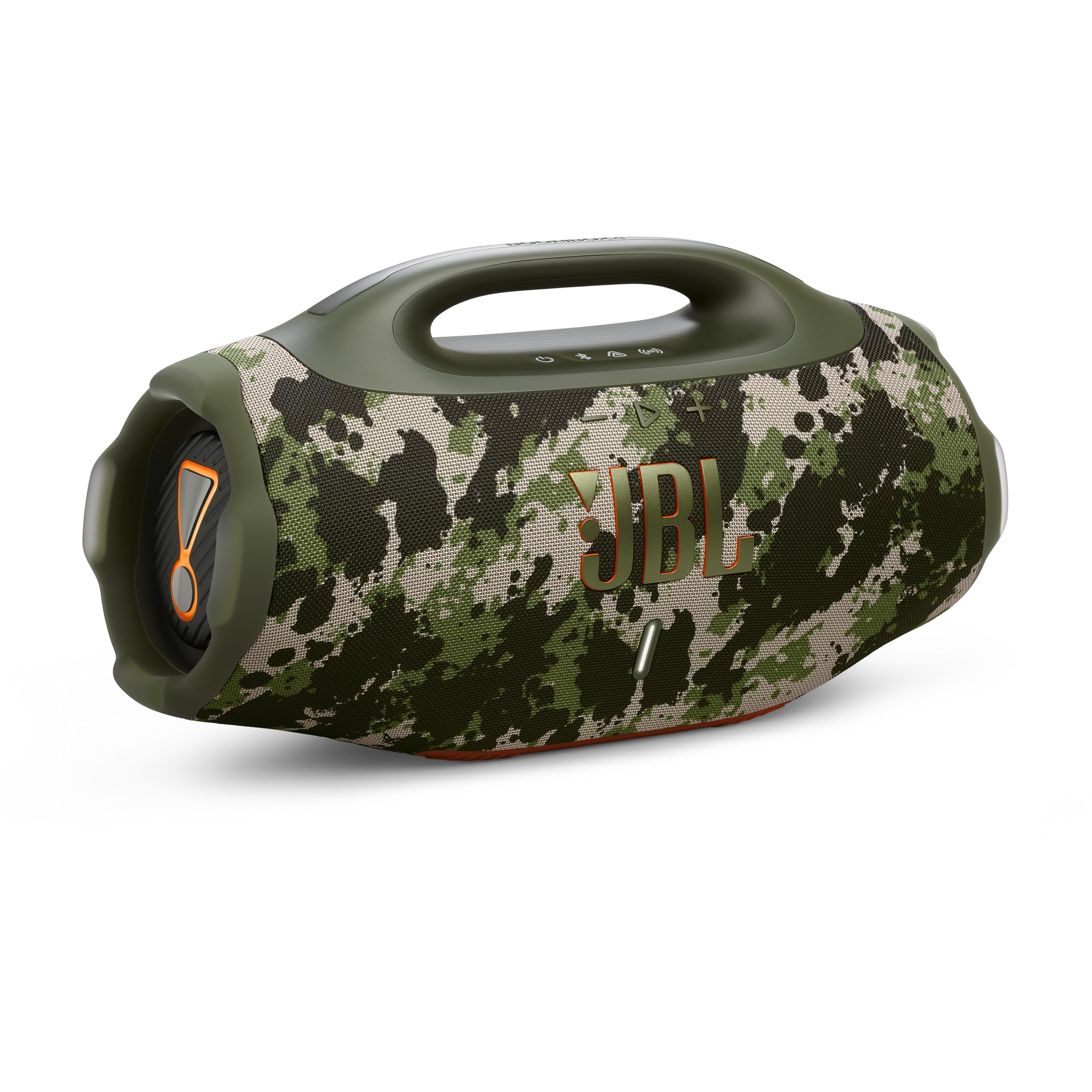
The JBL Boombox 4 is the portable champion of deep bass, redesigned to be lighter than its predecessor while packing 200W RMS through dual bigger woofers, dual tweeters, and three passive radiators. The AI Sound Boost feature monitors the music in real-time to maximize power output while holding distortion at bay. For outdoor events where low-end extension is the priority, this speaker delivers sub-40Hz bass that sustains on battery power, a feat most portable speakers cannot achieve.
The IP68 rating makes it waterproof and dustproof, and the battery life reaches up to 34 hours with the Playtime Boost feature. The Auracast connection standard allows effortless stereo pairing with a second Boombox 4 or linking with other Auracast-enabled JBL speakers for multi-speaker synchronization. The replaceable battery design addresses a longevity concern that plagues most sealed wireless speakers, allowing you to refresh the unit rather than replace it entirely.
The sound signature is undeniably bass-forward, with two distinct boost modes: Deep Bass for extended low-end and Punchy Bass for a tighter kick. The 2-way system is a slight disappointment compared to a 3-way configuration, but the sheer impact and clarity at high volumes make it the definitive outdoor party speaker. It is less suited for critical near-field listening but dominates any scenario requiring maximum SPL with wireless freedom.
Why it’s great
- Replaceable battery for long-term use
- Sub-40Hz bass extension on battery power
- IP68 waterproof and dustproof
Good to know
- No 3.5mm aux input; USB-C only for wired
- 2-way driver design limits midrange separation vs. 3-way
7. Sonos Play
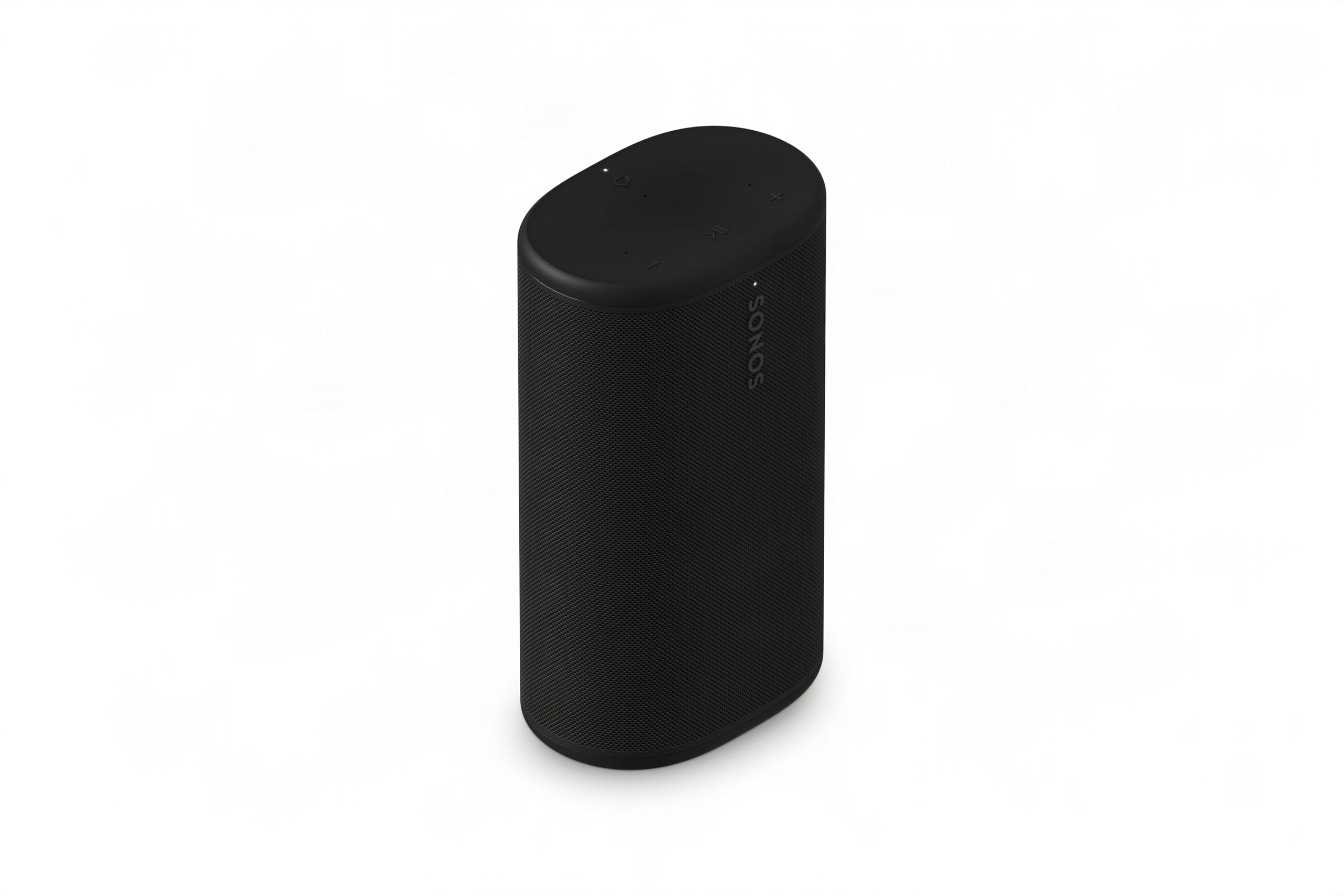
The Sonos Play is the bridge between a stationary home audio system and portable convenience, offering seriously big stereo sound and deep bass in a compact, IP67-rated package. It operates over Wi-Fi at home to integrate with your Sonos system for multi-room playback, then switches to Bluetooth when you take it outside. The included wireless charging base eliminates the need to fiddle with cables, and the 24-hour battery life makes it viable for all-day gatherings.
The acoustic design is tuned for a wide sweet spot, so the speaker sounds full regardless of room placement. When linked in stereo with a second Sonos Play, the soundstage expands dramatically, creating a true left-right separation that single-unit portable speakers cannot achieve. The optimized power management system extends battery longevity, and the drop-resistant durability ensures it survives the transition from patio to poolside.
The wood? It is all polycarbonate and fabric—not an audiophile material, but the tuning is clever enough to minimize resonance artifacts. The sound is more articulate than typical party speakers, with clear midrange and controlled bass. The main compromise is that to access the full Sonos ecosystem (Trueplay tuning, multi-room grouping), you must use the Sonos app, which adds a dependency that standalone Bluetooth speakers do not require.
Why it’s great
- Wi-Fi + Bluetooth hybrid for home and away
- Wireless charging base included
- Stereo pairing for wide soundstage
Good to know
- Polycarbonate cabinet not as inert as wood
- Heavy for a portable speaker at 2.9 lbs
8. Bose SoundLink Plus

The Bose SoundLink Plus is built for the listener who demands portable durability without sacrificing sonic nuance. It delivers bold, resonant audio with a surprisingly deep low-end for its compact form factor. The IP67 rating ensures it survives dust, submersion, and tumbles, and the 20-hour battery life (with a full charge in about 5 hours) supports extended outdoor sessions. The USB-C charge-out port lets you use the speaker as a backup power bank for your phone.
The Bose app includes a 3-band EQ (bass, mid, treble) for precision tuning, allowing you to dial in the sound signature to match your environment. SimpleSync technology lets you connect the portable speaker to a compatible Bose smart soundbar for whole-home audio. The build is heavy and solid, weighing over 3 lbs, but that mass contributes to a stable, non-resonant enclosure that supports clean sound reproduction even at high volumes.
The sound profile is Bose’s signature: rich mids, articulate highs, and bass that is impactful but not bloated. Instruments remain separated during complex passages, and vocals have a natural presence that stands above the mix. It does not have the ultra-deep low-end extension of a larger unit like the Boombox 4, but within its portable category, it offers the best balance of clarity, feature set, and ruggedness.
Why it’s great
- IP67 waterproof and dustproof
- 20-hour battery with USB-C charge-out
- 3-band EQ for custom tuning via Bose app
Good to know
- Weighs over 3 lbs, less convenient for backpacking
- Does not support high-res Bluetooth codecs
9. KEF Muo
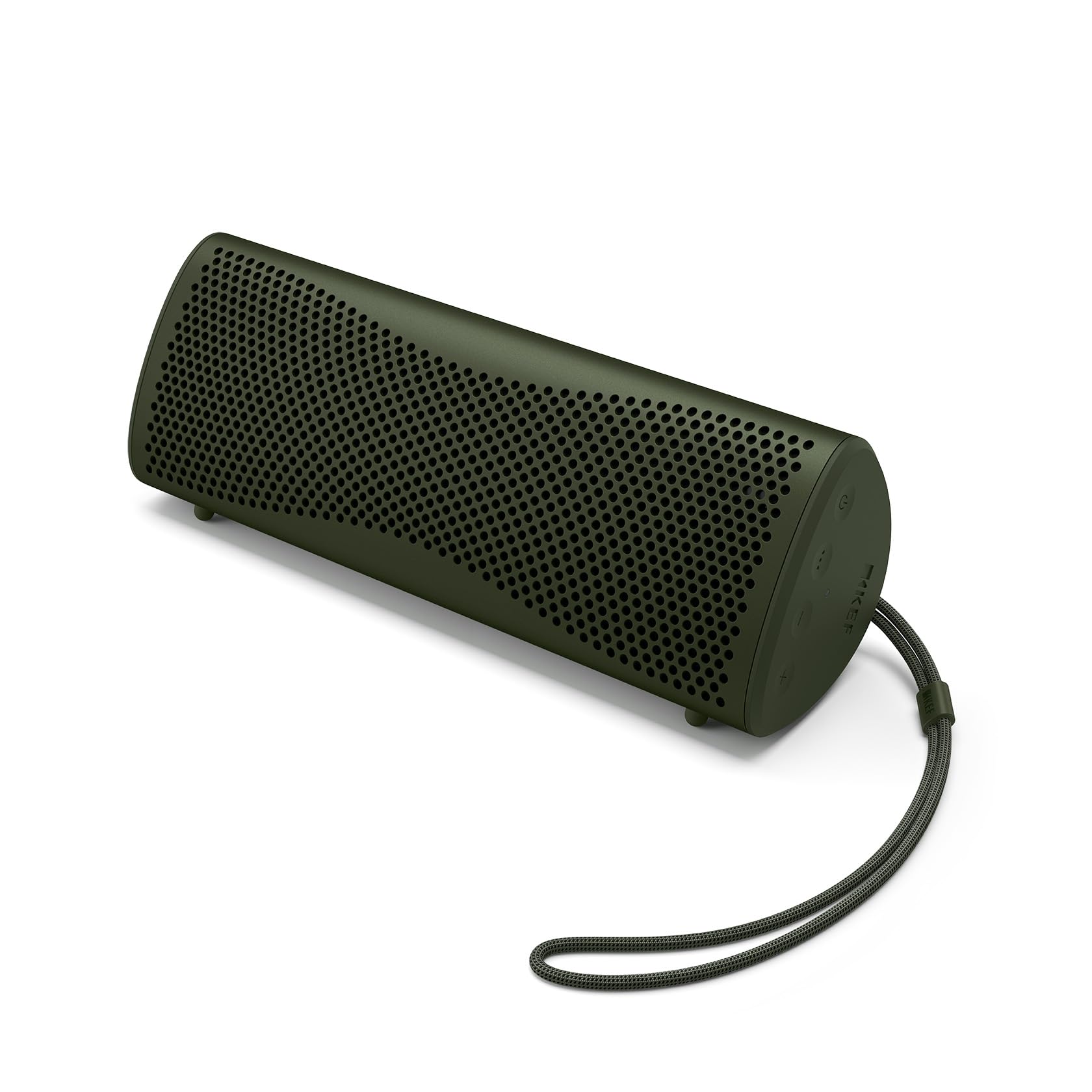
The KEF Muo is a compact Bluetooth speaker that prioritizes high-fidelity at low volumes, making it an exceptional choice for near-field desktop or bedside listening. Its racetrack driver and P-Flex Surround technology deliver controlled bass detail that defies the speaker’s small size. The addition of Bluetooth 5.4 with aptX Adaptive ensures a stable, high-resolution wireless connection, preserving the transient detail that budget codecs smear.
The IP67 rating and aluminum enclosure provide ruggedness and a premium tactile feel. The battery life of 24 hours, plus a quick 15-minute charge for an extra 3 hours of playback, supports all-day use. The True Wireless Stereo pairing allows two Muo units to create left and right channels, producing a stereo soundstage that single-unit portable speakers cannot match. It ships with a removable carrying strap for added portability.
The criticism from some users about hollow or boxy bass is valid when the speaker is pushed to high volumes in large rooms—this is not a party speaker. Its forte is near-field listening where its clean midrange and articulate vocal reproduction shine. The bass is detailed and present but lacks the chest-thumping volume of larger units. For the listener who values clarity over loudness in a compact form, the Muo is a refined, niche choice.
Why it’s great
- Bluetooth 5.4 with aptX Adaptive
- Compact aluminum build with excellent near-field clarity
- True Wireless Stereo pairing for spatial audio
Good to know
- Bass can sound boxy at high volumes or in large rooms
- Heavy for its size; not the most portable
FAQ
Can a Bluetooth speaker truly be audiophile-grade?
What is the difference between aptX Adaptive and standard aptX?
How important is the DAC in a wireless speaker?
Does a larger speaker always sound better?
Can I use an audiophile Bluetooth speaker for a home theater setup?
Final Thoughts: The Verdict
For most users, the best audiophile bluetooth speaker winner is the Bowers & Wilkins Zeppelin Pro Edition because it offers a true three-way driver topology with titanium tweeters and a dedicated subwoofer in a single elegant unit, delivering the most transparent and spacious soundstage of the entire group. If you want a loud, room-adaptive system with Dolby Atmos height processing, grab the JBL Authentics 500. And for the best value in a bookshelf format with genuine Wi-Fi high-res streaming, nothing beats the Edifier S1000W.