
Our readers keep the lights on and the weekend projects moving. As an Amazon Associate, I earn from qualifying purchases.
When the grid goes down, a backup solar generator is the difference between sitting in the dark with a dead phone and running your fridge, lights, and Wi-Fi as if nothing happened. Unlike gas generators that guzzle fuel, need constant maintenance, and leave you breathing fumes, a solar generator silently converts sunlight into silent, instant power. With battery capacities now ranging from 768Wh all the way up to 11,520Wh, and inverters pushing 2400W or more, the right unit can handle everything from a short-term outage to an extended off-grid lifestyle.
I’m Rikta — the co-founder and writer behind FitlyFast. With over 15 years of market research in the portable power sector, I have scrutinized battery chemistries, inverter efficiencies, and charge rates to bring you a practical, no-fluff guide that cuts through the marketing noise. My focus is on the concrete specs that actually matter: LiFePO4 cycle life, pure sine wave output, MPPT solar efficiency, and real-world runtime under load.
Whether you are a homeowner preparing for hurricane season, an overlander building a self-sufficient rig, or a remote worker who simply wants a reliable power backup, this deep-dive guide to the best backup solar generator will help you match the perfect power station to your specific needs and budget.
How To Choose The Best Backup Solar Generator
Choosing the wrong backup solar generator means either running out of power in the middle of a storm or overpaying for capacity you will never use. This guide focuses on the four most important decision points: battery chemistry, inverter type, capacity vs. runtime, and recharging options.
Battery Chemistry: LiFePO4 vs. NMC vs. Lead-Acid
For a backup solar generator, LiFePO4 (Lithium Iron Phosphate) is the only chemistry you should consider. It provides 3000 to 4000 full charge cycles before degrading to 80% capacity, easily outlasting the 500 cycles of NMC (Nickel Manganese Cobalt) packs. LiFePO4 is also thermally stable, does not explode if punctured, and handles partial charging without long-term damage. Lead-acid is heavier, slower to recharge, and delivers far fewer cycles — skip it entirely for standby use.
Inverter Type: Always Choose Pure Sine Wave
A pure sine wave inverter produces AC power that is identical to grid electricity. This is non-negotiable for sensitive electronics like CPAP machines, laptops, medical devices, and variable-speed fridge compressors. Modified sine wave inverters can cause buzzing, overheating, or damage in these devices. Every product in this review delivers pure sine wave output, and you should reject any unit that does not.
Capacity vs. Runtime: Watts Matter More Than Watt-Hours
Your total power need is calculated by adding the running watts of everything you plan to power. A 500W refrigerator will drain a 1000Wh battery in about two hours, while a 50W Wi-Fi router sips the same battery for 20 hours. The key spec is not just total watt-hours (Wh) but also continuous output in watts (W). A generator with 2048Wh capacity but only 1800W output cannot start a 1500W well pump. Always match your surge and continuous wattage requirements first, then buy enough battery capacity to cover your desired runtime.
Solar Recharge Speed: MPPT Efficiency and Panel Compatibility
Solar charging speed depends on two factors: the maximum solar input wattage the generator can accept (e.g., 500W vs. 1200W) and the efficiency of its MPPT (Maximum Power Point Tracking) controller. A good MPPT controller captures 97-99% of available solar power, especially in partial sun or overcast conditions. The unit should support XT-60 or MC4 connectors for easy pairing with portable solar panels, and you should match the voltage range of the generator (typically 12-60V) to your panels.
Quick Comparison
On smaller screens, swipe sideways to see the full table.
| Model | Category | Best For | Key Spec | Amazon |
|---|---|---|---|---|
| Anker SOLIX C2000 Gen 2 | Premium | Ultra-fast recharging + expandable capacity | 2048Wh LiFePO4, 2400W output | Amazon |
| Jackery Explorer 2000 v2 | Premium | Lightest 2kWh unit, quiet UPS backup | 2042Wh, 2200W output, 39.5 lbs | Amazon |
| GROWATT INFINITY 2000 Pro | Premium | Winter operation with Cold Start tech | 2048Wh, 2400W output, TT-30 & Anderson | Amazon |
| EcoFlow DELTA 2 Max + 400W Panel | Premium | Highest bundle value with solar panel | 2048Wh, 2400W output, 400W solar panel | Amazon |
| Segway Cube 2000 | Mid-Range | Modular expandability to 5kWh, IP56 | 2048Wh LiFePO4, 2200W output | Amazon |
| AFERIY P210 | Mid-Range | Near-silent operation, server-level UPS | 2048Wh, 2400W output, 48.5 lbs | Amazon |
| Dabbsson 2000L | Mid-Range | Lightest 2kWh with semi-solid battery | 2048Wh, 2200W output, 41 lbs | Amazon |
| EcoFlow DELTA 2 + 220W Panel | Mid-Range | Entry-level 1kWh with solar kit | 1024Wh, 1800W output + 220W panel | Amazon |
| ABOK Ark3600 + 200W Panel | Premium | Massive 3840Wh capacity, wheels included | 3840Wh, 3600W output, 92 lbs | Amazon |
| BLUETTI AC70 | Mid-Range | Compact 768Wh for essentials, fast AC charge | 768Wh, 1000W output, 2000W surge | Amazon |
| EBL Acc2400 | Mid-Range | High 2400W output at lowest cost per watt | 1843.2Wh, 2400W output, 54 lbs | Amazon |
In‑Depth Reviews
1. Anker SOLIX C2000 Gen 2
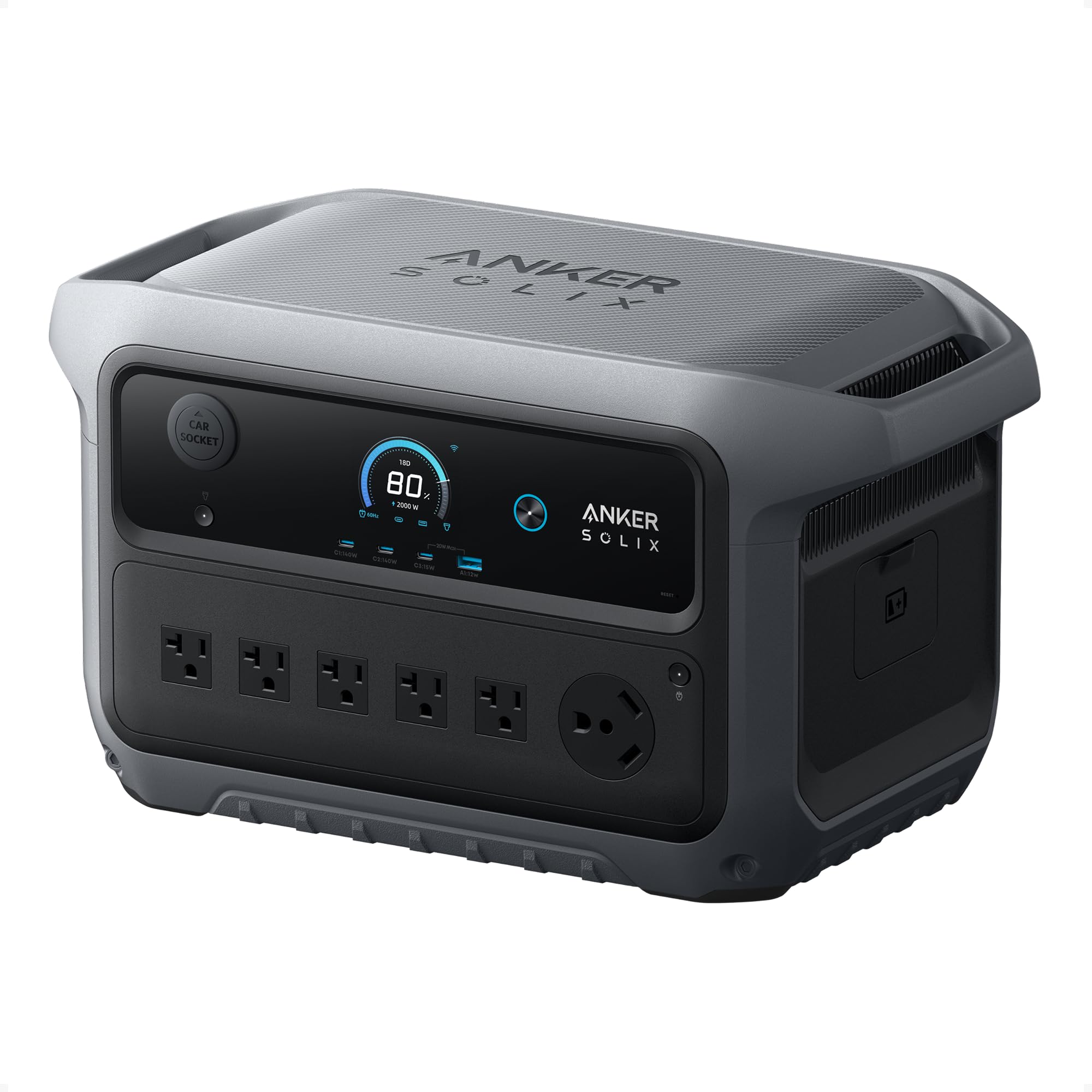
The Anker SOLIX C2000 Gen 2 is the most balanced 2kWh backup solar generator in its class. At 2048Wh and 2400W continuous output (4000W peak), it can power a dual-door refrigerator for 32 hours on a single charge. The standout feature is the sub-60-minute full recharge time via AC, which reduces downtime during back-to-back outages. Its standby power draw is remarkably low at only 9W, meaning you lose less stored energy when the unit sits idle for days between uses.
For solar recharging, the Gen 2 supports up to 800W of solar input with MPPT technology, and it also accepts alternator charging at 800W — a feature that lets you recharge fully from your vehicle’s alternator in just three hours. The expandable capacity (up to 4kWh with an additional battery) gives future flexibility. At 41.7 pounds, it is 25% lighter than many 2kWh competitors, making it easier to move from home to RV or campsite.
Build quality is excellent, with a sturdy metal and plastic chassis. The front panel includes a clear status display, and the app-based control works reliably over Bluetooth and Wi-Fi. The only real consideration is that the internal fans can be audible under high load, but the unit remains significantly quieter than any gas generator. For most homeowners, this is the best overall choice for serious home backup duty.
Why it’s great
- Full recharge in 58 minutes via AC — fastest in class
- Expandable to 4kWh for longer outages
- Very low 9W standby power consumption
- 800W alternator charging for mobile use
Good to know
- Fans can be audible at high continuous load
- No included solar panel in base package
2. Jackery Explorer 2000 v2

The Jackery Explorer 2000 v2 weighs just 39.5 pounds with a 2042Wh capacity, making it the lightest 2kWh backup solar generator on this list. Jackery achieved this with CTB (Cell-to-Body) technology borrowed from EV manufacturing, which integrates the battery cells into the structural frame rather than using a separate casing. The result is a unit that is 41% lighter and 34% smaller than typical competitors, without sacrificing the 2200W continuous output.
Charging is flexible and quiet: AC fast charging hits 80% in 66 minutes, and the Emergency Super Charging mode in the app reaches full charge in 102 minutes. For overnight use, Silent Charging mode runs at under 30 dB, which is genuinely whisper-quiet. The 20ms UPS switchover is UL1778 certified, so your computer never blinks when the grid fails. The included flashlight with dim/bright/SOS modes is a practical bonus during power outages.
Real-world performance is strong. Users report powering a full-size refrigerator for over 21 hours, and the unit has been successfully used for off-grid living in tropical climates to keep Wi-Fi running during rainy periods. The main downside is solar charging speed — with only a 200W panel, a full charge takes about 6 hours of direct sun. Pairing with 400W panels would cut that time roughly in half. This unit is best for users who prioritize portability and quiet operation above raw charging speed.
Why it’s great
- Lightest 2kWh unit at 39.5 lbs — easy to carry
- UL1778 certified UPS with 20ms switchover
- Super silent charging mode under 30 dB
- CTB technology for superior structural safety
Good to know
- Solar charge speed is slower without a large panel array
- Emergency Super Charging only available via app
3. GROWATT INFINITY 2000 Pro
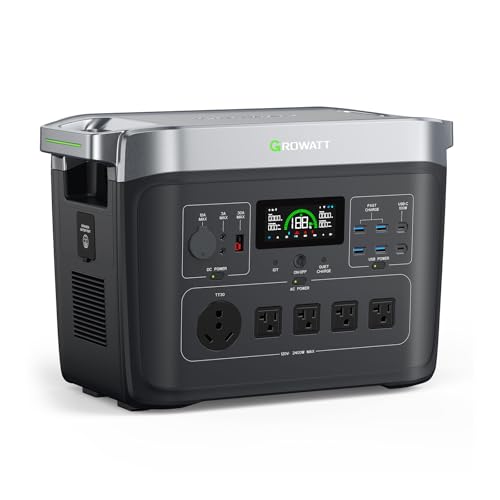
The GROWATT INFINITY 2000 Pro is purpose-built for users who need reliable power in freezing conditions. Its exclusive Cold Start technology enables operation down to -22°F (-30°C), which is a problem most LiFePO4 generators face — standard packs cannot charge below 32°F. With 2048Wh capacity and a 2400W continuous inverter (4000W surge), it can handle refrigerators, sump pumps, and heating equipment even during winter storms.
A major differentiator is the inclusion of both a NEMA TT-30 outlet (standard for RVs) and an Anderson-style 30A DC output. This makes it ideal for overlanders and RV owners who need to directly power RV electrical systems. The unit charges from AC at 1800W (90 minutes to full) and accepts up to 1200W of solar input, among the highest solar charging rates in this category. The MyGro app provides full monitoring over Wi-Fi and Bluetooth.
Build quality is backed by a 5-year warranty and Growatt’s reputation as a major inverter manufacturer. The 15ms EPS switchover keeps sensitive electronics uninterrupted. At 26 pounds, it is surprisingly light for a 2kWh unit, aided by the compact form factor. The only risk is inconsistent quality control — a small number of users report units that fail to power on without grid input. However, this appears to be the exception rather than the rule, and the warranty covers defects.
Why it’s great
- Cold Start tech allows operation down to -22°F
- TT-30 and Anderson outlets for RVs and campers
- 1200W solar input — fastest solar recharge in class
- Lightweight at 26 lbs for a 2kWh battery
Good to know
- Some quality control issues reported (defective units)
- Warranty support responsiveness varies
4. EcoFlow DELTA 2 Max + 400W Panel

The EcoFlow DELTA 2 Max paired with the 400W bifacial solar panel is the most complete solar generator bundle in this lineup. The power station delivers 2048Wh capacity with a 2400W inverter that can surge to 3400W using X-Boost, covering 99% of household appliances. The bundled 400W panel features IP68 waterproofing and 23% conversion efficiency, with bifacial technology capturing up to 25% more energy from reflected light on the rear side.
Charging speed is exceptional: dual AC + solar input allows 80% charge in just 43 minutes, and AC alone reaches 80% in 1.1 hours. Two 400W panels can fully recharge the station in 2.6 hours of direct sun. The panel folds into a compact 35.3-pound kit with a carrying case, making it mobile enough for camping or emergency use. The battery chemistry is LiFePO4 with a claimed 3000 cycles to 80% capacity, backed by a 5-year service term.
The EcoFlow app provides granular control over charging speeds, solar priority, and load monitoring. Users report real-world reliability during hurricanes, using the system to keep a 25 cubic foot fridge, fan, and TV running for 4 days with daily solar panel adjustments. The bundle cost is a significant upfront investment, but the included high-wattage panel makes it a true turnkey solution for serious off-grid or emergency power.
Why it’s great
- Includes a high-efficiency 400W IP68 solar panel
- Dual AC + solar charging hits 80% in 43 minutes
- 3400W X-Boost surges through high-startup appliances
- Comprehensive app-based controls and monitoring
Good to know
- Bundled panel case is flimsy; a DIY stand improves performance
- Premium price point for the full kit
5. Segway Cube 2000
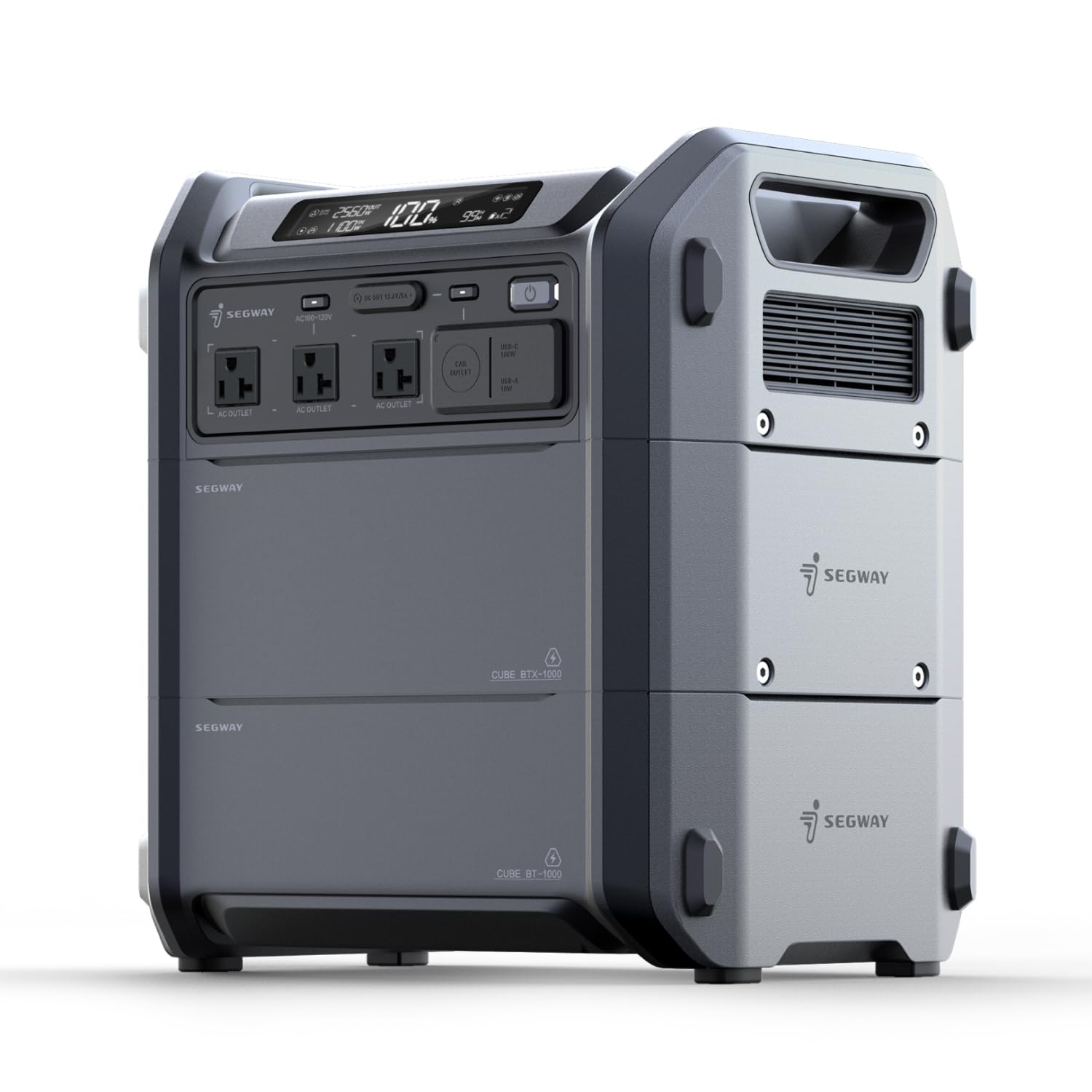
The Segway Cube 2000 stands out for its modular expandable design. The base unit provides 2048Wh capacity with a 2200W inverter that can be boosted to 4400W using the R-drive function. You can stack up to three BTX-1000 expansion batteries (sold separately) to reach a total of 5kWh, making this a scalable solution for users whose power needs may grow over time. The system uses cordless stacking — no cables or tools needed — which is cleaner than most competitors’ expansion approaches.
Durability is a key selling point: the Cube 2000 carries an IP56 rating for water and dust resistance, meaning it can withstand rain and heavy dust without issue. The LiFePO4 battery is rated for 4000+ cycles, among the highest in this class. Solar charging uses MPPT technology advertised at 97% conversion efficiency, and the unit charges from AC in 1.8 hours. The port selection includes dual 100W USB-C ports, multiple AC outlets, and car battery detection for smart alternator charging.
Real-world use cases include running power tools and work lights for contractors, and powering pitching machines at baseball fields. The unit is quiet and convenient for indoor use. The biggest downside is the app-dependent activation — initial setup requires a Bluetooth connection and app, and some users have reported persistent beeping issues or Bluetooth connectivity problems that rendered the unit unusable. Make sure you download the app and test the unit immediately after purchase to ensure proper function.
Why it’s great
- Expandable from 2kWh to 5kWh via cordless stacking
- IP56 rating for water and dust protection
- 4400W surge via R-drive mode
- Dual 100W USB-C ports for fast device charging
Good to know
- App activation required for initial setup
- Bluetooth issues reported in some units
6. AFERIY P210

The AFERIY P210 delivers 2048Wh of capacity and a 2400W inverter with a 4800W surge in a package that is quieter than almost any competitor. At normal load, the unit operates at just 16 dB — quieter than a whisper — and even at full load it stays below 30 dB. This makes it ideal for overnight use in an RV, bedroom, or hospital environment where noise is a real concern. The 10ms server-level UPS switchover is fast enough to keep sensitive IT equipment running seamlessly.
The 7-year extended warranty (2 years longer than industry standard) demonstrates confidence in the battery and inverter components. Charging from AC reaches full in about 2 hours, and the P210 accepts solar input via an XT60 connector. The 16 output ports include 6 AC outlets, 4 USB-C ports (one at 100W), and a 12V/25A XT60 DC output for high-amp devices. The pure sine wave AC input and output ensures clean power on both sides of the circuit.
User feedback is positive, with food truck operators praising the silent operation and RV owners appreciating the 1200W UPS capability (when plugged into grid power, it switches to battery in under 10ms if the grid fails). At 54 pounds, it is not the lightest, but the weight is distributed well in a 15.4 x 11 x 12.7-inch frame. The only limitation is the LiFePO4 temperature restriction — it cannot charge below freezing, which is standard but worth noting for cold-climate users.
Why it’s great
- Exceptionally quiet at 16 dB under normal load
- 10ms UPS switchover protects sensitive electronics
- 7-year extended warranty — best in class coverage
- 6 AC outlets and 16 total ports for maximum connectivity
Good to know
- Cannot charge in sub-freezing temperatures
- Heavier than some competitors at 54 lbs
7. Dabbsson 2000L
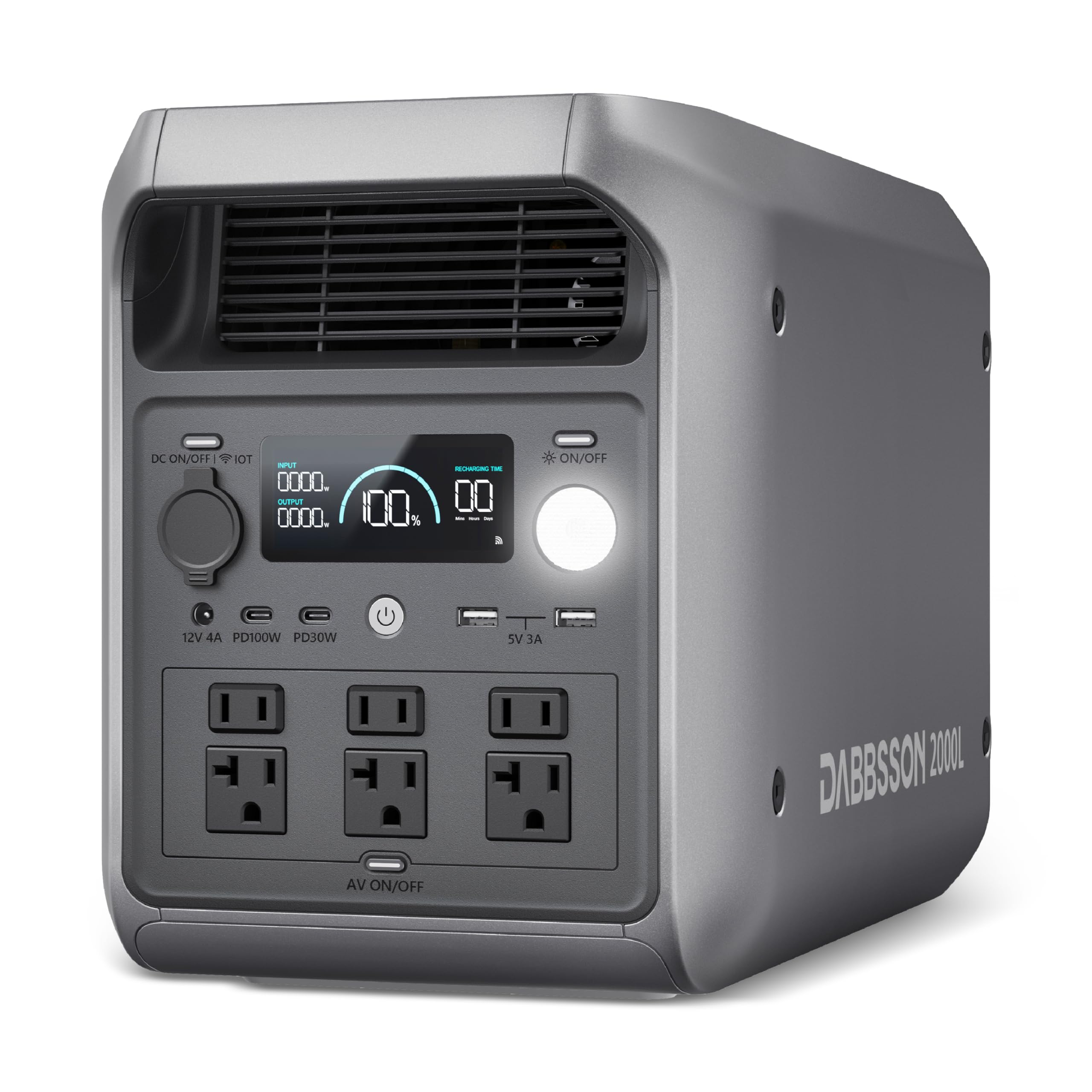
The Dabbsson 2000L uses an upgraded semi-solid LiFePO4 battery chemistry that provides higher stability and safety compared to standard LFP cells. At 41 pounds for a full 2048Wh capacity, it is one of the lightest 2kWh units available, making it much easier to carry between home, car, and campsite. The 2200W continuous output (3300W surge) is enough to handle heavy loads like refrigerators, electric grills, and power tools.
Charging speed is a highlight: the 2000L reaches full charge in just 1 hour via AC, which is among the fastest in its class. Solar input is capped at 800W with MPPT, and the system supports hybrid AC + solar dual-input for maximum charging flexibility. The EPS switchover happens in under 15ms, protecting computers and NAS drives from power loss. The Dabbsson app provides Wi-Fi and Bluetooth control for remote monitoring and schedule management.
User reviews consistently praise the compact size and modern design. The unit has been used successfully to power e-bike recharges, car fridges, and as emergency backup for extended periods. A 5-year warranty backs the investment. The semi-solid battery cells are a genuine step forward in safety, with UL94-V0 flame-retardant housing that resists fire propagation. The trade-off is that this is a relatively new technology, and long-term field data is still emerging compared to established LiFePO4 packs.
Why it’s great
- Semi-solid LiFePO4 battery for enhanced safety
- Full AC recharge in just 1 hour
- Very lightweight at 41 lbs for 2kWh class
- UL94-V0 flame-retardant housing
Good to know
- Semi-solid technology has less long-term field data
- Solar input limited to 800W max
8. EcoFlow DELTA 2 + 220W Solar Panel

For users who need a compact starter setup, the EcoFlow DELTA 2 with the 220W bifacial solar panel is an excellent entry point. The DELTA 2 delivers 1024Wh of capacity with an 1800W inverter (enough for about 90% of household devices), and the included 220W bifacial panel captures reflected sunlight from the rear side to boost daily harvest by up to 25%. The system is expandable with extra batteries to reach 3kWh, giving room to grow.
The DELTA 2 uses LiFePO4 chemistry rated for 3000 cycles, and supports up to 500W of solar input for faster recharging when used with additional panels. AC charging is quick at about 1.6 hours to full. The 15 output ports include USB-C, USB-A, and multiple AC outlets. The EcoFlow app provides smart control over charging schedules and solar priority, which is useful for off-grid living or time-of-use grid management.
Real-world feedback from hurricane-prone areas is very positive: users kept swamp coolers, pool filters, and refrigerators running for days. The 220W panel itself is weatherproof and folds into a compact case. The main practical limitations are the relatively modest 1024Wh capacity (enough for a night but not multiple days of high consumption) and the fact that the solar panel’s elastic bands can be temperamental when folding or adjusting angles. This kit is best as a budget-friendly emergency backup or for weekend camping trips.
Why it’s great
- Includes a high-quality 220W bifacial solar panel
- Expandable capacity up to 3kWh with extra batteries
- 1800W inverter covers 90% of household devices
- EcoFlow app for smart energy management
Good to know
- 1024Wh capacity is modest for extended multi-day outages
- Solar panel elastic bands can be finicky
9. ABOK Ark3600 + 200W Solar Panel
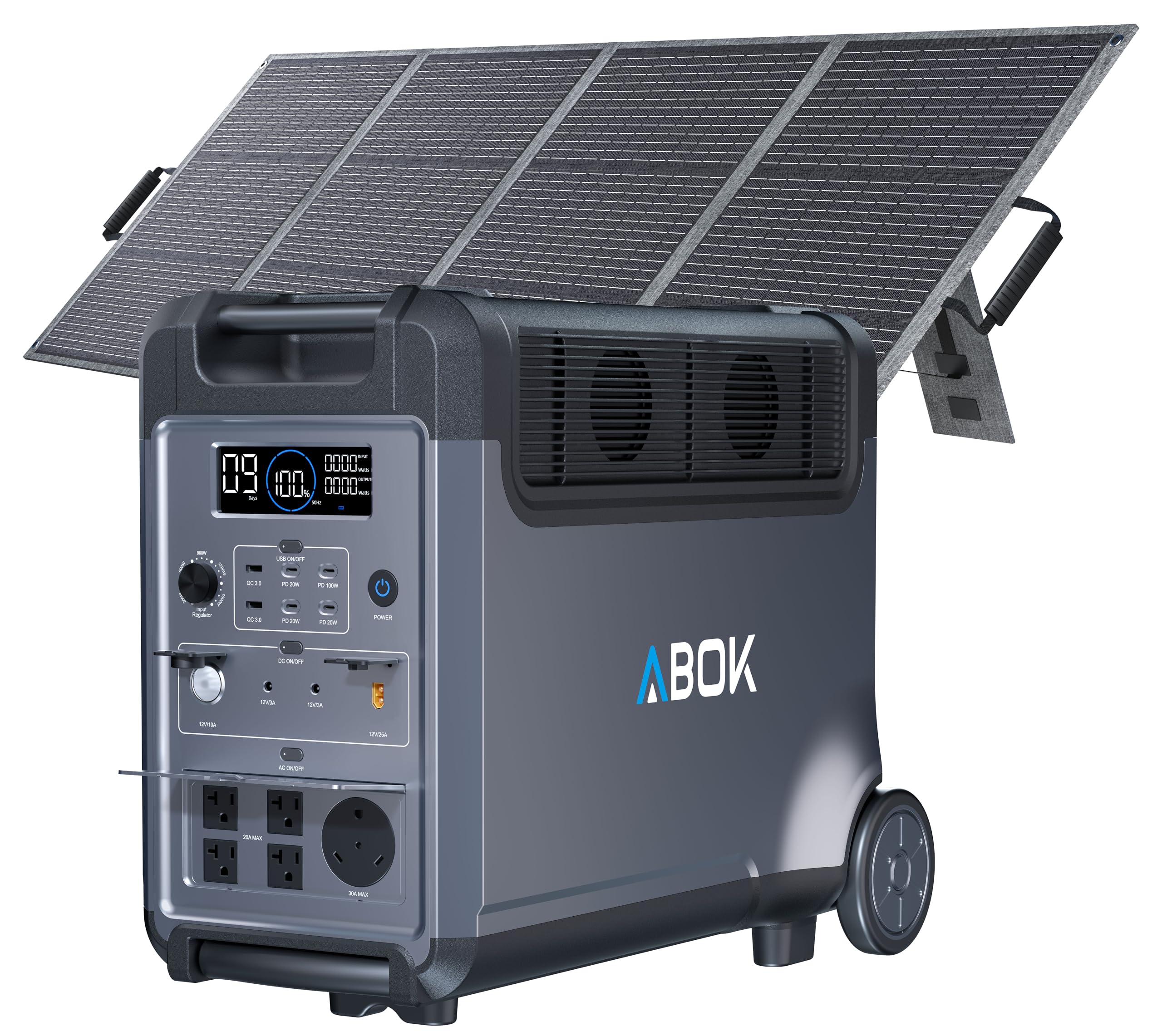
The ABOK Ark3600 is the heavy hitter of this lineup, offering 3840Wh of raw capacity with a 3600W inverter (4500W peak). This is enough power to run a full-size refrigerator, freezer, lights, and a TV simultaneously for well over a day. The capacity is expandable up to 11520Wh with additional units, making this a genuine whole-home backup solution. It comes with a telescoping handle and durable wheels for transport despite its 92-pound weight.
Charging options are comprehensive: AC input at 1500W, solar input at 2000W (using MC4 connectors), and car charging at 120W. Combined AC + solar charging delivers a full charge in just 1.29 hours. The 15 output ports include a 30A AC outlet, 4 x 20A AC outlets, multiple USB-C (one at 100W), and a dedicated XT60 DC port for high-amp applications. The 10ms UPS switchover ensures seamless transition during blackouts.
The real-world performance is impressive — users report running a full workday of power tools (wetvac, heat gun, SDS drill, battery chargers) and the battery only dropped to 22%. The EV-grade LiFePO4 battery is rated for 4000+ cycles and a 10-year lifespan. Bluetooth app monitoring is included. The only real downsides are the sheer weight: this is not a portable unit you grab and go. The included 200W solar panel is useful but underpowered relative to the massive battery; you would likely want to add more panels for faster solar recharge.
Why it’s great
- Massive 3840Wh capacity expandable to 11520Wh
- 3600W continuous inverter handles heavy appliances
- Wheels and telescoping handle for mobility
- 30A AC outlet plus 15 total ports
Good to know
- Very heavy at 92 lbs — not truly portable
- Included 200W solar panel is underpowered for the battery size
10. BLUETTI AC70

The BLUETTI AC70 is a 768Wh backup solar generator that packs a surprising punch with its 1000W inverter and 2000W Power Lifting mode. While the capacity is smaller than the 2kWh giants, the AC70 can still handle essential devices: a fridge, a few lights, a laptop, and a phone charger. The 2000W surge capability means it can even start small motors like a table fan or a water pump without tripping.
Charging is genuinely fast: 0-80% in just 45 minutes and full charge in 1.5 hours using AC input. Solar input is capped at 500W, which charges the unit from empty in about 1.9-2.4 hours with strong sun. The XT-60 DC input is robust and compatible with most portable solar panels. The BLUETTI app provides remote monitoring of battery status and charge/discharge modes, which is a premium feature at this capacity tier.
At 22.5 pounds, it is genuinely portable and easy to carry. The silent operation and sub-20ms UPS backup make it suitable for home office use. Customer reviews are consistently strong, with users powering a 100W guitar amp and pedals for over 19 hours of runtime. The main limitation is the 768Wh battery — it is enough for a single night of essential loads but not for multi-day outages without solar recharging. This is best as a lightweight emergency kit for apartment dwellers or weekend campers.
Why it’s great
- Fast 45-minute 80% AC charge
- 2000W Power Lifting surge for starting motors
- Compact and light at 22.5 lbs
- Robust XT-60 solar input connector
Good to know
- 768Wh capacity is limited for extended use
- No included solar panel in base package
11. EBL Acc2400
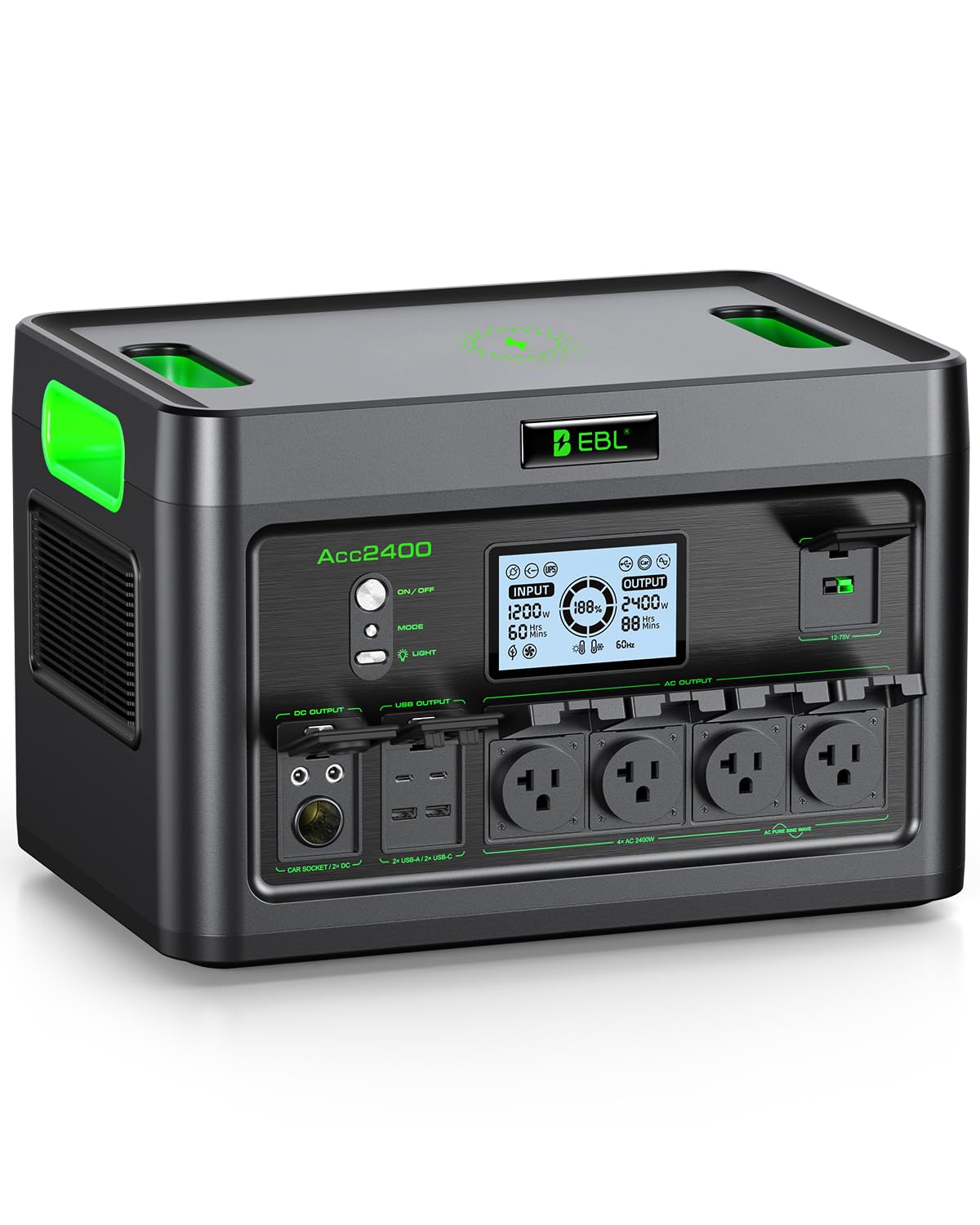
The EBL Acc2400 offers a compelling price-to-performance ratio with 1843.2Wh capacity and a full 2400W inverter in a single package. This is enough power to run high-wattage appliances like electric kettles, hair dryers, coffee makers, and even some power tools. The 2400W continuous output matches premium units at a significantly lower cost per watt, making this a strong candidate for budget-conscious buyers who need serious capacity.
The unit supports simultaneous charging of 12 devices across 4 AC outlets, 2 USB-A ports, 2 USB-C ports, a car port, 2 DC ports, and a wireless charging pad. The LiFePO4 battery is rated for over 3500 cycles and a 10+ year service life. A built-in intelligent BMS protects against overcharge, over-discharge, short circuits, and high temperatures. The 0.1-second UPS switchover (100ms) is fast enough for most devices but slightly slower than the sub-20ms switches in premium units, so very sensitive electronics may flicker.
Portability is decent at 54 pounds with dual-side handles, and the clear display shows remaining battery and working status. A 4-mode LED light serves as emergency lighting. Build quality is solid, with shock-resistant and flame-retardant designs. User feedback is positive, with CPAP users reporting all-night operation and families using it as a backup during power outages. The primary trade-off is the slightly slower UPS response time and the heavier weight compared to similarly-priced 2kWh competitors.
Why it’s great
- Excellent value: high capacity + high wattage at low cost
- 2400W continuous output handles heavy appliances
- 3500+ charge cycles for 10+ year lifespan
- Wireless charging pad integrated into the unit
Good to know
- UPS switchover is 100ms vs. sub-20ms on premium units
- Heavier at 54 lbs without wheels or telescoping handle
FAQ
Can a backup solar generator power a refrigerator during an extended blackout?
What is the difference between a solar generator and a gas generator for home backup?
How long does it take to charge a 2kWh solar generator with a 200W solar panel?
Is it safe to leave a backup solar generator plugged in and charging all the time?
Can I use a backup solar generator in an apartment or small space?
Final Thoughts: The Verdict
For most users, the best backup solar generator winner is the Anker SOLIX C2000 Gen 2 because it combines the fastest AC recharge time (58 minutes), a low 9W standby draw, and expandable capacity up to 4kWh in a reasonably light 41.7-pound chassis. If you prioritize extreme portability above all else, grab the Jackery Explorer 2000 v2 at 39.5 pounds with certified UPS backup. And for those who need massive whole-home capacity and have a dedicated space to park it, nothing beats the ABOK Ark3600 with 3840Wh of storage, a 3600W inverter, and wheels for easy placement.