
Our readers keep the lights on and the weekend projects moving. As an Amazon Associate, I earn from qualifying purchases.
Getting a child to willingly step away from a screen and engage in physical play that actually builds something useful—coordination, core strength, spatial awareness—feels like a small miracle. A quality balance board transforms that miracle into a daily reality, turning a living room floor into an obstacle course, a pirate ship, or a “floor is lava” battleground. The challenge is separating the toys that genuinely support developmental growth from the flimsy plastic shapes that collect dust after day two.
I’m Rikta — the co-founder and writer behind FitlyFast. I’ve spent years analyzing the hardware and materials behind active-play toys, from foam density in gymnastics equipment to the weight distribution specs on wooden wobble boards. This guide focuses on the specific build quality, surface textures, and weight limits that determine whether a board truly helps a child develop balance or just takes up closet space.
Whether you are a parent building an indoor sensory course or a therapist looking for motor-skill tools, finding the right balance board for kids means understanding how material choice, weight capacity, and surface grip translate into real, repeatable play value.
How To Choose The Best Balance Board For Kids
Not all balance boards are built the same, and the wrong choice can mean a toy that tips too easily, splinters after a month, or simply doesn’t engage a child’s imagination. Focus on these three factors to match the board to your child’s age and play style.
Wood vs. Plastic Construction
Wooden wobble boards, typically made from beech or birch plywood, offer a rigid, responsive balancing surface that shifts predictably under weight. They are open-ended toys that support rocking, sliding, and even support for an adult joining in. Plastic stepping stones are lighter, often stackable for storage, and usually part of a multi-piece set that encourages sequential stepping and obstacle-course logic. Wood suits older toddlers and children who enjoy dynamic rocking; plastic stepping stones work best for younger toddlers (18 months to 3 years) who are still mastering the concept of stepping from one stable point to another.
Weight Capacity and Surface Grip
A board’s maximum weight recommendation is a direct signal of its internal build quality. Premium wooden boards easily support 300 to 480 pounds, meaning a parent can safely spot a child or even use the board alongside them. Plastic stepping stones typically support between 165 and 330 pounds. Surface grip matters just as much—rubberized bases or textured tops prevent slipping on hardwood floors, which is critical for both safety and confidence-building during early balancing attempts.
Open-Ended Play vs. Structured Obstacle Courses
A single wobble board offers unstructured imaginative play—it becomes a bridge, a ramp, a rocking chair, or a shop counter depending on the child’s mood. A stepping stone set, by contrast, imposes a loose structure (step from stone A to stone B) that helps children practice sequencing and motor planning. Choose based on your child’s temperament: imaginative free-players thrive on a wobble board; rule-followers and puzzle-solvers often prefer the clear goal of crossing a lava floor without touching the ground.
Quick Comparison
On smaller screens, swipe sideways to see the full table.
| Model | Category | Best For | Key Spec | Amazon |
|---|---|---|---|---|
| NUTTY TOYS Wooden Wobble Board | Wood Wobble | Imaginative open-ended play | 488 lb weight capacity, beech wood | Amazon |
| WOOD CITY Wobble Board | Wood Wobble | Family-friendly yoga & balance | 480 lb capacity, 35″ length | Amazon |
| PLAY-IN-JOY Balance Board | Wood Wobble | Durable Montessori classroom use | 390 lb capacity, 13-layer wood | Amazon |
| LoomLark Stepping Stones | Stepping Stones | Indoor obstacle courses | 330 lb capacity, anti-slip base | Amazon |
| Lehoo Castle Stepping Stones | Stepping Stones | Sensory play with light & sound | 220 lb capacity, light-up stones | Amazon |
| Tiny Land Stepping Stones | Stepping Stones | Vintage-style coordination play | 165 lb capacity, textured top | Amazon |
| JOYIN Turtle Balance Stones | Stepping Stones | Themed turtle-path games | 265 lb capacity, PP material | Amazon |
In‑Depth Reviews
1. NUTTY TOYS Montessori Wooden Wobble Board

The NUTTY TOYS wobble board is the clear leader in this category because it nails the fundamentals—thick, solid beech wood construction, a generous 35-inch length, and a weight capacity that comfortably supports two kids or a child plus an adult. The natural wood finish with non-toxic coating means no off-gassing, and the rounded edges are genuinely smooth with zero splinter risk. This is the board that stays in the living room, not the closet.
Its open-ended nature is a real differentiator. Children use it as a rocking seat, a ramp for toy cars, a bridge for dolls, or a balance beam for practicing walking. The 488-pound rating isn’t marketing fluff—it reflects the thick wood laminate that resists cracking even under repeated jumping. Reviewers consistently mention that siblings of different ages all find ways to play with it together, which is rare for a single-piece toy.
The only real trade-off is space. At 35 inches long, it requires a clear floor area to use safely, and the curved profile means it doesn’t stack flat against a wall as neatly as a stepping stone set. But for parents who want a single heirloom-quality toy that develops balance, coordination, and imagination simultaneously, this is the one to buy.
Why it’s great
- Massive 488 lb capacity supports parent-child play
- Solid beech wood with smooth, child-safe edges
Good to know
- Requires open floor space; doesn’t store flat
- Natural wood shows scuffs over time
2. WOOD CITY Wobble Board

The WOOD CITY wobble board mirrors the NUTTY TOYS in dimensions and weight capacity, but its slightly thinner profile (0.66 inches vs. 0.7 inches) and eco-friendly lacquer finish give it a slightly different feel. It’s a fantastic option for families who want a board that serves double duty—both as a children’s balance toy and as an adult yoga or core-strength tool. The natural wood grain is visually appealing and fits seamlessly into a modern home.
The board’s versatility is impressive. Children use it upside down as a mini table or chair, flipped as a ramp for toy cars, or standing as a wobble rocker. Adults can use it for standing balance exercises or as a seat aid for back stretches. The 480-pound capacity is verified by real-world testing, with reviewers noting it held up to 220 pounds of jumping without any creaking or flexing.
One minor concern is the packaging. Some units arrive wrapped in plastic that can leave a temporary smell, and the lack of a sealer means the raw wood edges are more susceptible to moisture over time if used outdoors. It’s best kept indoors, but for the price, the build quality is excellent—especially for a board that spans both kids’ play and adult fitness.
Why it’s great
- Dual use for child play and adult yoga/fitness
- Eco-friendly lacquer with natural wood grain
Good to know
- Thinner wood may show wear on edges faster
- Best for indoor use only
3. PLAY-IN-JOY Natural Wood Balance Board

PLAY-IN-JOY differentiates itself with a specialized construction method—13 alternating layers of birch and beech wood hot-pressed together. This gives the board exceptional rigidity without excessive weight, and the FSC certification ensures the wood is sourced responsibly. Smaller dimensions (31.8 inches long vs. 35 inches) make it a better fit for tighter playrooms or for younger toddlers who don’t need the full span.
The board’s 390-pound capacity still allows for parent-child play, but the slightly shorter length means the rocking arc is tighter and more responsive to small shifts in weight. Children as young as 18 months can learn to rock gently without the board tipping too far forward. The double machine-grinding and triple manual-sanding process results in a surface that reviewers describe as “buttery smooth” and free of any rough patches.
The biggest drawback reported is cosmetic. Several units arrive with small chips or dings in the wood—not structural issues, but the lack of a thick sealer means the raw wood is vulnerable to denting during shipping. Some parents sand and seal it themselves for longevity. If you want a board that looks perfect out of the box, you may need to inspect it carefully upon arrival.
Why it’s great
- Multi-layer construction resists warping and cracking
- Smooth, splinter-free finish after extensive sanding
Good to know
- Some units arrive with minor shipping dings
- Shorter length limits some adult uses
4. LoomLark Balance Stepping Stones

The LoomLark stepping stones shift the play dynamic from rocking to sequenced stepping. Each stone measures 13 inches across and 9.85 inches high, creating a substantial platform that feels stable even for older kids. The wide top surface and thick rubber base prevent sliding on wood floors, and the 330-pound weight capacity means adults can join in without hesitation. This is the set that turns a hallway into a “floor is lava” championship course.
The color recognition angle is genuinely useful for younger children. Each stone features a different vibrant pattern, so parents can call out “jump to the green circle” or “step on the star,” combining physical coordination with cognitive color and shape identification. The stones stack neatly into a single column for storage, which is a major space-saving advantage over a flat wobble board.
The plastic material, while durable and non-toxic, does have a hollow feel compared to the solid wooden boards. Some children may prefer the slight give of the plastic, but parents looking for absolute rigidity might notice a small amount of flex under heavy weight. Also, the stones are not designed for rocking motion—they are stepping platforms only, so they serve a narrower play scope than a wobble board.
Why it’s great
- High weight capacity for parent-child play
- Stackable design for easy, compact storage
Good to know
- Limited to stepping play; no rocking motion
- Plastic material may flex slightly under high weight
5. Lehoo Castle Stepping Stones

Lehoo Castle adds a sensory dimension that no other product in this list offers—three of the five stepping stones light up and make sound when stepped on. This feature is a powerful engagement tool for toddlers who are visually oriented or who need extra motivation to stay on the obstacle course. The textured surface and anti-slip ring on the bottom keep the stones firmly planted on hardwood, tile, or low-pile carpet.
The set includes five stones total: three interactive (requiring batteries, not included) and two silent, passive stones. This mix allows children to learn patterns and sequencing by associating specific stones with light/sound feedback. The included storage bag makes cleanup and transport simple, and the lightweight plastic is easy for small children to reposition themselves, encouraging independent play setup.
The trade-off for the sensory features is battery life and noise level. The lights are bright and the sounds are genuinely loud enough to be heard across a room, which some parents may find distracting. Batteries drain faster than expected with heavy use, so budget for replacements. Additionally, the 220-pound weight capacity is lower than the rest of the stepping stone sets here, meaning it’s strictly for children and light-footed adults only.
Why it’s great
- Light and sound engage sensory-seeking toddlers
- Storage bag included for easy transport
Good to know
- Batteries required and drain quickly
- Lower weight capacity limits adult use
6. Tiny Land Stepping Stones

Tiny Land takes a design-first approach, offering stepping stones in a muted “Vintage Color” palette that blends more naturally with home decor than primary-colored plastics. The textured top surface provides tactile feedback for little feet, and the rubber base grips well on both indoor floors and outdoor grass. This is the set that disappears into a playroom’s aesthetic rather than screaming “toy corner.”
The 165-pound weight capacity is the lowest in this roundup, which makes sense given the set is specifically designed for toddlers aged 3 and up. Children will have no problem stepping, hopping, and balancing, and the lightweight construction (each stone is easy for a child to move) encourages independent play. The stones stack vertically, and the small footprint when stored is a bonus for tight spaces.
The primary limitation is exactly that weight capacity. The vintage color scheme is lovely, but the muted tones don’t pop as much for children who respond best to bright, high-contrast colors. For a dedicated toddler set with a clean look, it works beautifully.
Why it’s great
- Muted colors blend into home decor
- Textured surface adds tactile sensory input
Good to know
- Lower weight capacity limits to child-only play
- Muted colors may be less engaging for some kids
7. JOYIN Turtle Balance Stepping Stones
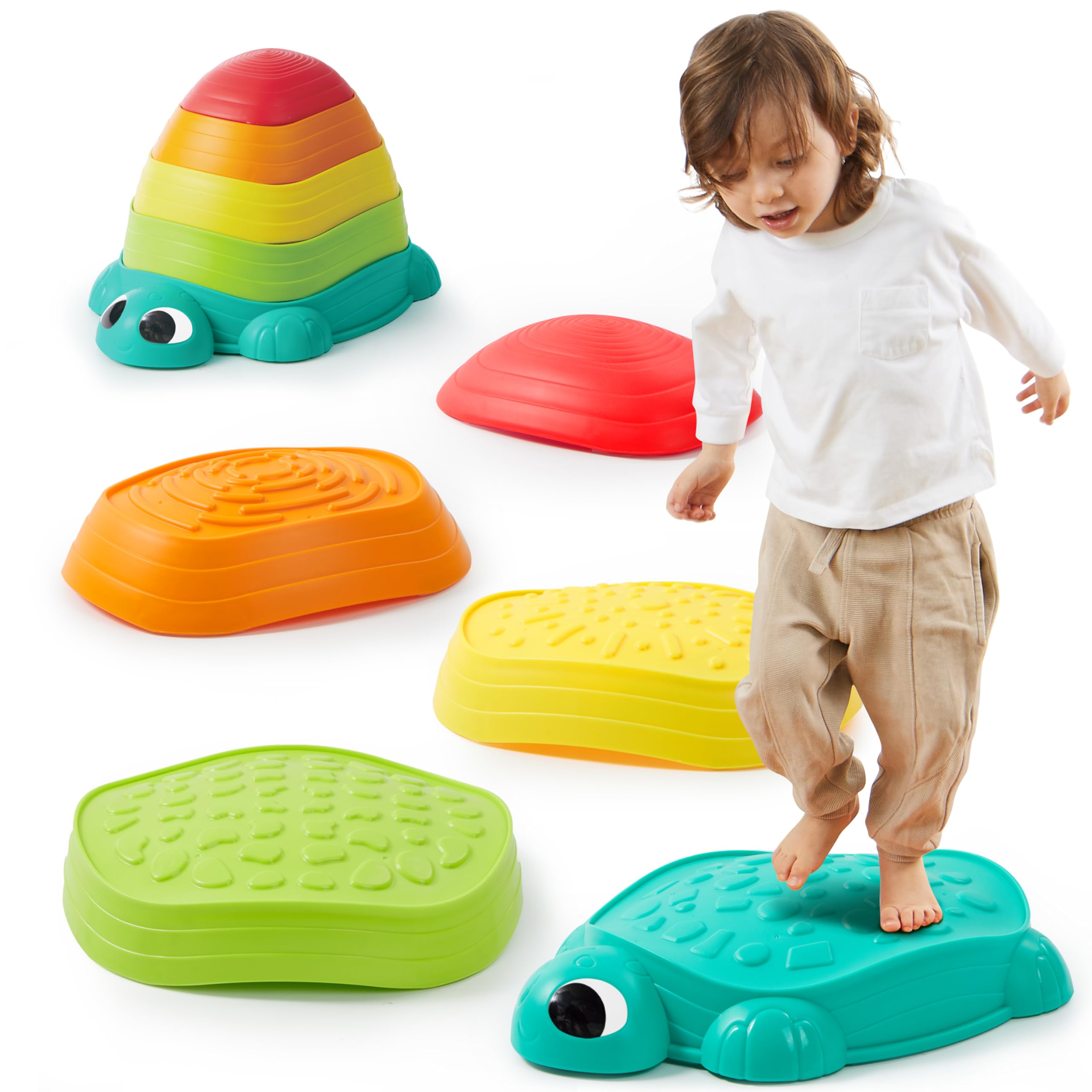
JOYIN’s turtle-themed stepping stones bring a playful themed element that younger children find immediately inviting. The stones are shaped like turtle shells with rounded green edges, and the reinforced PP plastic construction feels surprisingly dense for the weight. With a 265-pound weight capacity, this set is a rare budget-friendly option that still allows a parent to step on and demonstrate the game without fear of cracking the platform.
The stones feature a thick rubber bottom that grips aggressively on smooth floors—no sliding even during enthusiastic “floor is lava” jumps. They stack into a neat tower for storage, and the rounded edges eliminate any risk of tripping. Reviewers consistently note that the stones are sturdy enough for children to stand on one leg while balancing, and the turtle theme makes cleanup feel like part of the game rather than a chore.
Compared to the premium wooden wobble boards, these stones offer less variety of motion. They are stepping platforms only—no rocking, no sliding, no flexible movement. The themed shape is cute but limits visual matching games (all stones look the same), and the bright green color is very specific, so it won’t disappear into a neutral-toned room. For the price, though, the build quality and capacity are a strong value proposition.
Why it’s great
- High weight capacity for a budget-tier set
- Aggressive rubber grip prevents floor sliding
Good to know
- Single-color theme limits color-learning variety
- Stepping-only play; no rocking or dynamic motion
FAQ
At what age should I introduce a wobble board versus stepping stones?
Can a balance board help a child who struggles with coordination?
How do I prevent a wooden wobble board from splitting or warping?
Final Thoughts: The Verdict
For most users, the reliable balance board for kids winner is the NUTTY TOYS Wooden Wobble Board because its massive weight capacity, solid beech construction, and smooth finish make it the most versatile and long-lasting single board available. If you want a board that doubles as a family fitness tool, grab the WOOD CITY Wobble Board. And for a toddler-focused sensory obstacle course that encourages active stepping and color recognition, nothing beats the LoomLark Stepping Stones.