
Our readers keep the lights on and the weekend projects moving. As an Amazon Associate, I earn from qualifying purchases.
The most common mistake when hunting for a bargain telescope is chasing the highest magnification number printed on the box — that triple-digit claim is almost always marketing fluff. What actually determines whether you’ll see Saturn’s rings as a crisp oval or a blurry smudge is the aperture, the diameter of the main lens. A 70mm aperture collects enough light for satisfying lunar craters, but jump to 80mm or 90mm, and you unlock Jupiter’s cloud bands and the Orion Nebula’s glow. This guide cuts through the spec sheet noise to find the scopes that deliver real starlight where it counts.
I’m Rikta — the co-founder and writer behind FitlyFast. Every recommendation here is based on hours of cross-referencing technical specs like objective lens diameter, focal ratio, coating quality, and tripod stability against thousands of verified buyer experiences to identify the true standouts in the budget-friendly telescope space.
Whether you’re a curious beginner or shopping for a young stargazer, finding the right entry-level instrument means balancing light-gathering capability with ease of use. This guide was built to help you confidently pick the best bargain telescope for your sky.
How To Choose The Best Bargain Telescope
Choosing a budget telescope doesn’t mean settling for a blurry view. The key is to prioritize a stable mount and a large objective lens over inflated magnification claims. Below are the core considerations that separate a genuinely useful starter scope from a frustrating one.
Aperture: The Light-Collecting Boss
Measured in millimeters, the aperture (objective lens diameter) is the single most important spec. A larger aperture captures more light, directly translating to brighter, sharper images of faint celestial objects. For bargain telescopes, 70mm is the entry-level floor — 80mm and 90mm options offer significantly better views of the Moon, planets, and brighter deep-sky targets like the Orion Nebula.
Optical Coatings: Clarity in a Layer
Uncoated lenses lose a significant fraction of incoming light to reflection. Fully-coated or fully multi-coated (FMC) optics improve light transmission across the visible spectrum, increasing contrast and reducing glare. Always look for “fully coated” or “fully multi-coated” in the spec sheet — this is a hallmark of a telescope designed for clear viewing, not just a toy.
Mount and Tripod Stability: The Quiet Hero
A wobbly tripod undermines even the best optics. An alt-azimuth (up-down, left-right) mount on a sturdy stainless steel or aluminum tripod is ideal for beginners. Look for a tripod that adjusts to a comfortable height for adults (around 40 inches or more) — the biggest frustration with low-end scopes is a short stand forcing awkward crouching.
Quick Comparison
On smaller screens, swipe sideways to see the full table.
| Model | Category | Best For | Key Spec | Amazon |
|---|---|---|---|---|
| YENGUAN 90800 | Premium | Lunar & Planetary Detail | 90mm Aperture / 800mm FL | Amazon |
| Hawkko 900mm | Premium | Bright Deep-Sky Views | 90mm Aperture / 900mm FL | Amazon |
| MEEZAA 90800 | Premium | Complete Starter Kit | 90mm Aperture / 800mm FL | Amazon |
| HETEKAN 900mm | Premium | High Magnification Range | 90mm Aperture / 900mm FL | Amazon |
| Dianfan 90800 | Mid-Range | Upright Terrestrial & Lunar | 90mm Aperture / 800mm FL | Amazon |
| HUGERSTAR 80600 | Mid-Range | Beginner Value Bundle | 80mm Aperture / 600mm FL | Amazon |
| Dianfan 80500 | Mid-Range | Kid-Friendly Fun | 80mm Aperture / 500mm FL | Amazon |
| MEEZAA 80500 | Mid-Range | Family Camping Scope | 80mm Aperture / 500mm FL | Amazon |
| Gskyer 70400 | Entry-Level | First-Time Lunar Viewing | 70mm Aperture / 400mm FL | Amazon |
In‑Depth Reviews
1. YENGUAN 90mm Aperture 800mm Telescope
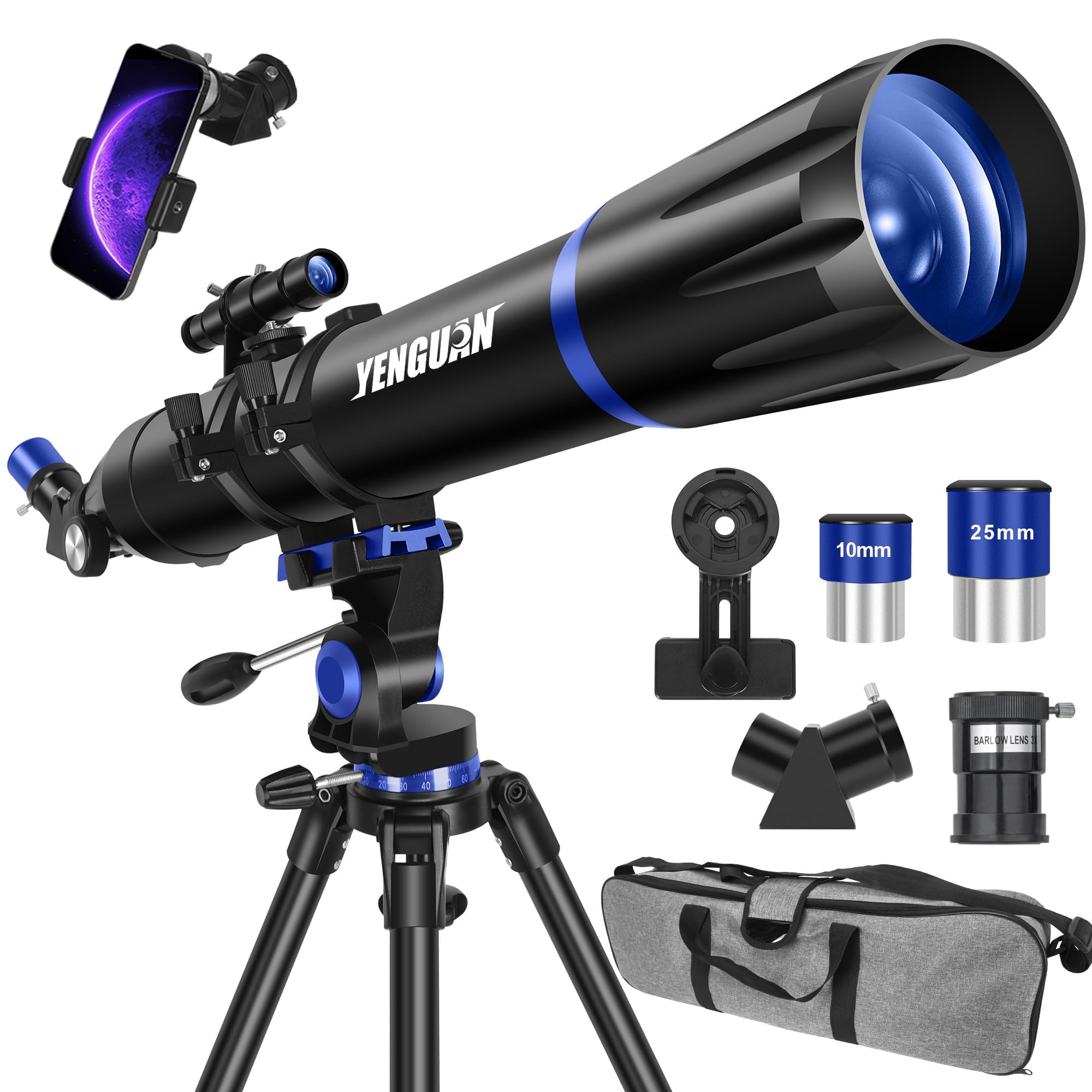
The YENGUAN 90800 commands the top spot thanks to its 90mm aperture and 800mm focal length — a combination that gathers significantly more light than the 70mm and 80mm competition. With fully coated multi-layer optics, it delivers crisp, high-contrast views of lunar craters and distinguishes Jupiter’s cloud bands, a feat entry-level scopes often fail to achieve.
Setup is tool-free, guided by a comprehensive manual, and the stainless steel tripod offers real stability for its price tier. The included 10mm and 25mm Kellner eyepieces pair with a 3X Barlow lens for flexible magnification, while the straight-through finder scope simplifies target acquisition. A smartphone adapter and padded carry bag round out the package.
One reviewer noted the tripod, while good, could be slightly more robust, and achieving perfect focus at high magnification requires patience. However, for the price, the YENGUAN punches well above its class. Beginners capturing their first image of Saturn’s rings will find this scope a rewarding investment.
Why it’s great
- Excellent 90mm aperture for bright, detailed planetary views
- Includes smartphone adapter for astrophotography
- Tool-free assembly and stable stainless steel tripod
Good to know
- Tripod stability is good but not premium-grade
- Manual focus can be slightly stiff initially
2. Hawkko 90mm Aperture 900mm Telescope

The Hawkko brings a 900mm focal length to the table, which translates to a longer optical tube and slightly higher native magnification potential than the 800mm designs. Its fully multi-coated (FMC) 90mm objective lens boosts light transmission by roughly 73%, and that extra light-gathering edge makes a noticeable difference when picking out detail on the Orion Nebula or resolving the Cassini Division in Saturn’s rings.
The mount is an alt-azimuth design on a stainless steel tripod with a smooth 360-degree rotation and an adjustable height range from 28 to 46 inches, comfortably fitting adults. Setup is under 15 minutes. The kit includes 25mm and 10mm Kellner eyepieces, a 3X Barlow lens, a straight-through finder scope, a 45-degree zenith mirror for upright terrestrial views, a smartphone adapter, and a carry bag.
Buyers consistently praise the image clarity and ease of assembly. The phone adapter works well for casual moon shots, though a remote trigger is recommended to avoid vibration blur. The Hawkko is a superb choice for someone ready to move past the Moon and start hunting for bright deep-sky objects.
Why it’s great
- 90mm FMC lens with excellent light transmission ratings
- 900mm focal length offers great native magnification
- Smooth alt-azimuth mount with 46-inch max height
Good to know
- Shipping issues reported by a few buyers
- Phone adapter requires steady hands for sharp photos
3. MEEZAA 90mm Aperture 800mm Telescope

The MEEZAA 90800 offers the same 90mm aperture and 800mm focal length as the YENGUAN but at a slightly lower price point, making it a strong value contender. The fully multi-coated optics minimize chromatic aberration effectively, delivering crisp lunar views where the terminator line reveals mountainous crater rims in stark relief. The f/8.88 focal ratio is forgiving for collimation and works well with budget eyepieces.
This model comes with an adjustable stainless steel tripod ranging from 28 to 46 inches, a 45-degree zenith mirror, and a 5×24 finder scope. The kit bundles 10mm and 25mm eyepieces, a 3X Barlow lens, a smartphone adapter, and a padded carry bag that stores everything neatly. Assembly takes about 10 minutes per the manual, and the mount’s slow-motion controls are smooth enough for fine adjustments.
Users frequently mention the sturdy build and the fact that the metal tube doesn’t flex in a breeze, a common issue with cheaper aluminum tubes. The standard Kellner eyepieces are serviceable but upgrading to a Plössl eyepiece can further sharpen the image. For a beginner wanting a no-compromise entry point that won’t need replacing after one season, the MEEZAA is a very smart buy.
Why it’s great
- Rigid stainless steel tripod and metal tube construction
- Versatile magnification range from 32X to 240X
- Includes all accessories for first-night use
Good to know
- Basic Kellner eyepieces can be upgraded for better views
- No motorized tracking included
4. HETEKAN 90mm Aperture 900mm Telescope
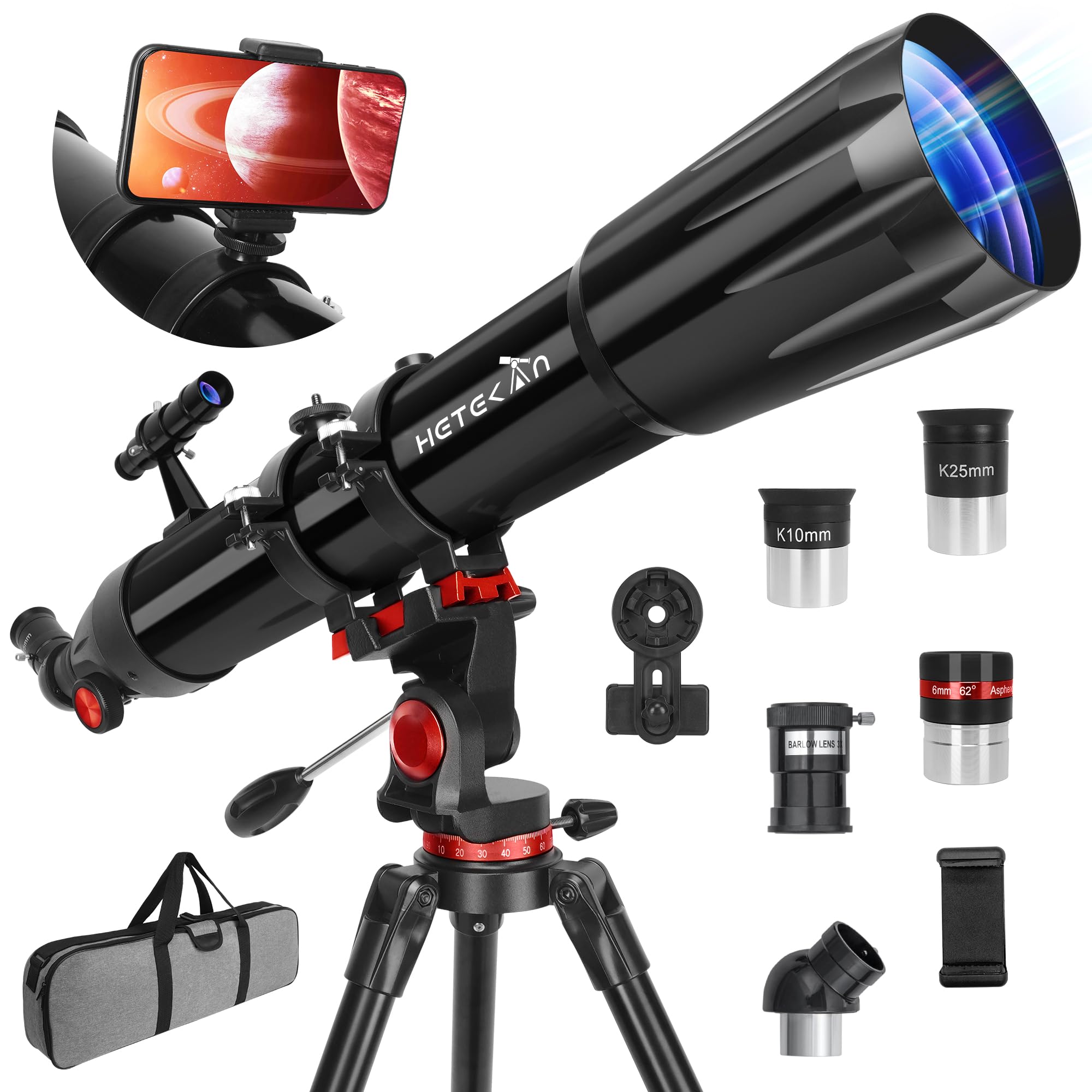
The HETEKAN stands out for its 900mm focal length and the inclusion of three eyepieces — 25mm, 10mm, and 6mm — paired with a 3X Barlow lens for a theoretical magnification range of 36X to 450X. In practice, 450X exceeds the useful limit for a 90mm scope under average atmospheric conditions, but the 6mm eyepiece alone provides a solid 150X for close-up lunar and planetary study. The fully multi-coated optics produce bright, clean images.
The stainless steel tripod adjusts from 29 to 46 inches and features a built-in accessory tray. The kit also includes a 5×24 finder scope, a 45-degree zenith mirror, a smartphone adapter, a stargazing-specific phone mount, and a carry bag. Setup is uncomplicated, though the instruction manual could be clearer for absolute novices.
One recurring note from buyers is that the “Sky Tonight” app promoted for phone use requires a subscription, which can feel like a hidden cost. The 6mm eyepiece, while a nice addition, offers a very small field of view that can be challenging for beginners. That said, the optical quality for the price is notable, and the extra eyepiece provides flexibility as skills grow.
Why it’s great
- Three eyepieces offer immediate magnification flexibility
- Large 900mm focal length for high-magnification potential
- Sturdy tripod with accessory tray
Good to know
- Instruction manual could be more beginner-friendly
- Promoted app requires a subscription fee
5. Dianfan 90mm Aperture 800mm Telescope

The Dianfan 90×800 brings strong optical performance in a lightweight package. The 90mm fully coated objective lens provides bright, vivid images, and the 45-degree zenith mirror corrects orientation for comfortable daytime terrestrial viewing — making it a dual-purpose scope for wildlife and night sky observation. The alt-azimuth mount is intuitive, with slow-motion adjustment rods that make tracking planets less of a chore.
Assembly is straightforward, with most users up and running in 15 minutes. The stainless steel tripod feels solid, and the included carry bag is generously sized. The kit includes 25mm and 10mm eyepieces, a 3X Barlow lens, a straight-through finder scope, and a smartphone adapter. Buyers consistently highlight the clear views of lunar craters and the ability to spot Saturn’s rings on a steady night.
Some users note that the straight-through finder scope produces an inverted image, which is standard for this price tier but can confuse beginners. A right-angle correct-image finder is a worthwhile future upgrade. The mount’s slow-motion cables are plastic but function well. Overall, the Dianfan offers a balanced mix of portability and capability for the aspiring astronomer.
Why it’s great
- 45-degree zenith mirror for comfortable terrestrial use
- Lightweight and easy to transport to dark-sky sites
- Stainless steel tripod with slow-motion controls
Good to know
- Finder scope image is inverted (standard for this level)
- Slow-motion cables are plastic
6. HUGERSTAR 80mm Aperture 600mm Telescope
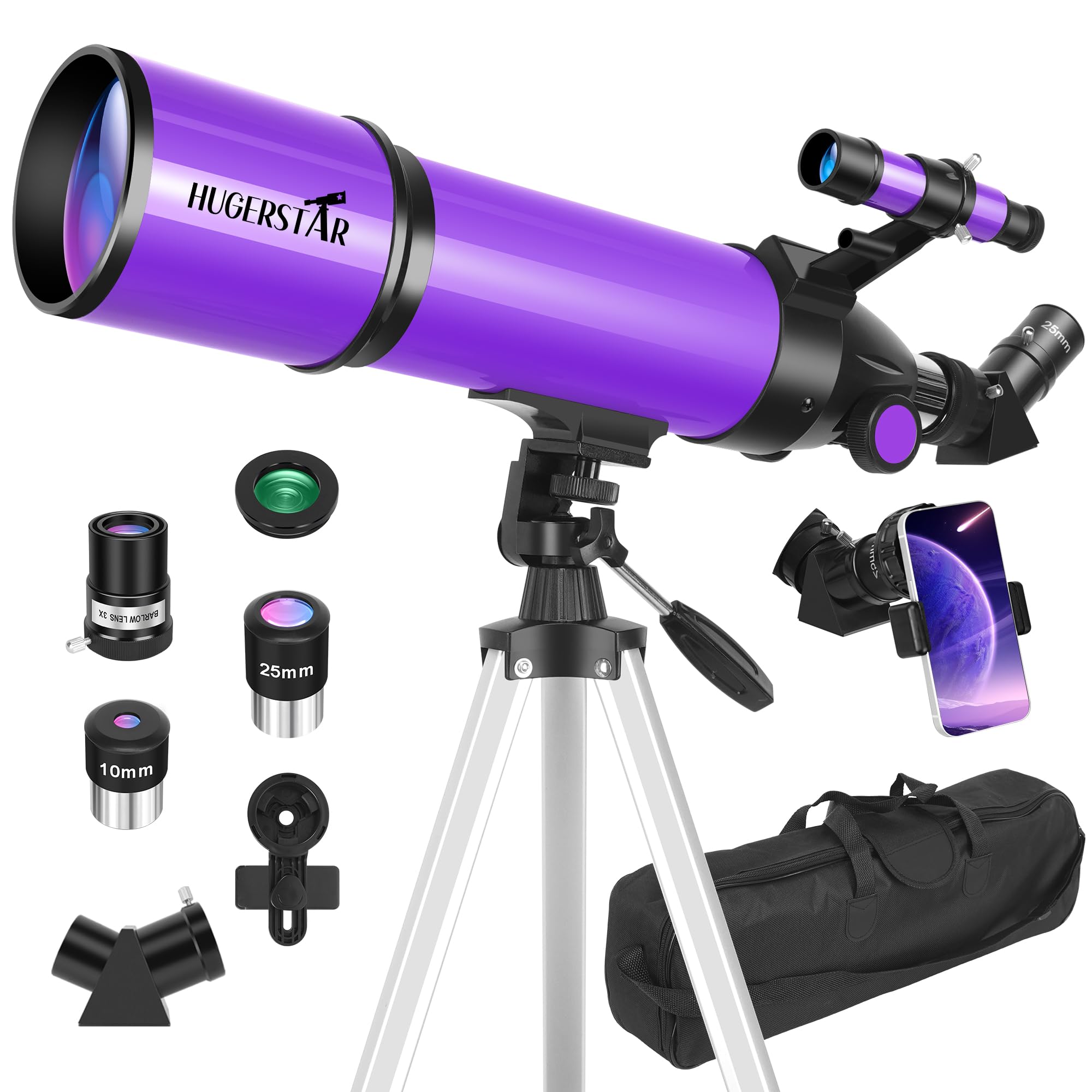
The HUGERSTAR 80600 is an excellent mid-range option that correctly prioritizes aperture at 80mm over inflated magnification numbers. The 600mm focal length at f/7.5 provides a wider field of view than the 800mm and 900mm scopes, making it easier to locate objects and enjoy sweeping lunar landscapes. The fully multi-coated optics deliver bright, high-contrast images with minimal chromatic aberration for the price.
This kit stands out for its inclusion of a moon filter, which reduces glare from the bright lunar surface and improves contrast for crater detail. The adjustable aluminum tripod ranges from 21.2 to 44 inches, and the alt-azimuth mount is smooth. It includes 25mm and 10mm Kellner eyepieces, a 3X Barlow lens, a 5×24 straight-through finder scope, a smartphone adapter, and a carry bag.
Buyers, including many who are tall adults, appreciate that the tripod’s top height allows comfortable standing viewing. The main drawback is the need for better instructions — some users found the manual sparse on how to best use all the components. For a family looking to share the wonder of the night sky without breaking the bank, the HUGERSTAR is a compelling choice.
Why it’s great
- Included moon filter improves lunar viewing experience
- 80mm aperture with fully multi-coated optics for bright views
- Tripod extends high enough for comfortable adult use
Good to know
- Instruction manual lacks detail for new users
- Finder scope is a basic straight-through design
7. Dianfan 80mm Aperture 500mm Telescope
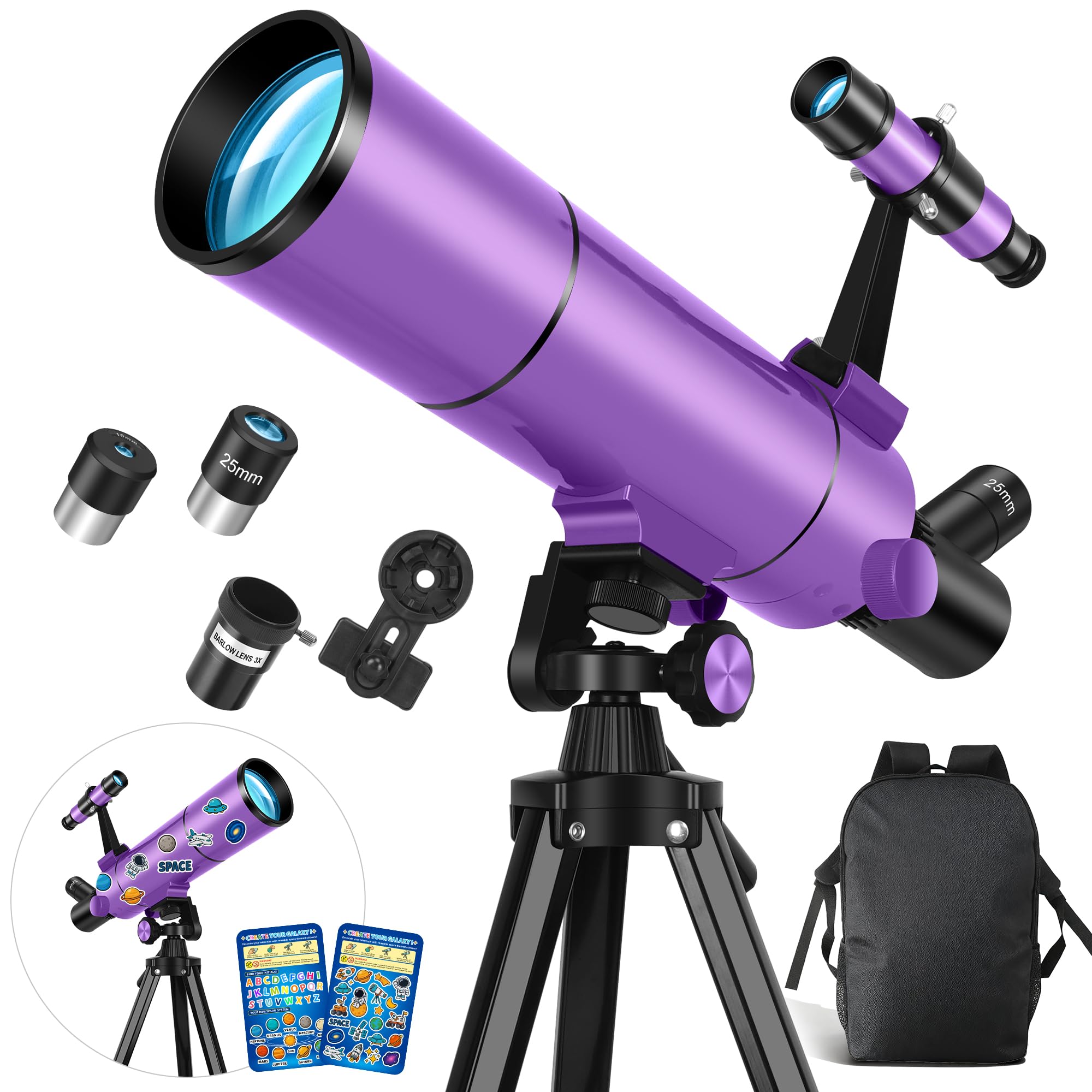
The Dianfan 80500 is purpose-built to engage younger astronomers. The vibrant purple design and included reusable space stickers let kids personalize the scope, turning the setup process into a fun activity. But beneath the playful exterior is a solid 80mm refractor with a 500mm focal length and fully multi-coated optics, capable of delivering clear lunar views and glimpses of Jupiter’s moons.
The kit includes 25mm and 10mm eyepieces, a 3X Barlow lens, a straight-through finder scope, a smartphone adapter, and a custom-fit backpack for easy transport. Assembly is tool-free and takes about 15 minutes. The alt-azimuth mount on an aluminum tripod is simple enough for children to operate with minimal adult supervision, and the 45-degree diagonal makes the eyepiece accessible for smaller users.
Reviewers note that the “high powered” claim of 150X magnification is usable under good conditions, but the scope shines at lower magnifications for wide-field stargazing. The backpack is a real plus for camping trips. The included finder scope, while basic, is adequate for getting started. This is the best option for parents wanting a scientifically genuine instrument that also appeals to a child’s sense of ownership and fun.
Why it’s great
- Kid-friendly purple design with custom stickers included
- Portable backpack makes it perfect for family trips
- Genuine 80mm fully coated optics for real stargazing capability
Good to know
- Best performance at lower magnifications
- Plastic focuser can feel slightly loose
8. MEEZAA 80mm Aperture 500mm Telescope
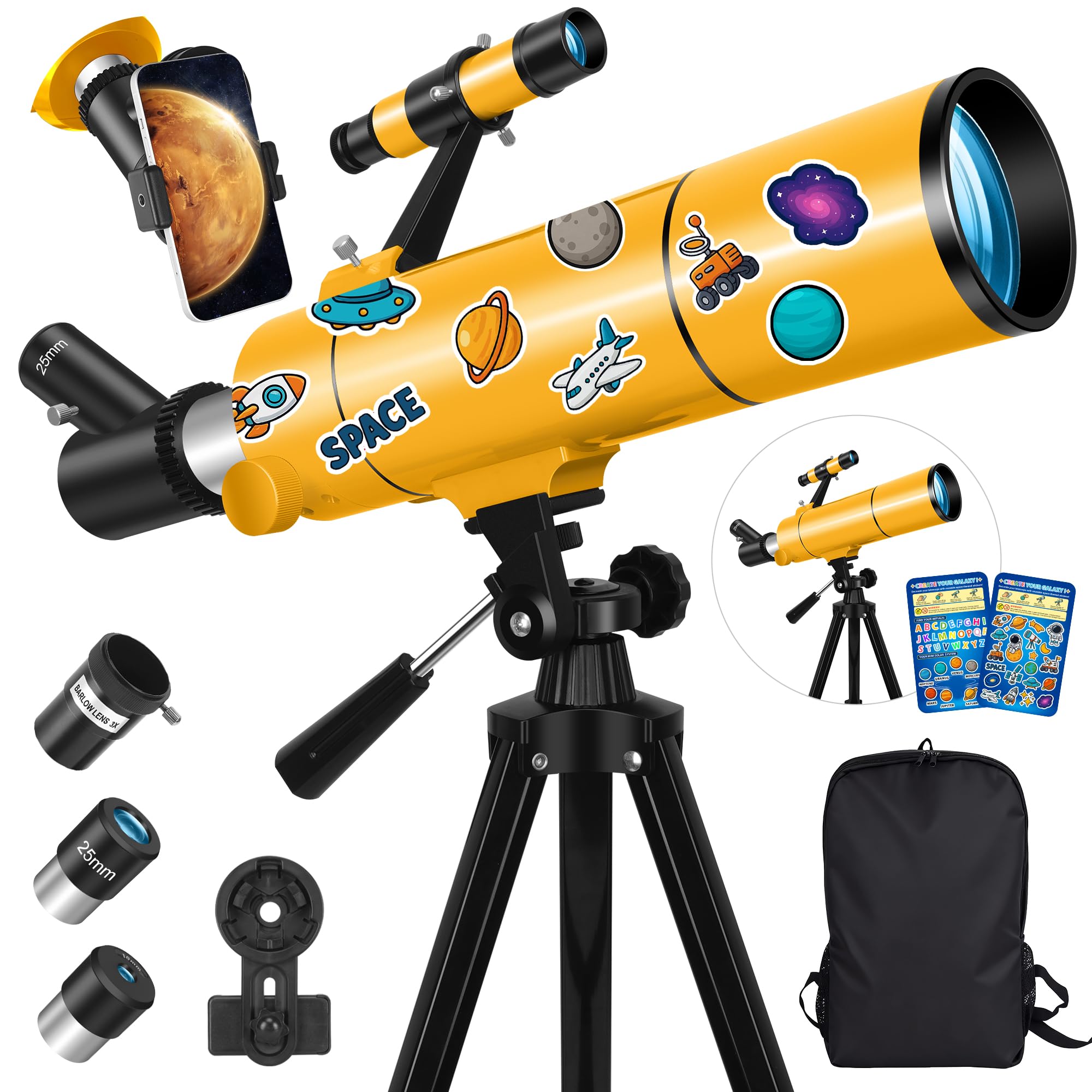
The MEEZAA 80500 is a thoughtfully assembled all-in-one kit that prioritizes portability without sacrificing optical quality. The 80mm aperture and 500mm focal length create a compact optical tube that pairs perfectly with the included waterproof backpack, making it an excellent companion for hikes, camping, and backyard star parties. The fully multi-coated optics produce sharp, bright images ideal for lunar observation and brighter planets.
The kit includes 25mm and 10mm Kellner eyepieces, a 3X Barlow lens, a 5×24 finder scope, a 45-degree zenith mirror, a stable aluminum tripod adjustable from roughly 17 to 44 inches, a smartphone adapter, and colorful space stickers for personalization. The no-tools assembly is simple, and the alt-azimuth mount operates smoothly. The inclusion of a 45-degree diagonal ensures upright images for daytime nature viewing.
User feedback consistently highlights how easy it is to take this scope on the go. The waterproof backpack keeps everything organized and protected. As with other 500mm focal length scopes, maximum useful magnification for planetary detail is somewhat limited compared to longer-tube designs. For families who value mobility and want a scope that will genuinely get used on weekend adventures, the MEEZAA 80500 is a strong pick.
Why it’s great
- Waterproof backpack is designed for real outdoor transport
- 80mm fully multi-coated optics in a compact, portable tube
- All-in-one kit with no additional purchases needed
Good to know
- 500mm focal length limits high-power planetary observation
- Basic finder scope can be tricky for very young users
9. Gskyer 70mm Aperture 400mm Telescope

The Gskyer 70400 is a classic entry-level refractor that has introduced countless beginners to the hobby. With a 70mm aperture and a short 400mm focal length (f/5.7), it provides a wide field of view ideal for scanning the Moon and bright star clusters. The fully coated optics do a good job for the price, revealing dozens of lunar craters and Jupiter’s four Galilean moons as distinct points of light. It includes 25mm and 10mm eyepieces and a 3X Barlow lens for magnification up to 120X.
The standout accessory is the wireless camera remote and smartphone adapter, which allow hands-free phone photography of the Moon — a feature that significantly boosts the fun factor for younger users. The aluminum alloy tripod is lightweight and adjustable, fitting inside the included carry bag alongside the optical tube. Assembly is simple, with clear instructions. The finder scope uses a reflex design, projecting a red dot onto a window for aiming.
Be realistic: the 70mm aperture is the entry-level floor. Under moderate light pollution, faint galaxies and nebulae will remain invisible, and planetary detail is soft. A common complaint is the short tripod, which forces adults to crouch. Still, as a first telescope for a child or a casual moon-watcher, the Gskyer offers genuine utility and a very low barrier to entry. The wireless remote is a unique inclusion at this price point.
Why it’s great
- Wireless remote enables easy smartphone moon photography
- Lightweight and packs into a small carry bag
- Genuine 70mm fully coated optics for a true first experience
Good to know
- 70mm aperture limits views to the Moon and brightest planets
- Tripod is short and uncomfortable for adults to use
FAQ
Can I see Saturn’s rings with a 70mm budget telescope?
Why do bargain telescopes advertise 300X or 450X magnification?
Do I need a Barlow lens for a bargain telescope?
Final Thoughts: The Verdict
For most users, the best bargain telescope winner is the YENGUAN 90mm 800mm Telescope because it combines the largest entry-level aperture with a stable stainless steel tripod and a complete accessory kit at an unbeatable value. If you want a scope with a longer focal length for high-magnification planetary study, grab the Hawkko 90mm 900mm Telescope. And for a portable kit that easily goes on family adventures, nothing beats the HUGERSTAR 80mm 600mm Telescope.