
Our readers keep the lights on and the weekend projects moving. As an Amazon Associate, I earn from qualifying purchases.
Choosing a battery for your home solar system is less about brand loyalty and more about matching chemistry, cycle life, and communication protocols to your inverter and energy goals. A mismatch between your battery’s voltage and your solar charge controller’s input range, or ignoring the BMS’s low-temperature cutoff threshold, can turn a promising energy upgrade into a costly paperweight.
I’m Rikta — the co-founder and writer behind FitlyFast. I’ve spent over a decade analyzing how solar battery specs like continuous discharge amps, BMS communication stacks (CAN/RS485), and cycle life at depth of discharge (DoD) translate to real-world solar storage performance.
This guide breaks down the core specs, chemistry, and safety features to evaluate when selecting the best batteries for home solar systems, helping you avoid expensive compatibility mistakes.
How To Choose The Best Batteries For Home Solar
Selecting a home solar battery involves more than just comparing watt-hours. The three non-negotiable factors are chemistry (LiFePO4 is the clear winner for cycle life and safety), a robust BMS, and communication protocol compatibility with your inverter (CAN/RS485).
Battery Chemistry: LiFePO4 vs. Lead-Acid
LiFePO4 offers a usable depth of discharge up to 100% and over 4,000 cycles, making it far more cost-effective than lead-acid, which suffers from sulfation at 50% DoD and typically only lasts 500 cycles. The higher upfront cost of LiFePO4 is offset by a lower total cost of ownership over a decade of service.
The BMS and Temperature Cutoff
A built-in BMS protects against overcharge, over-discharge, and short circuits. For cold climates, a low-temperature charging cutoff (typically below 32°F) is essential to prevent permanent cell damage. Many mid-range and premium batteries include this feature, but cheap batteries often omit it.
Quick Comparison
On smaller screens, swipe sideways to see the full table.
| Model | Category | Best For | Key Spec | Amazon |
|---|---|---|---|---|
| Growatt HELIOS 2-Pack | Premium | Whole-home 240V backup | 7200W continuous AC output | Amazon |
| Anker SOLIX F3800 | Premium | High-wattage home backup | 6000W dual-voltage output | Amazon |
| EcoFlow DELTA Pro | Premium | Expandable home storage | 3600Wh, X-Boost 4500W | Amazon |
| Jackery HomePower 3000 | Premium | Lightweight home backup | 59.5 lbs, 3072Wh, 7200W surge | Amazon |
| SaiJiaoYang 314Ah | Premium | Large DIY off-grid system | 51.2V, 200A BMS, parallel up to 15 | Amazon |
| AOUSK 48V 2-Pack | Mid-Range | Server rack solar storage | 10.24kWh, CAN/RS485 | Amazon |
| Litime 460Ah 2-Pack | Mid-Range | Large-capacity 12V bank | 5888Wh, 250A BMS | Amazon |
| HumsiENK 24V 320Ah | Mid-Range | Space-saving 24V solar builds | 8192Wh, 200A BMS, Bluetooth | Amazon |
| Jackery Explorer 2000 v2 | Mid-Range | Compact home & camping backup | 2042Wh, 39.5 lbs, 20ms UPS | Amazon |
| VTOMAN FlashSpeed 2400 | Mid-Range | Fast-recharge emergency power | 1408Wh, 1-hour charge, 2400W | Amazon |
| PECRON F3000LFP | Mid-Range | Portable high-capacity power station | 3072Wh, 3600W, 2-hour charge | Amazon |
| ECO-WORTHY 280Ah 2-Pack | Budget-Friendly | Budget 12V RV & solar setup | 3584Wh, metal case, Bluetooth | Amazon |
| VATRER POWER 48V 100Ah | Budget-Friendly | Entry-level 48V off-grid battery | 5.12kWh, BMS with APP | Amazon |
In‑Depth Reviews
1. GROWATT HELIOS 3600 2-Pack
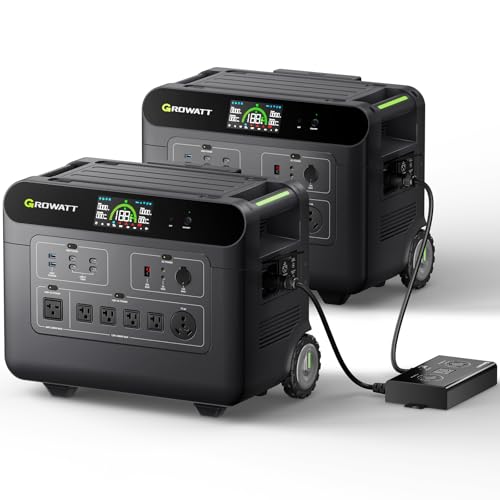
The GROWATT HELIOS 2-pack delivers 7200W of continuous AC output at both 120V and 240V, which is enough to power a well pump, air conditioner, and full kitchen circuit simultaneously. Each unit packs 3600Wh of LiFePO4 capacity, and the system expands to 36kWh with extra batteries, offering true whole-home backup without needing a transfer switch.
The built-in split-phase hub makes paralleling the two units truly plug-and-play, and the <15ms EPS switchover means critical loads like routers and medical devices never flicker. Users report running an 8,000 BTU AC for roughly five hours on a single charge, and the combination of AC and solar charging can bring the pair to full in about 1.5 hours.
At 250 pounds total, the units are heavy but include integrated handles and optional wheel kits for mobility. Some buyers noted initial Bluetooth connectivity hiccups, but GROWATT’s US-based customer service quickly resolved issues, including replacing shipping-damaged units. The cold-start technology down to -22°F also ensures reliable winter operation.
Why it’s great
- True 240V split-phase for whole-house backup without extra equipment
- Expandable to 36kWh for multi-day outages
- Fast hybrid AC+solar charging to 100% in under 2 hours
Good to know
- Combiner hub disables EPS pass-through when in 240V mode
- APP interface has low-contrast text and long translations
- Very heavy at 250 lbs total; wheel kit is essentially required
2. Anker SOLIX F3800

The Anker SOLIX F3800 is a beast at 132 pounds, but its 6000W AC output (dual voltage 120V/240V) through a NEMA 14-50 port can directly charge an EV—no grounding hacks needed. The base 3.84kWh capacity expands up to 26.9kWh with additional battery packs, and pairing two F3800 units pushes maximum AC output to 12,000W.
It uses EV-grade LFP cells with Anker’s InfiniPower technology, which is rated for a 10-year lifespan. The built-in BMS includes low-temperature charging cutoff, but users report that below 50°F the charging power is throttled to roughly 700W, which may be a limitation for winter off-grid setups. The proprietary MPPT is also optimized for Anker panels—third-party solar can still work, but achieving the max 2400W solar input is difficult.
Users with home transfer switches found it effortless to connect, and the 20ms UPS transition is fast enough to keep computers running. Downside: the app lacks time-of-use charging schedules and a detailed energy tracking dashboard, which power users may find restrictive. Customer service received mixed reviews regarding firmware update requirements.
Why it’s great
- 6000W AC output with direct EV charging via NEMA 14-50
- 5-year warranty and 10-year battery lifespan
- Stackable capacity up to 26.9kWh
Good to know
- Charging power is throttled to ~700W below 50°F
- Proprietary MPPT limits third-party solar panel efficiency
- Heavy at 132 lbs; app lacks advanced scheduling features
3. EF ECOFLOW DELTA Pro
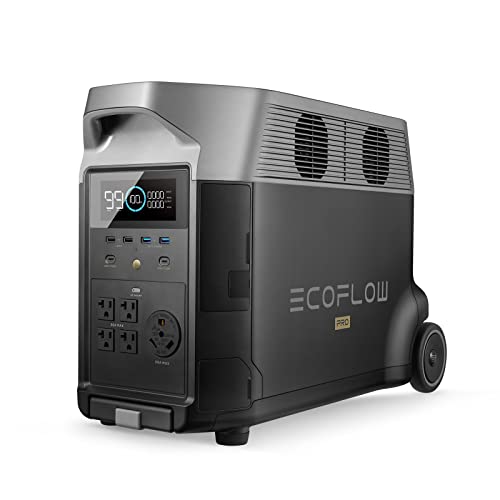
The EcoFlow DELTA Pro offers a modular ecosystem that starts at 3600Wh and scales up to 25kWh with extra batteries. Its X-Boost technology allows a single unit to deliver up to 4500W—enough to start a refrigerator compressor or power a circular saw—while the standard 3600W continuous output runs 99% of household devices via five 120V AC outlets.
X-Stream charging is exceptionally fast: full recharge in 1.8 hours via a 240V outlet, or 2.7 hours from a standard wall outlet. The unit can also accept up to 1600W of solar input, recharging fully in about 2.8 hours with four 400W panels. The smart app controls allow complete input/output customization and real-time monitoring of charge levels and temperature.
Weighing 99 pounds, the DELTA Pro is more manageable than the Anker F3800 and features a robust handle. Users running small mobile businesses (vendor markets, event photography) praise its silent operation and ability to run heat presses without voltage sag. The quiet cooling fans are a welcome upgrade from earlier EcoFlow models.
Why it’s great
- X-Stream charging fully recharges in under 2 hours on 240V
- Modular expandability from 3.6kWh to 25kWh
- X-Boost handles 4500W surges for starting motors
Good to know
- Extra batteries are expensive and proprietary
- Does not provide 240V split-phase without extra hub
- At 99 lbs, it still requires two people or a dolly to move
4. Jackery HomePower 3000
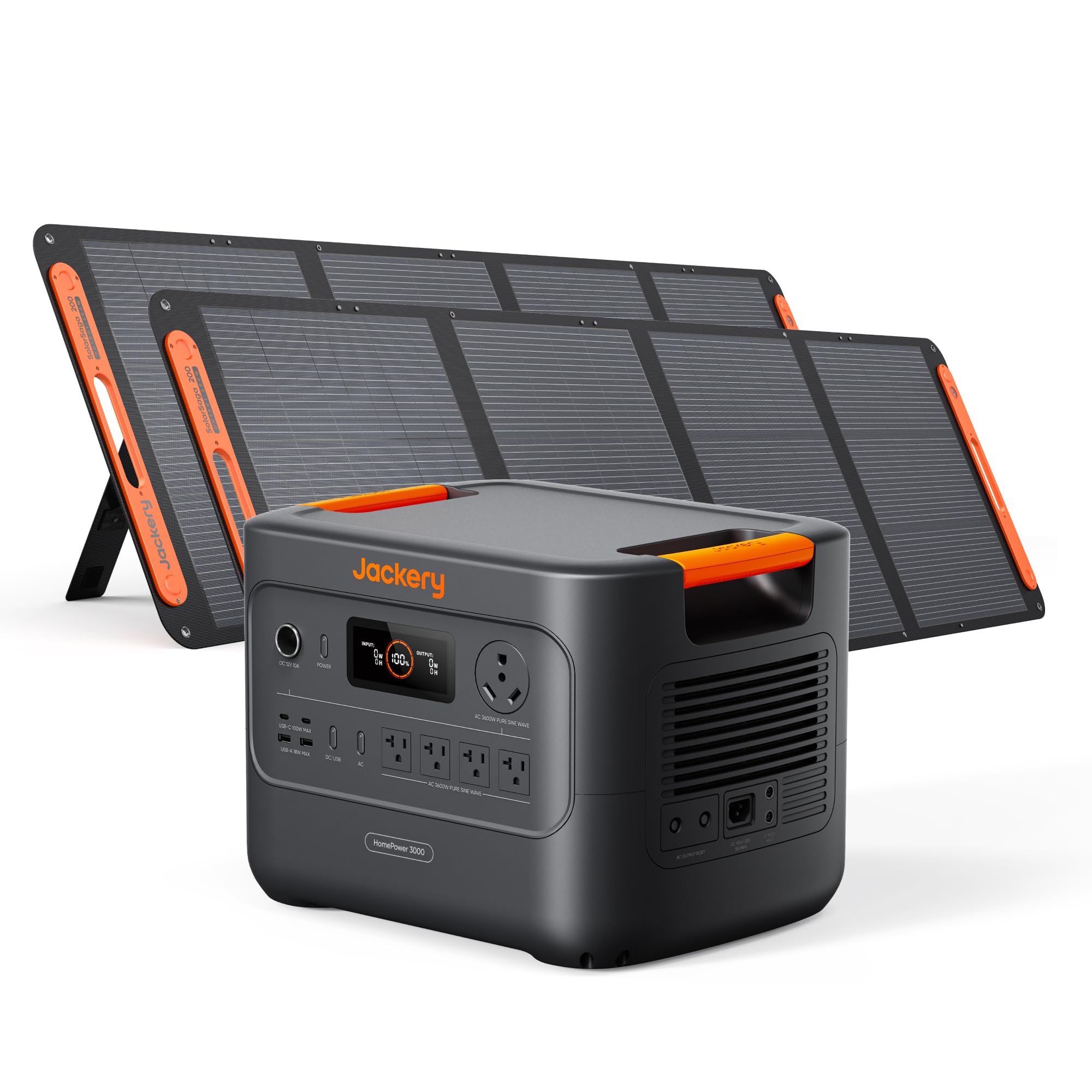
The Jackery HomePower 3000 stands out as the world’s lightest 3kWh-class portable power station, weighing only 59.5 pounds thanks to its Cell-to-Body (CTB) technology. This design integrates the battery cells directly into the structural shell, boosting space efficiency by 14% and reducing overall volume by 47% compared to similarly rated units.
It delivers 3600W continuous output (7200W surge) through a full complement of ports, including dual USB-C 100W PD, a TT-30 RV port, and standard AC outlets. The ChargeShield 2.0 AI algorithm extends the LFP battery’s lifespan to 4,000 cycles at 70% capacity retention. The built-in ≤20ms UPS is UL-certified and seamlessly powers critical loads during grid failures.
Real-world users confirm it runs a refrigerator for 1–2 days and keeps Wi-Fi, lights, and TV running overnight. The solar panel input (up to 400W) takes roughly 6 hours for a full charge on a sunny day. The included 200W panels have solid output, but the unit’s lack of expansion ports means you cannot add extra battery packs later—a limitation for future-proofing.
Why it’s great
- Unmatched portability at 59.5 lbs for a 3kWh unit
- 4000-cycle LFP battery with ChargeShield smart management
- UL-certified ≤20ms UPS and built-in TT-30 RV port
Good to know
- Capacity cannot be expanded with additional batteries
- 400W solar input is lower than many competitors
- Very heavy for one person despite being lightest in class
5. SaiJiaoYang 51.2V 314Ah
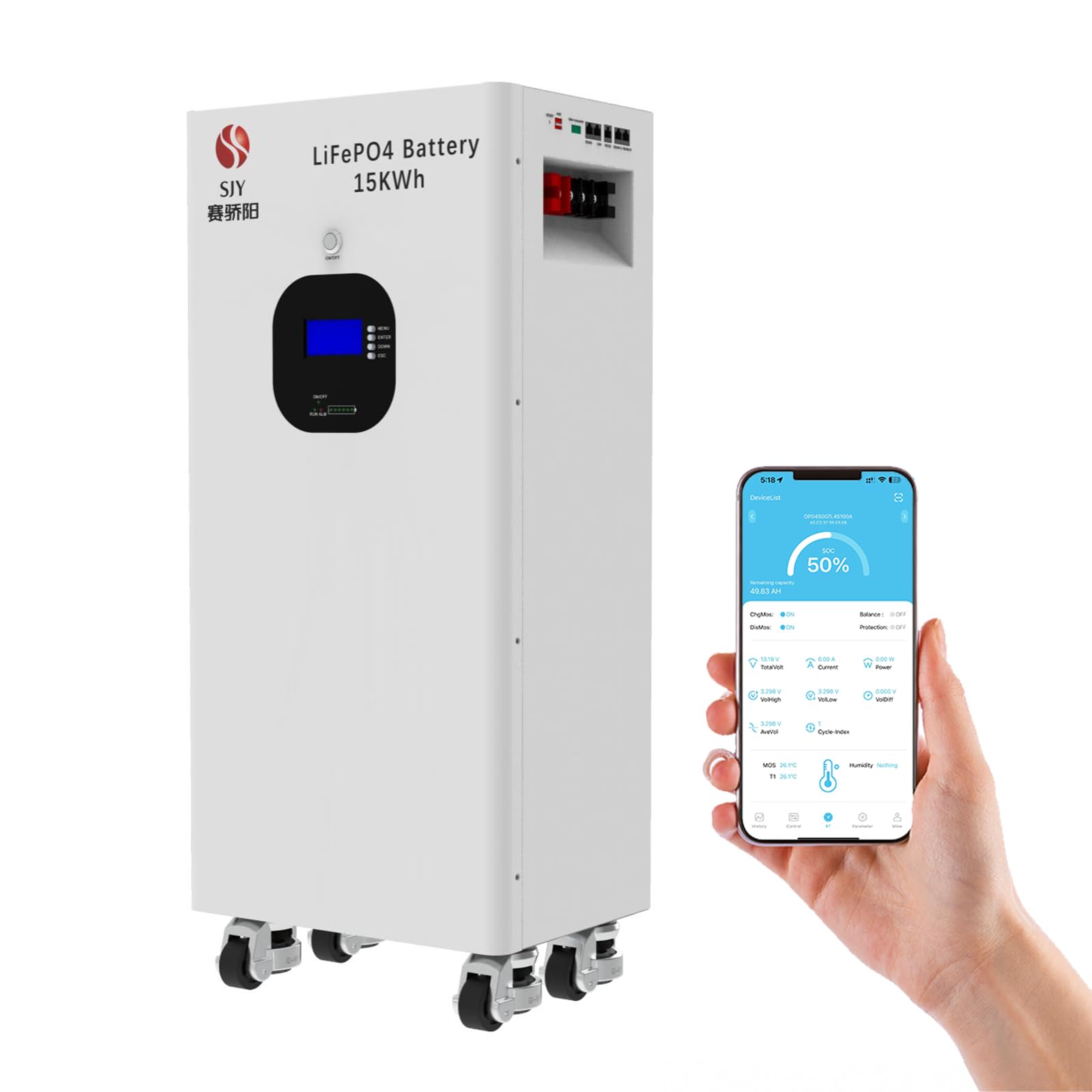
The SaiJiaoYang 314Ah is a 16kWh 48V server-rack battery designed for large DIY solar installations. It uses brand new Grade A prismatic LFP cells with a built-in 200A BMS that supports CAN and RS485 communication protocols, making it compatible with popular inverters from Growatt, Victron, SMA, Pylontech, and Lux Power Tek.
Capacity testing confirms the unit delivers over 15.3 kWh of usable energy, and the BMS allows up to 15 batteries in parallel for a maximum system size of 240kWh. The LCD screen enables protocol switching without a laptop, and the Bluetooth app provides cell-level voltage monitoring. The battery ships in a heavy-duty wooden crate weighing nearly 250 kg and requires freight delivery.
Users integrating with EG4 6000XP inverters report smooth communication via the Pylon protocol, though one note that the state-of-charge reading jumps from 85% to 100% during charging, which is a firmware characteristic rather than a defect. The included power cables are sufficient for 100A constant draw, but anyone planning 200A peaks should upgrade to custom cables.
Why it’s great
- 16kWh of usable capacity with premium Grade A LFP cells
- Supports CAN/RS485 for broad inverter compatibility
- LCD screen with protocol switching and Bluetooth cell monitoring
Good to know
- High center of gravity; must be securely strapped down
- Included power cables are undersized for 200A peak load
- Freight shipping requires a liftgate and careful handling
6. AOUSK 48V 200Ah (2-Pack)
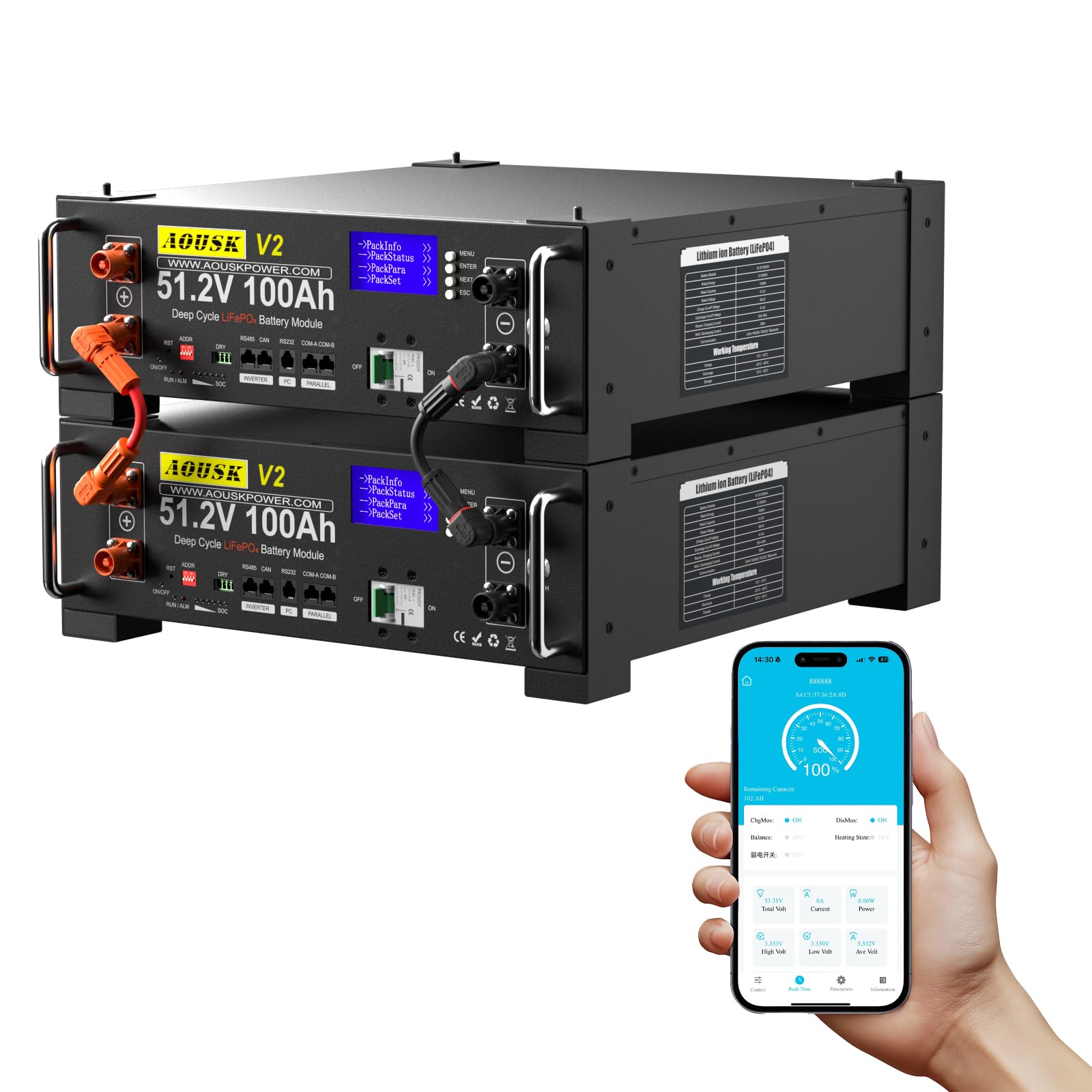
The AOUSK 48V 200Ah system comes as two 100Ah server-rack batteries that deliver a combined 10.24kWh of energy. Each unit fits standard 3U cabinets and weighs only 94.8 pounds, making them easier to handle than monolithic high-capacity batteries. The built-in 100A BMS includes a 125A air switch for additional safety.
Communication supports both CAN and RS485, allowing seamless integration with popular all-in-one inverters. The mobile app gives real-time status of each cell’s voltage and temperature. The package includes parallel cables, communication cables, grounding wires, and terminal covers—everything needed to get started out of the box.
Users report the batteries arrived perfectly packaged and balanced within a few millivolts of each other. The smart touch display and one-touch ON/OFF switch simplify daily operation. The main downside: the dual-terminal design on the earlier version could not accommodate larger cable lugs (2/0 or 4/0) without modifications. The newer version appears to have addressed this, but check the terminal design before ordering.
Why it’s great
- 10.24kWh total capacity in two manageable rack-mount units
- Full accessory kit included for immediate installation
- 5-year warranty with app-based cell monitoring
Good to know
- Earlier version had terminal lug compatibility issues
- 100A BMS may be limiting for high-draw inverters
- Parallel expansion beyond 2 units can get expensive
7. Litime 460Ah 2-Pack
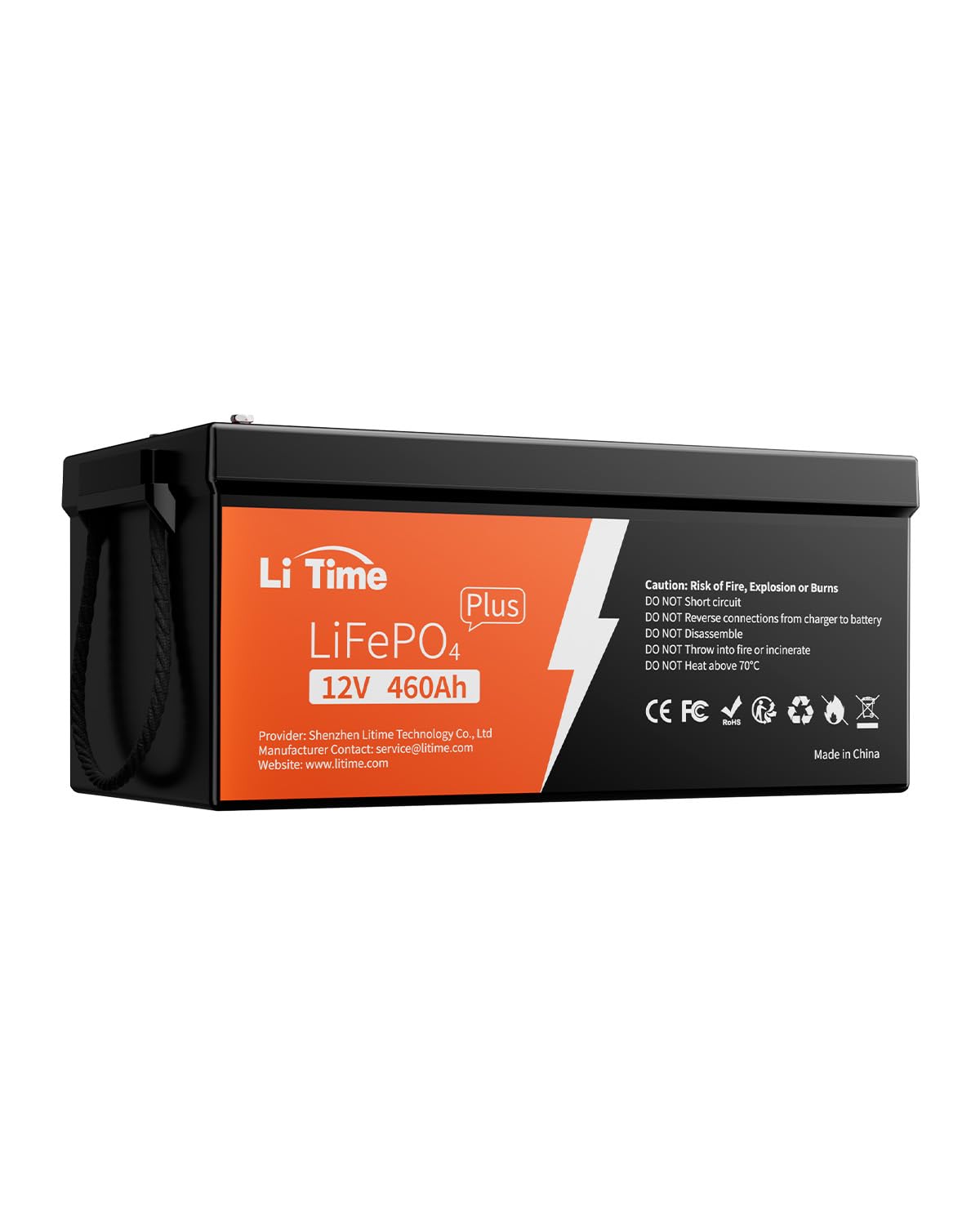
The Litime 460Ah 2-Pack provides a massive 5888Wh of 12V storage with a powerful 250A BMS. This is ideal for high-current setups like marine trolling motors, large RV inverters, or 12V-based off-grid solar systems where you need sustained high discharge rates without voltage sag.
The cells are EV-grade and ETL-tested, ensuring safety and stability over the 15,000+ cycle rating at 60% depth of discharge. Users running Victron MultiPlus inverters with 1.4kW of solar report excellent BMS behavior and no nuisance shutdowns. The Group 8D form factor is a direct drop-in replacement for large lead-acid batteries, making upgrades straightforward.
One longevity concern: a user reported a battery failing after 2.5 years (well short of the advertised lifespan), which highlights the importance of buying from a brand with responsive customer support. Also, the OT terminals require gaskets—if the screw lug rings are thinner than 2mm, add washers to prevent overheating and loosening.
Why it’s great
- 5888Wh capacity in a standard Group 8D footprint
- 250A BMS handles heavy loads (trolling motors, inverters)
- 100% depth of discharge with no sulfation risk
Good to know
- Some reports of premature failure after 2+ years
- OT terminals need extra gaskets for thin lugs
- Heavy at 86 lbs per battery
8. HumsiENK 24V 320Ah
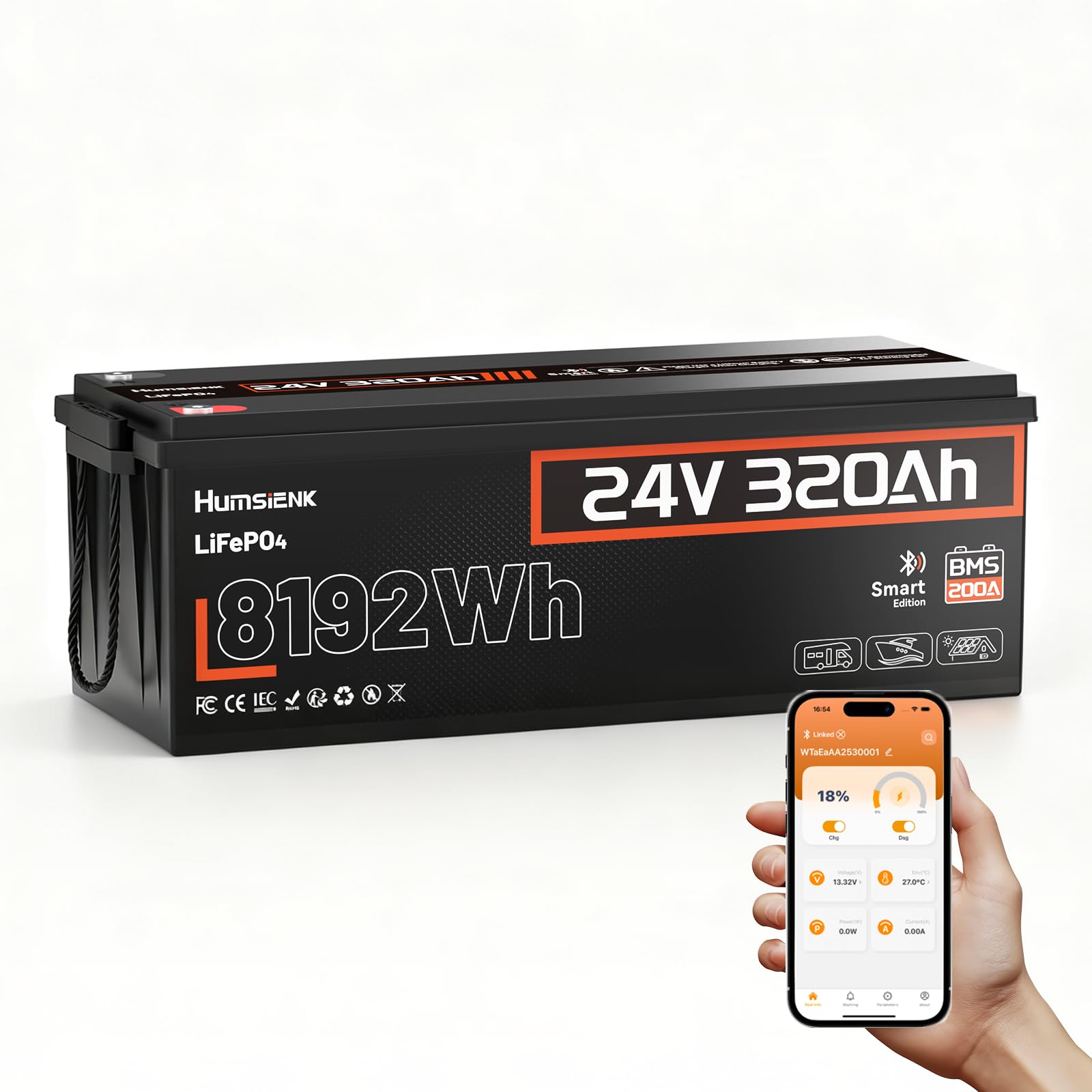
The HumsiENK 24V 320Ah battery packs 8192Wh into a single 107.9-pound unit that is 35% smaller than six 12V 100Ah batteries wired in series. This dramatically reduces wiring complexity and physical space requirements, making it an excellent choice for RV installations and compact off-grid systems.
It uses Grade A LFP cells rated for 15,000+ deep cycles at 60% DoD and delivers up to 5120W of continuous power through a robust 200A BMS. The Bluetooth app provides full cell-level monitoring, charge/discharge control, and data diagnostic capability. The battery supports up to 2S4P configurations to build systems as large as 65.53kWh.
Users praise the build quality and found the Bluetooth functional if not flashy. However, one user in Cuba reported the battery stopped holding a charge after just two weeks, indicating potential quality control variation. The 200A BMS provides less than 60% C-rate (200A / 320Ah), so this battery is not suitable for high-surge engine starting applications.
Why it’s great
- 8192Wh capacity in a single, space-efficient 24V unit
- 15,000+ cycle rating with premium Grade A cells
- Bluetooth app with full remote control and diagnostics
Good to know
- Mixed reports on reliability; some units failed quickly
- 200A BMS limits surge output for engine starting
- At 107.9 lbs, it still requires two people for safe lifting
9. Jackery Explorer 2000 v2
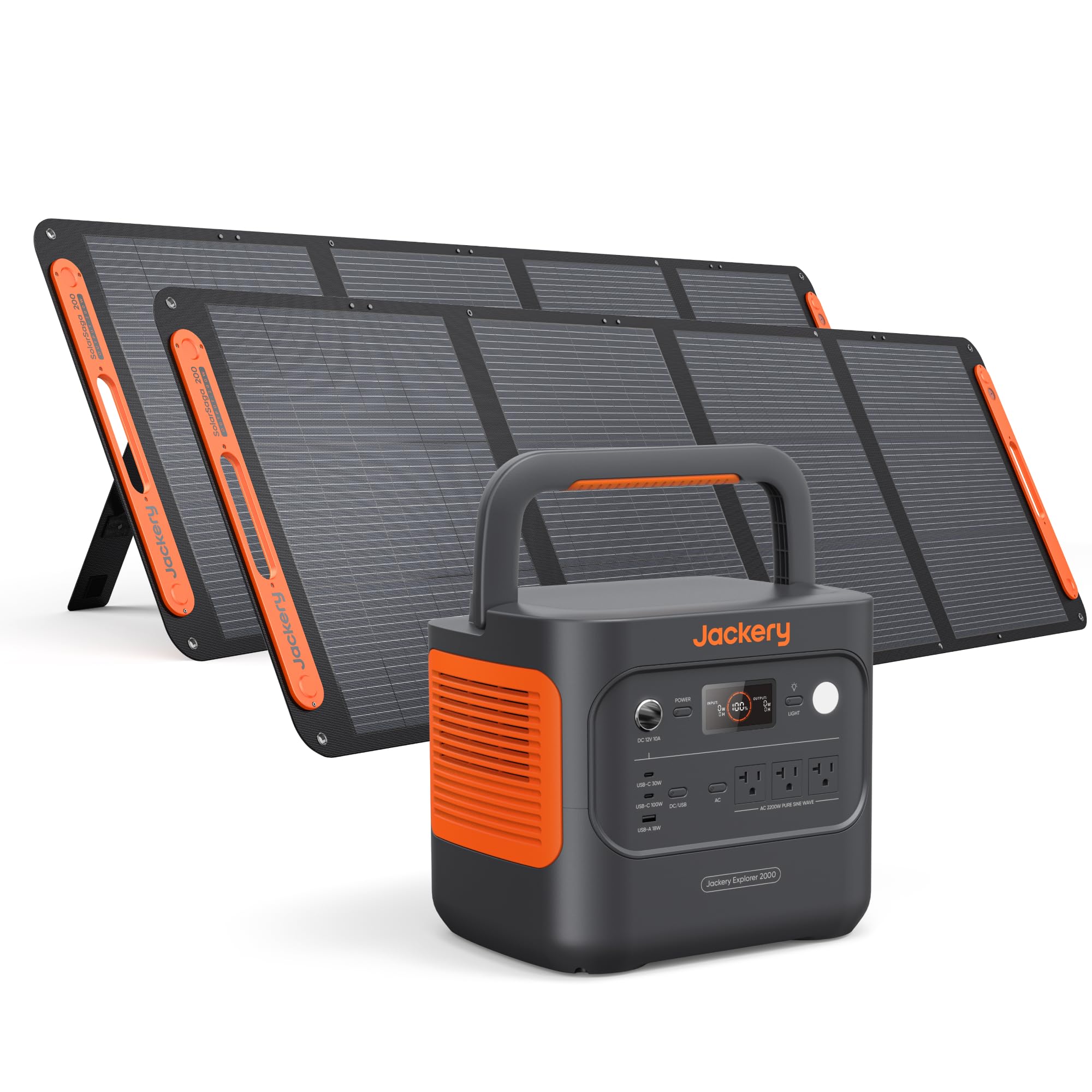
The Jackery Explorer 2000 v2 uses CTB technology to achieve a 2kWh capacity in a 39.5-pound package—41% lighter and 34% smaller than conventional LiFePO4 power stations of similar capacity. This makes it one of the most portable home backup generators on the market without sacrificing cycle life (10-year battery lifespan).
It features a 2200W AC output (sufficient for most home appliances and power tools), three AC ports, and dual USB-C 100W PD. AC charging reaches 80% in 66 minutes, and Emergency Super Charging mode (app-activated) fills the battery in 102 minutes. Solar charging with 400W panels takes about 6 hours, and the Silent Charging mode operates at just 30dB—perfect for overnight use in an RV or bedroom.
The 20ms UPS transition keeps sensitive electronics running seamlessly during outages. User feedback is overwhelmingly positive, with specific praise for the ability to run a window air conditioner for 3.5 hours. The main limitation is the lack of expandability: you cannot add extra battery packs, so the 2042Wh is the maximum you get.
Why it’s great
- Extremely portable at 39.5 lbs for a 2kWh unit
- Emergency Super Charge reaches 100% in 102 minutes
- UL-certified 20ms UPS and Silent Charging mode at 30dB
Good to know
- Capacity is not expandable—you’re limited to 2042Wh
- Solar charging is slower than competitors at 400W max input
- Only 3 AC outlets may require a power strip
10. VTOMAN FlashSpeed 2400
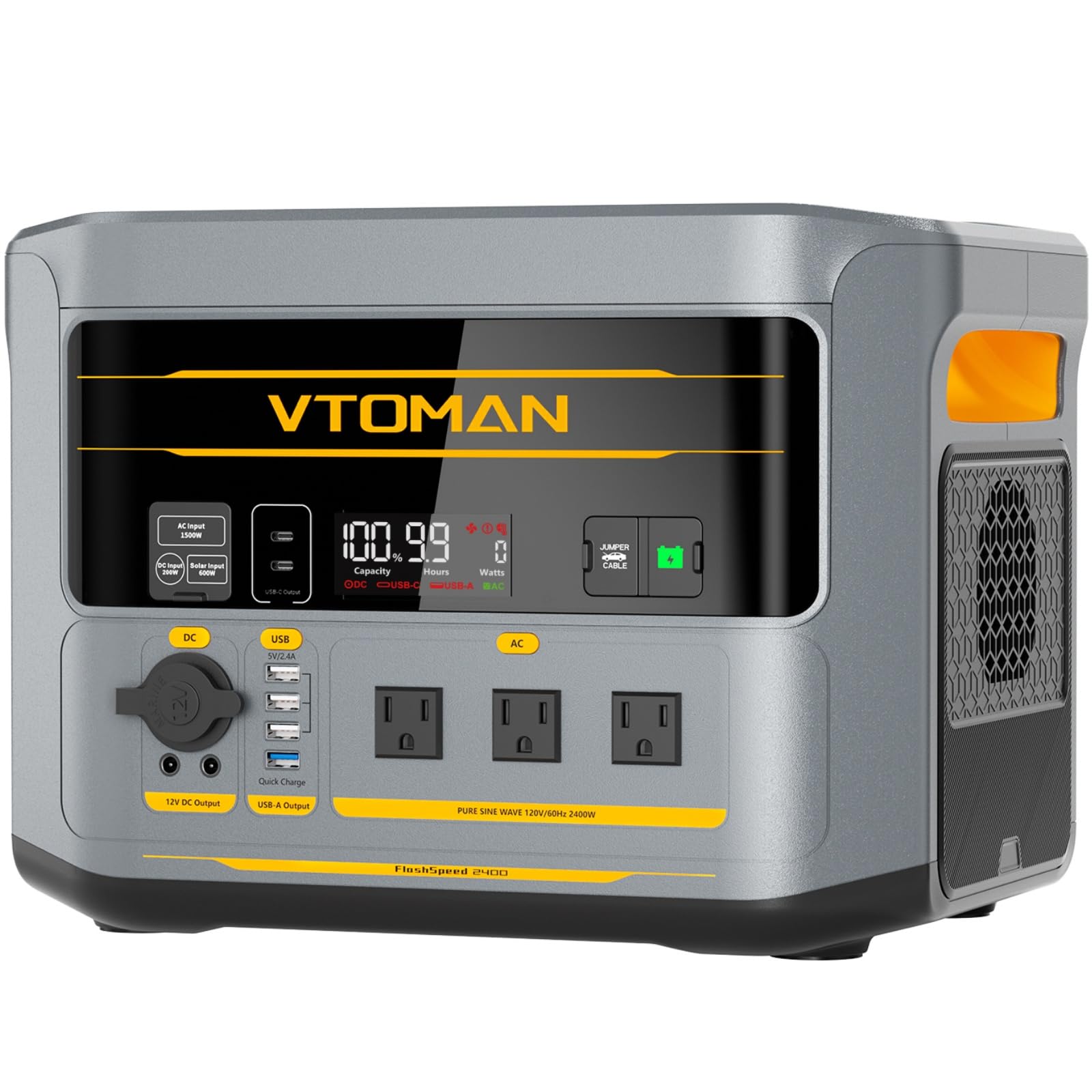
The VTOMAN FlashSpeed 2400 differentiates itself with industry-leading recharge speed: a full 0-100% charge in roughly one hour via 1500W AC input. This is a practical advantage when you need to quickly replenish between outages or during short sunny windows.
With 2400W continuous (3200W peak) output, it can handle 95% of household devices, including refrigerators, microwaves, and power tools. The 12V jump-start capability is a unique bonus for roadside emergencies. The unit features 12 output ports (3 AC, 4 USB-A, 2 USB-C, 3 DC) and supports up to 600W solar input via MPPT.
Users appreciate the quiet operation and the built-in 5-mode LED light. The 10ms UPS transition provides reliable backup for sensitive gear. However, some users noted that the solar input maxes out around 90W (far below the 600W rating) unless using VTOMAN’s own panels. A few owners experienced detection issues that required a BMS reset, but customer support resolved the problems.
Why it’s great
- Full recharge in approximately 1 hour via 1500W AC
- 12V jump-start capability for vehicles
- 10ms UPS and quiet operation
Good to know
- Solar input often underperforms with non-VTOMAN panels
- Some units require a full BMS reset to fix detection errors
- 1408Wh capacity is modest for whole-home backup
11. PECRON F3000LFP
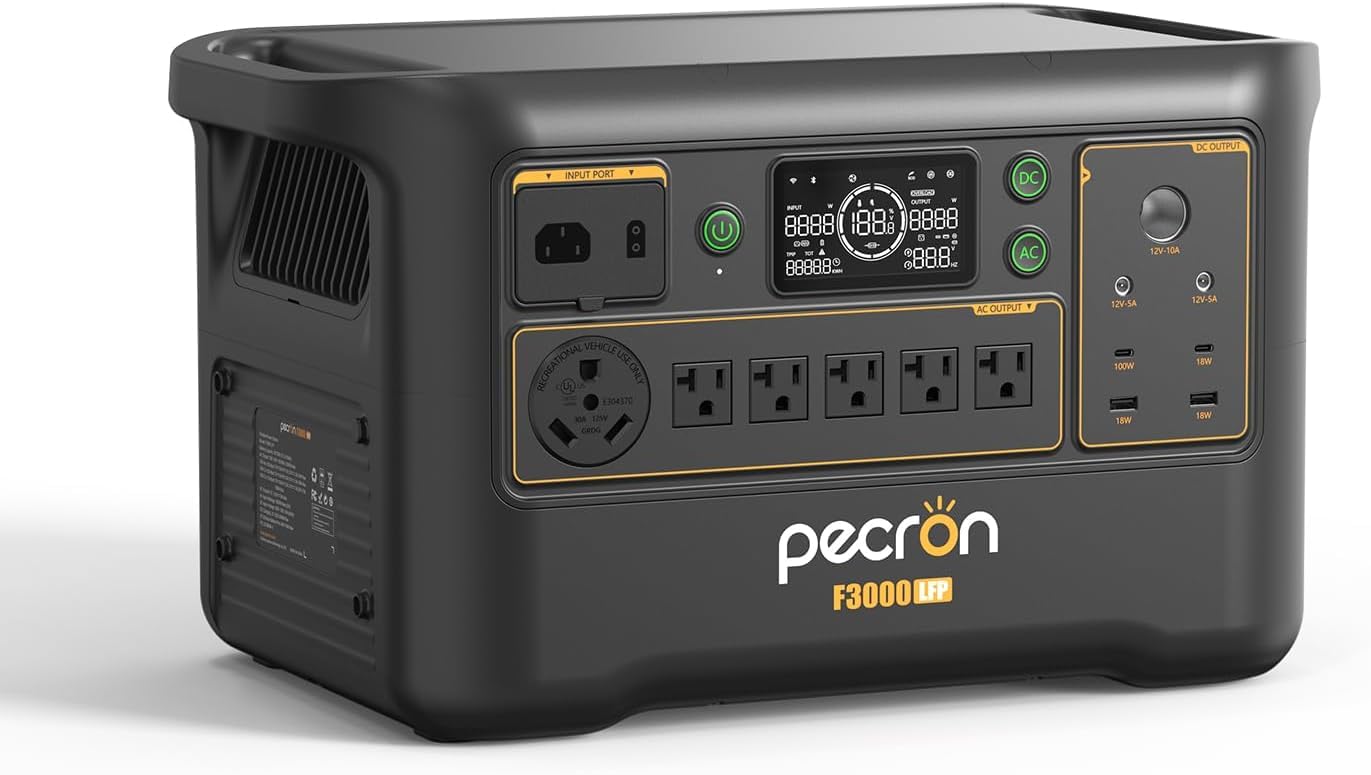
The PECRON F3000LFP delivers 3072Wh and 3600W continuous output in a 63.3-pound package that is compact enough for both home backup and camping trips. It recharges from 0% to 100% in just 2 hours via 1800W AC input—30% faster than many competitors in the same capacity class.
It provides 13 output ports (including 6 AC outlets, 2 USB-C 100W PD, and 2 USB-A 18W), making it easy to power an entire household circuit of essential devices. The 1600W solar input capability allows fast off-grid charging, and the UPS mode switches in 8-20ms to protect computers and medical devices during outages.
The fan noise during charging is noticeable but not high-pitched, which users found acceptable. The Bluetooth app lets you monitor real-time power consumption and set charge speed limits. One quirk: the charge controller drops solar input to 0W if the wattage falls below 100W (e.g., during shading), which can be frustrating for partial sun conditions.
Why it’s great
- 1800W AC input achieves full charge in only 2 hours
- 13 output ports with 6 AC outlets for whole-circuit backup
- 3600W continuous output handles high-draw appliances
Good to know
- Solar charge controller drops input below 100W
- Fan is audible during high-power charging
- User manual has poor English translations
12. ECO-WORTHY 280Ah 2-Pack
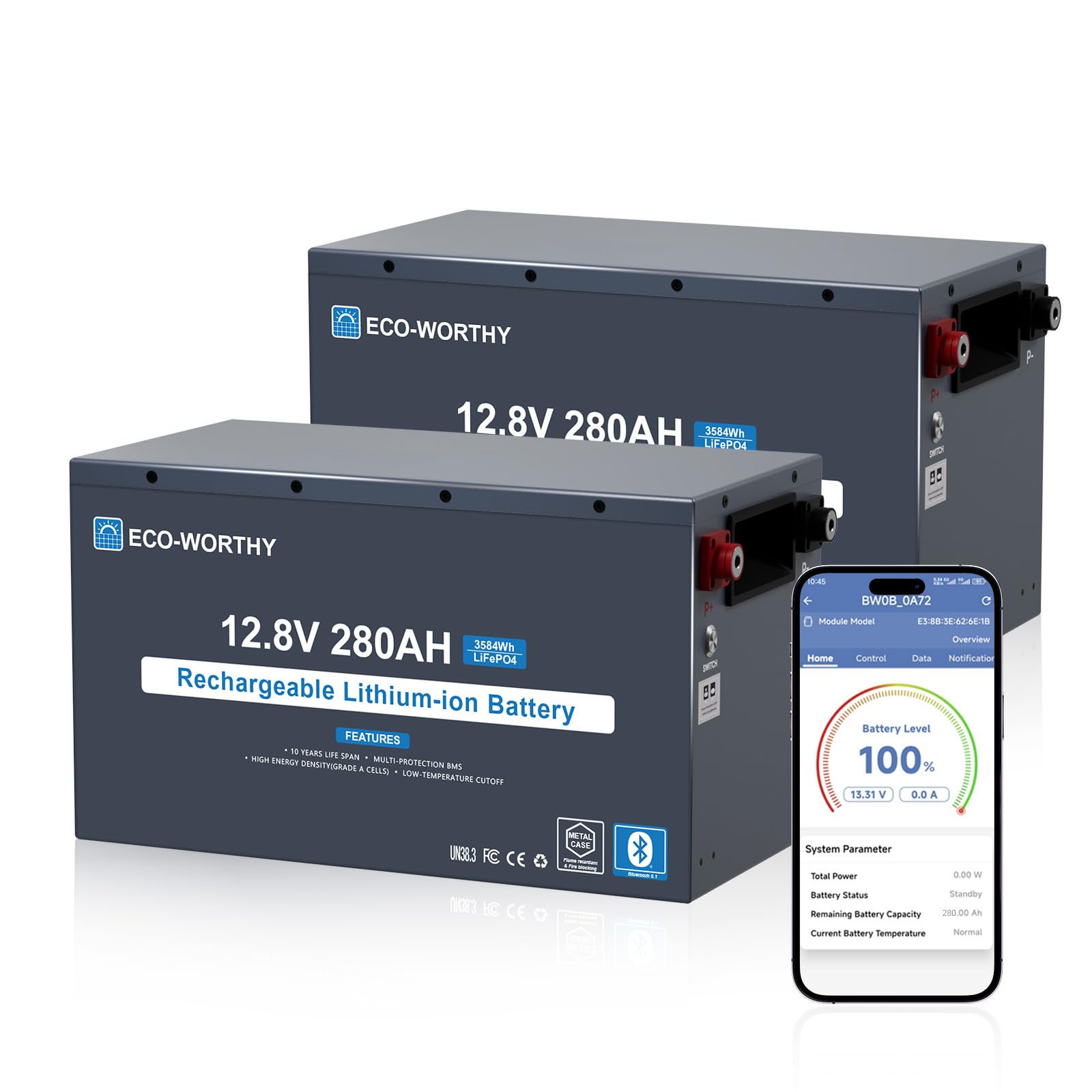
The ECO-WORTHY 280Ah 2-Pack offers 3584Wh of 12V LiFePO4 storage at an accessible price point, making it a strong entry point for budget-conscious off-grid or RV solar builds. The metal case design (as of mid-2026) provides improved durability and thermal performance compared to the earlier plastic enclosure.
Each battery features a 200A BMS with low-temperature protection: charging cuts off below 19.4°F and discharging halts below -4°F, preventing cold-weather damage. The Bluetooth 5.1 app provides real-time monitoring of cell voltage, current, and state of charge. Up to 4 batteries can be connected in parallel (1120Ah at 12V) or in series (up to 48V systems).
Users report actual tested capacity around 290Ah per battery—exceeding the 280Ah rating by about 3.5%. However, some off-grid users found the BMS disconnects at 14.2V, causing inverters to cycle. The workaround is to set the charge controller’s absorption voltage to 14.1V. The 3-year warranty is a solid safety net, but budget buyers should be aware of this voltage threshold nuance.
Why it’s great
- Lithium performance at a price that competes with lead-acid replacements
- Metal case improves heat dissipation and structural safety
- Low-temperature protection for cold-weather installations
Good to know
- BMS disconnects at 14.2V, requiring charge controller adjustment
- Each battery weighs 61.7 lbs, so the 2-pack is heavy to transport
- Full charge may take 14 hours with a standard 20A charger
13. VATRER POWER 48V 100Ah

The VATRER POWER 48V 100Ah battery is an accessible entry point into the 48V solar storage ecosystem, offering 5.12kWh of Grade A LiFePO4 capacity with a built-in 100A BMS. Its smart touch display and Bluetooth app provide real-time monitoring and control—features typically found on more expensive units.
The battery supports a one-touch ON/OFF switch that also functions as a circuit breaker, automatically shutting down if the load current exceeds safe limits. The dual terminal design (two positive and two negative posts) helps equalize current distribution and reduces heat buildup. The battery is rated for 5000+ cycles and is 50% lighter than an equivalent lead-acid bank.
User reviews consistently praise the build quality and measured capacity (one test showed 101.75Ah vs. 100Ah rated). The battery integrates well with EG4-3000 inverters after a minor bulk voltage adjustment. One recurring complaint: the plastic terminal housing makes it difficult to fit large-gauge cable lugs (2/0 or 4/0), often requiring bus bars or modifications. The newer design may have addressed this, but it is worth verifying.
Why it’s great
- Solid performance with tested capacity exceeding its rating
- Smart touch display and Bluetooth app for easy monitoring
- Dual terminals reduce heat and simplify parallel connections
Good to know
- Plastic terminal housing incompatible with thick cable lugs
- 100A BMS is limiting for high-power inverter setups
- Some units require charge voltage adjustment to avoid BMS trips
FAQ
How long do LiFePO4 home solar batteries last before needing replacement?
Can I connect my solar battery directly to my existing solar charge controller?
What does low-temperature charging cutoff mean for my solar system?
Final Thoughts: The Verdict
For most users, the batteries for home solar winner is the GROWATT HELIOS 3600 2-Pack because it delivers true 240V split-phase whole-home backup with 7200W continuous output and expandability up to 36kWh. If you want a lighter, more portable backup for essential circuits without 240V, grab the Jackery HomePower 3000 at 59.5 lbs. And for a large DIY off-grid installation where inverter compatibility and raw capacity matter most, nothing beats the SaiJiaoYang 51.2V 314Ah with its 16kWh of Grade A LFP cells and CAN/RS485 communication.