
Our readers keep the lights on and the weekend projects moving. As an Amazon Associate, I earn from qualifying purchases.
A dead battery you swore was fine. A “good” reading that sends you to the shop for nothing. That is the reality of cheap voltage-only testers — they measure surface charge, not real capacity. The difference between a battery that launches a cold engine and one that leaves you stranded is internal resistance under load, and that is exactly what a proper battery analyzer measures with conductance or pulse-load technology. Whether you manage a fleet, maintain off-grid equipment, or just want to stop tossing usable household batteries, the right tool saves money and prevents headaches.
I’m Rikta — the founder and writer behind FitlyFast. I spend my time reverse-engineering technical specifications and comparing real-world user data across automotive and household diagnostic tools to separate genuine performance from marketing claims.
After analyzing dozens of models across consumer and professional tiers, I have narrowed the field to the seven analyzers that actually deliver reliable diagnostics. This guide breaks down the specs and trade-offs to help you choose the best battery analyzer for your specific testing needs, from household alkalines to heavy-duty 24V commercial systems.
How To Choose The Best Battery Analyzer
Choosing the right analyzer depends entirely on the batteries you test. A household tester built for AAA alkalines will not diagnose a 24V truck battery, and a professional conductance meter is overkill for checking remote-control toys. Map your battery types and usage volume first.
Match the Technology to the Battery Chemistry
Voltage alone tells you nothing about usable capacity. Pulse-load testers like those from ZTS apply a precise resistive load and measure voltage drop to estimate remaining charge for household cells. For automotive lead-acid (flooded, AGM, GEL, EFB) and lithium starter batteries, conductance testers measure internal resistance and calculate CCA, state of health, and state of charge. Ensure the unit explicitly supports your battery chemistries — many automotive testers do not handle 6V or lithium house batteries.
Prioritize CCA Range and Voltage Support
For automotive use, check the Cold Cranking Amps range. A small car battery may need 350 CCA; a heavy-duty truck battery can exceed 1500. Most enthusiast analyzers cover 100-2000 CCA, which handles cars, trucks, motorcycles, and marine. Confirm the tester supports 6V if you work with classic cars or small equipment. Temperature compensation is also critical — a tester without it will over-report health in winter and under-report in summer.
Consider Workflow Features for Professional Use
If you test batteries daily, look for built-in printing, data logging, and cloud report generation. Models like the TOPDON BT600 include a thermal printer for immediate customer receipts, while the BT90 PRO offers QR-code cloud reports. These features eliminate manual note-taking and provide traceable history for warranty claims and fleet maintenance schedules.
Quick Comparison
On smaller screens, swipe sideways to see the full table.
| Model | Category | Best For | Key Spec | Amazon |
|---|---|---|---|---|
| BT90 PRO | Mid-Range | Mixed fleet diagnostics | 30–3800 CCA, 2–360Ah | Amazon |
| TOPDON BT600 | Premium | Shop-grade automotive | Built-in thermal printer | Amazon |
| ANCEL BA101 Plus | Mid-Range | 6V/12V lead-acid | 2.8″ color display, 1400 records | Amazon |
| AUTOPHIX BAS100 | Mid-Range | Car/truck/bike starter | 99.98% accuracy, copper clips | Amazon |
| Clore SOLAR BA9 | Mid-Range | Quick 12V health checks | 40–1200 CCA, 7-15V | Amazon |
| ZTS MBT-1 | Premium | Household/coin cell testing | Pulse load, 10+ types | Amazon |
| ZTS Mini-MBT | Budget | Home alkaline/NiMH | 2-second pulse load test | Amazon |
In‑Depth Reviews
1. Acclope BT90 PRO
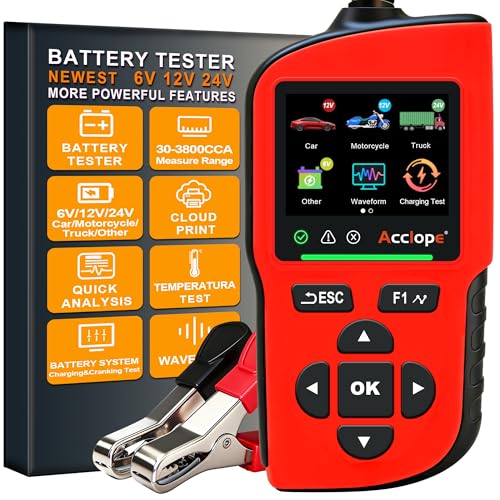
The BT90 PRO bridges the gap between enthusiast tools and professional shop gear by combining wide electrical coverage (6V/12V/24V, 30–3800 CCA, 2–360Ah) with true chemistry-aware algorithms for flooded, AGM, EFB, GEL, and lithium batteries. Its ambient temperature sensor feeds real-time data into the conductance calculations, correcting the cold-bias and hot-bias that cause misdiagnosis on cheaper testers. The 4-metric output — SOH, SOC, voltage, and internal resistance — gives you the full picture rather than a single go/no-go reading.
What sets this unit apart is the cloud printing feature. After each test, a QR code appears on screen; scan it and you get a shareable, time-stamped report with cranking and charging data. For fleet managers or service advisors, this eliminates photo-of-a-screen documentation and provides objective proof for warranty claims. The tool also captures alternator ripple and diode health, so a single connection can rule out charging system faults.
Build quality is solid, with a rugged housing and a daylight-readable display. The included vehicle modes (car, motorcycle, truck) stabilize clamp contact and improve first-pass accuracy. For a shop standardizing across mixed fleets or a serious DIYer who maintains multiple vehicles, the BT90 PRO delivers pro-level depth without the pro-level price.
Why it’s great
- Cloud QR reports with traceable timestamps
- Temperature compensation prevents seasonal misreads
- Covers 6V to 24V, 2Ah to 360Ah
- Chemistry-aware for AGM, EFB, GEL, and lithium
Good to know
- Micro-USB port for firmware updates only
- Some users report trimming firmware updates a niche process
2. TOPDON BT600

The TOPDON BT600 is purpose-built for the working shop environment. Its 3.5-inch color screen is easy to read across a bay, and the built-in thermal printer lets you hand a customer a physical receipt showing SOH, CCA, cranking voltage, and charging results immediately after the test. This single feature changes the customer conversation from “trust me” to “here is the data.” The BT600 uses conductivity testing technology for 12V and 24V lead-acid batteries (100-2000 CCA), covering flooded, AGM flat, AGM spiral, GEL, and EFB types.
Operation is straightforward — connect the copper clamps, select the battery type and rating from the menu, and the unit runs a battery test followed by cranking and charging system checks. The data playback function stores the last test, and the mini-USB port allows firmware updates (Windows only). Reviewers consistently note that it matches or outperforms shop-grade Interstate testers, with particular praise for reliability after repeated daily use and drops.
The one limitation is that it does not support 6V batteries or lithium chemistries. If your work involves only standard automotive lead-acid and you need documented proof for every job, the BT600’s print-on-demand workflow is tough to beat. The accuracy rating of up to 99.5% holds up well in independent comparisons, and the build quality handles the abuse of a busy service bay.
Why it’s great
- Built-in thermal printer for instant customer receipts
- Large 3.5″ color display readable in garages
- 12V and 24V support up to 2000 CCA
- Firmware upgradable via USB
Good to know
- No 6V battery support
- Does not test lithium chemistries
3. ANCEL BA101 Plus
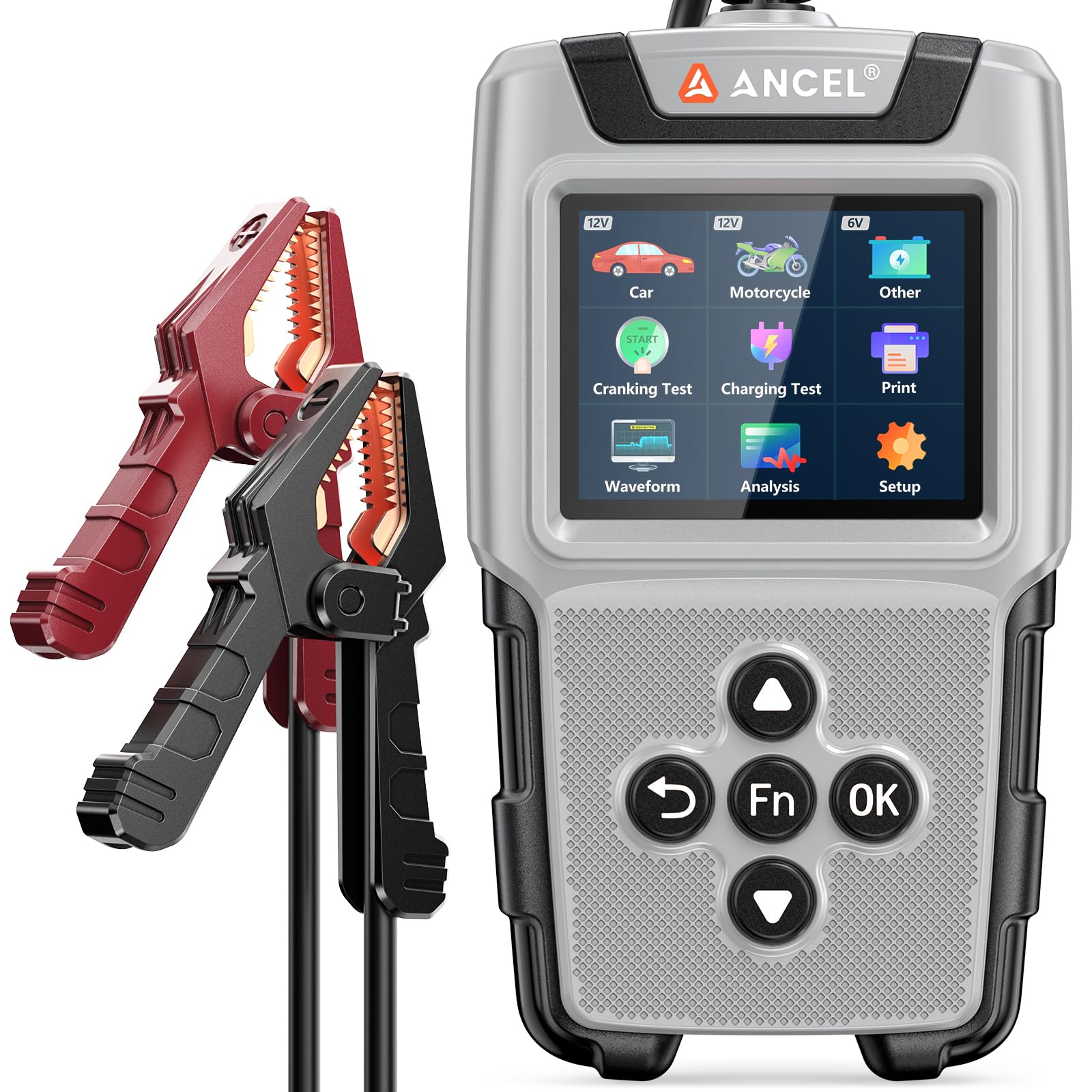
The ANCEL BA101 Plus stands out because it supports 6V batteries — a rarity among modern conductance testers. If you maintain classic cars, motorcycles, golf carts, or small equipment with 6V systems, this is one of the few accessible options that handles both 6V and 12V lead-acid types (flooded, AGM, GEL) across a 20-2000 CCA range. The 2.8-inch color display shows real-time voltage waveforms and large, clear icons, making it readable even in bright outdoor conditions.
This unit uses 4-wire Kelvin clip measurement to read internal resistance and estimate CCA. The clamps are slightly smaller than professional-grade models, but the device warns if contact is poor, which helps maintain measurement integrity. It stores up to 1,400 test records and can replay 120-second voltage waveforms, which is useful for tracking battery degradation over time. The Type-C port connects to a PC for printing professional reports, though the driver may trigger a standard Windows Defender alert — this is safe but worth noting for IT-managed environments.
Temperatures from -4°F to 158°F are handled with built-in compensation. While the CCA range tops out at 2000, the 6V support and generous record storage make it a strong choice for mixed-voltage shops or serious hobbyists with vintage vehicles.
Why it’s great
- Supports 6V batteries (20-2000 CCA)
- 1400-test record storage with waveform replay
- 2.8″ color display with temperature compensation
- 4-wire Kelvin clip measurement for accuracy
Good to know
- Smaller clamps than pro-grade models
- PC printing requires driver installation
4. AUTOPHIX BAS100

The AUTOPHIX BAS100 earned a recommendation from the Project Farm YouTube channel, and the data backs it up. It tests 12V and 24V batteries (100-2000 CCA) with a claimed 99.98% accuracy, using high-conductivity copper alligator clips with anti-slip coating to maintain stable contact. The unit runs battery, cranking, and charging tests in sequence, and the LCD display is straightforward enough for a beginner to interpret confidently.
Internal AI chip analysis delivers results in seconds, and the tool includes safety protections against reverse polarity, short circuits, over-voltage, and over-current. The compact handheld design is easy to store, and the device powers itself from the test battery — no internal batteries to replace. Reviewers note that it correctly identified a failing battery that saved them from an unnecessary alternator replacement, and repeated tests on healthy batteries showed consistent results.
One limitation is that it cannot test batteries under 30 Ah, so small motorcycle or lawn mower batteries may not register. The USB-C port is for factory use only, not data transfer. For a straightforward, no-frills automotive tester with proven YouTube-verified accuracy, the BAS100 is a reliable entry point.
Why it’s great
- Project Farm tested and verified
- High-conductivity copper clips with anti-slip grip
- 12V and 24V support up to 2000 CCA
- Safety protections for reverse polarity and overcurrent
Good to know
- Cannot test batteries under 30 Ah
- USB-C port is not for data or printing
5. Clore Automotive SOLAR BA9

The SOLAR BA9 from Clore Automotive is a focused tool for one job: checking 12V starting batteries quickly. Its CCA range of 40-1200 covers passenger cars, light trucks, motorcycles, and marine applications using flooded, AGM, spiral, and gel cell batteries. The LCD display is designed for optimal viewing in bright and dim conditions, and the unit runs on battery power — no external power source needed, though it does require four AAA cells.
Operation is simple: connect the leads, input the battery rating and type, and the BA9 displays resting voltage, tested CCA, state of health, and state of charge. It also runs cranking and charging system tests. Reviewers with 5,000-mile oil change routines found it catches weak batteries before failure, and it correctly measured a new 750 CCA battery at 695 CCA — within expected tolerance for a conductance reading.
The main trade-off is the display interface. The manual is minimal, and navigating tests can be fiddly with dirty hands. The CCA ceiling of 1200 means it will not work for heavy-duty trucks or large diesel equipment. For a reliable, non-destructive diagnostic tool for standard automotive use, the BA9 is a proven workhorse that has been on the market for years.
Why it’s great
- Reliable conductance testing for 12V starting batteries
- Covers flooded, AGM, spiral, and gel types
- Non-destructive testing — no load applied
- Compact and well-built
Good to know
- 40-1200 CCA range does not cover heavy trucks
- Minimal manual and small display text
6. ZTS MBT-1 Multi-Battery Tester

The ZTS MBT-1 is the gold standard for testing household and specialty batteries. Unlike automotive conductance testers, this unit uses patented Pulse Load Technology to apply a precise resistive load and measure voltage drop, giving a real indicator of remaining capacity rather than a simple voltage check. It tests AA, AAA, C, D, 9V alkaline, 1.5V lithium, CR123, CR2032, CR2016, CR2, and 18650 Li-ion cells without needing any switches or settings — just connect the probe and read the result in under three seconds.
This tester is particularly valuable for anyone who manages large volumes of batteries. The 10-LED display shows remaining capacity in 10% increments, and the device uses the battery’s own power to test, requiring four AA batteries (sold separately) for the internal circuit. Reviewers report that it reliably identifies individual dead cells in multi-battery devices, saving money by grouping partially depleted batteries (60-80%) for low-drain applications like remote controls or clocks.
The MBT-1 is larger and heavier than the Mini-MBT, but this gives it room for a wider contact plate and better ergonomics. It does not support LiFePO4 cells. For anyone serious about battery management — photographers with multiple camera batteries, electronics hobbyists, or households running dozens of devices — the MBT-1 pays for itself by preventing premature disposal.
Why it’s great
- Pulse load test for accurate capacity reading
- Tests 10+ battery types including coin cells
- No switches or settings — automatic detection
- 10% LED increments for precise sorting
Good to know
- Does not test LiFePO4 batteries
- Requires 4 AA batteries for operation
7. ZTS Mini Multi-Battery Load Tester Mini-MBT

The ZTS Mini-MBT brings the same Pulse Load Technology as its larger sibling into a smaller, more portable package. It automatically detects the battery chemistry and applies a load in roughly two seconds, showing remaining capacity in 20% increments on the LED display. The unit tests 1.5V AAA, AA, C, D, N cells, 1.2V NiMH/NiCd, 3.6V Li-Ion, 3V photo lithium, and 9V alkaline batteries without any manual settings.
The compact design includes a probe and lead wire that store in the seam, making it easy to throw in a tool bag or kitchen drawer. It requires four AAA batteries for operation and is manufactured in the United States with a one-year warranty. Reviewers consistently note that it saves money by identifying batteries that still have useful life, though some report minor inconsistency with the first reading versus a second read — this is typical of pulse-load testers that momentarily stress the cell.
The Mini-MBT does not test coin or button cells, and the 20% resolution is coarser than the MBT-1’s 10% increments. For casual users who want to stop throwing away perfectly good batteries and own mostly standard cylindrical cells, this is the most accessible entry point to proper load testing.
Why it’s great
- Automatic pulse load test in 2 seconds
- Portable design with built-in probe storage
- Tests AAA through D, plus 9V and lithium cells
- Proudly made in the USA
Good to know
- No coin cell or button battery support
- 20% resolution — less granular than MBT-1
FAQ
Can one battery analyzer test both my car battery and my household AA batteries?
Why does my battery analyzer show different readings when I test the same battery twice?
What does the SOH number on an automotive analyzer really mean?
Final Thoughts: The Verdict
For most users, the best battery analyzer winner is the Acclope BT90 PRO because it marries wide voltage and CCA coverage with cloud reporting and temperature-aware conductance algorithms — a true cross-fleet tool. If you want battery testing with professional documentation for customer handoffs, grab the TOPDON BT600. And for managing household batteries and coin cells with pulse load accuracy, nothing beats the ZTS MBT-1.