
Our readers keep the lights on and the weekend projects moving. As an Amazon Associate, I earn from qualifying purchases.
Specs are compiled from manufacturer listings and verified buyer reviews and can change over time — please confirm the key details on the product page before buying.
A power outage hits and your internet goes down with it—your modem and router have no built-in battery. That means no work, no streaming, no security cameras, and no smart home until the power comes back. The fix is a dedicated battery backup that keeps your networking gear running through blackouts, brownouts, and flickers, so your WiFi stays on when everything else goes dark.
I’m Rikta — the founder and writer behind FitlyFast. This guide is built by comparing the manufacturers’ published specifications and the patterns across verified customer reviews, so you get each pick’s real strengths and trade-offs instead of marketing spin.
When the power goes out, you want your internet to stay on. That is what a battery backup for modem and router does, and the three specs that decide if it works are: capacity (measured in watt-hours, or Wh, which tells you how long it lasts), output voltage (5V, 9V, or 12V — matching your device’s power needs), and transfer time (how fast it switches from wall power to battery). Every pick here must survive a real outage and protect your gear from surges.
Quick Picks
- TalentCell Mini UPS (27000mAh/97.2Wh) — Best Overall
- SKE DC20000 Plus Altair — Best Value
- PECRON D77 DC UPS (76.96Wh) — Compact Specialist
- Shanqiu Mini UPS (74Wh) — Metal Build
- SKE VL425 425VA/240W UPS — AC UPS Pick
- KP3 Mini UPS (10000mAh/36Wh) — Budget Champion
How To Choose The Best Battery Backup For Modem And Router
Picking the right backup starts with understanding what your gear actually needs. Most modems and routers run on 12V DC power, but some use 9V or even 5V. The wrong voltage or connector size means your backup simply won’t work — or could damage your device. Check the label on your router’s original power adapter for the voltage (V) and current (A) before buying.
Capacity — Watt-Hours Tell the Real Story
Milliamp-hours (mAh) sound impressive but can be misleading because the voltage changes the math. Watt-hours (Wh) give you the real energy stored. A 36Wh unit might keep a typical modem and router alive for 4-6 hours, while a 97.2Wh model could run the same gear for 12 hours or more. Match the Wh rating to how long your typical outages last.
Number and Type of Outputs
You need enough ports for your router, modem, and any connected devices like a switch or access point. Most mini UPS units have multiple DC barrel jacks and USB ports. Pay attention to the barrel size — 5.5mm x 2.1mm is the standard, but some gear uses 5.5mm x 2.5mm or other sizes, so you may need an adapter.
Transfer Time — How Fast It Kicks In
If a backup takes more than a few milliseconds to switch over, your router can reboot — which defeats the whole purpose. Look for units with “0ms transfer” or “instant switching” (meaning the switch happens in zero milliseconds, so fast your gear never notices). These keep the power flow smooth, so your modem never knows the wall power dipped.
Safety Protections
Overcharge, over-discharge, short-circuit, and thermal protection keep both the battery and your expensive networking gear safe. Some units also include surge protection for the AC input, which adds a layer of defense against lightning strikes and power spikes coming through your wall outlet.
Quick Comparison
| Model | Best For | Capacity (Wh) | Output Options | Weight | Amazon |
|---|---|---|---|---|---|
| TalentCell Mini UPS | Long runtime / AP usage | 97.2Wh | 4x DC 12V, 1x DC 9V, 2x USB 5V | 1.5 lb | Amazon |
| SKE DC20000 Plus Altair | All-day runtime / weather station | — | USB-A, USB-C | 1.43 lb | Amazon |
| PECRON D77 | Low-power gear / PoE devices | 76.96Wh | 1x USB-A, 3x DC 5V/9V/12V, 1x PoE | 1.5 lb | Amazon |
| Shanqiu Mini UPS | High-power 12V devices / metal build | 74Wh | 1x USB 5V, 1x DC 5V, 1x DC 9V, 2x DC 12V | 1.83 lb | Amazon |
| SKE VL425 | Full AC backup / multiple devices | — | 5x battery backup + 2x surge-only AC outlets, USB, Type-C | 8 lb | Amazon |
| KP3 Mini UPS | Budget entry / tight spaces | 36Wh | 1x USB-A 5V, 3x DC 5V/9V/12V | 0.66 lb | Amazon |
In-depth Reviews
1. TalentCell Mini UPS (27000mAh/97.2Wh)

The 97.2Wh powerhouse that keeps your whole network rack alive through long outages.
With a 97.2Wh lithium-ion battery pack, this TalentCell unit holds 97.2Wh versus the KP3 Mini UPS at 36Wh — enough to run a typical modem, router, switch, access point, and smart hub for over five hours. Buyers report it provides roughly 5.5 hours of backup for a 10.5W load, which covers most home setups comfortably.
It outputs through four 12V DC ports, one 9V DC port, and two 5V USB ports — enough to consolidate up to five separate wall adapters into a single clean box. The unit’s 6.3 x 5.51 x 1.3-inch footprint is larger than the KP3’s credit-card-sized body (6.3 inches deep versus 1.06 inches deep), but that extra size holds twelve 18650 battery cells for serious runtime. One reviewer noted their router and old phone ran for 24 hours 18 minutes before shutdown, which far exceeds most power outages.
The trade-off is that the provided charger only recharges at 12.6V/2A, so a full charge takes several hours. The battery LED indicator is also imprecise — one reviewer found that four lights show 100-85% and three lights show 85-40%, leaving a big grey zone. Unlike the SKE DC20000 Plus Altair which fit a slimmer travel profile, this one is best parked permanently next to your network gear.
What makes it the top pick
- 97.2Wh capacity — the largest in this roundup — can run a full network stack for 5+ hours
- Seven total output ports (4x 12V, 1x 9V, 2x USB) replace multiple wall warts
- Buyers confirm 24+ hour runtime on a single modem and router
Where it compromises
- Battery level LEDs are not accurate — big gap between 85% and 40%
- Recharge is slow (12.6V/2A charger) compared to USB-C fast-charging alternatives
- Internal cells are not user-replaceable; one buyer mentioned cell failure after warranty
Reach for this if: you have multiple networking devices and need the longest possible runtime from a single DC UPS. It beats anything in this list on pure capacity.
Watch out for: the imprecise battery gauge and slow recharge — not ideal if you need to quickly top it up between short outages.
2. SKE DC20000 Plus Altair

A slim 20000mAh DC UPS that doubles as a travel companion and runs your router for a full workday.
This unit from SKE packs 20000mAh into a compact 4.2 x 8.1 x 1.3-inch frame that fits neatly beside a router or inside a network cabinet. Owners mention one router ran 8+ hours without depleting the battery — enough for a full workday plus some evening browsing. The slim profile makes it the most portable pick here, unlike the bulky 8-pound SKE VL425 AC UPS below.
It offers USB-A and USB-C ports, giving you flexibility for different gear without hunting for adapters. The USB-C port also handles recharging, which is more convenient than the PECRON D77’s AC-only charge. A long press on the power button prevents accidental shutdown — a thoughtful touch for setups where you might bump the unit.
The catch is reliability over time: one reviewer’s unit stopped charging after only 5 months and the company did not respond to support requests. That’s a red flag compared to the TalentCell’s proven multi-year track record. The LED indicators are also very bright, which could be annoying in a bedroom or media cabinet.
What makes it a value pick
- Compact and lightweight design fits in tight spaces and travels well
- 8+ hour runtime on a single router, per verified buyer reports
- USB-C charging is faster and more universal than barrel-style chargers
Consider before buying
- One reported early failure and no customer support response — potential longevity concern
- Very bright status LEDs that you cannot dim or turn off
- Output power limited; may struggle with high-power WiFi 7 routers
Grab this if: portability matters and you want USB-C recharging. It slides into a travel bag easier than the TalentCell’s wider chassis.
skip it if: you need proven long-term reliability or plan to run multiple high-power devices simultaneously.
3. PECRON D77 DC UPS (76.96Wh)
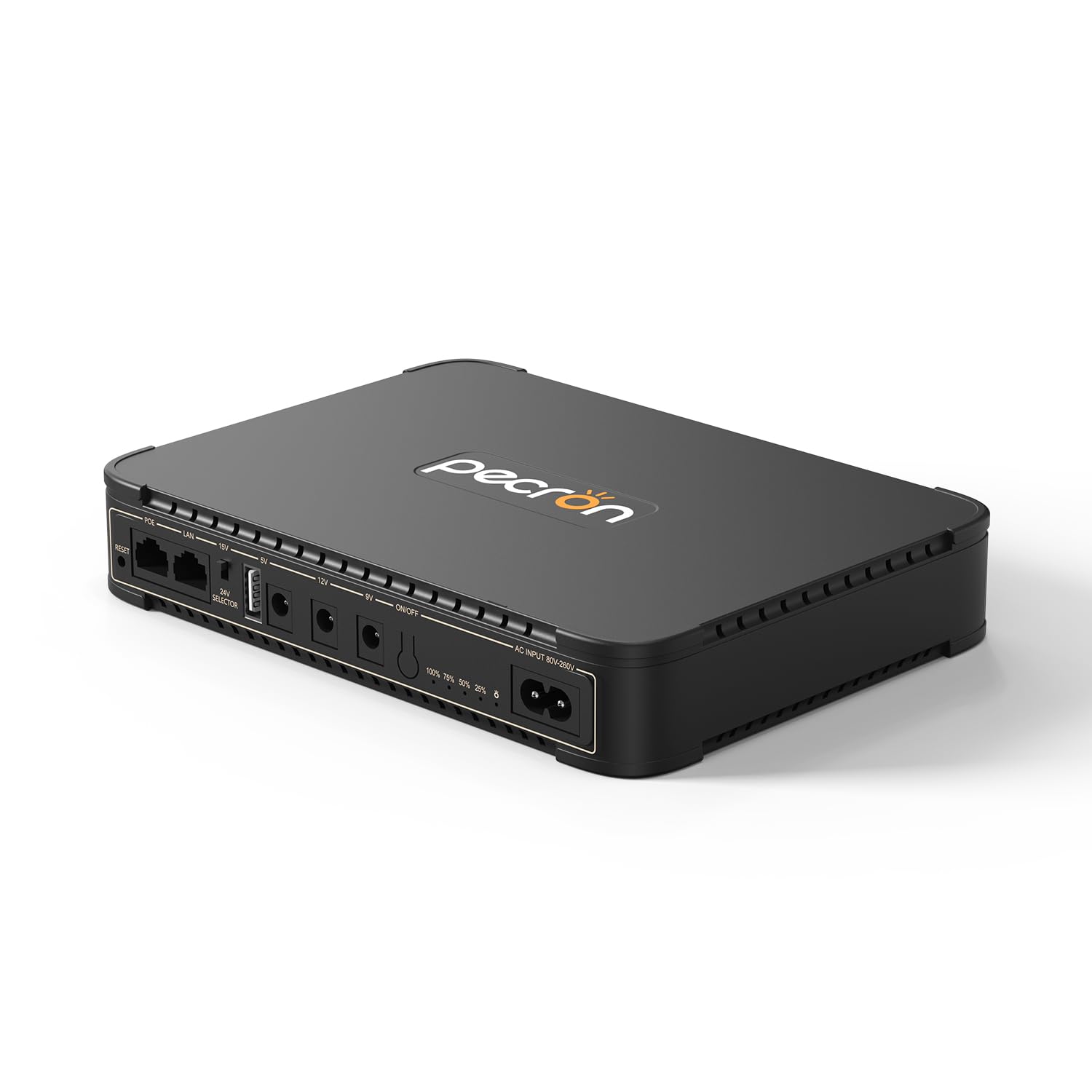
A 1.5-pound DC UPS with a built-in PoE port for powering cameras and access points.
The PECRON D77 stands out with its integrated PoE (Power over Ethernet) port, which delivers power and data through a single Ethernet cable to devices like security cameras and wireless access points. At 76.96Wh, it holds 76.96Wh versus the KP3’s 36Wh, while weighing 1.5 pounds versus the KP3’s 0.66 pounds, but still very portable.
It offers a 5V/2.6A USB-A port and three DC5521 outputs (5V, 9V, and 12V). One owner reported it “works great for low-power devices like AT&T ONT box” and found the voltage outputs accurate at 5.0V, 9.1V, and 12.2VDC. The six-fold protection system (over-charge, deep-discharge, over-current, short-circuit, voltage instability, and thermal protection) is more comprehensive than the KP3’s basic safeguards.
The limitation is the 2-amp current at 12V. As one reviewer pointed out, it cannot power a modern WiFi 7 tri-band router that needs at least 3A at 12V — something the Shanqiu unit below handles with its 5A 12V output. The 5-foot power cable is also on the short side. Unlike the SKE VL425 which includes user-replaceable battery, the D77’s cells are sealed inside.
What makes it unique
- Built-in PoE port powers cameras and APs without extra adapters
- Accurate voltage outputs confirmed by buyers (5.0V, 9.1V, 12.2V)
- Lightweight at 1.5 lb and compact for its 76.96Wh capacity
Where it falls short
- Only 2A at 12V — too weak for high-end WiFi 7 routers that need 3A+
- Short 5-foot power cable limits placement options
- No USB-C input for faster or more universal charging
Choose this for: a PoE-powered security camera or access point setup where you want a single backup device for both network and camera power.
pass on it if: you own a high-power tri-band router — the 2A 12V output won’t cut it, and the Shanqiu or TalentCell handles those loads better.
4. Shanqiu Mini UPS (74Wh)

A 74Wh aluminum-clad DC UPS that pumps 5A through its 12V ports for power-hungry gear.
The Shanqiu Mini UPS earns its spot because it can power a WiFi 7 tri-band router (a very high-power router) that the PECRON D77 cannot handle. It wraps its 20000mAh (74Wh) lithium-polymer battery in an aluminum alloy housing that feels more premium and helps with heat dissipation — a clear step up from the plastic enclosures of the TalentCell and KP3 units. It delivers a maximum 60W total output, with the two 12V ports sharing a full 5 amps.
Output options include 1x USB 5V, 1x DC 5V, 1x DC 9V, and 2x DC 12V ports. Buyers confirm it powers fiber ONTs, routers, and switches through outages, with one reporting 18 hours of runtime on two devices. The input accepts 100-240V AC, so it works anywhere in the world without a voltage converter. It also serves as a power bank with a standard USB output.
Compatibility is not universal, however. The included cables use the standard 5.5mm x 2.1mm barrel connectors, so if your router uses a 5.5mm x 2.5mm barrel or a coaxial plug, you will need separate adapter pigtails. Unlike the SKE VL425 which has a user-replaceable battery, this unit’s lithium-polymer pack is sealed. Charge time is about 3 hours, which is reasonable for its capacity.
What stands out
- Aluminum alloy construction — more durable and heat-resistant than plastic alternatives
- 5A shared output on 12V ports — handles WiFi 7 routers and other power-hungry gear
- Buyers confirm 18-hour runtime with two devices
What to know
- Only includes 5.5mm x 2.1mm barrel cables; other sizes need separate adapters
- Lithium-polymer battery is not replaceable
- Heavier than plastic competitors at 1.83 pounds
Get this if: you own power-hungry networking gear (WiFi 7, high-end routers) and want the durability of an aluminum chassis.
Consider the TalentCell instead if: you need the absolute longest runtime (97.2Wh vs 74Wh) and can accept a plastic body.
5. SKE VL425 425VA/240W UPS

A full-size AC UPS that protects your whole desk — computer, monitors, router, and all.
Unlike the compact DC-only units above, the SKE VL425 is a traditional tower UPS with 425VA/240W of backup capacity and 7 total outlets (5 battery-backed + 2 surge-only). This is the right pick if you want to keep your desktop computer and monitors running alongside your modem and router — something no DC mini UPS can do. It weighs 8 pounds, so it stays under a desk, not in a bag.
It includes Automatic Voltage Regulation (AVR), which smooths out voltage fluctuations before switching to battery — a feature absent from all the DC mini UPS units here. The simulated sine wave output works well for most electronics, though sensitive audio gear may prefer pure sine wave. One customer observed the outlets are side-by-side and close together, so large power bricks can block adjacent sockets.
The sealed lead-acid battery is user-replaceable, extending the unit’s lifespan beyond the typical 3-5 years of consumer UPS batteries — a clear advantage over the sealed lithium packs in the TalentCell and Shanqiu. Buyers appreciate the compact tower design that “takes up less room” than bigger name-brand units, and the three USB ports for charging phones and tablets.
Why choose this AC UPS
- Powers computers and monitors — a full backup, not just network gear
- AVR smoothes voltage fluctuations, protecting your equipment from brownouts
- User-replaceable battery extends the unit’s usable life for years
Trade-offs to know
- Much heavier (8 lb) and larger than DC mini UPS options
- Outlets are close together — large adapters may block neighboring sockets
- Simulated sine wave output, not pure sine wave for sensitive audio gear
Grab this if: you want one backup for your whole desk — computer, monitors, modem, and router — all in a single box with AVR protection.
Stick with a DC mini UPS if: you only need to keep your internet gear alive and want something small, quiet, and portable.
6. KP3 Mini UPS (10000mAh/36Wh)
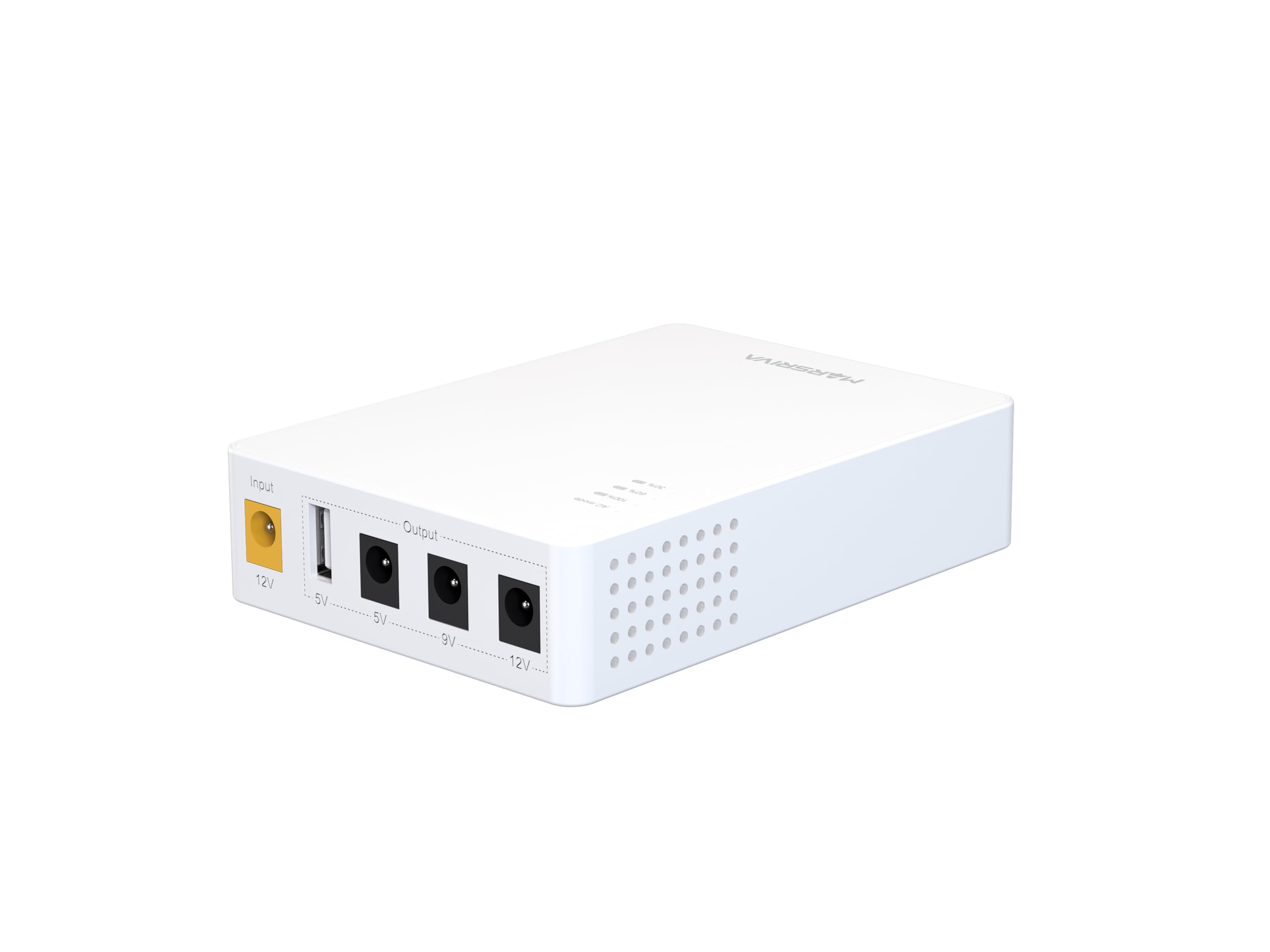
A credit-card-sized 36Wh backup that slips into any nook and keeps your modem online.
The KP3 is the lightest and most compact unit here at 0.66 pounds and 1.06 inches thick, versus the PECRON D77 at 1.5 pounds and the TalentCell at 6.3 inches deep. Its 36Wh battery is smaller than the TalentCell’s 97.2Wh, but it will still keep a typical modem and router running for 3-5 hours. Customers note it “works well to run unmanaged network switch” for low-power setups.
It features a 0ms smooth transfer time, so your router never experiences a gap in power during the switch from wall power to battery. Outputs include one USB-A 5V port and three barrel ports (5V, 9V, 12V). The catch is that each barrel port is voltage-specific, so you can only power one device per voltage — unlike the TalentCell, which offers four identical 12V ports for multiple 12V devices at once. Reviewers point out that the aluminum housing stays cool even during extended use, a real plus for heat-sensitive setups.
At this entry-level price, you get basic protections (overcurrent, short-circuit, overcharge) but no advanced features like AVR, USB-C input, or PoE. One review noted it “won’t power an eero 6+ from the USB-A,” so check your router’s power requirements before buying. For the price, it is a decent insurance policy against short flickers and brief outages, but not meant for extended blackouts or high-power gear.
What makes it budget-friendly
- Smallest and lightest UPS in this roundup — fits in a jacket pocket
- 0ms transfer time ensures no reboot during power blips
- Buyers confirm it works well for low-power switches and basic routers
Limitations to expect
- Only 36Wh capacity versus the TalentCell’s 97.2Wh; shorter runtime
- Voltage-specific barrel ports limit each voltage to one device
- Not powerful enough for WiFi 6E/7 routers or multiple high-power devices
Best for: a single modem or low-power router in a location where space is extremely tight and outages are brief.
Look elsewhere if: you need to power multiple devices, have a power-hungry WiFi 7 router, or want a backup that lasts through multi-hour outages.
Understanding the Specs
Watt-Hours (Wh) vs Milliamp-Hours (mAh)
Watt-hours measure total energy storage — the real number that tells you how long your gear runs. Milliamp-hours can be misleading because the voltage matters: a 27000mAh battery at 3.7V stores only 97.2Wh, while the same 27000mAh at 12V would be 324Wh. Always compare Wh when judging runtime between different UPS models.
0ms Transfer Time
A backup with 0ms or instant transfer time switches from wall power to battery so fast that connected devices never notice the power gap. Without it, your router might reboot in the milliseconds it takes the UPS to kick in — defeating the whole point of having a backup. Every unit in this list that advertises 0ms transfer delivers smooth operation.
FAQ
How long will a battery backup keep my modem and router running?
Will any UPS work with my modem and router?
What voltage do most routers use — 5V, 9V, or 12V?
What is the difference between a DC UPS and an AC UPS?
Can I use a power bank as a battery backup for my router?
What size barrel connector does my router use — 2.1mm or 2.5mm?
Is it safe to leave a battery backup plugged in 24/7?
Will a battery backup protect my router from lightning strikes?
How do I know if my router needs more than 2 amps at 12V?
Can I power a PoE switch from a DC UPS?
Final Thoughts: The Verdict
Across the board, the top battery backup for modem and router is the TalentCell Mini UPS because it packs the highest capacity (97.2Wh) and most output ports for the price, giving you the longest runtime and widest compatibility. If you want something ultra-portable with USB-C charging, grab the SKE DC20000 Plus Altair. And for a full AC backup that also protects your computer, the SKE VL425 is the complete desktop solution with user-replaceable battery and AVR.
How We Picked
We do not accept paid placement. Every pick is matched to a real buyer and a real use-case; we do not hands-on test units.
Sources & Methodology
Specifications: manufacturer listings and product documentation. Review insights: verified customer reviews, as of July 2026. Pricing: not shown on this page (it changes often); check the current price via the retailer link.
As an Amazon Associate, FitlyFast earns from qualifying purchases. This does not affect which products we feature.