
Our readers keep the lights on and the weekend projects moving. As an Amazon Associate, I earn from qualifying purchases.
That first bead can either make you feel like a fabricator or leave you picking spatter off your jacket. The line between a perfect puddle and a bird’s nest of tangled wire comes down to picking a machine that matches what you want to weld — thin sheet metal for auto repair, thick brackets for a home gate, or all-purpose steel around the property. For someone new to MIG welding, the difference between a frustrating session and a solid, confident start is a machine with genuine 110V capacity, smooth wire feed, and a simple synergic setting that auto-matches voltage and speed.
I’m Rikta — the co-founder and writer behind FitlyFast. I research heavy equipment and hardware specs by comparing user weld logs, real-world duty-cycle reports, and customer feedback to find the best beginner MIG welder models that deliver reliable results without the steep learning curve. Handling flux-core wire correctly and understanding what machines are actually running on household power is where most buyers get lost, so I’ve spent time sorting through inverter technology, wire feed tension, and voltage ranges to find what actually works.
This guide walks through how to read a duty cycle, what synergic control actually does for a new welder, and how to avoid common wire feed traps — details that separate a smooth project from a headache. Use this as a reference on the best beginner mig welder that fits your shop and your skill level.
How To Choose The Best Beginner MIG Welder
Buying a first MIG welder feels confusing because every machine claims high amps and long arc time. The reality is that cheap machines often hit a 20% duty cycle at max power, meaning two minutes of welding forces eight minutes of rest. Look for a machine that uses IGBT inverter technology — it runs cooler, weighs less than transformer-based models, and handles voltage fluctuation better. For home garages running 110V standard outlets, a capable beginner machine should weld 1/8-inch steel in a single pass without tripping breakers.
Synergic Control vs Manual Tuning
Synergic control automatically matches voltage and wire feed speed when you set material thickness. This is the primary feature that separates a beginner-friendly welder from a frustrating one. An automatic system lets you focus on torch angle and travel speed rather than guessing which knob controls voltage. For a first-time buyer, a machine with a synergic mode produces cleaner beads immediately. Manual control is still useful — advanced machines offer both modes so you can bypass auto settings once you understand wire speed compensation.
Gasless Flux Core vs Gas MIG
Flux core wire comes with its own shielding flux that burns off during welding, eliminating the need for a separate gas cylinder. This is the practical choice for outdoor use, windy conditions, and thinner materials up to 1/4 inch. Gas MIG requires a bottle of CO2 or argon mix, produces less spatter, and yields cleaner welds on steel and stainless steel — ideal for indoor shop work on body panels or furniture. Many machines support both modes, which offers flexibility to start with flux core and switch to gas later. Beginners should prioritize flux core capability first because it removes the need for a gas cylinder purchase.
Wire Feed System and Drive Rollers
The wire feed mechanism is the most common failure point on budget welders. A machine with a metal wire feeder and dual-groove drive rollers (one groove for 0.030-inch flux core and one for 0.035-inch solid wire) prevents the bird-nesting jam where wire tangles inside the torch. Look for models with tension control knobs and quick-change drive rollers. A 10-pound spool capacity is desirable for longer welding sessions without spool changes. The torch cable gauge matters — larger copper conductor reduces resistance and maintains consistent feed speed, especially on long runs.
Duty Cycle and Actual Amperage Output
Amperage is a marketing number. What matters is how long the machine can sustain that amperage before thermal protection kicks in. A 30% duty cycle at 155A means three minutes of welding followed by seven minutes of cooldown in a ten-minute window. Beginners often weld in short bursts anyway, but a machine with at least 20% duty cycle at its maximum rating avoids frustration when joining thicker sections. The actual welding current on a standard 110V outlet tops out around 120A-140A in practice — any spec above 140A typically requires 220V input to deliver real output.
Quick Comparison
On smaller screens, swipe sideways to see the full table.
| Model | Category | Best For | Key Spec | Amazon |
|---|---|---|---|---|
| Bestarc 145A | Mid-Range | Best Overall for Beginners | 145A / 110/220V / Synergic / 4-in-1 | Amazon |
| YESWELDER 160A | Mid-Range | Synergic Learning | 160A / 110/220V / Smart & Manual Control | Amazon |
| AZZUNO 200A | Mid-Range | High Amps on Budget | 200A / 110/220V / Synergic / 4-in-1 | Amazon |
| FEMEROL 250A | Premium | Multi-Process & Aluminum | 250A / 60% Duty Cycle / 6-in-1 | Amazon |
| ARCCAPTAIN 165A | Premium | Ultra-Light Portability | 165A / 110/220V / 12.8 lb / Synergy | Amazon |
| Lincoln Electric 90i FC | Premium | Brand Trust & Thin Metal | 120V / 15 lb / Flux Core / 1/4″ Steel | Amazon |
| Weldpro 155A | Premium | All-Inclusive Kit | 155A / 110/220V / Synergic / Gas Regulator | Amazon |
| HZXVOGEN 250A | Mid-Range | 6-in-1 Process Versatility | 250A / 110/220V / 10 Presets / MCU | Amazon |
| JEGS MIG 100 | Budget | Entry-Level Price Point | 110V / 20A / Gasless / 34.8 lb | Amazon |
In‑Depth Reviews
1. Bestarc 145A MIG Welder
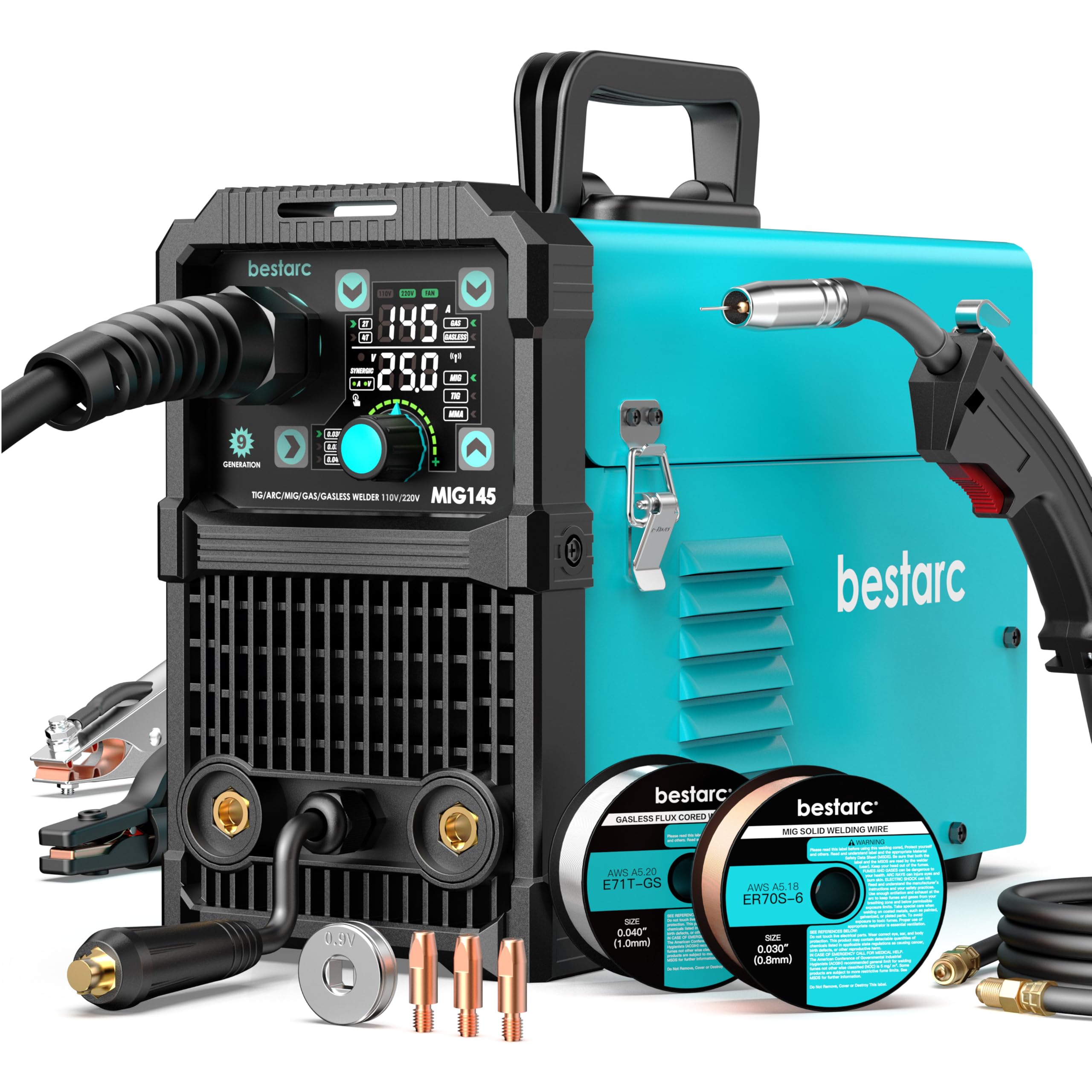
The Bestarc 145A is the standout starter machine because it packs synergic control, 110V/220V dual voltage, and a 13.7-pound shoulder-strap portable frame into one package. The synergic mode auto-selects voltage and wire speed when you choose wire diameter — you adjust current alone, which dramatically reduces the guesswork that frustrates new welders. Running gasless flux core on 110V, it handles 1/8-inch steel without bogging down, and the LED display makes parameter reading easy even with a helmet on.
It supports solid wire MIG with gas for indoor work, stick for thicker repairs, and lift TIG for detail jobs, giving you room to grow into different processes without buying another machine. Users consistently report stable arc performance and clean penetration on auto body panels and RV modifications. The built-in safety protections (over-current, over-heat, over-load) provide reassurance during long practice sessions.
The 2-meter gas hose and included 0.030-inch solid and flux core wires let you start welding right out of the box. Some reviews mention the stick lead could be replaced with a solid copper cable for better arc starts, but for MIG and flux core use, this machine delivers well above its price tier. It is the most balanced beginner unit between cost, features, and actual build quality.
Why it’s great
- True synergic control eliminates guesswork for beginners
- Lightweight 13.7 lb design with shoulder strap for portability
- 4-in-1 processes (gas MIG, flux core, stick, lift TIG)
Good to know
- Stick lead is copper-clad aluminum — upgrade to solid copper for better performance
- Short 5.5 ft MIG gun lead on early units, later models have longer cables
2. YESWELDER 160A MIG Welder
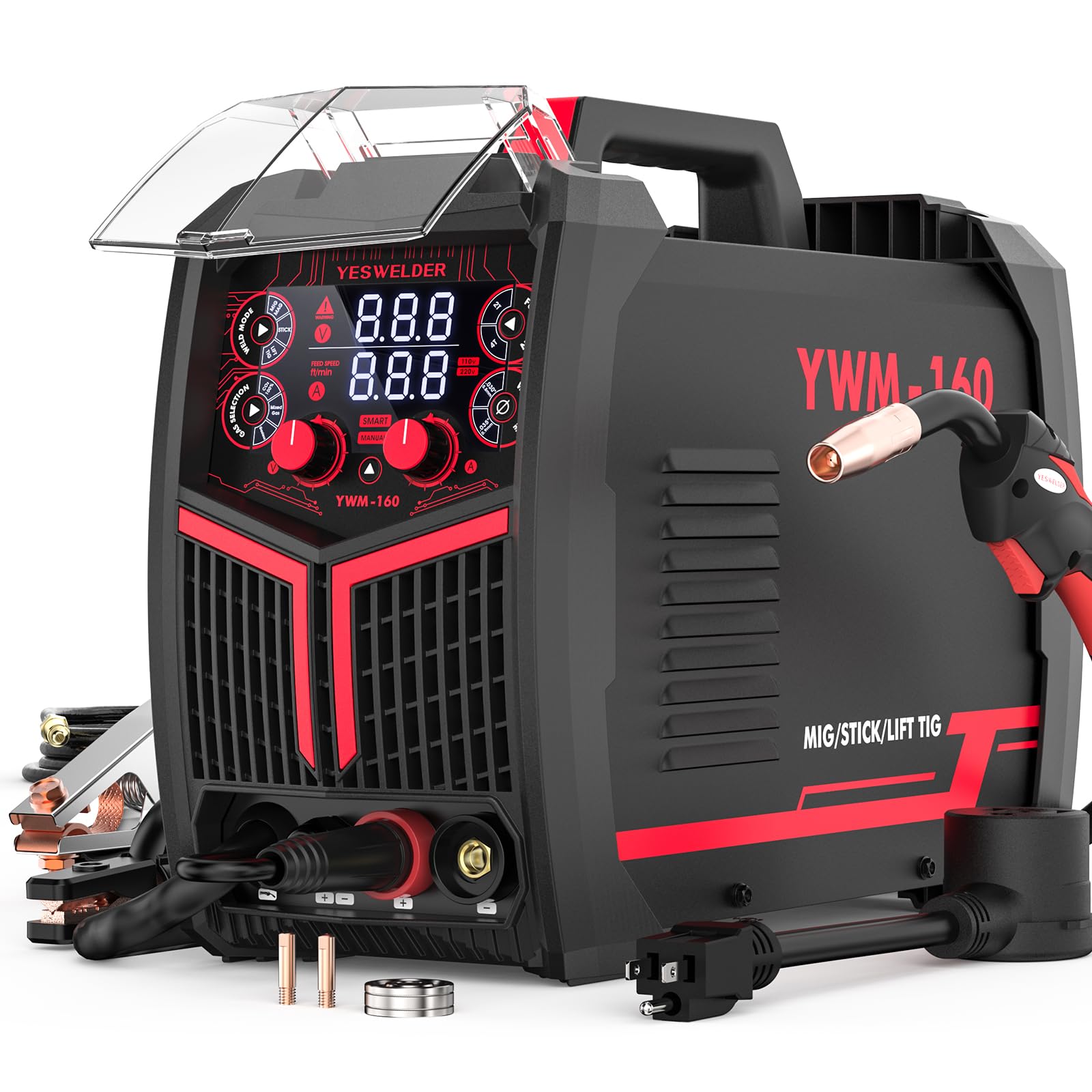
The YESWELDER 160A strikes a near-perfect balance for a beginner who wants to learn with auto-synergic help but transition to manual control later. It offers both smart mode (auto voltage/wire speed by thickness selection) and manual mode where you dial in wire feed and voltage separately. On 220V, it burns through 1/4-inch plate in one pass, while on 110V it handles 16-gauge sheet metal cleanly — ideal for auto exhaust work and light fabrication.
The large LED digital display shows all parameters clearly, and the compact 19.4-pound frame includes a comfortable carrying handle. Users upgrading from Harbor Freight models report a noticeable improvement in arc stability and spatter reduction. It accepts 2-pound and 10-pound spools in 0.030-inch and 0.035-inch sizes, and the built-in gas solenoid supports future gas MIG upgrades.
The included 220V-to-110V adapter is functional but bulky, and some users note the stick welding mode requires practice to start the arc cleanly. Once running, the stick arc is stable with 6013 and 7018 rods. This machine is a solid step above basic entry-level units and offers room to grow into manual techniques.
Why it’s great
- Dual smart and manual control modes for learning and growth
- Lightweight and easily portable at 19.4 lb
- Strong penetration on 220V for 1/4″ steel
Good to know
- 110/220V adapter is large and awkward for 110V-only use
- Stick arc can be difficult to initiate for absolute beginners
3. AZZUNO 200A MIG Welder

The AZZUNO 200A hits a sweet spot for new welders who want higher amperage capacity without jumping to premium pricing. The 200A rating on 220V lets it weld mild steel up to 5/16-inch thickness, while the synergic control auto-sets voltage and feed speed when you select wire diameter. This simplifies setup — choose 0.030-inch flux core wire, and the machine calculates the rest. Users report solid bead quality immediately with no manual tuning required.
Supporting gas and gasless MIG, lift TIG, and stick modes, the 4-in-1 design covers most home shop tasks. The grey chassis is surprisingly sturdy, and the digital readout provides clear feedback. Customer support from AZZUNO is notably responsive — several reviews mention fast replacement of damaged units and updated manual PDFs. The included 10-foot ground clamp and electrode holder provide decent reach for small garage layouts.
The main drawback is the documentation: the stock manual is poorly written with unexplained features, so beginners will need to search online guides. The gas inlet uses a 1/4-inch hose barb instead of a standard CGA fitting, requiring an adapter for gas cylinders. For those comfortable with minor setup learning, this machine delivers exceptional value and 200A capacity that undercuts similarly specced competitors.
Why it’s great
- 200A output capable of welding 5/16″ mild steel
- Synergic control simplifies beginners’ learning curve
- Excellent customer support and warranty handling
Good to know
- Poor manual with unexplained features — online research needed
- Gas inlet uses hose barb, not standard CGA fitting
4. FEMEROL 250A MIG Welder

The FEMEROL 250A brings a 60% duty cycle at 250A, which is significantly higher than what most entry-level machines offer. For a beginner who plans to weld for extended periods or tackle thicker materials, this means less waiting for thermal cooldown. It supports six processes — gas MIG, flux core, stick, lift TIG, spot welding, and spool gun compatibility for aluminum — making it the most versatile unit in this price range.
Adjustable inductance control allows fine-tuning of the arc puddle: lower inductance for a tighter arc on thin metal, higher inductance for a wider puddle on thick sections. This feature is typically found on machines twice the price. The 9.5-foot cables provide good reach, and the synergic MIG mode auto-matches parameters for wire diameter and gas type. Users report smooth arc characteristics with 7014 and 7018 rods in stick mode.
The continuous cooling fan runs loudly even when not welding, which some users find annoying. The gas inlet uses a barbed fitting rather than a standard threaded connection, requiring a separate adaptor. The spool holder design is awkward for quick changes. Despite these minor complaints, the build quality and feature set at this price point are exceptional.
Why it’s great
- 60% duty cycle at 250A for long welding sessions
- Adjustable inductance for fine arc control
- Spool gun compatible for aluminum welding
Good to know
- Continuous fan runs loudly even when idle
- Gas inlet uses barbed fitting, requires adapter for standard regulators
5. ARCCAPTAIN 165A MIG Welder
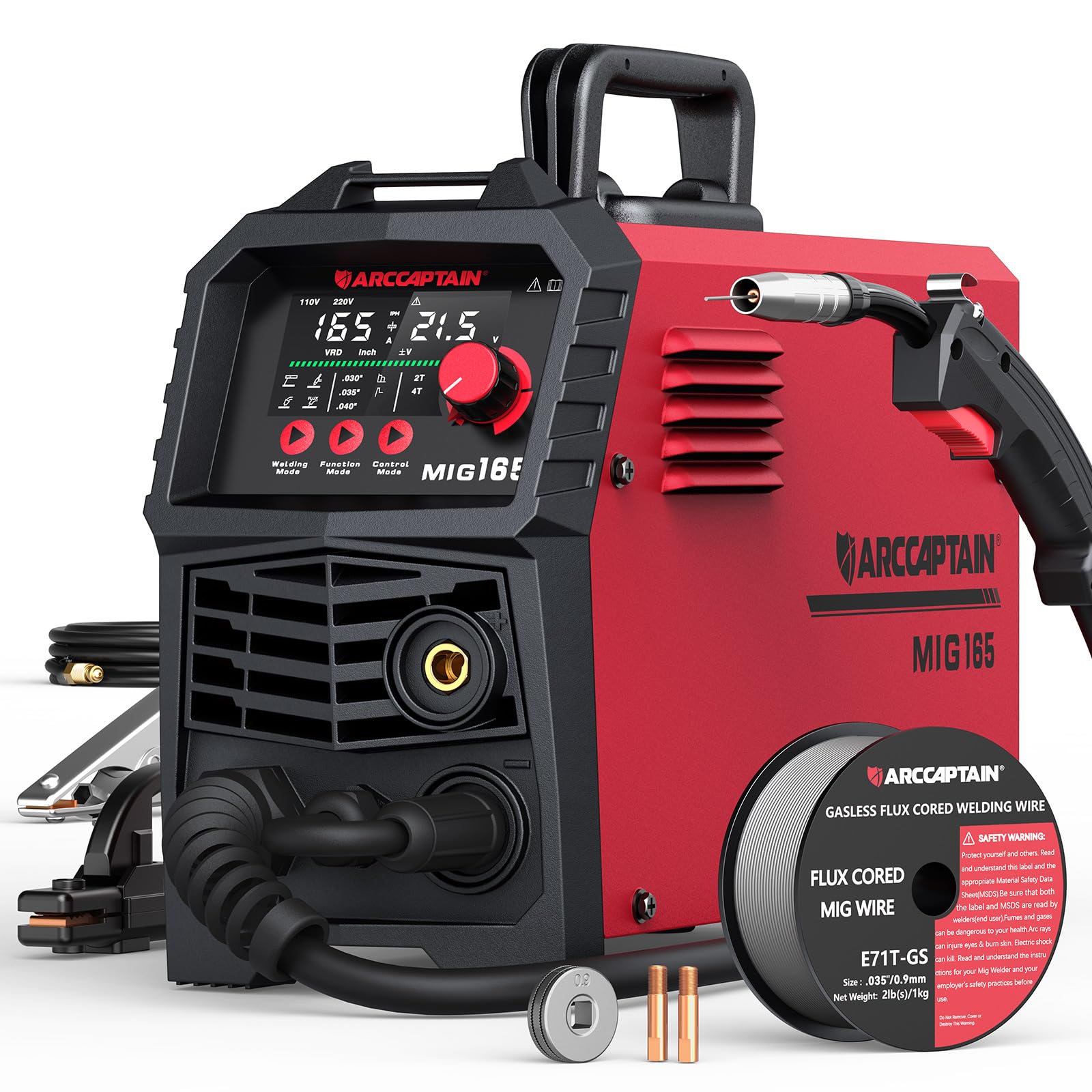
The ARCCAPTAIN 165A weighs only 12.8 pounds, making it the lightest inverter welder on this list. The MCU and IGBT technologies allow precise parameter control in synergic mode — set material thickness and the machine selects voltage and wire speed. The LED display is readable without removing the helmet, and the 2T/4T trigger mode selection helps with long continuous welds on seams.
Output reaches 165A, which handles 3/16-inch mild steel on 220V. The cooling fan is upgraded to 30% better heat dissipation, supporting the 60% duty cycle rating. Users report excellent results on race car parts and home shop repairs, noting the arc is smooth with minimal spatter when using flux core wire. The included shoulder strap adds convenience for carrying to job sites.
The biggest limitation is the 6-foot MIG torch cable, which is too short for welding on vehicle frames or large structures without extension cords. It only accepts 2-pound wire spools, so you will change spools frequently during longer jobs. The manual is sparse on gas MIG setup details, and no TIG torch is included. Despite these constraints, the portability and welding quality make it a strong travel companion.
Why it’s great
- Extremely lightweight at 12.8 lb for true portability
- Upgraded MCU/IGBT technology for stable arc
- Clear LED display readable with welding helmet on
Good to know
- Short 6 ft MIG torch cable limits reach for large projects
- Only accepts 2 lb wire spools — frequent changes needed
6. Lincoln Electric 90i FC Weld-Pak

The Lincoln Electric 90i FC is a flux-core-only machine built for portability and simplicity. Running on standard 120V, it welds up to 1/4-inch steel and is optimized for thin materials like 14-18 gauge sheet metal. The inverter power source produces smoother weld characteristics than traditional transformer machines, with an infinitely variable voltage dial (1-10) instead of a two-position rocker switch. This allows fine voltage adjustment for precise bead control.
Weighing 15 pounds and packing into a protective metal case with shoulder strap, it is genuinely portable. Users restoring cars praise the easy-to-handle torch for precision work on body panels. The included cold feed switch lets you change spools safely without live wire. Lincoln’s reputation for parts availability and warranty support is a significant advantage for buyers who plan to keep a machine for years.
It only takes 1-pound wire spools, which means spool changes happen often during larger jobs. There is no gas MIG capability — this is strictly flux core. The lack of a carry handle (shoulder strap only) is an ergonomic complaint. For a beginner who values brand trust and plans to work primarily on thin metal, this machine is a reliable, low-hassle starting point.
Why it’s great
- Lincoln Electric build quality and customer support
- Infinitely variable voltage for precise bead tuning
- Lightweight metal case protection and portability
Good to know
- Flux core only — no gas MIG or stick capability
- Only accepts 1 lb spools, frequent changes required
7. Weldpro 155A MIG Welder

The Weldpro 155A comes with a gas flow meter and hose included, which is rare for a machine at this price — most competitors require a separate regulator purchase for gas MIG operation. It delivers 155A at 30% duty cycle on 220V (120A on 110V) and supports gas MIG, flux core, and stick modes. The synergic control automatically matches voltage and wire speed when you select material thickness, and the IGBT inverter keeps weight down to 21.2 pounds.
Users highlight easy setup under 10 minutes and immediate good results with 75:25 argon/CO2 mix on 0.035-inch solid wire. The 3-in-1 versatility covers body panels, gate repairs, and farm equipment. The included stick holder and earth clamp are better quality than typical budget accessories, and the dual-voltage auto-sensing feature eliminates confusion about plug configuration.
The manual is poorly written with incomplete wire feed instructions — users report initial bird-nesting issues until they discovered the drive roller groove orientation online. Live tech support is responsive, but the manual issue is a real friction point for absolute beginners. The stick welding mode works best on 220V for arcs lasting longer than 4-5 seconds. For a novice who wants a complete kit, including a gas regulator, this is a convenient package.
Why it’s great
- Includes gas flow meter and hose — saves separate purchase
- Auto-sensing 110V/220V dual voltage
- Good arc stability with 75:25 gas mix
Good to know
- Poor manual causes wire feed confusion for beginners
- Stick welding requires 220V for longer weld cycles
8. HZXVOGEN 250A MIG Welder
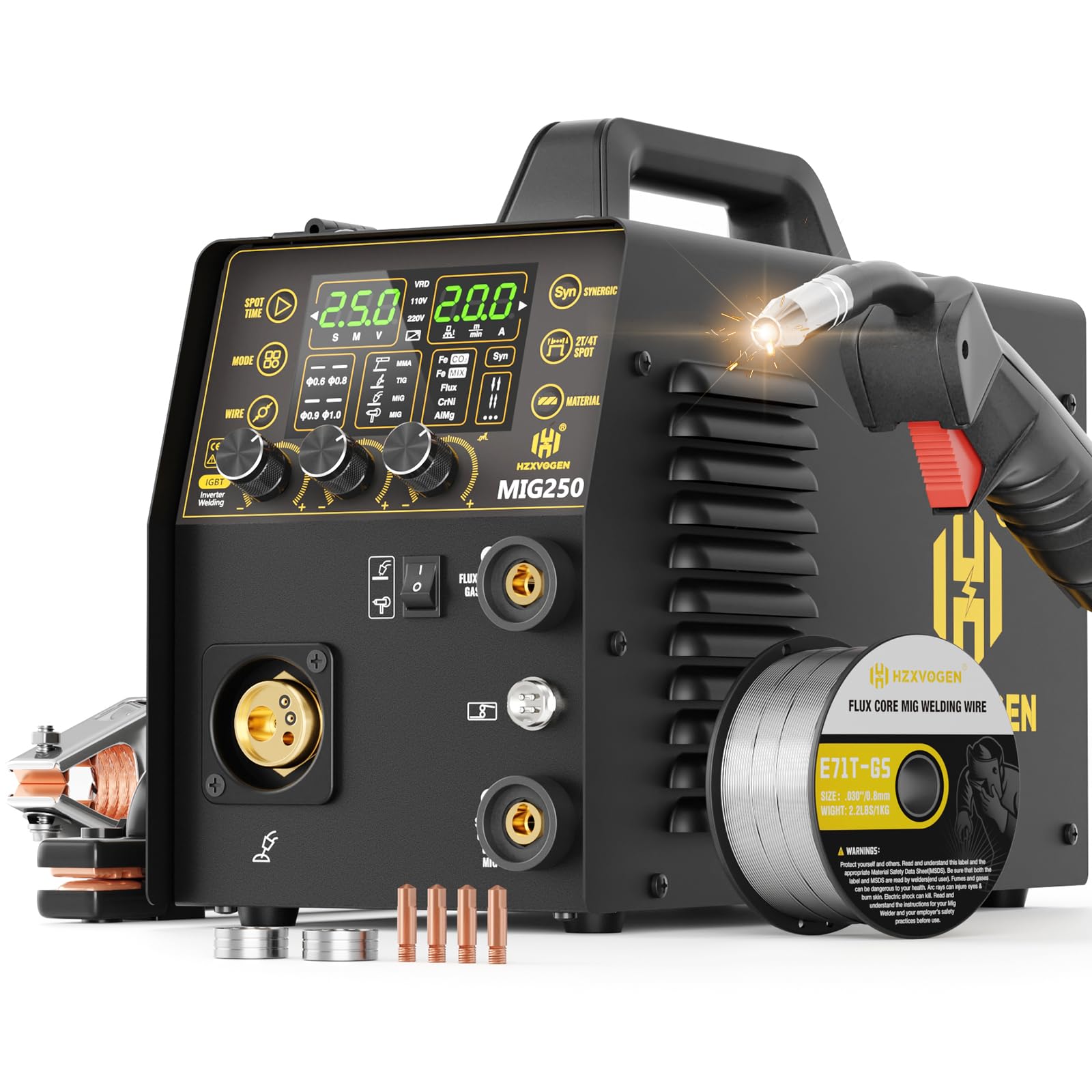
The HZXVOGEN 250A pushes into 6-in-1 territory: gas MIG, flux core, stick, lift TIG, spot welding, and spool gun compatibility. The MCU digital control board lets you store up to 10 user presets per mode, so you can recall a known-good setting for frequently used material thicknesses. The synergic mode auto-matches voltage and wire speed, while manual mode allows experienced welders to make voltage compensation adjustments.
On 220V, it burns through 1/4-inch plate with ease using 0.030-inch flux core wire, and test users report clean penetration on 3/4-inch hooks at 180A. The upgraded cooling fan system handles extended welding sessions without thermal shutdown. The large LED display provides clear feedback on all parameters, and the 2T/4T trigger function helps with long seam welding.
The 4-foot ground cable is too short for practical shop use — most users immediately replace it with a longer 10-foot or 15-foot cable. The panel interface is non-intuitive, requiring time to learn the menu structure. The 250A rating is likely optimistic as the 110V input limits practical high-current output. For a beginner who wants maximum process flexibility and is comfortable with a learning curve, this unit offers more than any other in its range.
Why it’s great
- 6 processes in one machine including spot weld and spool gun
- 10 user presets let you save repeatable settings
- Synergic and manual modes for learning to professional use
Good to know
- Ground cable is only 4 ft — plan for replacement
- Control panel is non-intuitive and requires study
9. JEGS MIG 100 Gasless Welder
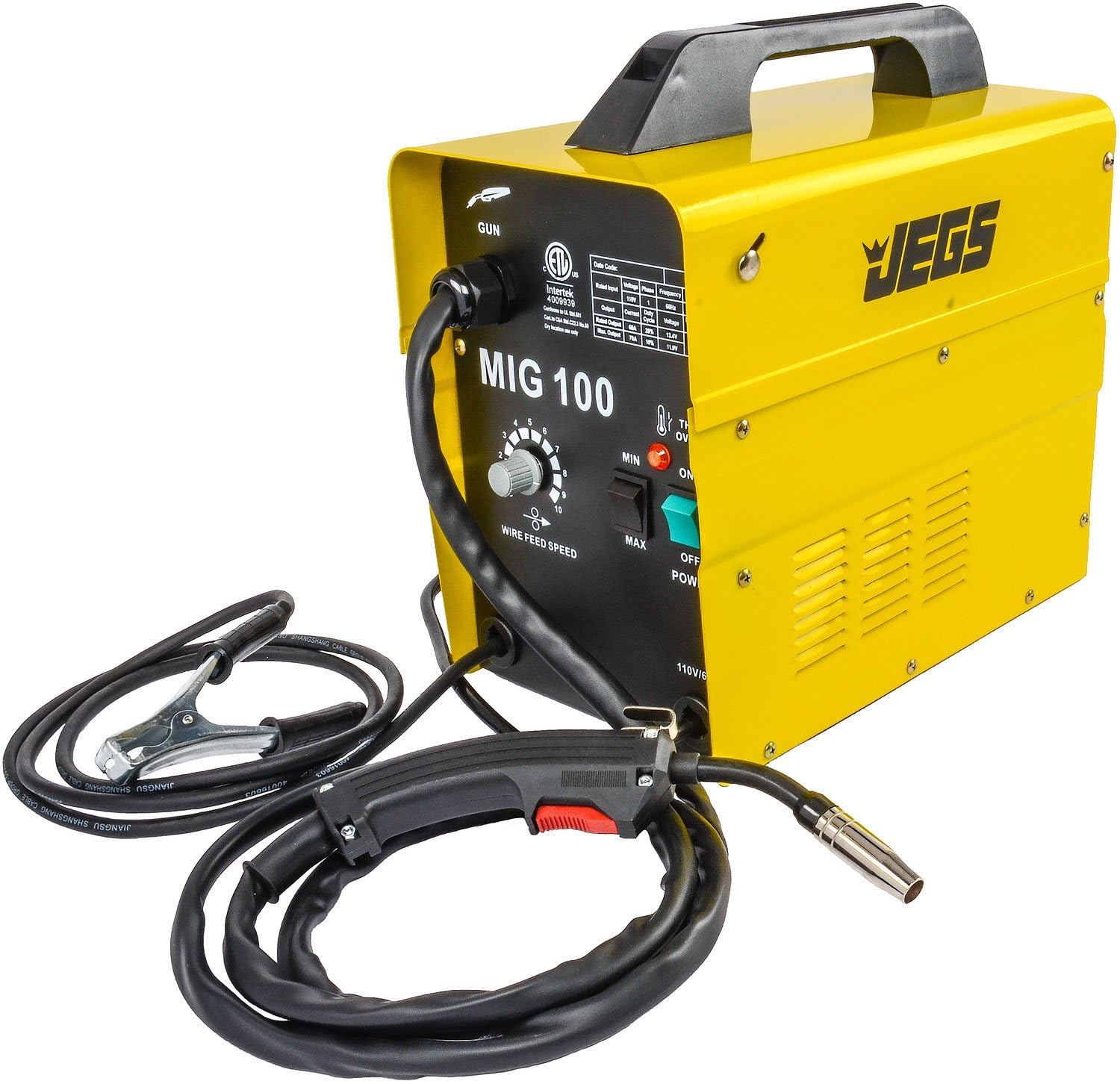
The JEGS MIG 100 is a simple, gasless flux core welder designed for the absolute beginner on a tight budget. Running on 110V with 20 amps of input current, it welds thin materials like exhaust pipes, mini bike frames, and sheet metal repairs. The controls are basic — high and low heat settings with a wire speed knob — no digital display or synergic assist. This simplicity reduces the learning curve, but also limits precision.
Users report good results on exhaust work and light home repairs after practicing with flux core wire. The machine is heavy at 34.8 pounds compared to inverter models, built with a transformer-based design that lacks the energy efficiency of IGBT units. It includes a hand-held mask, wire brush, spool of wire, and welding torch, so total out-of-box readiness is high. Several reviews note the machine has held up well after two years of light home use.
The lack of user-friendly features is the biggest limitation. Without a voltage adjustment chart for metal thickness, beginners must learn through trial and error. The ground clamp and torch cable are basic quality and benefit from aftermarket upgrades. For someone who needs to weld thin steel occasionally and wants the lowest entry cost, this machine works, but the modern inverter options above provide a significantly better experience for a small increase in investment.
Why it’s great
- Lowest entry cost for flux core welding
- Includes mask, wire, and brush for immediate use
- Reliable for thin material exhaust and light repairs
Good to know
- Only high/low heat settings — no fine voltage control
- Heavy transformer design at 34.8 lb
FAQ
Can a beginner MIG welder run on a standard 110V household outlet?
What thickness of steel can a 110V beginner MIG welder handle?
Is flux core wire as strong as gas MIG welding?
What does synergic control actually do for a beginner?
Why does my cheap MIG welder keep jamming the wire?
Final Thoughts: The Verdict
For most users, the best beginner mig welder winner is the Bestarc 145A because it combines synergic control, 4-in-1 process versatility, lightweight portability at 13.7 pounds, and genuine 110V/220V dual voltage at a price that leaves room for accessories. If you want a dedicated learning machine with smart and manual modes, grab the YESWELDER 160A. And for the highest power-to-cost ratio and a 6-in-1 feature set that includes spool gun capability, nothing beats the FEMEROL 250A.