
Our readers keep the lights on and the weekend projects moving. As an Amazon Associate, I earn from qualifying purchases.
Watching a flash of brilliant blue streak across your yard is one of the simple joys of spring, but that moment only happens if you’ve chosen a nesting box that actually meets a bluebird’s demanding requirements. The wrong entrance hole invites starlings, poor ventilation suffocates chicks, and flimsy materials crumble within a single season — turning your good intentions into a real hazard for the very birds you’re trying to help.
I’m Rikta — the co-founder and writer behind FitlyFast. I spend my time cross-referencing customer build-quality reports with technical specs like predator guard thickness and fledgling ladder grooves to separate the safe, durable houses from the dangerous duds.
A well-designed box balances a precise 1.5-inch entrance, internal climbing grooves for fledglings, and weatherproof cedar or recycled plastic construction. This guide walks through everything you need to find a safe, long-lasting best bluebird house that eastern and western bluebirds will actually raise their young in.
How To Choose The Best Bluebird House
The market is filled with cute birdhouses that are actually death traps for bluebirds. A house that looks charming on a shelf can bake chicks in direct sun, allow predators to reach the nest, or trap fledglings inside. Focus on these three non-negotiable features before you buy.
Entrance Hole Size and Predator Guard
Eastern bluebirds require a precisely 1.5-inch diameter entrance hole. European starlings — aggressive cavity invaders — cannot fit through that exact dimension while bluebirds enter comfortably. Any deviation invites competition or tragedy. Look for a metal predator guard ring around the hole: this prevents squirrels, raccoons, and woodpeckers from chewing the opening wider to access the nest.
Interior Fledgling Support
Young bluebirds must climb from the nest cup up to the exit hole using only their feet. Smooth interior walls are a death sentence for late-hatching chicks who cannot gain traction. Essential houses include either vertical grooves on the inside front wall or a rough textured surface — sometimes called a fledgling ladder — that lets chicks scramble out on their own when they fledge.
Material Durability and Ventilation
Cedar is the gold standard because it resists rot, warping, and insect damage without chemical treatment. Carbonized wood adds surface hardness for longer life. Recycled plastic never rots and stands up to the harshest winters, though it can trap heat in direct sun if ventilation gaps are insufficient. Whatever material you choose, ensure the design includes air vents near the top and drainage holes at the floor — stagnant heat and moisture are the top killers of nestlings.
Quick Comparison
On smaller screens, swipe sideways to see the full table.
| Model | Category | Best For | Key Spec | Amazon |
|---|---|---|---|---|
| Dreyoo Bluebird House | Premium Cedar | Purists wanting a classic 1.5″ design | 1.5″ entrance, metal guard, cedar build | Amazon |
| Woodlink Audubon | Audubon Spec | Trusting an Audubon‑endorsed blueprint | 13.75″H, 1.5″ hole, handcrafted cedar | Amazon |
| Kingsyard Recycled Plastic | Plastic Premium | Weather‑proofing for harsh winters | Recycled plastic, view panel, 1.5″ hole | Amazon |
| Fitraho 2‑Pack Cedar | Multi‑Pack | Starting a bluebird trail on a budget | Two houses, 1.5″ hole, carbonized cedar | Amazon |
| Auslar Hanging House | Entry Level | Casual garden decoration | 1.57″ hole, cedar build, herringbone roof | Amazon |
| SISTERBIRD Wren House | Small Species | Wrens and chickadees specifically | 1.125″ hole, cedar, fledgling kerfs | Amazon |
| Kingsyard Royal Blue Wren | Classic Design | Compact spaces with wren traffic | 1″ hole, pine wood, metal predator ring | Amazon |
In‑Depth Reviews
1. Dreyoo Cedar Bluebird House

The Dreyoo is built precisely for cavity-nesting bluebirds: the 1.5-inch entrance hole is the North American bluebird society standard, and the front-mounted metal guard stops raccoons and squirrels from chewing it larger. Solid carbonized cedar construction with nailed joints gives this box the rigidity to survive windy seasons without warping, and the pre-drilled mounting holes include stainless screws for quick post installation.
Internally, the box features vertical fledgling grooves on the front wall that let young bluebirds climb out when they fledge — a critical safety detail missing from many cheaper houses. The front door swings open on a secure latch for end-of-season cleanout, and the elevated mesh floor provides drainage while keeping the nest cup dry.
Customers consistently note the excellent workmanship for the price tier, with most buyers reporting bluebird occupancy within the first spring. The only minor trade-off is the compact interior dimensions — some eastern bluebird pairs prefer slightly roomier boxes, but the Dreyoo’s dimensions stay within Audubon guidelines for safe brooding.
Why it’s great
- Correct 1.5″ entrance with durable metal guard
- Thick carbonized cedar resists rot and insects
- Interior grooves help fledglings escape safely
- Easy-clean front door with secure latch
Good to know
- Interior is on the smaller side for large eastern bluebirds
- No perch — correct for bluebirds, but first-time buyers sometimes expect one
2. Woodlink NABB Audubon Cedar Bluebird House
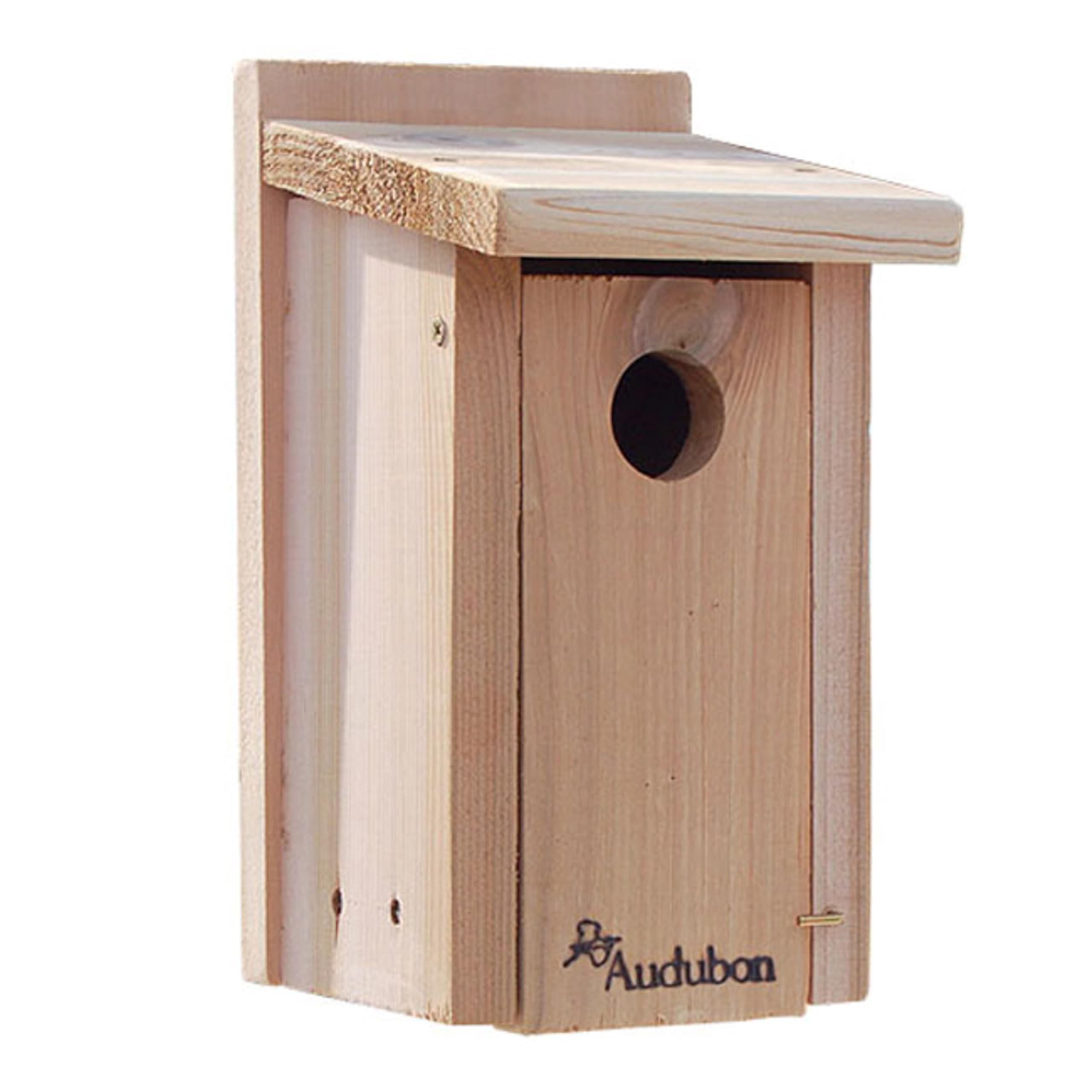
This Woodlink house follows the National Audubon Society’s exact blueprint for eastern bluebirds, including the 1.5-inch hole, 8-inch depth, and slanted roof that sheds rain away from the entrance. Handcrafted from natural unfinished cedar, the box breathes naturally and blends into woodland environments better than painted or carbonized alternatives. The design is a time-tested standard used on bluebird trails from Maine to Georgia.
The cleanout mechanism is a hinged front panel secured by a simple latch — no tools required for seasonal maintenance. Pre-drilled pilot holes and included screws make mounting on a post or tree straightforward. At 13.75 inches tall, the box provides generous headroom that eastern bluebird pairs seem to prefer over shorter models.
Some buyers mention quality control variability: a small number of units arrive with slightly misaligned doors or gaps in the cedar joints. Applying clear exterior caulk at the roof seam is a common buyer modification to prevent water seepage over time. Overall, the Audubon pedigree and solid cedar construction make this a reliable choice for serious bluebird trail managers.
Why it’s great
- Design approved by National Audubon Society
- Tall spacious interior preferred by eastern bluebirds
- Natural unfinished cedar breathes and resists decay
- Made in the USA with handcrafted quality
Good to know
- No metal predator guard around the entrance hole
- Some units have minor joint gaps that benefit from caulk
3. Kingsyard Recycled Plastic Bird House

The Kingsyard recycled plastic house is the most weather-resistant option in this lineup. It will never rot, warp, splinter, or succumb to wood-boring insects. The 1.5-inch entrance hole is molded with a built-in predator guard extension that prevents enlargement, and the side door features a transparent panel that lets you observe nest activity without opening the box. The material also holds up against years of direct sun and snow without fading.
Assembly requires attaching the roof and side latch, but the pieces are precisely molded and fit together cleanly with stainless steel hardware. A bottom mesh grate elevates the nest above any moisture that might accumulate, and the interior walls include textured climbing surfaces for fledglings. For hot southern climates, several owners have drilled a few extra ventilation holes in the back panel with success.
The recycled plastic does not breathe like wood, so in full-summer exposure the interior can run marginally warmer than a cedar box. Positioning it with afternoon shade is a smart precaution. Bluebird occupancy rates are high, and the cleanout process is tool-free — simply slide the side door open.
Why it’s great
- Recycled plastic never rots or requires painting
- Transparent viewing panel for interior observation
- Built-in predator guard on the entrance hole
- Tool-free side door cleanout
Good to know
- Plastic can trap heat — position with some afternoon shade
- Requires simple assembly of roof and latch
4. Fitraho 2‑Pack Cedar Bluebird Houses
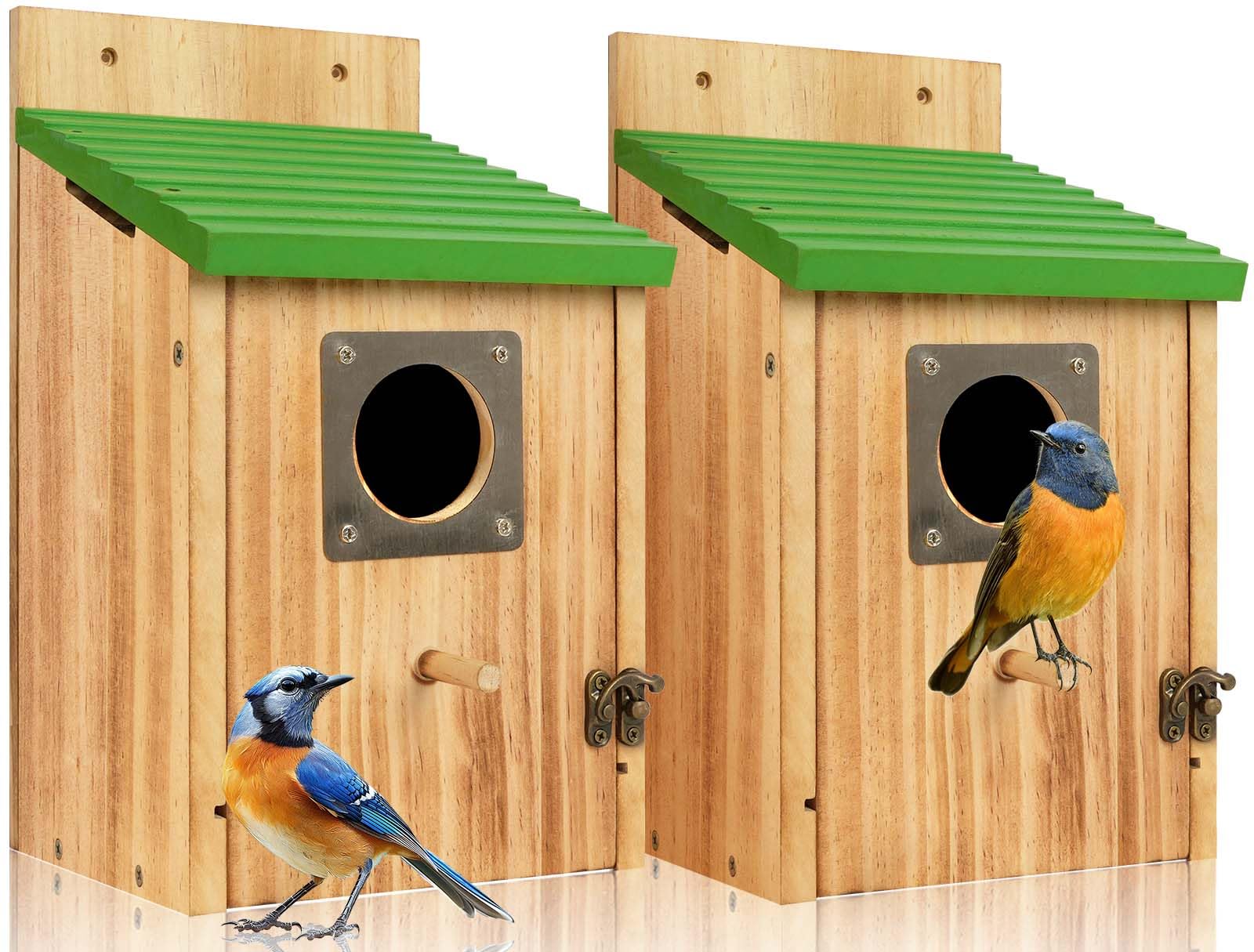
The Fitraho 2-pack gives you two carbonized cedar houses with metal predator guards at the per-unit cost of a single economy box. Carbonization hardens the wood surface and darkens the aesthetic to a rich rustic brown that weathers elegantly without paint. Each house has a 1.5-inch entrance hole precisely sized for bluebirds and tree swallows, and the front door opens on a small latch for cleaning.
Assembly is required, but the pre-drilled holes align perfectly, and each kit includes a small screwdriver and all necessary hardware. Customers consistently report the assembly process taking under ten minutes per house. Internal grooves function as a fledgling ladder, and the sloped roof overhangs the entrance to keep rain from blowing directly into the cavity.
The green roof color option stands out nicely against foliage, though the paint finish on the roof is less durable than the carbonized cedar body. A clear matte acrylic spray on the roof extends its appearance. For anyone starting a bluebird trail or wanting houses for two locations, this pack delivers the best per-unit value without compromising the essential safety features.
Why it’s great
- Two houses for the cost of one premium single box
- Carbonized cedar body with metal predator guards
- Pre-drilled holes and included tools simplify assembly
- Interior fledgling grooves support chick survival
Good to know
- Roof paint may fade faster than the carbonized wood
- Soft cedar requires careful screw tightening to avoid stripping
5. Auslar Hanging Bluebird House
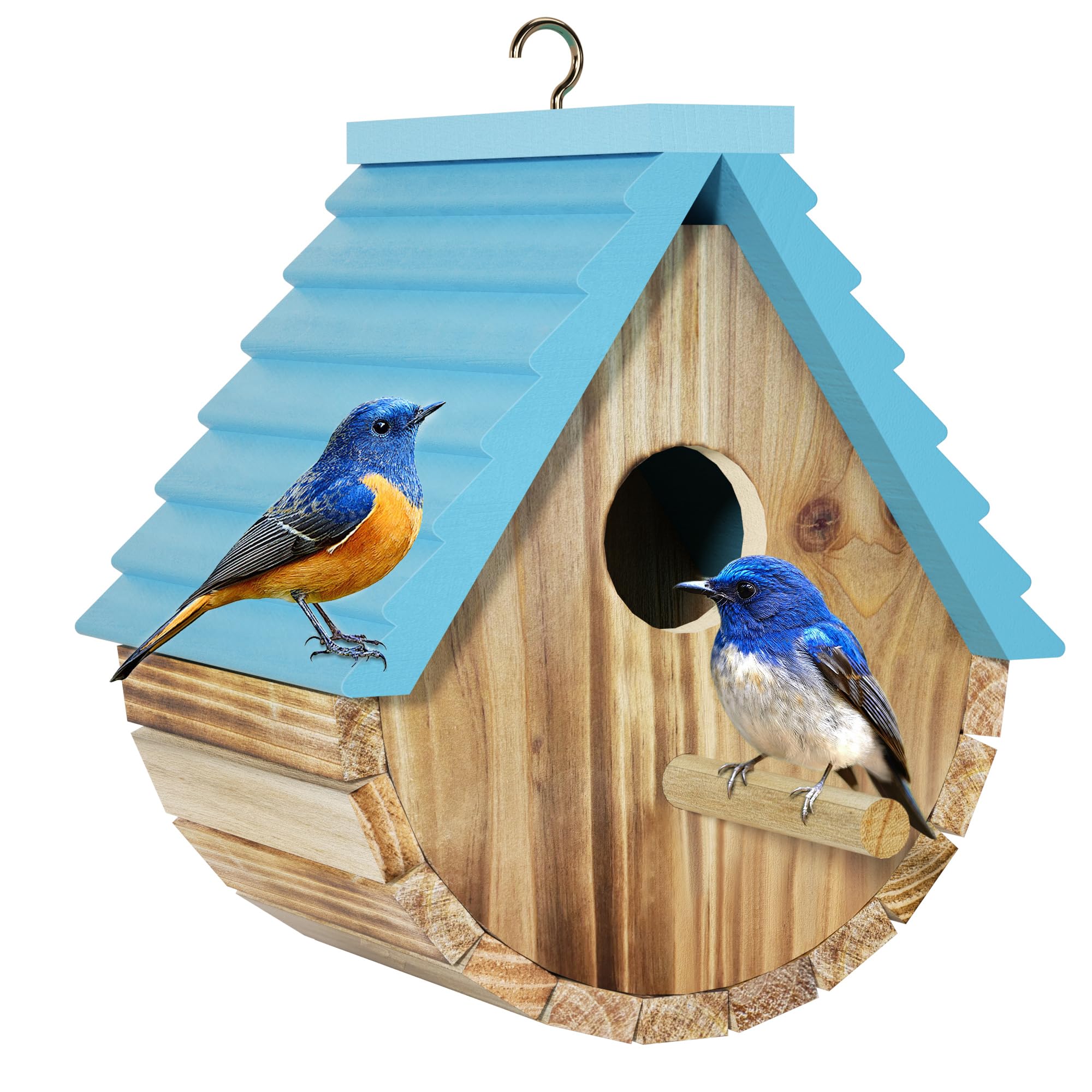
The Auslar house is the most visually distinctive option here, with a herringbone wood roof and a carbonized black body accented by a royal blue top. The 1.57-inch entrance hole is slightly larger than the ideal 1.5 inches for bluebirds, which means it will also admit larger birds like starlings. It is best viewed as a decorative house that may attract smaller cavity nesters like wrens or chickadees rather than a dedicated bluebird conservation box.
It arrives fully assembled and can be hung from its built-in hook or mounted using the included screws. The swivel back door provides decent access for cleaning, and the cedar construction offers natural weather resistance without needing paint. The interior floor measures roughly 5.9 by 7 inches, giving birds reasonable room to build a nest cup.
Customer reviews highlight the sturdy build and vibrant blue roof that resists fading. However, the oversized entrance and lack of a metal predator guard mean it should not be your first choice for bluebird-specific trails. For a garden accent that might host the occasional chickadee, it looks great on a patio hook.
Why it’s great
- Unique herringbone roof design with vibrant colors
- Ready to hang or mount straight out of the box
- Cedar construction is naturally weather-resistant
- Swivel back door for easy interior access
Good to know
- 1.57″ entrance is too large for strict bluebird exclusion
- No metal predator guard around the hole
6. SISTERBIRD Wren House with Predator Guard
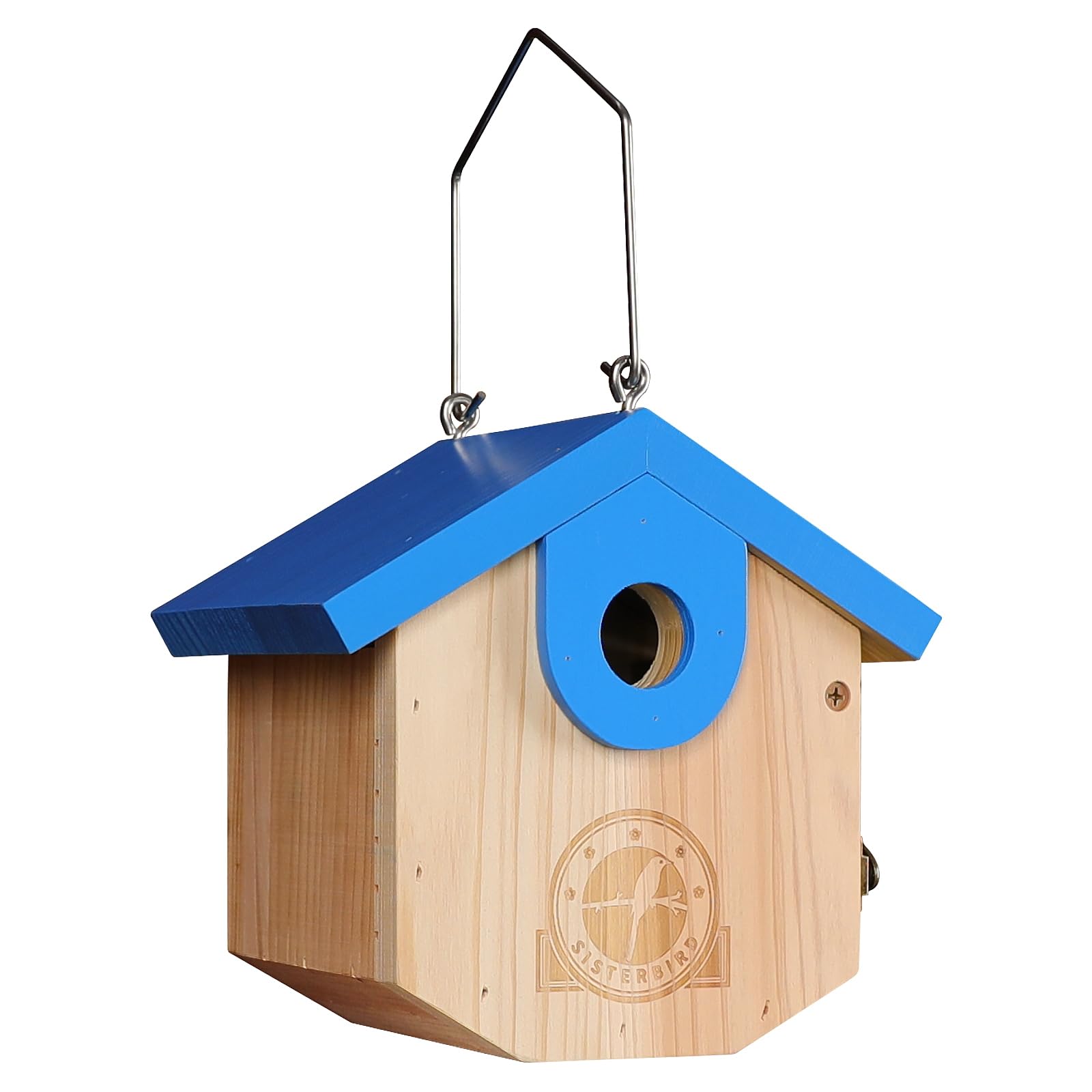
The SISTERBIRD house is engineered specifically for smaller cavity nesters like Carolina wrens and chickadees, with a 1.125-inch entrance that completely excludes bluebirds. If your goal is bluebirds, this is the wrong house — but if you have a wren population that needs safe housing, this is one of the most thoughtfully designed boxes available. The U-shaped interior floor mimics a natural nest cup contour that wrens instinctively prefer.
The cedar construction includes five fledgling kerfs on the interior walls, three upper air vents, and six drainage holes in the floor. The front door uses a metal latch secured with four screws, which is far more predator-resistant than the flimsy L-screw latches found on competing models. A 304 stainless steel hanging hook resists corrosion and supports the box securely from a tree limb.
Customers praise the thick cedar walls and precise joinery, noting that the box feels significantly more substantial than its weight suggests. The blue roof finish is attractive but some owners add a clear coat for UV protection. For bluebird-specific needs, look elsewhere — but for targeted wren conservation, this box is a standout.
Why it’s great
- 1.125″ hole is perfectly sized for wrens and chickadees
- U-shaped interior floor encourages natural nesting behavior
- Five fledgling kerfs help young birds exit safely
- Stainless steel hanger and secure metal latch
Good to know
- Entrance too small for bluebirds — not a bluebird house
- Blue roof paint may benefit from a protective clear coat
7. Kingsyard Royal Blue Wren House

This Kingsyard house is built from New Zealand pine rather than cedar, and its 1-inch entrance is designed exclusively for wrens — bluebirds cannot fit through this opening. It makes an excellent companion house to place in a different part of the yard where you want to support wren populations without competition from larger birds. The royal blue roof adds a cheerful garden accent.
The lid lifts off entirely for cleaning — no tools or latches required — which customers consistently describe as the most convenient cleanout mechanism in this price range. A metal predator guard ring lines the entrance to prevent chewing, and the included wire hanger lets you suspend the box from a hook or branch. Interior ventilation comes from gaps in the wall joints rather than dedicated air vents.
The pine construction is lighter and less rot-resistant than cedar, so placing this house in a covered or partially shaded spot extends its life. Several buyers have reported wren occupancy within days of installation, drawn by the compact cavity and the anti-predator ring. For a second or third yard box aimed at small songbirds, this is a solid choice.
Why it’s great
- Tool-free roof removal for effortless seasonal cleaning
- Metal predator guard ring around the entrance hole
- Compact size ideal for wrens in small garden spaces
- Attractive royal blue roof color
Good to know
- Pine wood is less durable than cedar outdoors
- 1″ entrance excludes bluebirds — wren use only
FAQ
What is the correct entrance hole size for a bluebird house?
Should I get a bluebird house with a perch?
How high should I mount a bluebird house?
Final Thoughts: The Verdict
For most users, the best bluebird house winner is the Dreyoo Cedar Bluebird House because it nails every critical spec — the exact 1.5-inch entrance, a sturdy metal predator guard, interior fledgling grooves, and carbonized cedar that weathers beautifully — at a mid-range price that undercuts premium options without sacrificing safety. If you want the Audubon-endorsed blueprint with more interior height for eastern pairs, grab the Woodlink NABB Audubon. And for a house that will outlast every wooden model in your yard through rain, snow, and blazing sun, nothing beats the Kingsyard Recycled Plastic Bird House.