
Our readers keep the lights on and the weekend projects moving. As an Amazon Associate, I earn from qualifying purchases.
Learning your first overlock machine is a mental hurdle — four thread cones, two loopers, and a blade that trims as you sew. Every new owner fights the threading anxiety, but a good beginner serger turns that fear into professional-looking seams within the first hour. The machines on this list prioritize color-coded guides, sturdy metal frames for vibration control, and differential feed to handle knits without puckering.
I’m Rikta — the co-founder and writer behind FitlyFast. I’ve spent years analyzing sewing hardware specifications and reading thousands of owner experiences across the budget to premium spectrum, separating marketing hype from the machines that actually hold up under daily use.
After comparing nine models on thread capability, stitch speed, frame construction, and real-user ease-of-threading scores, this guide delivers the clearest path to picking the right beginner serger without overpaying for features you do not need.
How To Choose The Best Beginner Serger
A first serger is a multi-year purchase. Picking the wrong one means fighting tension knobs and broken thread instead of finishing projects. Focus on three pillars: threading ease, fabric-handling range, and build stability. A machine that scores well in these areas will keep you serging for a decade.
Threading System and Color Coding
The lower looper is every beginner’s nightmare. Machines with color-coded thread guides and numbered path diagrams reduce setup time from an hour to ten minutes. Look for a lay-in threading system or a pre-threaded unit out of the box. If the manual has tiny greyscale diagrams, make sure YouTube tutorials exist before you buy.
Differential Feed and Fabric Versatility
Differential feed is the single spec that separates sewable sergers from frustrating ones. A ratio between 0.7 and 2.0 lets you prevent puckering on thin silk and gather stretchy knits without distortion. Machines without this feature are limited to stable woven fabrics only — skip them if you ever sew t-shirts or jersey.
Frame Construction and Stitch Speed
Plastic frames vibrate at high speed, causing skipped stitches and uneven thread tension. A metal frame absorbs vibration and keeps the blade cutting clean across multiple layers. Stitch speed above 1,200 per minute is standard for modern machines — the real quality marker is how quietly and smoothly that speed runs.
Quick Comparison
On smaller screens, swipe sideways to see the full table.
| Model | Category | Best For | Key Spec | Amazon |
|---|---|---|---|---|
| Brother 1034D | Premium | Pro-level threading ease | 1,300 SPM, metal frame, 3 feet | Amazon |
| Brother ST4031HD | Premium | Heavy-duty home sewing | 1,300 SPM, carbon steel blade, xl table | Amazon |
| Janome MOD-8933 | Premium | Lay-in threading simplicity | 3/4 thread, lay-in system, diff feed | Amazon |
| SINGER S0100 | Mid-Range | 6 built-in decorative stitches | 1,300 SPM, adjustable tension, 6 stitches | Amazon |
| SINGER S14-78 | Mid-Range | Rolled hem accuracy | 1,200 SPM, free arm, diff feed | Amazon |
| MILLEPUNTI MLD42 | Mid-Range | 12 built-in stitch variety | 1,300 SPM, 12 stitches, metal frame | Amazon |
| Lumina Moda | Budget-Friendly | Free arm for tubular projects | 1,250 SPM, metal frame, LED, free arm | Amazon |
| VEVOR | Budget-Friendly | Cost-effective 4-thread serging | 1,250 SPM, cast-iron frame, LED | Amazon |
| FEIYUE FY505 | Budget-Friendly | Entry-level price, metal build | 1,100 SPM, metal frame, 2/3/4 thread | Amazon |
In‑Depth Reviews
1. Brother 1034D

The Brother 1034D is the default recommendation for a reason — it balances a high-quality metal frame with a proven color-coded threading system that owners consistently call simple. At 1,300 stitches per minute, it chews through denim layers and delicate knits alike without bogging down. The three snap-on feet (standard, gathering, blind stitch) cover the essential stitch types most beginners need from day one.
Differential feed handles stretch fabrics cleanly, and the removable trim trap keeps your workspace from looking like a fabric explosion. Multiple long-term owners report two-plus years of reliable performance without major issues. The foot pedal is responsive, and disabling the upper knife for non-trimming passes takes seconds.
One minor downside: the included instructional DVD is borderline unwatchable due to small text, but a quick YouTube search for “Brother 1034D threading” solves the problem instantly. The machine does not do coverlock or chain stitches, but for pure overlocking and rolled hem work, it is hard to beat at this level.
Why it’s great
- Proven reliable metal-frame build that lasts years
- Color-coded lower looper threading reduces setup frustration
- Three included feet cover standard, gathering, and blind hem jobs
Good to know
- No coverlock or chain stitch function
- Instructional DVD is too small to follow; YouTube is the real manual
2. Brother ST4031HD Strong & Tough

The Brother ST4031HD is the 1034D’s tougher sibling, built with a carbon steel blade that stays sharper longer and a large extension table ideal for quilting and home decor projects. It handles two-ply towel fabric and canvas without tension adjustments, making it a true heavy-duty option for sewists who plan to push beyond garment finishing.
Threading follows the same color-coded system that made the 1034D famous, with numbered upper and lower loopers. Owners consistently report first threading around ten minutes with the printed guide. The included dust cover, thread nets, and cleaning brush mean you do not need to buy extras just to set up properly.
At 1,300 stitches per minute with a 17.6-pound metal frame, the ST4031HD stays planted during high-speed runs. The wide side table is a genuine quality-of-life upgrade for large projects like curtains or patchwork blankets. A few users noted missing accessories were replaced promptly, and the Brother app-based video guide simplifies any rethreading confusion.
Why it’s great
- Carbon steel blade delivers cleaner cuts through heavy materials
- Large extension table makes big projects manageable
- Pre-threaded from factory for immediate practice
Good to know
- Larger footprint requires dedicated sewing table space
- No 2-thread stitch option without the converter
3. Janome MOD-8933

Janome’s MOD-8933 stands out with its lay-in threading system, which eliminates the need to thread the lower looper through narrow slots. You simply lay the thread into the guide path, press the lever, and the machine does the rest. This is a genuine time-saver for anyone with poor eyesight or shaky hands.
The 3 and 4 thread convertible capability covers overlock seams and rolled hems, and the differential feed prevents wavy results on both knits and lightweight wovens. Owners note that the default tension settings work well out of the box, so you can start serging immediately instead of fighting dials. Metal internal parts give it durability that plastic-bodied units lack.
On the con side, the MOD-8933 lacks a free arm for tubular work, and the upper knife housing feels a bit awkward to access for cleaning. At high speed the machine runs noticeably louder than Janome’s premium siblings, and the tension can drift slightly during extended sessions due to vibration.
Why it’s great
- Lay-in threading is the easiest lower-looper system available
- Metal internal parts provide long-term reliability
- Default tension settings need minimal adjustment for most fabrics
Good to know
- No free arm for cuffs and sleeves
- Noisier at max speed than other mid-range models
4. SINGER S0100

The SINGER S0100 offers six built-in stitches, which is more decorative variety than most sergers in this class. This makes it a strong option for creative edge finishing and home decor accents. The machine arrives pre-threaded in the box, letting you test stitches immediately rather than struggling through initial setup.
Color-coded thread guides are printed on the machine body, and the adjustable tension and stitch length controls are positioned for easy access. At 1,300 stitches per minute, the S0100 keeps pace with higher-priced competitors. The differential feed system handles stretch fabrics without wavy seams, and the front compartment stores all accessories neatly.
Criticisms include occasional confusion about the pre-threaded claim — some units ship without thread in the loopers, which contradicts the listing. A few owners with larger hands found threading the lower looper tight. The foot pedal is lightweight and can slide on smooth floors, so consider a non-slip mat underneath.
Why it’s great
- Six built-in stitches for decorative edging and home decor projects
- Pre-threaded out of box for instant practice
- Front storage compartment keeps accessories organized
Good to know
- Some units arrive not actually pre-threaded despite listing
- Tight lower looper area for larger hands
5. SINGER S14-78

The SINGER S14-78 combines a free arm and rolled hem conversion at a price point that undercuts most machines offering these features. The free arm slides out when you remove the extension table, making sleeve cuffs and pant hems accessible. The rolled hem mode produces a fine, narrow edge on scarves and table linens without needing a separate foot.
Rated at 1,200 stitches per minute, it is slightly slower than the 1,300 SPM standard found on premium models, but real-world owners rarely push that limit. The differential feed prevents puckering on lightweight fabrics, and the color-coded threading system with on-deck guides reduces rethread time. Suction cups at the base keep the machine stable on smooth surfaces.
Owners note that no physical manual ships with the unit — you must download a PDF, and finding the correct version on SINGER’s site takes a few clicks. A few users also wished for a dust cover in the box. The lack of additional presser feet beyond the general-purpose foot limits stitch variety without buying extras.
Why it’s great
- Free arm simplifies cuffs, sleeves, and trouser hems
- Rolled hem conversion is easy without extra foot purchase
- Suction cup base reduces vibration on smooth tables
Good to know
- No printed manual — must download PDF from SINGER
- Only one presser foot included in box
6. MILLEPUNTI MLD42

With 12 built-in stitches and a detachable trim trap, the MILLEPUNTI MLD42 targets sewists who want stitch variety without moving to a premium price tier. The 2-3-4 thread capability lets you switch between rolled hems, flatlocking, and overlock seams. The adjustable differential feed covers a wide range from lettuce edges on knits to flat seams on denim.
The machine ships pre-threaded with color-coordinated threads so beginners can start serging immediately. Owners praise the stable weight and suction cup feet that keep the 18-pound metal frame planted. The comprehensive accessory kit includes a dust cover, tweezers, thread nets, and a 2-thread converter.
Some experienced users found the stitch quality acceptable but not as tight as Juki equivalents. The thin plastic looper thread mover requires gentle handling to avoid breakage. One owner reported missing a spool holder, and the manual lacks detailed guidance for narrow rolled hem settings.
Why it’s great
- 12 built-in stitches for decorative and functional versatility
- Pre-threaded with matching colors reduces setup friction
- Heavy 18-pound metal frame with suction feet for stability
Good to know
- Plastic looper thread mover is fragile
- Manual lacks detailed rolled hem instructions
7. Lumina Moda

The Lumina Moda packs a free arm and built-in LED lighting into a budget-friendly package that competes with machines costing significantly more. The free arm makes sleeve cuffs and sock tops easy to access, and the bright white LED illuminates the cutting area without shadows. The adjustable differential feed prevents puckering on lightweight materials while creating controlled gathers on stretch fabrics.
At 1,250 stitches per minute via a 90W motor, the Lumina Moda handles multiple denim layers without hesitation. The color-coded threading guide printed on the machine body simplifies setup, and the disengageable upper knife allows non-trimming passes. A carrying handle makes it semi-portable for classes or workshops.
Build quality is decent for the price, but at least one owner reported a motor failure after three months with no warranty available. The manual lacks instructions for the narrow rolled hem setting, requiring trial-and-error or YouTube. The plastic components feel less premium than the metal-frame-only competitors.
Why it’s great
- Free arm handles sleeves and cuffs without wrestling fabric
- LED lighting improves visibility around the blade area
- Budget-friendly price for a machine with differential feed
Good to know
- Motor durability concerns reported in long-term use
- Rolled hem settings require external video research
8. VEVOR Serger
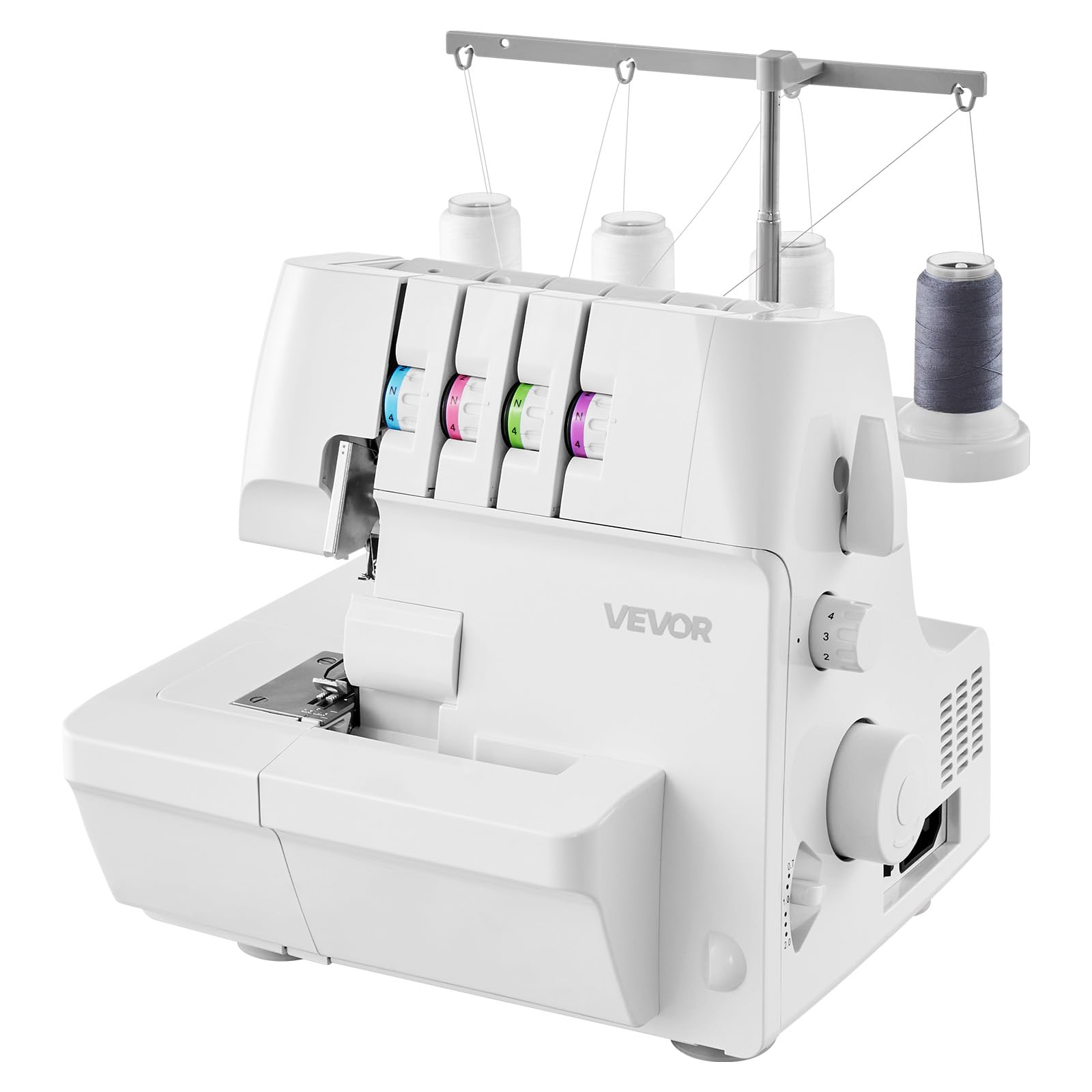
The VEVOR serger delivers a genuine cast-iron frame at a budget price, which is rare in this category. The weight and rigidity reduce high-speed vibration, producing consistent stitch quality across woven and stretch fabrics. The 2-3-4 thread capability covers overlock seams, rolled hems, edging, and lettuce hems.
Color-coded threading guides and a free arm for tubular work are included. The machine comes with a test fabric, dust cover, and waste bin pre-installed. Owners were impressed with the stitch quality out of the box — one reviewer called it “flat freaking awesome” after testing thick thread on multiple layers.
Negative reports include the machine arriving completely dry, requiring manual oiling of metal rubbing parts before first use. The supplied thread frays and breaks easily. The manual features low-resolution diagrams that are difficult to read. A small number of units failed shortly after setup, highlighting inconsistent quality control typical of entry-level pricing.
Why it’s great
- Cast-iron frame absorbs vibration better than plastic builds
- Excellent stitch quality right out of the box
- Includes dust cover and waste bin for workspace organization
Good to know
- Arrives bone dry — must apply oil before first use
- Supplied thread is low quality; replace immediately
9. FEIYUE FY505

The FEIYUE FY505 is the most affordable entry point in this list, but it still packs a heavy-duty metal frame and a carbon steel blade that cuts cleanly. The 2-3-4 thread capability covers the essential overlock and rolled hem stitches that beginners need. Color-coded thread guides and numbered loopers help reduce the intimidation factor of first-time threading.
At 1,100 stitches per minute, the FY505 is the slowest machine in this roundup, but the speed is sufficient for non-production sewing. The packaged construction is solid for the price, and several reviewers described it as “life changing” for their sewing accuracy. Customer service was responsive when one unit arrived malfunctioning due to incorrect plugging.
Threading the lower looper is genuinely challenging — the manual print is too small, and the upper knife placement makes access frustrating for large fingers. A YouTube video is essential for setup. A few units arrived with mechanical defects (uncontrollable full-speed running), which is a risk at this price tier. Consider the purchase only if budget is the absolute primary constraint.
Why it’s great
- Metal frame and carbon steel blade at the lowest entry price
- Color-coded guides help first-time threading
- Produces clean, professional seams when set up correctly
Good to know
- Lower looper threading is difficult; YouTube is mandatory
- Inconsistent quality control — some units arrive defective
FAQ
Can I use a beginner serger for heavy fabrics like denim and canvas?
Why does my serger thread keep breaking at the tension disc?
Do I need a differential feed on my first serger?
Final Thoughts: The Verdict
For most users, the beginner serger winner is the Brother 1034D because it combines a reliable metal frame, color-coded threading, three included feet, and proven long-term durability at a mid-range price. If you want a stronger cutting blade and a large extension table for heavy-duty home projects, grab the Brother ST4031HD. And for the smoothest threading experience with a lay-in lower looper system, nothing beats the Janome MOD-8933.