
Our readers keep the lights on and the weekend projects moving. As an Amazon Associate, I earn from qualifying purchases.
Cutting tile is one of those jobs where the wrong blade turns a clean line into a jagged mess. Whether you’re trimming porcelain for a shower surround or slicing through thick floor tile, the blade’s rim design, bond hardness, and core thickness determine whether you get a smooth edge or a handful of shards.
I’m Rikta — the co-founder and writer behind FitlyFast. I’ve spent years analyzing diamond-blade metallurgy, bond formulations, and rim geometries to understand what separates a blade that burns out after ten cuts from one that lasts through an entire renovation.
Continuous rim and turbo-mesh designs each solve different chipping problems, and bond hardness must match the tile’s density. This guide breaks down the best blade for cutting tile based on real user experience, core durability, and cut quality across porcelain, ceramic, and stone.
How To Choose The Best Blade For Cutting Tile
Selecting the right diamond blade isn’t about brand loyalty — it’s about matching the rim style, bond hardness, and core thickness to your tile type and cutting tool. A blade that works beautifully on soft ceramic will glaze over and stop cutting on dense porcelain.
Rim Design: Continuous vs. Segmented vs. Turbo
Continuous rim blades deliver the smoothest, cleanest cut and are the go-to choice for glazed ceramic and porcelain tiles where chipping is unacceptable. Segmented rims cut faster but leave rough edges — better for quarry tile or stone where finish isn’t critical. Turbo rims combine a continuous edge with small serrations, offering faster cutting than a smooth rim while still producing chip-free results.
Bond Hardness and Tile Density
Diamond blades use a metal bond that wears away to expose fresh diamonds. A soft bond is designed for hard materials like porcelain — it erodes just enough to keep the diamonds cutting. A hard bond works on soft materials like ceramic, resisting wear so the blade doesn’t dull too quickly. Using the wrong bond leads to glazing or rapid loss of cutting particles.
Core Thickness and Arbor Size
Thin blades (1.0–1.2 mm) produce less waste and put less strain on the motor, but they flex more in hand-held grinders. Thicker cores (1.6 mm and up) run truer and resist bending, making them safer for freehand cuts. Always check the arbor hole — common sizes are 7/8 inch (22.23 mm) and 5/8 inch (15.88 mm) — and confirm it matches your saw or grinder.
Quick Comparison
On smaller screens, swipe sideways to see the full table.
| Model | Category | Best For | Key Spec | Amazon |
|---|---|---|---|---|
| DEWALT DW4738 | Tile Blade | Wet saw precision cuts | 4-3/8 in. continuous rim | Amazon |
| Bosch DBX4543S | Tile Blade | X-Lock grinder convenience | 4-1/2 in. continuous rim | Amazon |
| YIJING 7-Inch | Tile Blade | Large-format tile on circular saws | 1.2 mm core, turbo segments | Amazon |
| YIJING 6-Inch | Tile Blade | Angle grinder tile trimming | 1.6 mm core, turbo mesh | Amazon |
| TOOLEAGUE 10-Pack | Multi-Pack | Bulk use for professionals | 1.2 mm core, 10 blades | Amazon |
| PEAKIT 5-Pack | Multi-Pack | General contractor tile work | 1.2 mm core, 5 blades | Amazon |
| OSTEK 2-Pack | Value Pack | DIY porcelain cuts on a budget | 1.2 mm core, 10 teeth | Amazon |
In‑Depth Reviews
1. DEWALT 4-3/8-Inch Tile Blade (DW4738)

The DEWALT DW4738 is the blade that sets the benchmark for chip-free cutting in demanding tile applications. Its 4-3/8-inch continuous rim design runs true on high-power tile saws, and the laser-cut expansion slots prevent warping even during extended wet-cutting sessions. Owners report cutting hundreds of linear feet through porcelain and concrete with no perceptible wear — the XP2 and XP4 diamond matrices deliver up to four times the life of standard blades.
This blade shines brightest when mounted on a wet saw or a circular saw with water feed. The continuous rim produces silky-smooth edges on glazed ceramic and rectified porcelain, eliminating the need for edge filing. The included thin bushing lets you adapt the 20mm arbor to 3/4-inch spindles, making it compatible with most tile saws right out of the box.
It is a premium blade priced for professionals, and it earns that cost through longevity and consistent cut quality. If you are tackling a large-format tile floor or a full shower enclosure, the DW4738 will finish the job without forcing a mid-project blade change.
Why it’s great
- Continuous rim delivers chip-free edges on porcelain and ceramic
- XP4 diamond matrix quadruples blade life versus standard models
- Laser-cut slots prevent heat-induced warping during long cuts
Good to know
- Requires a bushing adapter for most non-DEWALT tile saws
- Priced higher than entry-level budget blades
2. Bosch DBX4543S 4-1/2 in. X-Lock Continuous Rim Diamond Blade
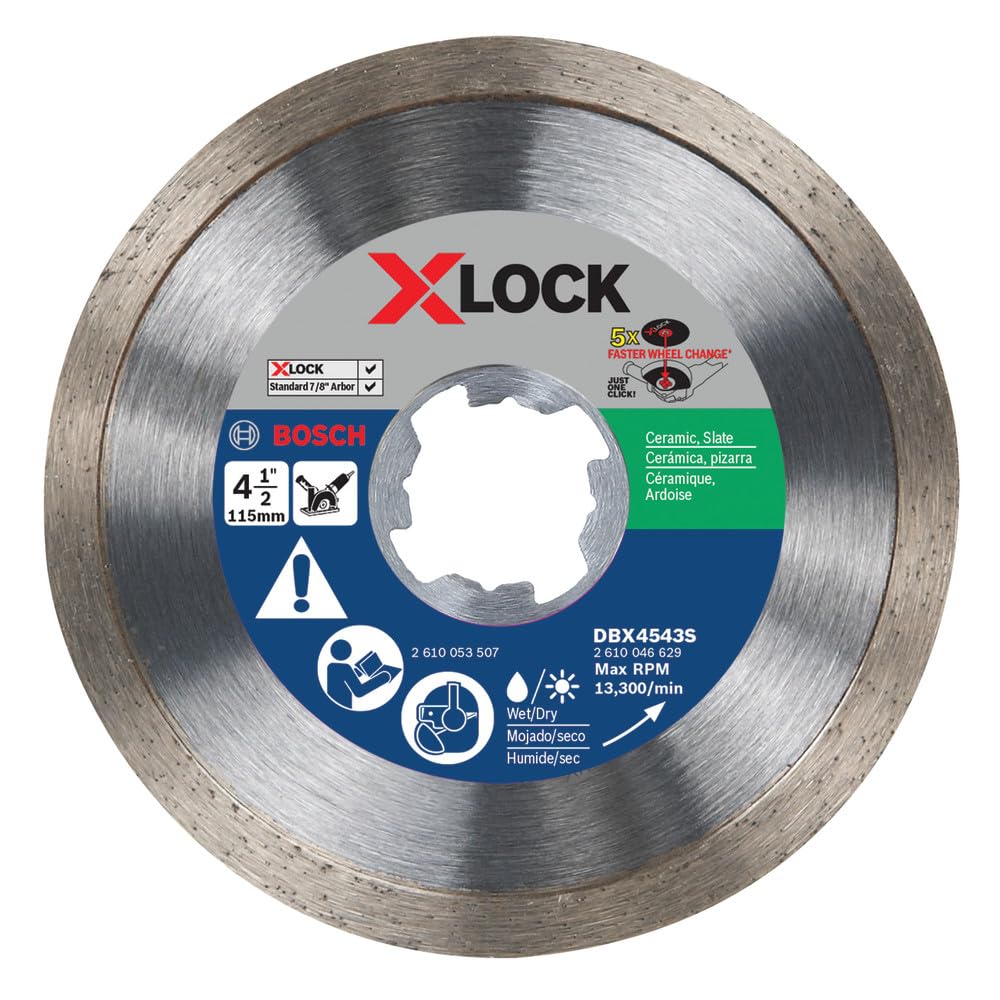
Bosch’s X-Lock system tackles one of the most annoying parts of tile cutting: swapping blades on an angle grinder. The DBX4543S snaps onto compatible X-Lock grinders without flange nuts or spanner wrenches, reducing change-out time to seconds. The continuous rim diamond blade cuts cleanly through ceramic and stone, and the steel core minimizes wobble for straighter cuts.
Real-world use confirms this blade can handle over 100 linear feet of ceramic tile dry while cutting as smoothly as a wet blade. The backward compatibility with standard 7/8-inch arbor mounts means it also fits conventional grinders if you ever switch tools. Users note that the blade runs cool even during aggressive cutting, which extends the life of both the blade and the grinder.
It is not designed for the deepest plunge cuts on thick floor tile, but for trimming wall tile, cutting around outlets, and making precision adjustments, the DBX4543S is a fast, frustration-free option. The X-Lock convenience alone justifies the mid-range investment for anyone who values tool-free swaps.
Why it’s great
- X-Lock mount allows tool-free blade swaps in seconds
- Continuous rim produces clean, chip-free edges dry
- Steel core reduces wobble for straighter cuts
Good to know
- Only fully exploits X-Lock speed on Bosch-compatible grinders
- Not ideal for deep cutting in thick porcelain pavers
3. YIJING 7-Inch Diamond Blade (Super Thin)
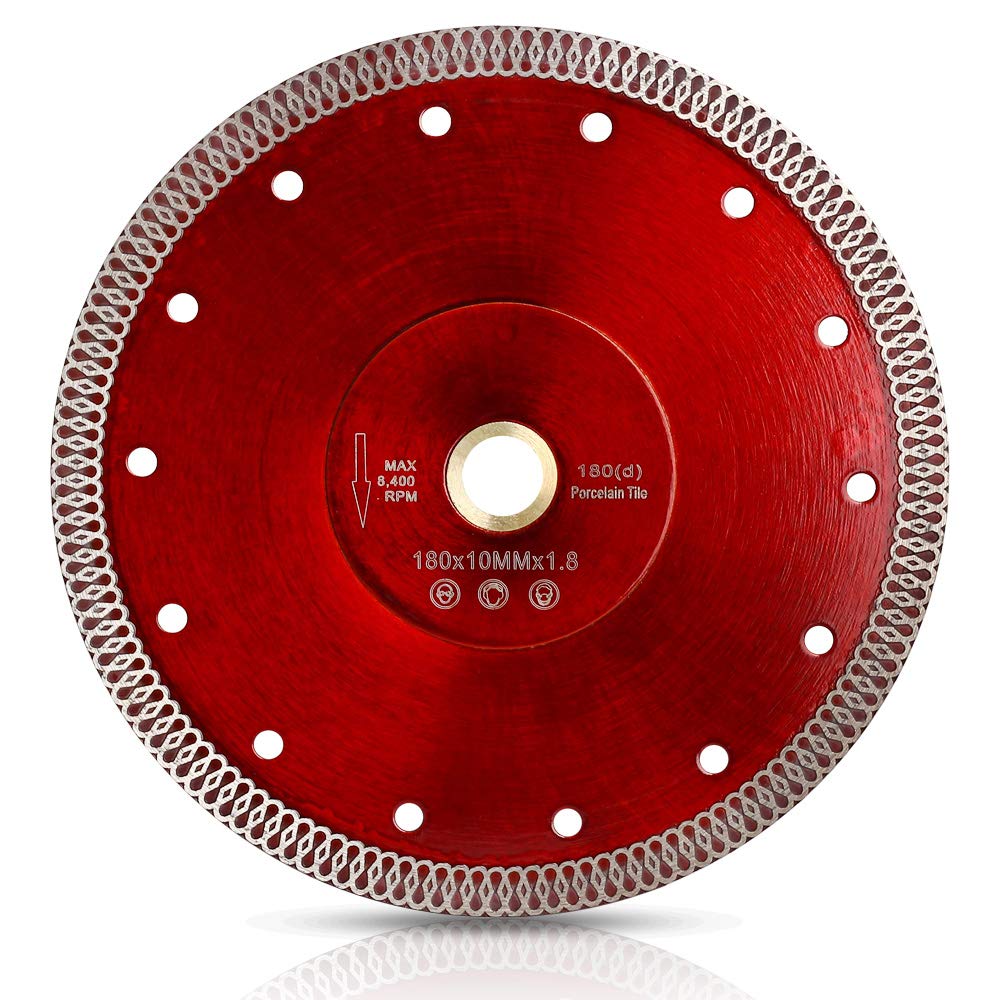
The YIJING 7-inch blade brings a larger diameter to the table, making it a strong match for circular saws and larger tile saws where 4-inch blades can’t reach full depth. The super-thin core measures 1.2 mm, reducing kerf waste and putting less strain on the saw motor. The hot-pressed sintered construction uses high-density diamond grain that keeps cutting long after budget blades glaze over.
Users running this blade on Ryobi circular saws report slicing through existing tile floors and mortar with clean edges, even during dry cuts. The 10 mm rim height provides plenty of diamond exposure for deep passes, and the turbo segment geometry helps clear dust from the cut line to prevent overheating. It handles porcelain, ceramic, marble, and masonry without hesitation.
The 7-inch size demands a saw with sufficient guard clearance, and the larger arbor hole may require reducer rings for some tools. But for anyone cutting large-format tile or doing demolition work where depth matters, this blade offers a blend of speed and precision that cheaper 7-inch blades rarely match.
Why it’s great
- Super-thin 1.2 mm core reduces dust and motor strain
- Turbo segments clear debris for cooler, faster cuts
- Sintered diamond matrix provides long service life
Good to know
- Requires saw guard clearance for the 7-inch diameter
- Arbor reducer rings needed for non-standard spindles
4. YIJING 6-Inch Super Thin Diamond Tile Blade
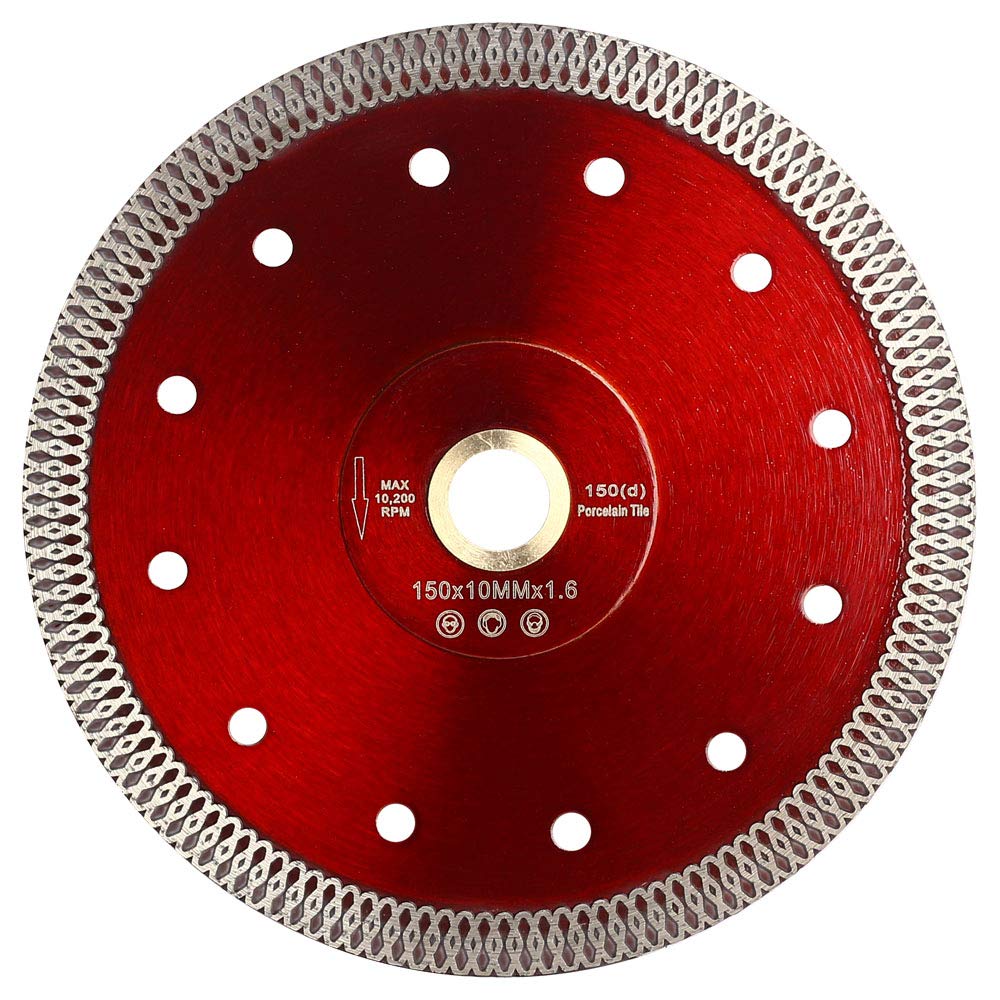
The YIJING 6-inch blade is built for the angle grinder crowd who need to trim tiles on the fly. Its 1.6 mm core is thicker than the ultra-slim competition, providing better resistance against bending and flexing during freehand cuts. The turbo-mesh rim design combines a continuous cutting edge with small serrations that speed up material removal while keeping chipping to a minimum — a solid compromise for tile work where speed matters.
Users testify that this blade cuts through 1/4-inch porcelain tile smoothly with just a water spray bottle, and one reviewer used it to widen a laundry cabinet opening without any edge damage. The 150-tooth configuration (referring to diamond segments along the rim) ensures a fine finish on ceramic and marble alike. The arbor ships at 7/8-inch but includes reduction rings for 5/8-inch spindles.
The thicker core means slightly wider kerf compared to 1.2 mm blades, but the stability gain is worth it for freehand grinder work. If you are cutting tile in tight spaces where a wet saw won’t fit, this blade delivers the confidence to cut without watching the blade wander.
Why it’s great
- Thicker 1.6 mm core resists bending during freehand cuts
- Turbo-mesh rim balances speed with chip-free edges
- Compatible with angle grinders and small tile saws
Good to know
- Wider kerf than ultra-thin blades
- Store in original packaging to prevent core bending
5. TOOLEAGUE Diamond Saw Blade 4-1/2 Inch (10-Pack)

The TOOLEAGUE 10-pack redefines value for professionals who burn through blades on daily tile jobs. Each 4.5-inch blade features a 1.2 mm core and a new-generation X-gear rim design that accelerates cutting speed while maintaining smooth, chip-free edges. The pack covers the equivalent of ten single-blade purchases, making it a smart inventory choice for contractors and serious DIYers alike.
Real-world testing on 3/4-inch porcelain outdoor pavers in a corded wet saw shows clean cuts with minimal chip-out after dozens of passes. Users note no perceptible wear after extensive use, which suggests the sintered diamond bond is well-matched to dense materials. The blades work on most tile saws and angle grinders with 7/8-inch or 5/8-inch arbors, and they cut both wet and dry.
The budget-friendly price per blade is the headline here, but the consistent cut quality across all ten units reassures buyers that they aren’t sacrificing performance for quantity. If you move from job to job and prefer not to resharpen or stress over a single blade’s lifespan, this pack keeps you cutting.
Why it’s great
- 10 blades at a cost-effective per-unit price
- X-gear rim cuts fast with minimal chipping
- Works wet or dry on porcelain, ceramic, and stone
Good to know
- Individual blade longevity may be shorter than premium single blades
- Thin core requires careful storage to prevent bending
6. PEAKIT Super Thin Tile Blade 4.5 Inch (5-Pack)

PEAKIT’s 5-pack hits the sweet spot between single-blade quality and multi-pack economy. Each 4.5-inch blade uses a 1.2 mm super-thin core combined with a turbo mesh rim that produces smooth, clean cuts with very little splintering. Professional tile installers report these blades handle all types of ceramic and porcelain with consistent edge quality.
The blades are designed for angle grinders and tile saws, and they work dry or wet — though wet cutting is recommended to reduce dust and keep the rim cool. Users highlight the chip-free performance on glazed ceramic and note that the blades last through multiple jobs without losing cutting speed. The five-blade count gives you backups for big projects or replacements when a blade reaches end of life.
The value here is straightforward: you get premium-level cut quality at a per-blade cost that undercuts most single-blade alternatives. If you are a general contractor or a dedicated DIYer who wants reliable blades without the premium-brand markup, the PEAKIT 5-pack delivers consistent results cut after cut.
Why it’s great
- Turbo mesh rim delivers chip-free cuts on ceramic and porcelain
- Five blades provide backup for large renovation projects
- Low per-blade cost without sacrificing cut quality
Good to know
- Thin core requires careful handling against flex damage
- Wet cutting strongly recommended for best performance
7. OSTEK 4-Inch Super Thin Diamond Tile Blade (2-Pack)

The OSTEK 2-pack is the entry-level champion for DIY tile work on a budget. Each 4-inch blade features a 1.2 mm super-thin core with 10 diamond teeth that cut through thick porcelain tile with surprising ease. One user reported tiling an entire shower with a single blade, calling the cut edges “beautiful” and noting barely any filing needed afterward.
The thin core keeps kerf waste low and reduces strain on hand-held grinders, making it a great match for small saws and angle grinders. Users recommend using a saw guide and water with dish soap to reduce dust and cool the blade — advice that extends the life of any budget blade. The two-blade count gives you a backup for free, which is rare at this tier.
Longevity is not the OSTEK’s strong card; the diamond bond wears faster than premium options, especially during dry cutting. But for a first-time tiler or a small bathroom floor, these two blades will finish the job at a fraction of the cost of a single premium blade.
Why it’s great
- Two blades at a very low combined cost
- Super-thin core cuts porcelain with minimal waste
- Makes clean edges that need little post-cut filing
Good to know
- Diamond bond wears faster than premium-grade blades
- Not designed for heavy professional use
FAQ
Can I cut porcelain tile with a continuous rim blade?
What arbor size do most tile saws use?
Is a wet blade better than a dry blade for tile?
How do I know if a diamond blade is glazed?
Final Thoughts: The Verdict
For most users, the best blade for cutting tile winner is the DEWALT DW4738 because its continuous rim design and extended-life diamond matrix deliver chip-free cuts and exceptional longevity on porcelain and ceramic tile. If you want tool-free swapping on an angle grinder, grab the Bosch DBX4543S. And for bulk use without breaking the bank, nothing beats the TOOLEAGUE 10-pack.