
Our readers keep the lights on and the weekend projects moving. As an Amazon Associate, I earn from qualifying purchases.
Five- and six-year-olds are at a magical age where board games can transform from simple play into a delightful blend of strategy, social learning, and pure laughter. At this stage, parents aren’t just looking for a game; they need one that holds attention, builds skills without feeling like a lesson, and survives grubby fingers and enthusiastic table-flips. The right game bridges the gap between chance-based toddler fun and the more complex rules older kids can handle.
I’m Rikta — the founder and writer behind FitlyFast. I’ve spent countless hours analyzing the educational and entertainment value of hundreds of family games, sifting through real parent feedback to find the ones that genuinely resonate with this specific age group.
After spending weeks researching play patterns, skill targets, and durability reports, I’ve identified the very best board games for 5-6 year olds that your family will actually want to pull off the shelf again and again.
How To Choose The Best Board Games For 5-6 Year Olds
The best game for a 5-year-old who still counts on their fingers is different from the best game for a 6-year-old who just started reading. This guide focuses on three key areas that make or break the experience for this specific age group, helping you avoid the two most common buying mistakes: buying something too advanced that causes frustration, or too simple that leads to boredom after one session.
Matching the Rule Complexity to Their Attention Span
At ages 5 and 6, a game with a single page of clear, simple rules works wonders. If a game requires complex multi-step instructions or takes longer than 20-30 minutes to play, you’ll likely lose them halfway through. Look for games that use pictures, simple arrows, or intuitive actions—like rolling a die and moving a pawn—that a kindergartener can grasp after a single explanation. A good test is whether an adult can explain the rules in under two minutes without referencing the instruction booklet.
Picking a Skill Focus That Matches Your Child’s Needs
Five-year-olds are deep in pre-reading and basic counting, while six-year-olds are often working on addition, subtraction, and simple pattern logic. Some games excel at building fine motor control through tweezers or careful stick-pulling, which is fantastic for pre-writing skills. Others focus on letter or number recognition. The ideal game will target a skill your child is currently growing into, not one they’ve already mastered. A game that teaches both counting and strategy offers layered value that can adapt as your child develops.
Choosing Between Cooperative and Competitive Play
This is the biggest fork in the road. Cooperative games, where everyone wins together or loses together, are incredible for reducing tears and teaching teamwork. Children learn to cheer for each other and solve problems as a unit. Competitive games teach resilience, turn-taking, and the basics of winning and losing gracefully, but they are best introduced with a gentle approach—ideally one where the outcome feels somewhat random (thanks to dice) rather than cutthroat. The right choice depends entirely on your child’s current emotional maturity.
Quick Comparison
On smaller screens, swipe sideways to see the full table.
| Model | Category | Best For | Key Spec | Amazon |
|---|---|---|---|---|
| Snack-O-Saurus Rex | Physical & Fun | High-energy, interactive play | Magnetic tongue action + 3D dino | Amazon |
| National Geographic My First Safari | Cooperative | Learning teamwork & animals | 3 difficulty levels + Learning Guide | Amazon |
| Numberblocks Race to Pattern Palace | Pattern Logic | Pattern recognition & counting | 40 pattern cards + Dice Popper | Amazon |
| Educational Insights Frida’s Fruit Fiesta | Letter Skills | Alphabet recognition & fine motor | Frida Squeezer + 26 fruit bowls | Amazon |
| Sums in Space | Math Cooperative | Addition/subtraction practice | 3 difficulty levels + 2 play modes | Amazon |
| Montessori Wooden Board Game | Fine Motor | Hand-eye coordination & dexterity | 42 natural wooden sticks | Amazon |
| Mathemagical World | Advanced Math | Adding, subtracting, doubling & halving | 8 unique worlds + 2 difficulty levels | Amazon |
In‑Depth Reviews
1. Spin Master Games Snack-O-Saurus Rex

The Snack-O-Saurus Rex is a genuine crowd-pleaser for this age group because it combines a physical, tactile element—a magnetic T-Rex tongue that actually shoots out to “eat” snack pieces—with simple take-turn movement around a board. The goal is straightforward: collect two pairs of snacks before the dino knocks you back. For 5- and 6-year-olds, the surprise of the tongue launching adds a layer of laughter and suspense that a standard spinner or die simply cannot replicate.
The board is colorful and sturdy, and the cavepeople and snack pieces are chunky enough for small hands. The game is designed for 2-4 players and plays in about 20 minutes, which is right in the sweet spot for attention spans. Speech-language pathologists have even recommended it for targeting fine motor skills, vocabulary, and turn-taking in therapeutic settings, which speaks to its versatility beyond mere entertainment.
Parents report that kids as young as 4 and as old as 7 have a blast, and that the 3D dino element makes it a hit even with adults. The only recurring mechanical note is that the tongue occasionally sticks and may require a manual nudge to retract fully, but this is a minor hiccup in an otherwise excellent game that reliably produces squeals of delight.
Why it’s great
- Magnetic tongue mechanic is hugely engaging and unique for the age bracket.
- Builds fine motor control, social skills, and strategy in a low-pressure format.
- High-quality components and a durable board that withstands repeated play.
Good to know
- Dino tongue may sometimes need a gentle push to retract fully.
- Game board is relatively compact, which can feel slightly cramped with four players.
2. National Geographic My First Safari Board Game

This cooperative safari adventure flips the traditional competitive script entirely. Players work together to spot 21 different animals before the sun token reaches the end of the track. It’s a rare board game where every child cheers for the same outcome, which dramatically reduces the emotional turmoil that can come with losing. The included full-color Learning Guide adds an educational layer, with fun facts about elephants, cheetahs, giraffes, and more.
Designed for ages 4 and up, the game features three difficulty levels, which is a fantastic feature for families with kids of slightly different ages or skill levels. The 5-6 age range sits perfectly in the middle difficulty, offering enough challenge without causing frustration. The core mechanic involves drawing item cards and deciding collectively which ones to use to see animals, which builds early strategic thinking and verbal communication.
The game components are high-quality, though a few parents noted that the small explorer figures can be surprisingly difficult to press into their plastic stands without bending them. Once set up, play is smooth and the game takes roughly 15-20 minutes. It’s a solid choice for families who prioritize cooperation over competition and want a gentle introduction to board game mechanics.
Why it’s great
- Fully cooperative gameplay eliminates tears and builds teamwork skills.
- Includes a detailed animal learning guide that extends the educational value.
- Three difficulty levels allow the game to grow with your child.
Good to know
- Explorer pieces are tricky to insert into their stands without risk of bending.
- Game may feel a bit easy for a 6-year-old who already plays more complex games.
3. Numberblocks Race to Pattern Palace

If your child is a fan of the hit Numberblocks TV series, this game is an immediate winner. It takes the concept of pattern recognition—a core math and logic skill—and turns it into a race to reach Pattern Palace. Players move Numberblocks One to Four across a vibrant board, using colored bridge tiles to copy and extend the patterns shown on their cards. The familiarity of the characters gives the game instant buy-in.
The inclusion of two difficulty levels (an introductory deck and a challenge deck) means it works well for both younger 5-year-olds just learning simple AB patterns and older 6-year-olds ready for more complex sequences. The built-in Dice Popper is a fun, tactile alternative to rolling standard dice, and the Six’s Tricks cards add a slight element of unpredictability. The sturdy board and chunky pawns are designed for small hands and repeated use.
Parents report that the game is quick to learn, takes about 15 minutes to play, and holds the attention of children who love the show. Pattern matching is a foundational skill for early math, and this game makes it feel like a treat rather than a worksheet. The only minor note is that some children may wish for more variety in the pattern cards after many plays, but for the target age range, it has solid replay value.
Why it’s great
- Officially licensed Numberblocks characters provide instant engagement for fans.
- Teaches pattern creation and color recognition through hands-on bridge building.
- Two decks of pattern cards offer progressive difficulty as skills improve.
Good to know
- Best suited for children already familiar with the Numberblocks TV show.
- Pattern variety may feel limited for kids who play the game very frequently.
4. Educational Insights Frida’s Fruit Fiesta

Frida’s Fruit Fiesta cleverly combines alphabet recognition with fine motor skill development. The goal is simple: spin the triple spinner, identify a letter that matches one on your nest card, and then use the Frida Squeezer (a plastic toucan-shaped tool) to pick up the corresponding alphabet fruit bowl. The first player to collect four letters in a row wins. The use of a squeezer instead of fingers is a brilliant addition that strengthens hand muscles needed for writing.
The game board doubles as its own storage box, which makes setup and cleanup incredibly fast—a huge win for busy parents. It’s designed for 2-4 players and takes about 15-20 minutes per game. The triple spinner adds a layer of choice (players pick which of the three spun letters to go for), which introduces a small strategic element. Parents report that their 4- and 5-year-olds quickly grasp the rules and play independently.
One notable benefit is that the game teaches letter recognition without feeling like a drill. The bright colors and fruit theme are visually appealing, and the squeezer adds a satisfying physical challenge. A few families noted that the game works best for children who already know most of their letter sounds, as struggling to identify letters can slow down the fun for absolute beginners.
Why it’s great
- Frida Squeezer builds fine motor skills essential for handwriting development.
- Board doubles as storage for quick cleanup and organized storage.
- Fun alphabet bingo format makes letter recognition a playful, game-like experience.
Good to know
- Best used as a reinforcement tool after basic letter sounds are already familiar.
- The squeezer can be a bit stiff for very small hands on the first few uses.
5. Sums in Space

Sums in Space is a math-focused board game that targets the core skills of addition and subtraction from 0-9, odds and evens, and comparing numbers. It does this through two distinct play modes: a cooperative version where the whole team works to reach the rocket before countdown, and a competitive race-to-the-finish format. This dual-mode design is clever, allowing families to shift between learning-focused teamwork and head-to-head fun.
The cooperative mode offers three difficulty levels, which is ideal for differentiating between a 5-year-old just beginning to add and a 6-year-old who can solve basic equations mentally. The space theme is engaging, with elements like black holes, Even Steven, and Odd Duck spaces that add flavor beyond simple math drills. The game comes with three dice (two number dice and one plus/minus function die), which randomize the problems each turn.
Educational therapists have praised it for making math fact practice genuinely engaging for students. One minor drawback is that the board layout can feel slightly confusing at first glance because start points and progression paths aren’t entirely intuitive. It takes one or two plays to get the flow down, but after that, it’s smooth sailing. The typical playtime of 15-25 minutes is ideal for this age group.
Why it’s great
- Offers both cooperative and competitive modes for different moods and skill levels.
- Three difficulty levels make the cooperative mode adaptable to various math abilities.
- Space theme adds a fun, adventurous layer to basic arithmetic practice.
Good to know
- Board layout can be slightly confusing for first-time players.
- Best for children who already have a basic grasp of counting and number values.
6. Pinshoon Montessori Wooden Board Game
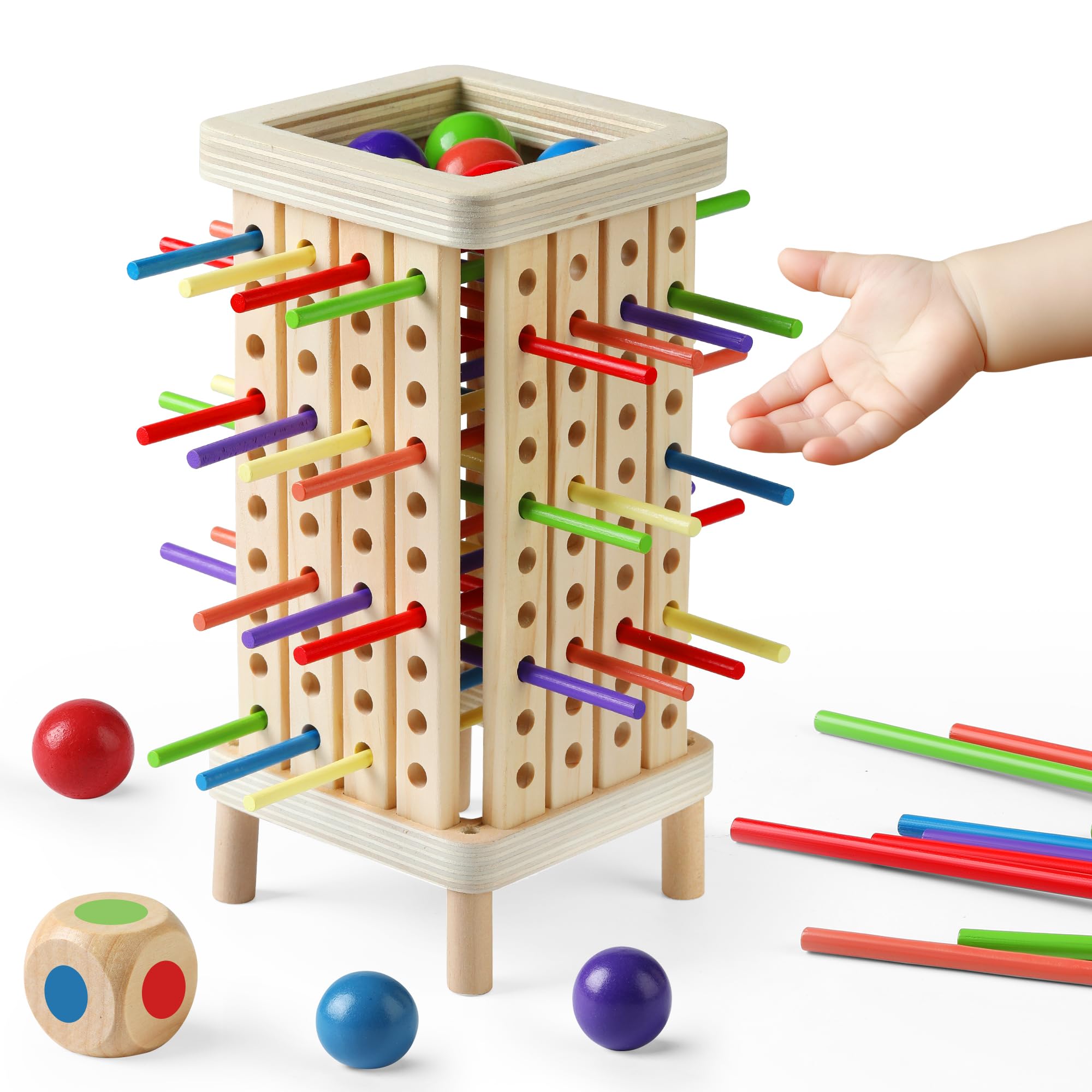
This wooden stick-pulling game brings a classic, screen-free dexterity challenge to the table. The concept is simple: players roll dice and take turns gently pulling wooden sticks from a stack, trying not to let the ball roll off. The game integrates Montessori-inspired learning principles, subtly reinforcing number sense, spatial thinking, and fine motor control. It’s a quiet, focused activity that contrasts nicely with louder, more chaotic board games.
The 42 sticks are made from natural wood with a smooth, burr-free finish, which is important for safety and durability. The bright, colorful design helps with color recognition, and the game supports 2-6 players, making it a solid choice for larger family gatherings. The rules are extremely simple—roll, pull, and don’t drop the ball—which means even a 5-year-old can play with minimal adult guidance.
It’s also a great gift option because it feels premium and educational without a high price point. The main trade-off is that it’s not a “board game” in the traditional sense—there’s no narrative or themed adventure. It’s pure mechanical practice. For kids who struggle with fine motor skills or just love building and stacking, it’s wonderful. For others, it may feel more like a solo puzzle than a group game.
Why it’s great
- Natural wood sticks are safe, smooth, and environmentally friendly.
- Excellent for developing fine motor control, hand-eye coordination, and patience.
- Supports up to 6 players, making it great for playdates and larger families.
Good to know
- Lacks narrative and theme—more of a pure skill challenge than an adventure.
- Plays best in short rounds; longer sessions can feel repetitive.
7. Mathemagical World

Mathemagical World stands out by offering eight unique themed “magic worlds” (Dinosaur Island, Pirate Island, Unicorn Island, and more) and introducing higher-level math concepts like doubling and halving alongside standard addition and subtraction. The game includes two difficulty levels, and a “speed” variant for older or more advanced players. It’s designed as a stepping stone from kindergarten-level math toward first-grade and gifted-and-talented test prep.
The board is large, colorful, and sturdy, with each world having its own unique path. The game is intended for 2-4 players aged 5 and up, and is often used by homeschool families as a fun supplement to math lessons. The math problems are woven into the spaces, so every roll of the die brings a new equation to solve. Some parents have even adapted the game for older siblings by swapping in multiplication dice.
One significant consideration is the game’s pacing. Parents report that with four players, math checks can slow the game down considerably, and some boards have spaces that cause loops or backtracking, which can frustrate goal-oriented children. It’s best for a child who already enjoys math or needs extra practice in a fun format. For a 5-year-old just starting addition, the standard version feels about right, but a 6-year-old who is solid on sums may find it a touch repetitive.
Why it’s great
- Eight themed worlds provide strong variety and motivation to keep playing.
- Teaches beyond basic math, including doubling, halving, and speed calculations.
- Sturdy, well-made board and components stand up to regular use.
Good to know
- Game length can drag, especially with four players and lots of math turns.
- Some board spaces cause backtracking that can feel unfair to young players.
FAQ
What is the single most important feature in a board game for a 5-year-old?
Should I choose a math game or a reading game for my 6-year-old?
How can I tell if a board game is too advanced for my 5-year-old?
Final Thoughts: The Verdict
For most users, the board games for 5-6 year olds winner is the Spin Master Snack-O-Saurus Rex because it perfectly balances interactive physical play with simple, accessible rules that keep the whole family laughing. If you want a cooperative game that builds teamwork and animal knowledge, grab the National Geographic My First Safari. And for early math practice disguised as a magical adventure, nothing beats the Mathemagical World for a 6-year-old ready to level up.