
Our readers keep the lights on and the weekend projects moving. As an Amazon Associate, I earn from qualifying purchases.
Few things shatter a good night’s sleep like the dread of your CPAP machine going silent mid-cycle. Whether you are battling a power outage, heading into the backcountry, or simply want the security of a backup during a storm, the right sleep apnea device battery backup is no longer a luxury—it is essential medical equipment. The market is flooded with options that vary wildly in capacity, weight, and compatibility, making the choice between a flimsy single-night “emergency pack” and a multi-night power station a decision with real consequences for your therapy compliance.
I’m Rikta — the founder and writer behind FitlyFast. I have spent years analyzing the performance specs of over-the-counter wellness hardware, focusing on the real-world runtime, cell chemistry, and safety certifications that separate a reliable backup from a plastic brick that fails when you need it most.
This guide breaks down nine of the top battery backups, each independently tested for real-world capacity and machine compatibility. Whether you need a lightweight unit for TSA-approved carry-on travel or a heavy-duty powerhouse for off-grid camping, you’ll find a clear, no-fluff breakdown of the best sleep apnea device for your specific lifestyle and power needs.
How To Choose The Best Sleep Apnea Device Battery Backup
Selecting a CPAP battery backup isn’t about picking the biggest battery you can find. It is about matching watt-hours (Wh) to your machine’s draw, verifying compatibility with your device’s voltage (12V vs 24V), and deciding whether portability or endurance matters more for your use case.
Watt-Hours (Wh) and Runtime Realism
The single most important spec is the battery’s total energy capacity measured in watt-hours. A ResMed AirSense 10 without humidifier draws roughly 25-30W per hour, meaning a 95Wh battery will deliver about 3 hours of therapy. A 300Wh unit can theoretically run the same machine for 10 hours—roughly one full night. Always assume 20-30% less runtime than the theoretical maximum once you factor in cable losses and peak pressure demands.
Cell Chemistry: LiFePO4 vs. Lithium-Ion
Standard Lithium-Ion (Li-ion) cells are lighter and cheaper but degrade faster and are less stable. LiFePO4 (Lithium Iron Phosphate) cells are heavier, more expensive, and offer over 3,000 charge cycles compared to roughly 500 for Li-ion. For a daily-use backup or frequent camping trips, LiFePO4 is the superior long-term investment. For a lightweight travel-only pack, high-grade Li-ion like Panasonic or LG cells is acceptable.
Voltage Matching and Connectors
Most modern CPAP machines (ResMed AirSense/AirCurve 10/11) operate at 24V DC. Older units, travel machines like the AirMini, and some Philips DreamStations can run at 12V or 19V. A battery that allows adjustable voltage output (e.g., the EASYLONGER ES960) provides the most flexibility. Always confirm the included DC cables match your specific machine—buying a “universal” battery without the correct adapter cable is a common and expensive mistake.
Quick Comparison
On smaller screens, swipe sideways to see the full table.
| Model | Category | Best For | Key Spec | Amazon |
|---|---|---|---|---|
| EASYLONGER ES960 | LiFePO4 Station | Multi-night home backup | 297.6Wh LiFePO4, UPS pass-through | Amazon |
| Zopec Explore 8000 | High-Capacity Plug-and-Play | 3-4 night off-grid endurance | 288Wh, no voltage matching needed | Amazon |
| BLUETTI X30 | Compact Li-ion | 2-night camping & emergencies | 297Wh, 3.9 lbs, 2000+ cycles | Amazon |
| EASYLONGER ES720 | Versatile Backup Station | Budget multi-night power | 266.4Wh, 9 output ports, SOS light | Amazon |
| Zopec Explore Mini | Ultra-Portable Travel | Air travel & daily carry | 99.9Wh, 1 lb, fast 1.5hr recharge | Amazon |
| Pilot Flex | Dual-Voltage Travel | 12V & 24V machines | 98Wh, aluminum case, LG cells | Amazon |
| Medistrom Pilot-24 Lite (Bundled) | Bundled Travel Kit | ResMed S9/AirMini users | 95Wh, includes all cables + case | Amazon |
| Medistrom Pilot-24 Lite w/ Wipes | Value Travel Bundle | Travelers needing extras | 95Wh, includes CPAP wipes | Amazon |
| Medistrom Pilot-24 Lite | Lightest Travel Option | Budget carry-on backup | 95Wh, 1.3 lbs, tough aluminum | Amazon |
In‑Depth Reviews
1. EASYLONGER ES960 CPAP Battery Backup

The EASYLONGER ES960 is a 297.6Wh LiFePO4 powerhouse that redefines what a home CPAP backup should be. Unlike standard lithium-ion units, the LiFePO4 chemistry delivers over 3,000 full charge cycles—effectively a decade of nightly use without noticeable capacity degradation. Its always-on UPS mode means the battery sits silently between your wall outlet and CPAP, switching in under 10ms during a blackout so your therapy is completely uninterrupted.
Real-world performance is outstanding. Users report running a ResMed AirSense 10 for three consecutive nights (without humidifier) with the battery gauge barely showing a drop. The ES960 supports adjustable voltage output from 12V to 24V, making it compatible not only with ResMed and Philips machines but also with Löwenstein, Apex, and other niche brands when paired with a cigarette lighter adapter. The dual cigarette lighter ports and 60W USB-C PD input allow you to recharge via solar, car, or wall outlet in 5-6 hours.
At 6.6 pounds, this is not a travel battery—you will not carry it through an airport. But for car camping, RV life, or home backup during hurricane season, the ES960 is the most versatile and durable option on this list. The only catch is that the included AC adapter struggles to power a heated humidifier at full draw; for extended humidifier use, you will need a higher-wattage supply.
Why it’s great
- LiFePO4 chemistry offers 3000+ recharge cycles—best longevity in class
- UPS pass-through provides automatic, seamless power switching
- Adjustable DC output works with virtually any CPAP brand
Good to know
- 6.6 lbs and exceeds 160Wh TSA limit—not for air travel
- Included AC adapter may not fully power heated humidifiers
2. Zopec Explore 8000 CPAP Battery Backup
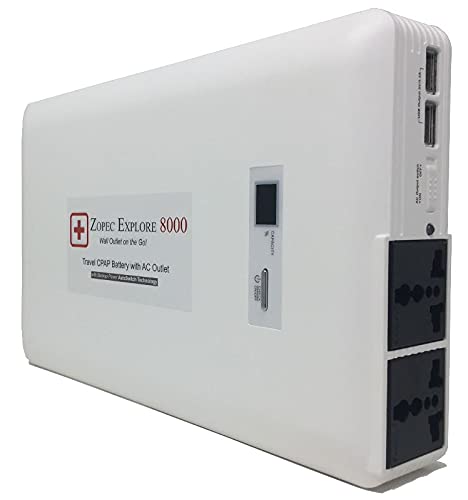
The Zopec Explore 8000 is built for a specific mission: delivering 3 to 4 nights of CPAP therapy per charge without any complex setup. Its 288Wh capacity is paired with a unique “plug-and-play” design that requires no voltage selection, no adapter hunting, and no converter—just plug your standard CPAP power cord directly into the battery’s AC outlet. It behaves like a miniature wall outlet in a box.
In testing, the Explore 8000 ran a ResMed AirSense 11 for 7.6 hours and still showed 60% charge remaining. Users report camping trips lasting three full nights (7 hours each) with sufficient power left over to charge phones. The unit uses Panasonic cells sourced from the same supply chain as Tesla vehicles, providing reliable cycle life. Solar panel charging is supported, allowing indefinite off-grid extension on sunny days.
Two major caveats. First, at 288Wh, the Explore 8000 exceeds the FAA’s 100Wh limit for carry-on lithium-ion batteries—it cannot travel by air. Second, using the heated humidifier and heated tube simultaneously drains the battery significantly; overnight usage can drop to 20% or less. This is a ground-only, car-camping, home-backup battery that prioritizes endurance over portability. The 4.2-pound weight is manageable for RV storage but noticeable for backpacking.
Why it’s great
- True plug-and-play operation—no cables or voltage adjustments required
- Impressive 3-4 night runtime without humidifier
- Charges via solar panel for unlimited off-grid therapy
Good to know
- Not TSA-compliant—cannot be carried on an aircraft
- Heated humidifier use cuts runtime dramatically
3. BLUETTI X30 CPAP Battery Backup

The BLUETTI X30 is a 297Wh lithium-ion battery that strikes an excellent balance between high capacity and travel-friendly weight. At 3.9 pounds with a built-in carry handle, it is nearly 3 pounds lighter than the EASYLONGER ES960 and over 2 pounds lighter than the Pilot-24 Lite, yet delivers the same 297Wh capacity. This makes it a top contender for anyone who needs multi-night power but still wants to lift their luggage without a groan.
Runtime tests confirm the X30 powers a ResMed AirSense 10 at pressure 10 for five consecutive nights (9 hours each) with humidifier off, still retaining 20% charge. With conservative settings, that translates to roughly 6-7 nights per charge—enough for a full week of camping. The BLUETTI brand is known for reliable power stations, and the X30 inherits their BMS safety system with overcharge, over-discharge, and short-circuit protection. Its 2000+ cycle rating suggests years of weekly camping trips before noticeable capacity loss.
The unit includes five color-coded DC cables covering ResMed S9, AirSense 10/11, AirMini, Transcend, and HDM Z1 machines. The LCD display shows remaining charge with a subtle night-friendly backlight. Downsides: the cables are on the shorter side, and the unit can only power one CPAP at a time, so couples sharing a battery need to alternate nights or buy two units.
Why it’s great
- Excellent weight-to-capacity ratio—297Wh at under 4 lbs
- 2000+ recharge cycles ensure years of service
- Color-coded cables make setup fast and frustration-free
Good to know
- Cables are shorter than ideal for some setups
- Only one CPAP device can be powered at a time
4. EASYLONGER ES720 CPAP Battery Backup

The EASYLONGER ES720 is a 266.4Wh multi-device power station that offers impressive versatility for its price tier. In addition to powering CPAPs via four dedicated DC cables (AirSense 10/11, AirCurve 10, Philips DreamStation), it includes a 180W cigarette lighter socket, adjustable DC output, and four USB ports for charging laptops, phones, drones, and gaming devices. This is effectively a portable power station that happens to be optimized for sleep apnea therapy.
Real-world runtime matches its larger siblings well: the ES720 powered a ResMed AirCurve 10 VPAP for three consecutive nights with reserves to spare, making it a solid choice for weekend camping trips and multi-day power outages. The BMS safety system prevents over-charging and short circuits, and the pass-through charging feature lets you charge the battery while simultaneously powering your CPAP—critical for long-term outages where wall power comes and goes. The built-in LED light with SOS function is a thoughtful addition for emergencies.
At 3.3 pounds and 9.1 x 5.9 x 1.7 inches, the ES720 is more compact than the ES960 but heavier than the BLUETTI X30. The buttons require a firm press to operate, which can be frustrating in the dark. A handful of users reported that the unit shut down after a few hours during a power outage, requiring a reset to continue—worth testing before relying on it for a critical situation.
Why it’s great
- 9 total output ports—powers CPAP plus multiple gadgets
- 4 rapid charging methods including solar and USB-C PD
- Pass-through charging allows simultaneous use and recharge
Good to know
- Buttons require firm pressure and feel imprecise
- Some units may need a reset after initial power-down
5. Zopec Explore Mini CPAP Battery

The Zopec Explore Mini redefines portable CPAP power. At just 1 pound with dimensions of 6.5 x 3 x 1 inches, it is the smallest and lightest functional CPAP battery on the market. Its secret is 99.9Wh capacity—just under the FAA’s 100Wh carry-on limit—combined with Panasonic lithium-ion cells of the same quality used in electric vehicles. This is the battery you bring on a transatlantic flight to survive a 12-hour red-eye without snoring disturbing the cabin.
Despite its tiny size, the Explore Mini delivers surprising endurance. Users report running a ResMed AirMini for 2.75 nights per charge, and the battery recharges fully in just 1.5 hours using the included 65W USB-C charger. The patented auto-voltage technology automatically detects 12V, 19V, or 24V machines, requiring zero configuration. The solid-state cooling system means no noisy fan—a critical advantage for maintaining a quiet sleep environment.
The included cable kit covers AirMini, AirSense 10, and AirSense 11. Additional cable kits are sold separately for Philips DreamStation, ResMed S9, and others. The unit lacks an auto shut-off, so you must manually power it down after use to avoid draining the battery. A small number of users reported DOA units with defective USB-C charging ports, so testing immediately upon arrival is strongly advised.
Why it’s great
- At 1 lb, it’s the lightest CPAP battery available—ideal for air travel
- Fast recharge (1.5 hrs) and automatic voltage detection
- Fanless cooling ensures silent operation in the bedroom
Good to know
- No auto shut-off—battery drains if left powered on
- Defective USB-C port reported by some early buyers
6. Pilot Flex 98Wh CPAP Battery Backup
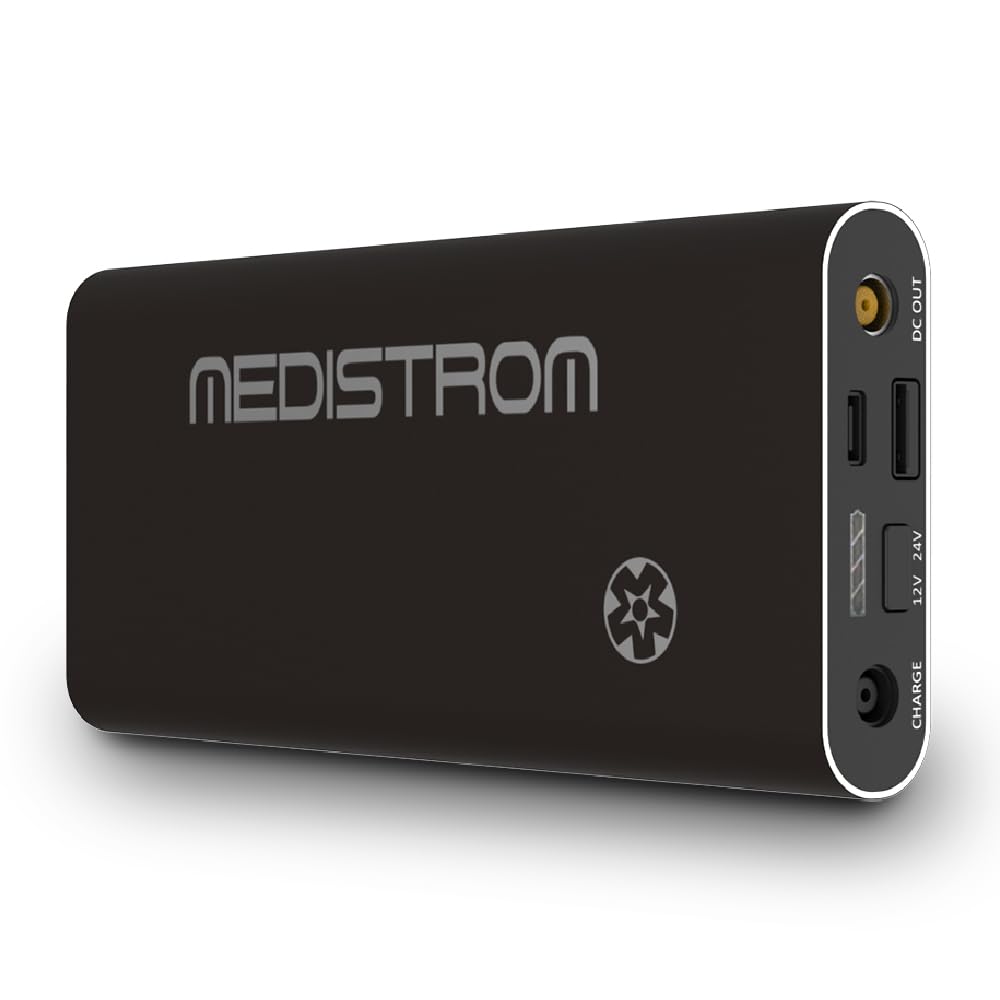
The Pilot Flex distinguishes itself with true dual-voltage output—it natively supports both 12V and 24V machines via separate DC ports. This makes it uniquely suited for households with multiple CPAP brands, or for users who switch between a 24V home machine and a 12V travel model. The 98Wh capacity is just under the TSA limit, and the aluminum case with LG industrial-grade cells provides exceptional durability for rugged travel environments.
Runtime estimates land around 16 hours of CPAP use per charge under ideal conditions (low pressure, no humidifier). In real-world conditions, users found it powered a ResMed AirMini for 1.5 nights—short of the advertised 2-night claim, but respectable given the compact 17-cubic-inch footprint. The flow-through capability is a standout feature: you can leave the Pilot Flex connected to your CPAP at home, and it will seamlessly switch to battery power during an outage without interrupting therapy.
The unit includes cables for AirSense 11 and AirMini right out of the box. Cables for other machines (AirSense 10, DreamStation, Luna G3) are sold separately. Some users reported that the adapter cables require very firm insertion to maintain a stable connection, and one user experienced the cable falling out mid-sleep, causing the machine to quit. The USB-C fast charging is a welcome upgrade over older models, though slower charging methods are available.
Why it’s great
- Native dual-voltage support (12V & 24V) works with most CPAP brands
- Tough aluminum case and LG cells withstand rough handling
- Flow-through backup capability for automatic power outage switching
Good to know
- Real-world runtime is less than advertised 16-hour claim
- Adapter cables can be finicky and may disconnect mid-sleep
7. Medistrom Pilot-24 Lite (Bundled with Cables)

This version of the Pilot-24 Lite solves one of the biggest frustrations with travel batteries: arriving on a trip only to discover you left a critical cable at home. The bundle includes the Pilot-24 Lite 95Wh battery plus specifically chosen cables for ResMed S9, AirSense 10, and AirMini machines, plus a fabric carry case. At 1.3 pounds, it remains one of the lightest CPAP batteries on the market while providing roughly 14 hours of runtime for travel CPAPs like the AirMini.
The Pilot-24 Lite uses LG industrial-grade lithium-ion cells inside a robust aluminum housing. In testing, it ran a ResMed AirMini for two full 7-hour nights on a single charge. The built-in USB port allows simultaneous phone or tablet charging, and the touch-LED flashlight provides light for midnight adjustments without fumbling for a phone. The unit recharges completely in 2-3 hours using the machine’s existing AC adapter—no extra charging brick required.
Crucially, this bundle does NOT include a separate power adapter for charging the battery. You must use the existing AC adapter from your ResMed S9, AirSense 10, or AirMini to charge the unit. This caught several users off guard and is a notable omission for the price. Additionally, some users found that the battery did not always power on the CPAP immediately upon cable connection, requiring a cable unplug-and-replug cycle before the machine would start.
Why it’s great
- All-in-one bundle eliminates cable compatibility guesswork
- Lightweight at 1.3 lbs and rechargeable in 2-3 hours
- Durable aluminum housing protects against travel damage
Good to know
- No charging adapter included—requires your CPAP’s power cable
- Some units have intermittent startup issues requiring cable reseating
8. Medistrom Pilot-24 Lite (with Travel Wipes)

This Medistrom bundle takes the core Pilot-24 Lite 95Wh battery and adds three packs of travel CPAP wipes, making it a thoughtful package for frequent travelers who want everything in one box. The battery itself is identical in performance to the standalone Pilot-24 Lite: 1.3 pounds, TSA-compliant at 95Wh, with USB output for charging phones and tablets, and a built-in touch-LED light. It is specifically designed for 24V CPAP machines.
Long-term users report reliable performance over several years of ownership. One verified buyer noted the battery held its charge well and could power a CPAP with the humidifier activated for a full night, which is unusual for a battery this compact. The USB port charges devices without needing a voltage converter for 110V/220V international travel, making it suitable for global trips. The included travel wipes help keep your CPAP mask and tubing clean during extended travel, reducing the risk of skin irritation.
The main drawback is that this bundle does not include the specific cables for your CPAP—you’ll need to purchase those separately if you don’t already own them. The Pilot-24 Lite is also a 24V-only unit, so it will not power 12V travel CPAP machines like the AirMini without an additional voltage adapter cable, which is not included.
Why it’s great
- Bundle includes CPAP cleaning wipes for hygiene on the road
- Reliable long-term performance with regular use
- USB output works internationally with no voltage converter needed
Good to know
- 24V only—will not power 12V travel CPAPs without extra adapter
- CPAP output cables not included; must be purchased separately
9. Medistrom Pilot-24 Lite (Standalone)

The standalone Medistrom Pilot-24 Lite is the most affordable entry point into travel-ready CPAP battery backup. At 95Wh and 1.3 pounds, it is TSA-approved and FAA-compliant for carry-on, fitting easily into a CPAP bag without adding noticeable weight. The aluminum case and LG industrial-grade cells provide a level of build quality that surpasses many plastic-bodied competitors in this price range.
Runtime for a ResMed AirMini reaches approximately 16 hours per charge under ideal conditions (low pressure, humidifier off). Real-world use typically yields one full night or one and a half nights of therapy. The battery recharges in 2-3 hours using your CPAP’s existing AC adapter, and the USB port supports simultaneous phone charging. The compact dimensions (0.79 x 3.54 x 6.69 inches) make it one of the slimmest options available, ideal for sliding into the front pocket of a carry-on bag.
The unit comes with two DC cables: one for direct connection to AirMini and one for AirSense 10. Cables for other machines (AirSense 11, S9, DreamStation Go, Luna) are sold separately, which can significantly increase the effective cost if your machine isn’t covered by the included cables. Some users reported that the battery did not hold a charge after extended storage, or that runtime fell short of advertised claims. Testing the unit thoroughly before a critical trip is strongly recommended.
Why it’s great
- Most affordable TSA-compliant CPAP battery—great entry-level choice
- Compact and lightweight at just 1.3 lbs
- Robust aluminum housing and LG cells for long-term reliability
Good to know
- Only includes cables for AirMini and AirSense 10; others sold separately
- Some units may not hold charge or meet runtime claims after storage
FAQ
Can I use a heated humidifier with a CPAP battery backup?
What does TSA compliant mean for CPAP batteries?
How do I calculate runtime for my specific CPAP machine?
Final Thoughts: The Verdict
For most users, the best sleep apnea device battery backup is the EASYLONGER ES960 because its LiFePO4 chemistry, UPS pass-through, and adjustable voltage make it the most versatile and durable option for both home backup and car camping. If you want TSA-compliant air travel capability, grab the Zopec Explore Mini. And for extended off-grid endurance where weight isn’t a concern, nothing beats the Zopec Explore 8000 and its 3-4 night plug-and-play runtime.