
Our readers keep the lights on and the weekend projects moving. As an Amazon Associate, I earn from qualifying purchases.
The perfect trivia board game turns a quiet evening into a battlefield of wits, but the wrong one collects dust after a single round of recycled questions you already knew. The difference comes down to question density, category variety, and the specific mechanisms that keep every player engaged regardless of their knowledge base.
I’m Rikta — the co-founder and writer behind FitlyFast. I have spent countless hours analyzing the question pools, card quality, and gameplay mechanics of the most popular trivia games on the market to build this guide around real specs.
Whether you are shopping for a casual family night or a competitive adult gathering, this breakdown of the best board games trivia market will help you match the right game to your exact group dynamics.
How To Choose The Best Board Games Trivia
Buying a trivia board game is deceptively simple until you realize that every box hides a different philosophy of what makes trivia fun. Some games prioritize deep knowledge of obscure facts, while others reward confident guessing. The key is understanding your audience before picking a box.
Question Count and Category Diversity
Two thousand questions sounds impressive, but if they are all drawn from the same three historical periods, your group will tire of them quickly. Look for games that spread their question pool across at least five distinct categories such as science, geography, pop culture, sports, and history. A broad mix ensures that every player gets a chance to shine regardless of their academic background.
Gameplay Mechanism and Player Engagement
Traditional trivia games ask a question and award a point for a correct answer, but modern designs incorporate guessing ranges, dice rolls, and team-based scoring to reduce the knowledge gatekeeping. Games that rely on a range-guessing mechanic where you estimate how many episodes of a TV show aired or how far the moon is from Earth keep the fun alive even when nobody knows the exact answer. That mechanic is especially effective for parties where players have wildly different knowledge levels.
Age Rating and Player Count
An age rating of 14+ does not guarantee that the questions are truly appropriate for teenagers, and a label of 8+ may include words that challenge a third grader. Check the listed age range and cross-reference it with customer feedback about difficulty. Also consider the maximum player count because many trivia games claim 2–30 players but function best at 4–8. For larger groups, look for games that explicitly support team play or have a flexible scoring system.
Quick Comparison
On smaller screens, swipe sideways to see the full table.
| Model | Category | Best For | Key Spec | Amazon |
|---|---|---|---|---|
| Confident? Party Game | Party | Mixed-skill groups | 200 range-guess cards | Amazon |
| HISTORY Channel Trivia Deluxe | Educational | Deep history lovers | 2,400 questions across 5 categories | Amazon |
| Bible Trivia by Pressman | Educational | Faith-based learning | 700+ scripture questions | Amazon |
| Super Trivia Game for Adults | General | Broad general knowledge | 1,200 questions, 6 types | Amazon |
| SongFest! Music Trivia | Music | Music nostalgia fans | 1,000 music questions with QR hints | Amazon |
| Who Knows More? Kids or Adults | Family | Multi-generation play | Team-based kids vs adults | Amazon |
| I Should Have Known That Yes or No | Casual | Quick-fire laughs | 400+ yes/no questions | Amazon |
In‑Depth Reviews
1. Confident? Party Game

Confident? flips the traditional trivia format on its head by asking players to estimate a numerical range rather than recall a precise fact. Questions cover everything from average dating durations to the number of Friends episodes, and the closer your range, the more points you earn. This design eliminates the frustration of a blank mind and rewards educated gut feelings instead.
The box includes 200 question cards, six dry-erase answer boards, markers, and a scoreboard, all packed in a durable 8.94 x 6.78 x 2.13-inch box. The recommended age of 12+ adapts well to younger players if you play in teams, and the 30-minute playtime fits neatly into a party slot. Customer feedback consistently mentions repeat plays, which indicates solid replay value.
The dry-erase components feel good but the markers may dry out over time, so consider keeping a backup set. Also, the game works best with creative groups who enjoy negotiating their ranges rather than quiet analytical types. For game-night hosts who want everyone to stay involved regardless of trivia skill, this is the strongest pick in the category.
Why it’s great
- Removes knowledge gatekeeping via range-guessing
- High-quality dry-erase components included
- Supports 2 to 30 players seamlessly
Good to know
- Dry-erase markers may need replacement over time
- Best with talkative, creative groups
2. HISTORY Channel Trivia Game Deluxe

Developed in partnership with The HISTORY Channel, this deluxe edition packs 2,400 questions spread across Arts & Culture, Sports & Recreation, Science & Technology, Geography & Landmarks, and People & Events. A dedicated bonus pack of 80s and 90s nostalgia questions makes it a standout gift for Gen X players and anyone who grew up during those decades.
The board and card design is noticeably premium, with thick cardstock and a sturdy 10 x 2-inch box that weighs 1.7 pounds. Gameplay follows a traditional roll-and-move format with category squares, and the 30-to-45-minute playtime feels appropriate for the depth of content. The 14+ age rating is accurate because many questions reference events and figures that younger players would not recognize.
Some customers note that the total card count, while generous, is lower than Trivial Pursuit sets, and the difficulty skews hard for casual players. The 80s/90s pack is a crowd-pleaser but repeats appear across the deck. For households that love history and want a dedicated trivia experience that looks and feels substantial, this delivers on every front.
Why it’s great
- Official HISTORY Channel partnership adds credibility
- 2,400 questions across five categories plus bonus decade pack
- Premium card and board quality
Good to know
- Difficulty can exclude casual players
- Some repeated questions across the deck
3. Bible Trivia by Pressman

Bible Trivia by Pressman focuses exclusively on scripture-based questions developed by a theology graduate with over 12 years of children’s ministry experience. The 700+ questions span both the Old and New Testaments with scripture references on each card, making it a learning tool as much as a game. Difficulty tiers separate kid-friendly questions from adult-level challenges.
The box measures 10.5 x 2.5 x 10.5 inches and supports 2 to 4 players ages 7 and up. Bonus cards and judgment cards add a layer of strategy and luck that keeps the gameplay from becoming a dry recitation session. Customers with advanced theology degrees report that even they find the adult cards challenging, which speaks to the depth of the question bank.
The 4-player cap is limiting compared to other games on this list, and the scripture-heavy focus means it is not a fit for secular game nights. For Sunday school classes, confirmation groups, or families who want to deepen their Bible knowledge in an engaging format, this game accomplishes its goal better than any generic trivia game could.
Why it’s great
- Scripture references on every card aid learning
- Balanced difficulty with kid-friendly tier
- Authored by a credentialed theology expert
Good to know
- Limited to 4 players maximum
- Exclusively Bible content; not for general use
4. Super Trivia Game for Adults
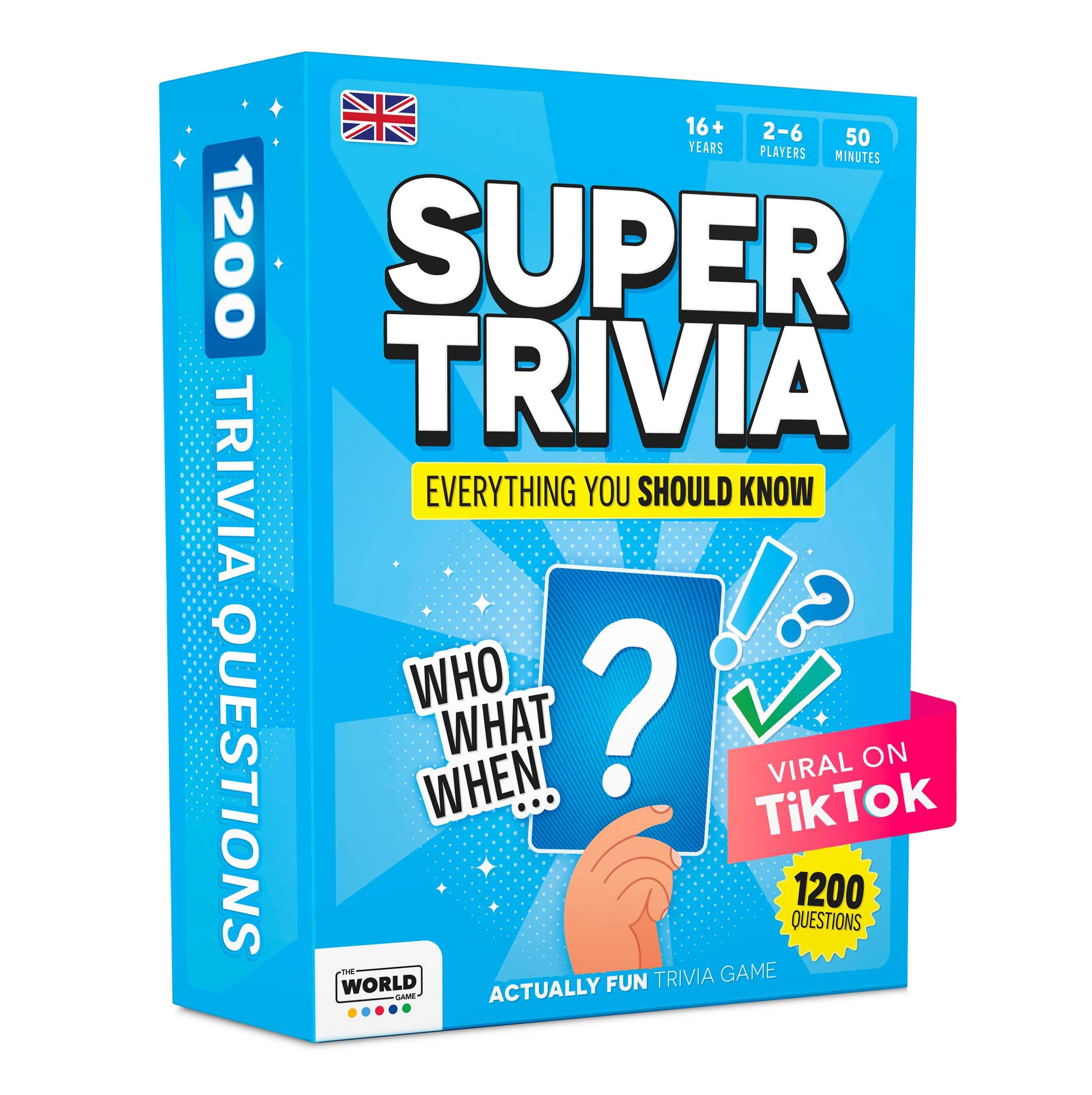
Super Trivia Game for Adults delivers 1,200 general knowledge questions across daily life, culture, history, natural science, and geography, with an additional 200 picture-based estimation questions that break up the pure text format. The dice-rolling mechanic determines which category you answer, adding a layer of chance that prevents one-skill domination.
The box contains 202 cards and a dice in a compact 7.99 x 5.79 x 1.77-inch package that travels well. The 16+ age recommendation is slightly conservative because many questions suit advanced high school students, and teachers have reported strong engagement in classroom settings. Customer feedback highlights the reasonable difficulty curve where questions are hard enough to feel rewarding but not impossible.
Some players note that the picture estimation questions are occasionally ambiguous, and the travel-friendly box means fewer cards than larger board games. The overall question variety and balanced difficulty make this a strong entry-level option for groups who want a broad trivia experience without niche specialization.
Why it’s great
- 1,200 questions with picture-based estimation rounds
- Dice-rolling mechanic adds variety
- Compact and travel-friendly box
Good to know
- Picture rounds can feel ambiguous
- Fewer cards than premium competitors
5. SongFest! Music Trivia Party Game

SongFest! covers five decades of music from the 1970s through today with 1,000 challenge questions organized into four fun categories. The standout innovation is the QR code system built into the hint mechanism: scan the code with a phone to hear a snippet of the song, which helps players connect the music to the answer without needing a separate playlist.
The 9.75 x 4.8-inch box supports 2 to 12 players and allows you to customize gameplay by selecting specific decades, so you can skip eras your group dislikes. Customer feedback emphasizes the spontaneous singing and story-sharing that erupts during play, which is exactly what a music trivia game should do. The quality of the cards and box is noticeably high.
A minority of reviews note that certain songs repeat across multiple questions and the music leans toward country while underrepresented in rock and alternative. The QR code dependency requires a smartphone and internet connection, which could be inconvenient in remote locations. For music-loving groups who want a sensory trivia experience, this is the clear choice.
Why it’s great
- QR codes play actual song snippets for hints
- Customizable decade selection for any group
- Compact, high-quality box for travel
Good to know
- Songs repeat across the deck occasionally
- Country-heavy playlist; less rock/alternative
6. Who Knows More? Kids or Adults

Who Knows More? splits players into two teams of kids versus adults, creating an immediate family rivalry that drives engagement. The 6.7 x 4.7 x 2-inch box contains category cards covering history, pop culture, science, random facts, and more, with the first team to 20 points declared the winner. The 8+ age rating is genuine, and most families find the difficulty balanced between the generations.
Customer feedback consistently describes laughter-filled sessions where adults are humbled by pop-culture questions the kids answer instantly. The simple point-tracking system means you can start playing within two minutes of opening the box. Several families report finishing all of the cards in two sittings, which hints at limited long-term replay value.
A common complaint is that timed questions asking you to recite six items in ten seconds are nearly impossible and no timer is included. The cardstock feels adequate but not premium, and the box could be more durable for travel. For families with kids ages 8 to 14 who want intergenerational competition on family night, this game delivers high energy at a reasonable cost.
Why it’s great
- Built-in kids versus adults rivalry drives engagement
- Simple 20-point scoring gets play started fast
- Good balance of difficulty between age groups
Good to know
- All cards exhausted in two sessions
- Timed questions lack included timer
7. I Should Have Known That Trivia Game Yes or No Edition
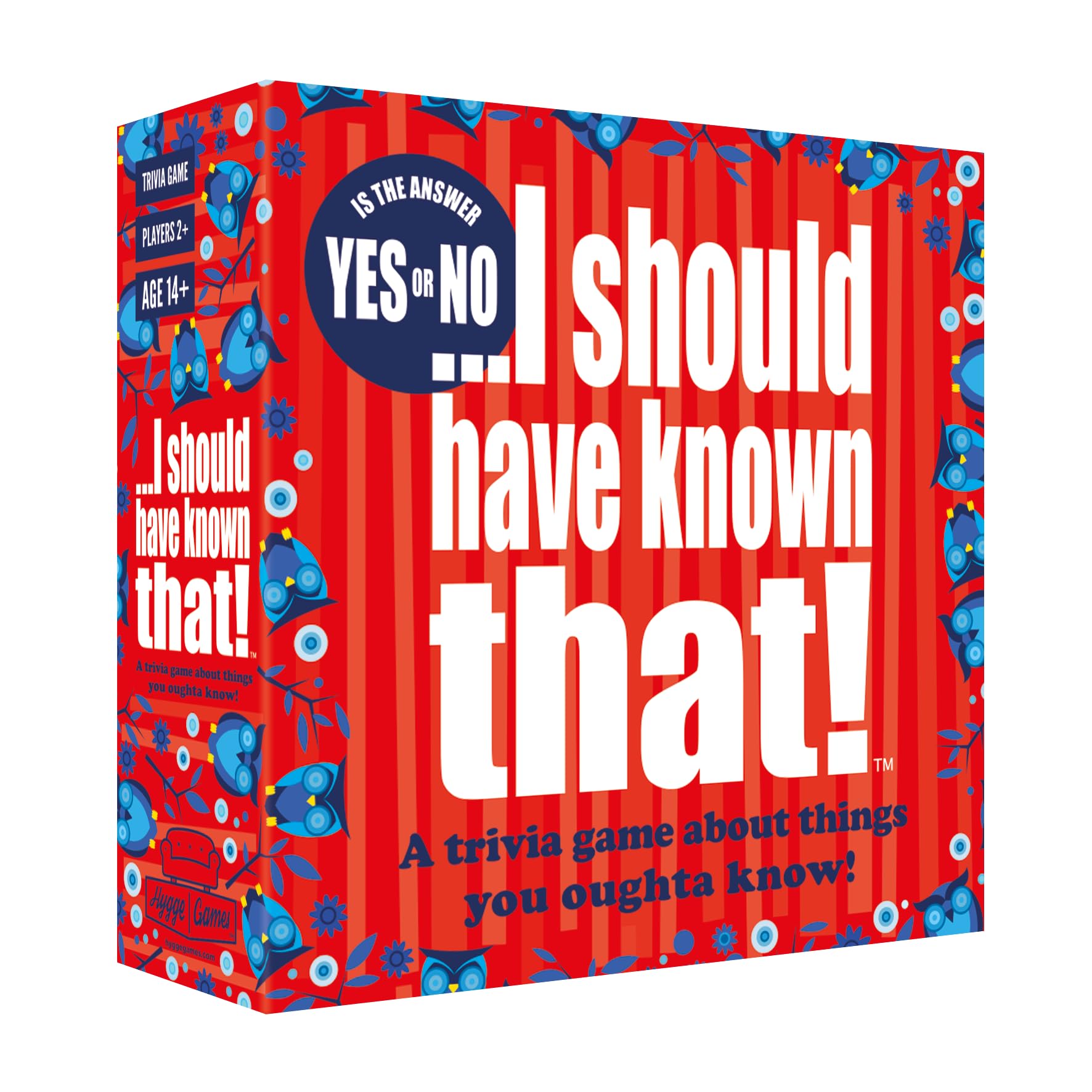
I Should Have Known That Yes or No Edition distills trivia down to its simplest form: a binary answer to questions like “Can you be allergic to a hairless cat?” or “Does Transylvania really exist?” The 110 cards contain over 400 questions and the 5.7 x 5.7 x 1.8-inch box is small enough to slip into a backpack or glove compartment for road trips.
The game is family-friendly with an age rating of 14+ that feels slightly conservative given the general-knowledge tone. It works as a standalone edition or combined with the original green version for more variety. Customer feedback highlights how quickly the game creates “I should have known that” moments that spark conversation and laughter among groups of all sizes.
The yes-or-no format is inherently less satisfying for players who prefer multiple-choice depth or category variety, and the tiny box means fewer total questions than larger games. The card quality is adequate but not designed for heavy shuffling over many years. For travelers, campers, or anyone who wants a no-fuss trivia fix that fits in a coat pocket, this is the most portable option available.
Why it’s great
- Ultra-compact box perfect for travel
- Simple yes/no format removes analysis paralysis
- Great conversation starter with surprising facts
Good to know
- Binary answers lack multiple-choice depth
- Fewer questions than traditional board games
FAQ
What is the recommended age for trivia board games?
How many questions should a trivia game have for good replay value?
What does a range-guessing mechanic mean in a trivia game?
Final Thoughts: The Verdict
For most users, the board games trivia winner is the Confident? Party Game because its range-guessing mechanic keeps every player engaged regardless of their knowledge base. If you want deep historical content with premium production, grab the HISTORY Channel Trivia Deluxe. And for a faith-based learning experience that families can enjoy together, nothing beats the Bible Trivia by Pressman.