
Our readers keep the lights on and the weekend projects moving. As an Amazon Associate, I earn from qualifying purchases.
Specs are compiled from manufacturer listings and verified buyer reviews and can change over time — please confirm the key details on the product page before buying.
Buying budget active speakers means you want the punch of a real sound system without the premium price tag. A 2.1 setup with a subwoofer shakes your gaming desk, while studio monitors give you honest sound for editing. The real win is a pair that delivers clear, balanced sound without demanding you decode every spec sheet.
I’m Rikta — the founder and writer behind FitlyFast. This guide is built by comparing the manufacturers’ published specifications and the patterns across verified customer reviews, so you get each pick’s real strengths and trade-offs instead of marketing spin.
Every option here runs on its own built-in amplifier — you plug in, connect, and play. The budget active speakers in this roundup cover everything from desk-friendly 2.1 systems to studio monitors that handle a full mix.
Our Picks at a Glance


How To Choose The Best Budget Active Speakers
Active speakers have the amplifier built right in, so you skip the separate receiver. Your placement — desk, shelf, or studio — determines the size, power, and bass response you need.
Peak Power vs. RMS Power
Peak power is the brief maximum burst a speaker can handle, while RMS tells you the continuous, comfortable listening level. A model rated 200W peak with 50W RMS will stay clean at normal volumes but won’t stay distortion-free if you crank it all the way.
Bass: 2.1 vs. 2.0
A 2.1 system adds a dedicated subwoofer to handle the low frequencies, keeping the main speakers clear. A 2.0 pair relies on larger drivers for bass — a 5-inch woofer digs deeper than a 3.5-inch one, so driver size matters more when there’s no sub.
Connectivity Checklist
List every device you’ll connect — phone, turntable, TV, or console — to match the right inputs. Bluetooth handles phones and tablets, RCA works for turntables, and optical or ARC connects to your TV with a single cable.
Quick Comparison
| Model | Best For | Power | Driver Size | Bluetooth Range | Amazon |
|---|---|---|---|---|---|
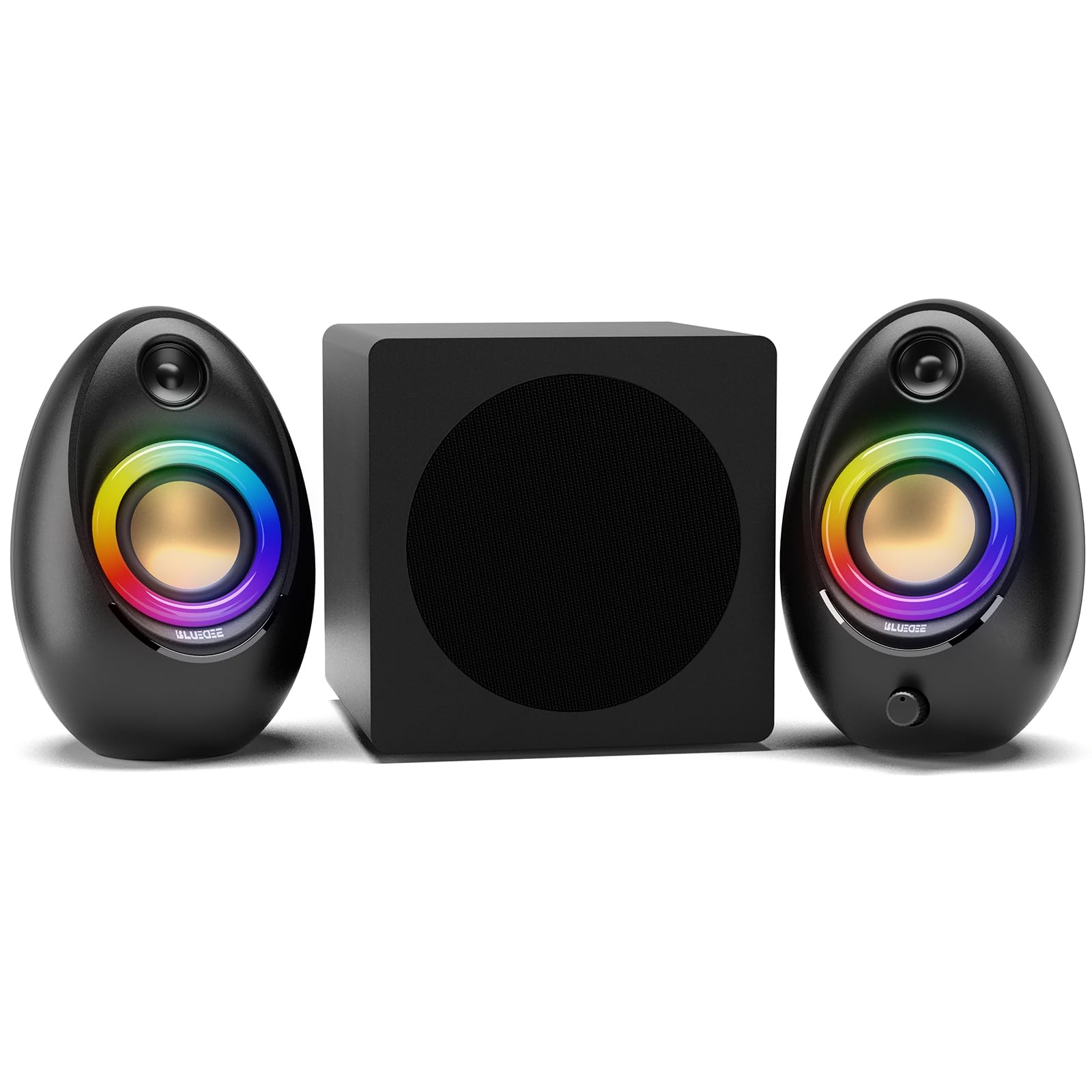
| Bluedee 2.1★ Best Overall | Deep bass & desk gaming | 80W peak | Sub + satellites | 10 meters | Amazon |
| Rockville ASM4Studio Pick | Critical listening | 200W peak / 50W RMS | 4″ woofer | 35 feet | Amazon |
| Edifier R33BTBest Value | Simple 2.0 desktop | — | 3.5″ mid/bass | 20 meters | Amazon |
| Mackie CR3.5 | Compact studio & gaming | — | 3.5″ woven woofer | — | Amazon |
| PreSonus Eris 3.5 | Near-field music production | 50W | 3.5″ woven-composite | — | Amazon |
| BESTISAN 50W*2 | TV & turntable with lights | 100W max | 3″ bass | 33 feet | Amazon |
| MEVOSTO 36W RMS | Full-room bookshelf sound | 36W RMS | 5″ bass | 15 meters | Amazon |
| Edifier R1280T | Vinyl & home listening | 42W RMS | 4″ full range | — | Amazon |
| Yamaha HS4 | Serious studio mixing | — | 4.5″ cone woofer | — | Amazon |
In‑Depth Reviews
1. Bluedee Computer Speakers with Subwoofer
The 2.1 setup that brings real subwoofer punch to your desktop without the premium price.
A dedicated subwoofer is the star here — it handles the low frequencies so the satellite speakers stay clean and clear. The DSP tuning (a built-in processor that shapes the sound) cuts harsh highs, so vocals stay smooth even during long work-from-home sessions. With 80W of peak power and a 10-meter Bluetooth range, this pair beats the simpler 2.0 setups that top out around 80W total.
Buyers report the sound is “clear, balanced audio with deep bass,” and they love the easy setup that connects right from the start. The all-in-one control knob adjusts volume, play/pause, lighting effects, and mode switching with a single turn. The desk-friendly RGB lighting switches between dynamic colors and a soft static glow so it won’t distract you during focus time.
Connectivity is wide open — Bluetooth 5.4, USB, USB-C, and 3.5mm AUX all work plug-and-play. The catch is that pushing it to maximum volume with bass-heavy tracks can introduce distortion, so it rewards a touch of restraint. It’s still a strong value for a complete 2.1 system with a subwoofer.
What owners love
- Deep, punchy bass from the separate subwoofer
- Multiple connections right from the start
- Compact design with stylish RGB lighting
Keep in mind
- Distortion can appear at very high volumes
- Plastic enclosure won’t win audiophiles
The crowd favorite: anyone who wants movies, music, and gaming with real bass on a desk budget.
The honest limit: if you live at max volume, this will show its budget roots.
2. Rockville ASM4 Powered Studio Monitor Pair
A studio monitor with 200W peak power and a silk dome tweeter for honest, critical listening.
A 1-inch silk dome tweeter (a soft fabric driver that smooths out high frequencies) pairs with a 4-inch paper cone woofer to deliver clear mids and controlled highs. The DSP tuning keeps the frequency response flat down to 50Hz, so you hear your music the way it was recorded. At 200W peak / 50W RMS, it has the headroom to fill a small room.
What wins people over is the sound quality — owners mention you “can’t beat the quality for the price” and call it a great value for studio monitoring. The versatility beats the Edifier R33BT above on connections: optical input for TVs, 1/4″ TS for pro audio gear, RCA, and 3.5mm aux. Bluetooth 5.0 gives you 35 feet of range for phone streaming.
The recurring gripe is the bass — even with the tone knob all the way down, some owners find it too deep for their taste. The 1/2″ MDF enclosure (a dense wood fiber board) with a curved front bezel reduces standing wave distortion, which matters for mixing. Better quality cables can improve the sound further, according to owners.
The honest take: the sound quality is the headline — 15 owners single it out as the standout feature, with value for money the second most-praised aspect.
Who it’s not for: if you want neutral, bass-light monitoring, the rock-solid low end here could be too much.
3. Edifier R33BT Active Bluetooth Bookshelf Speakers
The wooden 2.0 pair with the longest Bluetooth reach on this list at 20 meters.
A wooden enclosure minimizes acoustic resonance (unwanted vibration that colors the sound), and the classic design blends into any room. Inside, a 1/2-inch tweeter and 3.5-inch mid/bass driver handle both highs and lows. Top-mounted controls give you on/off, input switching, Bluetooth disconnect, and volume without reaching behind the speaker.
These connect easily to your phone — customers note they “connect easily via Bluetooth” with pretty decent bass for the size. At 20 meters of range, this pair gives you double the wireless reach of the Bluedee 2.1 above. An IT professional who tested dozens of brands called these the best at the price for sound, ease of use, and durability.
The honest fit note: sound quality gets mixed feedback — some love the music reproduction, but a few find it tinny with limited deep bass. One owner upgraded to the larger Edifier R1280DB and called it a night-and-day difference. For acoustic jazz and classical, reviewers point out the bass is clean; electronic and rock fans may want a sub.
The value read: appearance and value for money are the two most-praised aspects — this is a lovely-looking desk pair that won’t break the bank.
The trade-off: the modest 3.5-inch driver means bass heads should look at a 2.1 system instead.
4. Mackie CR3.5 Creative Reference Studio Monitors

Small enough to hide on a desk, loud enough to fill a medium room with articulate sound.
The tone knob is the defining trick — start with the transparent studio response, then turn it up to boost bass and add high-end sparkle for gaming or parties. A silk dome tweeter and 3.5-inch woven woofer produce clean, articulate sound with surprisingly solid bass for the driver size. The location switch tune the sound for desktop listening up close or bookshelf listening from the couch.
Owners call them “small but mighty” — great stereo separation, very loud for their size, and ideal for mixing or hearing music differently. The build quality earns praise with a note that they “can take a pretty good beating.” At 10.2 pounds, they have heft that reassures. TRS and RCA inputs connect to audio interfaces, and a 3.5mm input handles gaming consoles and PCs.
What stands out is how the sound quality wins the room — 70 owners single it out, with value for money the second most-praised aspect. The built-in headphone output is a quiet bonus for late-night listening. They excel as entry-level monitors if you’re getting into audio or content creation.
The compact verdict: a genuinely loud, clear pair that works for studio, gaming, and party duty in one box.
The realistic note: at 3.5 inches, the drivers have limits — floor-shaking bass needs the separate CR8SBT subwoofer.
5. PreSonus Eris 3.5 Powered Studio Monitors

50 watts of clean amplification that fills a room while keeping every detail audible.
A 3.5-inch woven-composite woofer (a stiff fabric weave that resists distortion) delivers deeper, tighter bass, while the 1-inch silk-dome tweeter smooths out harsh highs. The frequency response spans 80 Hz–20 kHz, covering the full range of music. Built-in high- and low-frequency acoustic tuning controls let you tailor the sound to your room without extra gear.
Owners repeatedly describe the sound as accurate and clean, with one noting it made them send back a much pricier portable speaker. The 50W of built-in amplification is “powerful enough to fill the room, clean enough to hear every detail.” Balanced TRS, RCA, and a front-panel aux input connect to computers, interfaces, consoles, phones, or turntables.
The honest caveats: some owners find the sound bass-heavy and recommend EQ adjustments for a flatter response, and a handful report units failing within weeks to months. The lack of included TRS cables frustrates some buyers. Still, the sound quality is the most-praised aspect by a wide margin, with value for money second.
The trusted pick: a recognized studio name delivering accurate, dynamic sound that’s louder than you’ll need for near-field desk listening.
The durability watch: most owners are thrilled, but a small number report units failing early — keep your receipt handy.
6. BESTISAN 50W*2 Active Bookshelf Speakers
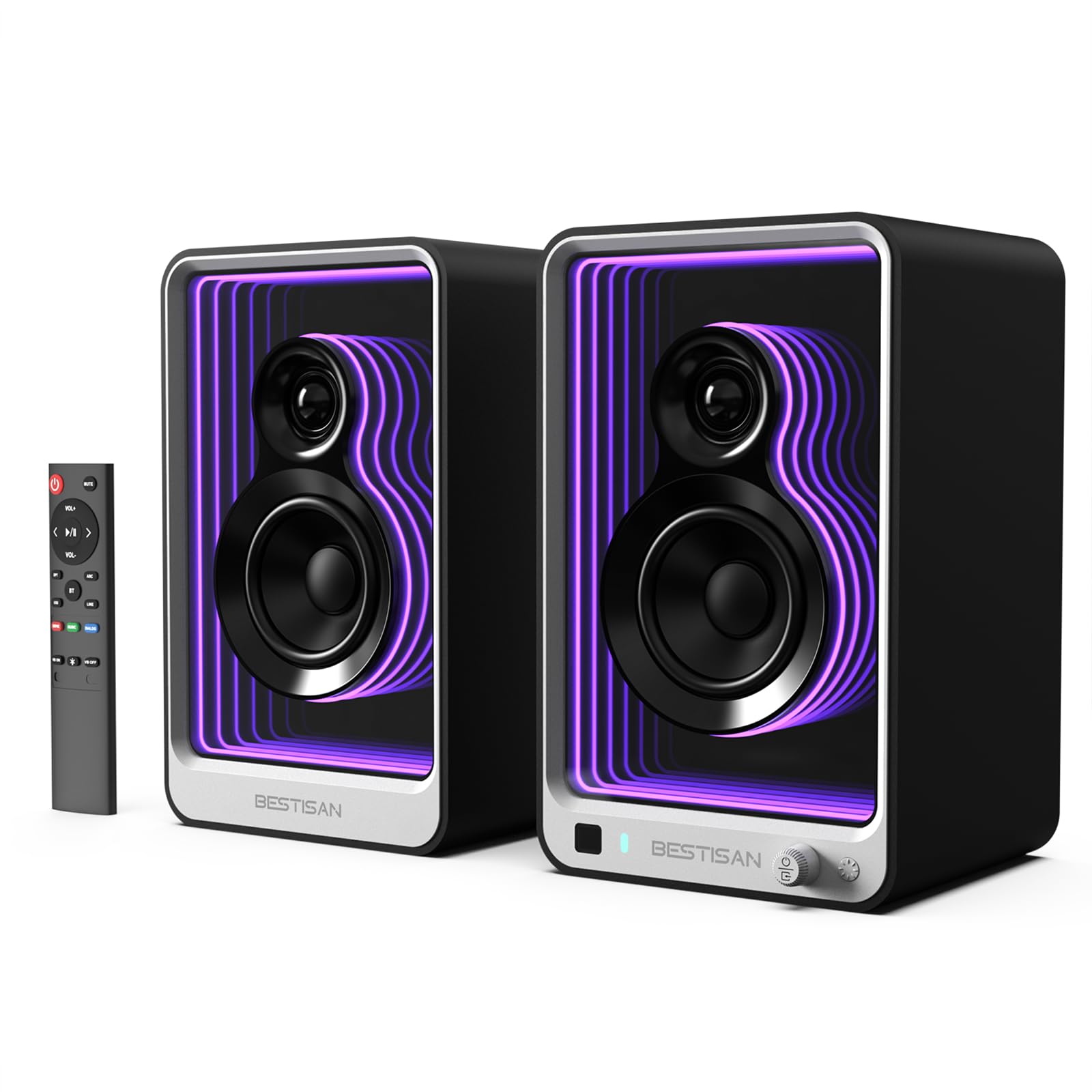
Mirror-finish speakers with nine lighting effects and a connection for every gadget you own.
ARC and optical inputs make TV hookup a single cable, while RCA connects a turntable and SUB out lets you add a subwoofer for stronger bass. Bluetooth 5.2 streams from any device, and a USB port plays music straight from a flash drive. The 1.25-inch tweeters and 3-inch bass speakers combine for 100W max total power.
Owners praise the “big sound in a small package” — balanced, clear, with plenty of low end and no muddiness. The infinity mirror lighting effect is a showpiece, and the remote controls everything from up to 33 feet away. Sound modes for movie, music, and dialog, plus bass and treble knobs, give you real tuning control.
The honest note: a few owners found the bass weak before adjusting EQ, and the initial highs and lows can sound muddy until you tune them. One lighting sync issue between left and right speakers was resolved quickly by customer service. At 10 pounds and 9.5 inches tall, they’re compact enough for a desk but put out volume that surprises.
The versatile verdict: if you want one pair that handles TV, turntable, PC, and phone with flair, this is it.
The setup reality: expect to spend a few minutes dialing in the EQ to get the balanced sound owners rave about.
7. MEVOSTO Active Bookshelf Speakers 36W RMS

The 5-inch woofers deliver deeper bass than any other 2.0 pair on this list.
Dual 1-inch (25.4mm) silk dome tweeters and 5-inch bass speakers create the richest low-end of any 2.0 setup here — explosions and footsteps in games feel more intense. The wood finish enhances resonance (the natural vibration that adds warmth) and looks at home next to a turntable. Customizable bass and treble controls offer 10 levels of adjustment for any genre.
Owners are “very pleasantly surprised” by the sound for the size and price, with one using them as a receiver to run a record player through. USB digital audio delivers lossless quality for PC use, and the remote controls everything from a distance. At 36W RMS, they fill a room without distortion, with owners noting 20-30 volume is plenty for YouTube.
Bluetooth 5.4 provides 15 meters of range with faster pairing and low latency — ideal for video. Trade-offs: no subwoofer out for deeper bass, and the AC adapter uses a boxy plug instead of a standard one. A Bluetooth quirk that cut off the start of audio was fixed via a software update from responsive support.
The sound verdict: the best pure bass of any 2.0 budget pair, with sound quality the most-praised feature among owners.
The practical note: if you demand floor-shaking sub-bass, you’ll want to add a subwoofer elsewhere.
8. Edifier R1280T Powered Bookshelf Speakers

A 42W RMS classic with a remote, dual AUX inputs, and a sound that pairs beautifully with vinyl.
You get clear, natural sound from a 13mm silk dome tweeter (the small speaker that handles high notes) and a 4-inch full-range unit (the main driver that covers most frequencies), so vocals and instruments stay distinct even at moderate volumes. Owners describe the range as “incredible,” meaning you hear both deep bass and crisp highs without distortion. The included remote lets you adjust volume from across the room, while bass and treble knobs on the side panel give you quick tone control without digging into menus. The cabinet is made of MDF (medium-density fiberboard, a dense wood composite that reduces vibration) with a wood-effect vinyl finish, so it looks like real wood and fits most living rooms without rattling at higher volumes.
Dual AUX inputs are the hidden gem — you can connect two devices at once, like a turntable and a phone, without plugging and switching. Shoppers say setup takes about 10 minutes and the cables stay in place well. One vinyl fan notes they pair beautifully with an Audio Technica LP60X turntable, making them great for record listening.
The recurring theme is strong value — owners call them “worth every penny” with clear sound quality and excellent budget performance. The honest limitation is weak bass on their own, so owners recommend pairing them with a subwoofer for deeper low end. They won’t be mistaken for studio monitors, but for in-home music enjoyment they’re a joy.
The vinyl verdict: the best-looking, remote-controlled pair here for relaxed home listening on a shelf.
The bass reality: expect clean, clear sound — and add a sub if you want rumble.
9. Yamaha HS4 Powered Studio Monitor Pair

The industry-standard name in studio monitoring, with a 60 Hz–22 kHz response that stays honest.
A 2-way bass-reflex design with a 4.5-inch cone woofer and 1-inch dome tweeter delivers the flat, accurate response that makes Yamaha a studio staple. Owners describe the sound as “pristine,” rivaling setups costing multiples more, and note it works particularly well in apartments. The room control and high trim response controls let you tune for placement — including a wall bass compensation switch.
XLR/TRS combo, RCA, and stereo mini inputs cover every pro and consumer connection. The included anti-slip pads and cables get you set up fast. Owners say they’re “cleaner, less muddy than cheaper monitors” with quality parts built for longevity — worth the extra cost if you take your audio seriously.
Highs start bright but settle after about 100 hours, and bass is thin at very low volumes. They perform best at medium volume from about 3 feet away. An owner upgrading from budget monitors said every song sounds new with amazing clarity and stereo width.
The pro verdict: the reference-grade pick — if -worth of audio quality at this size appeals, this is it.
The investment note: the most expensive pair here, but owners say the extra cost buys honest sound and lasting parts.
Understanding the Specs
Peak Power vs. RMS Power
Peak power is the maximum burst a speaker can hit for a split second, like the impact of an explosion in a movie. RMS (root mean square) is the continuous power it can sustain cleanly, which is the more honest number for everyday listening. A 200W peak / 50W RMS monitor will stay clear at normal levels, but pushing full volume invites distortion.
Driver Size and Bass
The woofer’s diameter directly controls how deep the bass goes — a 5-inch driver moves more air than a 3.5-inch one, producing deeper low frequencies. A 2.1 system adds a dedicated subwoofer, which frees the main speakers to stay clear while the sub handles the rumble. If bass matters most, look for a larger woofer or a separate sub.
FAQ
What is the difference between active and passive speakers?
Can I connect these speakers to my TV?
Will a 2.1 speaker system sound better than a 2.0 pair?
How much power do I need for a desktop setup?
Is Bluetooth good enough for music production?
What is DSP tuning and why does it matter?
Can I use studio monitors for gaming?
Do I need a subwoofer for a bookshelf speaker setup?
Final Thoughts: The Verdict
For the majority of shoppers, the budget active speakers winner is the Bluedee 2.1 because it brings real subwoofer bass, easy connectivity, and great reviews at an approachable price. If you want honest studio sound for mixing, grab the Yamaha HS4. And for a pair that fills a room with deep bass and looks great doing it, the MEVOSTO is the one to reach for.
How We Picked
We do not accept paid placement. Every pick is matched to a real buyer and a real use-case; we do not hands-on test units.
Sources & Methodology
Specifications: manufacturer listings and product documentation. Review insights: verified customer reviews, as of August 2026. Pricing: not shown on this page (it changes often); check the current price via the retailer link.
As an Amazon Associate, FitlyFast earns from qualifying purchases. This does not affect which products we feature.