
Our readers keep the lights on and the weekend projects moving. As an Amazon Associate, I earn from qualifying purchases.
Specs are compiled from manufacturer listings and verified buyer reviews and can change over time — please confirm the key details on the product page before buying.
TPU’s flexibility makes it prone to curling and peeling off the print bed mid-job. The fix is a build plate with a surface that grips flexible filament on the first layer and releases it cleanly when you want. The best build plate for TPU pairs a fine or smooth texture with a spring-steel core, so a single flex pops the finished part free without scraping.
I’m Rikta — the founder and writer behind FitlyFast. This guide is built by comparing the manufacturers’ published specifications and the patterns across verified customer reviews, so you get each pick’s real strengths and trade-offs instead of marketing spin.
if you want zero-glue first layers or a satin bottom finish, these six plates cover the surfaces that tame flexible filament. build plate for tpu buyers get a clear verdict on adhesion, durability, and which machine each sheet actually fits.
Our Picks at a Glance


How To Choose The Best Build Plate For TPU
Flexible filament bends under pressure instead of breaking, unlike rigid PLA or ABS. A plate tuned for rigid plastics can grip TPU too hard, ruining the first layer, or too softly, letting the print wander. Focus on three things: surface texture, bed temperature range, and whether the sheet uses a flexible spring-steel design.
Surface texture decides grip
Smooth PEI and fine-textured sheets give TPU a consistent bonding surface, reducing the gaps that cause warping. A coarse textured plate can leave a pebbled bottom finish and can grab flexible filament unevenly. For TPU specifically, a smooth or fine matte finish is the safer route to a clean first layer.
Bed temperature is a balancing act
TPU prints best at lower bed temperatures, often 45–55°C, because too much heat makes the material soft and sticky. Some plates are rated for a maximum bed temperature, and exceeding it can bubble or damage the surface coating. Check the plate’s heat ceiling before you set your slicer profile.
Spring steel means easy removal
A spring-steel sheet bends slightly to release the finished part cleanly once the bed cools. That one flex is what keeps you from prying at a stuck TPU print with a scraper. Plates that lack this flexibility force you to wait longer or risk damaging the surface.
Quick Comparison
| Model | Best For | Surface | Weight | Max Bed Temp | Amazon |
|---|---|---|---|---|---|
| BIQU CryoGrip Pro Glacier★ Best Overall | Low-temp PLA & PETG | Fine Textured | 14.4 oz | 100°C handle | Amazon |
| FLASHFORGE Smooth PEI (AD5M)Best Value | Glue-free PLA & TPU | Smooth PEI | 13.7 oz | — | Amazon |
| IdeaFormer-3D PEI Sheet | Bambu Lab accuracy | Smooth + Textured | — | 300°C textured | Amazon |
| FLASHFORGE Smooth PEI Platform | Easy cool-down release | Smooth PEI | 13.7 oz | — | Amazon |
| HIKUDIY PEI Plate (QIDI) | Low-temp PLA & TPU | Smooth + Textured | 14.4 oz | 70°C | Amazon |
| TEWIRROW Textured PEI | Bambu Lab durability | Textured PEI | 1.15 lb | — | Amazon |
In‑Depth Reviews
1. BIQU CryoGrip Pro Glacier Panda Build Plate
Our pick — 4.5★ from 800+ verified ratings; the strongest balance of quality and price.
The cold-printing sheet that kills glue sticks and edge warping for good.
The defining trait here is low-temperature adhesion: BIQU recommends 45–55°C for PLA and 60–75°C for PETG, so you start prints faster and burn less power while TPU stays cool enough not to fuse. The 7-layer polymer build and fine-textured surface are what owners credit for warp-free first layers on engineering materials up to 300°C nozzle temps.
The honeycomb handle stays cool enough to touch even when the bed hits 100°C, letting you pull a finished part the moment the plate cools. Buyers report mounting it on printers outside the Bambu family — including a Kobra 3 and a Prusa Core One — and seeing “zero adhesion failures in a month” with no adhesive at all. The fine matte finish is regularly called smoother than stock textured PEI.
Anything that grips this well grips hard: several owners say prints stick almost too well and a plastic razor scraper earns its place beside the printer. Adhesion is genuinely strong, so let the plate cool fully before flexing — the freezer trick helps stubborn parts. The crowd favorite here holds a 4.5-star average with over 800 ratings.
What wins owners over
- Genuine cold-print adhesion at 25–30°C with zero warping
- Heat-insulated handle stays touch-safe at a 100°C bed
- Satin finish beats stock textured PEI for bottom-surface looks
Where to be patient
- Strong grip means some parts need a scraper or a cool-down wait
- Skip acetone during cleaning; soap and water are the rule
Reach for this if: you want glue-free, warp-free low-temperature printing on a Bambu Lab machine.
Plan around: the tenacious adhesion — give parts time to cool before you flex the sheet.
2. FLASHFORGE AD5M Smooth PEI Plate
A glue-free smooth sheet built for the Adventurer 5M family and flexible filament.
Flashforge positions this 13.7-ounce magnetic sheet for the Adventurer 5M, 5M Pro, and AD5X, and its whole pitch is skipping glue for PLA, TPU, and carbon-fiber filaments. The smooth PEI face is what delivers the cleanest possible bottom finish, which is exactly the look TPU parts benefit from. Owners say parts stick correctly through the print and do not break free.
This is the pick that out-holds the textured plate in the same lineup, with buyers reporting adhesion strong enough that parts never come loose mid-job. The catch is material limits: the review pages carry the blunt warning that despite the advertising for PETG, this smooth surface is not the right home for it — “it’s definitely not.” PLA and TPU stay squarely in its comfort zone.
At 13.7 ounces it is 0.7 ounces lighter than the BIQU Glacier above, a small difference you feel only when swapping sheets often. For its price, this is the most affordable route to a smooth TPU surface in the Flashforge ecosystem, and it holds a 4.4-star average.
The strong points
- Smooth surface sits perfectly flat for clean first layers
- Adhesion beats the stock textured plate for many owners
- Works glue-free with PLA, TPU, and carbon-fiber filaments
Know the limit
- PETG adhesion is poor even though the marketing claims otherwise
- An occasional sheet arrives with a high-gloss sticker needing air-bubble attention
Choose it for: a budget-friendly, glue-free smooth surface when you print mostly PLA and TPU.
Look elsewhere if: PETG is a staple material — this plate is not the one for it.
3. IdeaFormer-3D PEI Sheet for Bambu Lab

Two surfaces in one sheet for Bambu Lab printers that want texture options.
This 257x257mm plate gives you a smooth black PEI face for glossy bottoms and a textured black PEI face for stronger grip, both on a thickened spring-steel core that boosts magnetic hold. The textured side handles the hot stuff — rated to 300°C — while the smooth side tops out at 200°C, so pick your face by the filament you are running. Owners mention perfect adhesion for ASA and PLA, with parts popping off cleanly.
For TPU, the smooth face is the safer bet because it lets flexible filament release without sticking in the texture. The thickened steel is the feature that prevents warping on larger models in filaments prone to it, like ABS, PC, and Nylon. A recurring note is the barcode sticker on the sheet washes off after a few cleanings, so plan to disable the plate-check feature in Bambu Studio long-term.
Quality control earns honest pushback, with an occasional defective sheet replaced free by the company; once swapped, the plate performs well. At roughly the same price as the Flashforge, this is the two-sided alternative for Bambu owners — and the 14.96 x 12.2 x 1.77-inch package is 3.7 inches longer than the BIQU’s 11.26-inch box, reflecting the extra steel.
Why it earns its spot
- Textured side holds up to a 300°C maximum temperature
- Thickened spring steel resists warping on big prints
- Both faces give you finish choices without a second purchase
The trade-offs
- Smooth side is capped at 200°C, not for hot engineering runs
- Barcode sticker fades after washes; disable plate check
- Adhesion can be almost too strong on some filaments
Grab this for: Bambu Lab owners who want one plate that covers both glossy and textured finishes.
Remember: the smooth face is your TPU friend; keep the textured side for hotter materials.
4. FLASHFORGE Smooth PEI Platform

The smooth platform that lets prints separate on their own once the bed cools.
This is the second-smooth PEI entry in the Flashforge Adventurer 5M family, and it sells on easy removal: cool to room temperature and the model separates from the plate without bending it a million ways. The smooth surface delivers a flawless bottom finish while offering strong adhesion for PLA, PETG, and TPU with no glue. It holds a 4.4-star average across more owners than its sibling sheet.
At 13.7 ounces, it matches the other Flashforge smooth plate exactly, and both target the same 5M, 5M Pro, and AD5X machines. The real-world praise centers on clean release and perfect first layers, with owners noting stubborn prints come off cleanly after a dishwasher cycle rather than scraping the surface. A distilled-water-only wash is the maintenance tip that keeps the smooth face sticking properly.
Durability draws the honest caution here: a number of owners flag quality issues over time, so treat the surface gently and never scrape it. For TPU, the auto-separation after cooling is the standout benefit — flexible parts pop free with zero prying. Unlike the IdeaFormer at 300°C, this sheet makes no high-temperature claim, keeping it a low-and-mid-temp specialist.
What owners like
- Models self-release once the bed cools to room temperature
- Smooth face gives TPU a clean, glossy bottom
- Strong glue-free adhesion with PLA, PETG, and TPU
Watch out for
- Durability and quality draw recurring complaints over time
- Some users still reach for spray adhesive on tricky materials
Best suited to: Flashforge owners who want cooled prints to lift off with no bending or scraping.
Be gentle: the smooth coating is the weak link, so wash with distilled water and skip the scraper.
5. HIKUDIY PEI Build Plate for QIDI Q2
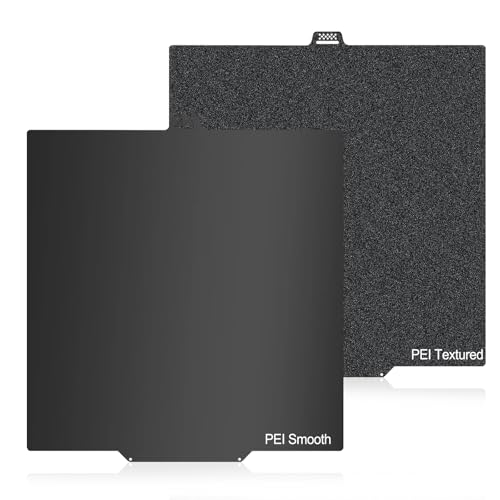
The budget dual-sided sheet that is explicitly built for PLA, PLA+, and TPU.
This 280x280mm plate is the most honest about its lane: it is “tune for PLA / PLA+ / TPU” and warns you away from ABS, PC, and Nylon. The smooth face gives a clean glossy bottom, while the textured face adds a frosted finish with stronger grip to reduce warping. Both sides share a firm 70°C maximum bed temperature to protect the laminated coating.
One owner racked up over 2000 hours of print time across both sides and still calls the plate excellent, which is strong value for the money. The textured face earned specific praise for ASA printing with no glue and no warping on a smooth side, while PLA needed glue and stuck too hard on the textured face. That split summarizes the trade-off: smooth for easy release, textured for grip.
The honest downside is durability on the smooth side, with a few reports of the PEI coating separating from the steel in under 20 print hours. That makes this a value play for low-temperature TPU work rather than a daily heavy-duty workhorse. It is 0.7 ounces heavier than the Flashforge plates above at 14.4 ounces, and the 11.81-inch square footprint is built for the QIDI Q2 bed.
What it does well
- Explicitly rated for low-temperature PLA and TPU printing
- Two textures in one sheet for finish flexibility
- Owner clocked 2000+ hours across both sides
The honest limits
- Smooth-side coating can separate from the steel in some units
- 70°C bed cap rules out high-temperature filaments
- Smooth side may need adhesive on some materials
Ideal for: QIDI Q2 owners printing mostly PLA and TPU on a tight budget.
Expect: an occasional coating failure on the smooth side, so keep a spare in mind.
6. TEWIRROW Textured PEI Build Plate
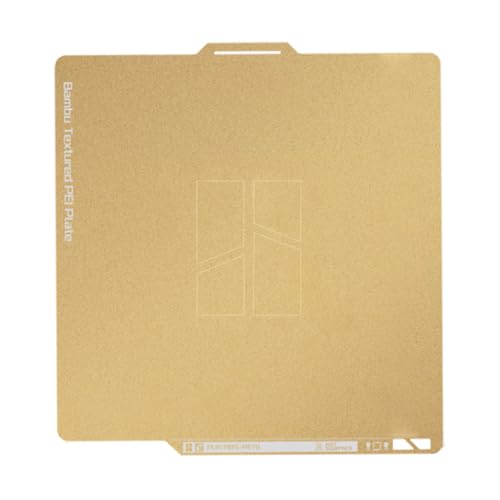
A Bambu Lab textured sheet that owners buy in bulk for the lab.
This textured PEI plate targets the Bambu Lab P1, P1P, P1S, X1, X1C, and A1 family, and leans on the classic textured-surface trick: parts stick firmly while printing and self-release once the bed cools to room temperature. It handles PLA, TPU, PETG, and PVA, with glue recommended only for non-PLA materials. The wear-resistant PEI is built to endure repeated heating and cooling cycles.
Owners describe one replacing a plate with roughly 1500 print hours of wear, then buying four more for a lab because the lifespan only shortened from careless users. The packaging gets repeated praise for arriving undamaged.
The catch is fit: this is a Bambu Lab-specific part, so it will not serve Flashforge or QIDI owners. It is also the most expensive option in this lineup, sitting at a premium over the other three Bambu-compatible plates here. For A1 owners who want an exact match to the stock feel, the review pages call it just like the one that comes with the A1.
What stands out
- Self-releases prints once the bed cools to room temperature
- Heavy-duty steel survived a plate with 1500 hours of wear
- Both sides usable for extended longevity
Consider first
- Premium pricing versus other Bambu-compatible sheets
- Textured face only — no smooth option for glossy TPU bottoms
Buy this for: Bambu Lab owners who value durability and a stock-like fit over the lowest price.
skip it if: you want a smooth glossy finish on your TPU parts — the textured face is all you get.
Understanding the Specs
PEI Surface Texture
PEI (polyetherimide) is the high-temp plastic coating that gives a plate its grip. Smooth PEI produces a clean, glossy bottom finish and releases flexible parts easily. Textured PEI adds a frosted look and stronger grip for warping-prone filaments, but it can hold TPU a little too firmly.
Bed Temperature Range
TPU prefers a cooler bed, often in the 45–55°C range, so it does not soften and fuse to the surface. Some plates list a hard maximum bed temperature — like the HIKUDIY’s 70°C cap — and exceeding it can bubble or damage the coating. Match the plate’s ceiling to your slicer profile.
Spring Steel Core
The flexible steel sheet underneath the coating is what lets you bend the plate slightly to pop a finished part free. A thicker core adds weight and resists warping on large prints, which is why the TEWIRROW at 1.15 pounds feels more substantial than lighter sheets.
Printer Compatibility
Build plates are cut to exact bed sizes, so a 257x257mm sheet fits Bambu Lab machines while a 280x280mm sheet targets the QIDI Q2. Before ordering, confirm your printer model and bed size, because a sheet that is a few millimeters off will not seat correctly on the magnetic base.
FAQ
What is the best build plate surface for TPU?
Do I need glue on a build plate for TPU?
What bed temperature should I use for TPU?
Will a Bambu Lab build plate fit my printer?
Why does my TPU print stick too well to the plate?
How do I clean a PEI build plate?
Can I print PETG on the same plate as TPU?
How long does a PEI build plate last?
Is a textured or smooth PEI plate better for flexible filament?
Why does my build plate need a maximum temperature rating?
Final Thoughts: The Verdict
Across the board, the build plate for tpu winner is the BIQU CryoGrip Pro Glacier because it delivers glue-free, warp-free low-temperature adhesion that owners trust across hundreds of prints. If you want a budget smooth surface for the Flashforge family, grab the FLASHFORGE AD5M Smooth PEI Plate. And for a Bambu Lab sheet that owners buy four at a time for the lab, the TEWIRROW Textured PEI is the one to reach for.
How We Picked
We do not accept paid placement. Every pick is matched to a real buyer and a real use-case; we do not hands-on test units.
Sources & Methodology
Specifications: manufacturer listings and product documentation. Review insights: verified customer reviews, as of August 2026. Pricing: not shown on this page (it changes often); check the current price via the retailer link.
As an Amazon Associate, FitlyFast earns from qualifying purchases. This does not affect which products we feature.