
Our readers keep the lights on and the weekend projects moving. As an Amazon Associate, I earn from qualifying purchases.
Specs are compiled from manufacturer listings and verified buyer reviews and can change over time — please confirm the key details on the product page before buying.
The biggest question for any golfer shopping on a budget is simple: will a sub- launch monitor actually give you numbers you can trust? The short answer is yes — if you know which features to prioritize. The best budget launch monitors use Doppler radar to report real ball and club data, not guesses, and the models here earn their place by delivering accuracy where it counts most for practice.
I’m Rikta — the founder and writer behind FitlyFast. This guide is built by comparing the manufacturers’ published specifications and the patterns across verified customer reviews, so you get each pick’s real strengths and trade-offs instead of marketing spin.
Whether you train indoors or at the range, the best budget launch monitors turn every swing into a measurable improvement session.
Our Picks at a Glance


How To Choose The Best Budget Launch Monitors
You want a budget launch monitor that actually improves your practice while staying affordable or your patience. The key is matching what each device measures to your goals, your space, and how much setup hassle you can tolerate.
Consider the Space You Have
Doppler radar needs room to track the ball. Some units require 10-15 feet of flight space, while others work in tight indoor spaces or even without a ball at all. Think about where you’ll practice most — a garage, a net in the yard, or the driving range — and check the clearance requirements before you buy.
Decide on App Dependence
Some budget monitors display data on a built-in screen without needing a phone, while others rely on a companion app for recording and analysis. A standalone device is simpler, but an app-based system can offer video replay and richer data over time. Watch for subscription fees that add up after the first year.
Quick Comparison
| Model | Best For | Ball Speed | App Needed | Indoor Use | Amazon |
|---|---|---|---|---|---|
| Shot Scope LM1★ Best Overall | Carry distance + smash | Yes | Yes | Yes | Amazon |
| Rapsodo MLMCrowd Favorite | Video tracer + GPS | Yes | iOS only | Yes | Amazon |
| PRGR HS 130-ANo-Fuss Pick | No-app simplicity | Yes | No | Partial | Amazon |
| Voice Caddie SC200Plus | Voice feedback + loft adjust | Yes | No | Yes | Amazon |
| TheStack Radar | Speed training system | Yes | iOS/Android | Yes | Amazon |
| Swinora GX-03 | Zero-fee full metrics | Yes | iOS/Android | Yes (15 ft space) | Amazon |
| Garmin Approach G80 | GPS + monitor combo | Yes | No | Partial | Amazon |
| Izzo Swami LMP | Full data suite, 420 yd range | Yes | No | No | Amazon |
| Garmin Approach R10 | Full home simulator | Yes | Yes | Yes | Amazon |
In‑Depth Reviews
1. Shot Scope LM1 Portable Mini Launch Monitor
The carry-distance specialist that measures smash factor in real time and stores your whole session history.
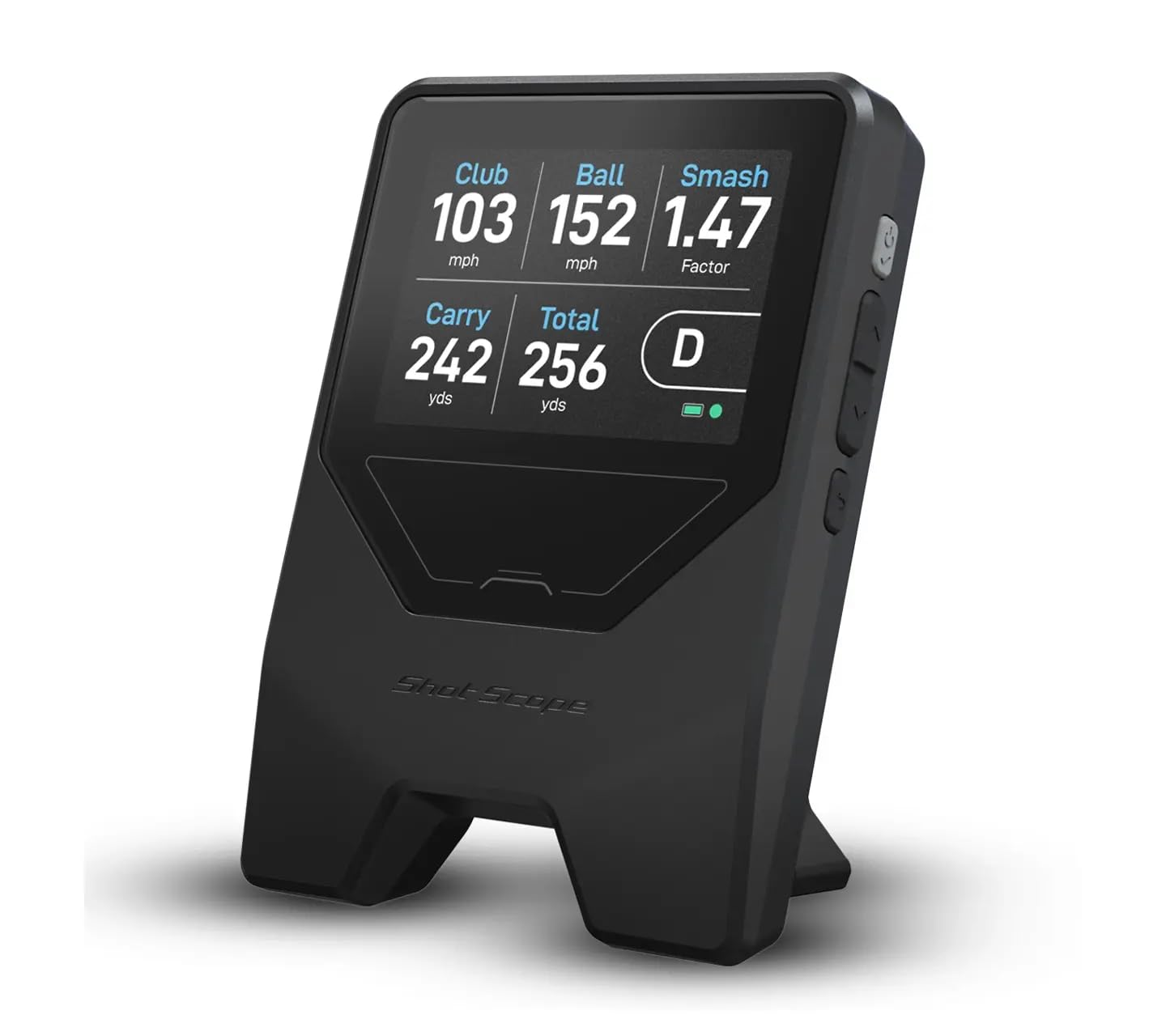
The Shot Scope LM1 earns the top spot because it nails the three numbers that matter most for practice: ball speed, club speed, and smash factor, all measured instantly. It also tracks both carry and total distance, giving you a complete picture of every shot you hit rather than a single rough yardage.
Owners praise its accuracy where it counts most. The review pattern is clear: mid irons and lower are spot on, while the longest drives can drift a little — an acceptable trade-off at this level. The device works indoors and out, includes a lifetime session history in the app, and even has a speed training mode to track your progress over weeks.
It’s the rare budget monitor that ships with a 2-year warranty, a carry case, and a 4.0-star consensus from early buyers. The recurring honest note is that it skips spin data, so you won’t see shot shape differentiation. Pick this one if you want a lightweight, session-tracking radar that prioritizes the core distance metrics.
What Owners Love
- Accurate on mid irons and below
- Speed training mode included
- Lifetime session history in app
- 2-year warranty covers you long-term
What To Know
- No spin data for shot shape
- Long-drive readings can drift slightly
- App directions are sparse out of box
Reach for it if: you value accurate carry and smash data with a real warranty and an app that keeps your history.
Look elsewhere if: you need spin numbers or rely on precision for driver distances.
2. Rapsodo Mobile Launch Monitor Golf Simulator
The iPhone-only radar that pairs every shot with video replay and a ball-flight tracer.
The Rapsodo MLM is the most-reviewed budget monitor here, with buyers consistently confirming it works right from the start and stays accurate to within 5 yards. It reports ball speed, club speed, launch angle, carry distance, and shot shape on every swing, then layers on video replay with an on-screen tracer so you can see exactly what your ball did.
Functionality is the thing buyers mention most — far ahead of everything else — and accuracy is a close second. Setup is genuinely simple: place it 6 to 8 feet behind the ball, angle it down, and swing. The GPS satellite view means you get a range map for each shot, not just a raw number.
The trade-off is clear: it’s iOS only, so Android users are out. And while the base app is free, premium simulator courses and game modes open up via subscription — a point a few owners found frustrating. Crucially, its dimensions are 7.72″L x 4.57″W x 6.85″H, compared to the PRGR HS 130-A at 3.03″L x 1.69″W x 5.63″H.
Why it dominates: video tracer plus accurate carry data is a combination almost nothing else at this price matches, and over 3,000 buyers have verified it. The Rapsodo MLM is the one to buy if you want to see your swing, not just read your numbers.
3. PRGR HS 130-A Portable Golf Launch Monitor
A pocket-sized 4.9-ounce radar with a built-in screen that needs no phone, no app, no subscription ever.
The PRGR HS 130-A flips the script on app-based monitors: it’s a standalone device with a clear sunlight-readable screen that tracks club head speed, ball speed, smash factor, total and carry distance using Doppler radar. No Wi-Fi, no Bluetooth, no app — just AAA batteries and a place to swing.
You can slip this one into your pocket and forget it’s there — it weighs just 4.9 ounces and measures 3.03″L x 1.69″W x 5.63″H, making it the smallest unit here by far. The Rapsodo MLM measures 7.72″L x 4.57″W x 6.85″H. It also stores 500 shots in memory, so you can review your swing history without pulling out your phone.
It’s the personal monitor of choice for 3-time Major Champion Padraig Harrington, and buyers consistently say it beats pricier units in ease, price, and consistency. The honest catch: accuracy is excellent for longer clubs (driver 240-260 yards is spot on) but short irons can run short — a 9-iron maxing at 102 yards versus an actual 130-140. The IP54 rating (meaning it shrugs off dust and water splashes) and a 1/4″ tripod mount make it a durable range companion.
The pure-play choice: if you want a monitor that just works every single time with no app pairing or subscription nagging, this is it. It’s also the top pick for speed training because it measures club head speed without a ball.
4. Voice Caddie SC200Plus Portable Golf Launch Monitor

The 8-ounce swing analyzer that talks to you and lasts up to 20 hours off a single charge.
The Voice Caddie SC200Plus combines an advanced LCD display with voice output, so you get real-time shot feedback by sight and sound. That’s a genuine advantage when you’re mid-swing and don’t want to walk back to the device to read the screen.
Its standout feature is adjustable loft angles, letting you customize settings to simulate various club conditions. An all-new swing speed mode lets you swing in your living room with no ball at all. The remote control included in the box makes range-session practice competitive and easy, and data storage lets you retrieve average distances for each club.
Buyers love it for comparing distances between old and new irons and dialing in approach-play wedges. The recurring note is that it’s less accurate for wedges than for full swings. It’s also not a device for everyone — a few found its accuracy disappointing. But for a casual golfer wanting an easy, voice-guided training aid that runs all day on a charge, the SC200Plus delivers real value.
The pick for feel: the Voice Caddie turns practice into a conversation, with spoken numbers, adjustable lofts, and 20 hours of battery life — best for players who want feedback without looking down.
5. TheStack Radar Launch Monitor
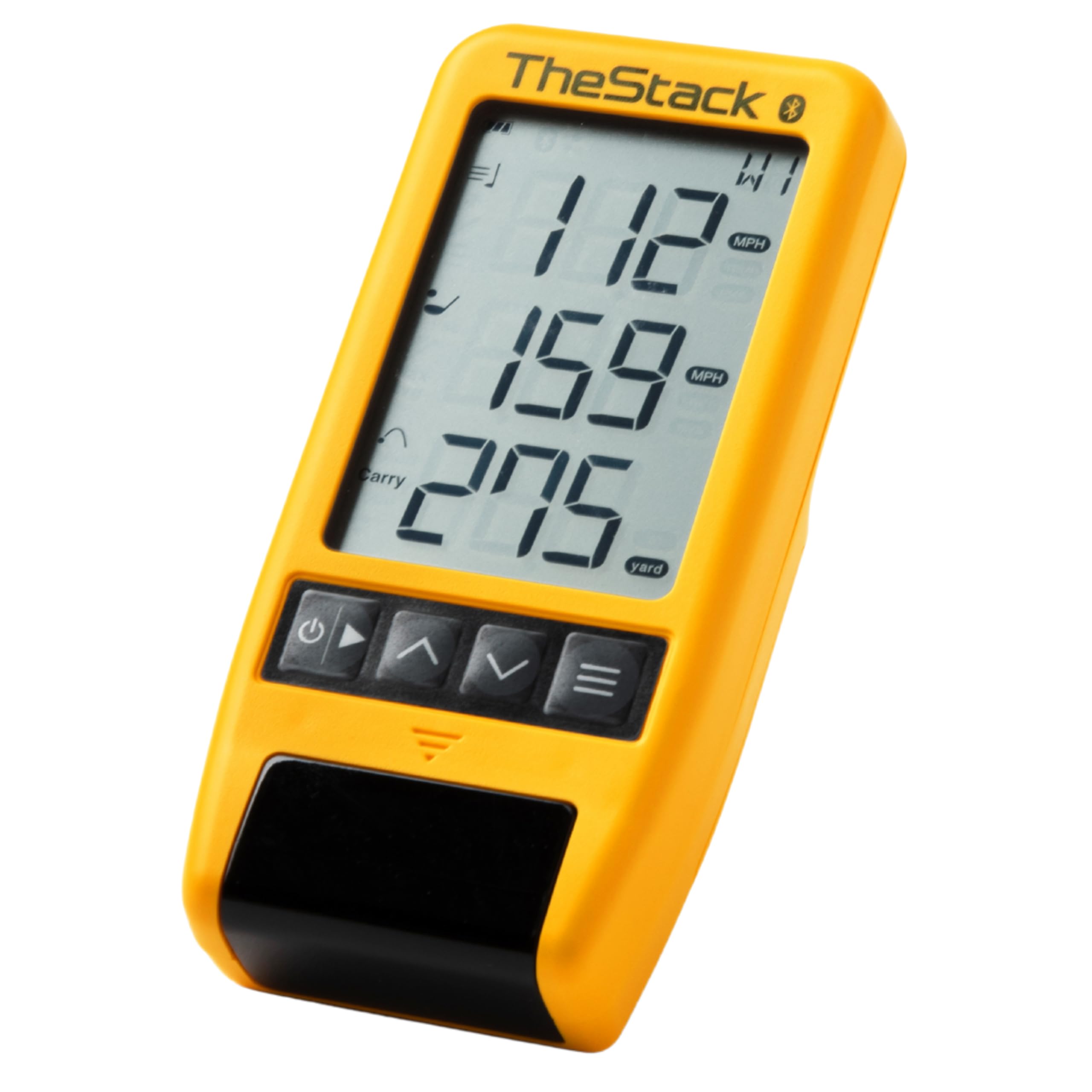
A radar that measures swing and ball speed, designed to pair with a gamified speed-training app.
TheStack Radar measures swing speed and ball speed — not just one or the other — then calculates an estimated carry distance and smash factor. It’s built to connect to TheStack App via Bluetooth and automatically transmit your training speeds to your phone, turning raw numbers into structured progress.
The included Stack Wedging app turns wedge practice into a gamified, skill-specific session exclusive to this radar, and a bonus Stack Putting app delivers guided putting practice. The 1-month free trial to Stack Wedge Mode (iOS only) gives you a taste before committing. It’s trusted by 2022 US Open Champion Matt Fitzpatrick for his speed training and range work.
The proof is in the numbers owners share: one golfer went from 113 mph to 119 mph driver swing speed in a few months, and another gained 4 mph in 10 days. Since it syncs to iOS and Android, it works with whatever phone you carry. It’s the most niche pick here — you’re buying into the Stack System, not a standalone monitor — but if speed is your goal, nothing else structures the grind like this.
Built for one mission: this is a training system first and a launch monitor second, perfect if you’re chasing driver speed gains.
6. Swinora GX-03 Golf Launch Monitor
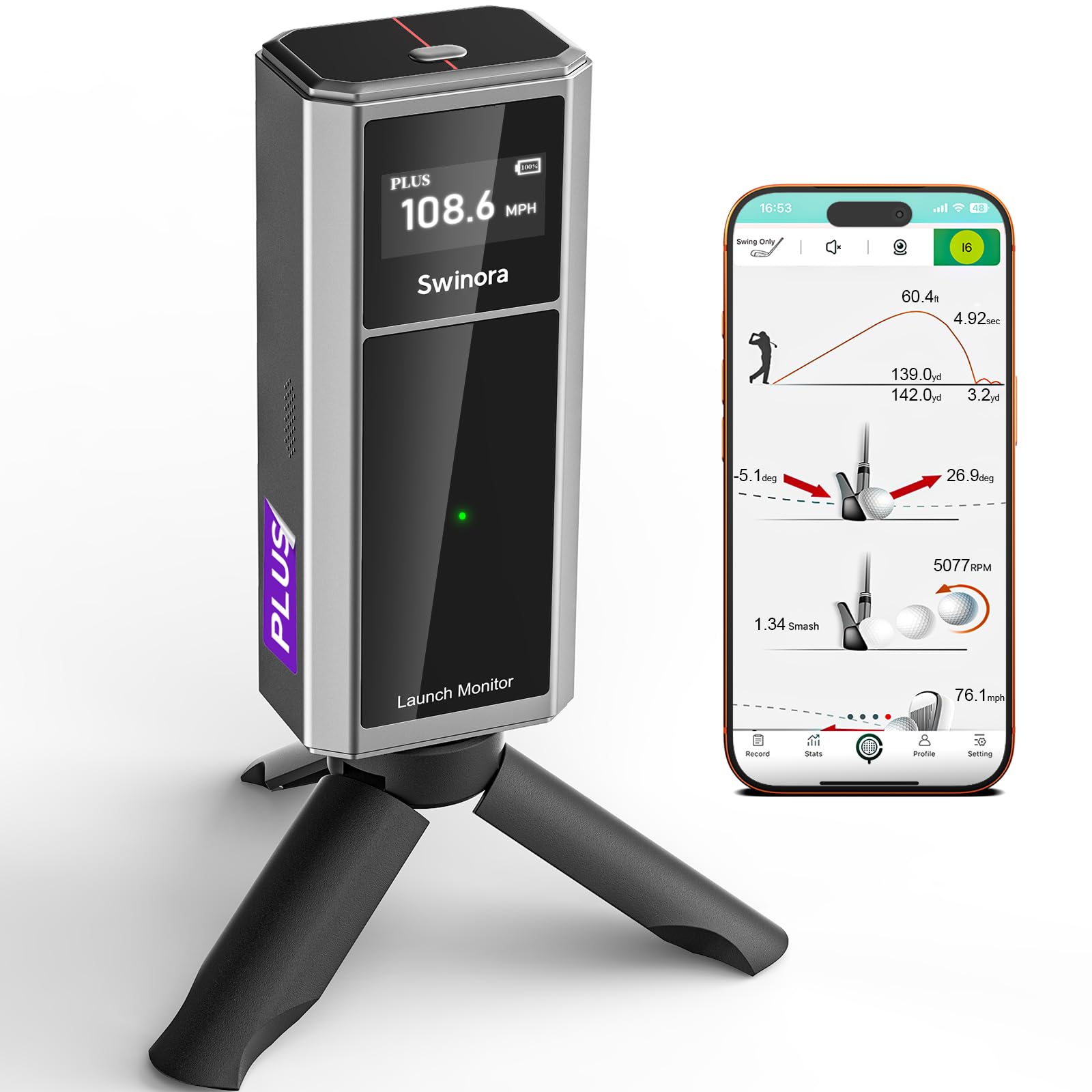
Zero annual fees, 13 tracked metrics, and an OLED display wrapped in a durable metal body.
The Swinora GX-03 is the pick for golfers who want full-featured data without a yearly fee. The app is a one-time download with lifetime use — all 13 metrics fully accessible, no hidden costs ever. Built-in temperature, humidity, and barometric pressure sensors automatically adjust your shot data to real-time conditions.
Buyers report it’s incredibly easy to set up and use, and portability earns almost as many mentions — it slips into a golf practice bag without a second thought. The multi-angle practice views include 45° and 90° perspectives, and a smart alert system detects shanks and missed shots. You can even adjust Distance Compensation from 80% to 120% per club to align with your on-course performance.
The real-world requirement is the one thing to plan for: indoor use needs at least 15 feet of total space, with the device placed exactly 5 feet behind the ball and 10 feet of ball flight. That’s more room than most budget units demand, but it’s what lets the radar capture accurate data. It also includes a tripod, has a 1-year manufacturer warranty, and works with both iOS and Android.
What Wins People Over
- Zero subscription — all 13 metrics free forever
- Auto-adjusts data for weather conditions
- Metal body with OLED display included tripod
Plan Around This
- Needs a full 15 ft of indoor space
- Short-shot accuracy can drift
- App occasionally lags
Choose this when: you have a clear 15-foot indoor lane and want rich metrics with no recurring cost.
Think twice if: your practice space is a cramped garage with less than 15 feet of run-up.
7. Garmin Approach G80 Premium GPS Handheld

A 3.5-inch sunlight-readable touchscreen that packs a full GPS unit and a launch monitor into one slim 4.16-ounce body.
The Garmin G80 is the two-for-one answer for golfers who want a rangefinder and a launch monitor in a single device. The integrated radar tracks club head speed, ball speed, smash factor, swing tempo, and estimated distance, while the GPS side is preloaded with more than 41,000 detailed color course maps worldwide.
The 3.5″ transflective color TFT touchscreen is genuinely readable in bright sun — a point buyers come back to again and again. The rechargeable battery runs up to 15 hours with GPS on, which easily covers multiple rounds. Practice and game modes let you test skills, and the closest-to-pin game adds a social layer to range days.
Buyers consistently rate this launch monitor within ±5 yards and praise the tempo trainer, but opinions split on distance accuracy — some find it extremely accurate, while others report it drifts on ball flight distance yet stays solid on clubhead speed. The magnetic mounting and flimsy clip draw occasional grumbles. The G80 shines as a course-ready combo that also warms you up on the range, not as a pure indoor simulator.
The two-in-one value: the G80 replaces a separate GPS watch and launch monitor, and its bright touchscreen is the best-looking display in this entire list.
8. Izzo Golf Swami Launch Master Pro

The full-swing data suite with a 30 to 420-yard measuring range and integrated live weather sensors.
The Izzo Swami Launch Master Pro is the most complete data package in the budget field. It measures total distance, carry distance, swing speed, ball speed, smash factor, launch angle, attack angle, spin rate, and apex — a full nine-metric suite that rivals monitors costing thousands. It also integrates live weather sensors for temperature, humidity, and altitude to deliver real-world shot analysis in any environment.
Its 30 to 420-yard measuring range means it handles everything from chips to your longest driver without switching modes. Customizable club and loft settings let you fine-tune data by selecting specific club types and lofts for more personalized feedback.
Buyers praise the packaging and presentation — one called it top-notch — and find its numbers close to range-side comparisons, often within 5 to 10 yards. The honest reality is that driver readings are the most reliable; several owners noted irons can run 10 to 15 yards off. Range balls also skew output, since they don’t fly like the premium balls you play on the course. It’s a capable training tool for working on attack angle and swing speed, best for outdoor range practice.
The data-rich option: if you want to work on attack angle and spin with a launch monitor that tracks every club in the bag, the Swami LMP delivers the most complete metrics here.
9. Garmin Approach R10 Portable Launch Monitor (Renewed)
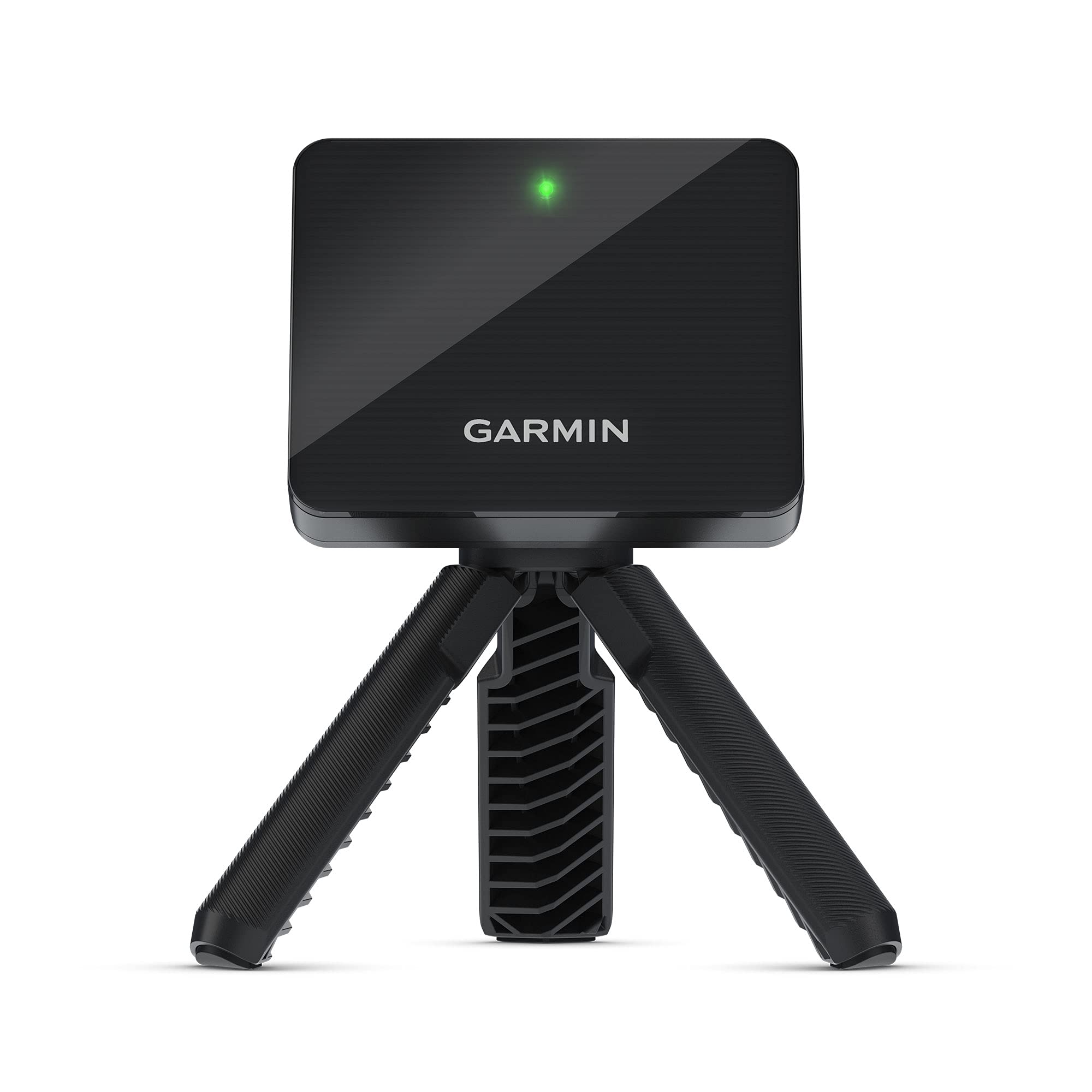
The budget radar that open up a full home simulator with 42,000 courses, virtual rounds, and video swing capture.
The Garmin Approach R10 is the one that transforms your garage or living room into a playing field. Paired with the Garmin Golf app on a compatible smartphone, it tracks club head speed, ball speed, swing tempo, ball spin, launch angle, and more — then records video clips of your swing with the metrics overlaid.
It’s IPX7 waterproof, meaning it shrugs off rain and splashes, and the battery runs up to 10 hours. With an active subscription, you can play virtual rounds on over 42,000 courses worldwide and compete in weekly tournaments with scores posted to a global leaderboard.
Owners rate its accuracy near big-budget units — around 98% versus k monitors — but the recurring theme is that precise setup is the hardest part. Precise straight-line placement and leveling matter enormously; a 2° misalignment can produce a false slice. The renewed unit includes a tripod stand, phone mount, and carry case. It’s the only budget monitor here that pairs with third-party sim software like E6 and Awesome Golf, making it the real gateway to a home simulator experience.
The full-sim upgrade: the R10 brings indoor virtual golf, video capture, and app-driven trackable stats — the most complete package money can buy at this level.
Understanding the Specs
Smash Factor & Ball Speed
Smash factor is the ratio of ball speed to club head speed — a number that tells you how efficiently you transferred energy to the ball. A higher smash factor usually means a better strike. Ball speed is measured in miles per hour and is the single most reliable indicator of how far the ball will travel, regardless of your swing quirks. Monitors that report both let you separate a bad strike from a slow swing.
Doppler Radar & Indoor Space
Doppler radar tracks your club and ball by bouncing radio waves off them as they move. The catch is that radar needs room — the Swinora, for instance, requires a full 15 feet of flight space, while others work in tight spots. Before buying, measure your practice area. If you plan to swing in a garage with less than 10 feet of clearance, look for a unit that supports ball-less swing speed training or has a compact field of view.
FAQ
Do budget launch monitors work indoors with a net?
Can I use a launch monitor without a smartphone app?
Will a budget monitor work with my Android phone?
How accurate are budget launch monitors compared to units?
Do I need a subscription to use these launch monitors?
Can I train swing speed without hitting a ball?
What is smash factor and why should I care?
How long do the batteries last on these devices?
Are launch monitors worthwhile for beginners?
Can I use budget launch monitors at the driving range?
Final Thoughts: The Verdict
For most people, the budget launch monitors winner is the Shot Scope LM1 because it nails the core distance metrics with a real warranty and an app that keeps your session history. If you want to see your swing, grab the Rapsodo MLM. And for a true home simulator experience, the Garmin R10 is the one to reach for.
How We Picked
We do not accept paid placement. Every pick is matched to a real buyer and a real use-case; we do not hands-on test units.
Sources & Methodology
Specifications: manufacturer listings and product documentation. Review insights: verified customer reviews, as of August 2026. Pricing: not shown on this page (it changes often); check the current price via the retailer link.
As an Amazon Associate, FitlyFast earns from qualifying purchases. This does not affect which products we feature.