
Our readers keep the lights on and the weekend projects moving. As an Amazon Associate, I earn from qualifying purchases.
Specs are compiled from manufacturer listings and verified buyer reviews and can change over time — please confirm the key details on the product page before buying.
A budget sleeping pad has one job: keep you off the cold, lumpy ground so you actually wake up rested. The catch is that under, you are choosing between three very different designs — self-inflating foam, foot-pump air, and fold-flat closed-cell — and each one trades comfort against weight, warmth, and pack size differently. This guide sorts those trade-offs so you can pick the right one for your trip without overspending or dragging a useless slab of foam into the backcountry.
I’m Rikta — the founder and writer behind FitlyFast. This guide is built by comparing the manufacturers’ published specifications and the patterns across verified customer reviews, so you get each pick’s real strengths and trade-offs instead of marketing spin.
You want a sleeping pad that won’t wreck your budget or your night’s sleep. This breakdown of the best budget sleeping pad options helps you match the right foam or air design to your sleep style and trip type.
Our Picks at a Glance
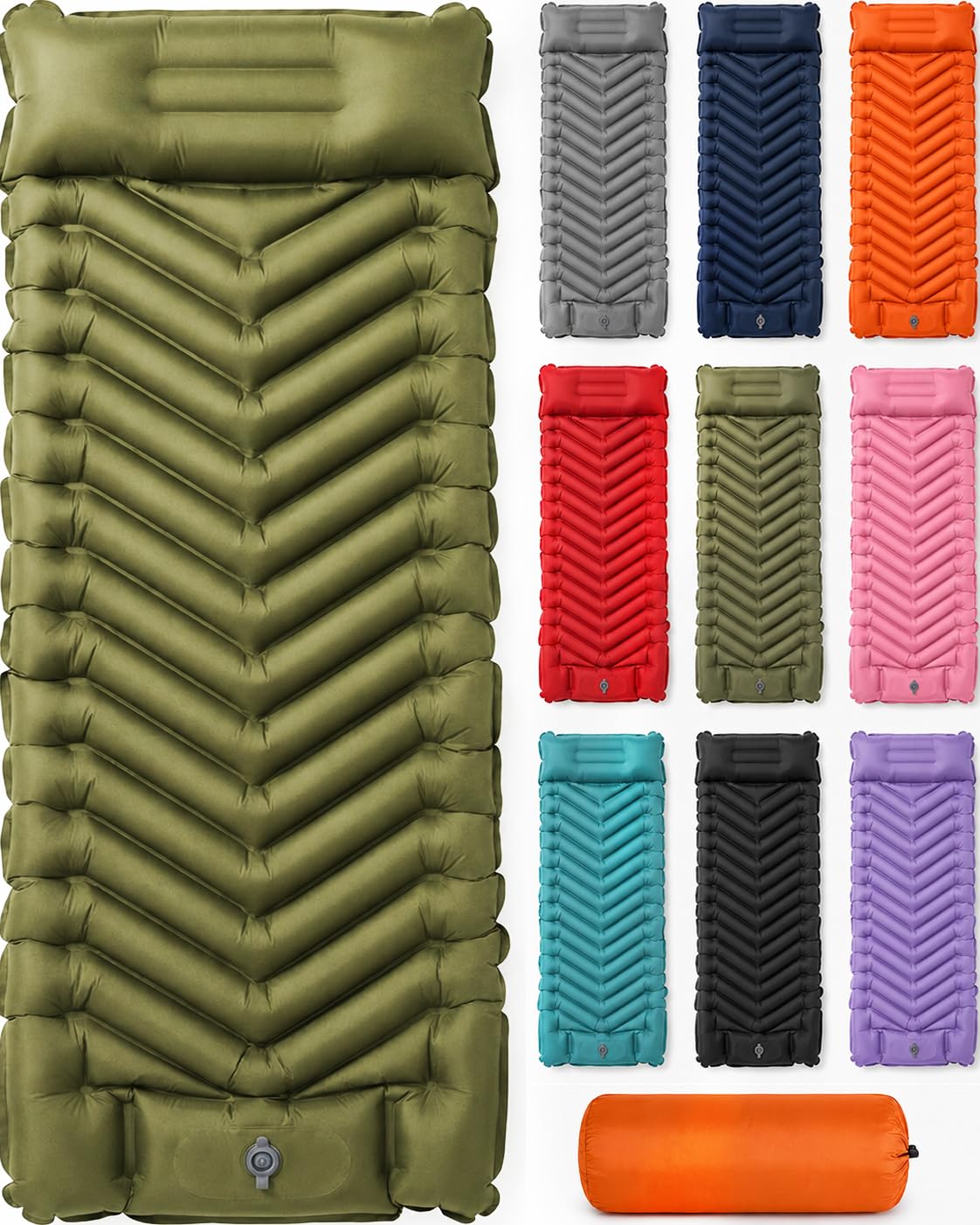


How To Choose The Best Budget Sleeping Pad
Before you buy, answer one question: are you carrying this pad on your back or driving it to a campsite? A 1.5-pound air pad that packs to the size of a water bottle is a joy on the trail, but the same pad can feel flimsy and cold next to a 3-inch foam mattress that rolls up like a bulky sleeping bag but sleeps like a real bed.
Air vs. Foam: Which construction fits your trip?
Air pads inflate small and light, which is why backpackers love them, but they need a pump or your lungs, and a puncture ends your night. Self-inflating foam pads are heavier and bulkier but they keep their shape even if they leak, and they add insulation that pure air lacks. Closed-cell foam pads are the lightest and most bombproof — they can’t pop — but they offer the least cushioning per inch of thickness.
R-Value: How warm will you actually be?
R-value measures how well a pad blocks ground chill.. A simple foam pad with an R-value of 2 suits summer camping.. For three-season camping down to 35°F, choose a pad rated R-3.0 or higher.. For freezing conditions, a pad with an R-value like 9.5 justifies the extra weight and bulk..
Quick Comparison
| Model | Best For | Thickness | Capacity | Weight | Amazon |
|---|---|---|---|---|---|
| MalloMe Self-Inflating★ Best Overall | First-time car campers | 1.5 inches | — | — | Amazon |
| Oramoose 4in UltralightSide-Sleeper Pick | Side sleepers | 4 inches | 400 pounds | 1.8 pounds | Amazon |
| Amazon Basics Foot PumpLightest Air Pad | Weight-conscious hikers | 2.2 inches | 220 pounds | 1.4 pounds | Amazon |
| Overmont 4.7in | Plush car camping | 4.7 inches | 300 pounds | 1.98 pounds | Amazon |
| Myxslop 50D | Kids & side sleepers | 3.7 inches | 450 pounds | 1.5 pounds | Amazon |
| VALEHOWL R3.0 | Three-season backpacking | 2.7 inches | 400 pounds | 1.8 pounds | Amazon |
| HomeMate Memory Foam | Car, RV & guest beds | 3 inches | — | 7.8 pounds | Amazon |
| Wevelel 3.1in Foam | Cold-weather comfort campers | 3.1 inches | 800 pounds | 6.59 pounds | Amazon |
| NEMO Switchback | Ultralight backpackers | — | — | 0.42 kg | Amazon |
In‑Depth Reviews
1. MalloMe Sleeping Pad for Camping
The self-inflating foam mattress that coddles first-time campers without demanding any real gear knowledge.
You get a plush, memory-foam top that contours to your body thanks to a patent-pending V-shape air-cell design, so your hips and shoulders don’t press into the tent floor. Owners consistently call it comfortable, and the 50D polyester shell is built 25% tougher to shrug off punctures and seam stress on rough ground.
The catch is the inflation ritual. The built-in foot pump handles the job, but buyers report you’ll need roughly 30 breaths on the very first use to prime the foam, then give it around 10 hours to fully decompress before the pad reaches its real 1.5-inch thickness. After that break-in, it self-inflates on its own, and it rolls down to a foam-pad size that fits in a backpack.
It’s a forgiving, leak-resistant choice for tent camping, festivals, and travel where you want a bit of cush without fiddling with a separate pump. The trade-off is that 1.5 inches of foam is noticeably thinner than the 4 inches you get on the Oramoose below, so it’s not the pad for anyone who wants maximum loft off the cold ground.
What wins people over
- Plush memory-foam top with a quality feel
- Rolls up compact enough for a backpack
- Foot pump and quick-release valve for easy deflation
The honest limits
- Needs patient initial inflation (~30 breaths + 10h decompress)
- Measures 1.5 inches thick, thinner than advertised
Reach for this if: you’re a first-time camper who wants an easy, leak-resistant foam pad that packs small and sleeps softer than the bare ground.
Look elsewhere if: you need serious warmth or thick loft for cold nights — 1.5 inches won’t lift you far off the chill.
2. Oramoose 4in Ultralight Camping Sleeping Pad
A 4-inch-thick air mattress with a built-in pillow that finally lets side sleepers forget the ground exists.
It’s the thickest budget pad here — a full 4 inches of air lifting your hips and shoulders clear of hard ground, which is 82% more loft than the 2.2-inch Amazon Basics pad below. That extra height matters most for side sleepers, and the support holds up to 400 pounds, comfortably covering larger body types and even a dog that climbs on.
Inflation is a 30-second foot-pump job — owners say about 2 minutes of stepping fills it fully — and a no-leak valve keeps air locked in for 24 hours, so you won’t be refilling at 2 a.m. The 40D nylon bottom shrugs off branches, rocks, and gravel, and the whole thing folds down to a 9.4 x 4.3-inch bundle that slips into a pack side pocket.
What makes it special is the connector snaps on the sides, letting you link two pads into a double bed for couples or family trips. The honest gripe from a few owners is a slight evening comfort dip, solved by shifting onto their back, so it’s not a flawless all-night mattress for every sleeper.
Where it shines
- 4 inches of air keeps hips and shoulders suspended
- Foot pump fills it in about 2 minutes with no gear
- Side snaps connect pads into a double bed
- Packs down to water-bottle size at 1.8 pounds
Worth knowing
- Some side sleepers shift to their back after an evening of pressure
- At 79 inches long, it’s made for taller frames — check your tent’s floor space
Best for: side sleepers and bigger bodies who want genuine 4-inch loft without paying air-pad premium prices.
Think twice if: you’re an ultralight purist counting every ounce — 1.8 pounds is fine, but this is more pad than a fast-and-light hiker needs.
3. Amazon Basics Camping Sleeping Pad
The featherweight air pad that disappears into your pack at just 1.4 pounds — the lightest in this lineup.
The built-in foot pump uses what Amazon calls Insta-Pump Technology to inflate it in under 60 seconds, and long-distance backpackers report it takes only about 30 pushes to fill — no mouth-blowing, no extra gear, no crinkling noise when you shift at night.
That 1.4-pound weight beats the 1.8-pound Oramoose above by a solid margin, making this the smarter pick when every ounce counts on a multi-day trail. It packs down to a tidy 12 x 4 x 4-inch bundle with the included stuff sack, and the 190T polyester shell shrugs off moisture from damp ground.
The recurring owner gripe is the built-in pump itself — a handful of units arrive with a nonfunctional pump, and while the pad still inflates easily by mouth, it’s a real quality-control lottery. It’s worth buying if you can accept that risk for the weight savings, since comfort and air retention earn steady praise.
Why hikers grab it
- Lightest pick here at 1.4 pounds
- ~30 foot-pump pushes fills it, no crinkling noise
- Water-resistant 190T polyester shell
- Packs down to 12 x 4 x 4 inches
Before you commit
- Some units ship with a built-in pump that doesn’t work
- 22.4-inch width is narrow for broad-shouldered sleepers
Choose it for: backpackers and bikepackers who rank low weight above all else and don’t mind mouth-inflating if the pump acts up.
skip it if: you want to connect pads or need wide, plush loft for car camping — this is a trail tool, not a basecamp mattress.
4. Overmont Ultralight Camping Mattress

The thickest air pad of the budget bunch, stacking 4.7 inches of insulated loft with a 300-pound capacity.
At 75 x 27.5 x 4.7 inches, it out-thicks even the Oramoose above, and the ergonomic wave-shaped cells support your neck, back, and hips whether you sleep on your back, side, or stomach. That extra loft isolates you from rocks and uneven ground, and the integrated pillow means one less thing to pack.
Inflation takes 30–60 seconds via the built-in foot pump, and a dual-layer anti-leak valve locks air in overnight. The 75D thickened pongee fabric with multi-layer TPU is the most puncture-resistant shell in this price range, handling rugged terrain and supporting up to 300 pounds, with a waterproof surface you can wipe clean.
Owners praise its durability across years of use — one has been happy after 2 years — but the recurring note is that the fabric is slippery, so a sheet or cover helps stop sliding. A few units also arrive measuring under the advertised 4.7 inches, so the thickness is a bit of a lottery.
What stands out
- 4.7 inches of thick loft isolates from cold ground
- Tear-resistant 75D pongee with TPU coating
- Built-in pillow saves pack space
- 30–60 second foot-pump inflation
Watch for
- Slippery fabric needs a sheet to stay put
- Some units measure under the advertised 4.7 inches
Grab this for: car campers and weekend tent sleepers who want near-mattress plushness without stepping up to a heavy foam pad.
Consider the alternative if: you’re a strict ultralight hiker — 1.98 pounds is fine, but the bulk favors vehicle-based trips.
5. Myxslop Ultralight 50D Camping Sleeping Pad
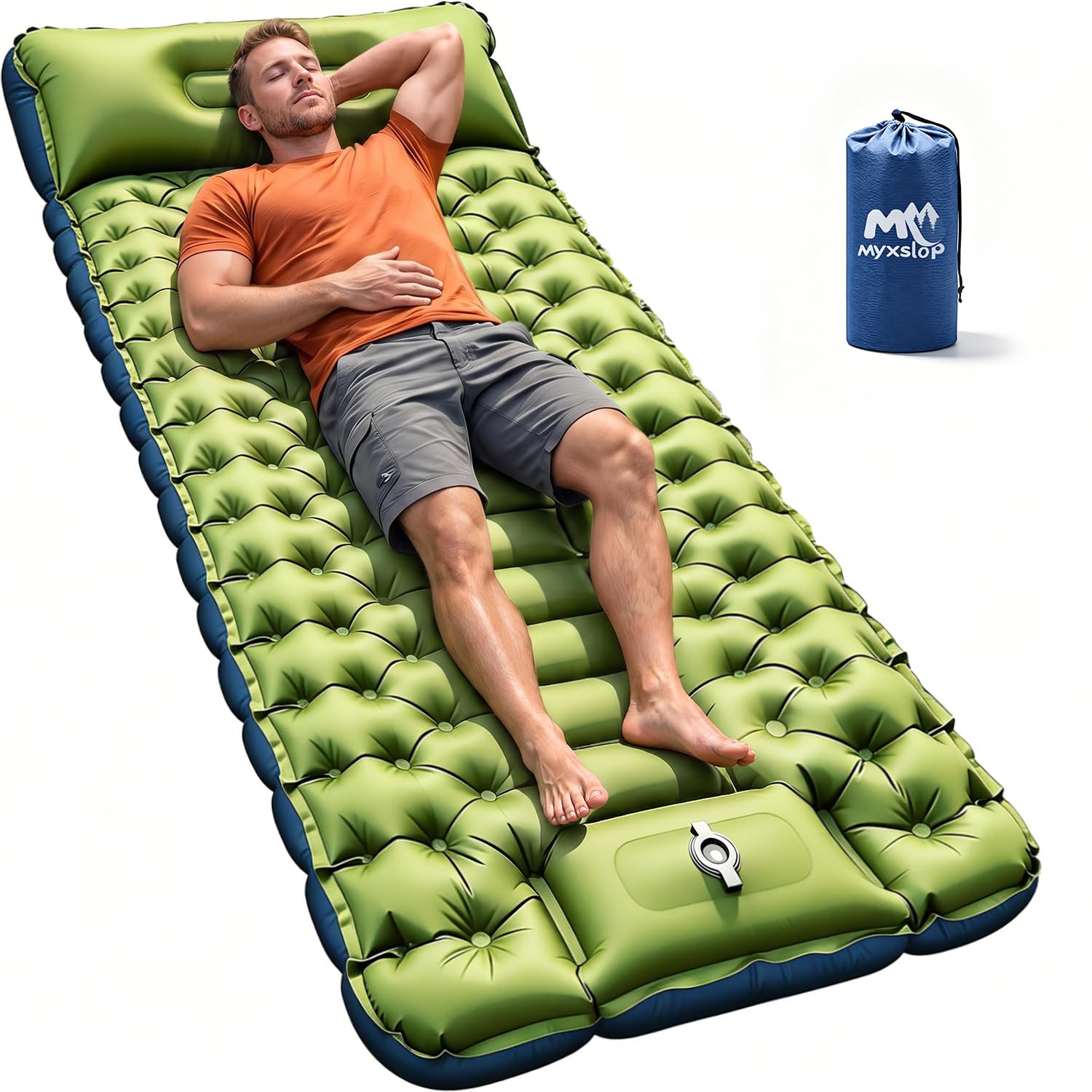
A 3.7-inch honeycomb air pad that a kid can set up solo, rated to hold up to 450 pounds.
It’s a hybrid design — 3.7 inches of anti-bottoming air chambers arranged in a honeycomb pattern to keep your spine aligned, plus an integrated ergonomic neck pillow. The 50D nylon shell with a reinforced TPU coating is a step up in toughness from the 40D fabric on cheaper pads, standing up to sharp rocks and roots.
Parents who bought four of these for a kids’ camping trip report the children slept through the night and set up their own sleeping zones — it’s that simple. The tail-pump design keeps the inflation valve away from your head, so the pillow area stays smooth and uninterrupted.
It weighs just 1.5 pounds and folds to a compact 10 x 4 inches, and side-snap fasteners link two mats into a double bed. The fair caveat from a few owners: at 3.7 inches it’s not “extra thick,” so very heavy sleepers might feel a hint of the ground beneath the honeycomb cells.
Why families love it
- Simple enough for an 8-year-old to set up
- Honeycomb cells keep spine aligned for side sleepers
- 50D nylon + TPU resists punctures and moisture
- Snaps connect pads into a double bed
Know the limits
- Lighter sleepers may feel bottoming on very hard ground
- 3.7 inches is good, but not the thickest option here
Best suited for: family tent trips and weekend backpackers who want a tough, connectable pad that’s genuinely easy for anyone to inflate.
Pass on it if: you need max winter insulation — there’s no R-value listed, so this is a three-season mat at best.
6. VALEHOWL R3.0 Ultralight Camping Sleeping Pad
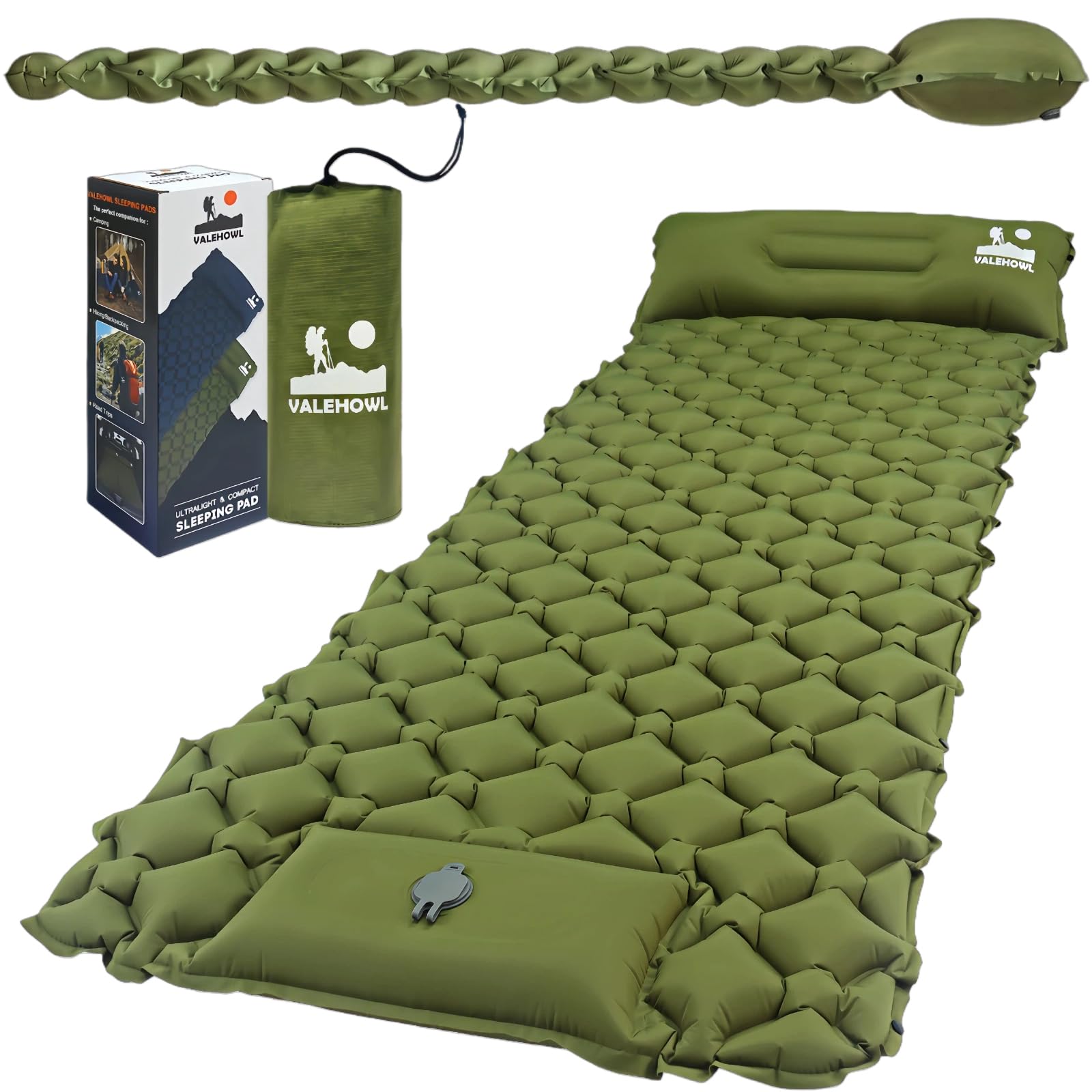
The only budget pad here with a real R-3.0 insulation rating, built for true three-season ground chill.
Most sub- air pads don’t bother with an R-value, but this one carries a 3.0 rating, meaning it blocks ground chill down to about 35°F — enough for spring-to-fall camping. Owners have tested it in a tent at 0°C with rain and hail for 20 days and slept comfortably using a thick liner.
The 2.7-inch honeycomb air chamber evenly distributes body pressure, and the pad measures 75 x 25 inches, fitting users up to 6.3 feet tall and 400 pounds. A 40-second foot pump inflates it with a one-way valve to prevent backflow, and side snap buttons let you connect pads into a double setup.
The integrated pillow draws mixed reviews — some find it awkwardly positioned and swap in their own. It weighs 1.8 pounds and packs to 10 x 5 inches, and while air retention is the most-criticized aspect, most of the complaints trace back to valves not being fully sealed rather than actual leaks.
Why it stands apart
- R-3.0 insulation blocks ground chill to ~35°F
- 40-second foot-pump inflation, no tools needed
- 40D nylon + TPU is 100% waterproof and airtight
- Fits up to 6.3 feet tall and 400 pounds
Fair warnings
- Pillow position is awkward for some sleepers
- Valves must be clamped shut firmly or you’ll lose air
Reach for it if: you camp shoulder-season and refuse to wake up cold — this is the budget pad with genuine insulation math behind it.
Look past it if: you’re a strict stomach sleeper who finds the built-in pillow more nuisance than help.
7. HomeMate Memory Foam Camping Mattress Pad
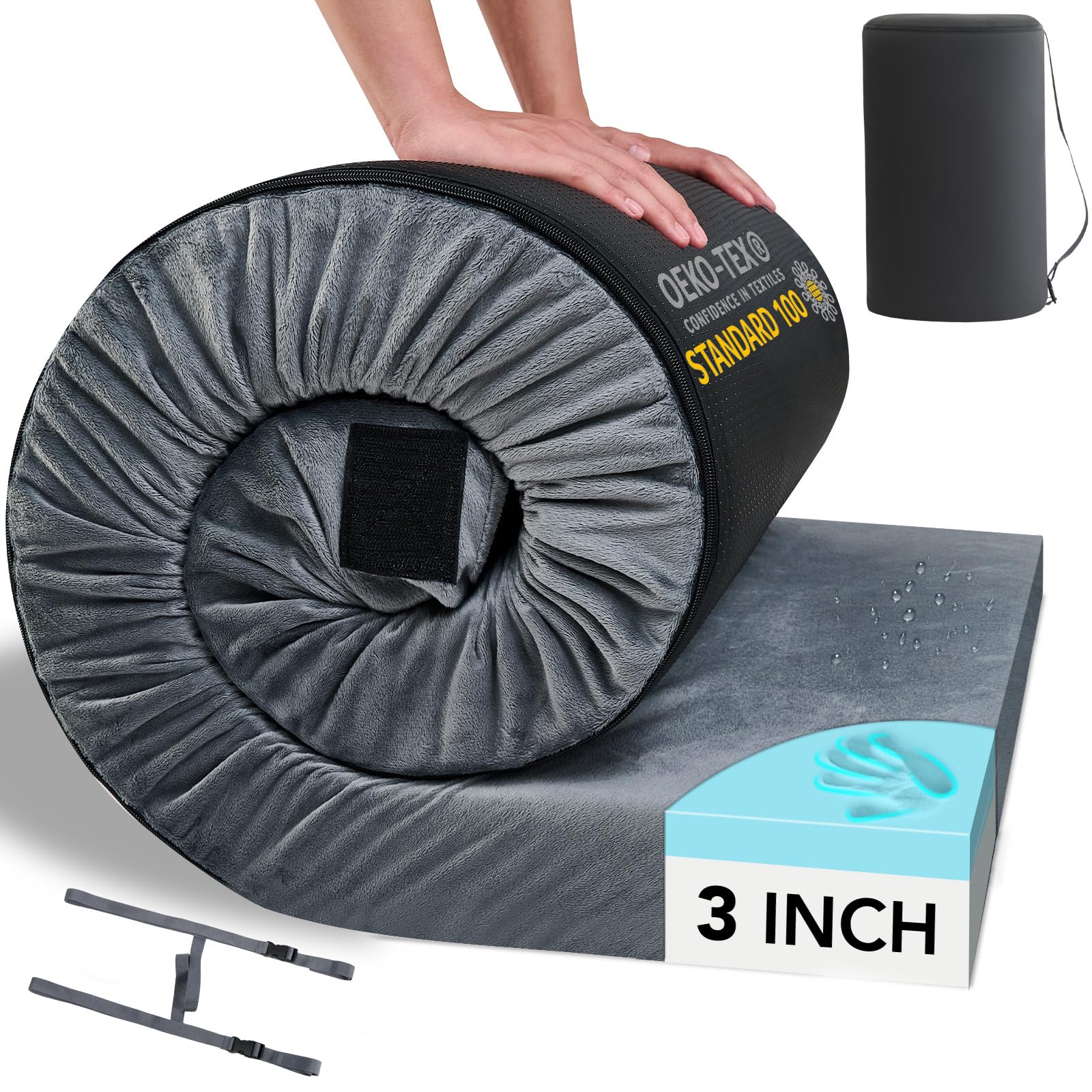
A 3-inch memory foam mattress that turns your camp cot into something dangerously close to a real bed.
This isn’t an air pad at all — it’s a roll-up foam mattress combining memory foam and high-density support foam for shock absorption that reduces travel fatigue.. It’s measured at 72 x 24 x 3 inches in the cot size, and owners use it for everything from tent floors to the back of a truck bed and even as a floor bed for a senior pet.
The quality feedback is strong — The memory foam relieves joint pressure for side sleepers and even helped one husband recovering from elbow and ankle surgery sleep better on a couch.. It’s waterproof, anti-slip, and temperature-regulating, with a removable, washable cover and a travel bag for storage.
The honest trade-off is bulk and weight: at 7.8 pounds it’s the heaviest pick here, and owners mention the rolled-up size is significant. That’s fine for car camping, RVs, or guest rooms — but it’s not going on your back. Some sizes also run a bit small, so measure your cot or tent spot first.
What makes it comfy
- 3 inches of true memory foam — no inflation needed
- Waterproof, anti-slip, and washable cover
- Relieves hip and side pressure on cots and floors
- Rolls up with straps and a storage sack
Consider first
- 7.8 pounds is car-camp weight, not backpack weight
- Rolled size is bulky — a vacuum bag helps shrink it
Pick this for: car campers, RV owners, and anyone who wants guaranteed plush comfort without fighting with pumps or valves.
pass on it if: you’re hiking to your campsite — the bulk and weight make it a vehicle-only luxury.
8. Wevelel Memory Sleeping Pad

A 3.1-inch foam-and-air hybrid with an R-value of 9.5 — the warmest, strongest pad on this entire list.
That R-9.5 insulation rating is genuinely exceptional for a sub- pad, making it warm in winter and cool in summer, and it’s backed by an 800-pound static load capacity tested for 24 hours without leakage. The high-tech memory foam uses a 50D density — far denser than the 19D foam found on other pads — for even weight distribution and reduced pressure points.
It measures 77 x 26.98 x 3.1 inches inflated, and the self-inflating design fills in about 30 seconds: open three valves, let it expand for 10 seconds, close the back two, and step on the front valve for 20 seconds. The upgraded dual-use valve makes deflation and storage simpler, and the 50D stretch knit fabric is quiet, breathable, and skin-friendly.
Customers note waking without back pain even on hard ground or cots., and one used it for at least ten nights of camping with no air loss. The fair caveat: at 6.59 pounds it’s car-camp weight, and re-squeezing it into the storage bag after deflating takes a bit of patience.
What makes it special
- R-value of 9.5 for genuine four-season warmth
- 800-pound capacity is the strongest here
- Quiet, breathable 50D knit fabric
- Self-inflates in about 30 seconds
Fair trade-offs
- 6.59 pounds is heavy for backpacking
- Folding it back into the bag takes some effort
Choose it for: winter campers and anyone who sleeps cold — this is the only budget pad that honestly handles freezing ground with an R-9.5 rating.
Pass if: you’re an ultralight hiker — the warmth comes with serious weight and bulk you’ll feel on every climb.
9. NEMO Equipment Switchback Foam Sleeping Pad
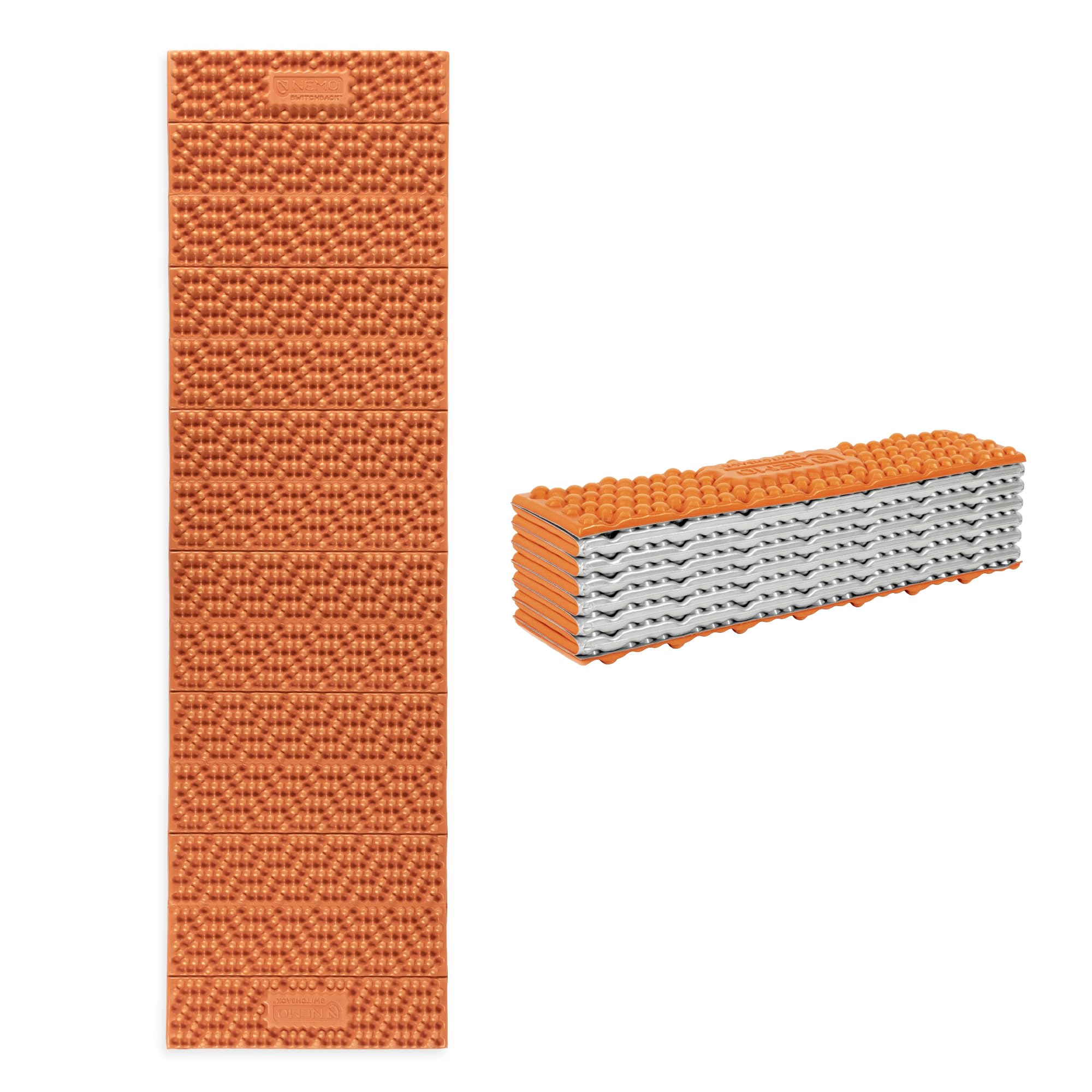
The fold-flat foam classic that can’t pop, can’t leak, and backs every purchase with a lifetime warranty.
This is the antithesis of the air pads above — a closed-cell foam pad that needs zero inflation, weighs just 0.42 kg, and folds into a compact 20 x 5 x 5.5-inch bundle. The hexagonal nesting pattern creates taller, wider nodes for noticeably more plushness than a flat foam slab, and it’s the most durable thing in this lineup.
The R-value sits at 2, so it’s a summer-to-shoulder-season pad, but owners pair it with a sleeping bag or an inflatable pad underneath for winter trips down to the teens. The metallized thermal reflective film bounces heat back at your body, and one owner slept on a concrete floor as a side sleeper with no pressure points and stayed warm.
It doubles as a sitting pad or gear mat, and buyers have cut it down to torso length and repurposed the panels. The fair trade-off: it’s not as cushioned as an inflatable pad, and it takes up more pack space strapped to the outside — but it’s also the only pad here that physically cannot deflate on you at 2 a.m.
Why it endures
- 0.42 kg — lightest pad in this guide, no pump needed
- Can’t pop, leak, or deflate — ever
- Thermal reflective film adds warmth at R-2
- Lifetime warranty against workmanship defects
Know before you buy
- Less cushioned than air pads — it’s firm, not plush
- Folded size takes up real pack space
- R-2 rating is three-season, not winter
Reach for this if: you’re an ultralight backpacker or mountaineer who wants bombproof reliability and zero setup time.
Look elsewhere if: you’re a side sleeper or car camper wanting plush comfort — the NEMO is firm by design, and the Overmont or HomeMate will sleep softer.
Understanding the Specs
R-Value (Insulation)
R-value indicates how effectively a pad blocks cold from the ground.. Higher numbers mean more warmth: an R-2 pad is fine for summer nights, an R-3.0 handles true three-season camping down to around freezing, and a pad rated R-9.5 like the Wevelel can handle genuine winter conditions. Air pads generally insulate worse than foam pads at the same thickness, which is why the thickest air pad can still leave you cold on a frosty night.
Thickness & Capacity
Thickness decides how far your hips and shoulders sit off the ground — critical for side sleepers who feel pressure points most acutely. A 4-inch pad like the Oramoose lifts you clear of most lumps, while a 1.5-inch foam pad just softens the ground. Capacity tells you the maximum weight the pad supports; the Wevelel handles 800 pounds, while the Amazon Basics maxes out at 220 pounds. Match the capacity to your body type plus a margin.
FAQ
What is the difference between a self-inflating pad and an air pad?
What R-value do I need for three-season camping?
Is a foot-pump sleeping pad worth it?
Will a budget sleeping pad hold a side sleeper?
How long does a budget sleeping pad last?
Which is warmer — foam or air sleeping pads?
Can I connect two sleeping pads to make a double?
How do I choose between a 1.5-pound and a 7.8-pound pad?
What is a closed-cell foam sleeping pad?
Why does my new foam pad need time to expand?
Final Thoughts: The Verdict
If you want one dependable pick, the budget sleeping pad winner is the MalloMe because it delivers genuine memory-foam comfort and self-inflating ease at an entry-level price that forgives first-time mistakes. If you’re a side sleeper who wants maximum 4-inch loft, grab the Oramoose. And for true cold-weather camping, the Wevelel with its R-9.5 rating is the one to reach for — the crowd favorite among cold sleepers, backed by a strong 4.4-star rating across hundreds of owners.
How We Picked
We do not accept paid placement. Every pick is matched to a real buyer and a real use-case; we do not hands-on test units.
Sources & Methodology
Specifications: manufacturer listings and product documentation. Review insights: verified customer reviews, as of August 2026. Pricing: not shown on this page (it changes often); check the current price via the retailer link.
As an Amazon Associate, FitlyFast earns from qualifying purchases. This does not affect which products we feature.