
Our readers keep the lights on and the weekend projects moving. As an Amazon Associate, I earn from qualifying purchases.
Specs are compiled from manufacturer listings and verified buyer reviews and can change over time — please confirm the key details on the product page before buying.
Building a great-sounding system on a budget usually means making hard choices about size, power, and convenience. This guide sorts through the options to find the loudspeakers that genuinely deliver clear, engaging sound for your desk, living room, or home studio, and it explains exactly what to look for so you don’t waste a penny. You’ll find powered sets that work straight from the start and passive companions for a system you already own, all picked for real-world value.
I’m Rikta — the founder and writer behind FitlyFast. This guide is built by comparing the manufacturers’ published specifications and the patterns across verified customer reviews, so you get each pick’s real strengths and trade-offs instead of marketing spin.
Here are the strongest options for anyone searching for budget loudspeakers that actually sound good, connect easily, and fill a small room without emptying a wallet.
Our Picks at a Glance


How To Choose The Best Budget Loudspeakers
Before you click “buy,” you have to settle one big question: do you want speakers with an amplifier built in, or speakers that need one from your receiver? That single choice shapes everything else.
The Powered vs. Passive Decision Comes First
Powered (or active) speakers have their own amplifier inside, so you can plug in a phone, TV, or computer and get sound immediately. Passive speakers need an external amplifier or receiver to drive them; you get more flexibility to upgrade components later, but you have to buy more gear to make them play.
Match the Driver Size to Your Room
Driver size is the easiest shortcut to predicting bass. A 3-inch woofer is fine for a near-field desktop setup where you sit close. A 5-inch or 6.5-inch woofer moves more air and will fill a living room much more convincingly. For floorstanding towers, two 6.5-inch woofers are common for that extra room-filling punch.
Check the Inputs Before You Commit
Look at what you’ll actually connect. Bluetooth is essential for streaming from a phone. RCA inputs are standard for turntables. USB-C or a 3.5mm AUX input covers computers and laptops. Missing one connection type can mean buying adapters or a whole new speaker later, so make sure the back panel matches your gear.
Quick Comparison
| Model | Best For | Type | Woofer Size | Connectivity | Amazon |
|---|---|---|---|---|---|
| Ortizan C7★ Best Overall | Desk & studio | Powered | 3.5 in | BT 5.3, USB-C, RCA | Amazon |
| Audio Express Koe’ B102Amplifier’s Best Friend | Amp owners | Passive | 5.25 in | Wired | Amazon |
| NEUMI BS5Warmest Tones | Stereo music | Passive | 5 in | Wired | Amazon |
| PreSonus Eris Accent | Turntables | Powered | 4 in | USB-C, RCA | Amazon |
| Edifier R1280T | Everyday TV & music | Powered | 4 in | Aux (x2) | Amazon |
| Micca RB42 | Near-audiophile | Passive | 4 in | Wired | Amazon |
| Dayton Audio T65 | Big rooms | Passive | 6.5 in (x2) | Wired | Amazon |
| Sony SS-CS5M2 | Hi-Res detail | Passive | 5.12 in | Wired | Amazon |
| Klipsch R-610F | Home theater | Passive | 6.5 in (x2) | Wired | Amazon |
In‑Depth Reviews
1. Ortizan C7 Powered Studio Monitors
A tiny desktop studio pair that brings near-flat response without the studio price tag.
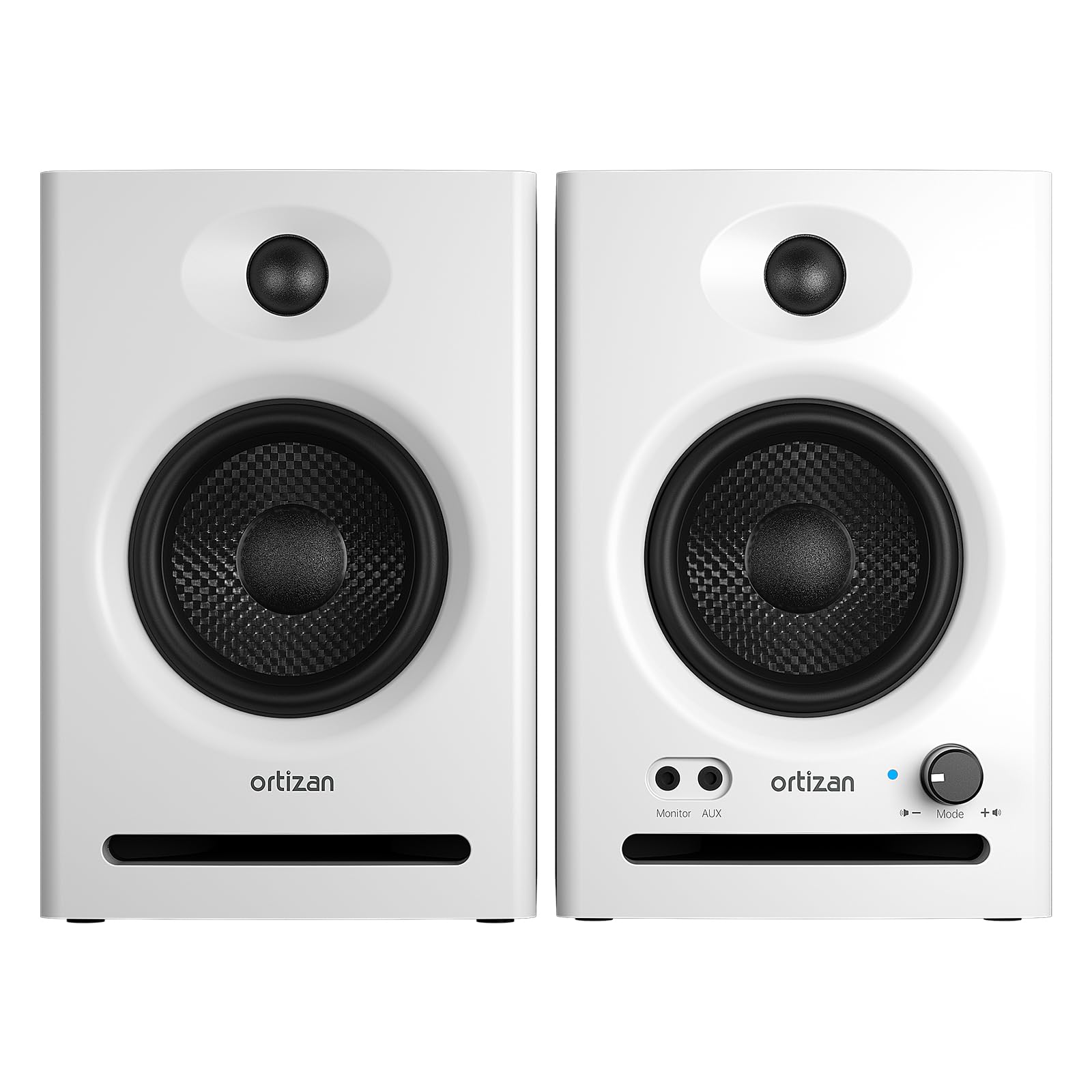
You get a true all-in-one for near-field listening (sitting close at a desk) because these speakers pack serious connectivity into a small frame. The 3.5-inch carbon fiber woofer (the driver that handles low tones) and 0.75-inch silk dome tweeter (the driver for high tones) deliver near-flat response, meaning sound stays accurate without boosting any frequency. Buyers report precise treble and midrange, plus bass that reaches down to about 45Hz — deep enough for kick drums and basslines, and impressive for the size. That woofer is a full 50% smaller than the one in the Audio Express Koe’ B102 below, yet these are built for close-up listening where accuracy matters most.
You can plug in almost anything without swapping cables. Bluetooth 5.3 (the latest wireless standard) pairs in about 2 seconds, so you can stream from your phone instantly. A 6.35mm TRS balanced input (a pro-audio jack) connects to mixing consoles, and a Type-C port feeds the built-in 24-bit DAC (digital-to-analog converter), giving you a lossless digital path straight from your laptop — so your audio stays clean from source to speaker. That makes it ideal for creators who want to switch from a guitar interface to a phone stream without touching a single cable.
The honest trade-off for that versatility: the volume dial feels choppy as you turn it, and the low bass is lean, so electronic music fans will want a subwoofer. There’s no grille to protect the drivers, and a faint hiss can appear at idle, but the clarity, the Bluetooth reliability, and the build quality make this the crowd favorite for a reason.
The Pro Side
- Near-flat studio response with precise treble and mids
- Multiple inputs: Bluetooth 5.3, TRS, USB-C, and two AUX
- Durable and compact enough for any desk
- Built-in 24-bit DAC boosts digital sound quality
The Trade-Offs
- Weak low bass; a subwoofer helps for bass-heavy music
- Choppy volume dial feels less refined
- No grille cover to protect the drivers
Ideal for: desktop creators, gamers, and anyone who wants one speaker that accepts nearly every input type.
Think twice if: you need thumping low-end for bass-heavy genres, or you dislike a faint background hiss at idle.
2. Audio Express Koe’ B102 Passive Bookshelf Speakers
The budget passive pair that has owners saying they didn’t need to spend hundreds more.
If you already own an amplifier, this is the speaker that makes that investment sing, anchored by a 5.25-inch driver that’s a full 50% larger than the Ortizan C7’s 3.5-inch woofer above. That extra cone area translates to noticeably deeper and more physical bass, which is exactly why owners mention being “blown away” and glad they didn’t spend extra on a bigger brand name.
What wins people over is the sound quality — it’s the most-discussed aspect by far, with over 30 owners singling it out. They describe crisp highs, warm mids, tight bass, and no distortion even when pushed, with a soundstage that some say outperforms a Klipsch R51M at a fraction of the cost. The 100-watt handling means a vintage receiver can drive them without breaking a sweat.
Each pair ships with its own SPL/Frequency Response chart, proof of individual testing for matched left and right channels. The catch is the size: several owners found them compact, and they face stiff competition from the NEUMI BS5 below, which fills a larger room with a warmer tone. These demand an amplifier, so factor that into your budget if you don’t have one.
What wins you over: the sound-per-dollar ratio is exceptional, with individual testing that ensures balanced output.
One honest note: they need an amp or receiver to play, and the compact size may surprise you if you expected a larger cabinet.
3. NEUMI BS5 Passive Bookshelf Speakers
The passive pair that fills a 16×18-foot room with warm, easygoing sound.
Built on a 5-inch fiberglass woofer with a rubber surround and a 1-inch silk dome tweeter, the BS5 is tuned for a smooth, relaxed listen rather than analytical sharpness. Owners describe a warm sound with excellent mids and tweeter, and the ability to fill a 16×18-foot room on modest power — a flexibility that makes it feel more like a full-size speaker than its bookshelf footprint suggests.
The defining feature here is the magnetic grill system, which snaps on and off cleanly with no unsightly mounting holes. A front-ported design means you can place these right up against a wall without killing the bass, which is rare at this level and a practical win for tight living room layouts.
Where it sits against the other picks: it has a larger driver than the Audio Express Koe’ B102’s 5.25-inch unit, and that extra surface area shows in a warmer, more relaxed midrange. The bass is light — owners note a bass boost helps — and the cabinet can ring slightly at high volume, so a subwoofer is a common pairing for music with real low-end.
The big win: warm, non-fatiguing sound that gets louder than you’d expect and mounts flush against a wall.
The limitation: bass is lacking on its own; you’ll want a subwoofer for full-range music.
4. PreSonus Eris Accent Powered Bookshelf Speakers
The powered set that makes hooking up a turntable a five-minute job.
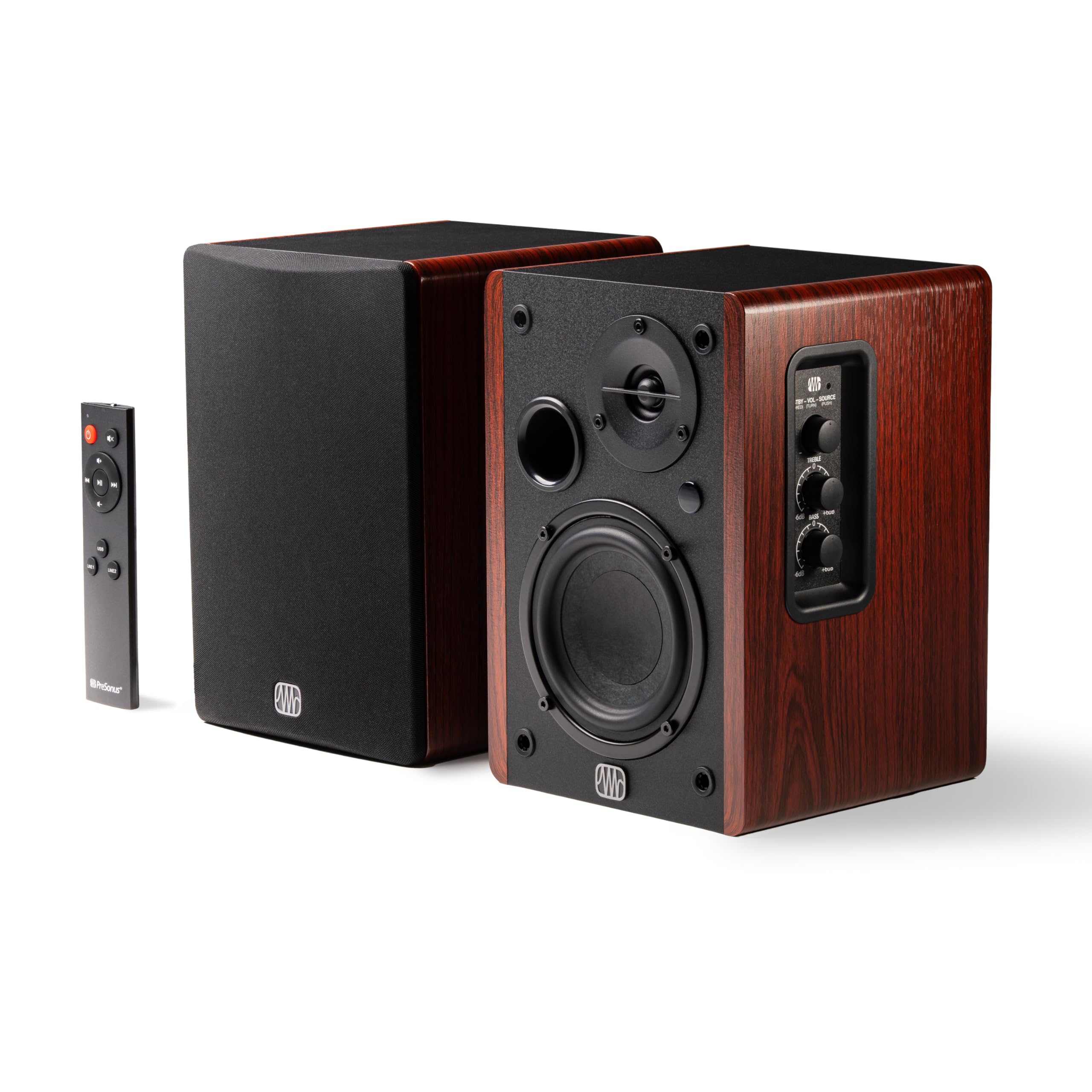
With a 4-inch woofer and a ½-inch silk dome tweeter delivering 50W total (25W per channel), the Eris Accent is built around one job: making your vinyl collection sound crisp. It has a 55Hz–20kHz frequency range and 85 dB peak SPL, and customers note an easy setup with a standard RCA cable to an Audio-Technica turntable — no Bluetooth, no fuss.
The standout convenience is the physical controls: you get treble and bass knobs on the front so you can dial in your sound without opening an app. A remote control adjusts volume and playback from across the room, and a dedicated sub out lets you expand with a subwoofer later without changing speakers. The sound is described as crisp and deep, with enough adjustability to tame the bass-heavy default tone.
The trade-off? It lacks Bluetooth entirely, so it’s a wired-only affair. The default bass is strong from the start, and while the EQ knobs fix it quickly, it’s something to know. For a dedicated turntable setup where you’re not streaming from a phone, this is the smart pick.
Owner Favorites
- Front-panel treble and bass knobs for easy tuning
- Remote control included
- RCA sub-out for future expansion
- Easy 5-minute setup with a turntable
Before You Buy
- No Bluetooth — wired connections only
- Bass-heavy default tone needs a quick EQ adjustment
Reach for it if: you’ve got a turntable or CD player and want powered speakers with manual EQ control.
Look elsewhere if: you plan to stream from your phone wirelessly, since there’s no Bluetooth here.
5. Edifier R1280T Powered Bookshelf Speakers

The no-fuss powered pair that pairs perfectly with a turntable and a phone.
Sometimes you just want speakers that work, and the R1280T delivers with 42W RMS of power pushing a 4-inch woofer and a 13mm silk dome tweeter. The a neat extra here is dual AUX inputs — plug in two devices at once and switch between them without unplugging anything, which makes it easy for a TV and a laptop to share the same pair.
Owners love the convenience: a remote control adjusts volume from the couch, and bass and treble knobs on the side panel let you tailor the tone. Setup takes about 10 minutes, and the MDF wood cabinet with a vinyl finish looks clean enough to sit anywhere in a home. It’s a natural partner for an Audio Technica LP60X turntable, giving a solid budget vinyl setup its voice.
The catch is the bass — it’s weak on its own, and reviewers point out you’ll want a subwoofer for balanced full-range sound. But for entry-level bookshelf duties, the clarity and the remote-driven convenience are hard to argue with at this level.
The core appeal: a dependable, remote-controlled powered speaker with dual source inputs.
The honest limit: bass is light; budget for a sub if you listen to bass-heavy music.
6. Micca RB42 Reference Bookshelf Speakers

The compact passive pair that gets bass you can feel in your chest.
The RB42 is the enthusiast’s pick, earning 4.8 stars and the highest rating on this list. Its secret is a long-throw 4-inch woofer built on a heavy steel frame with a vented pole piece, which pushes surprising bass weight from a small cabinet. Owners literally report feeling the bass in their chest, and it fills a 20×20-foot room on the back of a Wiim Pro Plus streamer.
The 0.75-inch silk dome tweeter uses an efficient neodymium magnet, and a 10-element crossover with film capacitors keeps the tonal balance transparent. This is a speaker that scales up beautifully in a 2.0 stereo setup, and its dark walnut cabinet looks far more expensive than it is. The magnetic grille is a nice touch for quick driver access.
Here’s the honest reality: it’s inefficient and power-hungry. It wants 50-60W of clean amplification to do its best, so a weak receiver will leave it sounding thin. At high volumes, the woofer can over-excuse and produce port noise, so small rooms and near-field listening are its happy place. You’re paying for bass physics, not convenience.
Where It Wins
- Remarkable deep bass for its compact 4-inch size
- Balanced, non-fatiguing sound with a wide soundstage
- Premium build with magnetic grille and attractive walnut finish
Know Before You Go
- Power-hungry; needs around 50-60W clean amplification
- Port noise possible at very high volume
- Needs its own speaker wire; not included
The verdict: the near-audiophile choice for small to medium rooms when power is plentiful.
The caveat: budget for a quality amplifier and skip it if you listen at very high volumes.
7. Dayton Audio Classic T65 Tower Speakers

Floorstanding towers that bring real room-filling bass without the premium price.
The T65 is your ticket to full-size tower sound on a budget. Standing over 39 inches tall, it places the tweeter at ear level and pairs dual 6.5-inch custom poly bass drivers with a 1-inch silk dome tweeter for that classic hi-fi formula. A 150W power handling rating means it can take a serious beating from an AV receiver.
Owners note the bass output is substantial right from the start — some find it too strong initially and dial it back — and the gold-plated binding posts accept banana plugs for clean, easy connections. It works great with vintage Marantz receivers, so older gear gets a modern voice. The packaging is double-boxed with foam, so it arrives in one piece.
The catch is the break-in period: these need around 30+ hours of play time before the drivers loosen up and the sound comes together. Until then, bass can overwhelm. A few owners note minor cosmetic dings from assembly, and it’s a plastic/polymer cabinet rather than wood, so the build feels lighter than the price implies. But for raw output and scale, nothing else on this list comes close.
The bigger driver here (a 6.5-inch woofer versus the Micca RB42’s 4-inch) gives it a far more powerful low end suitable for large rooms.
What you get: genuine tower-scale bass and volume that fills large rooms with ease.
What to expect: a 30-hour break-in period and a lightweight polymer cabinet finish.
8. Sony SS-CS5M2 3-Way Bookshelf Speakers

A 3-way bookshelf design that pulls out detail your other speakers miss.
Where most budget speakers are simple 2-way designs, the Sony SS-CS5M2 steps up with a true 3-way, 3-driver layout: a 5.12-inch woofer for lows, a high-precision tweeter for mids, and a wide-dispersion super tweeter for expansive highs. That extra driver means a frequency response reaching up to 50,000 Hz, well beyond human hearing, which supports Hi-Res Audio files that carry extra detail.
Owners talk about superb mid and high clarity and a wide soundstage, noting these “sparkle” without sounding artificially bright. The bass reflex enclosure and reinforced cellular cone keep distortion low, and the 6-ohm impedance pairs cleanly with most AV receivers. A 200W amp drove them easily in one setup, so they handle real power.
The honest caveat: deep bass is limited below 50-60Hz, so a subwoofer is nearly essential for music with real low-end. They’re placement-sensitive and can sound bright with a low-quality or underpowered amp. Owners also note the retail price is optimistic and recommend waiting for a discount, where they shine as a value pick.
The standout: 3-way construction for genuinely layered, detailed sound that’s rare at this tier.
The trade-off: weak sub-bass means a subwoofer is a near-must for full-range listening.
9. Klipsch Reference R-610F Floorstanding Speakers

The efficient tower pair that makes dialogue and effects crisp.
The R-610F brings Klipsch’s legendary home theater presence to the budget tier, anchored by dual 6.5-inch woofers and a 1-inch aluminum LTS tweeter mounted in a 90 x 90 Square Tractrix Horn. That horn is the key: it makes the speaker 94dB sensitive, meaning it produces loud, clear sound with surprisingly little amplifier power — a vintage 40-watt stereo drives it just fine.
With 85W continuous and 340W peak handling, it fills a room with clean, dynamic sound that owners describe as a dramatic upgrade over old surround speakers. The 45Hz – 21kHz frequency response delivers real bass depth, and the magnetic grilles keep the copper-toned drivers looking sharp. At 8 ohms, it’s a simple match for most AV receivers.
The catch is the “Klipsch” brightness — that clear treble can sound forward or bright to some ears, though EQ adjusts it. A subwoofer is still recommended for the very deepest bass. Each speaker weighs 36 lbs, so be ready to wrestle them from the start, and the included leg screws are cheap enough that owners recommend replacing them.
Why It Stands Out
- 94dB sensitivity for powerful sound from low-power amps
- Horn-loaded tweeter gives crisp dialogue and effects
- 85W continuous / 340W peak power handling
- Magnetic grilles with attractive copper drivers
Consider This
- Bright treble signature; not for ears sensitive to forward highs
- Each speaker weighs 36 lbs, so setup is a workout
- Included leg screws feel cheap; replacements are recommended
Best for: home theater lovers who want efficient, powerful towers for movies, games, and TV.
Not ideal if: you prefer a warm, relaxed treble, or you’re in a very small room without subwoofer plans.
Understanding the Key Specs
Driver Size
Driver size is the single best predictor of bass depth. A 3.5-inch driver like the Ortizan C7’s is perfect for desktop near-field listening where you sit close and don’t need to move lots of air. A 5.25-inch driver like the Audio Express Koe’ B102 moves significantly more air, delivering punchier, deeper bass that can fill a small living room. Dual 6.5-inch drivers, as found in the Dayton T65 and Klipsch R-610F, are for room-filling floorstanding performance. The physical rule is simple: bigger cones move more air, and more air means more bass.
Passive vs. Powered
Passive speakers (like the NEUMI BS5, Micca RB42, Sony SS-CS5M2, Dayton T65, and Klipsch R-610F) have no amplifier inside. They need an external amplifier or AV receiver to produce sound. This lets you mix and match components and upgrade later, but you must buy extra gear. Powered speakers (like the Ortizan C7, PreSonus Eris Accent, and Edifier R1280T) have an amp built in, so they work right from the start by plugging into a phone, TV, or computer. If you don’t own a receiver, powered is far simpler and often cheaper overall.
Sensitivity
Sensitivity tells you how loud a speaker plays with a given amount of power, measured in decibels (dB). A speaker with 94dB sensitivity, like the Klipsch R-610F, produces substantial volume with modest power, making it a great match for low-wattage vintage amps. Lower-sensitivity speakers, like the Micca RB42, need more clean power (around 50-60W) to hit the same volume. If you have a weak amplifier, high sensitivity matters greatly; if you have a powerful receiver, you have more freedom.
Frequency Response
Frequency response describes the range of bass and treble tones a speaker can produce, measured in Hertz (Hz). A spec like 55Hz–20kHz means the speaker handles lows down to 55Hz (about the low end of a bass guitar) and highs up to 20kHz (the edge of human hearing). A figure starting lower, like 45Hz, means deeper bass. But the spec alone doesn’t tell you how loud or clean that bass is — a subwoofer is still the most reliable way to get true sub-bass below 50Hz from small bookshelf speakers.
FAQ
Do I need an amplifier for the passive speakers on this list?
What is the difference between a 2-way and a 3-way speaker?
Will Bluetooth bookshelf speakers sound as good as wired ones?
How do I connect my turntable to a powered speaker?
Why does the Micca RB42 need so much power?
Can I use these speakers for a home theater setup?
How long do budget loudspeakers typically last?
What does sensitivity mean for my amplifier choice?
Why do some speakers need a subwoofer?
Should I break in my new loudspeakers?
Final Thoughts: The Verdict
For the majority of shoppers, the budget loudspeakers winner is the Ortizan C7 because it combines Bluetooth 5.3, a USB-C DAC, and studio-flat response in a compact powered package that works anywhere. If you want a passive pair to feed from an amplifier you already own, grab the Audio Express Koe’ B102 for outstanding sound-per-dollar. And for a floorstanding setup that fills a large room, the Klipsch R-610F at 94dB sensitivity is the one to reach for.
How We Picked
We do not accept paid placement. Every pick is matched to a real buyer and a real use-case; we do not hands-on test units.
Sources & Methodology
Specifications: manufacturer listings and product documentation. Review insights: verified customer reviews, as of August 2026. Pricing: not shown on this page (it changes often); check the current price via the retailer link.
As an Amazon Associate, FitlyFast earns from qualifying purchases. This does not affect which products we feature.