
Our readers keep the lights on and the weekend projects moving. As an Amazon Associate, I earn from qualifying purchases.
Specs are compiled from manufacturer listings and verified buyer reviews and can change over time — please confirm the key details on the product page before buying.
Hunting for budget PLA usually means one thing: you want the print to come out right the first time without paying a premium for the brand on the box. The good news is that the cheap spools have caught up — several of the picks here hold their own against spools that cost twice as much. The catch is that “budget” covers a huge range, from bare-bones single-color rolls to feature-packed multi-color silks, so the real job is matching the spool to the kind of printing you actually do.
I’m Rikta — the founder and writer behind FitlyFast. This guide is built by comparing the manufacturers’ published specifications and the patterns across verified customer reviews, so you get each pick’s real strengths and trade-offs instead of marketing spin.
You want a spool that feeds cleanly, holds its diameter, and finishes the job without a jam — here are the budget pla picks that deliver on all three without emptying your wallet.
Our Picks at a Glance
How To Choose The Best Budget PLA
Budget PLA is a game of consistency. A cheap spool that prints the same from the first meter to the last is worth more than a premium one that tangles halfway through. Here are the three things that separate a bargain from a headache.
Dimensional Accuracy Is Everything
You want smooth, clog-free printing, so check the diameter tolerance — how even the filament is along its whole length, usually listed as something like ±0.02 mm or ±0.03 mm. Tighter tolerance means the nozzle never gets a fat section jammed into it, so you get fewer clogs and smoother extrusion. A 1.75 mm spool with a ±0.02 mm rating is the balance for trouble-free printing.
Match the Finish to the Part
Matte PLA hides layer lines and gives a frosted, premium look — great for display pieces. Silk PLA has a glossy, metallic sheen that needs no post-processing. Tri-color silk blends three colors into one filament so every inch shows a different shade, even on tiny prints. Pick the finish that matches what you’re making, not just what looks cool in the listing photo.
Know Your Printer’s Extras
Some spools carry an RFID chip that your printer reads to auto-configure temperature and speed. That’s only useful if your machine supports it — on a plain Ender 3 or Anycubic it does nothing. Similarly, a reusable spool only helps if you actually plan to refill it, and a cardboard spool might need an adapter ring on some printers.
Quick Comparison
| Model | Best For | Finish | Diameter Tolerance | Spool Weight | Amazon |
|---|---|---|---|---|---|
| OVERTURE Matte PLA★ Best Overall | Display parts & miniatures | Matte | ±0.02 mm | 1 kg | Amazon |
| ERYONE Silk PLABest Shine | Decorative & artistic prints | Silk | ±0.03 mm | 1 kg | Amazon |
| YOUSU Tri Color PLAColor Champion | Multi-color small prints | Silk tri-color | ±0.02 mm | 1 kg | Amazon |
| ELEGOO PLA Basic | Everyday reliable printing | Basic | ±0.02 mm | 1 kg | Amazon |
| LANDU Silk Tri-Color PLA | Striking multi-color models | Silk tri-color | ±0.02 mm | 1 kg | Amazon |
| SEMDON Tri-Color Silk PLA | Cosplay & decorative props | Silk tri-color | ±0.02 mm | 2.2 lbs | Amazon |
| Creality Hyper PLA | High-speed printing | Basic | ±0.03 mm | 1 kg | Amazon |
| Bambu Lab PLA | AMS users & clean black parts | Basic | ±0.03 mm | 2.9 lbs (with spool) | Amazon |
| Bblife 8-Spool Bundle | Color sampling & gifts | Basic | 1.75 mm (not stated) | 8 × 250 g | Amazon |
In‑Depth Reviews
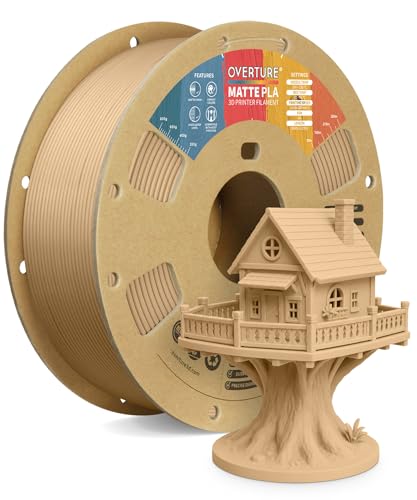
1. OVERTURE Matte PLA Filament
The frosted-finish workhorse that hides layer lines so well you’ll think the part came off a mold.
The matte surface here is the whole story — it delivers that frosted, gloss-free look that conceals layer lines, which is why it’s the go-to for miniatures and display pieces. The dimensional accuracy holds at ±0.02 mm on the 1.75 mm diameter, which is exactly the tight tolerance that keeps extrusion smooth and clogs rare. It’s engineered with low shrinkage and low odor, so even long overnight prints tend to come out clean without filling your room with that burnt-plastic smell.
Owner reports highlight sheer throughput: one buyer ran through a full 1 kg spool in just 6 days, printing 96 parts with a beefy 0.8 mm nozzle at 210°C, and called it strong. That’s a spool that disappears fast because it works, not because it’s wasteful. Buyers consistently praise the bed adhesion, and support structures pop off without a fight — small conveniences that make a budget spool feel premium.
There are a couple of honest caveats. The filament absorbs moisture, so a thorough drying session matters if you live somewhere humid, and it’s a touch less sturdy than a PLA Pro blend — treat the extruder kindly. But for the price, you’re getting a finish that rivals spools well above this tier.
What wins people over
- Matte finish hides layer lines for a professional look
- ±0.02 mm tolerance keeps jams rare
- Handles high-volume printing — 96 parts from one spool
The honest trade-offs
- Absorbs moisture and benefits from drying
- Less sturdy than a PLA Pro blend
Reach for this if: you want a reliable everyday matte that makes your prints look more expensive than the spool cost.
Look elsewhere if: you need maximum part toughness or you never dry your filament.
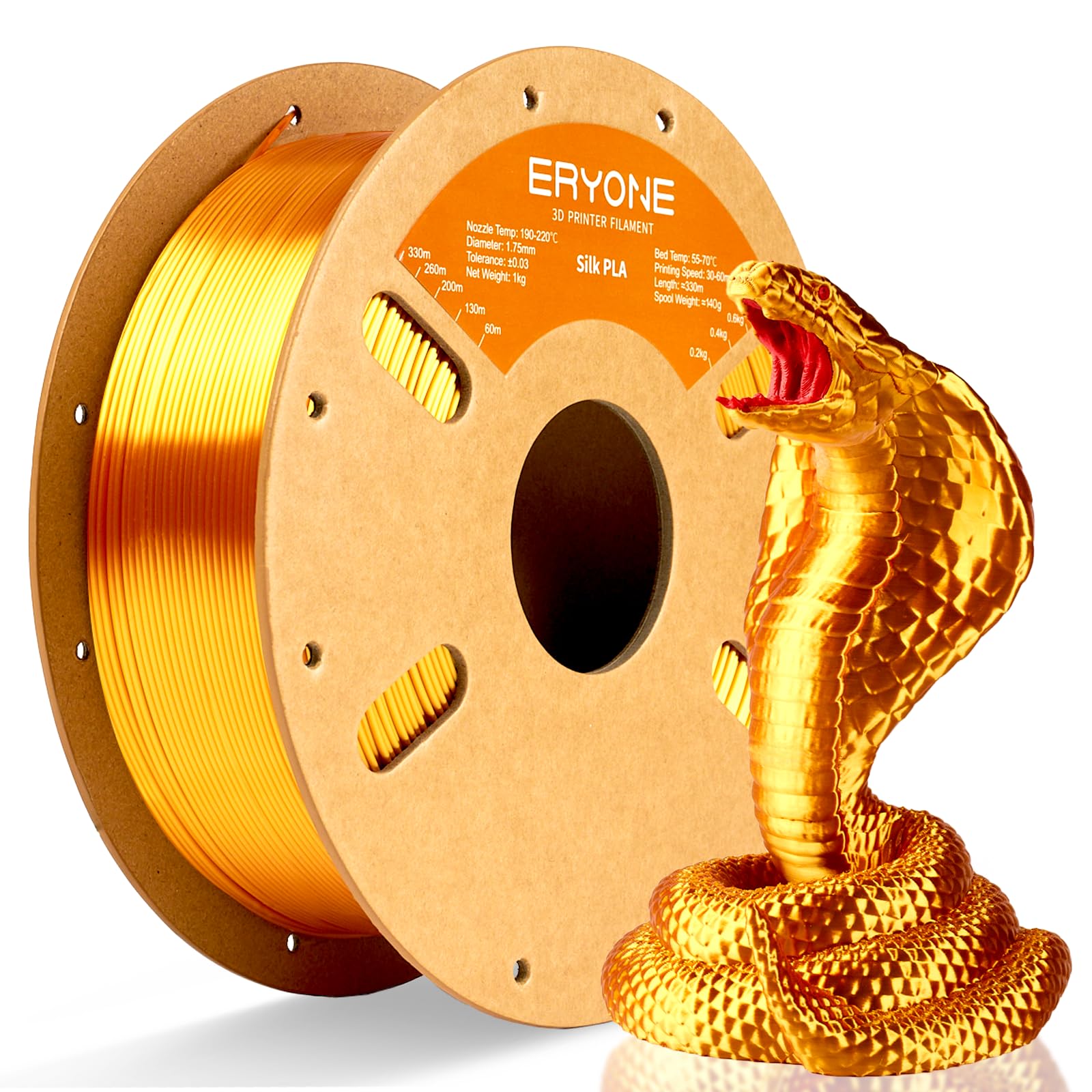
2. ERYONE Silk PLA Filament
A liquid-gold shimmer straight off the spool, with zero post-processing needed to look finished.
If you’re printing something meant to be seen — a vase, a display model, a gift — this silk PLA delivers a brilliant metallic sheen that needs no sanding or coating. The color is the thing everyone raves about, and it holds up across the whole spool. The diameter tolerance sits at ±0.03 mm on the 1.75 mm filament, which is perfectly workable and keeps extrusion smooth on most FDM printers within a 190°C–220°C range.
The vacuum-sealed packaging with desiccant means it arrives dry and ready to print, which is a real edge for a silk filament. On high-speed machines like the Bambu P1S it handles fast printing without clogs or inconsistent extrusion, and layer adhesion comes out strong. There’s a real-world catch the review pages don’t hide: the filament runs a bit brittle, and a few owners found a tri-color dragon model failed twice before they got it right, likely from clogs on the tricky geometry.
That brittleness is the one thing to weigh before buying — it’s comparable to other PLA filaments, so it’s not a defect, just a trait. If your parts are delicate or need to flex, this isn’t the spool. For decorative pieces where the shine sells the print, it’s a bargain.
The shine factor: the metallic gloss is the headline — it’s the reason owners keep coming back for display prints.
The fit note: this spool suits visual parts, not functional ones that need to bend or take a beating.
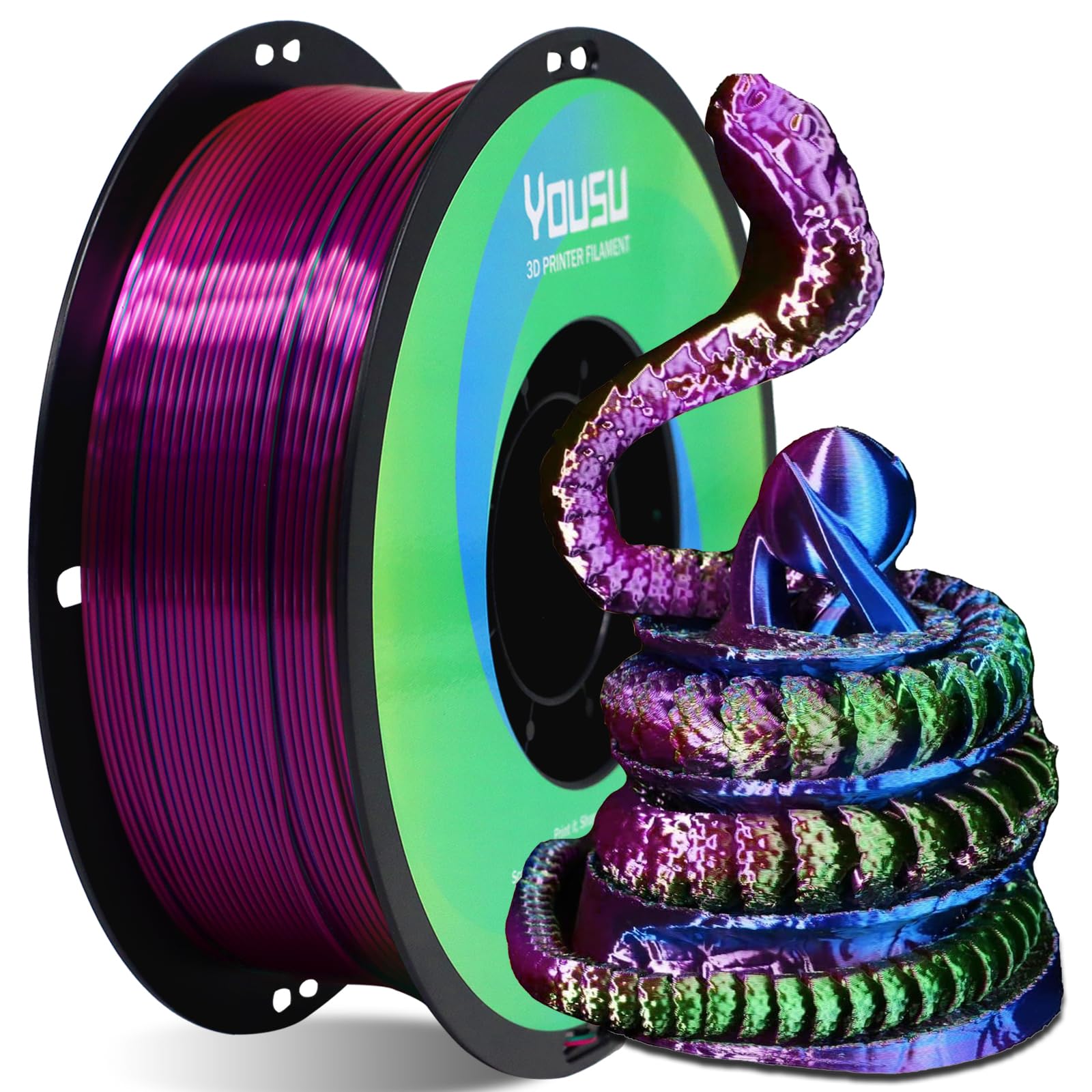
3. YOUSU Tri Color PLA Filament
Every inch of this spool is pink, blue, and green at once — so even a tiny print shows all three colors.
This is the tri-color filament that fixes the classic rainbow-PLA problem. Normal color-change filament shifts slowly, so a small print might only catch one shade. YOUSU co-extrudes pink, blue, and green into every inch of the filament, which means even a 20 mm charm shows the full spectrum. The finish is silk glossy, and the diameter holds a ±0.02 mm tolerance for smooth, consistent extrusion.
The updated plastic spool is a genuine quality-of-life upgrade over cardboard — it feeds cleanly on most FDM printers, including the Bambu Lab AMS, Ankermaker, Creality, Qidi, Flashforge, and Anycubic. The layer bonding is strong, and warping stays minimal thanks to good first-layer adhesion. The color-changing results get described as “amazing,” and on larger curved surfaces like vases the blend looks genuinely striking.
Bed adhesion gets mixed feedback in the review data — some buyers report it sticks great, others found it needed a bit more coaxing. It’s a silk PLA, so a clean bed and a little squish on the first layer go a long way. The tangles that plague cheaper spools are a non-issue here, and the winding is clean.
The multi-color payoff
- Tri-color co-extrusion shows all shades even on tiny prints
- Plastic spool feeds cleanly on most printers
- Strong layer bonds with minimal warping
What to watch
- Bed adhesion is hit-or-miss depending on your setup
- Silk finish may string if your retraction isn’t tuned
Pick this when: you print small models or vases and want the full rainbow effect without painting.
Think twice if: you want a solid single color or you’re not ready to tune your first layer.
4. ELEGOO PLA Basic Filament
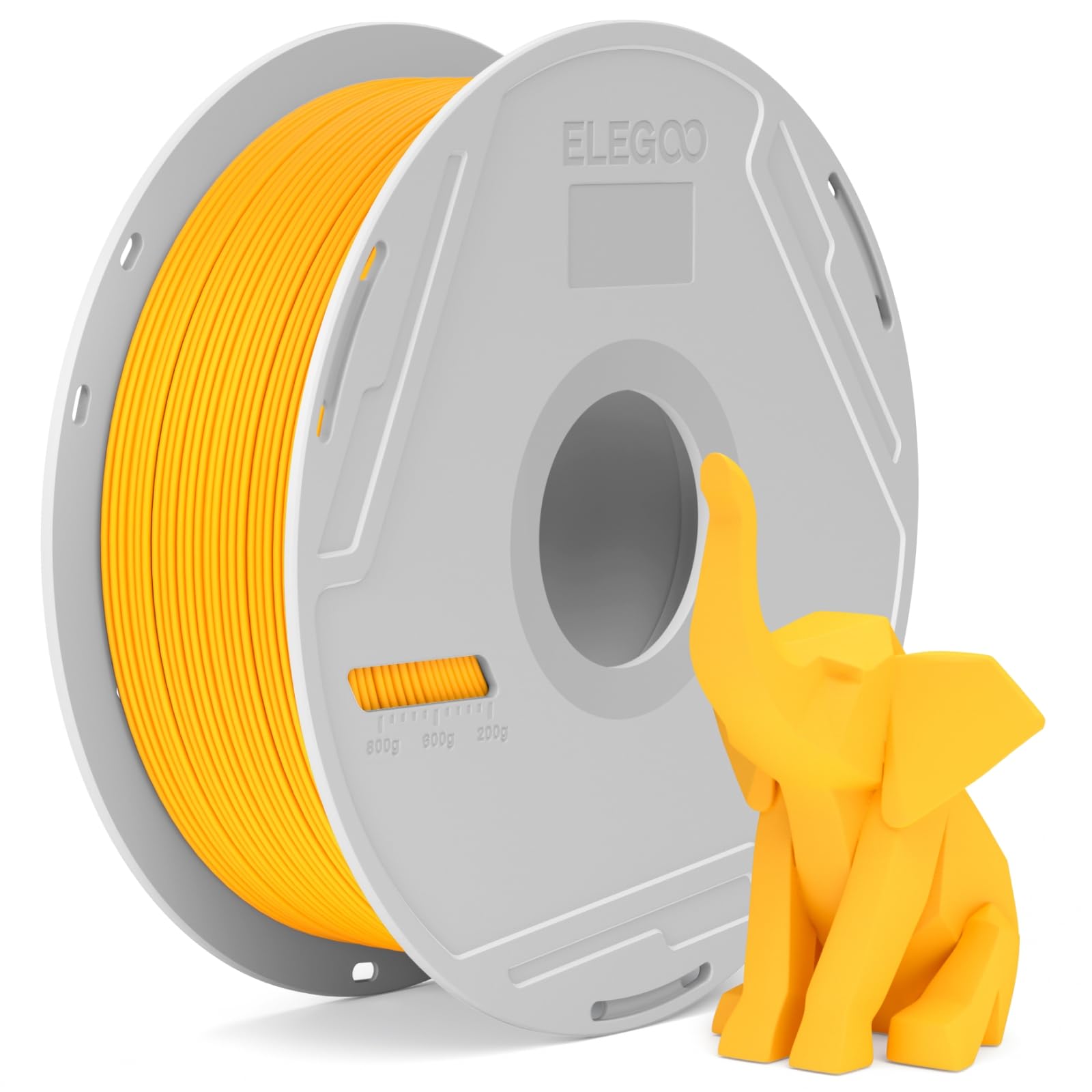
The beginner-friendly spool that locks onto its own reusable hub with a tool-free twist.
Here’s a budget pick that thinks ahead: the spool itself is reusable, so you can transfer partially used filament onto it to keep everything organized between prints. The filament locks on with a simple twist — no tools, no fuss. The 1.75 mm diameter holds a ±0.02 mm tolerance, and it prints smoothly at a modest 200–210°C with good adhesion and minimal stringing. That makes it genuinely friendly for someone still learning the machine.
The print quality earns the praise it gets — owners describe it as consistently smooth with no clogs or tangles, and the color options are vivid. The filament quality is the top reason people stick with this brand, and it’s not brittle, which is a relief for a budget spool. It’s the kind of filament you can load and forget about while it runs.
The one honest limitation is that this is standard PLA, so it’s not built for high-heat or high-durability applications — keep it for everyday parts and prototypes. Tangling was “hit or miss” for a few owners on older spool designs, though the new reusable spool is specifically meant to cut down on that kind of damage.
The everyday angle: this is the set-and-forget spool for routine prints, prototypes, and parts that don’t face heat or stress.
The boundary: it’s a basic PLA — brilliant at what it does, but not the pick for engineering-grade durability.
5. LANDU Silk Tri-Color PLA Filament

A triple-color silk that transitions smoothly between red, blue, and green with a polished, glossy finish.
LANDU takes the tri-color idea and cranks the visual impact up — the three colors blend into a smooth gradient that shifts as you rotate the model in your hand. The silk texture gives that polished, display-ready look with no post-processing, and the red-blue-green combination is genuinely eye-catching. The diameter tolerance is tight at less than ±0.02 mm, which keeps the filament flow stable and detailed prints crisp.
It’s engineered to be clog-free and tangle-free, with neat winding that prevents the knots that interrupt long prints. The review data backs this up — owners describe smooth flow, no jams, and clean output with minimal stringing. The triple-color gradient gets called “stunning” on curved surfaces, and the layer adhesion is strong enough that prints come out with good structural integrity.
The main compatibility note: a few owners found it doesn’t play perfectly with the Bambu AMS system, so if that’s your setup, check your spool adapter situation first. And like most silk filaments, it runs a little brittle — a small price for that glossy sheen. For decorative prints and high-visibility models, the color payoff is worth it.
The visual reward
- Smooth triple-color gradient shifts as you rotate the model
- Tight ±0.02 mm tolerance for stable, detailed prints
- Clean winding that resists tangles on long jobs
Compatibility checks
- Some Bambu AMS users hit spool-fit issues
- Silk brittleness means it’s not for flexing parts
Choose this for: decorative models and display pieces where the color-shift is the entire point.
Pass if: you run a Bambu AMS rig without a spool adapter or you need parts that survive bending.
6. SEMDON Tri-Color Gradient Silk PLA
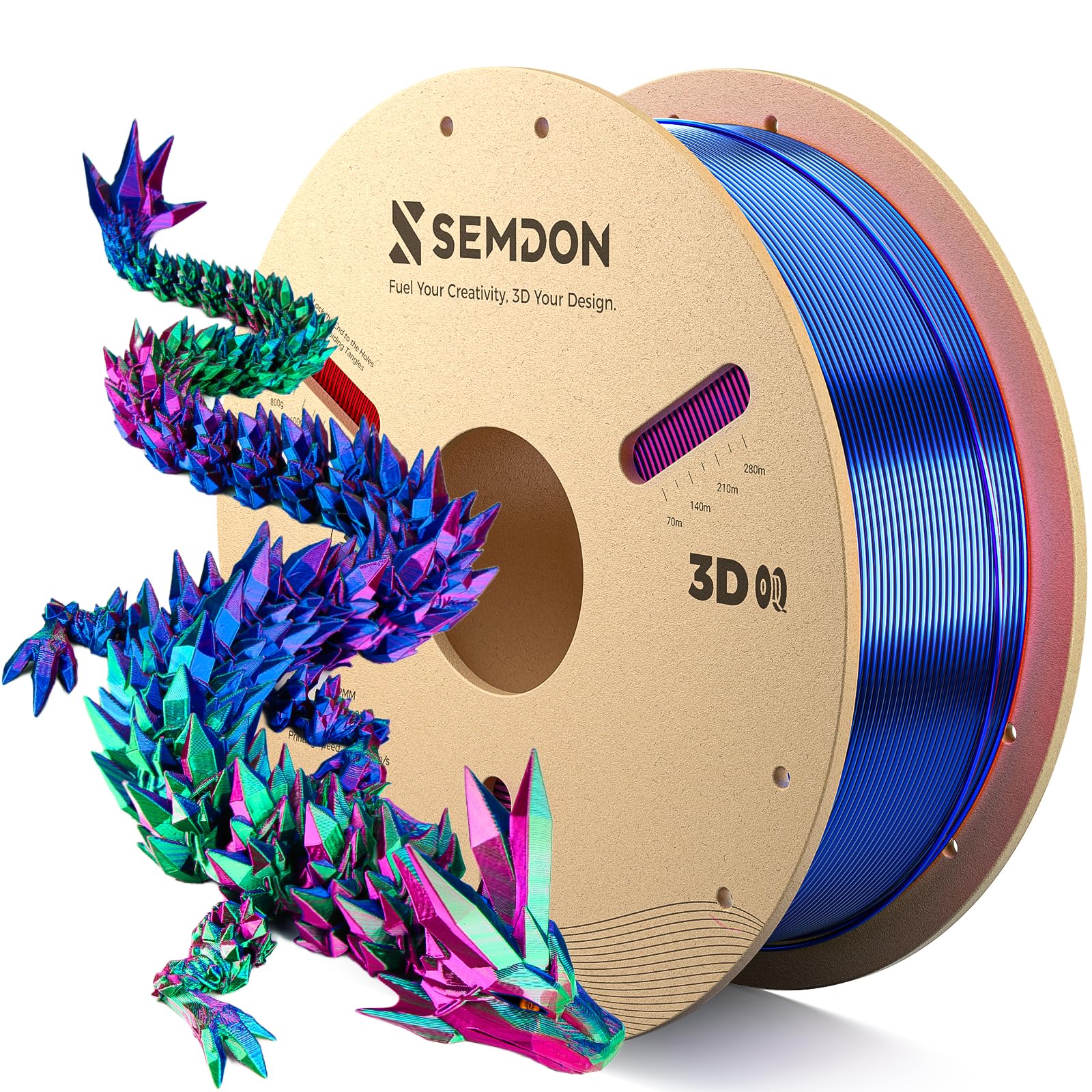
A tri-color silk that bends repeatedly without snapping — the toughness edge most silk spools skip.
Most silk PLA is brittle; that’s just the nature of the finish. SEMDON specifically claims its silk PLA can be bent repeatedly with less susceptibility to breakage than other PLA filaments, which matters if you’ve ever had a spool snap mid-print. It’s pre-dried for 24 hours before packaging and vacuum-sealed with desiccants, so it arrives ready to run — and the 0.02 mm accuracy holds across the whole 340 m spool for consistent extrusion.
The printed surface has that laser-tested glossy finish with mesmerizing color shifts as the model rotates, and no painting is required. The recommended temperature range of 200–230°C with a 50–70°C heated bed gives you a forgiving window to dial in clean layer adhesion. Owners describe the color transitions as stunning and the extrusion as consistently smooth, with no warping even on larger prints.
The 2.2 lbs spool weight is slightly heavier than the standard 1 kg rolls, and the maker’s claim of reducing clogs by 80% is marketing language — treat it as a claim, not a measured fact. The color accuracy on screen versus in-hand gets a thumbs-up, which is rarer than it should be. This is the tri-color pick for people who want the silk look with a bit more backbone.
The durability angle: repeated bending without breakage is the standout here — a genuine edge over typical silk spools.
The honest note: the 80% clog-reduction figure is the maker’s claim, so judge it by the clean-printing owner reports instead.
7. Creality Hyper PLA Filament

A high-speed PLA that auto-configures via RFID on Creality’s K2 Plus and still prints clean at 600 mm/s.
This is the speed-focused pick for owners of the Creality K2 Plus or Hi Combo. The RFID chip on the spool is read automatically by the CFS system, which sets the optimal temperature and speed for you — load it and start printing without touching a settings screen. The speed range is genuinely wide at 30–600 mm/s, so it keeps up with fast machines while still printing fine at normal speeds for older printers.
The dimensional accuracy of ±0.03 mm keeps the filament outflow uniform, and the low shrinkage means stable print sizes with good layer fusion. The toughness gets a specific claim that’s rare for PLA: higher tensile strength than ABS. That’s the kind of spec that makes this spool worth reaching for when you need structural parts, not just pretty ones. Owners on both Creality and Bambu A1 machines report consistent, reliable prints with no clogs.
The catch is the ecosystem. The RFID auto-configuration only works on Creality’s K2 Plus and Hi Combo — on any other printer, it’s just a very good high-speed PLA. There’s also a mixed note on stringing in the review data, so retraction tuning might be needed on some rigs. The spool winds neatly with no cross-turning, which cuts down on tangles and threading issues.
The speed payoff
- RFID auto-configures settings on Creality K2 Plus and Hi Combo
- Prints clean across a huge 30–600 mm/s range
- Higher tensile strength than ABS for structural parts
Ecosystem limits
- RFID feature only works on Creality’s newest combos
- Occasional stringing reported on some setups
Grab this if: you own a Creality K2 Plus or Hi Combo and want the auto-configure convenience at speed.
Reconsider if: your printer doesn’t support RFID — you’d be paying for a feature you can’t use.
8. Bambu Lab PLA Filament
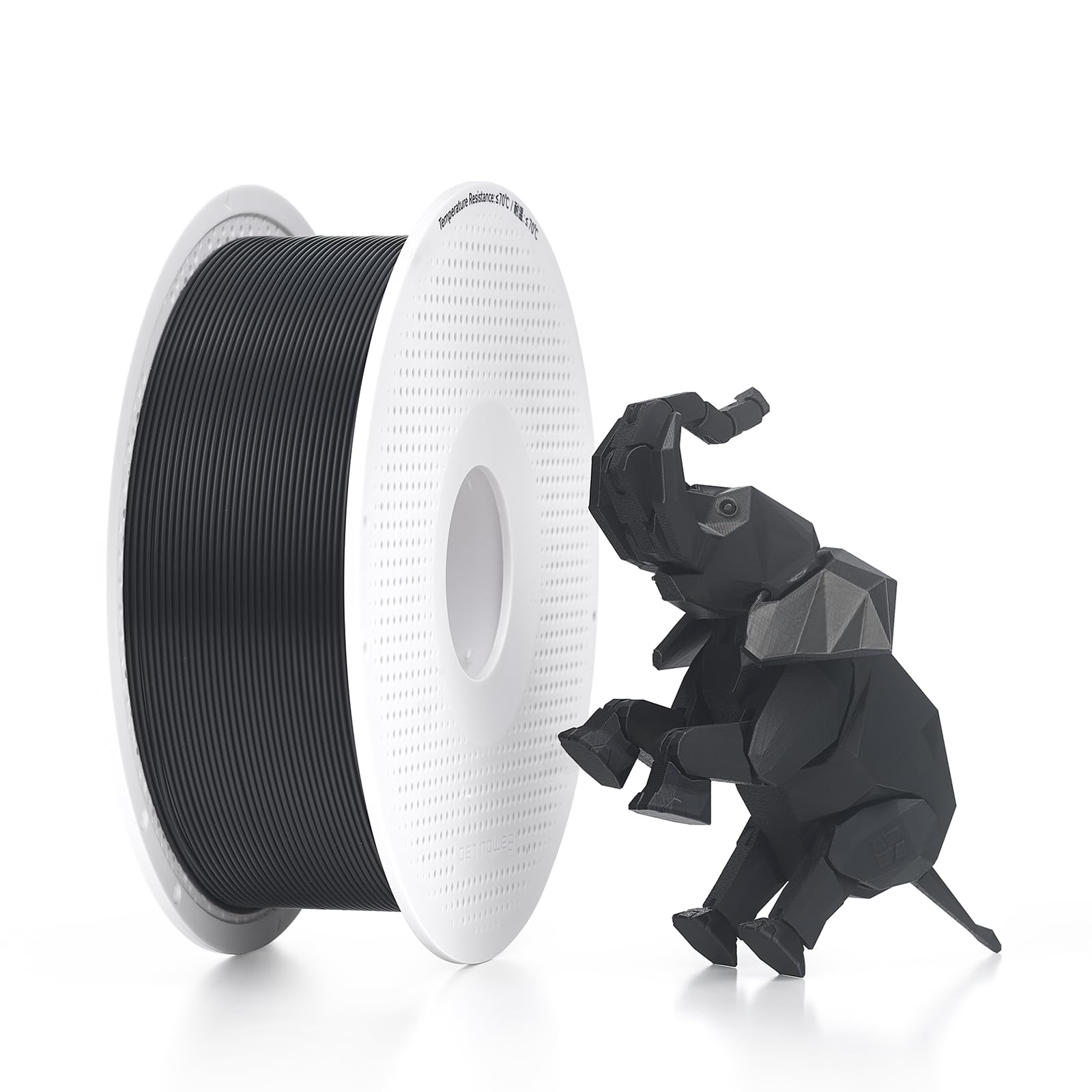
The deep-black spool that feeds flawlessly in the AMS and self-configures the moment it’s loaded.
For Bambu Lab owners, this is the no-thought-required spool. The RFID chip talks to Bambu Studio, which automatically picks the right print settings the second you load it into the AMS. The black color is consistent and deep with clean lines, which sounds simple but is actually hard to get right on a budget machine. The 1.75 mm diameter holds a ±0.03 mm accuracy, and the design focuses on stable extrusion to cut down on clogs and under-extrusion.
The reusable spool is a genuine sustainability win, and the toughness of the filament is what makes it AMS-compatible in the first place — it feeds reliably through the multi-color system without snapping. Owners describe flawless feeding every time, smooth layers, and rock-solid adhesion with no stringing or warping. It’s the kind of consistency that makes you forget the filament is even there, which is exactly the point.
The quality jump over bargain brands is real: consistent layers, smoother finish, better adhesion, and less brittleness. If you’re already in the Bambu ecosystem, the convenience of the RFID auto-setup and the flawless AMS feeding justify the premium.
The ecosystem edge: if you own a Bambu printer with an AMS, this is the most friction-free spool you can load.
The cost reality: you pay more per spool than the budget picks — the convenience and quality are the return.
9. Bblife 8-Spool PLA Filament Bundle

Eight popular colors in one box — the fastest way to build a palette without committing to eight full spools.
This bundle is built for color exploration. You get black, white, red, blue, yellow, orange, lime green, and sky blue — each in a 250 g spool for a total of 2 kg of printing material. That’s not enough for massive builds, but it’s perfect for sample projects, multi-color gifts, or testing how each color looks on your specific printer before you commit to a big 1 kg roll of one shade.
Each spool is vacuum-packed, and the 1.75 mm filament is designed to fit most FDM printers and 3D pens, including Comgrow, Creality Ender, Anycubic, and MYNT3D. The suggested settings are approachable: print at 200°C, heat the bed to 30–60°C or skip it entirely, and use a fresh 0.4 mm nozzle. The PLA is odorless and made from eco-friendly raw material, which keeps it comfortable for indoor printing.
The review data is genuinely mixed here — some owners get perfect rainbow blends and clean prints, while others report the filament fails to print well at all. That’s the risk with an ultra-budget multi-pack. The individual 250 g spools also mean you’ll be swapping filament more often than with a full roll. Treat this as a starter or sample kit, not a production workhorse.
The variety win
- Eight popular colors in one box for palette testing
- Odorless, eco-friendly PLA for indoor printing
- Approachable 200°C print temperature
The mixed bag
- Quality reports vary — some owners hit failures
- 250 g spools run out fast on larger prints
Best as: a gift pack, a sampler for new printers, or a way to find your favorite color cheaply.
Not ideal if: you need consistent quality across long production runs — go with a single-color workhorse instead.
Understanding the Specs
Dimensional Accuracy
This is the ±0.02 mm or ±0.03 mm number you see on every spool. It tells you how consistent the filament diameter is along the whole roll. Tighter tolerance means the filament feeds evenly through the nozzle, which directly translates to fewer clogs and smoother layer lines. For budget PLA, a ±0.02 mm rating is the mark of a well-made spool.
Print Temperature Range
PLA is the easiest material to print because it melts at a low temperature — most spools specify a range like 190–230°C. A wider range gives you more room to tune, while a narrow range means the filament is pickier about your hotend. Heated bed settings usually land around 50–70°C. Stick within the listed range and you’ll get proper layer bonding and a smooth finish.
FAQ
What does the ±0.02 mm diameter tolerance actually mean for my prints?
What’s the difference between matte, silk, and tri-color PLA?
Will the RFID filament work on any 3D printer?
How long does a 1 kg spool of PLA last?
Why does my silk PLA keep snapping or feel brittle?
Is a multi-pack of 250 g spools worth it, or should I buy a full roll?
What temperature should I print PLA at?
Can I use budget PLA in a high-speed printer like the Bambu P1S?
Why does my filament keep tangling on the spool?
What’s the difference between a cardboard spool and a plastic spool?
Final Thoughts: The Verdict
For the majority of shoppers, the budget pla winner is the OVERTURE Matte PLA because it pairs tight ±0.02 mm dimensional accuracy with a premium frosted finish at a price that’s tough to top. If you want a high-gloss metallic look for display pieces, grab the ERYONE Silk PLA and let the shine sell the print. And for multi-color models that need the full rainbow even on tiny parts, the YOUSU Tri Color PLA is the one to reach for — it delivers the crowd-pleasing “amazing color changing results” owners rave about, backed by a 4.8-star rating that makes it the safest color gamble on the list.
How We Picked
We do not accept paid placement. Every pick is matched to a real buyer and a real use-case; we do not hands-on test units.
Sources & Methodology
Specifications: manufacturer listings and product documentation. Review insights: verified customer reviews, as of August 2026. Pricing: not shown on this page (it changes often); check the current price via the retailer link.
As an Amazon Associate, FitlyFast earns from qualifying purchases. This does not affect which products we feature.