
Our readers keep the lights on and the weekend projects moving. As an Amazon Associate, I earn from qualifying purchases.
Specs are compiled from manufacturer listings and verified buyer reviews and can change over time — please confirm the key details on the product page before buying.
Finding a subwoofer on a budget that actually shakes the room without falling apart is a genuine hunt. Too many cheap options deliver a muddy, one-note thud, and you are left wondering if it is even turned on. This guide cuts through that noise to show you the models that prove deep, controlled bass does not require a premium price tag.
I’m Rikta — the founder and writer behind FitlyFast. This guide is built by comparing the manufacturers’ published specifications and the patterns across verified customer reviews, so you get each pick’s real strengths and trade-offs instead of marketing spin.
Whether you are filling out a desktop setup or adding low-end punch to a small home theater, this review of the best budget subwoofer options gives you a straight answer on where your money goes furthest.
Our Picks at a Glance


How To Choose The Best Budget Subwoofer
Picking a subwoofer on a budget means focusing on a few key specs that actually determine if it will sound good in your specific room. Here is what to prioritize.
Match the Driver Size to Your Room
The diameter of the woofer, measured in inches, is the biggest predictor of how much air it can move. An 8-inch driver works beautifully in a small bedroom or office, providing tight, punchy bass. For a living room or theater space, a 10-inch or 12-inch driver is needed to pressurize the room and deliver that deep, chest-thumping rumble. A larger driver can move more air, which is essential for hitting lower frequencies at higher volumes.
Don’t Confuse Peak Power with Real Power
Manufacturers often advertise a “peak” power rating, which is a theoretical maximum the sub can handle for a split second. The figure that matters for continuous, clean sound is the RMS (Root Mean Square) rating. A subwoofer with a 300W RMS amplifier will deliver significantly more usable, distortion-free bass than one with a 100W RMS amp, even if the peak rating on the 100W unit looks higher. Focus on RMS for a realistic picture of performance.
Look for Crossover and Phase Controls
A low-pass crossover control (usually adjustable from around 50Hz to 150Hz) lets you set the point where the subwoofer stops playing and your main speakers take over. This ensures the transition is smooth and prevents the bass from sounding muddy or “boomy.” A phase switch (0 or 180 degrees) helps align the subwoofer’s output with your main speakers in time, which is critical for sound clarity, especially if the sub is placed far from the listening position.
Quick Comparison
| Model | Best For | Driver Size | Power (RMS) | Low Frequency | Amazon |
|---|---|---|---|---|---|
| Bestisan 6.5″ Powered★ Best Overall | Ultra-Compact Desk Setup | 6.5″ | — | 70Hz | Amazon |
| Edifier T5sAlso Great | Desktop / Bookshelf System | 8″ | 70W | 35Hz | Amazon |
| Klipsch Sub-120Top Performer | Powerful Home Theater | 12″ | 200W | — | Amazon |
| Rockville Rock Shaker 10 | Big Rooms on a Budget | 10″ | 300W | 20Hz | Amazon |
| Rockville Rock Shaker 12 | Medium Theater Room | 12″ | 400W | — | Amazon |
| Dayton Audio Classic CS1000 | Accuracy and Value | 10″ | 180W | 28Hz | Amazon |
| Fluance DB10 | Small Home Theater | 10″ | — | 38Hz | Amazon |
| Klipsch R-8SW | Small Room / Apartment Living | 8″ | — | — | Amazon |
| PreSonus Eris Sub 8BT | Home Studio / Critical Listening | 8″ | 100W | 30Hz | Amazon |
In‑Depth Reviews
1. Bestisan 6.5″ Powered Active Subwoofer
The entry-level ticket to better bass that fits in places nothing else can.
This is the smallest subwoofer on the list, with a 6.5-inch side-firing driver in a slim, 12.6-inch cube. It is designed for people who have run out of floor space or want to add just a touch of low-end to a soundbar or small computer speakers. The included controls (volume, crossover, and 0/180-degree phase) allow you to integrate it with a receiver, soundbar, or bookshelf speakers via standard RCA or LFE inputs. Buyers summarize that it delivers “good sound at 70Hz” and offers “plenty of bass” for its tiny size, making it a perfect entry point.
There is a catch. The output is minimal compared to anything with an 8-inch or larger driver. It will reinforce the low-end of your system but will not produce the deep, visceral rumble of a theater sub. Some buyers also reported confusion about input options, noting that units arrived without the advertised Bluetooth or optical ports. The build quality and performance receive mixed feedback, with some units failing over time.
It works well as a starter sub or for a very small desk setup where room is the absolute priority. Its value is undeniable, but its performance ceiling is low.
easy entry level: This will fill in the missing low-end for a desktop system, but it is not a substitute for a real home theater subwoofer. Buy it for the size, not the power.
desktop use: you absolutely need a subwoofer to fit in a cramped space or you just want a very cheap first step into better sound.
main system: you have room for a slightly larger cabinet and want the superior depth and control of an 8-inch or 10-inch driver.
2. Edifier T5s Powered Active Subwoofer
The small-footprint champion that delivers a deep, defined thump without hogging your floor space.
You get an 8-inch long-throw woofer that digs down to 35Hz, powered by a 70W RMS Class-D amplifier. That combination produces a clean, textured low-end that works perfectly for a desktop or small to medium-sized room, as owners consistently note it brings “tremendous value” and “superb sound”. The slim wood-grain cabinet is only 6.69 inches wide, letting it slot into tight spots where a bigger sub would stick out.
It comes packed with the controls you need to integrate it smoothly with your system. There is a low-pass filter adjustable from 30Hz to 160Hz and a phase selector switch at 0° or 180°, which allows you to tune out the boominess that plagues budget subs. It even includes an auto-standby feature that kicks in after 15 minutes of inactivity, saving power. The driver size is 8 inches versus the Bestisan’s 6.5-inch driver, giving it a clear advantage in low-end authority. Buyers also report it pairs especially well with the Edifier R1280T bookshelf speakers, creating a complete system that punches well above its cost class.
The main thing to know is that it is rated for small to medium spaces. If you are trying to pressurize a large living room or a dedicated theater, the 70W RMS will run out of steam, and you would need to look at the higher-powered Rockville or Klipsch options instead.
compact bass powerhouse: This subwoofer hits a balance that is tough to top. It delivers deep, rich bass from a compact cabinet, offers genuine tuning controls, and is built to a standard that feels far above its price tier. For anyone building a desktop system or a small room setup, it is the most balanced choice available.
small rooms: you have a small office or living room and want tight, controlled 35Hz bass without a giant box dominating the space.
large spaces: your room is large or you need the kind of wall-rattling output that only a 12-inch driver at 200W RMS versus the Edifier’s 70W RMS can deliver.
3. Klipsch Synergy Black Label Sub-120
The crowd favorite that makes the whole house shake for a price that feels like a steal.
This is the subwoofer that owners describe as providing “massive thump” with the power to “shake pictures off the wall.” It features a 12-inch front-firing Cerametallic driver (a spun-copper composite material Klipsch is known for) that is driven by a digital amplifier with 200 watts continuous and 400 watts of dynamic power. This combination gives it the muscle to fill a large living room or a dedicated home theater with deep, authoritative bass that you feel in your chest. It also features a low-pass crossover and variable volume control so you can dial it in to your system.
The build is a large ported MDF cabinet (21.3 inches high) with a removable grille, designed to be placed in a corner for optimal output. The thing owners praise most is the sound quality, with well over a hundred buyers citing it specifically. The Sub-120 consistently ranks as a top-tier performer on paper, outpacing the Rockville Rock Shaker 12 in user ratings (it holds a higher score from a larger pool of nearly a thousand verifications). The consensus is clear: it “hits the deep balance” and “changed the entire surround system sound.”
Keep in mind that this sub is not for small apartments. Its power and ported design mean it produces serious low-end pressure that will travel through walls. The cabinet is also large and heavy, so ensure you have the floor space for it.
punchy home theater: The subwoofer to buy if you want real theater bass: This unit delivers a level of performance that many budget shoppers assume requires spending far more. It is powerful, clean, and built to last.
movie nights: you want the most effective, room-filling low-end for a home theater system and you have a space where you can let it loose.
critical listening: you are in a small room, an apartment, or need a sub that blends into a desk setup without dominating the space.
4. Rockville Rock Shaker 10 Black 600W Powered Subwoofer

The bare-bones bruiser that proves raw power does not have to cost a fortune.
If your primary goal is to shake the room without spending much, this Rockville delivers. It packs a 10-inch woofer with a Class-D amplifier that puts out 300W RMS and 600W peak. Buyers report that it produces “chest-thumping bass” and will “shake the room at 50% gain,” making it ideal for large living spaces or anyone who wants a visceral movie experience. It includes adjustable volume, crossover frequency, and phase controls, plus both RCA and high-level speaker inputs for flexible connectivity to any receiver.
The build quality is solid with an MDF enclosure and a vinyl finish. However, the price comes with a couple of noted trade-offs. Some buyers mention the crossover control acts more like a shelf filter than a true steep crossover, which can cause some mid-bass muddiness if you are not careful. The sound quality is the most-discussed aspect (over 200 buyers highlight it), but a significant number of owners also flag mixed feelings on reliability and noise floor—so occasional unit variance is a reality here.
This is the cheapest way to add a serious amount of low-end to your system. It is not the most refined subwoofer, but its sheer power output for the money is class-leading.
massive output: For the money, nothing in this list punches harder. It is the first choice for budget shoppers who prioritize sheer volume and deep extension over polish and precise tuning.
party setups: you want as much low-end power as possible for a living room or man cave without spending over the budget mark.
audiophile systems: you need a high-fidelity, zero-noise, audiophile-grade subwoofer or if you plan to use it in a small room where its power would be wasted.
5. Klipsch Reference R-8SW Surround Subwoofer

The apartment-friendly Klipsch that neighbors will never know is there.
The R-8SW is designed for small spaces and peace-keeping. It features an 8-inch down-firing driver (meaning the woofer fires toward the floor, which helps blend the bass into the room) and an all-digital amplifier. The sound is described as “clean” and “tight,” ideal for adding richness to a small living room or a desktop system without overwhelming the room or your neighbors. The compact footprint and down-firing design make placement easy, as you do not need to worry about obstruction.
It integrates smoothly with most receivers via RCA or LFE inputs, and owners note it “makes their stereo come alive” and “packs a mean punch” for its size. The recurring downside is that it produces an audible “pop” when it powers off (it shuts down automatically to save energy), which some owners find annoying. Also, because it is an 8-inch sub, it lacks the depth and wall-rattling power of larger models, making it unsuitable for large theater rooms.
For the money, it delivers the reliable Klipsch sound signature in a package that will not get you evicted. It is the best pick for small apartment dwellers.
tight and controlled: This Klipsch is a winner for fine-tunable bass that will not rattle the walls. It is a premium-feeling small-room solution, but it stops short of being a home theater monster.
mixed use: you live in an apartment or have a small room and want the quality of a major brand without the subwoofer dominating the space or the sound.
budget builds: you are a bass head who needs deep, chest-thumping output—you will want to step up to a 10-inch or 12-inch model.
6. PreSonus Eris Sub 8BT

The studio-grade choice that adds accuracy to your music mixing, not just boom for movies.
The Eris Sub 8BT is built for critical listening. It uses an 8-inch woven glass-fiber driver paired with a 100-watt Class-AB amplifier that extends down to a low 30Hz. This is a studio subwoofer, meaning its priority is accuracy and a flat frequency response rather than exaggerated output. It includes connectivity options you don’t see on most budget subs: 1/4-inch TRS balanced inputs for professional audio gear, unbalanced RCA inputs, and a front-panel headphone jack. It even has Bluetooth 5.0 for streaming from your phone. These features make it exceptionally versatile, equally at home in a small recording studio, a gaming rig, or a hi-fi listening setup.
Owners mention it pairs perfectly with monitors like the JBL 305P MkII to provide a “clean” and “accurate” low-end that makes mixing easier. The adjustable low-pass and high-pass filters allow you to dial in the crossover point for a smooth blend. The Bluetooth feature is a bonus that is simple to set up and works reliably. The main downside for the budget shopper is the price premium, which crosses over into the mid-range territory occupied by larger, more powerful subs. It is not a room-shaker, but a sound-sharpener.
If your priority is audio fidelity for music production or enjoying pristine sound, this sub is worth the stretch. If you just want to feel explosions in movies, a different, larger driver sub would be a better match.
studio-grade accuracy: This is the subwoofer for those who value clarity and control over raw power. It is a studio tool that also happens to be excellent for general listening.
nearfield mixing: you need a subwoofer for music production, mixing, or demanding critical listening where accuracy is non-negotiable.
loud parties: your budget is very tight and you just want maximum boom for movies—a cheaper, higher-power sub will serve you better.
7. Rockville Rock Shaker 12″ Black Powered Subwoofer

The budget big-boy subwoofer that brings the thunder without the big-name price tag.
Stepping up to the 12-inch version of the Rock Shaker gets you a significantly larger driver and an amplifier pushing 800W peak / 400W RMS. This is a massive amount of power for the money, making it capable of producing “deep, clean, powerful bass without distortion” in a medium to large home theater room. It includes a phase switch and an adjustable crossover from 50Hz to 150Hz, plus both RCA and speaker-level inputs, making it easy to integrate with virtually any receiver. It runs directly against the Klipsch Sub-120 on paper, but at a noticeably lower entry point.
Owners are genuinely impressed, with the top praise centered on sound quality and value for money. They describe it as music that “rocks the house” and is “surprisingly good” for the price. The build uses an MDF enclosure, though some owners note the laminate finish can have minor imperfections and that the internal wiring can buzz if not secured with zip ties. It is a trade-off for the low price.
If you are on a stricter budget but still want the low-frequency authority of a 12-inch driver, this is an excellent alternative to the more expensive Klipsch. It offers incredible output, but you may need to do a tiny bit of DIY finishing to quiet it down.
deep bass for cheap: It gets you into 12-inch performance territory for the least money. The sound is huge, but the fit and finish reflect the cost savings.
home theater: your budget is capped, your room is large, and you want the deepest, most powerful bass you can buy for the money.
small rooms: you expect a perfectly finished cabinet and dead-quiet operation from the start—the Klipsch Sub-120 is the better-finished step up.
8. Fluance DB10 10-inch Powered Subwoofer

A finely-tuned performer that adds layered warmth to music without the muddy mess.
The Fluance DB10 is built around a 10-inch long-throw driver known for longer excursion (the distance the cone moves) which helps produce accurate, controlled bass. It is rated to hit a genuine 38Hz, and its front-firing port design allows it to be placed against a wall without compromising performance. This makes it a flexible choice for rooms where rear-port clearance is a problem. Owners say it delivers “crazy loud” output even at low volumes and provides a “rich sound” that adds low-end foundation to existing speakers.
The design is tasteful, featuring a precision-crafted MDF cabinet in a Black Ash finish. It has an auto power-on feature that detects a signal from your audio source, saving energy. The build quality and appearance are major highlights, with buyers praising it as an “amazing addition” to their system. The limitation is that its extension falls off noticeably below 40Hz, making it less capable of reproducing the very deepest movie effects compared to a more powerful or larger sub.
It is a great match for a small home theater or an office, especially if you pair it with bookshelf speakers and value a punchy, musical bass over floor-shaking rumble.
fast transient response: This Fluance is a confident pick if you listen to a lot of music and want a sub that reinforces the rhythm section with speed and accuracy rather than just one-note boom.
music systems: you care about music quality and need a sub that is punchy, well-built, and can fit close to a wall.
movie explosions: your main purpose is watching movies and you need the sub-audible rumble and wall-shaking power of a 12-inch driver.
9. Dayton Audio Classic CS1000
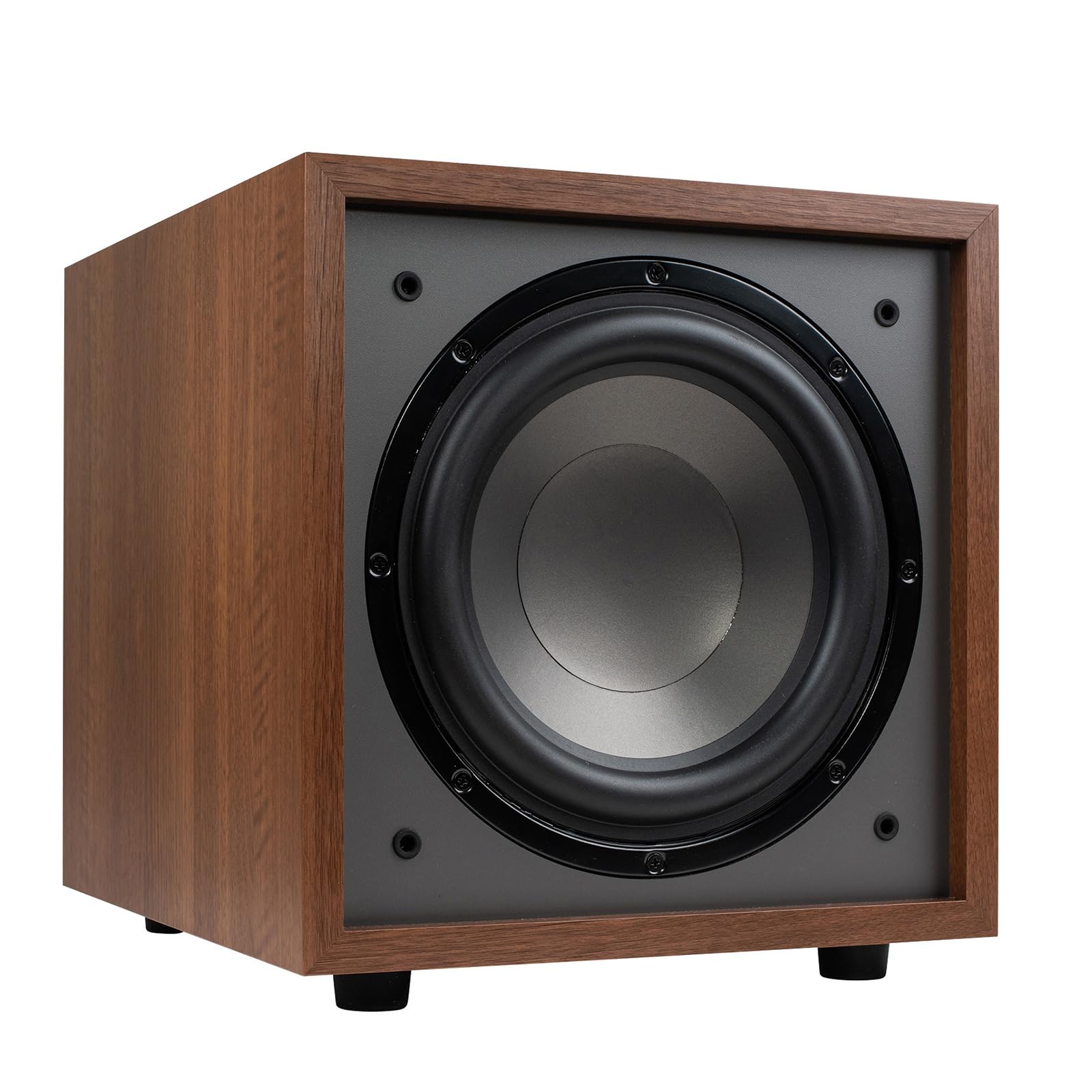
The quiet overachiever that goes deeper than anything in its class.
The Dayton Audio CS1000 presents an intriguing value proposition: a 10-inch driver with a 180W Class-D amplifier that reaches down to 28Hz, making it the deepest-extending subwoofer at this price point. That 28Hz bottom end means it can reproduce organ pedal notes and movie LFE (Low-Frequency Effects) channels with genuine depth that other subs in the same range simply cannot touch. It achieves this with a rigid, braced cabinet that keeps the sound “tight and accurate” without unwanted cabinet resonance or boominess. It is available in a wood grain finish with a swappable grille.
Connectivity includes stereo RCA, LFE, and speaker-level inputs for compatibility with any system. The controls are simple and effective, including gain, crossover, and an auto-on feature. A standout feature is the 5-year warranty, which adds significant long-term confidence. Buyers are impressed, noting it provides a “solid,” “clear, tight deep bass.”
The pool of reviews is smaller than the other top picks, so the high rating is from a narrower sample. Also, while its bass is deep and clean, it is not a high-SPL (Sound Pressure Level) monster; it prioritizes accuracy and extension over sheer brute force.
exceptional depth: For buyers who want to hear the lowest possible frequencies on a budget, this is the clear winner. The 28Hz extension and the confidence of a 5-year warranty make it a very smart buy.
bass heads: your main priority is sub-audible bass extension and high-fidelity sound reproduction for both music and movies.
casual listeners: you need maximum volume output to fill a very large space; for that, the Rockville or Klipsch 12-inch options will hit harder.
Understanding the Specs
RMS Power (Continuous Power)
This is the single most important power figure. RMS, or Root Mean Square, tells you how much power the amplifier can deliver consistently, cleanly, and without distortion. A subwoofer with a 300W RMS rating will sound louder and tighter than one with a 100W RMS rating, even if the peak power rating on the 100W unit is higher. Ignore peak power for your buying decision; RMS tells you what the sub can actually do over a long movie or song.
Low-Pass Crossover (LPF)
This control sets the highest frequency the subwoofer will play. You set it so the sub handles only the low frequencies, while your main speakers handle everything above that point. For example, setting the LPF to 80Hz means the sub plays sounds below 80Hz, and your speakers play sounds above 80Hz. This prevents overlap that causes muddy, boomy bass and helps the sub blend smoothly with your system. A good sub will have a variable control so you can match it to your specific speakers.
Frequency Response (Hz)
This spec tells you the range of low notes the subwoofer can produce, measured in Hertz (Hz). The lower the number, the deeper the bass. A response down to 35Hz can handle most music and movie effects well, while a response down to 25Hz or 28Hz (like the Dayton CS1000) is needed for the deepest subsonic rumbles in action movies and organ music. The higher number (often around 200Hz) is less important, as it indicates the top end of its range where your speakers take over.
Phase Switch (0°/180°)
This switch helps align the timing of the subwoofer’s sound waves with your main speakers. If the sub is placed at a different distance from your listening position than your speakers, the sound waves can arrive at different times and cancel each other out, killing your bass. The 0° and 180° settings reverse the polarity of the sub’s output. Flicking the switch to whichever position makes the bass sound louder and more defined at your listening seat is the correct setting.
FAQ
Will a budget subwoofer work with a soundbar?
What size subwoofer is best for a small room?
Do I need a special subwoofer cable or will a normal RCA cable work?
Is a down-firing subwoofer better than a front-firing one?
How long do budget subwoofers typically last?
Can I use a home theater subwoofer for music production?
What does the phase switch do and when should I change it?
My subwoofer makes a humming noise even when no music is playing. What is wrong?
How loud should I set my subwoofer’s gain (volume) control?
Final Thoughts: The Verdict
For the majority of shoppers, the budget subwoofer winner is the Edifier T5s because it delivers a stunning balance of deep 35Hz bass, genuine tuning controls, and a compact, high-quality build that fits smoothly into any small to medium room. If you need raw, room-shaking power for a large theater space, grab the Klipsch Sub-120. And for the deepest sub-audible extension with the best warranty confidence, the Dayton Audio CS1000 is the one to reach for.
How We Picked
We do not accept paid placement. Every pick is matched to a real buyer and a real use-case; we do not hands-on test units.
Sources & Methodology
Specifications: manufacturer listings and product documentation. Review insights: verified customer reviews, as of July 2026. Pricing: not shown on this page (it changes often); check the current price via the retailer link.
As an Amazon Associate, FitlyFast earns from qualifying purchases. This does not affect which products we feature.