
Our readers keep the lights on and the weekend projects moving. As an Amazon Associate, I earn from qualifying purchases.
The silent hum of convection heat should mean warmth, not worry about high bills or bulky eyesores along your wall. Finding a unit that delivers even, efficient heat without dominating the room’s aesthetic is where many buyers hit a wall of confusion.
I’m Rikta — the co-founder and writer behind FitlyFast. I have spent countless hours analyzing the technical specifications, customer feedback, and long-term performance data to cut through the marketing noise on convective zone heating.
This guide focuses on the core specs that determine real-world comfort: wattage-to-length ratios, element build quality, and thermostat compatibility. My research points to the top contenders in the category of electric baseboard heaters.
How To Choose The Best Electric Baseboard Heaters
Selecting the right heater begins with understanding your room’s voltage and the cubic footage you need to condition. A mismatch here leads to either a constantly running unit or a space that never reaches its setpoint.
Match Wattage to Room Size, Not Just Length
A 6-foot heater can pack 1500 watts, while a shorter 4-foot model might only push 1000 watts. Overheating a small room with too much wattage causes short cycling, while under-powering a large room forces the unit to run non-stop. Calculate roughly 10 watts per square foot for an 8-foot ceiling to start.
Prioritize Element and Cover Build
Look for an aluminum ribbon fin or a fully enclosed steel sheath element for longevity. The cover’s gauge matters — dent-resistant die-formed steel survives installation bumps and years of accidental kicks, while cheaper 25-gauge metal can warp or bend in shipping.
Thermostat Integration is Key
Many units ship without a built-in thermostat, requiring a separate line-voltage wall thermostat. Others include a built-in dial. Decide early whether you want a simple on-wall dial or a programmable digital thermostat for zoned control. A heater that requires a separate thermostat adds to the total installation cost.
Quick Comparison
On smaller screens, swipe sideways to see the full table.
| Model | Category | Best For | Key Spec | Amazon |
|---|---|---|---|---|
| Cadet 09956 72-Inch | Convection | Zone Heating with External Thermostat | 1500W / 6.25A / 240V | Amazon |
| Cadet Com-Pak CSC202TW | Forced Air | Compact Wall Recess | 2000W / 8.33A / 240V | Amazon |
| Dimplex LC3010W31 | Linear Convector | Discreet, Low-Profile Styling | 1000W / 4.8A / 240V | Amazon |
| KING 4K1210BW | Convection | Durable, Dent-Resistant Build | 1000W / 8.3A / 120V | Amazon |
| King 6K1215BW | Convection | Warmth for Medium Rooms | 1500W / 12.5A / 120V | Amazon |
| Broan-NuTone 9815WH | Forced Air | Supplemental In-Wall Heat | 1500W / 12.5A / 120/240V | Amazon |
| Fahrenheat FHP1500T | Hydronic | Portable, Quiet Operation | 1500W / 12.5A / 120V | Amazon |
In‑Depth Reviews
1. Cadet 09956 72-Inch 1500W 240V

This 72-inch Cadet delivers 1500 watts of convection heat through a 25-gauge steel body with an all-metal junction box. Customers consistently praise its quick heat-up in rooms up to 250 square feet, often replacing 1970s-era units with noticeably thinner metal that actually improves heat dissipation.
The unit requires a separate external thermostat, which is a standard expectation for hardwired baseboard heaters. User feedback highlights compatibility with Honeywell digital thermostats for precise temperature cycling. The 6.25-amp draw at 240 volts keeps the electrical load manageable on a dedicated circuit.
Shipping packaging drew complaints of bent units, though the functional damage was minimal. The open-element design is prone to dust accumulation, but the silent convection operation avoids the fan noise of forced-air models. For a straightforward, zone-capable heater, this Cadet remains the benchmark.
Why it’s great
- Heats a standard bedroom quietly and evenly
- UL listed with all-metal construction for safety
- Compatible with most line-voltage thermostats
Good to know
- Thermostat sold separately
- Thin steel can arrive slightly bent
2. Cadet Com-Pak CSC202TW 2000W 240V
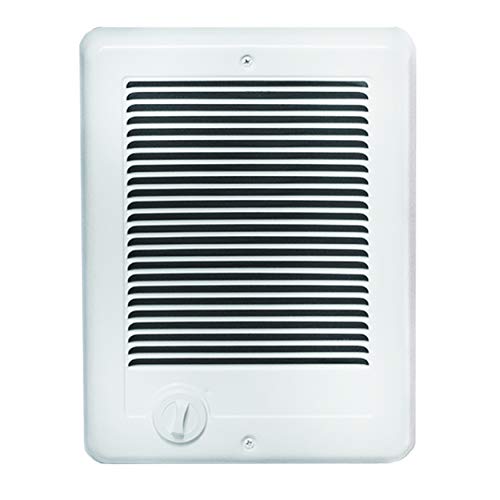
This Cadet Com-Pak is a forced-air unit that recesses into the wall, making it a space-saving alternative to long baseboard strips. It includes the wall can, heater, grill, and a built-in adjustable thermostat in one package. Customers report heating 200 to 250 square feet of basement space effectively with the 2000-watt setting.
The fan-forced design pushes heat into the room immediately, unlike the slower natural convection of a baseboard strip. Users note it works well with a Honeywell programmable thermostat for consistent temperature control. The high-gloss enamel finish resists yellowing over time.
Some reviews mention a slight fan noise, but describe it as unobtrusive. The rough-in dimensions require a 8-inch by 10.25-inch wall cutout, which is standard for recessed heaters. This unit is ideal for rooms where floor space is at a premium but you need rapid heat delivery.
Why it’s great
- Complete kit includes built-in thermostat
- Compact recessed design saves wall space
- Fast heat output for basement or room addition
Good to know
- Fan noise is present during operation
- Higher amp draw requires a 20A circuit
3. Dimplex LC3010W31 Linear Convector 30-Inch 1000W

The Dimplex Linear Convector stands out with its 2.38-inch depth and 42 percent smaller footprint than traditional baseboard units. The shark-fin blade design on a steel tubular element enhances heat transfer, and the top discharge vents warm air toward the room center rather than trapping it against the wall.
At 1000 watts and 240 volts, this unit is suited for smaller rooms or supplemental heating of up to 300 square feet. The polyester-epoxy powder coating resists fading and abrasion. The full-length automatic overheat shutoff provides a safety layer that standard convection heaters often lack.
A key trade-off is the absence of any thermostatic control — this is a line-voltage unit designed for use with a separate wall thermostat. One user returned the unit after discovering it cannot accept a digital controller. For buyers prioritizing aesthetics and quiet convection, this is a premium choice, but only if you plan for external thermostat integration.
Why it’s great
- Slim profile blends into room décor
- Top discharge improves air circulation
- Durable powder-coated finish
Good to know
- No built-in thermostat or digital compatibility
- Some reports of DOA units on delivery
4. KING 4K1210BW K Series 4-Foot 1000W 120V

The King K Series features a crushproof aluminum ribbon fin element and a dent-resistant die-formed cover, addressing the durability concerns that plague thinner metal units. This 1000-watt, 120-volt model is ideal for smaller rooms where a 240-volt circuit isn’t available.
User reviews highlight effective heating for a 10-by-14-foot basement bedroom, with rapid warm-up and silent operation after an initial burn-off period. The full-length safety cutout provides overheat protection. The 8.3-amp draw is well within a standard 15-amp circuit.
The installation instructions were widely criticized for wire color mismatches and confusing thermostat wiring diagrams. The front cover can scratch during reattachment. Despite these frustrations, the heater’s build quality and consistent heat output make it a long-lasting choice for 120-volt applications.
Why it’s great
- Crushproof element resists damage
- Dent-resistant cover stays looking new
- Runs on standard 120V household circuits
Good to know
- Confusing wiring instructions
- Thermostat sold separately with complex wiring
5. King 6K1215BW 6-Foot 1500W 120V
The King 6K1215BW takes the same proven K Series platform into a longer 6-foot, 1500-watt configuration. The aluminum ribbon fin element and dent-resistant cover are identical to the smaller model, but this unit’s 12.5-amp draw at 120 volts requires a dedicated 15-amp circuit.
Customer feedback confirms it effectively warms a 350-square-foot room when installed by an electrician. The quiet natural convection is a major advantage over forced-air units. The full-length safety cutout offers peace of mind for continuous winter use.
Build quality concerns include thin metal that can arrive slightly bent due to inadequate packaging. One user reported a failure after three months of use, while others have had units last for years. The separate thermostat requirement and tricky wiring compared to the instructions remain the main user friction points.
Why it’s great
- Crushproof element for long-term reliability
- Silent convection operation
- Full-length safety cutout included
Good to know
- Thin metal cover can bend in shipping
- Thermostat not included
6. Broan-NuTone 9815WH High Capacity Wall Heater 1500W

The Broan-NuTone 9815WH is a forced-air wall heater with a built-in adjustable thermostat and the ability to run on 120V or 240V. The fan-delay switch lets the element warm up before the fan kicks on, reducing that initial blast of cold air common in fan heaters.
Rated for 1500 watts, it covers up to 150 square feet, making it a strong supplemental heat source for bathrooms or small bedrooms. Customer reports note that it can heat an 8-by-8-foot bathroom from cold to 80°F in about 10 minutes. The clean white grille with straight louvers has a contemporary look.
Some users report fan noise, particularly if the plastic housing vibrates against tile. A few experienced thermal protector failures after extended use, though Broan’s warranty service replaced the units. The internal thermostat cycles on and off without a temperature display, which limits fine-tuning.
Why it’s great
- Built-in adjustable thermostat for direct control
- Dual-voltage operation (120/240V)
- Fan-delay prevents cold start drafts
Good to know
- Fan noise may be noticeable in very quiet spaces
- Not intended as a primary heat source
7. Fahrenheat FHP1500T 58-Inch Hydronic Portable 1500W

The Fahrenheat FHP1500T uses liquid-filled hydronic technology to provide even, radiant heat without the noise of a fan. It operates as a portable plug-in unit, so there is no hardwiring or thermostat installation needed. The built-in smart thermostat automates temperature cycling.
Covering 150 to 200 square feet, it is frequently used in breezeways and lower-level rooms. Users in colder climates note it keeps a space comfortable even during rough winters. The 12.5-amp draw is standard for a 1500-watt portable heater, and the 1000-watt limit on the switch adds a margin of safety for the plug connection.
Some units arrived with assembly defects, including a non-functional pilot light and face louver misalignment. Heat output is described as excellent by some and minimal by others, suggesting possible unit variation. It is heavier and slower to warm than forced-air models, but the quiet, even heat is a significant benefit for bedrooms or living spaces.
Why it’s great
- Silent hydronic operation ideal for bedrooms
- Built-in smart thermostat for automatic control
- No installation required — plug and play
Good to know
- Slower initial warm-up than fan heaters
- Inconsistent quality control on assembly
FAQ
Can I use a standard thermostat with any baseboard heater?
What happens if I install a 1500W heater on a 15-amp circuit?
Should I choose a hydronic or a standard convection baseboard heater?
Why does my new baseboard heater smoke or smell the first time I use it?
Final Thoughts: The Verdict
For most users, the electric baseboard heaters winner is the Cadet 09956 72-Inch 1500W because it balances proven convection performance, standard 240V efficiency, and wide compatibility with third-party thermostats. If you need rapid heat in a compact wall space, the Cadet Com-Pak CSC202TW delivers fan-forced warmth with a built-in thermostat. And for a portable, silent option that avoids hardwiring, nothing beats the Fahrenheat FHP1500T.